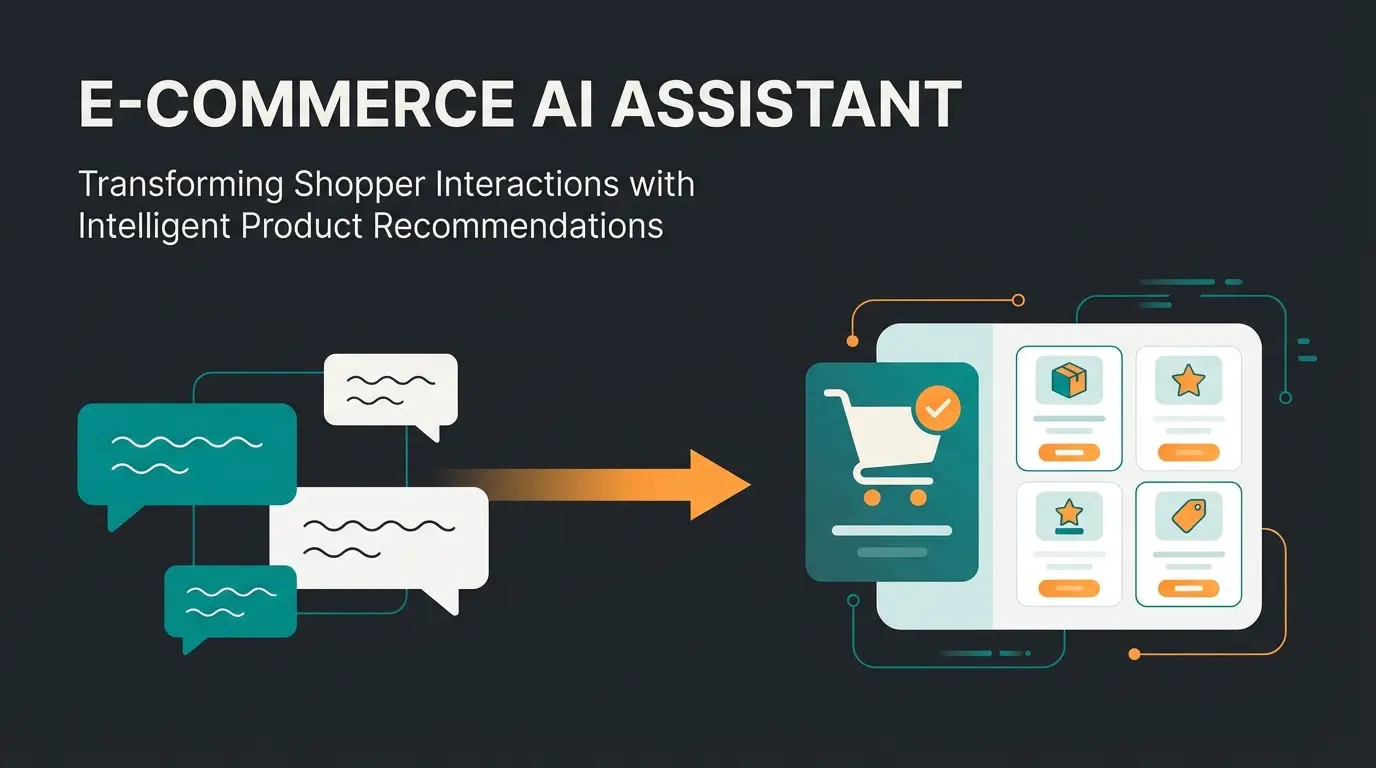
Is Your AI Just Blocking Costs or Already Driving Revenue?
When you think about AI customer service, what image comes to mind? Probably a chatbot window in the bottom right corner of a website, responding to delivery status inquiries with a generic tracking number. Or a system that automatically categorizes support tickets to save personnel resources. That's the status quo – and it's outdated.
The search landscape and public perception of AI in customer service are currently still heavily focused on efficiency and cost savings. The goal is to reduce ticket volume and keep the Head of Support happy. But while most of the market is still discussing how to relieve support staff, a quiet revolution is taking place in the background that will fundamentally change e-commerce in 2025.
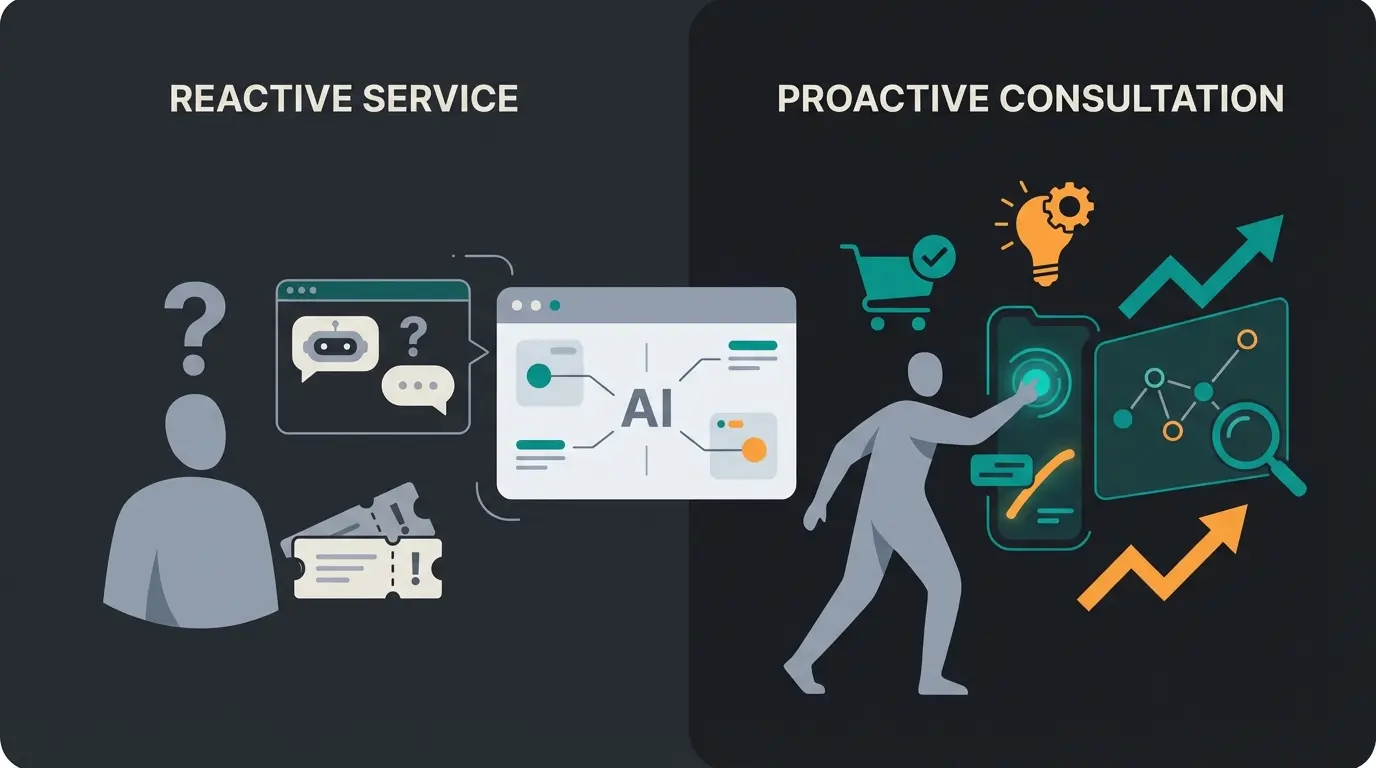
We're moving away from reactive problem-solving (post-sales) toward proactive purchase consultation (pre-sales). The new generation of AI agents doesn't just answer questions – it sells. It understands complex technical relationships, recognizes customer needs, and guides users through the purchasing process like an experienced salesperson in a brick-and-mortar store.
In this article, you'll learn why the definition of customer service needs to be rewritten, how you can massively increase your conversion rate with AI, and why your next customer service "employee" should have access to your product feed instead of your FAQs. Through Conversational AI solutions, businesses are discovering entirely new revenue streams.
The Evolution: Service vs. Consultation
To understand the full potential of AI in customer service, we first need to sharpen our terminology. Traditionally, customer service is viewed as a department that fixes errors. A customer has a problem (defective goods, late delivery, incorrect invoice), and the service solves it. This is reactive service.
Consultation, on the other hand, is proactive. It takes place before a problem arises – ideally even before the customer knows exactly which product they need.
Why the "Service" Term Is Misleading
Most companies optimize their AI based on metrics like "Ticket Deflection Rate" (How many inquiries can be blocked?). The goal here is often to avoid contact with humans to save costs.
The approach of AI-powered consultation turns this logic on its head. Here, the goal is not to avoid interaction, but to qualify and convert through interaction.
- Classic Approach (Service): "How can I help you solve your problem?" → Goal: Close ticket.
- New Approach (Consultation): "What do you want to achieve and which product will help you best?" → Goal: Fill shopping cart.
According to current market analyses for 2025, the market for Conversational AI will grow to over 132 billion USD by 2034, as reported by Precedence Research. A large part of this growth is not driven by savings in support, but by new revenues in "Conversational Commerce." Companies that view AI only as a "support tool" are therefore leaving the largest part of the value creation potential on the table.
5 Benefits of AI Customer Service Beyond Efficiency
Of course, the classic benefits remain. But anyone who wants to stay competitive in 2025 must expand the list of benefits. It's no longer just about whether someone responds, but how and with what result they respond. Modern AI consulting in e-commerce goes far beyond simple FAQ handling.
1. 24/7 Availability (The Standard)
This is basic hygiene in e-commerce. Customers today expect immediate answers, whether at 2:00 PM or 3:00 AM. AI eliminates waiting times and ensures no lead is lost just because the office is closed. This foundational capability enables 24/7 product consultation that meets customer expectations around the clock.
2. Multilingual Support Without Barriers
Modern LLMs (Large Language Models) don't simply translate word for word – they understand cultural nuances. A German shop can thus expand into the French or Italian market without native speakers, with AI handling customer service in perfect local language.
3. Conversion Rate Increase (The Game Changer)
This is where differentiation begins. Websites that use Conversational AI not just for support but for sales consultation see a 23% higher conversion rate compared to conventional search filters or static pages, according to Market.us and Experro.
The reason: AI takes over the role of the salesperson who eliminates uncertainties. A customer wavering between two products often abandons the purchase ("Choice Overload"). An AI that says: "Take Model A because it better fits your requirements" leads to closing the sale. This is what AI-powered sales consultants excel at.
4. Reduced Return Rates Through Precise Consultation
An often overlooked benefit of AI in customer service is its impact on returns. Many returns occur because the product doesn't meet expectations or isn't technically compatible (e.g., wrong replacement part, too complicated operation).
An AI that matches technical specifications before purchase ("Does this lens fit my camera?") prevents incorrect purchases. As noted by Qualimero and other specialized providers, "Guided Selling" can significantly reduce return rates because customer expectations are refined through consultation.
5. Personalized Product Recommendations & Upselling
Statistics show that AI-powered product recommendations can massively increase average order value (AOV) – some studies from Gauss.hr speak of up to 50% growth with optimal implementation.
Unlike static "Customers also bought" widgets, AI can understand context: "Since you're buying this laptop for video editing, I recommend not the standard mouse but this ergonomic model with programmable buttons." That's upselling through added value, not through pushiness. This is the core strength of revenue-generating product consultants.
Conversational AI market growth with strong focus on retail and e-commerce
Websites with integrated Conversational AI vs. those without
Through proactive AI engagement when users show exit intent
Consumers trust AI agents that show human-like friendliness and empathy
Use Cases: Where Standard Chatbots Fail
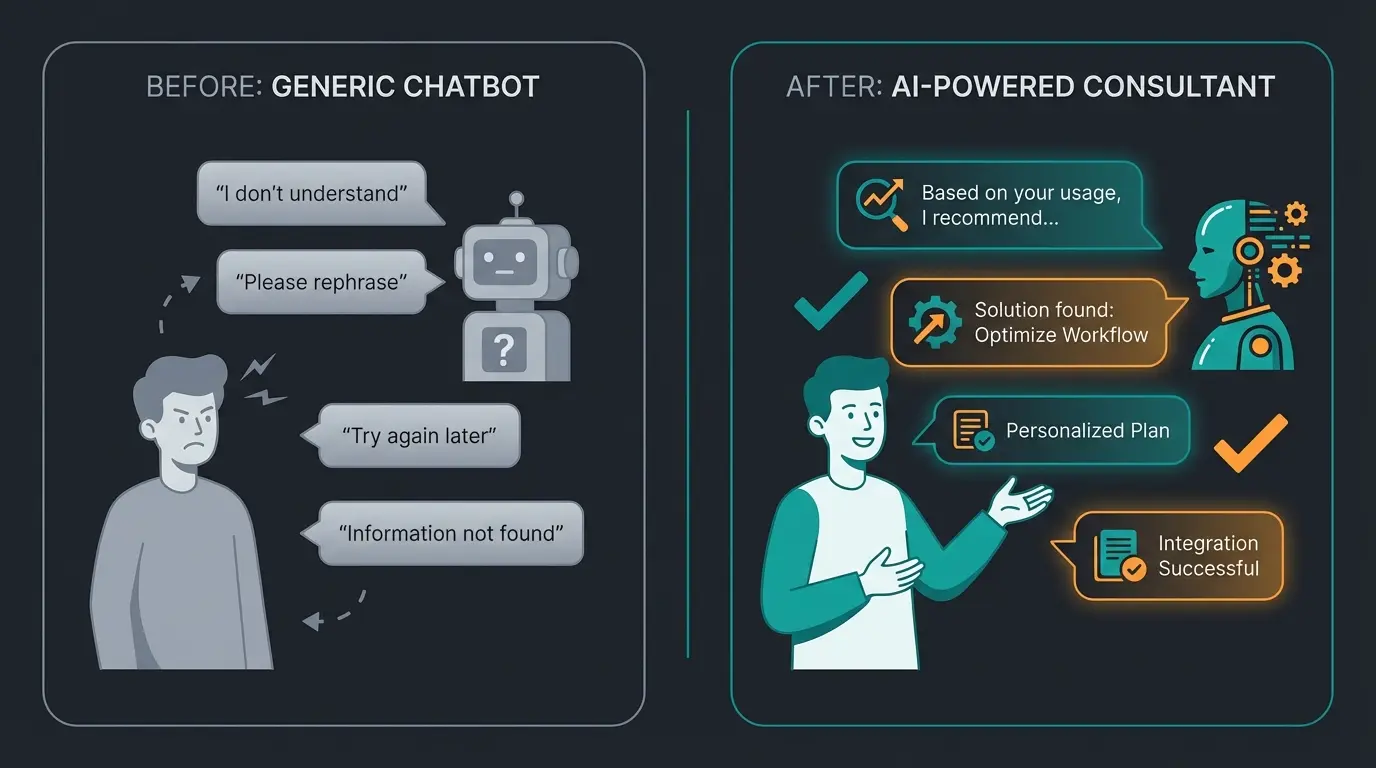
To make the difference between "AI in customer service" (old) and "AI sales consultation" (new) tangible, a direct comparison in a complex purchase scenario is worthwhile. This is where AI product consultation truly shines.
Scenario: A customer is searching in an online sports equipment store for ski boots. They have wide feet and are an advanced beginner.
The Classic Chatbot (FAQ-based)
- Customer: "Which ski boots fit wide feet?"
- Chatbot: "We have a large selection of ski boots. Here is the link to our 'Ski Boots' category. Our return period is 30 days."
- Result: The customer feels left alone. They have to click through hundreds of products, search for filters (which are often missing) and leave the shop frustrated.
The AI Product Consultant (Consultative AI)
- Customer: "Which ski boots fit wide feet?"
- AI Consultant: "For wide feet, I recommend models with a last of 102mm or more. How well do you ski? Are you a beginner or already advanced?"
- Customer: "I'm an advanced beginner."
- AI Consultant: "I understand. Then you need a boot that's comfortable but provides enough support for progress. Based on our assortment, I recommend the Model X Comfort (last width 104mm, medium flex). It's currently available in size 42 and 43. Would you like me to show you the details?"
- Result: The customer feels understood and advised. The likelihood of a purchase increases dramatically.
AI Software Comparison: Generalists vs. Specialists
The market for AI in customer service is increasingly dividing into two camps in 2025. For your strategy, it's crucial to choose the right tool for the right goal.
1. The Generalists (Focus: Support & Ticketing)
Tools like Zendesk, Salesforce Service Cloud, or Freshdesk are the incumbents in classic support, as noted by eDesk.
- Strength: Omnichannel management, ticket routing, CRM integration, efficiency measurement.
- AI Use: Often focused on "Agent Copilots" (supporting human employees) or FAQ bots for ticket avoidance.
- Ideal for: Post-sales support, complaint management, large support teams.
2. The Specialists (Focus: Sales & Consultation)
New players like Qualimero, Charles (Conversational Commerce), or specialized e-commerce AIs focus on the shopping experience. These solutions function as digital expert consultants rather than simple support tools.
- Strength: Deep integration into product feeds (Shopify, Shopware, Magento), understanding of product attributes, "Guided Selling," integration into messengers like WhatsApp for direct sales.
- AI Use: Autonomous sales conversations, product recommendations, shopping cart rescue.
- Ideal for: Pre-sales, increasing conversion rate, online shops with products requiring explanation.
| Feature | Classic Chatbot (FAQ Bot) | AI Product Consultant (The New Solution) |
|---|---|---|
| Primary Goal | Reduce support tickets (cut costs) | Increase sales & conversion (boost revenue) |
| Knowledge Base | Static FAQs & text templates | Dynamic product feed & technical specifications |
| Interaction Style | Reactive ("What is your order number?") | Proactive ("What exactly are you looking for today?") |
| Complexity | Low (return status, opening hours) | High (compatibility, needs analysis, cross-selling) |
| ROI Metric | Saved work time / Cost-per-ticket | Conversion Rate / Average Order Value (AOV) |
| Technology | Often rule-based or simple NLP | LLM (GenAI) + RAG (Retrieval Augmented Generation) |
Discover how AI-powered product consultation can boost your conversion rates by up to 23% while reducing returns. Join leading e-commerce brands already seeing results.
Start Your Free TrialCurrent Data & Facts 2025: Why Now Is the Right Time
To convince your stakeholders, you need more than just gut feeling. The data situation for 2024/2025 speaks a clear language in favor of "Conversational Commerce." Research from Zendesk confirms growing consumer trust in AI agents.
Implementation: How to Integrate AI Consultation
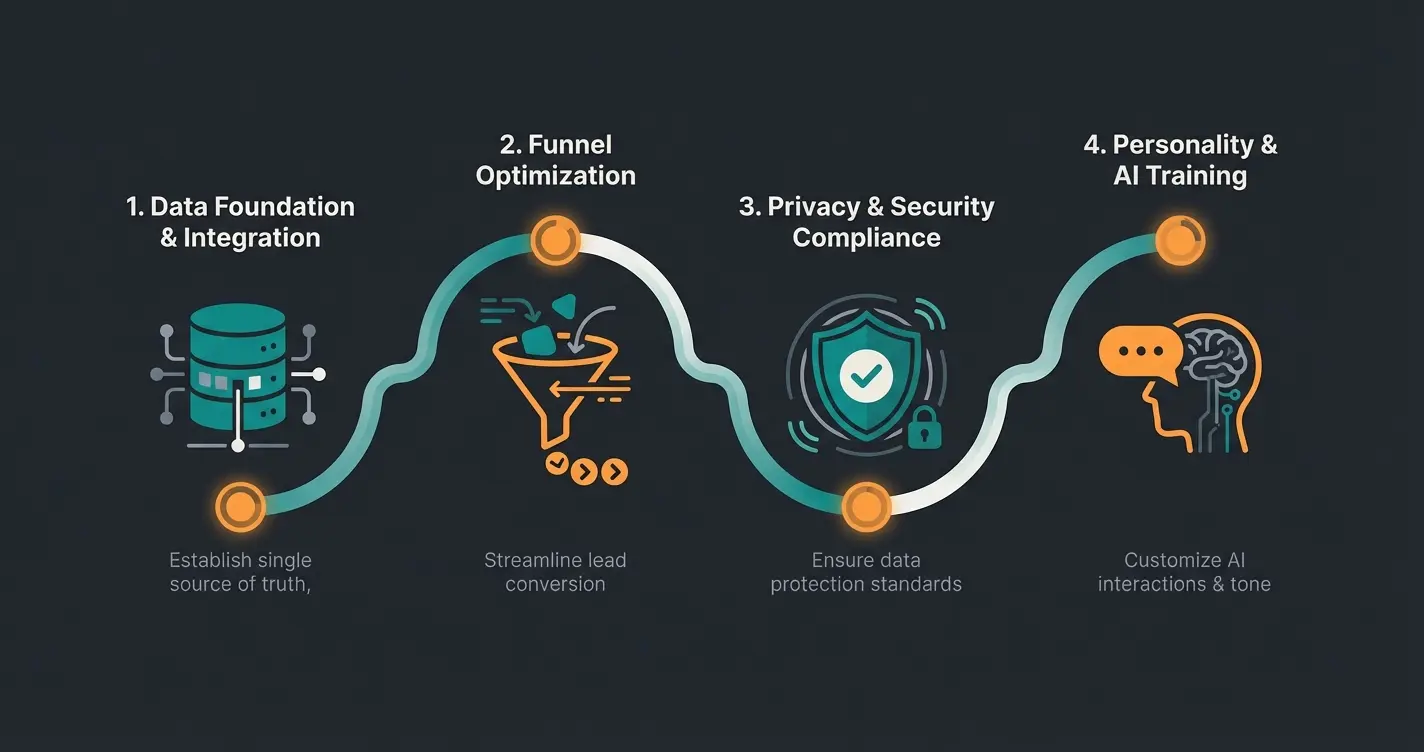
Introducing a sales-oriented AI in customer service differs technically and strategically from introducing a classic support tool. Here's a roadmap for integration that enables active product advice in your online shop.
Step 1: Create the Data Foundation (Product Feed Instead of FAQ)
The heart of a consultation AI is not your return policy, but your product catalog. As explained by Medium and Alex Genovese, RAG technology is the key.
- Challenge: LLMs (like GPT-4) hallucinate when they don't have facts.
- Solution: Use RAG (Retrieval-Augmented Generation). Here, your product feed (XML, CSV from Shopify/Shopware) is loaded into a vector database. When a customer asks, the AI first searches this data for matching attributes (size, color, technical data) and then formulates the answer.
- Tip: The better your product data is maintained (attributes like "material," "fit," "compatibility"), the better the AI consults.
Step 2: Close the "Missed Opportunity" in the Funnel
Visualize your customer journey. Most companies deploy AI only after the purchase (support). This is where an AI product consultant guide becomes invaluable.
- Pre-Sales (Consultation): This is where revenue is decided. Integrate the AI consultant on product category pages and product detail pages. Have it proactively offer help when a customer lingers on a page for a long time.
- Post-Sales (Support): Here, AI can still provide tracking info, but the focus should be on revenue generation in the first step.
Customer asks: "Which laptop is best for video editing?" → AI suggests Model X + Accessories (Upsell opportunity)
AI matches customer needs with product attributes, eliminates choice overload, builds confidence
Customer receives personalized recommendation with clear reasoning, leading to conversion
Customer asks: "Where is my laptop?" → AI provides tracking info and proactive delivery updates
Step 3: Data Privacy and Transparency (The Right Approach)
Trust is currency in business.
- Labeling: Make transparent that the customer is talking to an AI. This builds trust and lowers expectations for "human perfection" while increasing acceptance for quick answers.
- GDPR/Privacy: Ensure your provider uses servers in the EU or offers appropriate standard contractual clauses. European providers often have advantages over US giants in this regard.
Step 4: Training the "Sales Personality"
A good salesperson isn't just an encyclopedia – they're empathetic. This applies equally to your AI product consultation solution.
- Define the "Tone of Voice." Should the AI be casual or formal?
- Train the AI on objection handling. What does it say when the customer finds the price too high? (Answer: Focus on durability and quality rather than just offering discounts).
The Future Belongs to Consultative Customer Service
The separation between "Sales" and "Service" is dissolving in 2025. Excellent customer service is sales consultation. Anyone who uses AI in customer service only to save costs and fend off customer inquiries may gain short-term efficiency but loses market share in the long run.
The winners in e-commerce will be those who use AI to transfer the experience of a specialty store into the digital world: competent, proactive, and personal.
Frequently Asked Questions About AI Customer Service
No, but it changes their role. AI handles repetitive inquiries and initial consultation (scaling). Humans take care of complex escalations, emotional complaints, and "white glove service" for VIP customers. The combination of AI efficiency and human empathy creates the optimal customer experience.
Yes. Through SaaS solutions and "done-for-you" providers, the technology is now accessible to SMBs as well. The ROI often materializes quickly since the conversion rate increases and returns decrease. Many solutions offer tiered pricing that scales with your business.
Through the technology "Retrieval-Augmented Generation" (RAG). The AI may only use information that explicitly exists in your product feed. It doesn't "make up" products but searches your database for facts and only reformulates them linguistically. This grounds all recommendations in your actual inventory.
A traditional chatbot relies on static FAQs and simple keyword matching. An AI product consultant uses Large Language Models (LLMs) integrated with your product database to understand complex queries, analyze customer needs, and provide personalized recommendations based on actual product specifications and attributes.
Basic implementation can take 2-4 weeks depending on your e-commerce platform and data quality. The key factor is your product data preparation. Well-maintained product attributes (material, compatibility, specifications) accelerate implementation and improve AI consultation quality from day one.
Stop leaving revenue on the table with outdated FAQ bots. See how AI-powered product consultation can increase your conversion rates and reduce returns while delivering exceptional customer experiences.
Book Your Free Demo