Why the Classic Newsletter Is Dying (And What Comes Next)
When you think about Shopware email marketing, what image comes to mind? Probably the weekly newsletter blasted to 10,000 recipients promoting the latest sale. Or the automated order confirmation that dryly lists what was purchased.
But the numbers for 2024 and 2025 speak a clear language: the effectiveness of this "one-to-many" communication is declining. While open rates in European e-commerce still hover around 30-32% according to MailerLite, these figures are often artificially inflated by Apple's Mail Privacy Protection (MPP) and obscure the true engagement rate, as GetResponse research indicates. Click-through rates (CTR) often stagnate in the low single digits—around 1-2% according to Mailchimp data.
The problem isn't the email channel itself—it remains the highest ROI marketing channel. The problem is relevance.
In an era when customers are accustomed to hyper-personalized content from AI-powered algorithms on TikTok and Instagram, a static newsletter feels like a relic from the stone age. Customers often don't buy because they forgot the product (the assumption behind classic abandoned cart emails), but because they're uncertain. Does spare part X fit machine Y? Is the jacket really waterproof enough for my needs? This is where AI product consultation becomes transformative.
Here lies the massive content gap in the current discourse around Shopware email marketing: We need to stop viewing emails as a megaphone ("Buy this!") and start using them as a consultant ("Can I help you with your decision?").
This article is your blueprint for Shopware email marketing in 2025. We'll analyze the standard tools, dive deep into the Shopware Flow Builder, and then show you how to build a genuine dialogue strategy with AI—one that doesn't just drive traffic but builds trust.
The Current State: Email Marketing in Shopware 6
Before we look at external tools, we need to understand what Shopware 6 delivers "out of the box." The heart of every automation in Shopware is the Flow Builder.
The Shopware 6 Flow Builder: The Backbone of Automation
The Shopware Flow Builder is a low-code tool that enables merchants to automate complex business processes without programming knowledge, as detailed in Solution25 documentation. It's based on a simple principle: Trigger (Initiator) -> Condition (Requirement) -> Action (Result).
For email marketing, this is crucial because it bridges the gap between customer behavior in the shop and communication. Understanding this foundation is essential for anyone exploring the broader Shopware AI guide to automation and product consultation.
Typical Native Scenarios in the Flow Builder
- Trigger: `checkout.order.placed` (Order placed) → Action: Send "Order Confirmation" email
- Trigger: `state_enter.order_transaction.state.paid` (Payment status: Paid) → Action: Send "Payment Received" email and generate invoice
The Limits of Native Functions
Shopware can determine when an email is sent logically, but the content is usually static. You create a template in the Shopping Experiences editor or the Email Template Manager, and this template gets used repeatedly. What's missing is the dynamic intelligence that responds to the customer's context.
Native Features vs. External Tools vs. AI Consultants
| Feature | Shopware 6 Native (Flow Builder) | Classic ESPs (Brevo, CleverReach, Klaviyo) | AI Product Consultant (The Future) |
|---|---|---|---|
| Main Purpose | Transactional emails (invoices, status) | Marketing campaigns & newsletters | Individual purchase consultation & dialogue |
| Triggers | Hard events (purchase, status change) | List segments & schedules | Behavior patterns (dwell time, click path) |
| Content | Static templates with variables | Drag & drop editor, personalization | Generative AI (context-based responses) |
| Data Basis | Order data | Click & open rates | Semantic understanding of catalog |
| Goal | Information & processing | Traffic & repeat sales | Trust & conversion rescue |
The Big 3: Standard Tools for Shopware Email Marketing
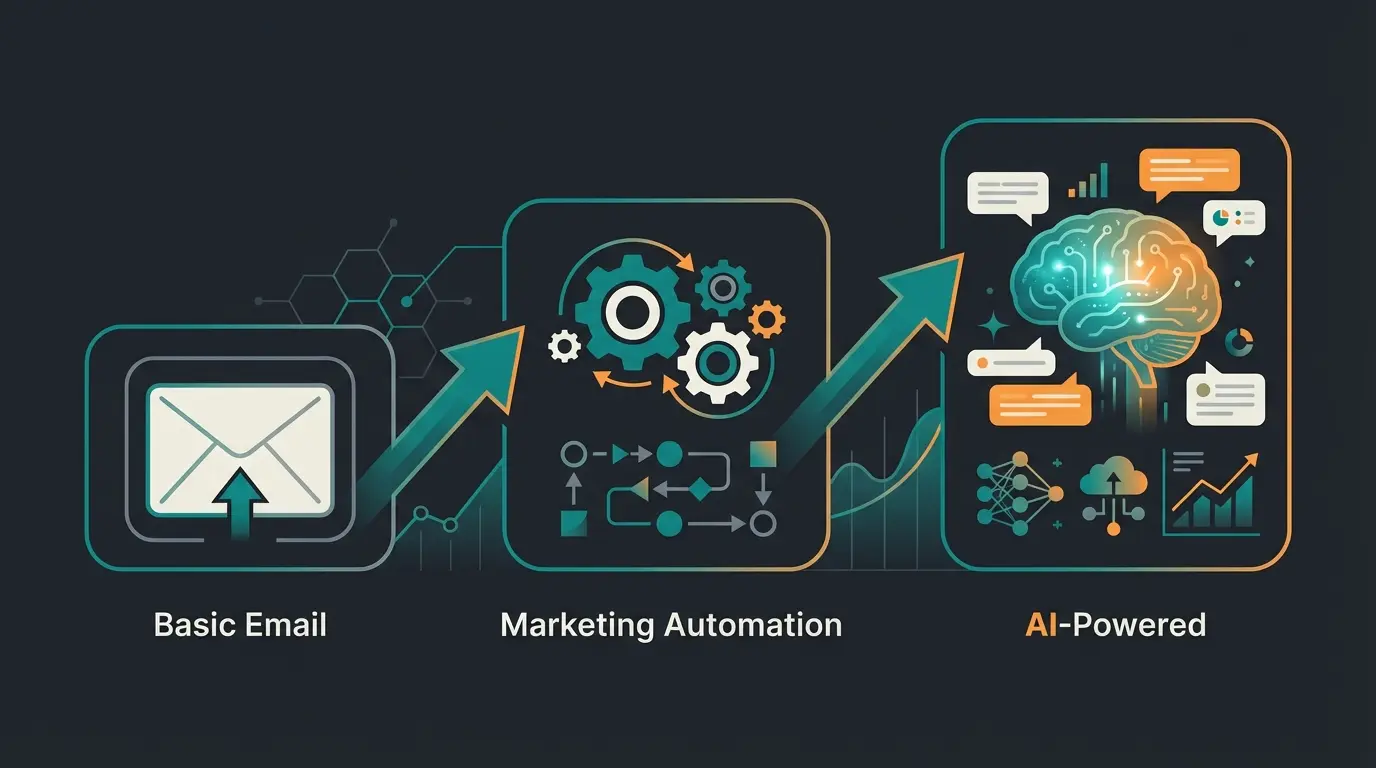
To build a solid foundation, you can't get around established Email Service Providers (ESPs). These tools are essential for deliverability and list management. Here's the current state of the top players for Shopware users in 2025.
1. CleverReach: The German Data Protection Standard
For many German Shopware merchants, CleverReach is the first choice, primarily due to strict GDPR compliance and server locations within the EU.
- Integration: Offers an official plugin that synchronizes product data and recipients
- AI Features 2025: CleverReach has integrated an AI content generator that creates subject lines and newsletter texts based on bullet points, as explained on CleverReach. This saves time but remains in the "broadcasting" realm—it helps the marketer write faster, not the customer decide better.
- Best For: Merchants seeking maximum legal security who want to send solid standard newsletters
2. Brevo (formerly Sendinblue): The All-Rounder
Brevo has evolved from a pure email tool into a CRM suite with comprehensive capabilities.
- Specialty: Strong integration of multi-channel marketing (SMS, WhatsApp) and a "Conversations" app for chats
- AI Features 2025: With Aura AI, Brevo offers an assistant that not only writes texts but also optimizes send times and automatically creates segments
- Best For: Shops wanting to combine email with chat and SMS to reach customers across different channels
This multi-channel approach connects well with implementing a Shopware AI chatbot for comprehensive customer engagement.
3. Klaviyo: The Data Machine
Klaviyo is the gold standard for data-driven e-commerce marketing and has been an official Platinum Technology Partner of Shopware since late 2025.
- Strength: The depth of data integration. Klaviyo doesn't just see "customer purchased" but "customer viewed red socks in size 42 but didn't buy."
- AI Features 2025: Klaviyo is heavily investing in AI. New features like Reputation Repair AI help rescue deliverability according to Klaviyo, and Personalized Campaigns AI creates variants for specific segments
- Best For: High-growth brands ready to invest time in complex flows and segmentation
The Missing Link: AI-Driven Product Consultation
Here begins the real innovation for your Shopware email marketing. Customers often don't abandon purchases because they lack interest, but because they're missing information.
A classic abandoned cart email says: "Hey, you forgot something! Here's 5% off." This is often ineffective and only trains customers to wait for discounts.
A consultation-recovery email says: "Hello [Name], I noticed you were looking at the X espresso machine. Many of our customers wonder whether this machine is suitable for small kitchens. Should I send you the dimensions and a comparison?"
This approach aligns perfectly with modern AI-driven product consultation strategies that prioritize helping over selling.
Generic broadcast emails struggle to engage customers who need specific information
Personalized help offers addressing specific concerns drive significantly higher engagement
Most abandonments stem from uncertainty, not disinterest—consultation can recover these
AI-powered consultation emails convert up to 3x better than discount-focused approaches
How Does This Work Technically in Shopware?
To implement this, we need a combination of the Shopware Flow Builder and an AI service (e.g., via OpenAI API or specialized plugins).
The Concept: The Consultation Loop
Instead of simply pushing data, we use AI to understand the context of the shopping cart.
- Analysis: The AI analyzes the products in the cart or wishlist. It recognizes not just the ID but the properties (e.g., "technically complex product," "high explanation need," "accessory part")
- Diagnosis: The AI formulates a hypothesis about why the customer is hesitating (e.g., "compatibility unclear" for spare parts)
- Intervention: The email is generated—not as advertising copy, but as a helpful service message
This consultation loop concept is a core component of AI guided selling, transforming passive browsing into active purchasing decisions.
Stop sending emails your customers ignore. Start conversations that convert. Our AI product consultation platform integrates seamlessly with Shopware to create personalized consultation loops.
Start Your Free TrialStrategy: Setting Up Consultation Loops in Shopware
Here's a concrete guide on how to build such a strategy. We'll use the Flow Builder's logic and conceptually enrich it with AI capabilities.
Step 1: Identify High-Value Abandonments
Not every cart abandonment needs consultation. A pair of socks for €5 doesn't need AI analysis.
- Shopware Rule Builder: Create a rule called `High_Value_Complex_Cart`
- Condition: `Cart value > €100` AND `Product category is one of [Electronics, Spare Parts, Premium Fashion]`
Step 2: The Trigger in Flow Builder
- Navigate to Settings > Flow Builder > Add Flow
- Trigger: `checkout.cart.abandoned` (Note: This often requires an additional plugin since Shopware Core only tracks this indirectly, or using tools like Klaviyo that relay this event to Shopware)
- Condition: Only when rule `High_Value_Complex_Cart` applies
Step 3: The AI Integration (The Magic Moment)
Instead of simply sending the "Cart Abandonment" template, we use a webhook or app action.
Scenario A (With Klaviyo/Brevo)
The data is sent to the ESP. There you use the new AI features (like Klaviyo's "Personalized Campaigns AI") to vary the text based on product properties.
Scenario B (Native AI Plugins)
Use plugins or custom scripts via webhook.
- The webhook sends the product IDs to your AI interface
- Prompt to the AI: "The customer left Product X (Technical data: ...) in their cart. Create a short, helpful email (max 3 sentences) that asks a specific question about usage or compatibility. No hard-selling."
- The generated response is injected into a Shopware email template in a variable `{{ ai_consultation_text }}`
Step 4: The Response Loop
The goal of this email is a reply or a click on a "Start Chat" button.
- Set up your support workflow so replies to these emails are prioritized
- If you use Brevo, these replies can land directly in the "Conversations" app
For optimal response handling, consider implementing AI chatbots for customer service that can continue the conversation seamlessly.
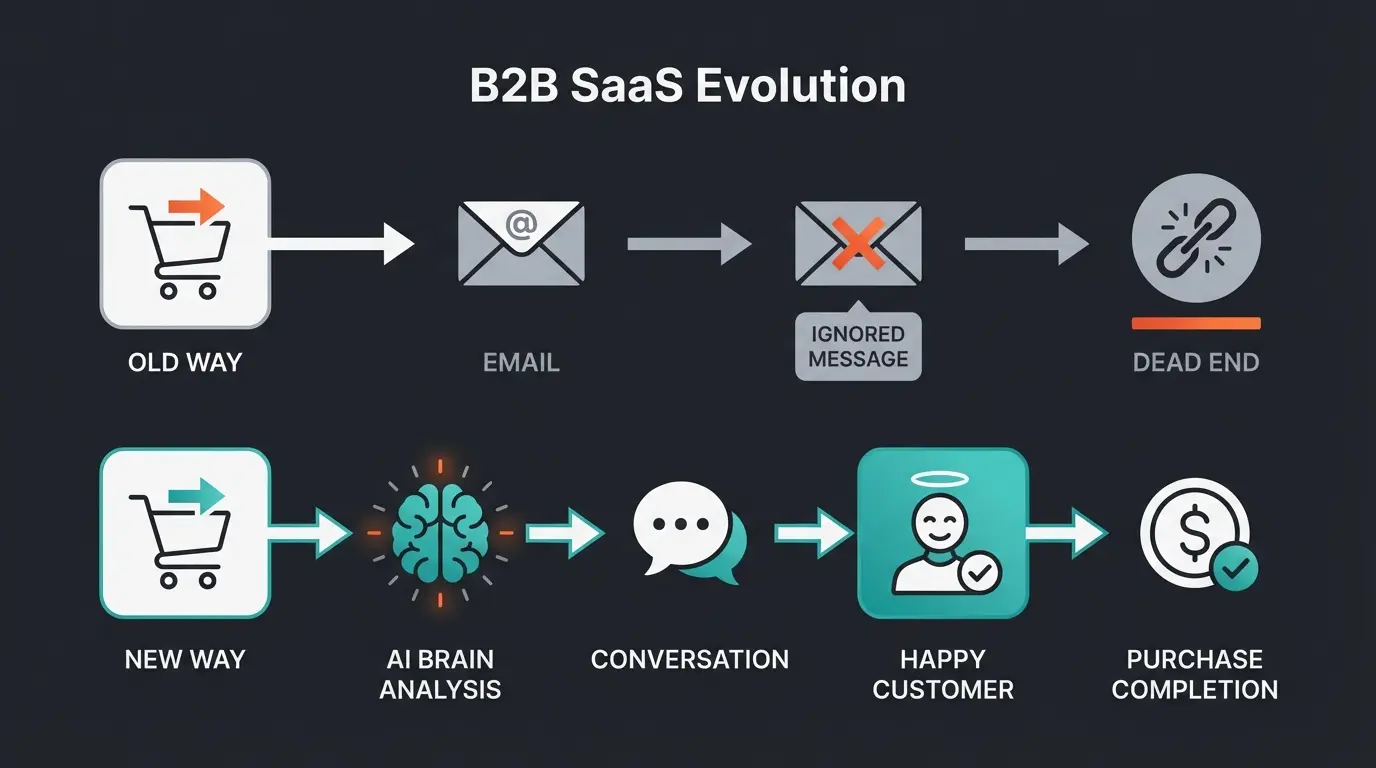
High-value or complex product left in cart triggers the automation
Instead of generic timing, AI evaluates product complexity and likely hesitation reasons
"Questions about lens compatibility?" replaces "You forgot something!"
Reply or chat click creates dialogue opportunity
Specific question answered builds trust
Purchase completed with positive experience that drives repeat business
GDPR & Trust: The German Competitive Advantage
A common objection against AI in Shopware email marketing is data protection. "Is the AI reading my customer data?"
Here lies your chance for differentiation. In Germany, data protection is a quality feature. This connects to broader Shopware customer service principles where trust is paramount.
Transparency as a Marketing Tool
When you use AI for consultation, communicate this openly.
- Privacy by Design: Use tools that anonymize data before sending it to an AI (like OpenAI). For product consultation, the AI doesn't need the customer's name or email—only the product ID. The connection happens again in your protected Shopware system.
- The Trusted Advisor: Position your emails not as "algorithm" but as "Digital Assistant"
- Opt-In: Ensure your cookie consent tools (integrated in Shopware) and newsletter sign-ups (double opt-in) are clean. Tools like CleverReach score points here with servers in the EU, which you can highlight in your privacy policy
AI vs. Tracking Pixels
Interestingly, the "consultation" approach is more privacy-friendly than massive tracking.
- Tracking secretly tries to figure out what the customer wants (by spying on click behavior)
- Consultation simply asks the customer what they want
This isn't just more ethical—it delivers better data (Zero-Party Data). This philosophy extends to AI customer service implementations where transparency builds lasting customer relationships.
Anatomy of a High-Converting Shopware Email
Understanding what makes consultation emails effective requires examining their structure. The difference isn't just in content—it's in approach.
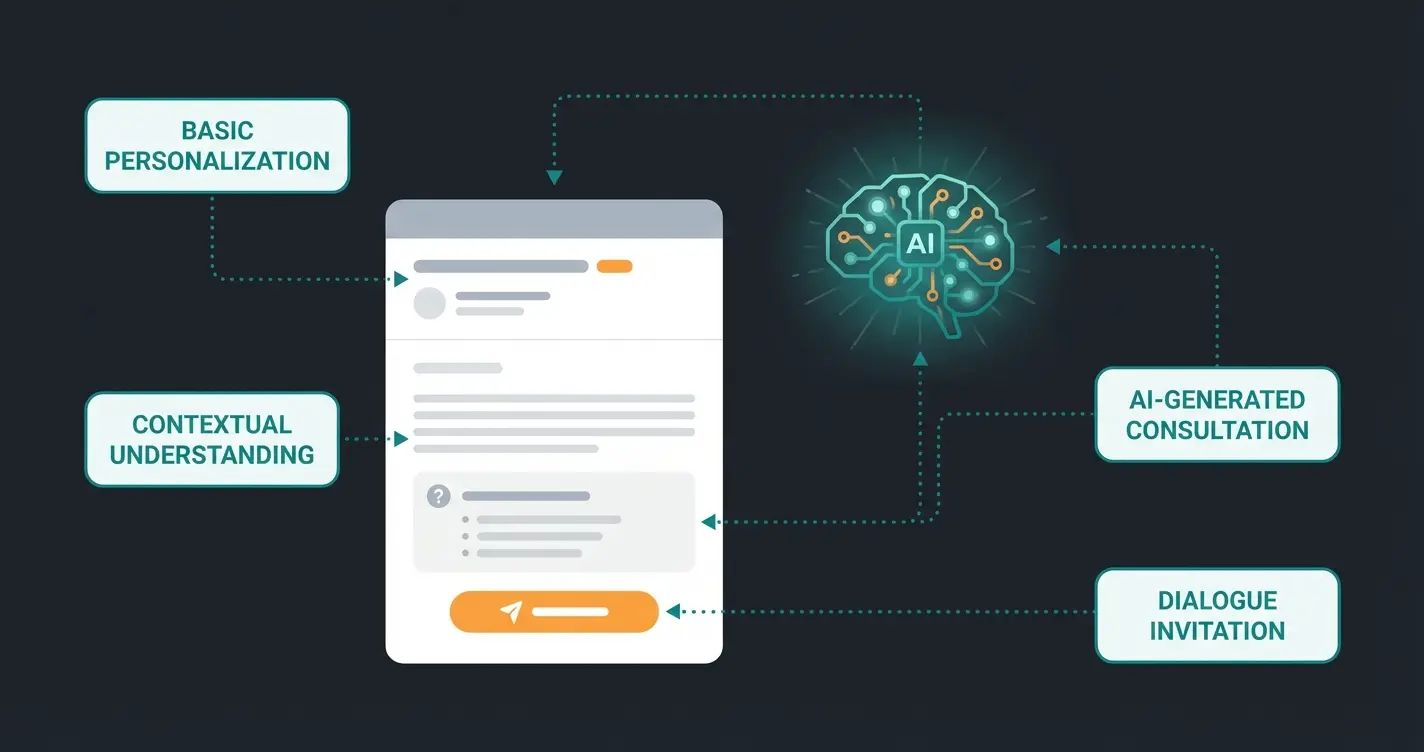
Basic Personalization (What Everyone Does)
"Hello [Name], you left something in your cart." This uses one variable—the name. It's barely personalization; it's mail merge from the 1990s.
Advanced Personalization (The Consultation Approach)
"Hello [Name], regarding your interest in [Category], I noticed you viewed [Product Name]. Many customers ask about [Common Question for this Product Type]. Would you like me to clarify [Specific Technical Aspect]?"
This approach mirrors what you'd find in conversational commerce—treating each interaction as the start of a dialogue, not the delivery of a message.
- Name: Basic variable
- Category interest: Behavioral inference
- Product name: Cart data
- Common question: AI-generated based on product type
- Specific technical aspect: Contextual to product properties
The email demonstrates understanding, not just awareness. It shows you know what might be confusing, not just what they browsed.
Optimizing Shopware Product Pages for Email Conversion
Your consultation emails are only as effective as the pages they link to. When a customer clicks through from a consultation email, they should land on optimized Shopware product pages that continue the consultative experience.
Key elements to ensure consistency:
- Answer the question asked: If your email mentioned lens compatibility, the landing page should immediately address compatibility information
- Continue the conversation: Include a chat widget or contact option prominently
- Maintain the helpful tone: Don't switch from consultative email to aggressive sales page
- Enable easy response: Make it simple for customers to ask follow-up questions
Leveraging Cross-Selling Through Consultation
Traditional Shopware cross-selling relies on "customers also bought" algorithms. Consultation-based cross-selling asks: "Based on what you're trying to achieve, you might also need..."
The difference is profound. One pushes products based on correlation; the other recommends solutions based on understanding.
In your consultation emails, AI can identify not just abandoned products but missing complementary items. If someone's buying a camera body, they likely need a lens. But instead of saying "People also bought this lens," a consultation email asks: "Are you planning to shoot primarily portraits or landscapes? This helps me recommend the right lens for your new camera."
The Role of AI in Modern E-Commerce Email
Understanding the broader context of AI in e-commerce helps frame why consultation-based email marketing represents a paradigm shift, not just an incremental improvement.
Traditional email marketing optimization focused on:
- Better subject lines (AI now writes these)
- Optimal send times (AI now calculates these)
- Segment refinement (AI now automates this)
These improvements made broadcasting more efficient. But consultation-based AI changes the fundamental model from broadcasting to conversing.
Conclusion & Future Outlook
The year 2025 marks the end of the "blast" era in Shopware email marketing. The tools are more powerful than ever—the Shopware Flow Builder automates the logic, Klaviyo and Brevo deliver the data infrastructure, and new AI plugins bring the brain to the operation.
Your Checklist for Getting Started
- Audit: Review your current automations. Are they pure transaction emails or do they offer added value?
- Tool Choice: Decide: Do you need CleverReach's GDPR security, Brevo's multi-channel power, or Klaviyo's data depth?
- Pilot Project: Don't start with your entire shop. Take your most complex product category and build a consultation loop for cart abandoners.
- Mindset: Don't just measure "clicks"—measure "replies" and "problems solved"
Those who understand email marketing as a service will continue to have high open rates and loyal customers in the future—regardless of what filters Apple or Google invent next.
FAQ: Common Questions About Shopware Email Marketing
It depends on your goals. For maximum data depth and US market focus, Klaviyo (Platinum Partner) leads. For German SMBs focused on data protection and ease of use, CleverReach is often the best choice. Brevo is ideal if you want to use chat and SMS alongside email.
No. The Shopware 6 Flow Builder is a no-code tool. You can create complex workflows via drag and drop. Only for very specific AI connections via webhook might technical understanding be helpful.
Yes, when implemented correctly. Ensure that no personally identifiable information (PII) is sent to AI models for training. Use established providers with data processing agreements (DPA) in place.
Costs vary. Plugins often have a one-time fee or subscription model, plus API costs (e.g., OpenAI) that depend on usage (traffic) but are usually in the cent range per consultation.
Traditional email marketing broadcasts messages to segments hoping for clicks. Consultation email marketing initiates dialogues that help customers make decisions. Instead of 'Buy this!' it asks 'Can I help you decide?' This approach generates higher engagement and builds lasting trust.
Move beyond broadcasts. Build consultation loops that convert uncertain browsers into confident buyers. Our AI platform integrates with Shopware 6 to create personalized product consultation at scale.
Get Started Free
Lasse is CEO and co-founder of Qualimero. After completing his MBA at WHU and scaling a company to seven-figure revenue, he founded Qualimero to build AI-powered digital employees for e-commerce. His focus: helping businesses measurably improve customer interaction through intelligent automation.