Introduction: The Elephant in the Room Is Now PlentyONE
Anyone searching for an e-commerce solution in 2025 that offers not just a webshop but the entire backbone of a trading company cannot ignore one name: Plentymarkets. However, if you search for it today, you'll often find a new logo and a new name: PlentyONE.
The German e-commerce market has fundamentally changed. It's no longer enough to simply list products on Amazon and eBay. Margins are shrinking, advertising costs (CAC) are rising, and customers expect a shopping experience that goes beyond simply clicking "Add to Cart."
In this comprehensive Plentymarkets review 2025, we take an uncompromising look at the current state of the system. We analyze not only the new Plentymarkets pricing and current user experiences from the community but also uncover a massive gap that most merchants overlook: While the backend (inventory management) is often highly automated, the frontend (the shop the customer sees) often resembles the standard from 2015.
This article is neither pure praise nor a harsh critique. It's a strategic analysis for merchants who want to understand whether PlentyONE is the right tool for their growth—and how they can achieve a competitive advantage through AI-powered sales consultation (not just text generation!) that the standard software alone cannot provide. Companies implementing AI product consultation are already seeing significant conversion improvements.
From Plentymarkets to PlentyONE: What's Behind the Rebrand?
Before we dive into the technical depths and costs, we need to clear up some confusion. Many merchants are asking: "Is PlentyONE a new system? Do I need to migrate?"
The Consolidation of Brands
In November 2024, plentysystems AG took a radical step. The brands plentymarkets (the product), plentysystems (the company), and plentyONE (formerly the enterprise division) were consolidated under the single brand PlentyONE, as announced on plentyone.com.
Why is this important for you?
- Strategic Alignment: With the entry of investor PSG Equity at the end of 2024, the company is now aggressively targeting the international market and larger SMBs up to enterprise customers, according to their press release.
- No System Migration Required: For existing users, technically little changes to the core system. It's not a "new" ERP that you have to laboriously migrate to. It's a repositioning.
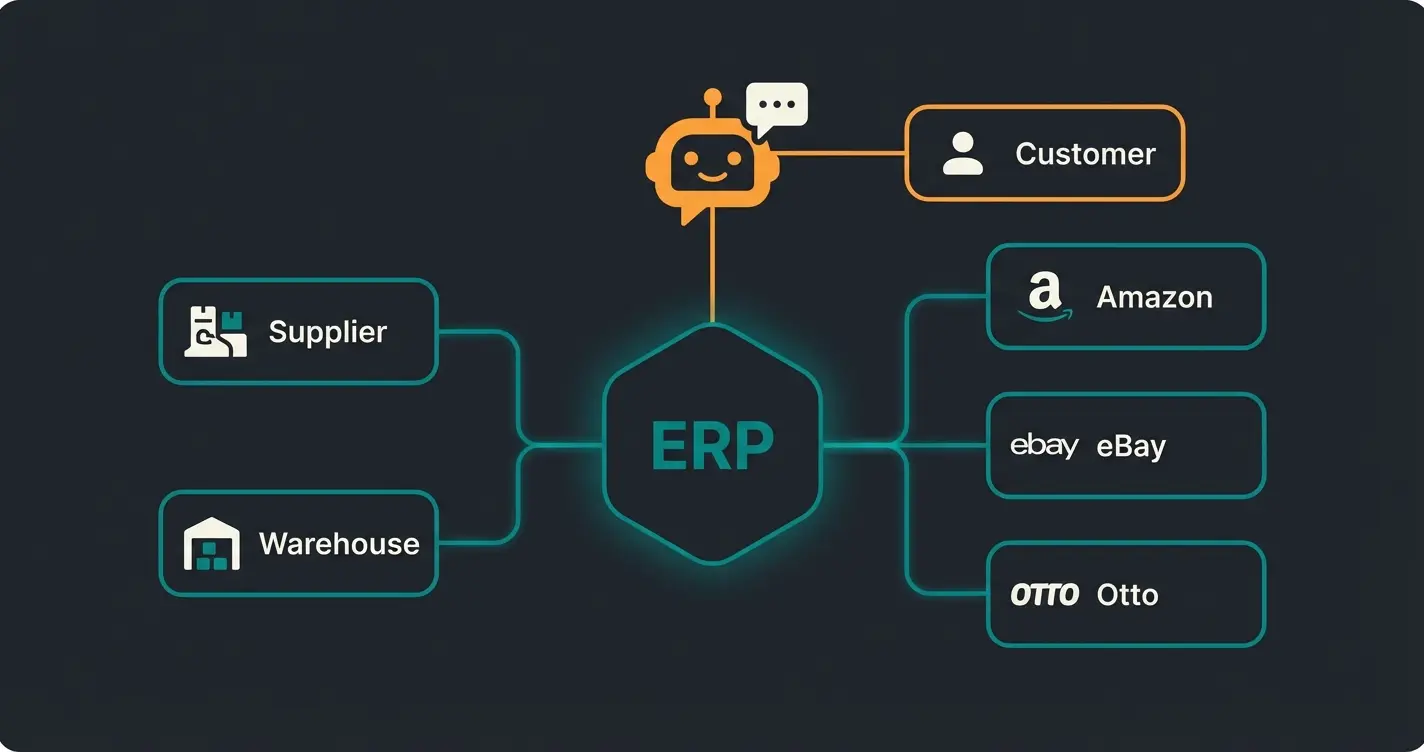
- Focus on "Unified Commerce": The term "Multichannel" is being replaced by "Unified Commerce." This means: B2B, B2C, marketplaces (Amazon, Otto, Kaufland), and POS (point of sale) should not only exist side by side but merge in real-time.
Plentymarkets Pricing 2025: The New Models Explained
One of the most frequently searched topics is Plentymarkets costs. Previously, the pricing model with "Classic," "Flex," and various additional fees was often a closed book. In 2025, the structure presents itself much more clearly organized, but you need to understand the fine print.
PlentyONE relies on a GMV-based model (Gross Merchandise Volume) combined with feature packages, as detailed on the official pricing page.
The Three Main Pricing Tiers (As of 2025)
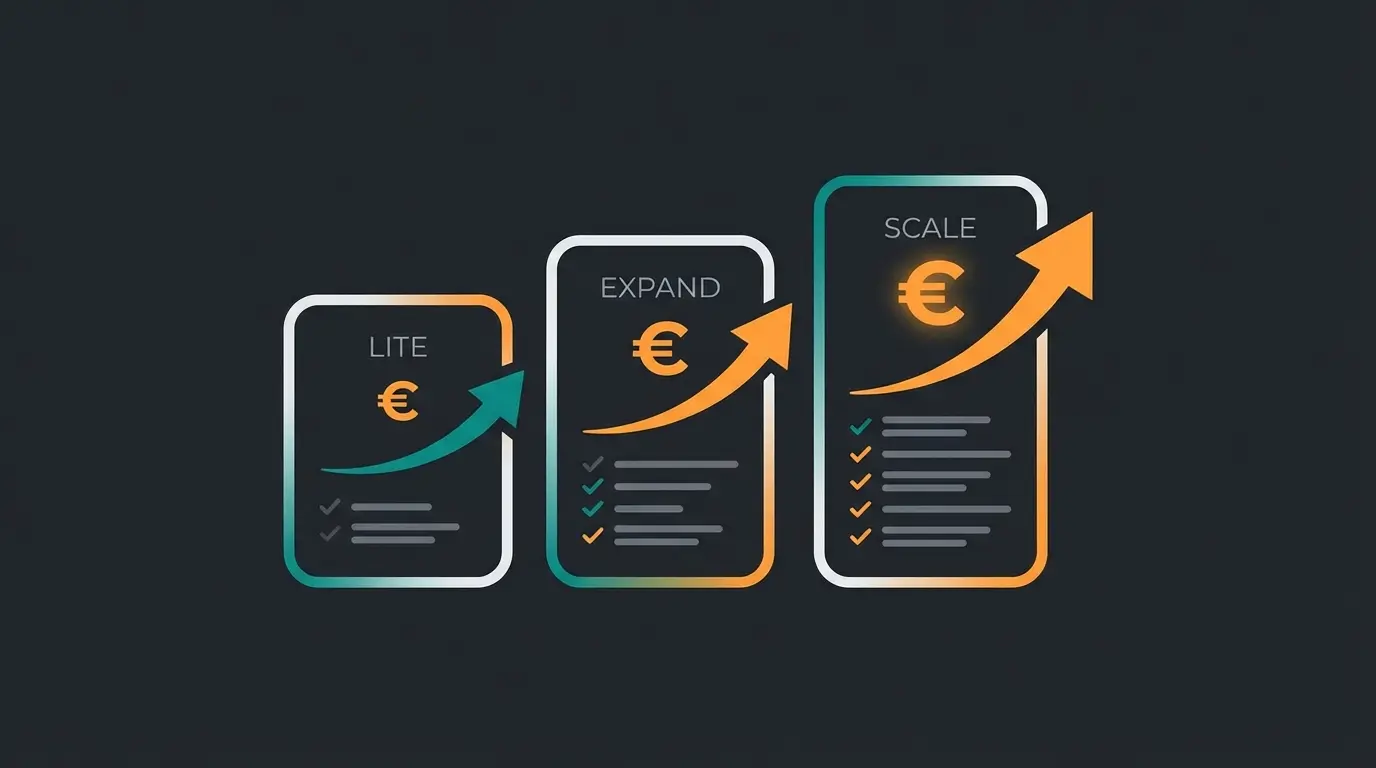
Here is an overview of the current editions as communicated for SMBs and growing merchants:
| Feature / Plan | LITE | EXPAND | SCALE |
|---|---|---|---|
| Starting Price (monthly) | from €59 | from €149 | from €229 |
| Target Group | Solo entrepreneurs, Start-ups | Established SMBs | High-volume merchants |
| Marketplace Connections | 5 included | 15 included | 25 included |
| PlentyONE Shops | 1 Shop | 2 Shops | 3 Shops |
| External Shops (e.g., Shopify) | 1 external shop | 1 external shop | 3 external shops |
| Article Variants (SKUs) | 1,000 | 10,000 | 25,000 |
| Users (Licenses) | 5 Users | 20 Users | 40 Users |
| Workflows (Automation) | 10 Workflows | 20 Workflows | 50 Workflows |
| Warehouses | 1 Warehouse | 5 Warehouses | 10 Warehouses |
Hidden Costs: What You Need to Factor In
The monthly base price is only the "rent" for the software. A realistic business case must consider the following positions:
- GMV Fees: The prices mentioned above are "starting prices." Depending on your sales volume, you'll move into higher tiers. If you start with the "Lite" plan but suddenly make €100,000 in monthly revenue, PlentyONE will upgrade you or charge overage fees, as noted in their terms and conditions.
- Setup Fees: PlentyONE is not "plug-and-play" like Shopify. The setup is complex. Expect either €3,000 - €15,000 for an agency or 2-3 months of intensive onboarding time if you do it yourself (the infamous "steep learning curve").
- Plugin Costs (plentyMarketplace): The system is modular. Important functions (e.g., specific export formats, certain payment providers, or SEO tools) often cost extra. An average merchant spends approximately €50 - €200 monthly on plugins, as indicated on the plentyMarketplace.
- Transaction Fees: Check exactly whether your contract includes transaction fees per order (previously common, now often regulated through GMV tiers in new models).
For a merchant with €50K revenue including plugins and support
Agency costs or equivalent time investment for self-setup
Average cost for essential marketplace and automation plugins
Calculation Example: The "Growth Merchant"
Let's assume you're a sports equipment retailer with the following profile:
- Revenue: €50,000 / month
- Channels: Own shop + Amazon + eBay
- SKUs: 4,000 products
Calculation:
- You need at least the Lite+ or Expand plan (due to SKUs). Let's take Expand for safety with the SKU limit (10k limit).
- Base fee: ~€149
- Plugins: ~€80 (e.g., DHL shipping, special theme, accounting export).
- Support: Possibly a service contract with an agency (approx. €200 flat rate).
Total Software Costs: approximately €430 / month.
Comparison: This sounds like a lot, but consider: You save yourself separate costs for a PIM (Product Information Management), a WMS (Warehouse Management System), and middleware tools like Magnalister, since all of this is integrated into PlentyONE.
Plentymarkets Experiences: The Good, Bad & Support Issues
Anyone searching for "plentymarkets experiences" finds a divided picture. On portals like OMR Reviews or Trustpilot, 5-star praises alternate with frustrated 1-star reviews. Let's structure these experiences.
Pro: The "Interface Monster"
The greatest strength of PlentyONE is undisputedly its connectivity.
- Omnichannel Dominance: There's hardly any system that connects so many marketplaces "out of the box" (over 150). Amazon, eBay, Otto, Kaufland, Zalando – everything is controlled centrally, as highlighted on their marketplace integration page.
- All in One: Article data (PIM), inventory levels (WMS), and orders (OMS) are synchronized. When you sell a pair of shoes on Amazon, the stock in your webshop is immediately reduced. This prevents overselling – a critical factor for Amazon rankings.
- Scalability: The system grows with you. Whether 10 packages per day or 10,000 – the cloud infrastructure (AWS) can handle it, according to partner integrations like getbyrd.
Contra: The Complexity and Support Issues
This is the pain point for many users.
- Steep Learning Curve: Plentymarkets is not intuitive. The backend is packed with features. A simple task like "change invoice template" can drive beginners to despair. You have to be willing to learn, as many users note on OMR.
- Support Criticism: A recurring theme in reviews is support. Users report long waiting times for tickets or responses that redirect to the forum. Phone support is often paid or only prioritized in expensive enterprise plans, as discussed on Trustpilot.
The Frontend Problem (Ceres Template)
The standard shop of Plentymarkets is called Ceres.
- Experience: Ceres is solid, performant, and secure. But: It often appears "wooden." The standard templates often look very technical.
- Customization: Anyone expecting design miracles must dig deep into their pockets (widget programming) or have very good CSS/Vue.js skills, as explained by Alphanauten and documented on GitHub.
The "Hidden" Weakness: Why Standard Shops Fall Short
We've established: The backend of PlentyONE is a machine. It automates your processes excellently. But what happens at the front, where the customer actually buys?
Here lies a significant gap. Most Plentymarkets shops (based on Ceres) work according to the principle of "Search & Filter":
- Customer arrives on the page.
- Customer uses the search bar ("running shoes").
- Customer uses filters ("Size 42", "Color Blue").
- Customer sees 50 results.
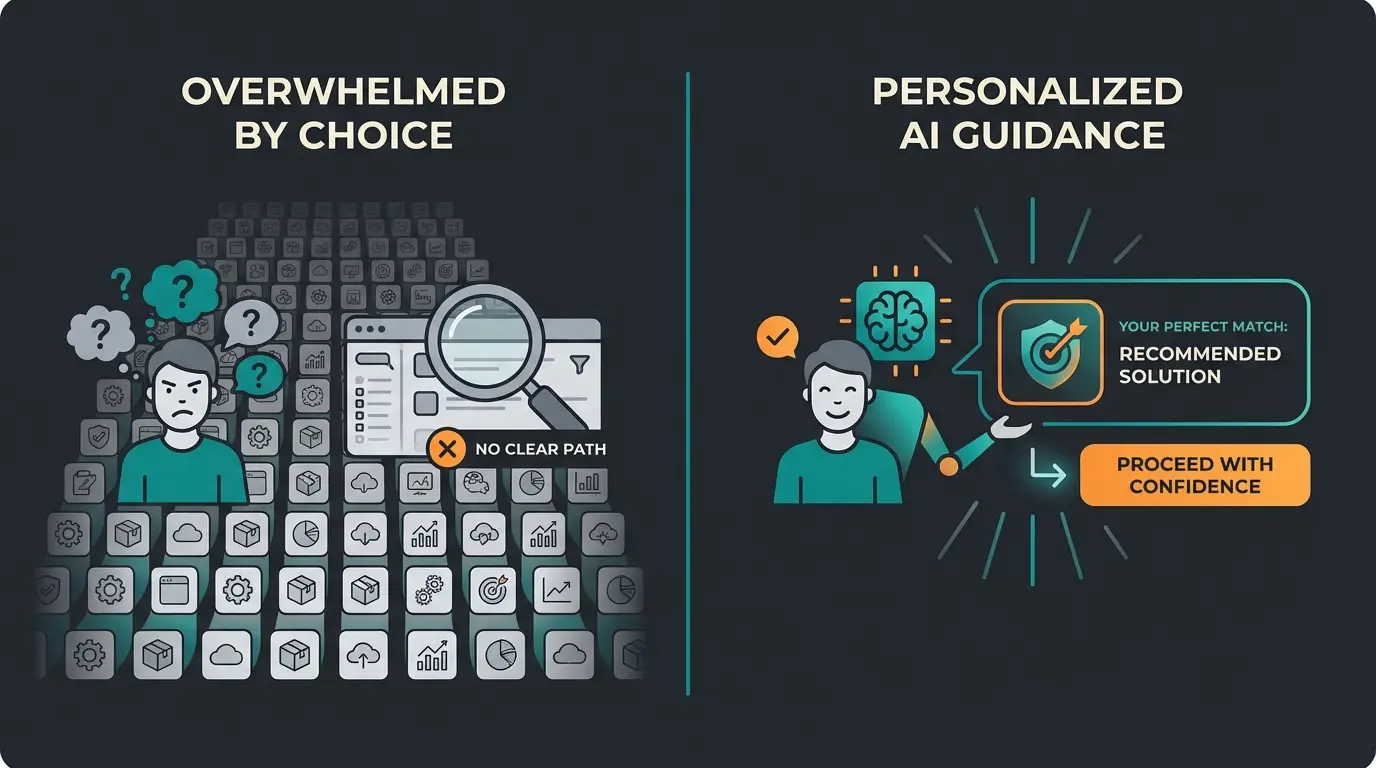
The Problem: In 2025, customers are spoiled by TikTok, Instagram, and personalized feeds. A list of 50 products overwhelms them (the "Paradox of Choice").
- Sites like Webshop-anbieter.de praise the filter functions, but they ignore that filters are not consultation.
- A filter tells me which shoes are "blue." It doesn't tell me which shoe is "good for my knee problems when jogging on asphalt."
This is exactly where merchants lose revenue. They have the traffic (expensively purchased through Google Ads), but the conversion rate stagnates because the shop leaves the customer "alone" with the products. Implementing solutions like the AI Employee 'Kira' can dramatically change this dynamic.
AI in Plentymarkets: Beyond Product Descriptions
When merchants today hear "AI in e-commerce," they usually think of ChatGPT writing SEO texts. PlentyONE also offers integrations for text generation or repricing, as shown on their AI features page. That's good for efficiency (saving costs), but it doesn't bring a direct revenue jump.
The true lever for 2025 is Frontend AI Product Consultation (Guided Selling).
What is Guided Selling AI?
Imagine you had cloned and digitized your best salesperson from the physical store. Instead of the customer filtering, the AI leads a dialogue:
- AI: "Hey, are you looking for running shoes for the forest or the street?"
- Customer: "More for the street, but I need good cushioning."
- AI: "I understand. Do you have a preferred brand, or is value for money more important to you?"
At the end, the AI suggests three perfect products and explains why they fit. This approach, similar to what AI Employee Theresa demonstrates, transforms the shopping experience entirely.
Why Is This the "White Space" for Plentymarkets Merchants?
Our analysis of search results shows: Nobody is talking about this. The competition is optimizing warehouse processes. If you as a merchant now focus on consultation AI, you differentiate yourself massively.
The Benefits of Integration into PlentyONE:
- Utilizing PIM Data: PlentyONE has excellent product data (attributes, properties). An AI can use this structured data to provide precise recommendations.
- Reducing Returns: In the German market, returns are the number one profit killer. When a customer is advised before the purchase ("This shoe runs small, better take a size larger"), the return rate drops drastically.
- Relieving Support: Remember the criticism of Plentymarkets support? The same applies to your customer support. When the AI clarifies standard questions ("Does part X fit machine Y?") in the shop, fewer tickets end up in your inbox. The lead qualification AI approach demonstrates how this works in practice.
Use the plentyMarketplace. Search for plugins offering chatbots or product guides with NLP capabilities.
Export article data (PIM) via API or ElasticSearch to your AI engine.
Configure the AI with your expertise (e.g., 'Behave like a sports expert').
Embed as a JavaScript overlay widget in your Ceres shop for seamless customer interaction.
Technical "How-To": Implementation Options
Since there is no standard "AI Consultant" function in the PlentyONE core yet, here is your path to implementation:
- The Plugin Route (Simple): Use the plentyMarketplace. Search for plugins that offer chatbots or "Product Guides." Make sure they don't just use static decision trees but employ NLP (Natural Language Processing).
- The Headless/API Route (Professional): PlentyONE is "headless-ready." You can send your product data via the REST API to an external AI engine (e.g., based on OpenAI or specialized e-commerce AIs).
Many merchants are discovering that implementing product consultation upselling strategies through AI can significantly boost average order values while simultaneously improving customer satisfaction.
Stop losing customers to static filters. Our AI product consultation integrates seamlessly with PlentyONE to guide customers to the perfect purchase—reducing returns and boosting conversions.
Start Your Free TrialStandard Search vs. AI Consultation: A Direct Comparison
To illustrate the difference between traditional e-commerce search functionality and AI-powered product consultation, consider this comparison that shows why the AI chat approach outperforms static filtering:
| Feature | Standard Ceres Search | AI Product Consultation |
|---|---|---|
| Input Method | Keywords ("pants black") | Natural language ("I need comfortable pants for the office") |
| Result Display | List of 100 items | 3 specific recommendations with explanations |
| Customer Feeling | "I have to search." | "I'm being consulted." |
| Conversion Rate | Average (~2-3%) | High (~5-10% with interaction) |
| Return Risk | High (selection orders) | Low (matching recommendation) |
| Support Tickets | High (pre-purchase questions) | Low (questions answered in-chat) |
The PlentyONE Ecosystem: Where AI Fits In
Understanding where AI product consultation fits into the broader Plentymarkets ecosystem is crucial for successful implementation. The system architecture allows for powerful integrations that enhance the customer experience without disrupting your backend workflows.
Think of it this way: PlentyONE serves as the central hub managing your inventory, orders, and marketplace connections. Your traditional Ceres shop handles the display layer. The AI consultation layer sits between the customer and your product catalog, transforming passive browsing into active guidance—similar to what KI Mitarbeiterin Flora achieves for product recommendations.
Who Should Use Plentymarkets (PlentyONE)?
Based on the costs and complexity, the target group in 2025 can be clearly defined.
NOT Suitable For:
- Hobby Merchants: Anyone shipping 5 packages a week will be overwhelmed by the costs (min. €59 + plugins) and complexity. Shopify or WooCommerce are better choices here.
- Pure Content Sites: Anyone with only a few products and a focus on storytelling will be unhappy with the rigid Ceres template.
PERFECTLY Suited For:
- The "Multichannel Scaler": You make €20,000 to €5 million in annual revenue and sell on Amazon, eBay, and your own shop. You need one central source of truth for inventory.
- Brands & Manufacturers (D2C): You have complex product data and want to expand internationally.
- Merchants with Automation Drive: Anyone who wants to automate processes like "If order from country X and value > Y, then shipping method Z" will find the most powerful tool on the market in the PlentyONE Workflow Manager.
Plentymarkets Test Results: Our Final Verdict
Conclusion: A Powerful Tool That Needs Direction
Plentymarkets (now PlentyONE) remains one of the most powerful e-commerce ERPs on the German market in 2025. The rebranding and new investors show that the system has matured and is focusing on professional merchants.
The Summary:
- Backend: Top class. The automation and marketplace connectivity is unmatched.
- Costs: Fair and scalable if you have the revenue.
- Frontend: The weak point. The standard "Ceres" shop is functional but not inspiring.
Our Recommendation:
Use PlentyONE for what it does best: processes and data management. But in 2025, don't rely on the standard shop alone anymore. Supplement the frontend with intelligent AI consultation tools. This closes the gap between technical perfection (backend) and emotional shopping experience (frontend).
Those who master the steep learning curve and extend the system with modern AI components build a fortress with PlentyONE that is far ahead of the competition.
FAQ: Common Questions About Plentymarkets / PlentyONE
Not necessarily. The new plans (Lite from €59) actually lower the entry barrier. For large merchants with very high revenue (GMV), it can be more expensive than old legacy contracts, but more features (users, workflows) are included.
Shopify is primarily a shop system focusing on design and simplicity (frontend-first). PlentyONE is an ERP system focusing on process automation and multichannel (backend-first). If you just want a shop, choose Shopify. If you need to synchronize Amazon, eBay, and your shop, choose PlentyONE.
Yes. Many merchants use PlentyONE as a pure backend (ERP/middleware) and connect a Shopify or Shopware system at the front. This is technically possible but increases the complexity of the interfaces.
PlentyONE offers native AI features for process automation and content creation (texts). For the 'Guided Selling' (customer consultation in the shop) described in this article, third-party plugins or individual integrations are currently still necessary.
Absolutely. PlentyONE supports multiple languages, currencies, and tax configurations. The marketplace connections extend to international platforms, making it ideal for merchants planning to expand beyond German borders.
Join hundreds of e-commerce merchants who have transformed their conversion rates with AI-powered product consultation. Works seamlessly with PlentyONE and Ceres.
Get Started Free
Lasse is CEO and co-founder of Qualimero. After completing his MBA at WHU and scaling a company to seven-figure revenue, he founded Qualimero to build AI-powered digital employees for e-commerce. His focus: helping businesses measurably improve customer interaction through intelligent automation.