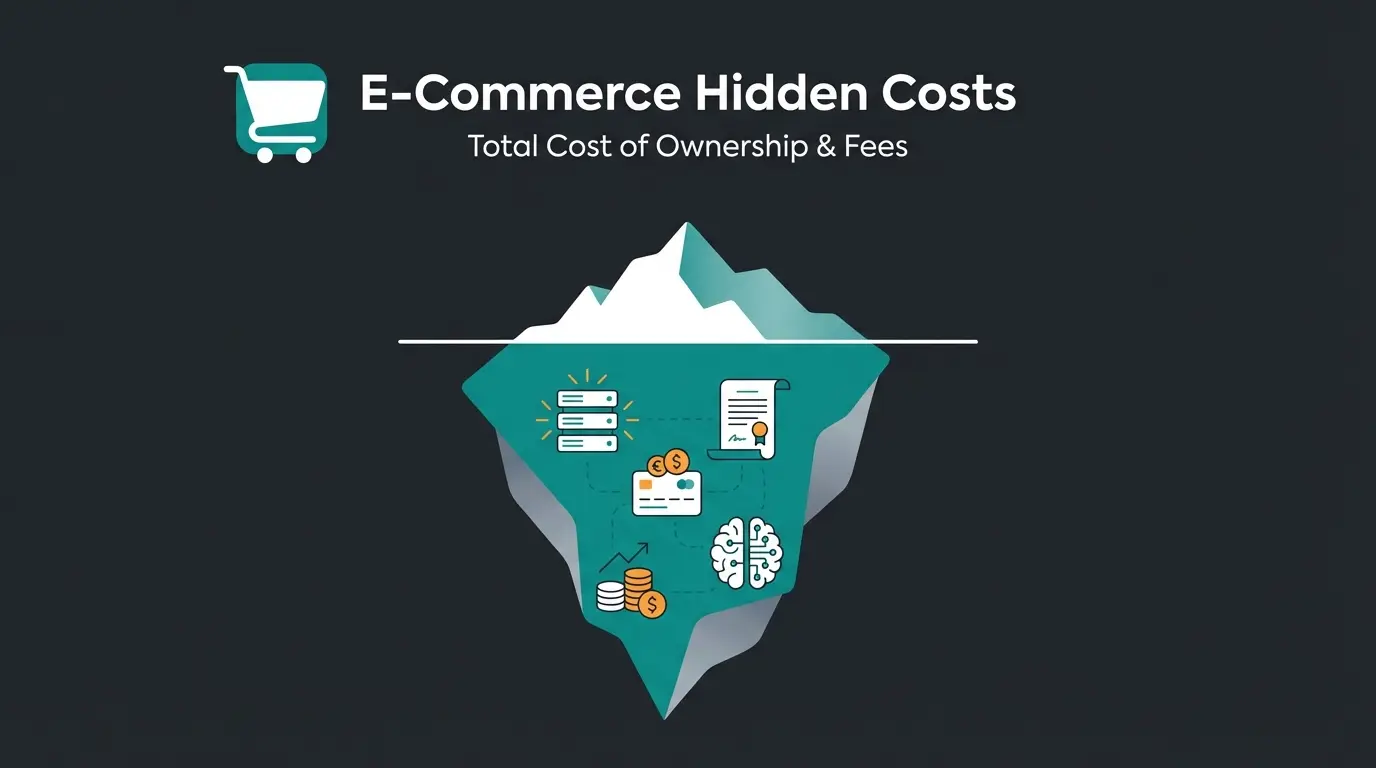
Why the Price Tag Only Tells Half the Story
When searching for "Shopware costs" in 2025, most results show quick tables with license fees. But for e-commerce decision-makers, the pure license price is often misleading. An online shop isn't a static product you buy once and put on a shelf—it's a living ecosystem of technology, service, and personnel.
The landscape has changed dramatically. With the introduction of the Fair Usage Policy in March 2025 and the firm establishment of the Rise, Evolve, and Beyond plans, budget planning has become more complex. Simply calculating the setup costs is no longer sufficient. Those who want to grow profitably must consider the Total Cost of Ownership (TCO) over at least three years.
This article doesn't just break down the official prices—it illuminates the "hidden" costs beneath the waterline of the iceberg. We'll also show you a modern approach: how using AI in product consultation can optimize the largest cost block—personnel—so effectively that your Shopware shop practically pays for itself. For a comprehensive comparison of platform options, check out our Shopware vs Shopify comparison to understand which solution fits your business model.
Official Shopware 6 License Costs (Monthly)
Since the transition from the purchase model (Shopware 5) to the subscription model (Shopware 6), the monthly fixed costs for the software license have become your first calculation anchor point. Shopware primarily differentiates based on feature scope and Gross Merchandise Value (GMV).
The "Big 3" Plans Compared
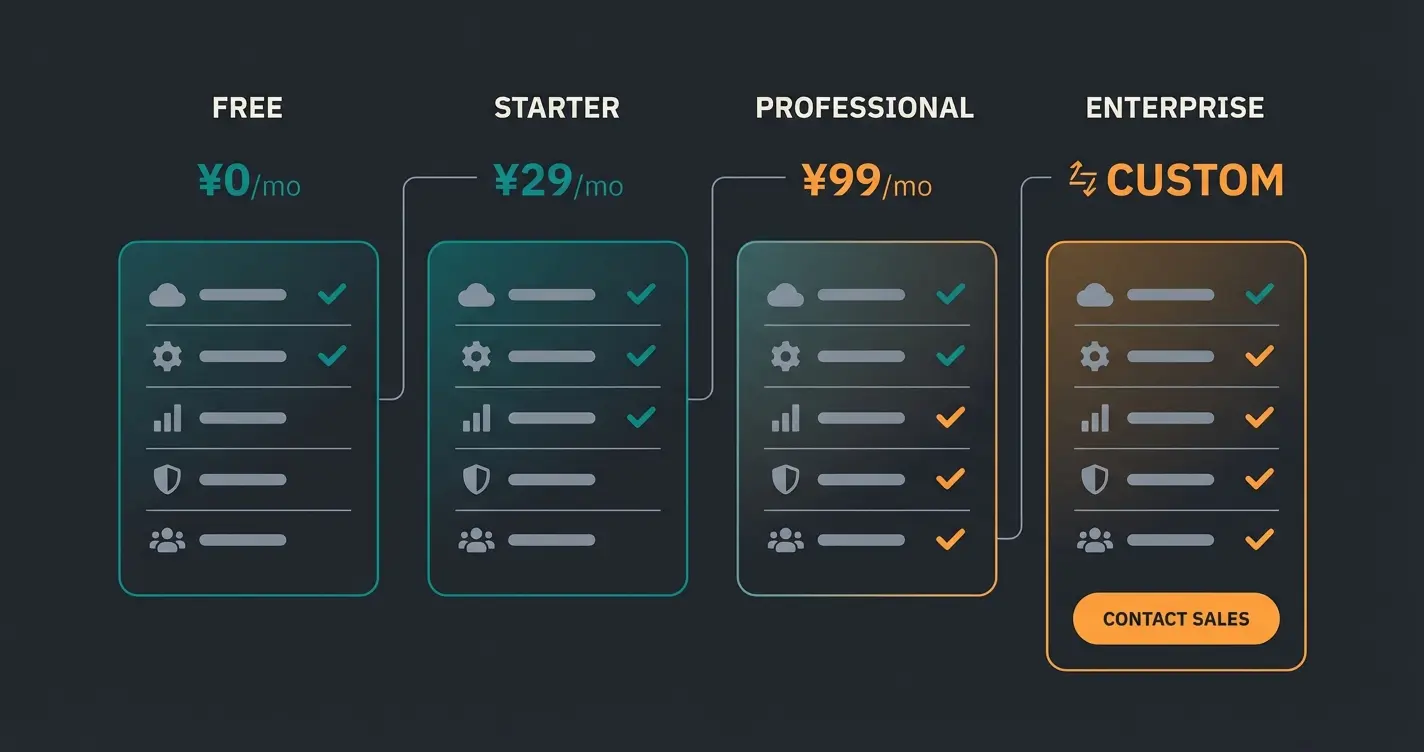
Here's the current state for 2025, based on official adjustments and market prices according to Shopware:
| Feature / Plan | Shopware Rise | Shopware Evolve | Shopware Beyond |
|---|---|---|---|
| Target Audience | Ambitious Startups & SMBs | Growing B2B/B2C Merchants | Enterprise & Market Leaders |
| Price (starting at) | €600/month | ~€2,400/month* | ~€6,500/month* |
| GMV Limit (p.a.) | Included up to ~€2 million | Included up to ~€5 million | Individual / High Volume |
| Support | Standard (8h response time) | Extended (4h + Phone) | 24/7 Priority Support |
| Key Features | Flow Builder, Rule Builder, AI Copilot | B2B Suite (Quotes, Roles), Advanced Search | Multi-Inventory, Subscriptions, Returns Mgmt. |
| Hosting | SaaS or Self-Hosted | SaaS or Self-Hosted | SaaS or Self-Hosted |
*Note: Prices for Evolve and Beyond are often project-based and can vary depending on GMV and negotiation. The values listed are typical entry prices in the market. For a detailed breakdown of all editions, see our Shopware editions comparison guide.
The "GMV Penalty": What Happens When You Succeed?
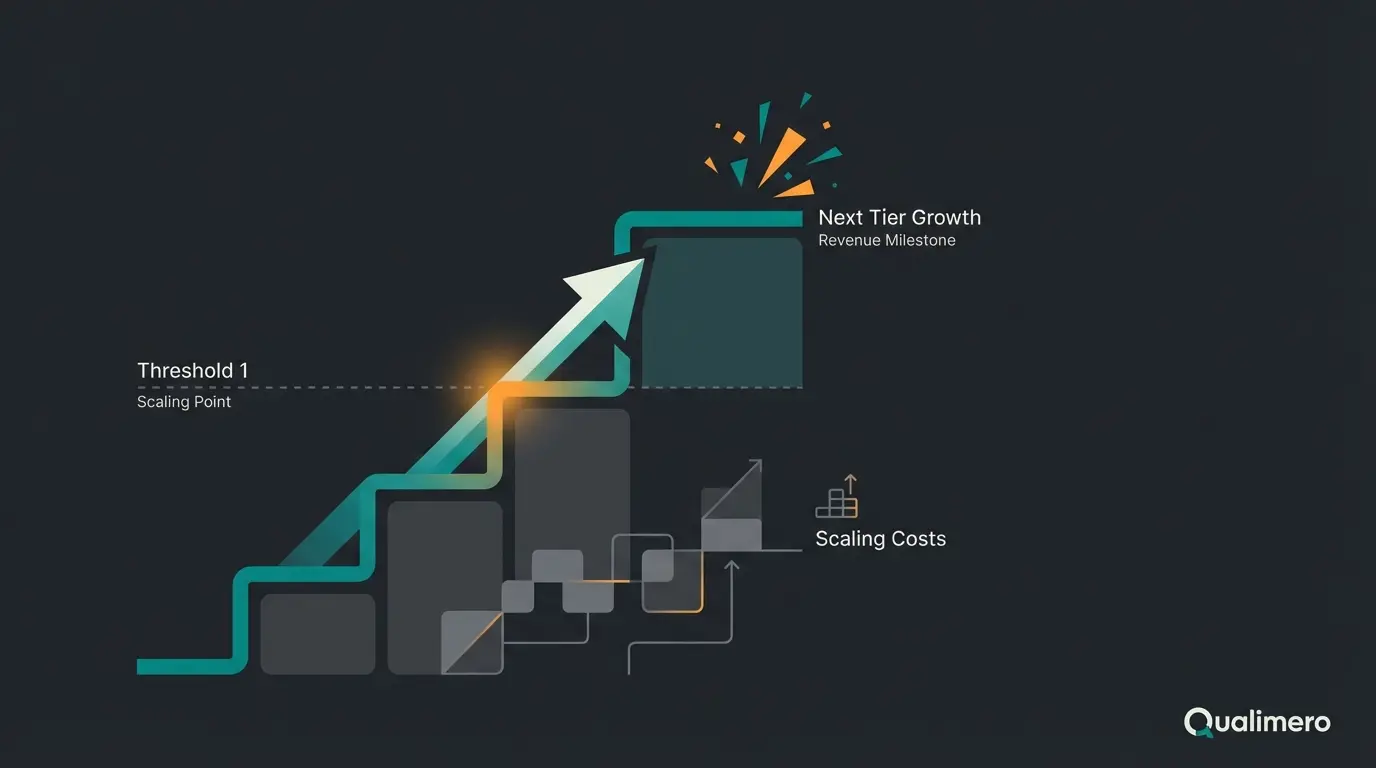
An often overlooked factor in cost planning is the GMV limit. Shopware grows with your success—and that costs money.
- Example: You start with the Rise Plan (€600/month). Your shop explodes and you reach €3 million in annual revenue.
- The consequence: You exceed the Rise plan's limit (usually €2 million). You must either pay overage fees or (more likely) upgrade to the Evolve Plan. Your monthly license costs jump from €600 to approximately €2,400.
- Strategy: Plan for this jump in your margins. A 50% revenue growth can mean a 300% increase in license costs.
The "Elephant in the Room": Fair Usage Policy 2025
For a long time, the Shopware Community Edition (CE) was the insider tip for budget-conscious businesses: free software, no license fees, full control. Many large shops used the CE and only paid for hosting and agencies.
This changes radically starting March 24, 2025.
With the new Fair Usage Policy, Shopware draws a hard line as reported by Splendid Internet and confirmed in the official Shopware documentation:
- Under €1 million GMV: The Community Edition remains free to use (including access to the Shopware Store and Account).
- Over €1 million GMV: Anyone generating more than one million euros in external revenue through the shop must switch to a paid plan (at least Rise).
- The consequence: Those who don't switch lose access to the Shopware Store (no plugin updates, no new extensions) and account support. Effectively, the shop becomes "frozen" and poses security risks.
According to ThemeWare, many merchants are now proactively planning their migration path to commercial plans to avoid disruption when they cross the GMV threshold.
One-Time Costs: What Does Setup Cost?
The license is just the rent for the tool. For the tool to work, it must be set up, customized, and connected to your systems (ERP, PIM). Here, costs vary extremely depending on your requirements. When evaluating your options, our Shopware vs WooCommerce comparison can help you understand the setup cost differences between platforms.
Scenario A: The "Lean Starter" (MVP)
- Approach: Using a standard theme, minimal custom programming, standard plugins.
- Cost range: €10,000 – €25,000 as documented by Codelivery.
- For whom? Startups, test balloons, brands with simple product ranges.
Scenario B: The "Professional Brand Shop"
- Approach: Custom UX/UI design (corporate identity), connection to ERP (e.g., SAP, Microsoft, Xentral), complex B2B logic, marketing automation.
- Cost range: €30,000 – €80,000 according to Shopware Agency Info.
- For whom? Established mid-sized companies, relaunch projects, B2B merchants. For B2B-specific pricing details, explore our Shopware B2B pricing guide.
Scenario C: The "Enterprise Leader"
- Approach: Headless architecture, PWA (Progressive Web App), multi-country/multi-currency rollout, deep process integration.
- Cost range: €100,000 – €500,000+
- For whom? Market leaders, corporations.
The Hourly Rate Factor
Setup costs are largely determined by the agency's hourly rate. According to Software Developer India and Satware, here are typical ranges:
- Freelancer: €60 – €100/hour
- Specialized Shopware Agency: €100 – €160/hour
- Top-Tier Enterprise Agency: €150 – €200+/hour
Working with a Shopware full service agency can often provide better value through integrated services and economies of scale.
Ongoing Operating Costs (The Hidden Drivers)
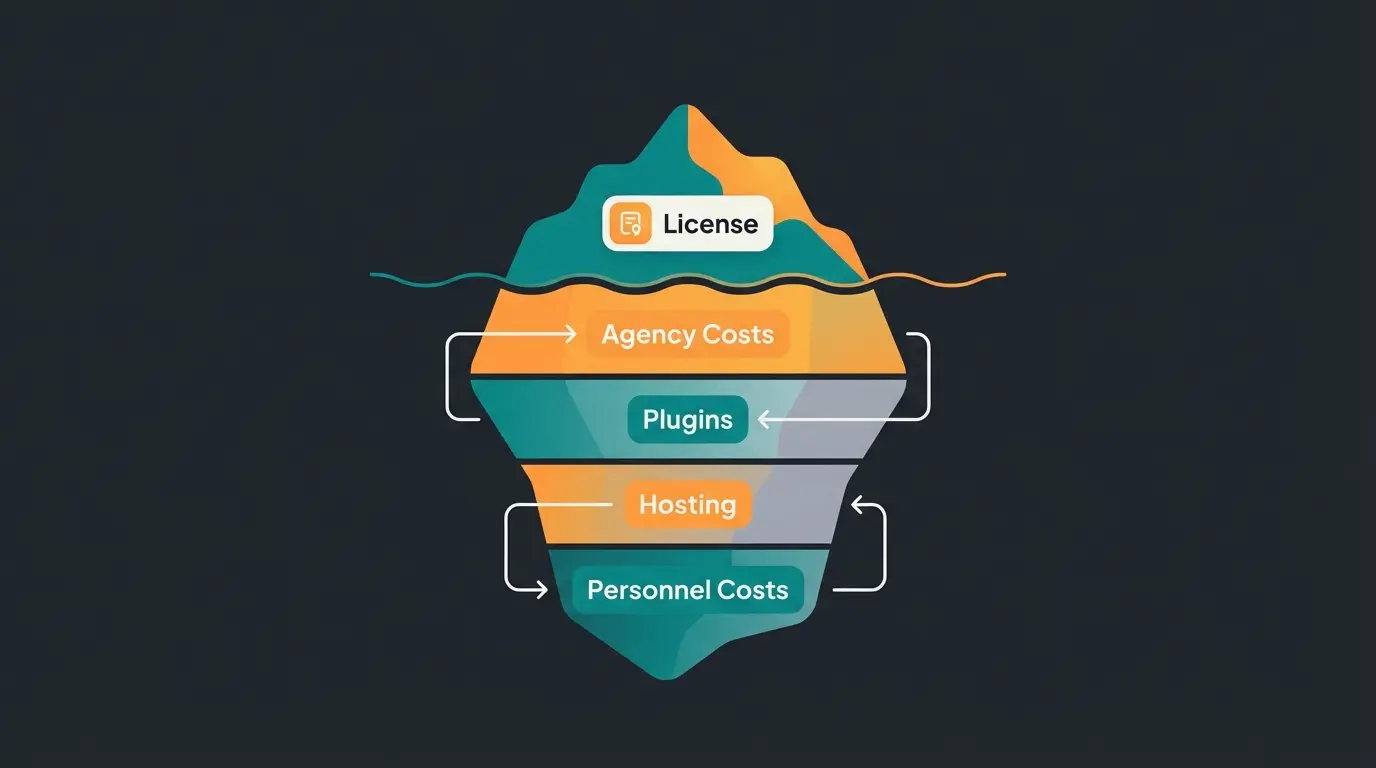
After go-live, monthly costs arise that are often underestimated. These "below the waterline" costs in the TCO iceberg add up quickly.
License fees typically represent only 20% of total ownership costs
Self-hosted Shopware requires specialized hosting infrastructure
Agency retainers for updates, monitoring, and patch management
The 'App Store trap' - subscription plugins add up quickly
1. Hosting (If Not Shopware Cloud/SaaS)
If you choose the self-hosted variant (which many German mid-sized companies do for data protection or performance reasons), you need specialized Shopware hosting as detailed by Uptain and DM Solutions:
- Costs: €50 – €500/month depending on traffic and performance requirements.
- Important: Don't cut corners here. A slow shop costs you more revenue through cart abandonment than you could ever save on hosting.
2. Maintenance & Updates (Retainer)
Shopware 6 evolves quickly. Security updates and feature releases must be deployed. For comprehensive Shopware 6 support solutions, having a maintenance agreement is essential.
- Costs: Agencies offer maintenance contracts (Service Level Agreements). Expect €300 – €2,000/month.
- Content: Monitoring, applying patches, checking plugin compatibility.
3. The "App Store Trap" (Plugin Rental Costs)
Shopware 6 relies heavily on rental plugins. A good SEO plugin here, a slider there, a DATEV interface on top.
- Costs: Quickly, €100 – €400/month accumulates just for plugin rentals.
- Tip: Regularly check whether you still need plugins or whether Shopware has integrated the feature into the core (e.g., in the Rise/Evolve plan).
Personnel Costs & Consultation: The Biggest Cost Block
Here lies the strategic error in most cost calculations. People compare license costs but forget the operational costs to keep the shop running. For businesses exploring their options, our Shopware vs OXID comparison and Shopware vs JTL analysis provide valuable context on platform-specific operational requirements.
The Problem: The "Mute" Online Shop
A Shopware shop is technically brilliant, but it's "mute." It can process transactions, but it can't advise.
- In B2B or for products requiring explanation (e.g., components, electronics, sports equipment), customers have questions.
- Traditional solution: You hire staff.
- Customer service employee (full-time): approximately €45,000 – €55,000 employer gross cost/year.
- That's roughly €4,000/month per person.
If you need two employees to handle chats, emails, and calls about "Which product is right for me?", your personnel costs are €8,000/month. That's more than the most expensive Shopware Beyond license.
The Solution: Cost Optimization Through AI Product Consultation
Here's where the modern approach comes in. Instead of letting personnel costs grow linearly with revenue, smart merchants rely on specialized AI consultation. Learn more about implementing Shopware AI features to automate your consultation processes.
- Don't confuse this: We're not talking about the "Shopware AI Copilot" (which helps you write text in the backend), but a frontend AI that advises your customers.
- The leverage: An AI solution that answers questions 24/7 on your site like "Which e-bike fits my height and riding style?" often costs only a fraction of an employee (e.g., €200 - €500/month).
Implementing Shopware 6 chatbots can transform how you handle customer inquiries while dramatically reducing operational costs. This represents a fundamental shift in AI e-commerce strategy.
Discover how AI-powered product consultation can reduce your personnel costs while improving customer experience. Our solution integrates seamlessly with Shopware 6.
Start Your Free TrialTCO Calculation: Example Over 3 Years
Let's translate theory into practice. We compare a standard approach with a smart automation approach for a growing merchant (Start: €1.5 million GMV, growth to €3 million).
Scenario: "Growth B2B" (Upgrade from Rise to Evolve in Year 2)
| Cost Position | Year 1 (Rise) | Year 2 (Evolve) | Year 3 (Evolve) | Total (3 Years) |
|---|---|---|---|---|
| Setup (Agency) | €40,000 | €5,000 (Features) | €5,000 (Features) | €50,000 |
| Shopware License | €7,200 (600×12) | €28,800 (2,400×12) | €28,800 (2,400×12) | €64,800 |
| Hosting & Maintenance | €6,000 | €6,000 | €6,000 | €18,000 |
| Plugins | €2,400 | €2,400 | €2,400 | €7,200 |
| Personnel (Support) | €48,000 (1 FTE) | €96,000 (2 FTE) | €96,000 (2 FTE) | €240,000 |
| TCO (Standard) | €103,600 | €138,200 | €138,200 | €380,000 |
| With AI Automation | Year 1 | Year 2 | Year 3 | Total (3 Years) |
|---|---|---|---|---|
| AI Tool Costs | €3,600 | €3,600 | €3,600 | €10,800 |
| Personnel (Reduced) | €24,000 (0.5 FTE) | €48,000 (1 FTE) | €48,000 (1 FTE) | €120,000 |
| TCO (Smart) | €79,600 | €90,200 | €90,200 | €260,000 |
| Savings vs Standard | €24,000 | €48,000 | €48,000 | €120,000 |
Analysis of the Numbers
- License costs (€64,800) are significant but not the largest block.
- Personnel costs in the standard model (€240,000) are the true cost driver.
- Through the use of AI consultation, TCO drops by €120,000. That's enough budget to pay for the complete setup and licenses for 3 years.
Start with Rise plan, implement AI consultation early, reduce initial support hiring by 50%
Upgrade to Evolve as GMV grows, AI handles increased volume without proportional cost increase
Fine-tune automation, achieve €120,000 total savings compared to traditional approach
Cost-Saving Tips: How to Reduce Shopware Costs
Beyond the major strategic levers, there are tactical opportunities to protect your budget. For additional support options, explore our Shopware technical support guide and Shopware service resources.
1. Maximize the Community Edition (Up to the Limit)
If you're under €1 million GMV, use the Community Edition. Invest the saved license money (€7,200/year) in marketing or SEO instead to break the €1 million barrier faster. But: Prepare technically for the switch.
2. Use Annual Payment Terms
Many Shopware plans and plugin providers offer discounts (often 1-2 months' rent) when you pay annually in advance. For an Evolve license, this can quickly mean €2,000 – €4,000 in cash savings.
3. Standard Before Customization
Shopware 6 is powerful. Use the Flow Builder and Rule Builder to automate processes instead of paying expensive agency hours for custom programming.
- Example: Instead of having a plugin programmed that automatically moves customers with €10,000+ revenue to the "VIP" customer group, you can often configure this yourself in the Rule Builder.
4. The Right Agency Choice
Separate "design" from "technology." A freelancer can often customize the frontend (theme) cost-effectively, while you bring in a specialized agency for complex interfaces (ERP). Hybrid models save money.
Conclusion: Investment Instead of Cost Block
The question "What does Shopware cost?" can no longer be answered with a simple number in 2025. The license costs are transparent (€600 - €6,500), but they're just the tip of the iceberg. The introduction of the Fair Usage Policy forces growing merchants to plan professional budgets.
But the real danger to your margin lies not in the software rental, but in inefficient processes. Anyone in 2025 still trying to handle increasing customer inquiries purely with more personnel will lose in the competition.
The Winning Strategy
- Accept license costs as a necessary investment in scalable infrastructure.
- Use Shopware's technological freedom (API-first approach).
- Integrate AI-powered product consultation to decouple your scaling from personnel costs.
This transforms the cost block "online shop" into a highly profitable sales machine.
FAQ: Common Questions About Shopware Costs
No. The Fair Usage Policy and revenue limits explicitly apply to Shopware 6. If you're still using Shopware 5 (warning: End of Life!), you're not affected by this, but you should urgently plan a migration.
Yes, absolutely. If you need B2B features (quotes, field service integration), you can switch to the Evolve plan at any time, even if your revenue is still low. The GMV limits are upper limits, not entry barriers.
In the DACH region (Germany, Austria, Switzerland), expect hourly rates between €100 and €160 for reputable agencies according to industry reports from Qualimero. Freelancers start at around €70, while top experts can charge up to €200.
For merchants without their own IT department, often yes. You save hosting costs (approximately €100-300/month) and the maintenance effort for server updates. However, if you need extremely individual core customizations, the self-hosted variant (PaaS or On-Premise) is often more flexible, though more expensive to operate.
Shopware calculates GMV based on the gross merchandise value of all orders processed through the shop, minus canceled orders (depending on the exact contract definition). From March 2025, Community Edition users must report their GMV to Shopware via a reporting plugin.
See how AI-powered product consultation can transform your cost structure. Join hundreds of Shopware merchants already saving thousands monthly.
Get Started Free