What does a Shopware agency actually cost?
Shopware agency costs range from €15,000 for a basic MVP store to over €200,000 for enterprise-grade implementations. Hourly rates for certified Shopware agencies in Germany sit between €100 and €180 net, with project scope, partner tier, and customization depth as the primary cost drivers.
That range is wide for a reason. A Shopware project is not a product you buy off the shelf. It is a custom build, and the price depends on what you need it to do. For a complete Shopware cost overview covering licensing, hosting, and development, our parent guide breaks down every line item.
The three project tiers below reflect what we see across the DACH market as of Q2 2026. Prices are net, excluding VAT.
| Project tier | Budget range (net) | Timeline | Typical scope |
|---|---|---|---|
| MVP / Starter | €15,000-€25,000 | 4-8 weeks | Standard theme, basic catalog, payment & shipping |
| Professional | €30,000-€70,000 | 8-16 weeks | Custom design, ERP/CRM integration, multi-language |
| Enterprise | €80,000-€200,000+ | 4-12 months | B2B suite, headless frontend, custom plugins, multi-store |
MVP / Starter project (€15,000-€25,000)
A Shopware MVP project typically costs between €15,000 and €25,000 and includes a standard theme, basic product catalog setup, payment integration, and essential shipping configuration.
This tier suits SMEs with fewer than 500 SKUs who want to validate their online channel before committing to a larger investment. Timeline: 4 to 8 weeks from kickoff to launch. No custom design, no ERP connection, no complex migration. You get a working shop that looks professional and handles orders reliably.
- Included: Shopware Community Edition or Rise, high-quality theme with corporate design adjustments, standard payment providers (PayPal, Stripe, Klarna), basic shipping configuration
- Not included: Custom UX design, ERP/CRM integration, product data migration from legacy systems, performance optimization
What you do not get: conversion-optimized UX, automated inventory sync, or the kind of product consultation that turns browsers into buyers. Those come at the next tier.
Professional shop (€30,000-€70,000)
Professional Shopware projects range from €30,000 to €70,000 and include custom design, ERP/CRM integration, multi-language setup, and advanced product configuration.
This is where most established retailers land. The budget covers a conversion-optimized UX design tailored to your brand, automated data sync with systems like SAP Business One, Microsoft Dynamics, or WeClapp, and migration from legacy platforms like Magento or Shopware 5. Timeline: 8 to 16 weeks.
The cost driver at this level is integration complexity. Each ERP connection consumes 10 to 20 project days, because data structures need mapping and synchronization logic needs testing under real conditions. Two integrations can easily account for 40% of the total budget.
Migration adds another layer of complexity. Switching from Shopware 5 or Magento to Shopware 6 is not an update. It is a replatform. Customer data, order histories, product catalogs, SEO redirects: each requires careful mapping. According to BrandCrock, migrations with poor data quality cost roughly twice as much as those with clean, structured data. Budget €2,000-€8,000 for same-platform migrations and €5,000-€15,000 for cross-platform moves.
Enterprise solution (€80,000+)
Enterprise Shopware implementations exceed €80,000 and can surpass €200,000 for multi-store setups with custom plugin development, B2B features, and high-performance infrastructure. For specifics on what Shopware Enterprise includes at the platform level, our dedicated guide covers every feature.
At this tier, you are building a system, not a shop. B2B suite with customer-specific pricing, multi-inventory across warehouses, headless frontends, guided shopping, custom configurators. Timeline: 4 to 12 months, sometimes longer.
One caveat worth stating plainly: not every shop that quotes enterprise prices delivers enterprise quality. We have audited projects where agencies charged €150,000+ and delivered what should have been a €50,000 build. Certification tier alone does not guarantee quality.
I have reviewed project quotes from 15+ agencies over the past two years. The pattern is consistent: agencies that skip the scoping phase underdeliver. The best enterprise projects start with a paid discovery workshop (€3,000-€8,000) that maps business processes, data flows, and integration requirements before a single line of code is written.
Cost components breakdown
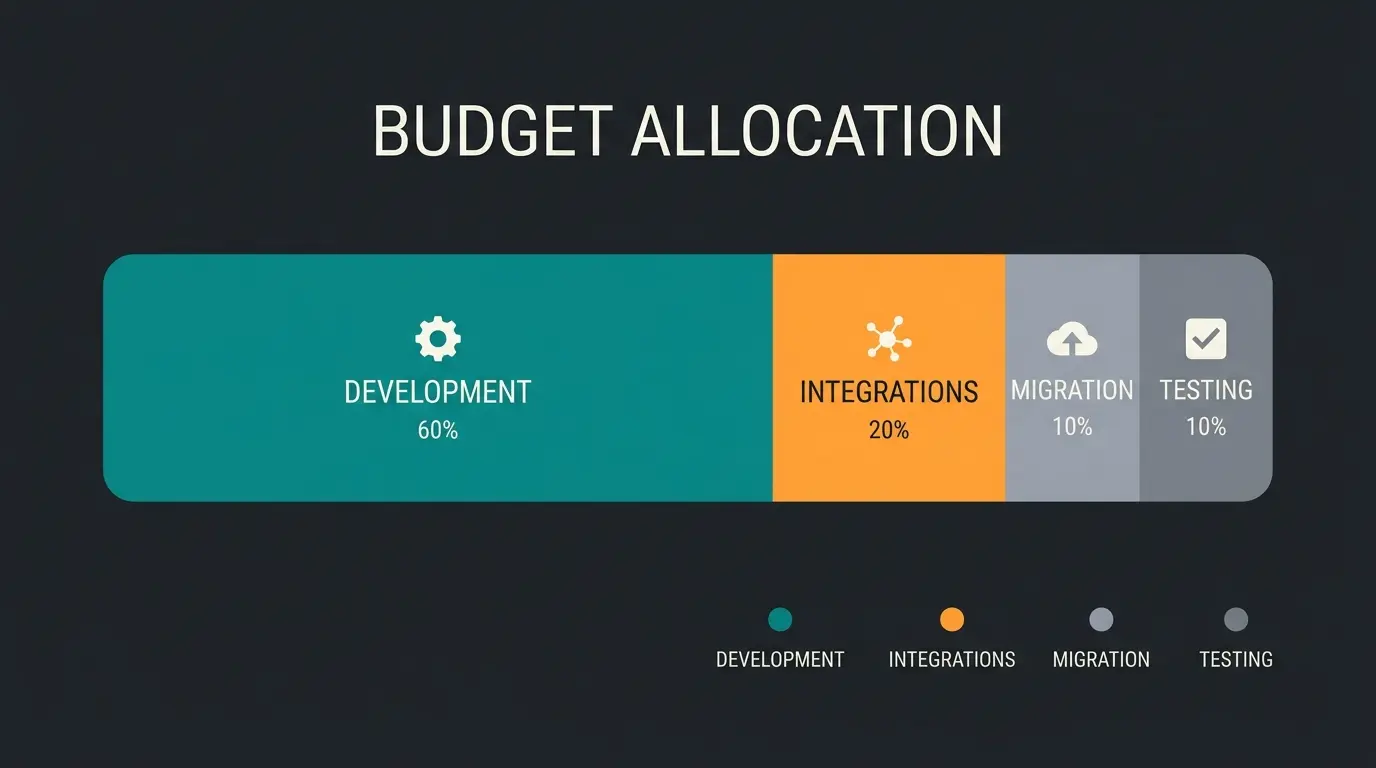
Shopware agency costs break down into five components: license fees (€0-€6,500/month), design and development (40-60% of budget), integrations (15-25%), content migration (10-15%), and testing plus launch (5-10%). For a detailed development cost breakdown, we cover each line item separately.
| Component | % of total budget | Typical range | Key cost driver |
|---|---|---|---|
| Design & development | 40-60% | €6,000-€120,000 | Custom vs theme, number of templates |
| Integrations (ERP/CRM/PIM) | 15-25% | €5,000-€40,000 | API quality, number of systems |
| Content migration | 10-15% | €2,000-€15,000 | Data quality, number of products |
| Testing & launch | 5-10% | €1,500-€10,000 | Number of payment/shipping combinations |
| License fees (annual) | Recurring | €0-€78,000/yr | Edition tier, GMV thresholds |
License costs
Shopware offers three commercial editions as of 2026: Shopware Rise from €600/month, Evolve from approximately €2,400/month, and Beyond from approximately €6,500/month. The Community Edition remains free but is limited by the Fair Usage Policy for shops exceeding €1M GMV. For a full comparison, our Shopware edition pricing guide covers every tier.
License costs are recurring, not one-time. A Rise license alone adds €7,200 per year to your operating costs. According to Shopware's official pricing page, Evolve and Beyond pricing scales with business requirements and GMV, meaning your license cost grows as your revenue grows.
Ongoing costs (monthly retainers and maintenance)
Monthly maintenance and support retainers for Shopware shops typically range from €500 to €3,000 per month, covering security updates, plugin compatibility, performance monitoring, and content updates.
This is the line item most merchants underestimate. According to BrandCrock's 2026 analysis, Shopware maintenance over three years often totals €12,000 to €30,000, separate from the initial build cost. Add hosting (€50-€400/month for managed infrastructure), plugin license renewals (€1,000-€3,000/year for 10 active plugins), and you are looking at €1,500-€5,000 per month in total operating costs.
A concrete example: a mid-sized garden supply retailer launched a €45,000 Shopware shop in 2025. Hosting, maintenance, plugin renewals, and two part-time support staff added €4,200/month in running costs. By month 18, the operational costs had exceeded the initial build investment. Planning for this from the start would have changed the vendor selection, the licensing tier, and the support model.
Agency hourly rates and pricing models compared
Certified Shopware agency hourly rates in 2026 range from €100 to €180 net in Germany, with Silver partners averaging €100-€130, Gold partners €120-€150, and Platinum partners €140-€180. Eastern European agencies offer rates of €40-€80, though communication overhead and timezone gaps often offset the savings.
| Provider type | Hourly rate | Best for | Risk level |
|---|---|---|---|
| Freelancer (DACH) | €60-€120 | Small tasks, single-skill work | High (single point of failure) |
| Silver partner | €100-€130 | Standard projects, MVP builds | Medium |
| Gold partner | €120-€150 | Professional shops, integrations | Low |
| Platinum partner | €140-€180 | Enterprise, complex B2B | Low |
| Nearshore (Eastern Europe) | €40-€80 | Development capacity | Medium-high |
The hourly rate tells you less than you think. A Platinum developer at €160/hr who solves a problem in 4 hours costs €640. A nearshore developer at €50/hr who needs 20 hours plus 5 hours of your project management time costs €1,000 plus your own time. Effective cost per solved problem matters more than the number on the invoice.
Two pricing models dominate the market. Fixed-price contracts work well for clearly scoped projects where requirements are stable. Time-and-material (T&M) suits projects with evolving scope, integrations with third-party APIs, or iterative design processes. According to shop-studio.io, fixed prices require extensive upfront scoping sessions to work fairly for both sides. Skip that phase, and you pay for it later in change requests.
A third model is gaining traction in 2026: value-based pricing. Some agencies tie a portion of their fee to measurable outcomes like conversion rate improvements or revenue milestones. This aligns incentives but requires transparent analytics and clear baseline metrics. It works best for established shops with existing traffic data, not for new launches.
Agency vs freelancer: cost comparison
Freelance Shopware developers charge €60-€120 per hour, 30-50% less than agencies, but agencies provide project management, quality assurance, and long-term support that freelancers typically cannot match.
| Factor | Freelancer | Agency |
|---|---|---|
| Hourly rate | €60-€120 | €100-€180 |
| Project management | You manage | Included |
| QA & testing | Limited or none | Dedicated QA team |
| Availability risk | Single point of failure | Team-based redundancy |
| Long-term support | Depends on individual | Contractual SLAs |
| Knowledge transfer | Leaves with the person | Documented processes |
| Best for | Small tasks, bug fixes, single plugins | Full builds, migrations, ongoing partnerships |
The real cost of freelancers is not the hourly rate. It is the management overhead you absorb. According to research by Abbacus Technologies, working with freelancers shifts 30-50 hours of project management to your team: briefing, reviewing, coordinating, and testing. For a business owner billing their own time at €100+/hr, that hidden cost quickly closes the rate gap.
When do freelancers make sense? For isolated tasks with clear deliverables. A single plugin customization, a theme adjustment, a specific bug fix. When the scope is narrow, the risk is manageable, and the cost advantage is real.
Geographic pricing differences add another dimension. Agencies in Munich, Hamburg, or Zurich charge 10-20% more than those in Leipzig, Dortmund, or Graz. Nearshore developers in Poland, Czech Republic, or Romania offer rates of €40-€80/hr, but timezone alignment, language barriers, and cultural differences in project communication can offset the savings. For DACH-focused e-commerce with German-language product data, a DACH-based team typically delivers faster.
When do agencies make sense? For anything that requires coordination across design, development, and infrastructure. For projects you cannot afford to restart if the developer disappears. For ongoing partnerships where continuity matters.
How AI reduces total Shopware project costs
AI-powered product consultation and customer service tools can reduce total cost of ownership for Shopware shops by automating tasks that would otherwise require €2,000-€5,000 per month in additional staff, while increasing average cart values by up to 35%.
This is the cost dimension most agency conversations ignore. Agencies quote you a build price. They rarely factor in the ongoing personnel cost of actually running the shop. Customer inquiries, product questions, returns handling: these are recurring expenses that scale with traffic. A shop doing 10,000 monthly visits needs fundamentally different support infrastructure than one doing 100,000.
Laut Statista lag der durchschnittliche Cost-per-Hire im deutschen E-Commerce 2025 bei über €4,500 pro Stelle. Multiply that by the two or three support hires a growing shop needs, add training time and turnover, and the personnel cost becomes the dominant budget line within 18 months of launch.
The Baymard Institute's checkout research, updated in 2025, found that 70.19% of online shopping carts are abandoned. The top reasons: unexpected costs, required account creation, and lack of trust. An AI employee addresses the trust dimension directly by answering product questions before the customer reaches checkout. That intervention alone can shift the conversion needle more than any post-launch optimization sprint.
AI employees, not scripted FAQ responders, but context-aware digital team members, change this equation. They know your product catalog, understand technical specifications, and guide customers through purchasing decisions in real time. The Rasendoktor case study illustrates this: a lawn care retailer deployed an AI employee for product consultation and achieved a 16x return on investment with 100% automation of advisory conversations.
How AI product consultation works in practice: the AI employee accesses your Shopware product data via API, understands product relationships and compatibility, and provides personalized recommendations. No flow builder. No scripted responses. Real product knowledge applied to individual customer questions.
ROI calculation: standard vs AI-enhanced shop
A standard Shopware shop with manual customer service costs approximately €3,000-€5,000 per month in personnel, while an AI-enhanced shop using tools like Qualimero achieves the same or better service quality at a fraction of the cost, with measurable conversion improvements.
| Cost factor | Manual service | AI-enhanced | Savings |
|---|---|---|---|
| Customer service staff | €3,000-€5,000/mo | €500-€1,000/mo | €2,500-€4,000/mo |
| Availability | Business hours only | 24/7 | No overtime costs |
| Cart value impact | Baseline | +35% average increase | Revenue gain |
| Checkout conversion | Baseline | +60% improvement | Revenue gain |
| Annual personnel savings | €36,000-€60,000 | €6,000-€12,000 | €24,000-€48,000/yr |
The Signed success story puts numbers to this: a retail e-commerce brand achieved an 18x return on investment, automated 70% of customer support, and generated 30% additional revenue through AI-driven up- and cross-selling. The payback period for the AI integration was under 8 weeks.
Average cart value increase across clients
Checkout conversion improvement
How to choose the right Shopware agency
Choose a Shopware agency by verifying their official partner certification, reviewing at least three recent projects in your industry, comparing transparent pricing models, and checking references from clients with similar project scope.
The Shopware Partner Directory lists all certified agencies by tier. As of 2026, Shopware recognizes Silver, Gold, and Platinum partners. The certification reflects technical competence and project volume, but it does not guarantee cultural fit or industry expertise.
- Verify certification tier in the official Shopware Partner Directory. Silver is entry level, Platinum signals sustained enterprise delivery.
- Request three comparable references. Not their flagship project, but projects at your budget level and in your industry. Ask those references about communication, deadline adherence, and post-launch support.
- Compare pricing models. Fixed-price for well-defined scope, T&M for iterative projects. If an agency only offers one model, that is a yellow flag.
- Ask about ongoing support terms. What happens after launch? Monthly retainer structure, response times, escalation paths. This matters more than the build price.
- Evaluate their technology stack beyond Shopware. Do they handle hosting, monitoring, SEO, and performance? Or do you need additional vendors for each?
- Check for AI and automation capabilities. Agencies that integrate AI-powered tools into your shop reduce your long-term operational costs. This is not a nice-to-have anymore.
As of Q2 2026, Shopware lists over 1,200 certified technology and agency partners in their Partner Directory. The market is competitive, which works in your favor. Get at least three quotes, compare scope definitions line by line, and pay close attention to what is explicitly excluded. The excluded items are where budget overruns hide.
Smart budgeting for your Shopware project
Smart Shopware budgeting means allocating 60-70% for initial development and reserving 30-40% for the first year of ongoing optimization, maintenance, and AI-powered automation that reduces long-term costs.
The agencies that deliver the best results in 2026 are not the cheapest or the most expensive. They are the ones that think beyond the launch date. Your shop does not generate revenue the day it goes live. It generates revenue the day it starts converting visitors into customers, and that requires ongoing investment in performance, product consultation, and customer experience.
Build the shop right. Budget for what comes after. And consider whether a KI-Mitarbeiter can do what your next two support hires would do, at a fraction of the cost, available 24/7.
More traffic without conversion is just more cost. Qualimero's AI employees turn visitors into buyers, with an average 16x ROI across e-commerce clients. See what that looks like in your shop.
Book a free demoFAQ: common questions about Shopware agency costs
Certified Shopware agencies in Germany charge between €100 and €180 net per hour as of 2026. Silver partners sit at €100-€130, Gold partners at €120-€150, and Platinum partners at €140-€180. Freelancers charge €60-€120 but typically offer no project management or long-term support.
An MVP build with a standard theme and basic configuration starts at approximately €15,000 with a certified agency. Using the free Community Edition and a freelancer can bring initial costs below €10,000, but the Fair Usage Policy limits free usage to shops under €1M GMV, and freelancer projects carry higher risk of delays and rework.
Typically not. Most agency quotes cover the initial build only. Monthly maintenance retainers (€500-€3,000/month), hosting (€50-€400/month), license fees (€600-€6,500/month), and plugin renewals (€1,000-€3,000/year) are separate recurring costs. Ask for a Total Cost of Ownership estimate before signing.
Freelancers work well for isolated tasks like single plugin customizations or bug fixes. For full shop builds, migrations, or projects requiring design, development, and infrastructure coordination, agencies reduce risk through team redundancy, documented processes, and contractual SLAs. The 30-50% rate advantage of freelancers is often offset by management overhead.
AI-powered product consultation replaces manual customer service staff (€3,000-€5,000/month) with automated, 24/7 advisory that increases cart values by up to 35%. Qualimero clients report an average 16x ROI. The payback period is typically under 8 weeks, making AI integration one of the highest-impact cost optimizations for e-commerce.

Kevin is CTO and co-founder of Qualimero. As an AI architect with over 15 years of experience as CTO and CPO in the tech industry, he designs the AI systems that automate tens of thousands of customer interactions daily for Qualimero's clients — reliably, securely, and at scale.