Introduction: Why "Have You Tried Restarting?" No Longer Works
Customer service stands at a historic turning point. For years, the prevailing maxim was: close tickets as quickly as possible and reduce costs. The tool of choice was often a simple customer service chatbot that mechanically recited FAQs. But consumer expectations have radically transformed.
As we approach 2026, customers no longer expect templated responses—they demand real solutions and expert guidance. According to current forecasts from Gartner, "Agentic AI" will be capable of resolving 80% of common service inquiries without human intervention by 2029. Yet the real revolution lies not in solving problems, but in preventing them through excellent pre-purchase consultation.
In this comprehensive guide, you'll discover why the traditional support bot has become obsolete and why the future belongs to the Digital Product Consultant—an AI that doesn't just answer questions but actively drives sales. Understanding AI customer service basics is essential for grasping this transformation.
What Is a Customer Service Chatbot? (Fundamentals & Definition)
Before diving into advanced strategies, we need to clarify terminology. The term "chatbot" is used inflationary today, but it describes technologically completely different systems.
A chatbot for customer service is a software application designed to simulate human conversations. It acts as an interface between a company and its customers. However, this is where the similarity between generations ends. To fully understand the landscape, explore the different chatbot types available today.
The Two Classes of Chatbots
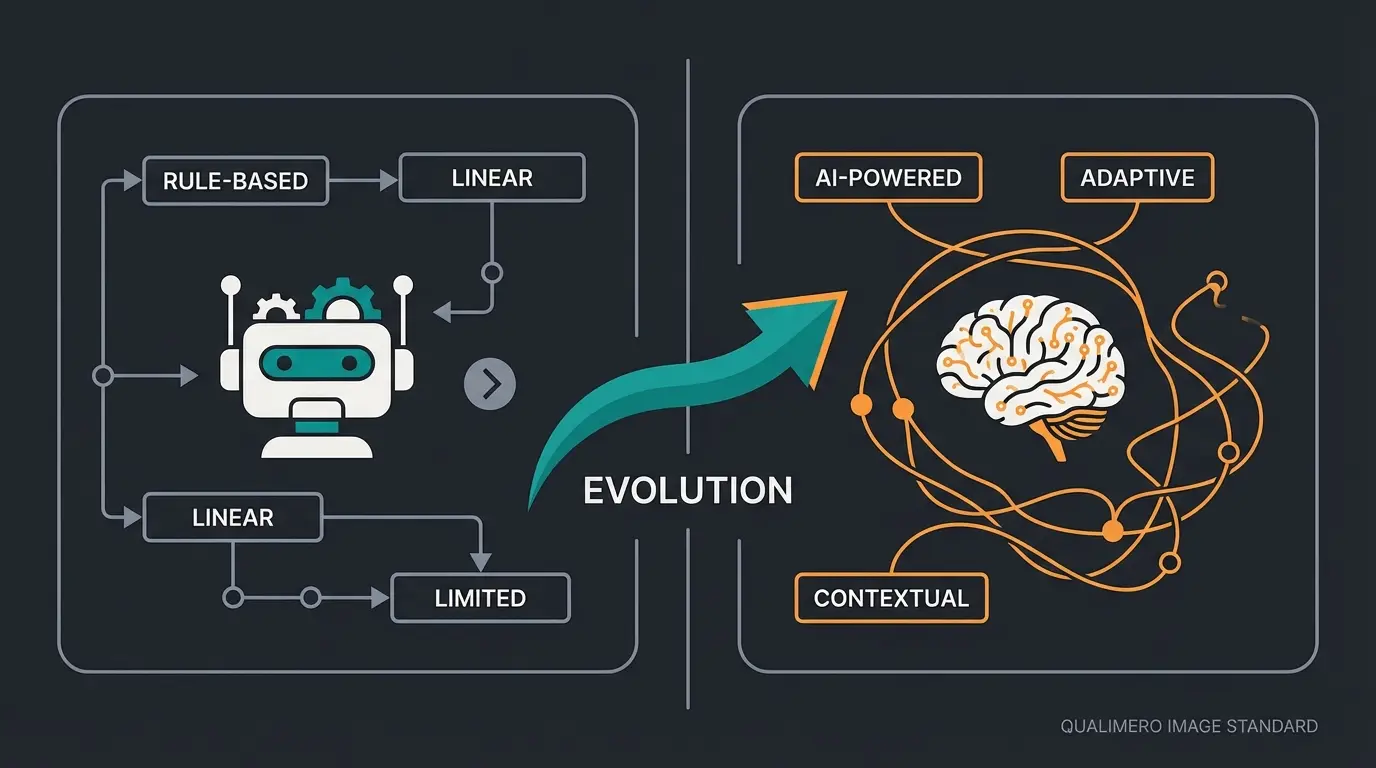
To understand why many companies are still leaving potential untapped, it's worth examining the technological differences:
| Feature | Rule-Based Chatbot ("The Old") | AI Agent / Digital Expert Consultant ("The New") |
|---|---|---|
| Technology | Decision trees (If-This-Then-That), fixed keywords | Natural Language Processing (NLP), Large Language Models (LLM), Generative AI |
| Understanding | Only reacts to exact phrases ("Where is package") | Understands context, nuances, irony, and complex sentences ("I'm looking for something for summer, but not too expensive") |
| Learning Capability | Static; must be manually programmed | Learns from interactions (Machine Learning) and uses dynamic knowledge bases |
| Objective | Support: Deflect tickets (Deflection) | Consultation & Sales: Understand customer needs and offer solutions |
| User Experience | Often frustrating ("I didn't understand that") | Fluid, human-like, empathetic |
Current Market Data: Acceptance for this new generation is high. According to the "Trendmonitor Deutschland 2024" from Trendmonitor Deutschland, the majority of consumers are open to using intelligent chatbots, as long as the transition to a human is guaranteed for complex problems. The chatbot evolution has been remarkable in recent years.
The Evolution: Support vs. Consultation (Your USP)
Most companies still view chatbots in customer support purely as "firefighters." They only come into play when the damage is already done—when the package is missing, the product is defective, or the invoice is wrong. This is reactive support.
The future—and your opportunity for differentiation—lies in proactive consultation. Understanding the distinction between chatbots and conversational AI is crucial for implementing this strategy effectively.
From Cost Center to Revenue Center
Here lies the crucial difference between a standard tool and a value-creating AI solution:
- The Old Model (Post-Sales Service): The customer has already purchased (often the wrong item) and contacts you with a problem. The chatbot incurs costs to solve the problem.
- The New Model (Pre-Sales Consultation): The customer is undecided. The Digital Expert Consultant (AI) conducts a sales conversation, analyzes needs, and guides them to the right product.
Why does this matter? Studies from VanChat show that 70% of consumers are willing to purchase through a chatbot if it delivers quick answers. Even more compelling: companies that strategically deploy AI chatbots report revenue increases between 7% and 25%, according to research from Amra and Elma.
Inquiries AI can handle independently by 2029
Potential uplift with AI-powered consultation
Decrease in refund risks through intelligent advice
Consumers willing to buy via chatbot
5 Benefits of AI Chatbots (With a Sales Focus)
When investing in a customer service chatbot today, you shouldn't only focus on efficiency. The modern benefits extend far beyond cost savings.
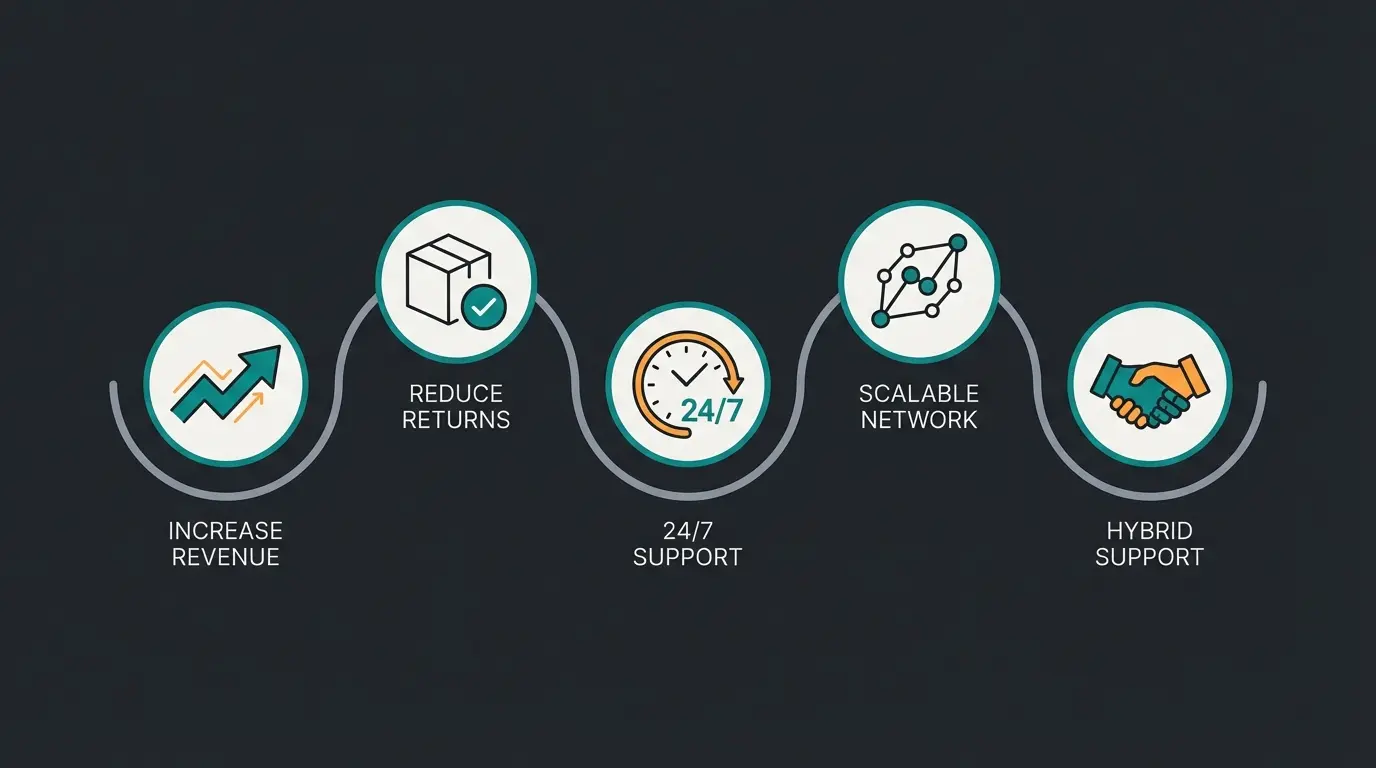
1. Revenue Growth Through Guided Selling
This is the often-overlooked "game changer." An AI bot can act like a top salesperson. It recommends cross-selling products ("You'll also need Cable X for this") and upselling options. The power of AI product recommendations in e-commerce cannot be overstated.
Fact: E-commerce websites with AI chatbots see an average 23% higher conversion rate compared to those without, according to Amra and Elma. Other sources, like HelloRep AI, speak of quadrupling conversion rates through AI chat.
2. Reduction of Returns
In fashion retail, return rates often exceed 50%, as reported by Sendcloud. A main reason: lack of advice on fit and size. A consulting chatbot that specifically asks about body measurements or preferences prevents the wrong purchase before it happens.
Fact: AI-driven processes in returns management and consultation can reduce refund risks and return rates by up to 25%, according to eDesk.
3. 24/7 Availability Without Wait Times
Customers shop in the evenings and on weekends. A human live chat is expensive to staff. The bot is always awake.
Fact: 58% of German consumers see constant availability as the greatest benefit of chatbots, according to Trendmonitor Deutschland.
4. Scalability During Peak Loads
Whether it's Black Friday or the Christmas season: when inquiry volume explodes, human support breaks down. A chatbot scales infinitely. Gartner forecasts that by 2025, 85% of customer service leaders will be piloting or deploying AI solutions to secure exactly this scalability.
5. Team Relief for Complex Cases (Hybrid Model)
By having the bot handle standard inquiries (status checks, FAQs) and initial consultation, your human experts have time for the truly tricky cases. This increases not only efficiency but also employee satisfaction, as monotonous tasks disappear. Learn more about AI customer service automation to maximize this benefit.
Practical Examples: FAQ Bot vs. Digital Product Consultant
To make the difference tangible, let's compare two scenarios in an online shop for running shoes.
Scenario A: The Classic FAQ Bot (The Dead End)
- Customer: "Which running shoe should I buy?"
- Bot: "We have a wide selection of running shoes. Here's the link to our 'Running Shoes' category. Do you need help with a return?"
- Result: The customer feels abandoned, clicks the link, is overwhelmed by 200 models, and leaves the shop (Bounce).
Scenario B: The Digital Expert Consultant (Your Approach)
- Customer: "Which running shoe should I buy?"
- AI Consultant: "That depends entirely on where you run! Do you mainly run on asphalt or in the forest?"
- Customer: "Mostly asphalt, but I have somewhat wider feet."
- AI Consultant: "I understand. For asphalt and wider feet, I recommend models with good cushioning and a 'Wide' fit. Do you run longer distances (marathon) or short sprints?"
- Customer: "More like relaxed 10km runs."
- AI Consultant: "Then the Model X Comfort is perfect for you. It offers stability for asphalt and is extra wide. Shall I show it to you in size 10?"
- Result: The customer feels understood and advised. Purchase probability increases massively.
This consultative approach is exactly what AI chatbots for e-commerce excel at—transforming passive browsing into active purchasing decisions.
See how AI-powered product consultation can quadruple your conversion rates while reducing support costs. Start your free trial today.
Start Free Trial NowHow to Implement a "Consultation Bot": In 3 Steps
Introducing a chatbot in customer support that can also sell requires more than just installing a plugin. It's a strategic project that demands careful planning and execution.
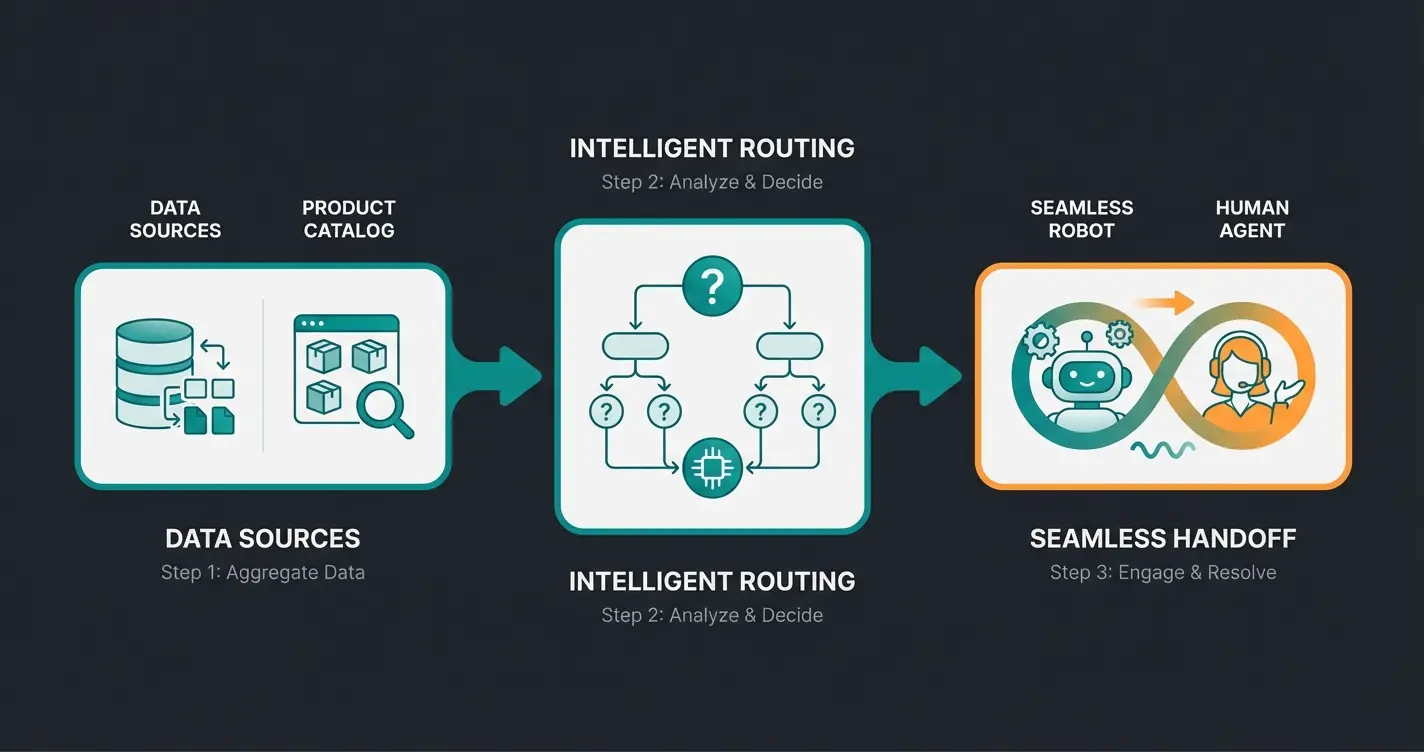
Connect Knowledge Base, FAQs, ERP/CRM systems, and deep Product Information Management (PIM) data
Build dynamic needs analysis with targeted questions about use cases, preferences, and requirements
Implement seamless escalation to human agents with sentiment analysis for frustrated customers
Step 1: Create the Data Foundation (Knowledge Base & PIM)
A consultation bot is only as good as the data it accesses. Understanding AI product consultation providers can help you choose the right foundation.
- For Support: It needs access to FAQs, shipping conditions, and order status (connection to ERP/CRM).
- For Consultation: It needs deep access to your product data (PIM). It must know that "Product A" is compatible with "Accessory B" and that "Material C" is not suitable for outdoor use.
Step 2: Define the "Sales Logic"
Unlike support, where there's often only one correct answer, consultation is dynamic. You must define which questions the AI should ask to reach the goal (Needs Analysis). The AI Product Finder approach demonstrates this perfectly.
Example: For laptops, the AI must ask about "Gaming," "Office," or "Graphic Design"—not just processor speed.
Step 3: Integration and Human Handover
Even the best bot has its limits. A seamless handover to a human is mandatory. In German-speaking markets particularly, this is a decisive trust factor.
Tip: Use sentiment analysis. When the AI detects that the customer is angry or frustrated, it should immediately escalate to a human. For comprehensive integration strategies, explore our Shopware Chatbot Guide.
Checklist: What to Look for When Choosing Software
The market for chatbot software is confusing. Many providers (like Zendesk, Freshworks, or Userlike) come from ticket management. For a Digital Product Consultant, however, you need specific capabilities.
Pay attention to these features when making your selection:
- Intent Recognition: Can the AI distinguish between "I want to buy" (Sales Intent) and "Where is my package" (Service Intent)?
- Product Feed Integration: Can the bot read your product catalog in real-time and display products directly in the chat as "Cards" (with image and buy button)?
- Guided Selling Flows: Does the software offer templates for consultation conversations?
- Generative AI (LLM) Connection: Does the system use modern LLMs (like GPT-4 or Claude) to formulate natural responses instead of just sending text blocks?
- Data Privacy (GDPR): Server location and data processing must be compliant for the European market. This is essential for German consumers.
- Omnichannel Capability: Does the bot work just as well on the website as on WhatsApp or Instagram?
Understanding Conversational AI capabilities is essential when evaluating these features. The technology behind AI chatbots for customer service has evolved dramatically.
| Criteria | FAQ Bot | AI Product Consultant |
|---|---|---|
| Goal | Cost Savings (Deflection) | Revenue Generation (Conversion) |
| Technology | Keywords, Decision Trees | NLP, LLM, Generative AI |
| User Experience | Search-Based | Dialogue-Based |
| Outcome | Link to Category Page | Personalized Recommendation |
| Data Requirements | FAQs, Static Content | Full PIM, Product Attributes |
| ROI Timeline | Months | Weeks |
The Future Is Consultative: Key Takeaways
The classic customer service chatbot has evolved. We're moving away from pure deflection (blocking customer inquiries) toward conversion (turning visitors into customers).
Companies that use AI solely to save costs in support are selling themselves short. The true potential lies in scaling expert knowledge: Make your best salesperson's knowledge available 24/7 to every website visitor.
The advantages are clear:
- Higher customer satisfaction through immediate, expert assistance
- More revenue through qualified product consultation
- Fewer returns through perfectly matched recommendations
- Better data insights through conversation analytics
- Competitive differentiation through superior service quality
Don't start 2026 with yet another FAQ bot. Start with a Digital Expert Consultant that transforms your customer service from a cost center into a profit center.
Frequently Asked Questions (FAQ)
Costs vary significantly. Simple DIY solutions start at a few hundred euros per month. Enterprise solutions with deep PIM integration and Generative AI often range in the four-figure range, but typically pay for themselves within a few months through revenue increases (ROI). The key is to focus on return on investment rather than just the initial cost.
Yes, acceptance is rising. According to Trendmonitor Deutschland 2024, most consumers are open to chatbots as long as the quality is right and a human contact person is available as a fallback. The key factors are response quality, natural conversation flow, and transparent escalation options.
No, and that shouldn't be the goal. The purpose is to relieve them of routine tasks ('Where is my package?') so they can focus on complex consultation and emotional customer engagement. It's about a hybrid model of human and machine working together.
Traditional chatbots operate on rule-based systems with predefined responses. Conversational AI uses advanced NLP, machine learning, and increasingly LLMs to understand context, intent, and nuance—enabling natural, dynamic conversations that adapt to each customer's unique needs.
Basic FAQ bot implementation can be done in days. A full Digital Product Consultant with PIM integration, custom sales logic, and proper training typically takes 4-8 weeks. The investment in proper setup pays dividends in conversion rates and customer satisfaction.
Join leading e-commerce brands using AI-powered product consultation to drive revenue, reduce returns, and delight customers 24/7.
Get Started Free