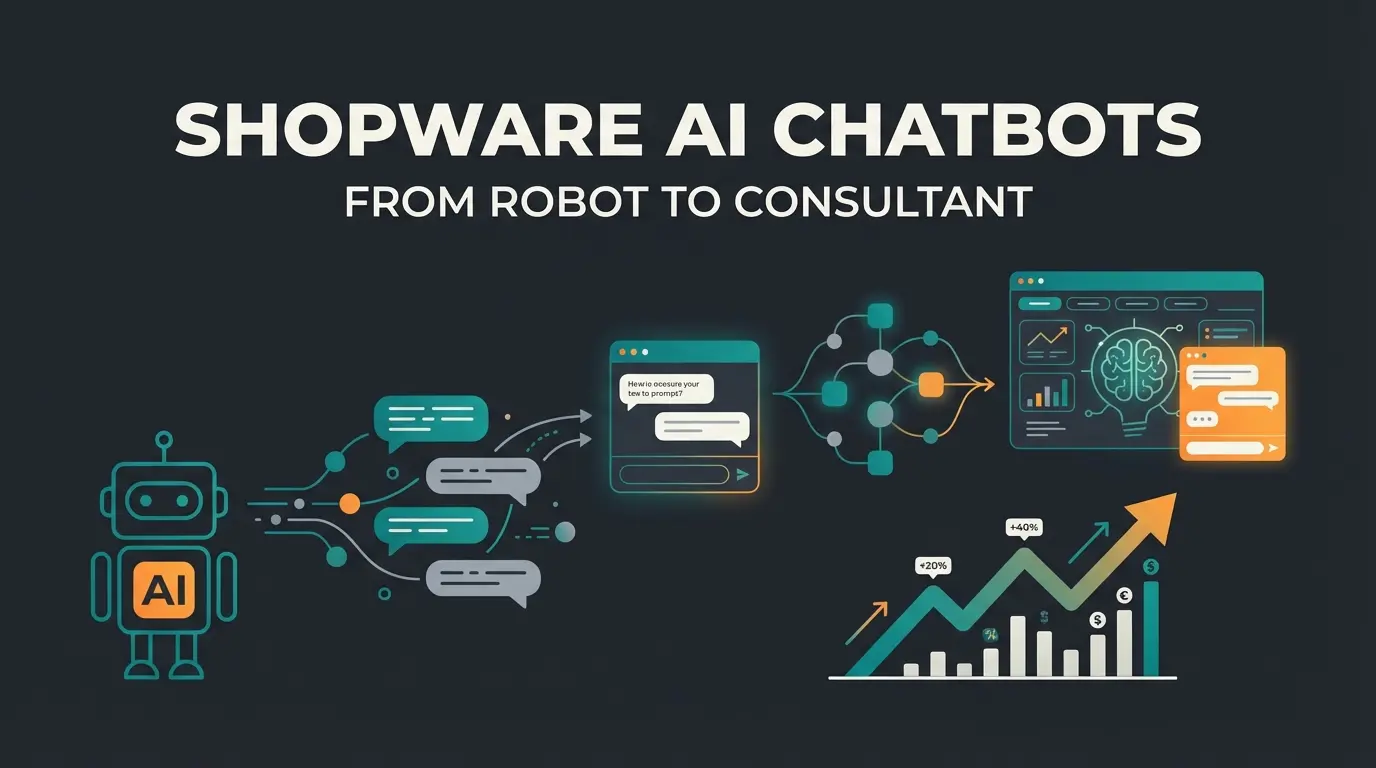
Introduction: The End of "Dumb" Chatbots
Remember your last interaction with a traditional chatbot? It probably went something like this: You had a specific question, the bot completely missed the point, delivered three irrelevant FAQ articles, and you ended up more frustrated than before you started.
This is the legacy of the first wave of automation. Companies desperately tried to automate customer service to conserve personnel resources. The result was often a "deflection strategy": The customer was supposed to solve their problem themselves without "bothering" a human agent.
But technology has evolved dramatically. We're entering the era of "Agentic AI" and context-aware intelligence. According to the Zendesk CX Trends Report 2025, customers today expect interactions that feel human, personal, and empathetic. As PR Newswire reports, this shift represents a fundamental change in customer expectations. It's no longer just about automatically answering "Where is my package?" It's about competently solving questions like "Which running shoe fits my marathon training?"
This article shows you how to make the leap from reactive support to proactive, automated consultation—and why this will be your biggest revenue lever for the coming years. Understanding AI customer service fundamentals is essential for any business looking to stay competitive in this rapidly evolving landscape.
What Does Customer Service Automation Mean Today?
When we talk about automating customer service, we mean far more today than simple auto-responders or rule-based chatbots.
Modern customer service automation is based on AI systems (often Large Language Models, LLMs) that understand the context of an inquiry instead of just searching for keywords. They can recognize intents, ask follow-up questions, and perform complex problem-solving. This is where AI Product Consultation truly shines—going beyond simple FAQ responses to deliver intelligent, contextual advice.
The Crucial Difference: Support vs. Consultation
To understand the full potential of automation, we need to separate two disciplines that are often confused: Support Automation and Consultation Automation.
Most companies are still stuck in the left column of this comparison. Your "Blue Ocean"—the market segment with little competition and high potential—lies in the right column.
| Feature | Classic Support Automation (The Standard) | Automated Product Consultation (The Opportunity) |
|---|---|---|
| Primary Goal | Ticket avoidance (Cost Cutting) | Purchase completion & Upselling (Revenue Driver) |
| Typical Questions | "What are the return policies?" | "Which laptop is best for video editing?" |
| Technology | Static FAQs, Keyword Matching | LLMs, RAG (Retrieval Augmented Generation), Agentic AI |
| Customer Feeling | "I'm being brushed off." | "I'm being understood and advised." |
| KPIs | Average Handling Time (AHT), Deflection Rate | Conversion Rate, Average Order Value (AOV) |
This shift toward Consultative AI represents one of the most significant opportunities in modern e-commerce. Companies that understand this distinction early will gain substantial competitive advantages.
The Benefits: More Than Just Cost Savings
Why should you invest now in automated customer service that goes beyond FAQs? The data for 2025 and 2026 is clear: It's about competitiveness and revenue growth.
1. Revenue Growth Through Cross-Selling and Upselling
This is the most underrated benefit. When you automate customer service, you create space for sales conversations.
- Fact: Companies identified as "CX Trendsetters" who strategically use AI report 49% higher cross-selling revenue compared to their competitors, according to Forbes.
- Scenario: A customer asks about caring for a leather shoe. A support bot sends a link to the care instructions. A consultation bot explains the care process and directly recommends the matching care spray from your shop (cross-selling).
Implementing AI customer service that understands the difference between reactive support and proactive sales consultation is crucial for maximizing these revenue opportunities.
2. Scalable Expertise (24/7)
Your best human salesperson can only advise one customer at a time. They need sleep, vacation, and occasionally have bad days.
- An AI solution can conduct thousands of consultation conversations simultaneously—with consistent quality and friendliness, at 3 AM just as effectively as Monday morning.
- Industry reports indicate that 80% of CX managers believe only companies that deploy AI at scale will survive the competitive pressure of the coming years.
This is where digital sales consultants powered by AI become invaluable—they never tire, never forget product details, and can handle peak loads effortlessly.
3. Hyper-Personalization Through "Memory-Rich AI"
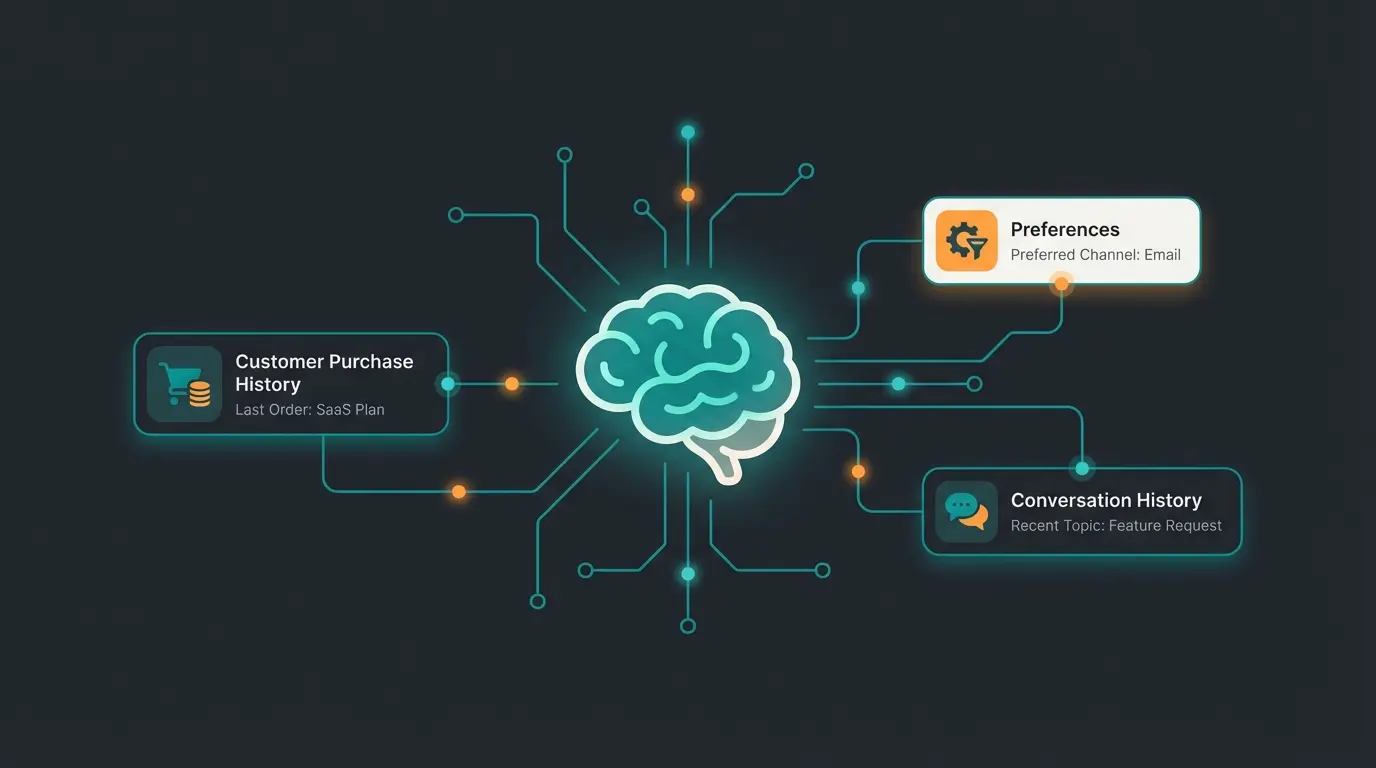
Customers hate repeating themselves. Modern systems offer what's called "Memory-Rich AI."
- The system remembers past purchases, previous issues, and preferences.
- Benefit: When the customer returns, they don't have to start from zero. The AI greets them: "Hello Thomas, did the last update solve your printer problem? Are you looking for matching paper today?" This increases customer retention rates by up to 22% among AI pioneers.
CX Trendsetters using strategic AI report significantly higher cross-selling compared to competitors
Projected AI agent handling rate by 2027 according to Salesforce predictions
Retention rate improvement among companies deploying Memory-Rich AI systems
Believe only companies deploying AI at scale will survive competitive pressure
Understanding AI consulting in e-commerce is becoming essential as these statistics demonstrate the tangible business impact of intelligent automation.
Common Mistakes in Automation (And How to Avoid Them)
The path to automated customer service is paved with failed projects. Here are the three biggest pitfalls you must avoid when planning your support automation.
Mistake 1: The "Dead End" Without Human Escape
Nothing frustrates customers more than a bot that doesn't understand a question and offers no option to speak with a human.
- Solution: Always implement a "Human Handover." When the AI detects negative sentiment (Sentiment Analysis) or the customer types "agent" twice, the handover must be seamless—including the entire chat history so the agent is immediately up to speed.
You can Automate Shopware support effectively while maintaining these crucial human touchpoints that preserve customer satisfaction.
Mistake 2: Using Keyword Matching for Complex Questions
Many companies still rely on outdated chatbots based on rigid if-then rules.
- The Problem: If a customer asks: "I'm looking for something quiet for my apartment since I have skittish cats," a keyword bot often doesn't respond at all because the word "vacuum cleaner" is missing.
- The Solution: Use LLM-based systems (Large Language Models). These understand context ("Quiet" + "Apartment" + "Cats" = Quiet vacuum cleaner) and can advise like a salesperson.
Mistake 3: Automating Only After Purchase (Post-Sales Trap)
Most companies automate returns and status inquiries. That's important, but it wastes potential.
- The Gap: The most valuable interactions happen before the purchase. When a customer is uncertain, they abandon the purchase. This is exactly where customer service automation must step in: As a digital shopping consultant that removes doubts and guides customers to checkout.
Companies leveraging revenue-generating digital sales understand that the pre-purchase consultation phase offers the highest ROI potential for AI investment.
Deep Dive: Automated Product Consultation vs. FAQ Bots
Here lies your biggest lever. Let's dive deeper into how automated product consultation differs from conventional bots and how you can bridge this gap.
The Scenario: Buying Running Shoes
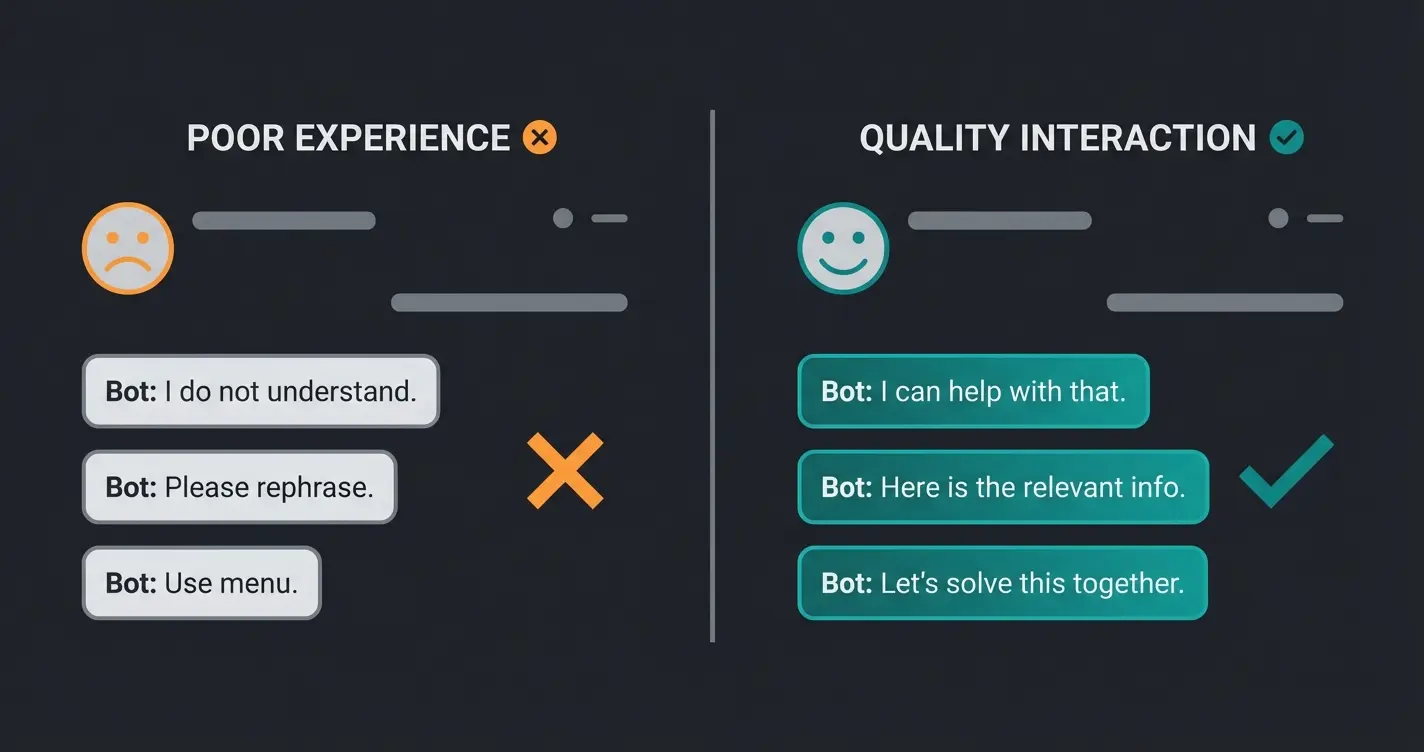
❌ The Traditional FAQ Bot (Support Focus)
- Customer: "Which running shoe should I get?"
- Bot: "Here you'll find our running shoes category: [Link]. Our return period is 30 days."
- Result: The customer feels abandoned. They click the link, get overwhelmed by 50 models, and leave the site.
✅ The AI Product Consultant (Consultation Focus)
- Customer: "Which running shoe should I get?"
- AI Consultant: "That depends entirely on where you run. Are you primarily on asphalt or in the woods?"
- Customer: "Mostly asphalt, but I have knee problems."
- AI Consultant: "I understand. With knee problems on hard surfaces, cushioning is crucial. I recommend our 'Cloud-Runner' series. Model X offers the strongest cushioning, Model Y is somewhat lighter. Would you like me to show you the details for Model X?"
Why This Approach Wins
- Needs Analysis: The AI asks follow-up questions (qualification), exactly like a good salesperson in a store.
- Empathy & Context: It addresses the pain point (knees) directly.
- Guided Decision: Instead of a list with 50 shoes, the customer gets two relevant recommendations. This reduces "Decision Paralysis."
This approach transforms AI employees from simple support tools into sophisticated sales consultants that understand customer needs and guide purchasing decisions effectively.
Technology Check: What You Need for This
To implement this, you need AI trained on your product data (often via RAG – Retrieval Augmented Generation). The AI accesses not just FAQs, but product descriptions, attributes (e.g., "strong cushioning"), and customer reviews.
Modern AI sales assistants leverage these technologies to deliver personalized recommendations that match or exceed human sales consultant performance.
AI Consultant helps customers choose products through intelligent needs analysis and personalized recommendations (Primary Revenue Focus)
Automated checkout assistance, payment processing support, and order confirmation handling
Automated shipping notifications, delivery tracking, and proactive status updates
Human agents handle complex issues, emotional complaints, and high-value relationship management
See how leading e-commerce brands are using AI product consultation to increase conversion rates by up to 35% while reducing support tickets. Start your free trial today.
Start Free TrialStep-by-Step Strategy for Implementation
You want to automate your customer service with a focus on consultation? Here's your roadmap.
Step 1: Identify High-Volume Queries
Analyze your current tickets and chat histories. Separate them into two categories:
- Transactional (Support): "Where is my package?", "Invoice copy", "Forgot password" → Goal: Maximum automation / Deflection.
- Consultative (Sales): "Does Part A fit Part B?", "Difference between Version 1 and 2", "Gift idea for..." → Goal: High-quality dialog automation.
Step 2: Train the "AI Expert"
Don't just feed your AI support texts. It needs sales knowledge.
- Upload product catalogs, technical data sheets, and "Sales Playbooks" into the AI's knowledge base.
- Define the "Brand Voice": Should the AI be casual or formal in its advice?
Implementing proactive product consultation requires this foundational work to ensure your AI truly understands your products and can advise customers effectively.
Step 3: Define the "Handoff" (The Transition)
A hybrid model is the key to success.
- The Hot-Lead Trigger: When the AI notices it's dealing with a large order or the customer is asking very specific questions indicating high purchase intent, it should proactively offer: "That's an exciting requirement. Would you like one of our experts to give you a quick call about this?"
- This transforms the service channel into a lead generation channel.
Step 4: Measure the Right KPIs
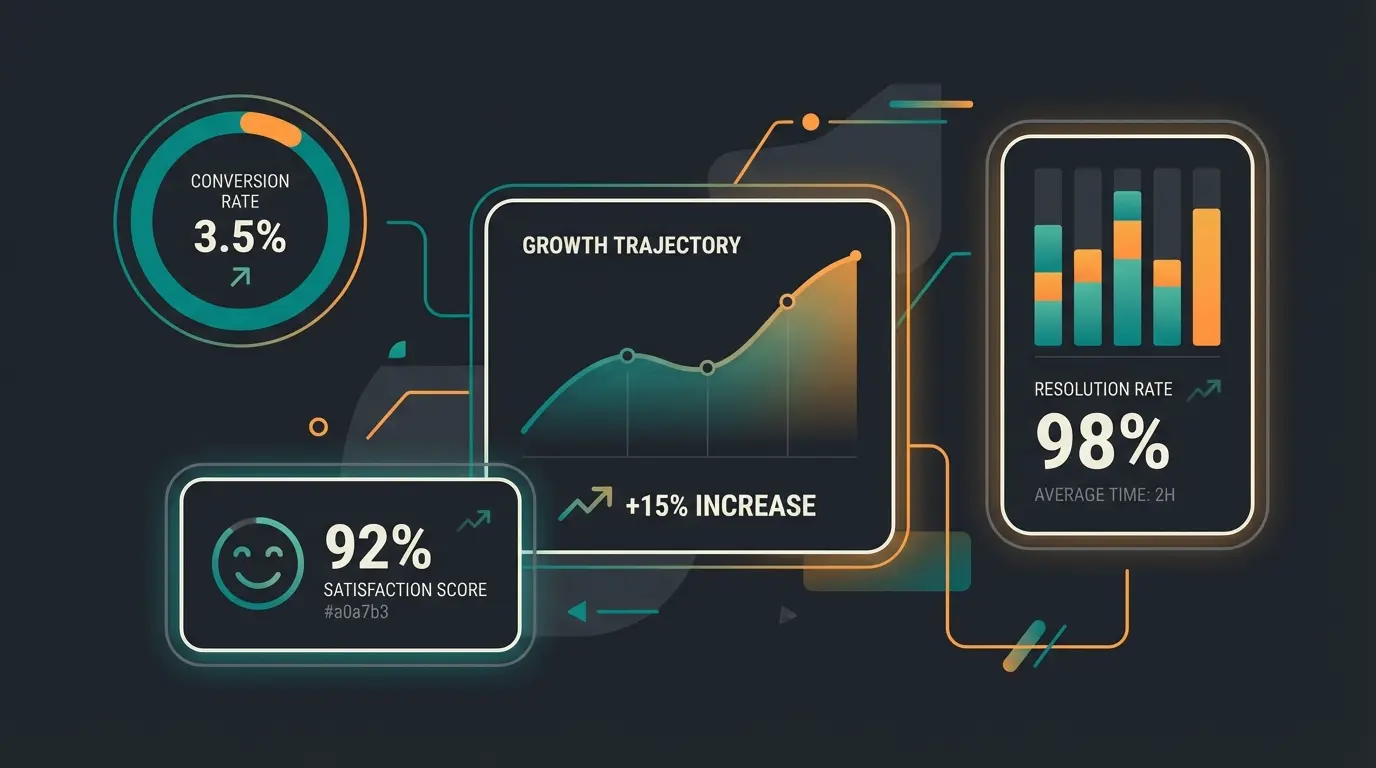
Say goodbye to pure "ticket reduction" as your only success metric. Measure instead:
- Conversion Rate After Chat: How many users purchase after interacting with the AI?
- CSAT (Customer Satisfaction): Do customers feel well-advised?
- Resolution Rate: How many consultations could the AI complete fully?
Understanding AI in customer service metrics helps you build business cases and demonstrate ROI to stakeholders effectively.
Conclusion & Outlook: The Future Is Hybrid
Automating customer service in 2026 is no longer optional—it's mandatory. But how you automate determines your market position.
Those who view automation merely as a cost-saving measure will lose customers to competitors offering better service. However, those who use AI to build scalable product consultation will tap into new revenue sources and relieve their teams of repetitive tasks, allowing humans to focus on what they do best: showing empathy and solving complex problems.
The emergence of AI Chatbots that truly understand customer intent marks a fundamental shift in what's possible with customer service automation.
The technology is ready. Are you?
Frequently Asked Questions (FAQ)
Costs vary significantly depending on complexity. Simple FAQ bots are available for just a few dollars per month. Intelligent, AI-powered solutions for product consultation (as described in this article) often start in the mid-three-figure range per month but usually deliver very fast ROI (Return on Investment) through revenue increases. The key is calculating total value including revenue uplift, not just cost savings.
No, and that shouldn't be the goal. AI excels at handling standard questions, retrieving data, and conducting initial consultations (First Level). For complex escalations, emotional complaints, or very individual high-ticket sales, humans remain indispensable. The ideal model is hybrid—AI handles volume while humans handle value.
For SMBs, platforms that are easy to integrate and don't require months of development time are most suitable. Well-known providers include Zendesk (with new AI features), Intercom (Fin AI), or specialized providers offering privacy-compliant AI solutions. The most important factor is that the tool has interfaces (APIs) to your shop system and can be trained on your specific product data.
Only if it's poorly implemented (e.g., unintelligent bots, no contact option). Well-implemented automation actually increases loyalty because customers appreciate fast responses. Studies show customers value immediate availability (24/7) and personalized interaction from modern AI systems. The key is ensuring quality conversations, not just quick deflection.
FAQ bots match keywords to pre-written answers—they're reactive and static. AI product consultants use Large Language Models to understand context, ask qualifying questions, and provide personalized recommendations based on customer needs. The former deflects questions; the latter drives sales through intelligent consultation.
Join leading e-commerce brands using AI-powered product consultation to drive revenue growth. Our experts will show you exactly how to implement intelligent automation that converts browsers into buyers.
Book Your Free Demo