Live chat vs chatbot vs AI agent: the short answer for 2026
Live chat routes visitors to a human agent, a chatbot answers from a fixed script, and an AI agent reads your product and order data to give a reasoned answer. Use chatbots for FAQs, live chat for complaints and escalation, and an AI agent for pre-sales product consultation. The touchpoint decides, not the technology.
Most comparison articles still frame this as human against machine. That framing stopped describing the market somewhere around 2023. Three categories now compete for the same widget in the bottom-right corner of your shop, and they differ by more than an order of magnitude in cost per conversation, response time, and what they can actually resolve without a handoff.
The shift is measurable, not rhetorical. A Gartner survey of 3,566 B2B and B2C customers conducted in February and March 2026 found that 58% of people who use generative AI in a service context have used it to complete a task on their behalf rather than just to get an answer. In B2B that figure rises to 74%. A scripted chatbot customer service setup cannot complete a task. Neither can a human agent at three in the morning.
What's the difference? Live chat, chatbot, and AI agent defined
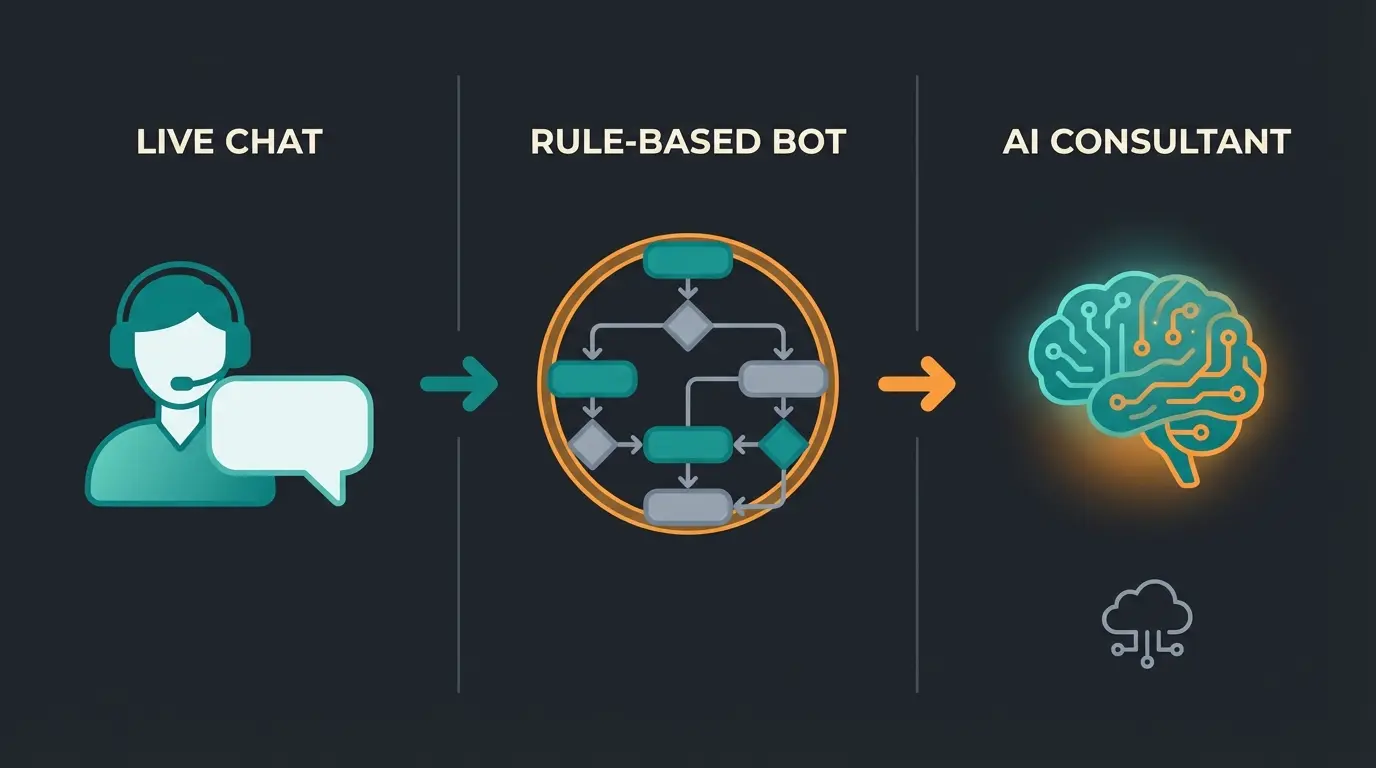
The difference is what sits behind the chat window. Live chat is a human agent typing in real time. A rule-based chatbot follows an if-then decision tree. An AI agent runs on a large language model connected to your live product, stock and order data, so it can reason about a question it has never seen before.
Live chat
Live chat is a real-time messaging channel embedded on your site that connects a visitor to a human agent. The agent types the answer. Canned replies, CRM panels and routing rules are tooling around that one fact, not a change to it.
The performance numbers are well documented. Tidio's live chat dataset, drawn from more than two million conversations a month, puts the average first response time at 1 minute 35 seconds and reports that 87% of live chat conversations close with a positive CSAT rating. The American Customer Satisfaction Index measures channel satisfaction at 88%, so the figure holds outside a single vendor's data. If you are still choosing a tool, the shortlist mechanics are in our guide to the best live chat software.
- Core competency: judgement, empathy, and any situation where an exception has to be made
- Hard limit: 3 to 5 concurrent chats per agent before quality degrades, and roughly 29 conversations per agent per day
- Best fit: complaints, disputes, contract questions, and late-stage high-value sales
- Current standard: hybrid live chat, where an automated layer takes first contact and hands off to a person on escalation
Rule-based chatbot
A rule-based chatbot matches a visitor's input against a keyword list or a menu of buttons and returns a pre-written reply. No language model, no reasoning, no memory. It is a decision tree with a chat skin on top.
That design explains both why it is cheap and why it fails. Inside the script it is instant and perfectly consistent. One question phrased outside the script and the conversation dead-ends, which is the complaint customers make about chat automation more than any other.
- Core competency: order status, opening hours, password resets, returns policy, structured intake before a handoff
- Hard limit: zero tolerance for unexpected phrasing, and no access to product or customer data
- Best fit: high-volume, low-variance questions where the answer never changes
- Warning sign: if your bot's most-used button is "talk to a human", it is a routing form, not a support layer
AI agent
An AI agent is a large language model wired into your systems with permission to act. It reads the product catalogue, checks live stock, looks up an order, and completes a step on the customer's behalf. IBM, in its chatbot reference updated on 16 July 2026, draws the line the same way: "AI agents can plan, make task-specific decisions and carry out multi-step workflows with limited human involvement." An AI chatbot, by IBM's definition, answers questions one step at a time.
- Core competency: open-ended product consultation grounded in your actual catalogue, plus lead qualification
- Hard limit: it is only as accurate as the product data behind it, and it needs an escalation path to a human
- Best fit: pre-sales consultation on consulting-intensive ranges, and 24/7 coverage without a night shift
- New obligation: it has to be labelled as AI at the first interaction under EU law
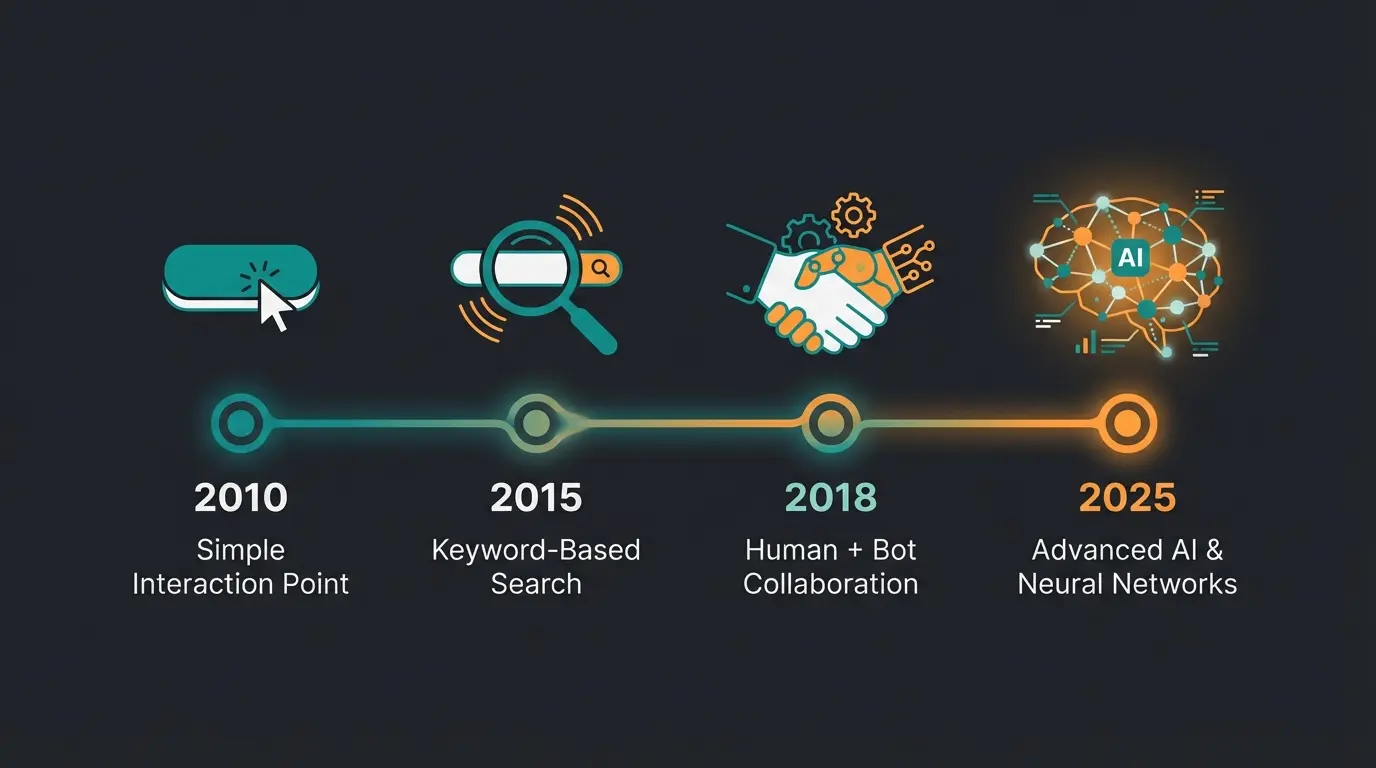
Button-based navigation on rigid decision trees. Fast, cheap, and useless outside the menu.
Text scanning against a keyword library. Better coverage, frequent misreads, no memory.
Automated pre-qualification with a human handoff. Still the most common setup on mid-market shops.
Language models connected to catalogue, stock and order data, with permission to complete a task.
Live chat vs chatbot vs AI agent: the comparison table
Across the nine dimensions that decide the choice, availability, response time, cost per conversation, scalability, complex-case handling, product consultation, personalisation, data protection exposure and AI Act labelling duty, no single option wins. Chatbots win on cost and speed, live chat on complex cases, AI agents on consultation and conversion.
| Dimension | Live chat (human) | Rule-based chatbot | AI agent |
|---|---|---|---|
| Availability | Staffed hours only | 24/7 | 24/7 |
| Response time | 1 min 35 s average | Under 2 seconds | Under 2 seconds |
| Cost per routine conversation | $20 to $25 | $0.50 to $0.70 | Low single-digit dollars |
| Scalability | 3 to 5 concurrent chats per agent | Unlimited parallel conversations | Unlimited parallel conversations |
| Complex complaints | Strongest option | Dead-ends outside the script | Escalates with full context attached |
| Product consultation | Strong, but queued | Not possible | Strong, catalogue-aware, instant |
| Personalisation | Manual CRM lookup by the agent | None | Reads order, stock and browsing data live |
| Data protection exposure | Agent sees everything typed | Low, no free-text processing | Needs EU hosting and zero-retention config |
| AI Act Article 50 labelling duty | None | None, if no AI is involved | Required since 2 August 2026 |
Two rows carry most of the decision. Cost per conversation separates the options by a factor of thirty, and product consultation is the only row where an AI agent beats both alternatives outright: a rule-based bot cannot do it at all, and a human can do it well but only for one visitor at a time during office hours.
Cost comparison: what each option costs per conversation
Cost per conversation is where the three options separate hardest: a rule-based chatbot handles a contact for cents, an AI agent for a low single-digit amount, and a live-chat conversation costs multiples of both because you are paying agent minutes. The break-even point is set by contact volume, not by licence price.
| Cost line | Live chat (human) | Rule-based chatbot | AI agent |
|---|---|---|---|
| Cost per routine conversation | $20 to $25 | $0.50 to $0.70 | Rising toward $3 by 2030 |
| Loaded cost per support agent | $60,000 to $80,000 per year | None | None |
| Onboarding time | 4 to 8 weeks per agent | Hours | Weeks of knowledge-base work |
| Throughput | 3 to 5 concurrent chats, ~29 per day | Unlimited | Unlimited |
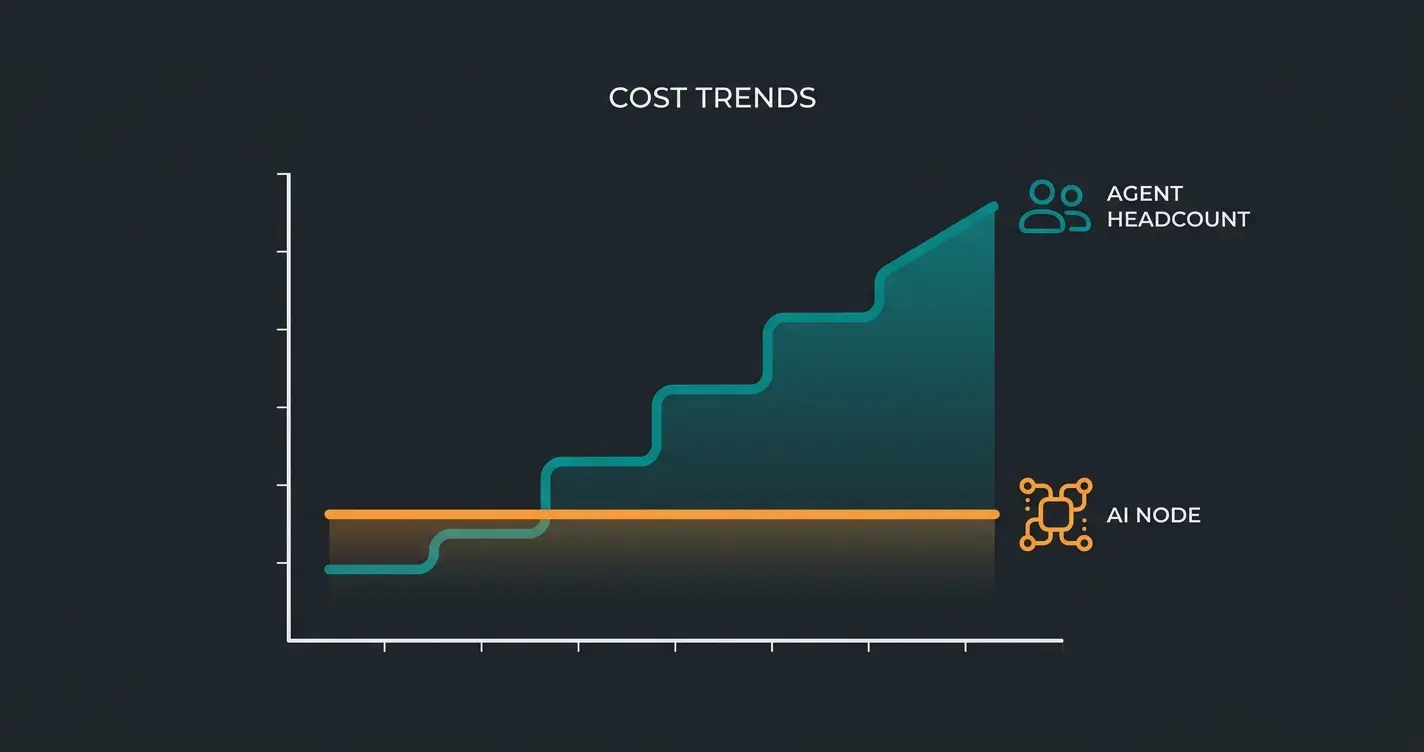
| Cost curve as volume grows | Linear with headcount | Flat | Flat, then token-driven |
| Share of contacts fully contained | Not applicable | Narrow, script-bound | 40% to 65% with a maintained knowledge base |
Run the arithmetic on your own volume rather than on a vendor's pricing page. A single support seat costs $60,000 to $80,000 a year fully loaded, which is $5,000 to $6,700 a month before you buy any software. One agent sustains around 29 conversations a day, so roughly 600 a month at normal staffing. That is where the maths turns. Past 600 conversations a month you are hiring a second seat, and a second seat costs more in one year than most AI agent platforms charge in flat fees over the same period.
This is also why free live chat software is only free at low volume. The licence really is zero. The agent minutes are not, and they are the line item that scales.
Is ChatGPT a chatbot or an AI agent?
ChatGPT is a chatbot interface running on a large language model. It becomes an AI agent only when it is connected to your systems and allowed to act: look up an order, check live stock, book a slot. The dividing line is not how well it writes, it is whether it can take an action against your data.
Four tests separate the two categories, and every one of them is about permissions rather than eloquence.
- Data access: can it read your live catalogue, stock levels and order records, or only a help-centre article?
- Autonomy to act: can it change, book or cancel something, or does it only describe how you would do it?
- Memory across sessions: does it recognise a returning customer, or start from zero every time?
- Escalation logic: does it know when it is out of its depth and hand over with the conversation history attached?
Applied to your own widget the test takes about a minute. A support widget that answers from a help-centre article is a chatbot. One that checks this specific customer's actual order status is an agent. The work between those two states is integration work rather than model work, which is exactly why chatbot integration for ecommerce is the part most projects underestimate when they scope a budget.
Are live chats usually AI? Partly, on most sites in 2026. Vendors now ship hybrid widgets where an automated layer takes first contact and a person takes over on escalation, so the first message you receive is often generated and the third one often is not. The more uncomfortable finding in the same Gartner survey: customers were roughly three times more likely to have used a third-party tool such as ChatGPT, Gemini or Copilot for their most recent service issue than a company-provided chatbot. A meaningful share of your product questions is already being answered by an AI you do not control and cannot correct.
Pros and cons in detail
Live chat's strength is judgement and its weakness is queueing. A chatbot's strength is instant, unlimited throughput and its weakness is the dead end. An AI agent removes the dead end but introduces a new obligation: it must be labelled as AI and kept out of your training data.
Live chat has a high ceiling and low throughput. It wins on satisfaction, 87% positive CSAT in Tidio's data and 88% at the American Customer Satisfaction Index, higher than any other support channel measured. Demand for the channel is not in doubt either: Forrester's retail chat research, which evaluated 113 US merchants, found 42% of US online adults called it important for retailers to offer live online chat, up from 27% two years earlier. The same study found shoppers almost never complete a purchase inside the chat window, so the value sits in influencing the decision rather than closing it there. The price of that ceiling is the queue: 1 minute 35 seconds to a first reply, 3 to 5 concurrent chats per agent, and nothing at all outside staffed hours.
A rule-based chatbot inverts every one of those numbers. Instant, unlimited, cheap, brittle. It is the right tool for order status, opening hours and password resets, and the wrong one for anything a customer phrases unexpectedly. Deflecting a question and answering it are not the same outcome, which is the distinction we drew in FAQ automation vs product consultation and the one most shops get wrong at the point of purchase.
An AI agent removes the dead end and adds two duties. It has to be labelled, and it has to keep the escalation path open. That second one is not a nice-to-have: Gartner's August 2026 survey found 87% of customers say an option to reach a human agent is essential when a company uses generative AI, while only 50% say generative AI makes the interaction easier. Eric Keller, Senior Director Analyst at Gartner, states the design rule plainly: "Service leaders should not use GenAI as a mandatory first step for every issue."
There is a third duty nobody puts on a pricing page. The containment rates of 40% to 65% that Crisp reports as realistic hold only while the knowledge base behind the agent is actively maintained, and Gartner expects half of the companies that cut service headcount because of AI to rehire by 2027, mostly under different job titles. In our own deployments the failure mode is almost never the model. It is a product catalogue with missing attributes.
With a maintained knowledge base, not out of the box
Which should you choose? Decision guide by use case
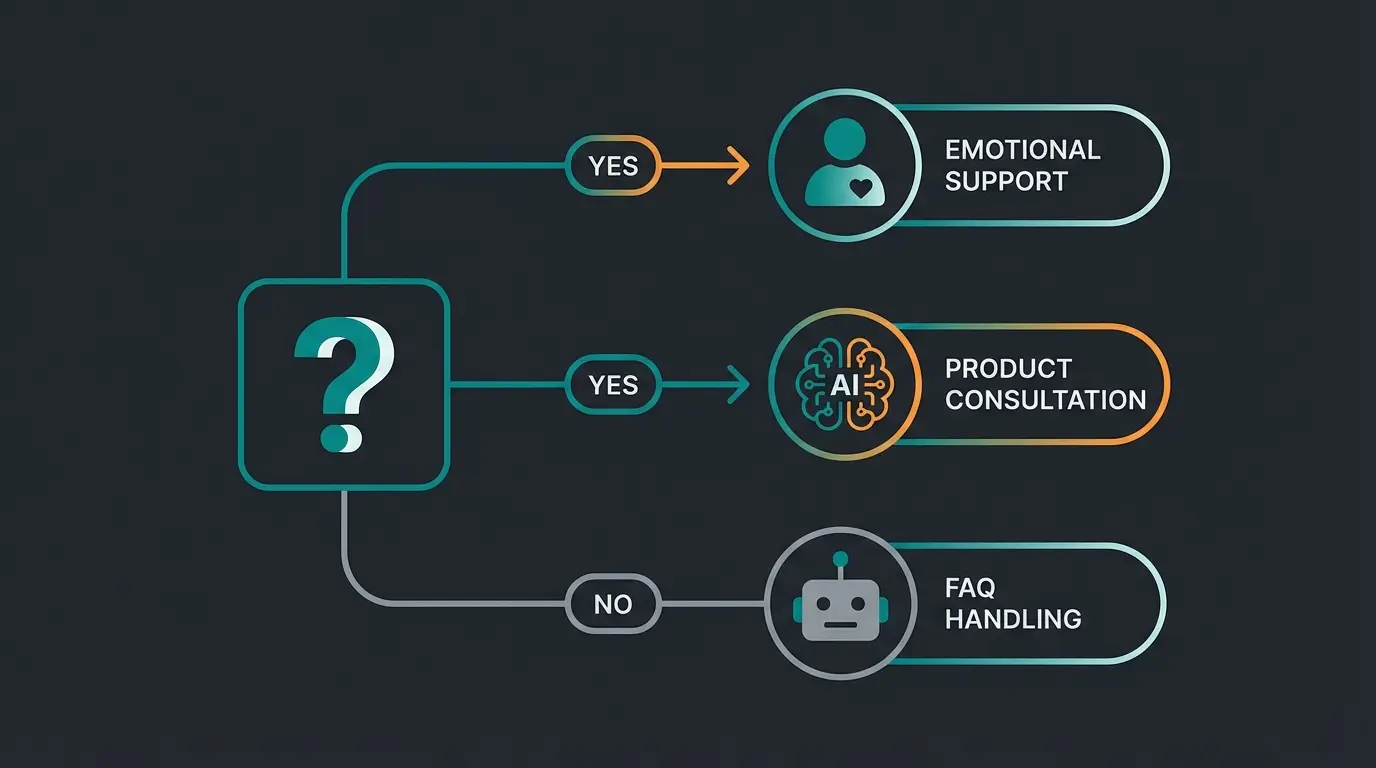
Match the technology to the touchpoint: rule-based chatbot for FAQs and navigation, live chat for complaints and high-value escalation, AI agent for pre-sales product consultation. Most shops need all three, layered, so that an AI agent takes first contact, a rule-based path handles order status, and a human takes anything emotional or contractual.
After-sales support and complaints
A customer whose order arrived damaged does not want a resolution flow. They want a decision, and someone with the authority to make it. Put a human on this touchpoint and use automation only for triage: collect the order number, the photos and the issue type before the agent picks up, so the conversation starts at minute three instead of minute one. The consequence is measurable in handling time rather than deflection rate, which is the honest way to build the case for AI customer service at this stage of the journey.
Pre-sales product consultation
This is the touchpoint where an AI agent beats both alternatives, and it is the one most shops automate last. A visitor comparing three fertilisers or four light bars has a question that a rule-based bot cannot parse and a human cannot answer at 11 p.m. Every hour that question goes unanswered is a cart that does not convert. AI product consultation closes that gap because the agent reads the catalogue rather than a canned answer sheet, and the business consequence lands on cart value, not on ticket volume.
FAQs and navigation
Shipping thresholds, return windows, opening hours. Crisp's implementation data puts five to seven question types at 60% to 70% of total contact volume, and none of them needs a language model. A rule-based path resolves these for cents and keeps them out of the queue entirely. The mistake is stopping here, which is what happens when an ecommerce chatbot is bought as a support cost-cutting tool and never given access to product data.
High-consideration B2B enquiries
A workshop asking whether a part is approved for a specific vehicle is running a compliance check, not browsing. Here the layered model earns its keep: the AI agent answers the technical qualification question immediately and captures the specification, then routes anything about pricing, volume or contract terms to a person with the full exchange attached. Gartner's data supports the split, with 74% of B2B customers who use generative AI having used it to complete a task rather than just to ask one.
Data privacy, GDPR and the EU AI Act
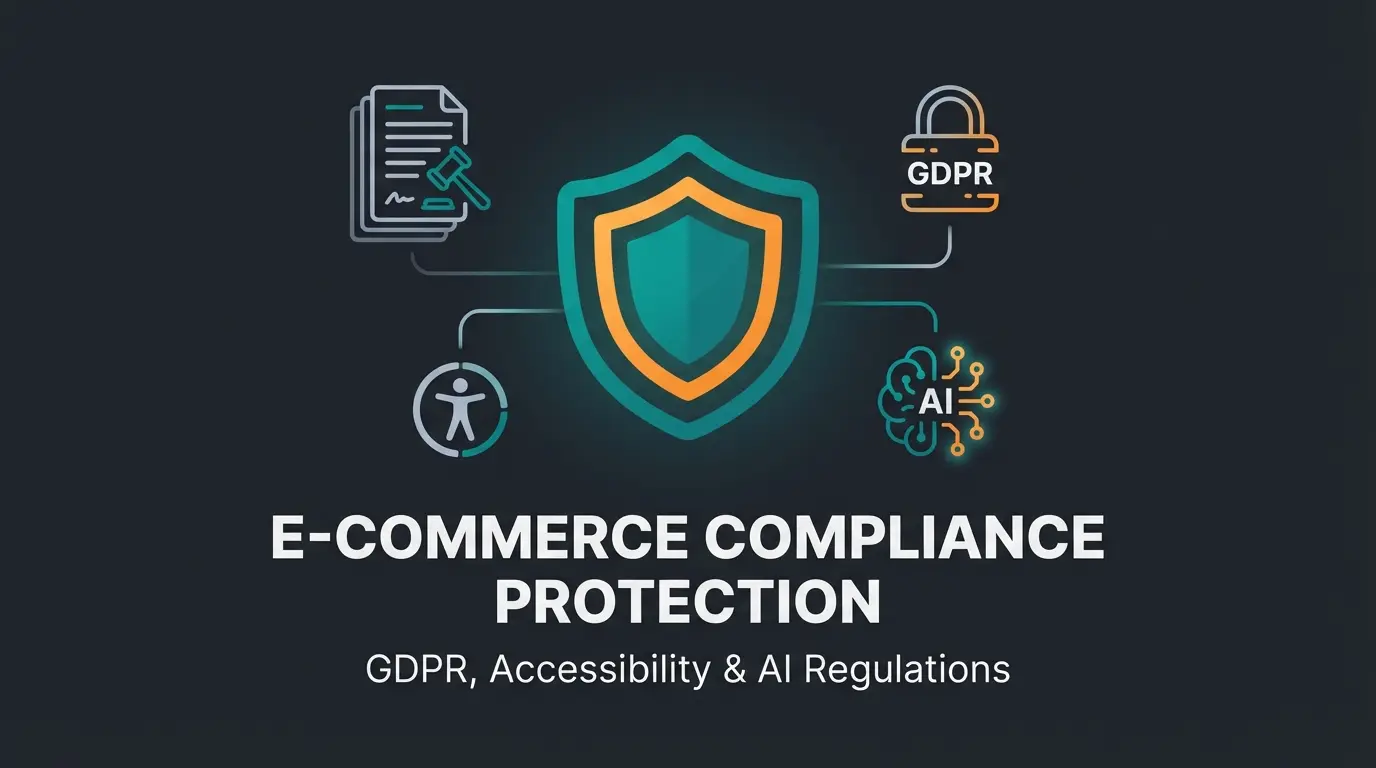
Since 2 August 2026, Article 50 of the EU AI Act requires that anyone interacting with an AI system is told they are talking to a machine. For chat that means a visible label at the start of the conversation, and it applies to the AI layer of a hybrid live chat, not only to standalone bots.
The Article 50 labelling duty
The obligation is short and unambiguous. Providers must ensure that AI systems intended to interact directly with natural persons are designed so that people "are informed that they are interacting with an AI system", unless that is obvious to a reasonably well-informed observer. Paragraph 5 adds the timing requirement: the information has to be given clearly "at the latest at the time of the first interaction". A disclosure buried in your privacy policy does not satisfy that. The EU AI Act implementation timeline confirms the date, and the exemption for law-enforcement systems is the only one in the paragraph.
- Label the AI layer in the first message, not in a tooltip and not after the third exchange
- Keep the label accurate on hybrid widgets: say when a human has taken over, because the duty attaches to the AI part of the conversation
- Do not rely on the "obvious" exemption, since a competent AI agent is precisely the case where it is not obvious
- Non-compliance falls under Article 99(4)(g), with administrative fines of up to EUR 15,000,000 or 3% of total worldwide annual turnover, whichever is higher
Hosting, retention and consent
The GDPR questions have not changed, but an AI agent widens the surface. Chat transcripts now pass through a model provider as well as your chat vendor, so the processing chain needs an EU hosting region, a data processing agreement covering the model layer, and zero data retention configured on the inference side. Customers type things nobody asked for: order numbers, health details, occasionally a full card number. Configure the transcript retention window on the assumption that they will, not on the assumption that they should not.
What the numbers look like in live deployments
Across 25 live AI-employee deployments, replacing a queued pre-sales live-chat conversation with an AI agent raised average cart value by 35% and checkout completion by 60%, with a documented 16x return on investment in one account. These are our own figures from our own customers. The gains come from pre-sales consultation, not from support deflection.
| Deployment | Sector | What the AI employee does | Measured result |
|---|---|---|---|
| Rasendoktor, AI employee Hektor | Lawn care e-commerce | Product consultation across 2,000 to 3,000 seasonal enquiries | 16x ROI, 100% of web-chat enquiries automated, 40% support saving |
| HELLA Lightstyle, AI advisor Ella | Automotive lighting | Technical compatibility and ECE approval advice | 60% fewer support enquiries, 24/7 technical consultation |
| Portfolio average, 25 deployments | Consulting-intensive e-commerce | Pre-sales product consultation | +35% cart value, +60% checkout completion |
Rasendoktor's AI employee Hektor is the clearest case for consultation over deflection. The shop was taking 2,000 to 3,000 consultation-heavy enquiries per season on a technically demanding range, and the support team was the bottleneck. René Deutsch, CEO of TURF Handels-GmbH, describes the outcome: "It's impressive how precisely Hektor applies our expertise. He now handles 100% of our web-chat inquiries automatically, in line with how we advise. Our team now focuses fully on the demanding cases."
HELLA Lightstyle's AI product advisor shows the same pattern under a compliance constraint, where a wrong recommendation is a street-legality problem rather than a preference problem. Charlotte Henkenjohann of HELLA Lightstyle puts the coverage benefit in concrete terms: "With Ella, we tell customers which light bar is street-legal for their truck even at 11 PM on a Saturday. That's cut our support inquiries by 60%, and the return rate at our partners along with it." Note which metric moved: returns, not ticket count alone.
Conclusion: a layered stack, not a binary choice
The live chat vs chatbot question has no winner because the two are not substitutes. The 2026 answer is a layered stack: an AI agent takes first contact and handles consultation, a rule-based path resolves order status, and a human agent takes complaints and contracts.
- Rule-based path for the five to seven question types that make up most of your volume, at cents per contact
- AI agent for pre-sales consultation, where the return shows up in cart value rather than in ticket count
- Human escalation kept one click away at all times, because 87% of customers treat that as a condition of using AI at all
- An AI label on the automated layer from the first message, which has been a legal requirement rather than a courtesy since 2 August 2026
So the useful question is not which tool to buy. It is where you are losing customers. If they leave during staffed hours after a wait, you have a throughput problem and an AI agent fixes it. If they leave at 11 p.m. mid-comparison, you have a coverage problem and only automation fixes it. If they leave after the bot fails them twice, you have an escalation problem, and no amount of model quality will fix that until the handoff works.
Frequently asked questions
Partly, on most sites in 2026. The common setup is a hybrid widget where an automated layer takes first contact and a human agent takes over on escalation, so the first reply is often generated and later ones often are not. Under EU law the AI portion has to be labelled from the first message.
ChatGPT is a chatbot interface running on a large language model. It becomes an AI agent only when it is connected to systems and permitted to act, for example to look up an order or book a slot. IBM draws the same line: agents carry out multi-step workflows, chatbots answer one step at a time.
Menu or button-based bots, keyword recognition bots, contextual AI chatbots built on language models, and hybrid bots that combine automation with a human handoff. The first two are rule-based and cannot handle unexpected phrasing. Only the third reads your product data, and only if it has been integrated with it.
Check response latency and consistency: automated replies land in under two seconds, human agents average 1 minute 35 seconds to a first reply. Ask an unusual follow-up question that references something you said three messages earlier. In the EU the company also has to tell you, under Article 50 of the AI Act.
Yes, by a wide margin on routine contacts. Crisp's 2026 analysis puts a human-handled routine ticket at $20 to $25 against $0.50 to $0.70 for an AI chatbot. The saving is real only on contained conversations, and realistic containment sits between 40% and 65% with a maintained knowledge base.
Yes, in the EU, since 2 August 2026. Article 50 of the EU AI Act requires that people are informed they are interacting with an AI system, clearly and at the latest at the first interaction. Breaches fall under Article 99(4)(g), with fines up to EUR 15,000,000 or 3% of worldwide annual turnover.
A rule-based bot deflects questions and live chat queues them. An AI employee from Qualimero answers them from your real product data, 24/7, with the escalation path to your team kept open. Our customers see +35% cart value and +60% checkout completion.
Start a free trial
Kevin is CTO and co-founder of Qualimero. As an AI architect with over 15 years of experience as CTO and CPO in the tech industry, he designs the AI systems that automate tens of thousands of customer interactions daily for Qualimero's clients — reliably, securely, and at scale.