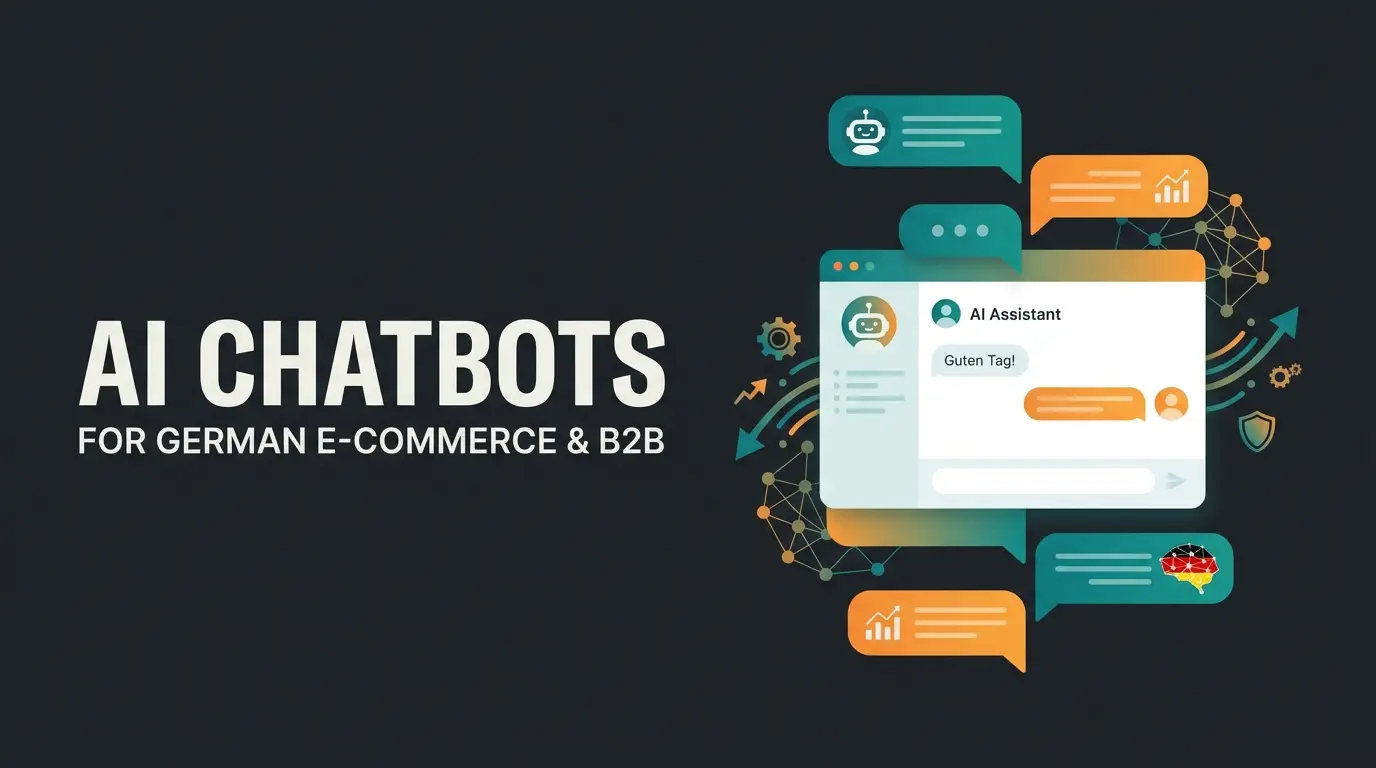
A chatbot example is a real-world deployment of conversational software that answers questions or guides a decision through chat. Recognizable ones include general assistants like ChatGPT, customer-service bots like Klarna's refund assistant, finance bots like Bank of America's Erica, and e-commerce product consultants like Neudorff's Flora that recommend the right product in seconds.
| Brand | Category | What it does | Result |
|---|---|---|---|
| Klarna | Customer service | Handles returns, refunds, and payment questions in 35+ languages | ~2/3 of chats, work of 700 agents |
| DHL | Logistics | Answers 'where is my package' and reroutes shipments 24/7 | Intercepts millions of status inquiries |
| Zalando | Fashion e-commerce | Turns a vague brief into curated outfit suggestions | Higher conversion via guided selling |
| Otto | Retail e-commerce | Summarizes hundreds of reviews into one answer | Faster purchase decisions |
| IKEA | Home & living | Visualizes room layouts and checks local stock | Bridges inspiration to purchase |
| Bank of America (Erica) | Finance | Checks balances, moves money, flags spending | Over 2 billion interactions to date |
| Neudorff (Flora) | Garden e-commerce | Product consultation on plant care, compliant with pesticide law | 97% accuracy, -99% cost per chat |
| Rasendoktor (Hektor) | Lawn-care e-commerce | Automates seasonal consultation across 2,000-3,000 inquiries | 16x ROI, 100% automation |
The end of "Sorry, I didn't understand"
Most people still picture a chatbot as a pop-up that loops you back to an FAQ page and gives up the moment you go off-script. As of 2026, that picture is outdated. The best chatbot examples now understand context, argue for one product over another, and guide a purchase, which is a different job than deflecting tickets.
Open the support inbox of a mid-sized garden retailer in May and you see the problem instantly. Hundreds of open messages, most of them the same question: which product helps against aphids? The answer sits on the product page. Everyone asks anyway.
That gap is exactly what the new generation of bots closes. According to Bitkom, roughly one in three German companies now uses artificial intelligence, close to double the share from two years earlier. What changed is the intent behind it. The bot is no longer just a cost lever for support. It is starting to act as a product consultant that moves the cart.
This guide sorts the noise. Eight named examples, three technology tiers, and one clear line between a "ticket handler" that saves money and a "sales assistant" that makes it.
The 3 evolution stages: from button clicker to AI expert
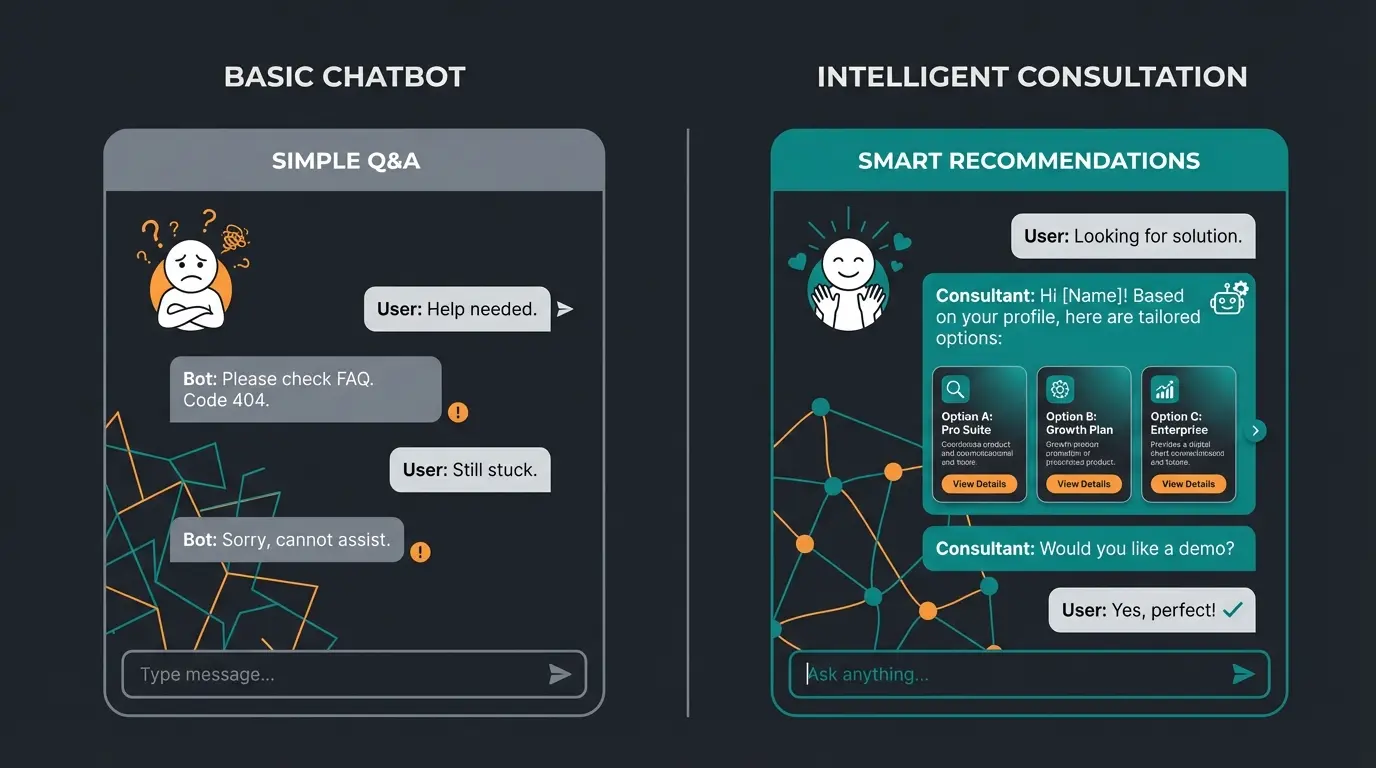
There are three different technologies hiding behind the word "chatbot," and mixing them up is why so many projects disappoint. Rule-based bots follow a script. NLP bots match keywords to FAQ answers. Generative bots built on large language models understand context and advise. Each tier solves a different problem, and only the third one sells.
Level 1: the rule-based click bot
These are the classic decision-tree bots. You click predefined buttons: "Return" then "Print label." IBM calls menu-based bots "the most basic type of chatbot," and that is precisely their strength and their ceiling.
- Strength: cheap, controllable, error-free for standard processes
- Weakness: rigid. The moment a customer asks something individual ("Does this part fit my 2018 model?"), it stalls
- Best fit: simple navigation and process automation where no personalization is needed
Level 2: the NLP FAQ bot
These bots use natural language processing to spot keywords and return the matching help article. A real step up from buttons. The catch is that they do not truly understand, they only pattern-match. Ask "I want something like X, but cheaper" and most of them fold.
- Application: classic first-level support
- Problem: they match words, they do not grasp intent. Follow-up questions and conversation context break them
- Limitation: stateless. Each message starts from zero
Level 3: the generative AI product consultant
This is where the money is. Built on large language models, these systems hold context across a conversation. They compare, they reason, they recommend, the way a strong salesperson does on the shop floor. Where a Level 2 bot forgets your last message, a Level 3 consultant remembers you hike on rough terrain and steers you to the right boot.
Button-clicking decision trees with predefined paths. Zero flexibility, fully predictable.
Keyword matching with static answers. Handles variations, but no real understanding.
Context-aware product consultation on LLMs. Compares, reasons, and guides like an expert.
Real-world chatbot examples: the new benchmark
The strongest chatbot examples in 2026 fall into three groups: maximum efficiency in service, intelligent consultation in e-commerce, and specialist B2B. Each answers a different business question. Service bots cut cost per contact. Consultation bots lift conversion and cart value. B2B bots qualify high-value leads that would otherwise leave without a trace.
Category A: maximum efficiency in customer service
This category is about absorbing huge volumes of standard inquiries, the classic "where is my order." The goal is cost and speed, not persuasion. Done well, it frees human agents for the messy cases, which is also the core promise of AI customer service when it is built on real product and order data.
1. Klarna: the two-thirds bot (and the walk-back)
Klarna delivered the most-cited support case of the decade, built with OpenAI. In its first month the assistant ran 2.3 million conversations, about two-thirds of all service chats, and by Klarna's own account was "doing the equivalent work of 700 full-time agents."
- Volume: 2.3 million conversations in month one, roughly two-thirds of service chats (Klarna)
- Efficiency: work equivalent to 700 full-time agents (OpenAI)
- Speed: resolution time dropped from 11 minutes to under 2, at comparable satisfaction
- Impact: an estimated $40 million USD profit improvement in 2024, later reframed higher as volume grew
- Scope: refunds, payments, and disputes in more than 35 languages
Here is the part the generic listicles skip. In 2025 Klarna publicly reversed course and began rehiring human agents, with CEO Sebastian Siemiatkowski conceding the company had cut too far and that lower cost had come at the expense of quality. That is not an argument against AI. It is an argument against deploying a bot without the data and guardrails to keep answers accurate.
2. DHL and logistics bots
Logistics giants deploy bots for pure data retrieval, not consultation. No advice needed, just a fast, correct answer at any hour.
- Use case: status inquiries, package rerouting, customs documents
- Value: 24/7 availability with no wait time
- Scale: a bot at DHL's volume intercepts millions of "where is my package" messages, so human agents handle exceptions and complaints
Category B: intelligent product consultation and shopping
This is where chatbot examples get genuinely interesting. These bots digitize the in-store salesperson: they ask what you actually need, then narrow thousands of products to the right few. The payoff is measured in conversion and cart value, not deflection, which is why this is the category where AI product consultation pays for itself fastest.
3. Zalando fashion assistant (the style advisor)
Zalando noticed customers rarely search by "category: dress, color: red." They have an occasion to dress for. The assistant takes a brief like "What should I wear to a wedding in Santorini in July?" and combines formality, heat, and vacation context into curated outfits instead of a 5,000-item result page.
- Scenario: a vague, human request instead of a filter query
- Performance: the assistant reasons across weather and dress-code etiquette, it does not just filter
- Result: a handful of curated looks, which lifts conversion because the bot acts as a trusted advisor
4. Otto AI assistant (the review analyst)
Otto solved a narrower problem: nobody reads through hundreds of reviews. Its assistant answers questions like "Is this coffee machine loud?" by synthesizing the review corpus and the product data into one honest sentence.
- Function: answers specific questions from hundreds of reviews plus the product description
- Guardrail: it only appears on items with enough reviews to form a reliable answer
- Value: seconds instead of 20 pages of scrolling ("Users say the grinder is quiet, the milk frother a bit louder")
5. IKEA AI assistant (the interior designer)
IKEA's assistant goes past product links into design. Ask for "a cozy living-room layout for a small apartment with sustainable materials" and it proposes ideas, then checks availability in your local store.
- Use case: open-ended design requests, not SKU lookups
- Innovation: it visualizes ideas rather than dumping a catalog
- Integration: it connects inspiration to logistics, closing the gap between dreaming and buying
6. MediaMarktSaturn "Smart Manual" (the after-sales hero)
Post-purchase support is the underrated use case. MediaMarktSaturn's "Smart Manual" bot was trained on manuals and data sheets for private-label products, so customers get the right technical answer instead of a returned appliance.
- Solution: answers questions about own-brand products from the actual manuals
- Problem solved: nobody reads printed manuals, which drives avoidable returns
- Payoff: ask "Why is the red light blinking on my washing machine?" and get the correct step, cutting returns caused by user error
7. Qualimero: AI product consultants in specialist retail (Flora, Hektor, Ella)
The named brands above prove the pattern at scale. These next three prove it works for owner-led specialist retailers too, with numbers you can check. Each is a Level 3 product consultant trained on one company's expertise, not a generic FAQ bot.
Neudorff's AI consultant Flora handles plant-care questions where the wrong recommendation can breach pesticide law. Flora reaches 97% accuracy on product recommendations, answers in under 5 seconds, and cut cost per chat by 99%. Compared with the old FAQ page, that is the difference between deflecting a question and closing a sale.
Rasendoktor's AI advisor Hektor took over 2,000 to 3,000 seasonal, consultation-heavy inquiries that used to overwhelm the support team. Hektor now automates 100% of web-chat requests, gives region-specific lawn advice around the clock, and returns 16x ROI at a 40% support saving.
HELLA Lightstyle's advisor Ella fields technically complex questions about auxiliary vehicle lighting, including ECE approval rules. Ella advises on compatibility and legality 24/7, keeping recommendations 100% compliant and reducing support inquiries by 60%. Across these accounts the pattern holds: cart value up around 35%, checkout rate up as much as 60%, and up to 16x ROI.
Rasendoktor's Hektor
HELLA Lightstyle's Ella
Typical uplift with guided AI consultation
Category C: B2B and industrial applications
B2B chatbot examples are less visible but often more valuable, because cart values and product complexity run higher. Here the job is qualification: turning a technical question the site search cannot answer into a warm, spec'd lead for sales.
8. The "sales engineer" bot
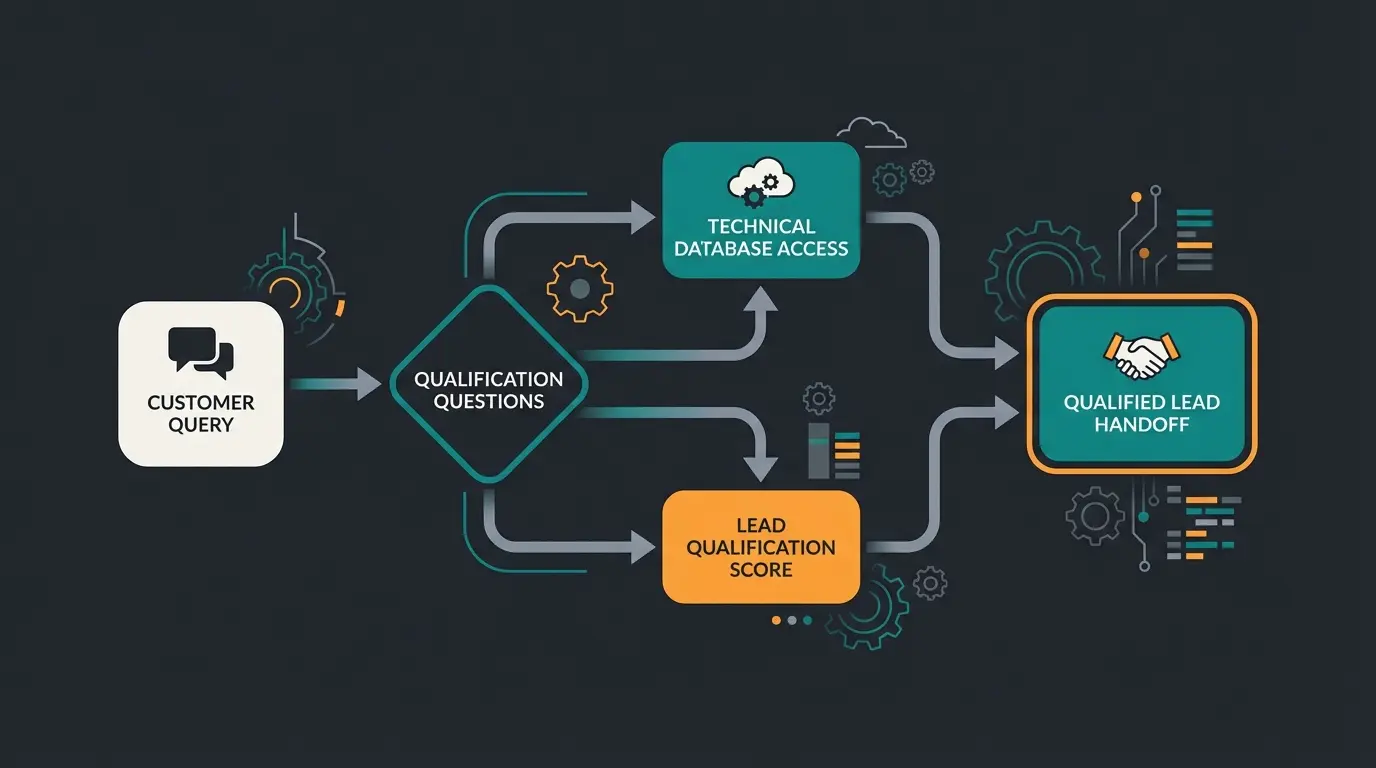
Many B2B products need explanation, and standard search fails them. A customer types "industrial adhesive for metal on plastic, heat-resistant to 200 degrees," gets zero results, and leaves. A B2B consultant bot instead asks about tensile strength and vibration, then hands a fully qualified lead to sales.
- Status quo: a precise query returns 0 results and the buyer bounces
- AI solution: the bot reads the technical documentation and responds like an engineer, 24/7
- Goal: lead qualification, handing sales a pre-warmed lead with every technical requirement attached
Deep dive: FAQ bot vs. AI product consultant
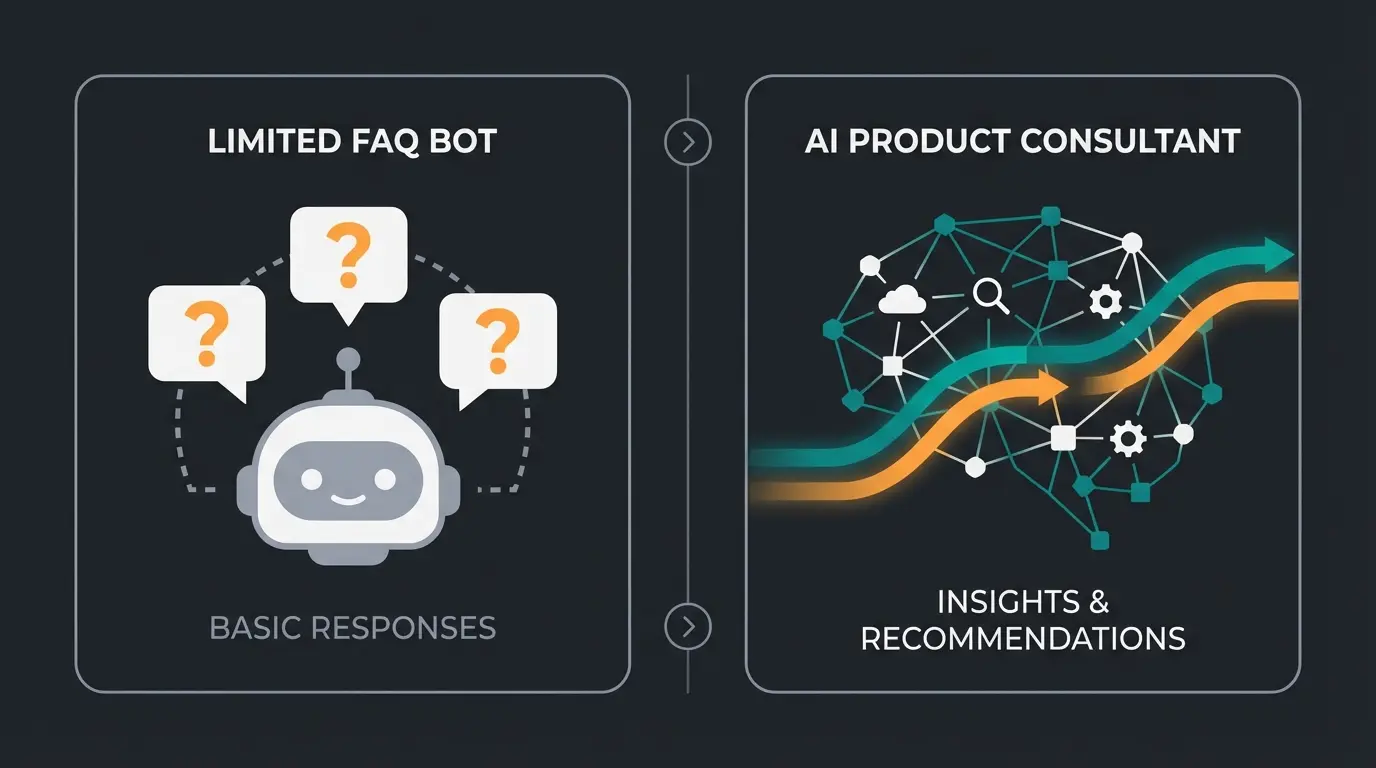
The decision before you is simple to state and easy to get wrong: do you want to save cost in support, or generate revenue in the shop? An FAQ bot deflects tickets. An AI product consultant closes purchases. They use different technology, different data, and different success metrics, and picking the wrong one wastes the budget. If revenue is the goal, the chatbot benefits for product consultation compound the more product data you feed the system.
| Feature | Classic FAQ bot (legacy) | AI product consultant (next gen) |
|---|---|---|
| Technology | Rule-based / simple NLP | Large language models / RAG |
| Data basis | Static text blocks | PIM data, manuals, reviews |
| Dialogue flow | Reactive ("ask a question") | Proactive ("what matters to you about X?") |
| Context | Forgets immediately (stateless) | Remembers preferences across the chat |
| Primary metric | Ticket deflection rate | Conversion and cart value |
| Typical outcome | Cost per contact down | Cart value up ~35%, checkout up to +60% |
| Example answer | "Here's the link to shipping costs." | "Since you hike rough terrain, take Model X over Y." |
Read that table as a rule of thumb. Where a legacy bot is stateless and reactive, a consultant is contextual and proactive. Where one optimizes for fewer tickets, the other optimizes for more completed carts. Both are valid. They are just not the same product.
Why consultation quality is the new conversion lever
Around 70% of online carts are abandoned, per the Baymard Institute, and a large share of that is indecision the shop never resolves. A bot that acts as an expert raises time on site and conversion because it answers the question a product page cannot. It brings the specialty-store experience into an anonymous online shop, which is exactly what generic listicles underweight when they only count deflected tickets.
Checklist: is your company ready for a consultation bot?
Not everyone needs a high-end AI consultant, and the honest answer is that some shops should start with a cheaper FAQ bot. Use the checklist below to decide. If most points apply to you, a Level 3 consultant will likely pay back fast. If they do not, understand what a chatbot costs before you commit, and consider a lighter WordPress chatbot as a first step.
- Product complexity: are your products explanation-heavy? (Yes = high potential for AI consultation)
- Data quality: do you have clean PIM data, data sheets, or solid FAQs to feed the AI? No data, no intelligence
- Recurring questions: does your team answer the same 50 pre-sales questions on repeat? A bot scales that infinitely
- Traffic volume: do you have enough visitors to justify it? For tiny niches, a contact form still wins
- Objective: do you want fewer tickets (Klarna approach) or more conversion (Zalando approach)?
Use cases and expected ROI by application type
Return depends on the job you give the bot. Lead qualification in complex B2B tends to pay back fastest because a single closed deal is large. Guided selling in e-commerce lands in the high range on conversion and cart value. Pure support automation delivers steady cost savings but rarely moves revenue. The table maps each use case to the right technology and the return you can reasonably expect in 2026.
| Use case | Goal | Suitable technology | Expected ROI |
|---|---|---|---|
| E-commerce product consultation | Increase conversion and cart value | LLM + PIM / product catalog | Very high, e.g. Rasendoktor 16x |
| Spare-parts finder | Reduce search abandonment | AI + PIM integration | High, prevents lost sales |
| Gift finder | Raise average order value | Generative AI | Medium-high, drives upsells |
| B2B configurator | Qualify complex leads | RAG + technical docs | Very high, large deal value |
| Style advisor | Personalized recommendations | LLM + product catalog | High, improves conversion |
| Technical support | Deflect support tickets | NLP + knowledge base | Medium, cost savings |
Conclusion: expert consultation, now for everyone
The 2026 evidence is clear: the era of mindless text-block bots is over. Klarna proved automation can carry two-thirds of support, and its 2025 walk-back proved the ceiling of doing it without quality control. The more durable trend sits in e-commerce, where Zalando, Otto, IKEA, and specialist retailers use AI to fix the one thing online shopping has always lacked, real consultation.
The gap between the recognizable brands and a mid-sized shop is smaller than it looks. AI product consultation trained on your own data is what turns Flora, Hektor, and Ella from case studies into a repeatable playbook.
Three recommendations for your business
- Start with data, not features: clean product data is the fuel. Without it, even the best model gives thin answers
- Pick your metric first: decide whether you are deflecting tickets or closing sales, then choose the tier that matches
- Build a consultant, not a greeter: a bot that only says hello wastes the budget. Build one that knows your products better than your best salesperson
The technology is here. Customers expect it. What is left to decide is whether your chatbot becomes an annoyance or your highest-revenue employee.
Frequently asked questions about chatbot examples
A chatbot is software that mimics human conversation over text or voice. Common examples in 2026 include ChatGPT (general assistant), Klarna's service bot (returns and refunds, handling roughly two-thirds of chats), Bank of America's Erica (banking), and e-commerce product consultants like Neudorff's Flora that recommend products with 97% accuracy.
The most common chatbots today are ChatGPT and Google Gemini for general tasks, Klarna and Bank of America's Erica for service and finance, and retail assistants from Zalando, Otto, and IKEA for shopping. In specialist e-commerce, AI product consultants such as Rasendoktor's Hektor automate 100% of web-chat inquiries.
Yes. ChatGPT is a chatbot built on large language model technology, designed to generate human-like text and handle a wide range of tasks. It sits in the generative tier, the same technology class that powers AI product consultants, which is a step above rule-based and keyword-matching FAQ bots.
An FAQ bot matches keywords to static answers and reacts to questions. An AI product consultant uses large language models to understand context, ask guiding questions, and recommend products, which lifts conversion rather than just deflecting tickets. It is the difference between a vending machine and a knowledgeable salesperson, and typically the difference between cost savings and a cart-value uplift of around 35%.
Costs range widely. A simple FAQ bot can start at a few hundred euros per month, while an enterprise-grade product consultant needs investment in data infrastructure and integration. The return can be substantial, from Klarna's estimated $40 million profit improvement to Rasendoktor's 16x ROI. Start with a focused pilot to validate return before scaling.
Not entirely, and Klarna is the cautionary tale. Its bot did the work of 700 agents, yet in 2025 the company rehired humans after quality complaints on complex cases. The proven approach is hybrid: AI handles volume and routine consultation, humans take exceptions and high-stakes decisions.
Flora, Hektor, and Ella prove it: an AI product consultant trained on your data lifts cart value by around 35% and returns up to 16x ROI. See what one could do in your shop.
Start your free trial
Lasse is CEO and co-founder of Qualimero. After completing his MBA at WHU and scaling a company to seven-figure revenue, he founded Qualimero to build AI-powered digital employees for e-commerce. His focus: helping businesses measurably improve customer interaction through intelligent automation.