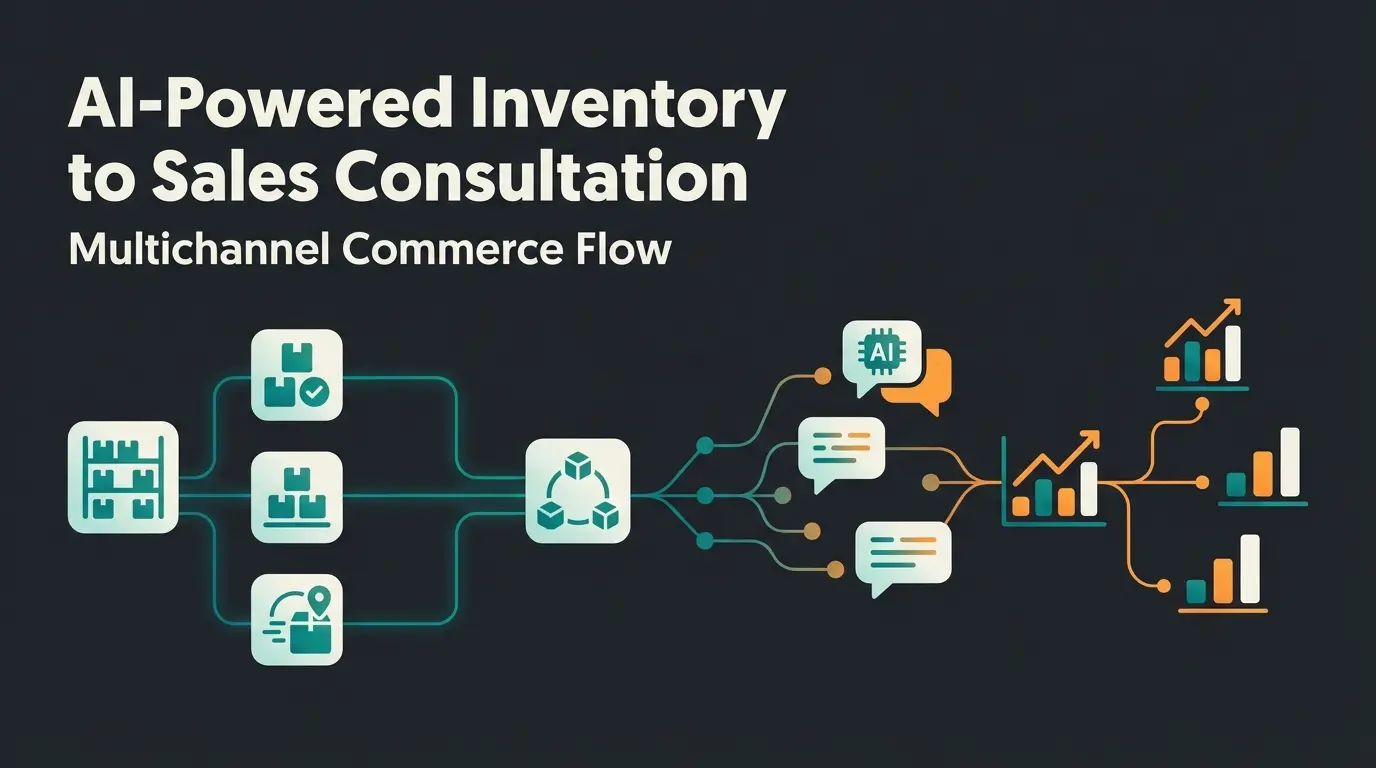
When Inventory Chaos Devours Your Growth
Picture this: Your Shopify store is on fire. Orders are pouring in. But behind the scenes, everything is burning: You just sold the last pair of hiking boots twice—once on Amazon, once in your shop. The inventory count was wrong. Now you have to disappoint a customer. Or worse: A customer asks in chat for an alternative to a sold-out product, and your support team needs 20 minutes to look it up in the system. The customer is long gone.
This is the reality for many e-commerce businesses that still view their inventory management system (ERP/WaWi) as a pure administrative tool. According to industry analysis from itprotoday.com, agentic AI and hyper-personalization now dominate the market landscape.
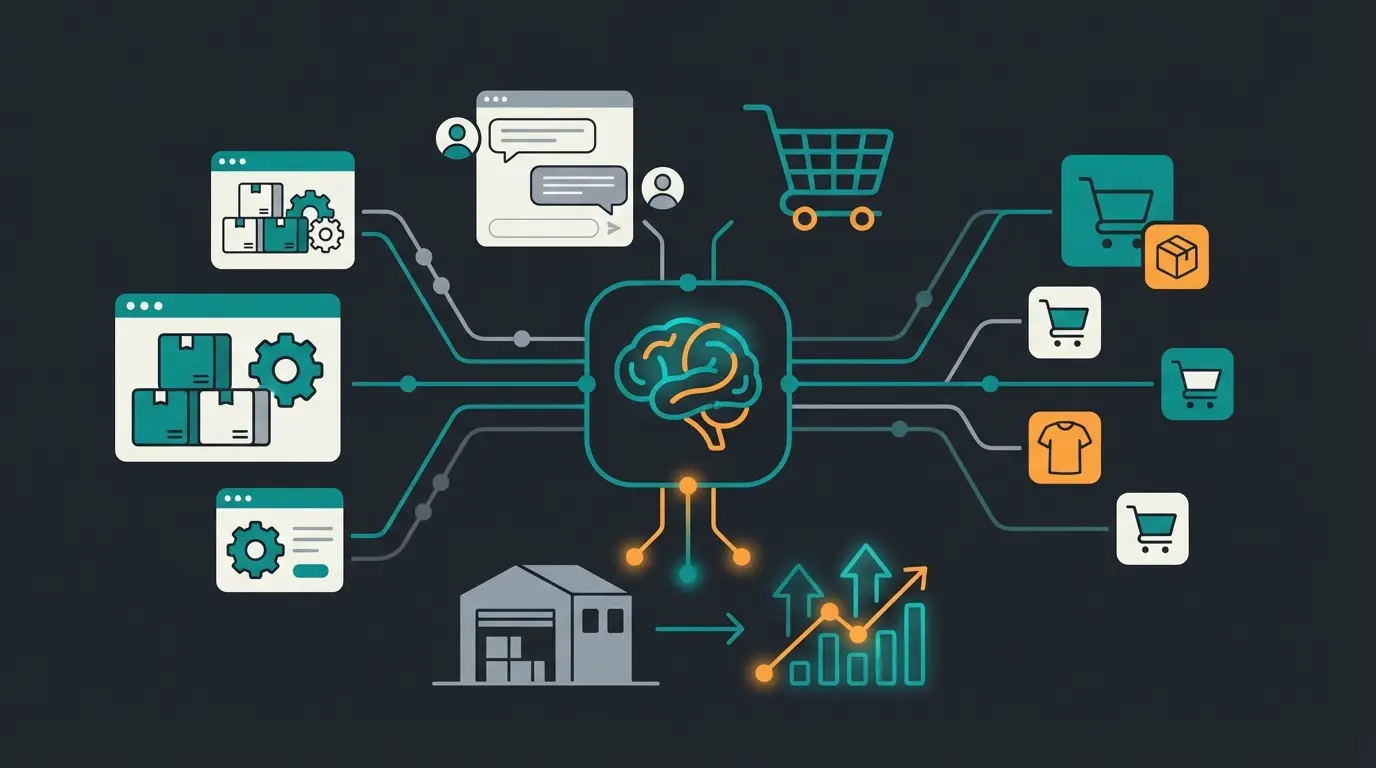
For a long time, the equation was simple: Inventory management = Logistics & Accounting. It was all about dry topics like pick lists, delivery notes, and stock reconciliation. But in 2025, the tables have turned. In an era where Agentic AI (autonomous AI agents) and hyper-personalization dominate the market, your Shopify inventory management system becomes the brain of your entire business.
This article isn't just another dry feature comparison. We'll show you not only the best Shopify ERP systems for every budget but also reveal the secret of how to use this data to transform a "silent" inventory into an active sales consultant. Companies leveraging AI-powered customer service are already seeing remarkable results in customer satisfaction and conversion rates.
Why Shopify Needs a Dedicated ERP System
Shopify is undoubtedly one of the best e-commerce systems in the world. But is Shopify also an inventory management system? The short answer: Sort of, but not really.
The Limits of Native Shopify Inventory Management
For beginners who only operate one channel (the online shop) and have fewer than 50 SKUs (Stock Keeping Units), Shopify is perfectly sufficient. You can track inventory, create SKUs, and make simple adjustments. But as soon as you grow, you hit the "Complexity Wall" as documented by loopwork.co and thetransformagency.com:
- Multichannel Synchronization: As soon as you sell on Amazon, eBay, or other marketplaces, manual inventory reconciliation becomes a nightmare. Without a central Shopify ERP connection, overselling is inevitable.
- Complex Products: Shopify struggles natively with Bills of Materials for bundles or sets (e.g., "Wellness Gift Set" consists of 1x Soap, 1x Towel). If the soap is sold individually, the set's inventory must automatically decrease.
- Purchasing & Supplier Management: Shopify tells you what you've sold, but it hardly helps you determine when you need to reorder where and at what price (Purchase Orders).
- B2B & Price Lists: Individual price lists for wholesale customers or tiered volume discounts often overwhelm the standard backend without expensive Plus apps.
The "Single Source of Truth" Concept
An external inventory management system functions as the single source of truth. Whether sales happen through Instagram, the Shopify store, phone orders, or in-store (POS)—the ERP centralizes all data flows. This centralization becomes even more powerful when combined with AI lead generation strategies that leverage accurate inventory data.
Top Shopify ERP Systems Compared (2025 Edition)
The market for inventory management systems is densely populated. Based on current market data and user feedback, we've analyzed the most relevant players for Shopify merchants.
Billbee: The Agile All-Rounder for Startups & D2C
Best for: Startups, small brands, solopreneurs.
Billbee is often called the "gateway drug" into the world of inventory management—and that's meant as a compliment. It's not strictly a classic, heavy ERP software, but an extremely flexible middleware that automates order processing, invoicing, and shipping. As detailed by pulpowms.com and the official Billbee documentation, the platform excels at automation.
- Cost: Very affordable, transaction-based model. No high fixed costs.
- Integration: Seamless Shopify ERP connection set up in minutes.
- Automation: Strong "if-then" rules (e.g., "If Country = Switzerland, then net invoice + CN23 form") as explained in their automation guide.
- Limitations: Hits walls with complex warehousing (chaotic storage, multiple locations) and deep purchasing management.
Xentral: The Scaling Powerhouse (Lean ERP)
Best for: Growing e-commerce brands, "Shark Tank" startups, mid-market companies.
Xentral has positioned itself as a "Lean ERP" and targets merchants who've outgrown their startup phase but dread SAP's complexity. According to their official platform, the system offers over 1,000 integrations.
- Process Engine: Very strong in automating logistics processes.
- Interfaces: Over 1,000 connections, deep Shopify integration as documented in their API documentation.
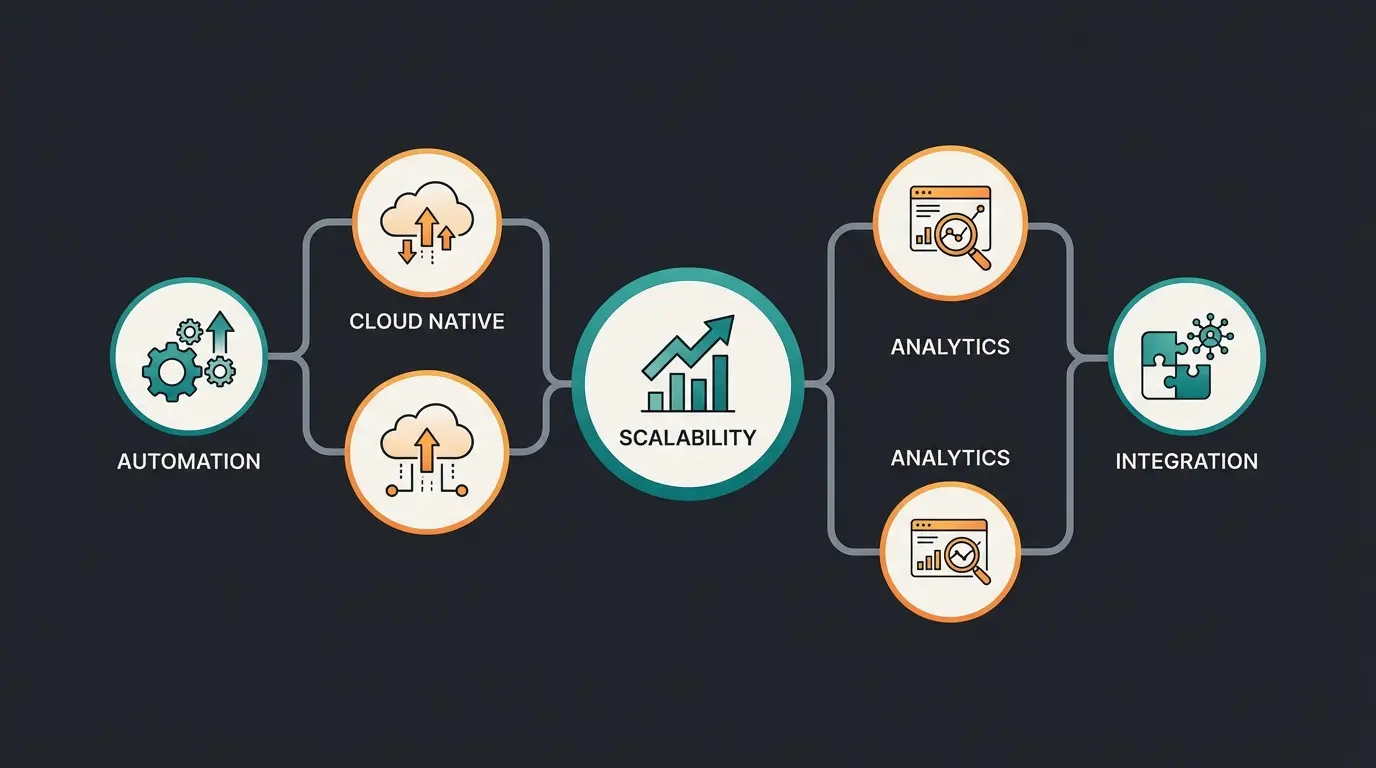
- Modernity: Cloud-native approach, meaning no installation on your own servers required.
- Considerations: Implementation requires time and often an onboarding partner. Costs increase with feature scope.
JTL-Wawi: The Market Leader with Community Power
Best for: Multichannel sellers with high volumes, eBay/Amazon focus.
JTL is a veteran in German e-commerce. Originally strongly on-premise (Windows-based), JTL is increasingly opening up to the cloud and modern features. Their software overview shows the extensive capabilities.
- Free (Basic): The software itself is license-free in the basic version (you pay for modules/hosting).
- Feature Depth: Extremely powerful. There's hardly a scenario JTL can't handle.
- AI Integration: JTL now integrates AI features (like ChatGPT) for creating product descriptions and SEO texts directly in the system, as announced on their official blog and feature updates.
- Considerations: The user interface can feel dated; steep learning curve. You often need service partners for setup.
PlentyONE: The Marketplace Monster
Best for: Merchants selling internationally on many marketplaces (Zalando, Otto, Amazon global).
In November 2024, Plentymarkets was rebranded to PlentyONE to emphasize the unification of shop, marketplace connection, and ERP as detailed on plentyone.com.
- All-in-One: ERP, PIM (Product Information Management), and listing tool in one package.
- Marketplaces: Arguably the best marketplace connection available according to their marketplace overview.
- Considerations: Known as complex to set up ("Plenty jungle"). The pricing model can be opaque for smaller merchants.
Weclapp: The Cloud ERP for Teams
Best for: Merchants who also offer services or need strong CRM functionality.
Weclapp scores with an extremely modern, clean interface and has strong roots in CRM (Customer Relationship Management) as showcased on weclapp.com.
- Usability: Regularly wins awards for user-friendliness.
- CRM Focus: Better than pure ERPs when it comes to customer records and sales processes.
- AI Features: Investing heavily in AI-powered automation and forecasting according to their AI features page and automation updates.
Comparison Table: Shopify ERP Systems Overview
| Feature | Billbee | Xentral | JTL-Wawi | PlentyONE | Weclapp |
|---|---|---|---|---|---|
| Target Group | Starters / Solopreneurs | Scale-ups / Mid-market | Power sellers / Pros | Multichannel experts | Teams / Hybrid models |
| Cost Model | Transaction-based (low) | Monthly license (mid/high) | Modular (basic free) | Revenue-based / Packages | User-based (SaaS) |
| Cloud/On-Prem | Cloud | Cloud | Hybrid (often cloud hosting) | Cloud | Cloud |
| Strength | Simplicity & Automation | Scalability & Processes | Feature depth & Community | Marketplace variety | Usability & CRM |
| AI Maturity | Basic rules | Process automation | Content creation (GPT) | Marketplace optimization | CRM & Forecasting |
The Missing Link: How ERP Data Fuels Your Revenue
This is where the wheat separates from the chaff. Most articles stop after the comparison. We're just getting started. Using a Shopify inventory management system only for administration is like driving a Ferrari only in first gear. Businesses implementing AI product consultation are discovering the true potential of their inventory data.
Why "Storage" Is Only Half the Battle
Classic ERP articles focus on backend efficiency: How do I print labels faster? How do I avoid picking errors? That saves costs. But it doesn't generate new revenue.
The Blue Ocean Strategy for 2025 is: Data Utilization. Use the data dormant in your ERP (attributes, variants, inventory levels, return reasons) to radically improve the customer experience on the frontend (Shopify). This approach is similar to how AI Employee 'Kira' transformed customer interactions for garden supplies retailers.
Could be rescued with real-time stock alternatives
Achievable through AI-powered pre-purchase consultation
When customers receive instant product recommendations
When alternatives are proactively suggested for out-of-stock items
From ERP to AI Sales Consultant
In an ERP like JTL or Xentral, structured data resides: Article A is a "hiking pants." Attributes: "waterproof", "red", "size M." Stock: "0." Delivery date: "in 3 weeks."
A dumb shop shows the customer: "Out of Stock". The customer leaves.
An intelligent shop connects the ERP via API to an AI agent (e.g., based on GPT-4 or specialized e-commerce bots). This is exactly how AI product consultation works in practice, transforming static inventory into dynamic sales opportunities.
The Future Scenario
Instead of leaving the customer alone with an "Out of Stock" badge, the AI recognizes inventory levels in real-time:
- ERP reports: "Pants Red M = Stock 0"
- AI analyzes: "Customer is looking for waterproof pants in M"
- AI checks ERP: "Pants Blue M = Stock 5" OR "Alternative model 'Mountain Pro' = Stock 10"
- Action: The chatbot or product page proactively reports: "The red pants are unfortunately gone, but I have the same model in Blue reserved for you—or the 'Mountain Pro', which even has a higher water column. Shall I show you?"
This is the "Customer Experience Gap" you can close. You use inventory data not for administration, but for sales rescue. Companies like those featured in our product consultation success story have seen dramatic improvements in conversion rates using this approach.
See how AI employees can leverage your ERP data to provide intelligent product consultation, rescue abandoned carts, and reduce returns by up to 45%.
Get Started FreeCase Study: "The Intelligent Shop"
Let's walk through this with a concrete example. Suppose you run a Shopify store for coffee accessories. This scenario mirrors what lead generation implementations have achieved for specialty retailers.
Situation: A customer chats with your store bot: "Do you still have the Barista Machine XZ500 in stock?"
Workflow Without Intelligent ERP Connection
- Bot (Standard): "Please check the product page."
- Customer clicks, sees "Out of Stock", is frustrated, buys on Amazon.
Workflow With ERP + AI Integration
Using a system like PlentyONE connected to a chatbot (similar to how AI chat implementations work):
- Intent Recognition: The bot understands the purchase intent.
- Real-Time API Call: The bot queries the ERP (PlentyONE): Status SKU 12345?
- Data Feedback: ERP responds: Stock 0. But: Delivery expected on March 15th (in 3 days).
- Intelligent Response: The bot answers: "The XZ500 is currently out of stock, but according to our system, it arrives on Tuesday! Would you like to pre-order and secure a 5% waiting discount? Alternatively, the XZ600 (successor) is immediately available."
The Results
- The customer feels consulted, not dismissed.
- The conversion is saved (pre-order or upsell).
- The return rate drops because the AI can ensure the alternative really fits (by comparing technical attributes in the ERP).
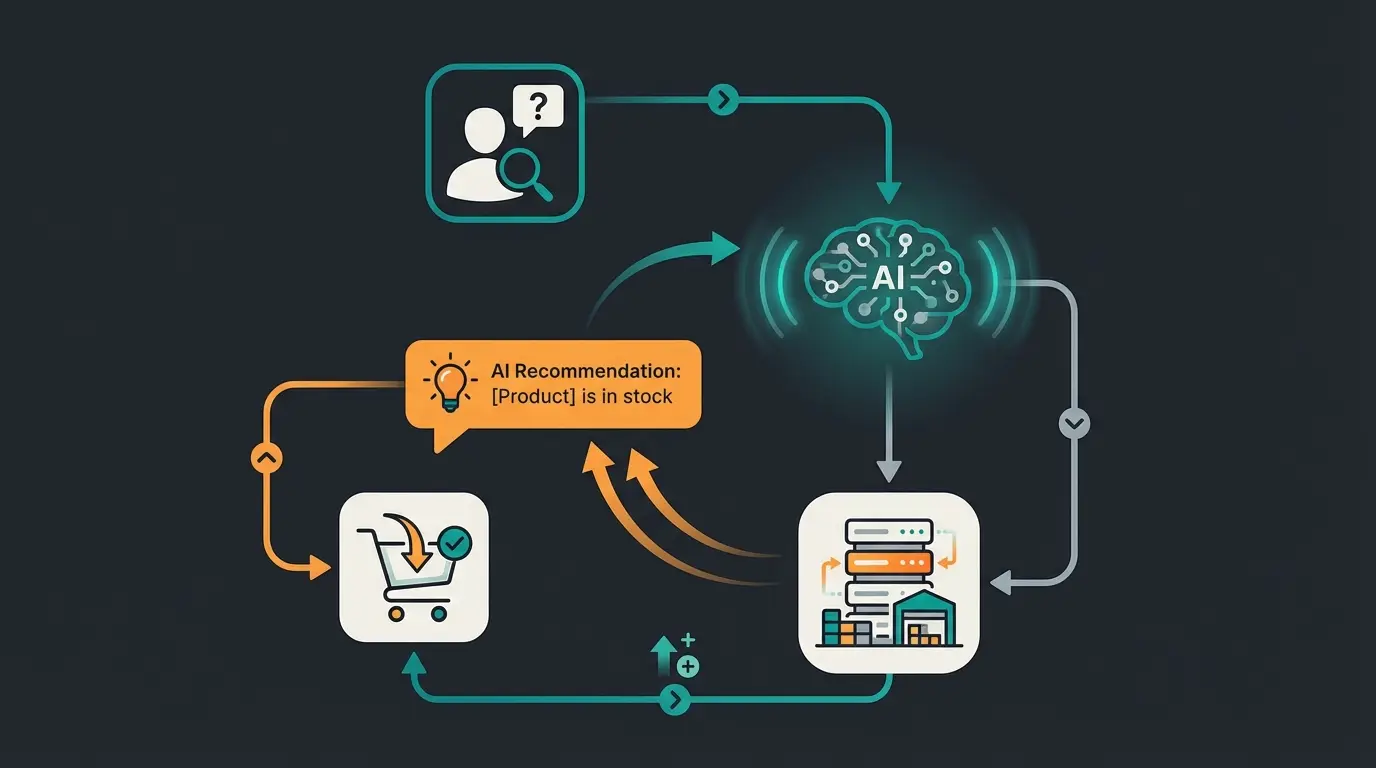
Customer asks about product availability or specifications in chat
AI agent identifies purchase intent and extracts product requirements
AI checks inventory levels, specs, and alternatives via API
AI formulates personalized recommendation with alternatives
Customer purchases, ERP updates stock, Shopify syncs automatically
Checklist: What to Look for in a Modern ERP
When evaluating a Shopify ERP in 2025, throw out the old checklists. Here's what really matters, whether you're implementing basic inventory management or advanced AI product consultation systems:
The Standards (Must-Haves)
- Deep Shopify Integration: Are tags, metafields, and locations (multi-location) synchronized?
- Multichannel Capability: Can the system handle Amazon, eBay, and other marketplaces simultaneously without chaos?
- Automation: Is there a "workflow engine" (like Billbee or Xentral) that allows "if-then" scenarios?
- Scalability: Does the system grow with you (from 100 to 10,000 orders/month)?
The "Game Changer" Criteria (2025 Features)
- API-First Approach: How easily can I access the data? Is there a REST API or GraphQL that I can connect to AI tools like ChatGPT or Make.com? This is crucial for AI employees integration.
- Consultation-Ready Data: Does the ERP allow maintaining consultation-intensive attributes (e.g., "Pairs with...", "Care instructions") that an AI can read?
- AI Features Included? Does the manufacturer already offer their own AI modules (e.g., JTL's SEO writer or Tricoma's image cutout feature as shown on tricoma.de and tricoma.ai)?
- Real-Time Synchronization: Polling intervals of 15 minutes are too slow in 2025. Is true real-time sync possible to prevent "overselling" during flash sales? According to aerochat.ai, this is becoming a critical differentiator.
Classic vs. Intelligent Automation Comparison
| Feature | Standard ERP Setup | AI-Enhanced ERP Setup |
|---|---|---|
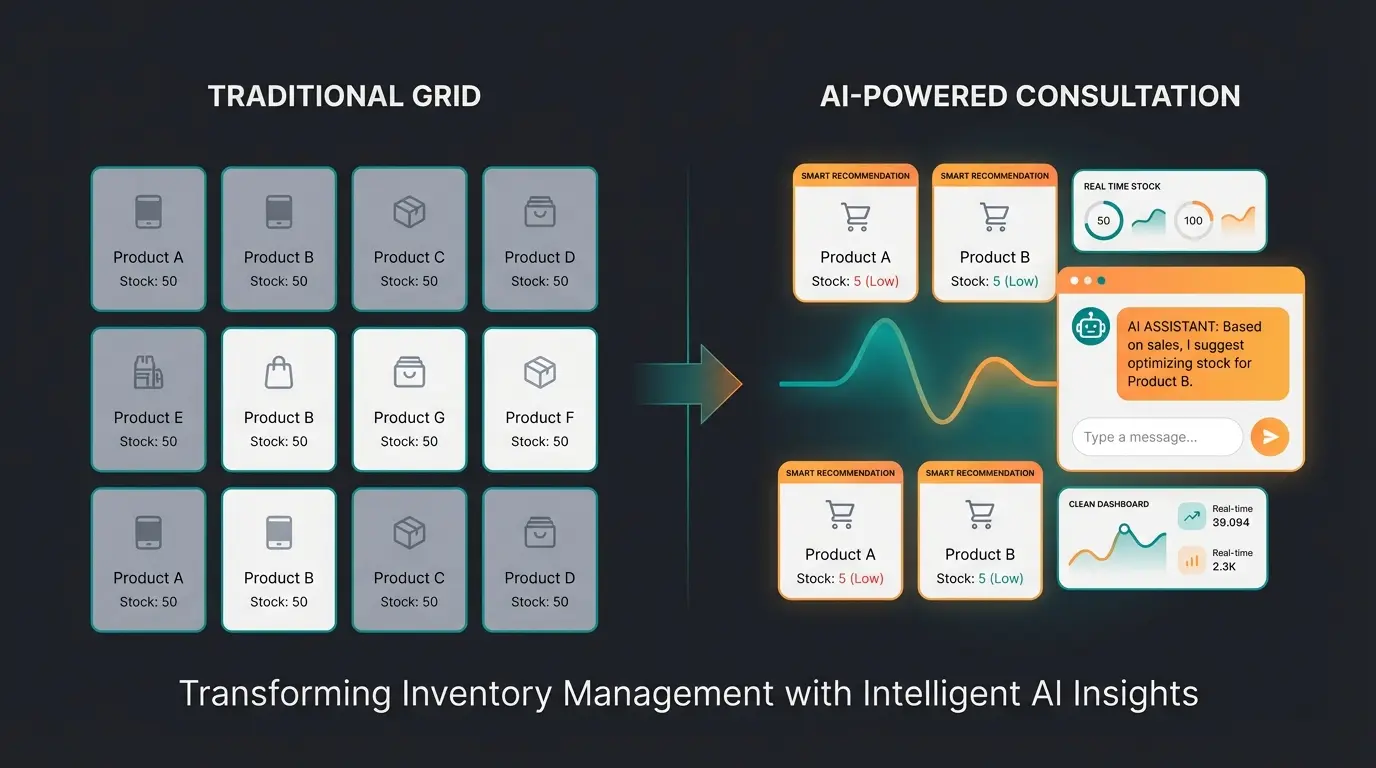
| "Out of Stock" | Shows "Sold Out" badge | Suggests specific alternative via chat |
| Product Questions | User reads FAQ | AI answers based on real-time ERP data |
| Returns | Manages return label | Prevents return via pre-purchase consultation |
| Customer Intent | Unknown until checkout | Recognized and addressed proactively |
| Cross-Selling | Generic "You might also like" | Personalized based on query + inventory |
Choosing the Brain, Not Just the Warehouse
The search for the perfect inventory management for Shopify is no longer just a logistics decision in 2025. It's a strategic fork in the road for your marketing and sales. Companies implementing advanced systems with lead qualification capabilities are seeing significant competitive advantages.
- Start lean: If you're small, use Billbee to automate processes without overextending financially.
- Scale smart: As you grow, look at Xentral or PlentyONE to tame multichannel complexity.
- Think further: Regardless of which system you choose—always ask: "How do I get the data out of here to better advise my customers?"
The future belongs to merchants who use their inventory management not as a dusty archive, but as a living data source for intelligent customer interactions. Transform your warehouse into your best salesperson. Ready to see how this works in practice? You can book a demo to explore the possibilities for your specific use case.
FAQ: Common Questions About Shopify ERP Systems
For very small shops, yes. But Shopify lacks functionality for purchasing (ordering from suppliers), complex warehouse management, and deep automation across multiple sales channels. Once you're selling on multiple platforms or handling more than 50-100 SKUs, a dedicated ERP becomes essential for maintaining accuracy and efficiency.
Costs vary significantly. Entry-level solutions like Billbee start at just a few cents per order (transaction-based). Mid-market solutions like Xentral or Weclapp often start at around €100-200 per month but can quickly reach four figures with enterprise features (PlentyONE, JTL Enterprise). Consider the total cost of ownership including setup, training, and integration costs.
Usually via interfaces (APIs). Modern tools like Make (formerly Integromat) or Zapier can serve as the 'glue' to send data from your ERP (e.g., 'Stock low') to AI tools (e.g., ChatGPT API), which then trigger actions (e.g., write marketing email or instruct chatbot). The key is choosing an ERP with a robust, well-documented API.
The software license for JTL-Wawi is free in the basic version. However, costs arise for database hosting, support, and special modules like the JTL Connector for Shopify or marketplace connections. Many merchants spend €50-200/month on hosting and additional modules even with the 'free' base software.
In German-speaking markets, 'WaWi' (Warenwirtschaft) specifically refers to inventory and merchandise management, while ERP (Enterprise Resource Planning) is a broader term encompassing all business processes. Most modern 'WaWi' systems have evolved into full ERP solutions, but the terms are often used interchangeably in e-commerce contexts. For Shopify merchants, the key is finding a system that handles inventory, orders, and ideally integrates with AI consultation tools.
Join forward-thinking merchants who use AI employees to transform static inventory data into dynamic sales conversations. Start free and [hire an AI](/en/sign-up) that knows your products inside and out.
Start Your Free Trial