
Introduction: From Warehouse Manager to Sales Genius
If you're searching for an eBay inventory management solution today, you probably have an acute problem: chaos. Orders are flooding in, stock levels don't match reality, and manually creating shipping labels is robbing you of sleep. This is the classic entry point for every online seller. You're looking for order in the madness.
But in 2025, order alone is no longer enough to dominate the fiercely competitive eBay marketplace. While most sellers are still searching for software that merely "counts" their inventory, market leaders are already seeking systems that "understand" their stock and actively sell it.
The landscape of eBay seller software has shifted dramatically. It's no longer just about avoiding overselling. It's about leveraging the data sleeping in your inventory system to increase conversion rates and reduce expensive return rates. According to boerse.de, return rates in e-commerce are alarmingly high—reaching up to 50% in the fashion sector alone.
In this comprehensive guide, we'll illuminate the status quo of eBay inventory management systems in Germany, analyze the dominant players like JTL and Billbee, and show you why the next generation of inventory management doesn't sit in the warehouse—it stands virtually on the sales floor.
The 3 Pillars of Modern eBay Inventory Management
To understand why many sellers stagnate despite expensive software, we need to divide inventory management functions into three evolutionary stages. Most systems cover stages 1 and 2 but fail at stage 3—and that's exactly where your untapped revenue potential lies.
1. Logistics & Synchronization (The Standard)
This is the foundation. An eBay stock management system must ensure that an item sold on eBay is immediately marked as "sold" in your own online shop or on Amazon.
- Stock synchronization: Real-time syncing to prevent overselling. eBay mercilessly penalizes sellers with high cancellation rates in their search rankings.
- Multichannel control: Central management of eBay, Amazon, Kaufland, and Shopify from one dashboard.
- Goods receipt: Scanning and booking new deliveries into the system efficiently.
2. Automation (The Obligation)
This is where you save time. Good systems like Billbee or JTL-Wawi excel in this area.
- Document generation: Automatic creation of invoices and delivery notes.
- Shipping: Printing DHL/Hermes labels with one click and automatic upload of tracking numbers to eBay.
- Payment reconciliation: Matching PayPal or bank payments to open orders automatically.
3. Consultation (The New Excellence Standard for 2025)
This is where the wheat separates from the chaff. A modern eBay inventory management solution shouldn't just store data—it should use it actively for sales.
- Pre-sales consultation: Can your software automatically answer customer questions like "Does this part fit my Golf 7?" based on stored attributes?
- Return prevention: Does the system recognize when a customer buys two incompatible items and warn them before shipping?
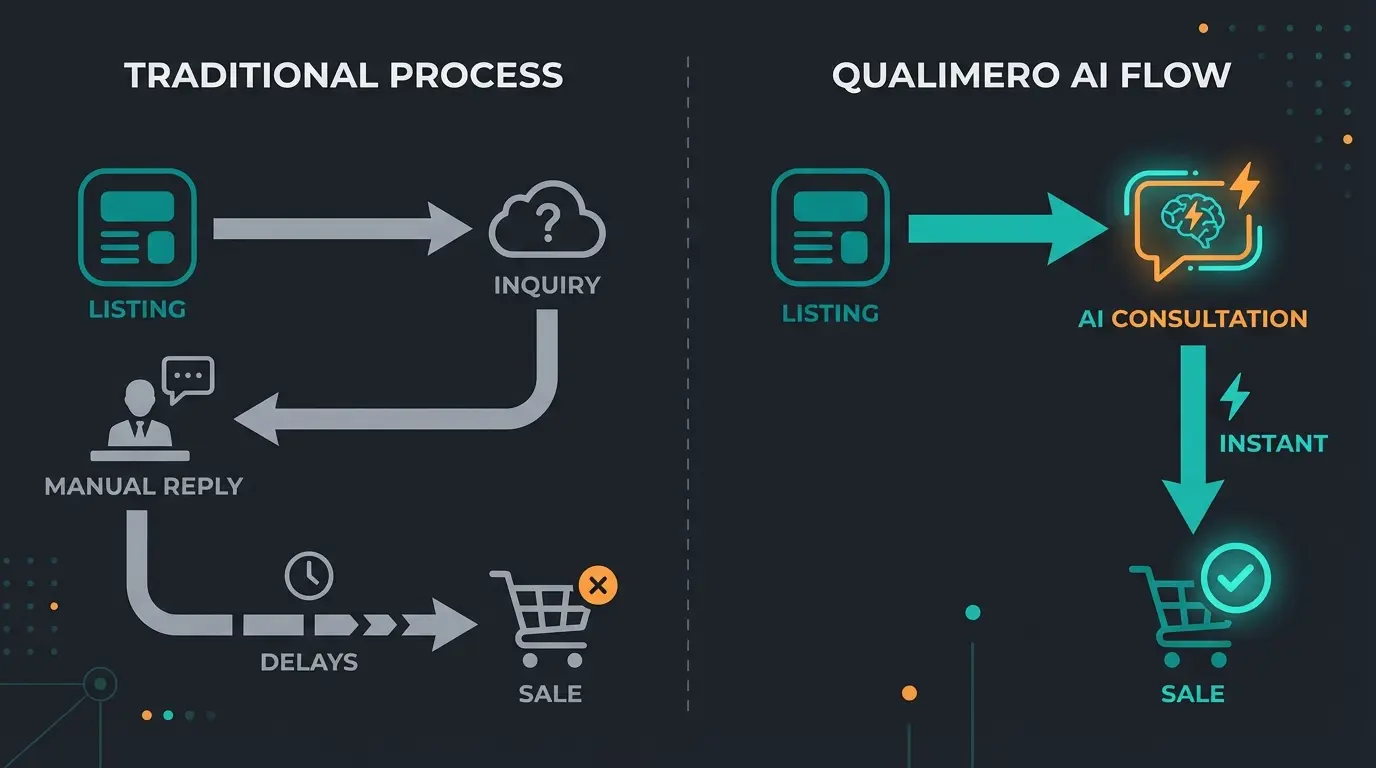
- Active selling: Most inventory systems are reactive (order comes in → stock decreases). The new generation is proactive (customer asks → AI advises → order comes in).

Classic Inventory vs. AI-Driven Commerce Intelligence
Market leader JTL-Software and challengers like Vario have begun integrating AI features. However, an analysis of current capabilities shows that the focus often remains on content creation (generating texts) rather than customer interaction. According to JTL-Software, their AI integrations primarily focus on text generation and SEO optimization.
Here's a direct comparison between what the market currently offers and what's actually possible:
| Feature | Classic eBay Inventory (JTL, Billbee, Vario) | Next-Gen AI Inventory (Consultation Focus) |
|---|---|---|
| Stock Synchronization | ✅ Yes, basic function | ✅ Yes, basic function |
| Shipping Labels | ✅ Yes, highly automated | ✅ Yes, integrated |
| AI Usage | ⚠️ Generative: Creates product texts & SEO titles | 🚀 Consultative: Answers technical buyer questions |
| Customer Communication | ❌ Manual or simple text templates | ✅ AI Agents: 24/7 consultation based on product data |
| Return Management | ⚠️ Reactive: Processes returns after receipt | 🚀 Preventive: Clarifies uncertainties before purchase |
| Data Depth | Stores attributes (size, color, weight) | Understands attributes (compatibility, application) |
The Problem with Current Market Leaders
Providers like Vario advertise AI features that are often still in beta phase or limited to forecasting and text generation, as noted on Vario-Software. JTL offers ChatGPT integrations through partners and interfaces that are excellent for optimizing thousands of product descriptions, as detailed in their plugin documentation. That's valuable for SEO, but it doesn't solve the problem of the customer who wants to know on Saturday evening whether the cordless screwdriver is suitable for concrete walls.
Current top tools offer no automated buyer guidance
High returns due to purchase uncertainty
Manual customer service delays cause lost sales
Why "Listing Faster" Is a Trap in 2025
A common sales argument from tools like Afterbuy or Xentral is the ability to create mass listings. "List 10,000 items in 5 minutes!" sounds tempting. But in 2025, this is often a trap.
Quantity Over Quality Leads to Returns
When you upload 10,000 items with generic data to eBay, you're provoking inquiries and mispurchases. Every return costs you not just postage but also processing time and eBay ranking points. The marketplace algorithm penalizes sellers with high return and cancellation rates, making it increasingly difficult to gain visibility.
The "Smart Inventory" Strategy
Instead of simply "pumping up" data, intelligent eBay stock management must function as a knowledge database. Consider this scenario: A customer searches on eBay for a replacement part.
- Classic approach: They read the (often sparse) description, feel uncertain, buy on spec—and then return it.
- The AI approach: They ask a question through eBay's messaging system. Your inventory AI analyzes the question, checks the item's technical attributes in milliseconds, and responds: "Yes, this part fits, provided your model was manufactured after 2020."
The result: Higher conversion, fewer returns. This consultative approach transforms your inventory system from a passive database into an active sales tool.
Stop managing chaos and start creating sales. See how AI-powered consultation can reduce your return rates and boost conversions.
Start Free TrialTop eBay Inventory Management Systems in Germany
Before we address the solution, a look at the current market is essential. Which system fits whom? Understanding the strengths and limitations of each platform helps you make an informed decision.
1. JTL-Wawi (The Market Leader)
JTL is the standard in Germany for ambitious eBay sellers. Their comprehensive ecosystem has made them the go-to choice for serious e-commerce operations.
- Strengths: Free basic version, extremely powerful "eazyAuction" interface, massive partner network.
- AI Status: Offers ChatGPT connections for text creation and translation through the "AI-Texting" plugin and workflows, as documented by IT-Schober.
- Best for: Sellers with complex requirements and technical understanding who need maximum flexibility.
2. Billbee (The Beginner Favorite)
Billbee isn't a classic ERP but rather a lean middleware solution that bridges multiple platforms seamlessly.
- Strengths: Cloud-based, extremely quick to set up, affordable, intuitive interface. Perfect for multichannel selling across Etsy, eBay, and Shopify, as highlighted on Billbee.io.
- AI Status: Focus lies on process automation through rules rather than AI content or consultation.
- Best for: Startups, D2C brands, and sellers who "just want to sell" without complex infrastructure.
3. Vario (The SMB Professional)
Vario positions itself as a robust "Made in Germany" solution with deep integration capabilities for established businesses.
- Strengths: Strong logistics processes, own production capabilities, connection to brick-and-mortar retail. Their new "Vario Cloud" promises modern architecture, as shown in their YouTube presentations.
- AI Status: AI features are firmly anchored in the roadmap, including order suggestions and data analysis, though some are still in development.
- Best for: Established companies with warehouses and physical retail locations.
4. Xentral (The Next-Gen ERP)
Xentral targets fast-growing e-commerce brands with modern expectations, as detailed on ERPSoftwareBlog.
- Strengths: Modern UI, strong reporting dashboards, "Agentic ERP" vision for the future of commerce.
- AI Status: Uses AI for data entry automation and reporting analyses, with their roadmap outlined on Xentral.com.
- Best for: Scaling startups looking for a modern, growth-oriented platform.
Prevent overselling with real-time inventory updates across channels
Automate labels, invoices, and payment reconciliation
Transform stored data into active pre-sales guidance
Anticipate customer needs and reduce returns before they happen
How AI Bridges the Gap Between Warehouse and Sales
The systems mentioned above are excellent at managing your logistics. But they leave the customer alone at the moment of purchase decision. This is where the approach of consultative inventory management comes into play.
From Data Cemetery to Sales Consultant
Your eBay inventory management system is full of valuable data: dimensions, materials, compatibilities, care instructions. Usually, this data "dies" in static description fields, never actively serving the customer's decision-making process.
An AI-powered solution connects to this data and makes it "conversational." Here's how it works:
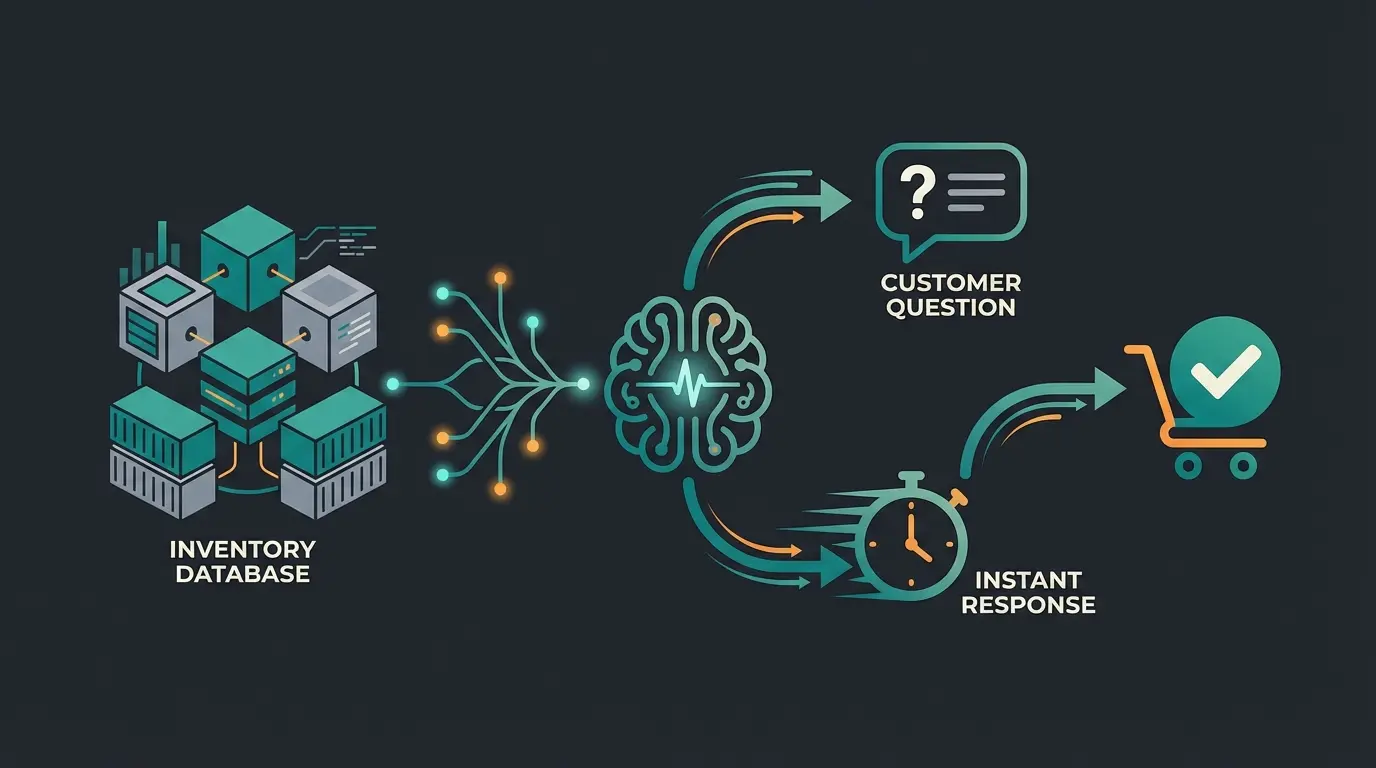
- Data Ingestion: The AI reads not just the title but all meta fields and attributes from your inventory system.
- Context Understanding: It understands that "IP67" for an outdoor lamp means the customer can leave it out in the rain.
- Interaction: When a question comes in via eBay, the AI generates not a generic "We'll get back to you" email, but a precise technical answer.
Practical Example: Auto Parts Trading
Let's examine a real-world scenario that demonstrates the power of consultative inventory management:
- Customer Question: "Does the control arm also fit the BMW E46 wagon?"
- Standard Inventory Response: No reaction or manual review by staff (duration: 4-24 hours). Customer buys elsewhere in the meantime.
- AI Solution Response: Checks vehicle compatibility list in the inventory system → Recognizes "E46 Touring" as compatible → Responds in under 2 minutes: "Yes, this control arm fits all E46 Touring models from model year 1999 onwards." → Sale completed.
Case Study: 50% Fewer Questions, 20% More Revenue
Let's consider a realistic case of an electronics seller on eBay who receives approximately 50 inquiries daily about technical specifications. This scenario illustrates the transformative potential of AI-powered consultation.
The Starting Situation
- Two employees spend half their day answering eBay messages about product specifications
- Average response time: 6 hours during business hours, often 24+ hours on weekends
- Many customers abandon their purchase while waiting for answers
- High return rates due to customers buying "on spec" without confirmation
The Implementation
Integration of an AI consultation layer on top of the existing JTL inventory system, connecting product attributes directly to an intelligent response engine.
Results After 3 Months
Technical questions answered automatically by AI
Staff now handles only complex escalations
Faster answers lead to confident purchases
Additional benefits included improved eBay seller level due to extremely fast response times, which positively impacted search visibility. The team could redirect their focus from repetitive inquiries to strategic growth activities and handling genuine customer service escalations.
Conclusion: Your 2025 Inventory Management Checklist
Choosing the right eBay seller software in 2025 isn't a decision between "JTL or Billbee." It's a decision about how you want to run your business: reactively managing or proactively consulting?
The established systems (JTL, Billbee, Xentral) form the indispensable backbone for your logistics. But to compete successfully, you need an intelligence layer on top that transforms your inventory data into sales arguments.
Is Your Inventory System Ready for 2025?
- Basic Check: Does inventory synchronization to eBay work in real-time (max 5-minute delay)?
- Automation: Are tracking numbers automatically uploaded to eBay after shipping?
- Data Quality: Do you maintain attributes (color, size, tech specs) cleanly in fields, not just in flowing text?
- AI Readiness: Does your system offer interfaces (APIs) to connect AI tools?
- Consultation Strategy: Do you have a strategy for answering customer questions on weekends or at night?
FAQ: Common Questions About eBay Inventory Management
For beginners, Billbee is often the best choice. It's cost-effective, cloud-based, and covers all basic functions (invoice creation, shipping labels, stock synchronization) without overwhelming users with complexity. Once your business becomes more complex (own warehousing, production), switching to JTL or Xentral makes sense.
Classic inventory management systems cannot do this—they only manage data. Modern solutions use AI to access this data and answer customer inquiries accurately and automatically. This bridges the gap between warehouse management and customer service, providing 24/7 consultation capability.
Indirectly through error prevention (no shipping of wrong items). However, the next generation of software helps directly by advising customers before purchase. When a customer knows with certainty through AI consultation that an item fits their needs, the probability of a return drops dramatically.
The trend clearly points toward cloud solutions (Billbee, Xentral, Vario Cloud). They enable access from anywhere and require no server maintenance. On-premise solutions (like classic JTL installations) often offer more performance with extremely large data volumes but require IT knowledge and hardware infrastructure.
Reactive systems respond after events occur: an order comes in, stock decreases, a return is processed. Proactive systems anticipate needs: AI consultation helps buyers choose correctly before purchase, preventing returns and increasing conversion rates through immediate, accurate information.
Join sellers who've moved beyond basic inventory management. Experience how AI-powered consultation can reduce support tickets, prevent returns, and increase your conversion rates.
Get Started Free