Redefining Shopware support
Shopware support automation replaces manual ticket handling with AI-powered systems that resolve up to 100% of recurring customer inquiries instantly, cutting support costs by 70-90% while improving response times from hours to seconds. The technology has matured past the experimental phase. As of Q1 2026, Gartner reports that 91% of customer service leaders are under active pressure to deploy AI in their support operations.
Most Shopware merchants searching for "support" face one of two problems: either the shop is technically broken (a plugin conflict, a failed update), or the inbox is drowning in repetitive customer questions. The first problem needs an agency. The second needs automation. Confusing the two is the most expensive mistake a growing Shopware shop can make.
We tested both approaches across dozens of Shopware Support implementations. The pattern is consistent: technical maintenance is a cost centre that prevents revenue loss. Customer support automation is a profit centre that actively generates it.
Two faces of Shopware support
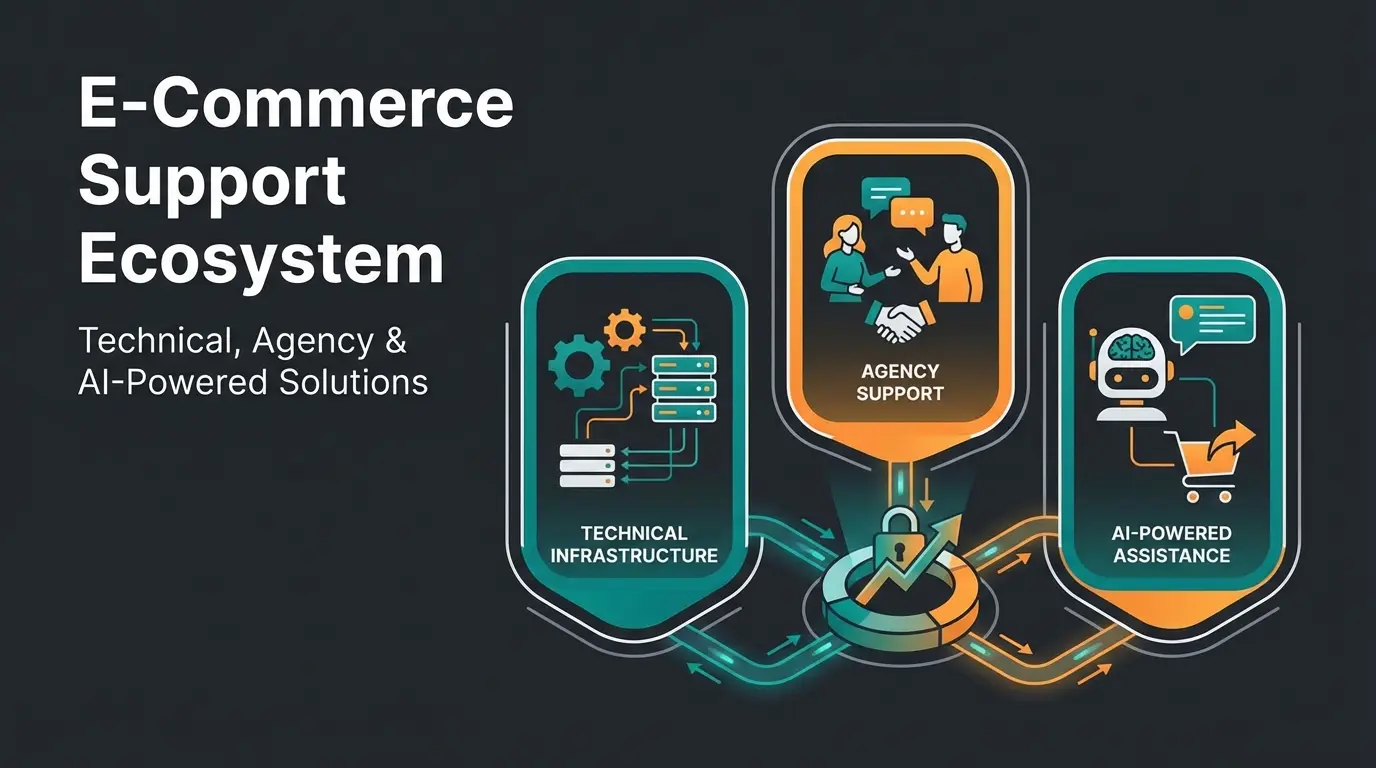
Shopware support divides into two categories: technical support for store infrastructure (hosting, updates, bugs) and operational customer support for shoppers (orders, products, returns). Automation targets the latter, because that is where ticket volume scales linearly with revenue. More orders mean more "Where is my package?" emails, and no agency retainer solves that problem.
Technical support: the foundation
Updates, security patches, plugin compatibility, hosting optimisation. Without this layer, the shop stops working. But it does not generate additional revenue. It only prevents loss.
The market for technical Shopware developers in the DACH region is competitive. Agency hourly rates range from EUR 90 to EUR 150, freelancers from EUR 70 to EUR 120. Maintenance contracts typically cost EUR 500 to EUR 2,000 per month for guaranteed response times. For the full picture on Shopware service options, we have a dedicated breakdown.
Operational customer support: the growth driver
Pre-sales product consultation, order status tracking, returns, invoice requests. This is where customers interact directly with the business, and where each unanswered question is a potential lost sale. According to Salesforce, WISMO ("Where Is My Order?") inquiries alone account for 30-50% of all ecommerce support tickets. During peak seasons like Black Friday, that number climbs to 50% or higher.
The Shopware forum and community channels handle technical questions well. Customer-facing support, though, requires a different solution entirely.
| Dimension | Technical Support | Customer Support |
|---|---|---|
| Purpose | Keep the shop running | Help shoppers buy and return |
| Scales with | Shop complexity | Order volume |
| Cost driver | Developer hourly rates | Ticket volume per month |
| Revenue impact | Prevents loss | Drives conversion and retention |
| Automatable? | Partially (monitoring, updates) | 70-100% of standard inquiries |
Why traditional support models fail
Traditional support models fail Shopware merchants because they scale linearly with ticket volume, cannot handle peak seasons, and leave customers waiting hours for responses that competitors answer in seconds. According to Stealthagents, 54% of customers expect a response within two hours. Only 37% of companies meet that expectation across channels.
The five biggest problems we see in Shopware shops that still rely on manual support:
- Seasonal peaks destroy margins. A garden retailer generating 60% of revenue between March and June cannot afford year-round staffing for peak load. Temporary workers lack product knowledge and Shopware system training
- Personnel costs compound. A qualified customer service agent in Germany costs EUR 35,000 to EUR 45,000 gross per year. Including workplace overhead, that is EUR 2.50 to EUR 4.00 per ticket. AI handles the same ticket for under EUR 0.50, according to Ringly
- Response time expectations have shifted. What was acceptable in 2024 is not in 2026. Customers trained by Amazon expect near-instant answers. Sub-one-hour email responses achieve 71% retention, versus 48% for 24-hour responses
- Knowledge silos create inconsistency. Employee A answers differently from Employee B. New hires need weeks of onboarding. A single AI employee delivers the same quality at 2 AM on Sunday as at 10 AM on Monday
- Classic chatbots make it worse. Flow-builder bots cover 50-60% of standard inquiries at best. When a customer phrases a question slightly differently, the bot gives up. That frustrates customers more than no automation at all
AI employees for Shopware shops
AI employees are context-aware digital team members that understand products, recognise returning customers, and make support decisions autonomously. Unlike chatbots that follow rigid scripts or Flow Builder rules, they use natural language understanding trained on your specific Shopware product data. The difference is not incremental. It is categorical.
According to Gartner analyst Daniel O'Connell: "Agentic AI introduces a new paradigm where AI systems possess the capability to act autonomously to complete tasks." Gartner predicts that by 2029, agentic AI will resolve 80% of common customer service issues without human intervention, leading to a 30% reduction in operational costs. Shopware merchants are already seeing early versions of this shift.
| Feature | Rule-Based Chatbot | AI Employee |
|---|---|---|
| Technology | Static decision trees (if-then) | Generative AI with NLU |
| Setup time | Weeks of flow building | Days via product data upload + API |
| Flexibility | Breaks on unexpected phrasing | Handles context, typos, and nuance |
| Knowledge base | Only what was programmed | Entire product catalogue via Shopware API |
| Learning | Manual updates required | Continuous improvement from conversations |
| Goal | Deflect tickets | Resolve inquiries and drive sales |
| Cost per interaction | EUR 1-3 | Under EUR 0.50 |
Seven capabilities that separate AI employees from traditional support tools:
- Up to 100% automation of standard inquiries. Because the AI understands language contextually, not just keywords, it handles complex questions that previously required humans
- True 24/7 availability. No night shifts, no breaks, no vacation coverage gaps. The AI answers at 11 PM on Sunday with the same precision as Monday morning
- Consistent brand voice. Every customer receives the same quality response, aligned to your tone guidelines
- Instant scaling. When 5,000 inquiries arrive simultaneously on Black Friday, the AI handles them all. Zero queue time
- No onboarding lag. New products in the Shopware backend are immediately available to the AI. No manual FAQ updates
- Cross-channel memory. The AI knows in chat what the customer previously asked via email (with CRM integration)
- Pre-sales revenue generation. Unlike deflection-focused chatbots, AI employees actively consult on products and increase cart value. The AI Customer Service page details the full capability set
Support tasks you can automate
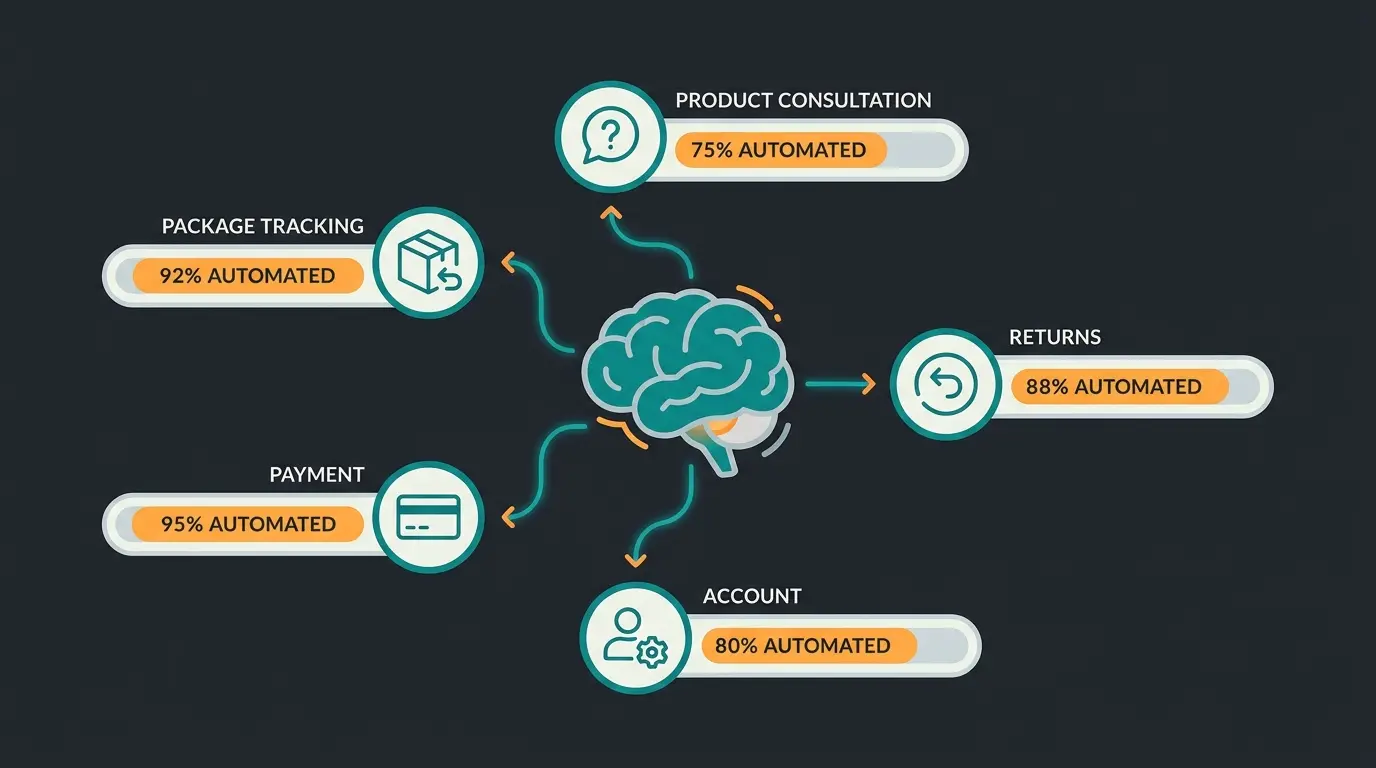
The five most automatable Shopware support categories are WISMO (order tracking), product consultation, returns processing, payment inquiries, and account management. Together they represent 70-90% of total ticket volume in a typical ecommerce operation.
WISMO (order tracking)
"Where is my order?" The single most common ecommerce support question. The AI identifies the customer via email or order number, queries the Shopware API (`/api/search/order`), checks the tracking status with the shipping provider, and delivers a precise answer: "Your package left the logistics centre in Cologne this morning. Expected delivery: tomorrow. Here is the tracking link." No human involvement. Under 5 seconds.
Product consultation (pre-sales)
This is where automation generates revenue, not just saves cost. A customer asks: "Which oil do I need for my chainsaw model X?" The AI searches product attributes and cross-selling data in Shopware. It responds with the product link and explains why it fits. That is genuine consultation, and it converts browsers into buyers. AI Product Consultation capabilities make this possible at scale.
Returns, payments, and account management
Returns: the AI checks whether the return window is still open, generates the return label, and sends it via email. Payment inquiries: it pulls the invoice PDF from Shopware's document repository and delivers it. Account changes: password resets, address updates (if not yet shipped), loyalty point balances. All fully automatable without human intervention.
| Category | % of Tickets | Automation Rate | Revenue Impact |
|---|---|---|---|
| WISMO (order tracking) | 30-50% | 95-100% | Retention (reduces churn) |
| Product consultation | 15-25% | 80-95% | Direct revenue (higher cart value) |
| Returns & complaints | 10-20% | 70-90% | Cost savings + data quality |
| Payment & invoices | 5-10% | 95-100% | Cost savings |
| Account management | 5-10% | 95-100% | Cost savings |
How to implement automated support in Shopware
Implementing support automation in Shopware follows five steps: analyse top inquiries, choose between native tools or AI employees, configure the system with your product data, connect all customer channels, then measure and optimise performance. The entire process takes one to two weeks for a mid-size shop.
Export the last 3 months of tickets. Categorise into WISMO, product consultation, returns, complaints, other. The top 5 categories will cover 80% of volume (Pareto principle).
Native Shopware Flow Builder for basic rules. Helpdesk software for ticket routing. AI employee for full automation with product consultation. Match the solution to your ticket volume and complexity.
Connect your product catalogue via Shopware API. Upload FAQs, shipping conditions, return policies. Define persona and tone. This takes hours, not weeks.
Live chat widget in the Shopware frontend (JavaScript snippet). Email forwarding. WhatsApp Business. The AI handles all channels from a unified inbox with customer recognition.
Track automation rate (target: >60% month one, >80% later), CSAT scores, and response time (<1 minute). Iterate based on unresolved conversation patterns.
Shopware-specific integrations and technology
Shopware 6's API-first architecture enables deep automation integrations through the Admin API, ERP connectors, and multi-channel messaging platforms. This allows AI employees to access real-time order, product, and customer data without middleware or manual syncing.
Shopware 6 Admin API
The AI acts as an external application communicating via the Admin API. Authentication uses OAuth 2.0. Read access covers orders, products, customers, and categories. Write access allows adding notes to orders or updating statuses. The Shopware Flow Builder documentation covers how to set up event-based triggers that complement AI automation.
ERP integration
Often the real inventory data or tracking information sits in the ERP (Pickware, JTL, Xentral, SAP), not in Shopware. A well-configured AI solution either connects to the ERP directly or uses Shopware as the single source of truth when the ERP syncs data back. When Pickware sets status to "Shipped," the AI knows immediately.
Multi-channel with customer memory
Whether the customer writes through the Shopware contact form, by email, or via WhatsApp, the AI recognises them by email address or phone number and has the last order ready. This is not aspirational. It is how Shopware 6 support works when the integration layer is set up correctly. The Shopware automation tools page covers the native side of this stack.
Success stories: Shopware merchants with automated support
Shopware merchants using AI-powered support automation report 80% cost reduction, sub-10-second response times, and measurable revenue increases through automated product consultation during peak seasons. The results are not theoretical projections. They come from verified implementations with documented metrics across lawn care, garden retail, and automotive lighting verticals.
Rasendoktor: 16x ROI in lawn care ecommerce
Rasendoktor.de, the online specialist for professional lawn care, handled 2,000 to 3,000 consultation-intensive inquiries per season. The product variety and technically demanding application questions overwhelmed the support team during spring peaks. Response times stretched to multiple days.
After deploying an AI employee: 100% automation rate on standard inquiries. 40% reduction in support costs. 16x return on investment. The AI handles product consultation ("Which fertiliser for my clay soil?") with the same depth as a trained specialist. Full details in the Rasendoktor Case Study.
Gartenfreunde: 7x higher conversion rate
Garten-Freunde.de, a retailer for garden and wellness products, faced up to 50 consultation-intensive inquiries per day during peak season. The AI employee "Kira" now handles product recommendations with a 45% click-through rate on suggestions and a 7x higher conversion rate compared to unassisted browsing. ROI: 6x. See the Gartenfreunde AI Employee story for the full implementation breakdown.
HELLA Lightstyle: regulated technical consultation at scale
HELLA's Lightstyle division needed to answer technically complex questions about auxiliary lighting around the clock, including legal approval questions (ECE R112, StVZO). The AI employee reduced support inquiries by 60%, provides 24/7 technical consultation, and delivers 100% legally compliant product recommendations. In regulated markets, consistency is not a nice-to-have. It is a compliance requirement.
These are not hand-picked outliers. Similar patterns appear in Shopware reviews from merchants who have moved to automated support.
Return on investment within the first year of AI employee deployment
Reduction in support inquiries at HELLA Lightstyle after AI deployment
Cost-benefit analysis
Support automation typically pays for itself within 2-3 months: a mid-size Shopware shop spending EUR 3,000 to EUR 5,000 per month on support agents can reduce costs to EUR 500 to EUR 1,000 per month with AI automation while handling 3x more inquiries. The numbers are straightforward.
Manual vs. automated: the cost breakdown
One full-time support employee costs approximately EUR 45,000 per year including employer contributions. Capacity: 60-80 tickets per day, 8 hours, 5 days per week. Cost per ticket: EUR 2.50 to EUR 4.00. An AI employee handles unlimited tickets, 24/7/365, at under EUR 0.50 per interaction. According to Opensend's cost analysis, the industry average for human-handled ecommerce support sits at EUR 5.50 per contact when including overhead, training, and turnover costs.
The rule of thumb: if you have more than 300 tickets per month, an AI solution pays for itself in the first billing cycle. With 1,000 monthly tickets and EUR 3 cost per manual ticket, that is EUR 3,000 in support costs. With 80% AI automation, only 200 manual tickets remain: EUR 600 in personnel plus the AI licence. Savings: over EUR 1,500 per month from day one.
Per employee, including payroll taxes and workplace expenses
Compared to EUR 2.50-5.50 for human-handled tickets
Typical savings after AI employee implementation
No night shifts, no vacation gaps, consistent quality
Hidden benefits beyond cost savings
As Intercom's 2025 AI Customer Service Report documents: "The industry average ROI on AI customer service is $3.50 returned per $1 invested, with a 3-6 month payback period." For ecommerce specifically, that payback period shrinks further because ticket patterns are more predictable than in SaaS or enterprise support.
Opportunity cost is the number most shops ignore. What does a customer who leaves because no one answered within 10 minutes cost? At a 3% conversion rate and EUR 80 average order value, every unanswered pre-sales question represents roughly EUR 2.40 in lost revenue. Multiply by hundreds of daily visitors during peak season.
Employee satisfaction matters too. Your team no longer answers "Where is my package?" 100 times per day. They handle complex cases that require human judgement. That reduces burnout and turnover, which reduces recruitment and training costs. The cycle compounds.
Comparing Shopware support solution types
Shopware merchants can choose from four support solution tiers: native Flow Builder rules (free, limited), traditional helpdesk software (EUR 50-200/month), scripted bots (EUR 100-500/month), or AI employees (EUR 500-2,000/month). Each tier offers different automation depth and ROI profiles.
| Capability | Native Flow Builder | Helpdesk Software | Scripted Chatbot | AI Employee |
|---|---|---|---|---|
| Automation depth | Basic rules only | Ticket routing | 50-60% of FAQs | 70-100% of inquiries |
| Product consultation | No | No | Limited (menu-based) | Yes (full catalogue access) |
| 24/7 availability | Rules run always | Depends on staff | Yes (within scripts) | Yes (contextual) |
| Setup time | Hours | Days | Weeks | Days |
| Monthly cost | Free (built-in) | EUR 50-200 | EUR 100-500 | EUR 500-2,000 |
| Understands context | No | Human agents do | No | Yes |
| Scales with volume | Yes (rules) | No (needs more agents) | Partially | Yes (unlimited) |
| Revenue generation | No | Indirect | No | Yes (pre-sales) |
| Shopware phone support replacement | No | Partial | No | Yes (across channels) |
For shops with fewer than 100 monthly tickets, the native Flow Builder is sufficient. Between 100 and 500 tickets, helpdesk software with basic automation makes sense. Above 500 tickets, or whenever pre-sales consultation is a revenue driver, an AI employee delivers the strongest ROI. There is no middle ground where scripted bots outperform the alternatives.
Frequently asked questions
No. AI employees respond immediately with contextual, personalised answers based on order history and product data. According to Freshworks, customers rate AI-assisted interactions higher than delayed human responses in 62% of cases. A seamless human handover is always available for edge cases.
The technical API connection takes under an hour. Training the AI with product data, FAQs, and policies takes 3-7 days depending on catalogue size. Most shops are live within two weeks. Shops with under 500 products can go live in under a week.
Yes, when using European providers with EU-based servers and a signed Data Processing Agreement (DPA). Shopware itself is "Made in Germany," and your support solution should maintain the same standard. All customer data stays within the EU.
Yes. When trained with technical documentation, data sheets, and product manuals, AI employees answer compatibility questions, recommend accessories, and explain specifications. Neudorff's AI employee Flora achieves 97% accuracy on complex horticultural product recommendations.
The system escalates to a human agent with a full conversation summary. Good AI systems recognise their limits. When a customer becomes very emotional or asks something outside the knowledge base, the ticket transfers with context intact. No information is lost.
B2B shops benefit disproportionately because their inquiries tend to be more complex and more expensive to handle manually. Technical compatibility questions, bulk pricing, and custom quote requests are all automatable with the right product data integration.
Conclusion
Support automation for Shopware is not a future-state ambition. It is a present-tense infrastructure decision with measurable ROI. The merchants who have implemented it report consistent results: 70-90% cost reduction, sub-10-second response times, and revenue increases through automated product consultation.
The question is not whether to automate. It is which tier to choose and how fast to deploy. For shops above 500 monthly tickets, the math is clear. For shops with consultation-intensive products, even clearer.
One honest caveat: automation does not replace every human support interaction. Complex complaints, emotionally charged situations, and genuinely novel problems still need people. The goal is freeing those people from the 80% of tickets that follow predictable patterns, so they can focus on the 20% where human judgement matters.
More traffic alone does not fix a broken support inbox. A Qualimero AI employee resolves customer inquiries in seconds and actively recommends products. Shopware merchants report up to 16x ROI and 7x higher conversion rates through automated product consultation.
Book a demo
Kevin is CTO and co-founder of Qualimero. As an AI architect with over 15 years of experience as CTO and CPO in the tech industry, he designs the AI systems that automate tens of thousands of customer interactions daily for Qualimero's clients — reliably, securely, and at scale.