
What is an average conversion rate?
Open every 100 visits to your online store, and somewhere between 2 and 3 of those visitors will buy something. That is the global average ecommerce conversion rate in 2026. The number sounds low because it is low.
The problem with averages: they flatten everything. A food & beverage store converting at 2.5% is underperforming. A luxury jewelry store converting at the same 2.5% is crushing it. Industry, device mix, traffic source, price point, and purchase cycle all determine what "good" actually means for your specific store.
Two types of conversions matter here. Macro-conversions are completed purchases, the number most people mean when they say "conversion rate." Micro-conversions are the steps that lead there: email sign-ups, add-to-cart actions, wishlist saves, account creation. Tracking both gives you a diagnostic map of where your funnel leaks.
One important caveat: definitions differ across platforms. Google Analytics calculates conversion rate as transactions divided by sessions. Other tools divide by unique users. A store with 10,000 sessions and 300 transactions has a 3.0% session-based rate, but if those sessions came from 7,000 unique users, the user-based rate is 4.3%. Always confirm which denominator your analytics tool uses before benchmarking.
The data in this article is cross-referenced from five major sources: Dynamic Yield (owned by Mastercard, 200M+ monthly unique users from 400+ brands), Statista (global coverage, all business sizes), IRP Commerce (SME-focused, UK and Ireland), Contentsquare (enterprise digital experience data), and Littledata (Shopify-specific benchmarks). Where sources disagree, we show the range and explain why.
Average ecommerce conversion rate 2026
The global ecommerce conversion rate in 2026 ranges from 1.6% to 3.5%, depending on the data source, sample size, and methodology. That spread is not a contradiction. It reflects fundamentally different data sets. Understanding which benchmark applies to your store is more valuable than memorizing any single number.
| Source | Overall CR | Sample | Methodology |
|---|---|---|---|
| Dynamic Yield (Mastercard) | 2.9% | 200M+ monthly unique users, 400+ brands | User-based, medium-large brands |
| Statista | 1.6% | Global e-commerce visits Q3 2025 | Session-based, all sizes |
| IRP Commerce | 1.89% | SME-focused, UK/Ireland heavy | Session-based, smaller retailers |
| Contentsquare | 2.5% | Q3 2025, broad industry mix | Session-based, enterprise focus |
| Littledata | 1.4% (median) | Shopify stores | Session-based, Shopify-specific |
The key trend: the global average reached 2.5% in Q3 2025, up 0.4 percentage points year over year according to Contentsquare. But that recovery masks a widening gap. Stores with strong personalization, AI-powered product advisory, and optimized mobile checkout are pulling further ahead. Stores that rely on static product pages and generic FAQ sections are falling behind.
For a deeper look at what drives these numbers for individual stores, see our online store conversion rate guide.
Conversion rate by industry
Not all ecommerce is created equal. A store selling EUR 15 protein bars and a store selling EUR 3,000 designer watches operate in different conversion universes. The benchmarks below are aggregated from Dynamic Yield, IRP Commerce, and Smart Insights data for 2025/2026.
| Industry | Average CR | Top Performers | Key Factor |
|---|---|---|---|
| Food & Beverage | 4.9-6.2% | 8%+ | Low price, repeat purchase, consumable |
| Health & Pharma | 3.0-5.0% | 6%+ | Necessity buying, subscription models |
| Pet Care & Supplies | 2.5-4.0% | 5%+ | Emotional buying, brand loyalty |
| Consumer Goods / FMCG | 2.5-3.5% | 5%+ | Low consideration, habitual buying |
| Beauty & Cosmetics | 2.5-3.5% | 5%+ | Strong brand affinity, repeat customers |
| Electronics & Tech | 1.5-3.0% | 4%+ | Research-heavy, comparison shopping |
| Fashion & Apparel | 1.5-2.5% | 3.5%+ | High return rates, sizing uncertainty |
| Sports & Outdoor | 1.5-2.5% | 3.5%+ | Seasonal demand, specialty products |
| Home & Garden | 1.4-2.5% | 3.5%+ | High AOV, long consideration cycle |
| B2B / Industrial | 2.0-5.0% | 6%+ | High intent, repeat orders |
| Automotive Parts | 0.5-1.5% | 2.5%+ | Complex compatibility, high AOV |
| Luxury & Jewelry | 0.8-1.5% | 2.5%+ | Highest AOV, longest decision cycle |
The pattern is straightforward: the higher the price point and the longer the consideration cycle, the lower the conversion rate. Food & Beverage leads because purchases are habitual, low-risk, and often subscription-based. Luxury sits at the bottom because a EUR 5,000 watch requires trust, research, and often an in-store visit before the click.
What the numbers do not show: consultation-heavy categories like Home & Garden and Electronics respond disproportionately well to intelligent product advisory. When a customer asks "which lawn mower fits my 200sqm garden with slopes?" and gets a precise, knowledgeable answer in real time, the conversion gap to low-consideration categories narrows significantly. Our client Rasendoktor achieved a 16x ROI through AI-powered product consultation in exactly this category.
B2B ecommerce deserves special attention. The 2.0-5.0% range reflects two very different buyer profiles. Repeat orders from established accounts (often via punchout catalogs or EDI integrations) convert at 5%+ because the buyer already knows the product. First-time B2B buyers, navigating complex pricing tiers and minimum order quantities, convert closer to 2%. If your B2B store treats both segments the same way, your blended average hides the real story.
Stores above this rank in the top fifth globally
Conversion rate by device and channel
Device type and traffic source are the two dimensions most stores overlook when benchmarking. Both shift the "average" dramatically, and understanding these splits is where actionable insight begins.
By device
| Device | Conversion Rate | Traffic Share | Trend |
|---|---|---|---|
| Desktop | 3.2-3.9% | ~25% | Stable, highest intent per session |
| Mobile | 1.8-2.8% | ~73% | Rising slowly, still 40-50% below desktop |
| Tablet | 2.0-3.5% | ~2% | Negligible traffic share, declining |
Mobile accounts for roughly 73-78% of all ecommerce traffic but converts at about half the desktop rate, according to Dynamic Yield and Smart Insights. The mobile-desktop gap has narrowed from over 2x a decade ago to approximately 1.7x today, but it remains the single biggest leak in most funnels.
Small screens make product comparison harder. Checkout forms are more friction-heavy. Trust signals (reviews, certifications, return policies) get buried below the fold. Mobile commerce is projected to account for over 60% of all ecommerce sales in 2026, a market exceeding USD 2.5 trillion. Closing the mobile conversion gap is not optional, it is the highest-ROI optimization for most stores.
An honest note on these device benchmarks: the mobile-desktop gap may be partially artificial. Many purchase journeys start on mobile and finish on desktop ("research on phone, buy on laptop"). Cross-device attribution remains imperfect in most analytics setups, which means mobile's true influence on conversions is likely higher than the raw numbers suggest. If your analytics show a very low mobile CR but strong desktop CR, investigate cross-device behavior before assuming mobile needs fixing.
By traffic channel
| Channel | Conversion Rate | Why |
|---|---|---|
| 4.0-6.0% | Pre-qualified audience, high purchase intent, opted-in | |
| Organic Search | 2.5-4.5% | Active problem-solving, high intent queries |
| Direct | 2.5-3.5% | Brand-aware visitors, repeat customers |
| Paid Search (PPC) | 2.5-3.5% | Keyword-targeted, commercial intent |
| Referral | 1.5-3.0% | Third-party trust, varies by source quality |
| Paid Social | 0.5-1.5% | Interruptive, low intent, discovery mode |
| Organic Social | 0.5-1.0% | Lowest intent, browsing-driven traffic |
Email converts 3-5x higher than paid social because subscribers already know your brand, opted in to hear from you, and often click with purchase intent. Organic search converts well because people type specific queries like "waterproof hiking boots size 42" with clear buying intent. Paid social sits at the bottom because it is fundamentally interruptive: you are showing ads to people who were scrolling, not searching.
Seasonal patterns shift these numbers too. Black Friday and holiday periods push conversion rates 30-50% above annual averages across all channels, with email and direct traffic seeing the biggest spikes. Plan your traffic mix and ad spend accordingly.
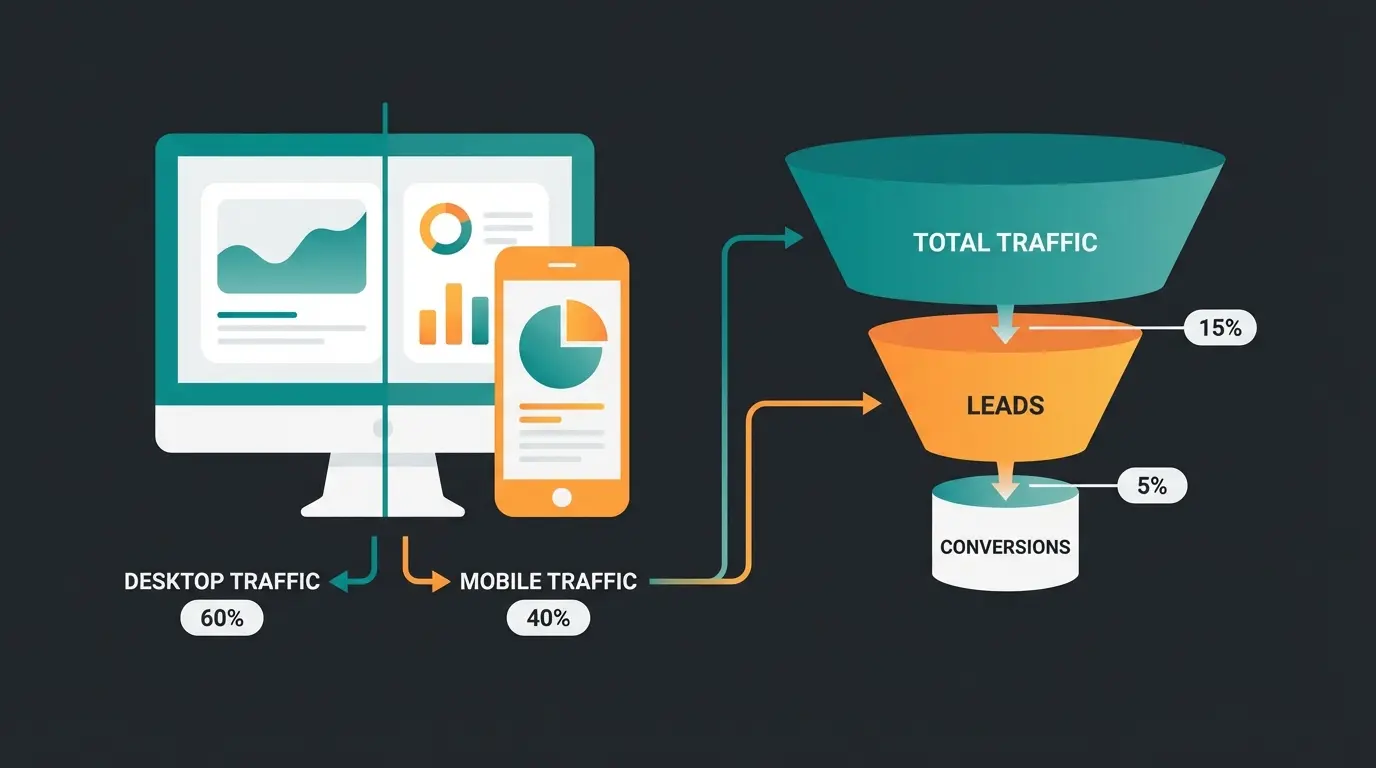
Conversion rate by shop system
Platform choice is one of the first questions store owners ask about conversion rates. Here is what the data shows, though the answer is more nuanced than any table can capture.
| Platform | Average CR | Typical Store Profile |
|---|---|---|
| Shopware 6 | 2.5-3.5% | German Mittelstand, B2B/B2C hybrid, complex catalogs |
| Shopify | 1.4-2.5% | Massive install base, many beginners and micro-stores |
| WooCommerce | 1.5-2.5% | WordPress-based, highly variable implementation quality |
| Magento / Adobe Commerce | 1.5-3.0% | Enterprise, large catalogs, heavy customization |
These numbers need context. Shopify's lower average reflects its massive install base, which includes hundreds of thousands of side projects, dropshipping experiments, and brand-new stores. An established Shopify store with proper theme optimization, fast checkout, and smart app stack converts just as well as any other platform. We break down the specific levers in our guide on how to improve your Shopify conversion rate.
Shopware's higher average reflects its concentration among established German retailers with mature operations, deeper product catalogs, and professional implementation partners. For a detailed comparison, see our Shopware conversion optimization guide.
What to do when your conversion rate is below average
If your conversion rate sits below your industry and channel benchmarks, start with diagnosis, not random fixes. The most common mistake is jumping to tactics ("let's add trust badges") without understanding where the funnel actually breaks.
Here is the diagnostic framework we use with our clients, ordered by typical impact. For the full optimization playbook, see our guide on how to increase your conversion rate.
- Map your funnel drop-offs. Use Google Analytics or your platform's analytics to identify where visitors leave. Is it product pages (discovery problem), add-to-cart (trust problem), or checkout (friction problem)? Each has a different fix.
- Fix checkout friction first. This is the highest-leverage point. Guest checkout, fewer form fields, progress indicators, and transparent shipping costs. A one-step checkout alone can lift conversion by 20-30%. Our checkout optimization guide walks through each step.
- Add real-time product advisory. Consultation-heavy products (Home & Garden, Electronics, Health) see the biggest lifts when customers can ask questions and get knowledgeable answers instantly, not from a FAQ page, but from an intelligent system that understands your catalog.
- Optimize for mobile specifically. Do not just shrink your desktop site. Redesign the mobile product page, simplify filters, and minimize form input. Mobile is where 75% of your traffic lives.
- Build trust signals above the fold. Reviews, return policy, security badges, and payment logos. On mobile, these must be visible without scrolling.
A common trap: optimizing for conversion rate in isolation. A store that raises its CR from 2% to 3% by offering 30% discounts on everything has not improved. Revenue per visitor, average order value, and customer lifetime value must move alongside CR. The best metric is revenue per session, which captures both conversion rate and order value in a single number.
Timing matters too. Conversion rates fluctuate by day of week (Tuesday and Wednesday typically convert highest for B2C), time of day (evening sessions convert better than morning browsing), and season. A store measuring CR only as a monthly average misses these patterns. Set up daily and hourly conversion tracking to find your peak windows, then allocate ad spend and email sends accordingly.
The stores we work with that implement AI-powered product advisory typically see the most dramatic improvement in consultation-heavy categories. Rasendoktor, a plant protection and garden supply retailer, achieved a +35% increase in average cart value and a +60% improvement in checkout rate after deploying a Qualimero KI-Mitarbeiter that understands their entire product catalog and advises customers in real time.
Our clients see up to 7x higher conversion probability when visitors interact with a KI-Mitarbeiter. Book a demo to see it with your own product catalog.
Book a demoConclusion
A "good" conversion rate is always relative to your industry, device mix, traffic channels, and shop platform. The 2026 global average of 2.5-3.0% is a starting point, not a target. Food & Beverage stores should aim for 5%+. Luxury retailers can celebrate 2%. What matters is knowing your baseline, understanding the benchmarks that apply to your specific situation, and systematically closing the gap.
What matters more than any single benchmark: continuous measurement and targeted optimization. Know where your visitors drop off, fix the biggest leak first, then move to the next. The stores that pull ahead in 2026 are not the ones chasing a magic number. They are the ones that treat conversion optimization as a system, not a one-time project. For the full strategic framework, start with our Shopware conversion optimization guide.
Qualimero's KI-Mitarbeiter delivers real-time product advisory that lifts conversion rates across all your traffic channels. Our clients report +35% cart value and +60% checkout rate.
Start your free trialFrequently asked questions
A good ecommerce conversion rate depends on your industry. The global average is 2.5-3.0% in 2026, but Food & Beverage stores average 4.9-6.2% while Luxury & Jewelry sits at 0.8-1.5%. Stores converting above 3.2% rank in the top 20% across all industries, according to Littledata.
The global average ranges from 1.6% (Statista) to 2.9% (Dynamic Yield) depending on the data source and methodology. The most commonly cited figure is 2.5%, reported by Contentsquare for Q3 2025, up 0.4% year over year.
Food & Beverage consistently leads with conversion rates of 4.9-6.2%, driven by low price points, habitual buying behavior, and high repeat purchase rates. Health & Pharma follows at 3.0-5.0%, driven by necessity buying and subscription models.
Mobile converts at roughly 1.8-2.8% versus desktop's 3.2-3.9%. The gap exists because mobile screens make product comparison harder, checkout forms create more friction, and trust signals often get buried below the fold. Many mobile visits are also browse-first with purchase intent shifting to desktop later.
Start with diagnosis: map your funnel drop-offs to find where visitors leave. The highest-leverage fixes are checkout optimization (guest checkout, fewer fields), mobile-specific UX improvements, and real-time product advisory. Stores using AI-powered product consultation see up to 7x higher conversion probability for engaged visitors.
Platform averages differ (Shopware 2.5-3.5%, Shopify 1.4-2.5%), but implementation quality matters more than the platform itself. A well-optimized Shopify store outperforms a poorly configured Shopware installation. Focus on theme performance, page speed, checkout UX, and customer advisory capabilities.

Lasse is CEO and co-founder of Qualimero. After completing his MBA at WHU and scaling a company to seven-figure revenue, he founded Qualimero to build AI-powered digital employees for e-commerce. His focus: helping businesses measurably improve customer interaction through intelligent automation.