Chatbot Costs 2026: Price Comparison for Support vs. Sales Bots
What does a chatbot cost in 2026? Compare pricing from DIY to AI solutions. Learn why product consultation bots generate more revenue than they cost.

What Does a Chatbot Really Cost? (The Quick Answer)
The costs for a professional chatbot in Germany in 2026 typically range between €500 and €2,500 monthly for mature SaaS solutions, plus one-time setup fees that can vary between €2,000 and €15,000 depending on complexity, according to market research from feedbax.de, lime-technologies.com, and moin.ai.
But this range is enormous. Why? Because the market now strictly distinguishes between two categories:
- Cost-Savers (Support Bots): These bots are designed to deflect tickets and reduce personnel costs in customer service.
- Revenue-Drivers (Product Consultation Bots): These bots act as digital salespeople, integrate deeply with product data (PIM), and aim to increase cart value and conversion rates.
Anyone who only looks at the price is comparing apples to oranges. A DIY bot for €50 per month can answer simple FAQs, but will never be able to provide complex product consultation ("Which ski boot fits my wide foot?"). Understanding the different chatbot types comparison is essential before making any purchasing decision.
In this comprehensive article, we break down chatbot costs in detail, uncover hidden price drivers, and show why a more expensive bot can ultimately be more profitable than a cheap solution. We'll explore how AI Chatbots E-Commerce solutions differ in their pricing models and value propositions.
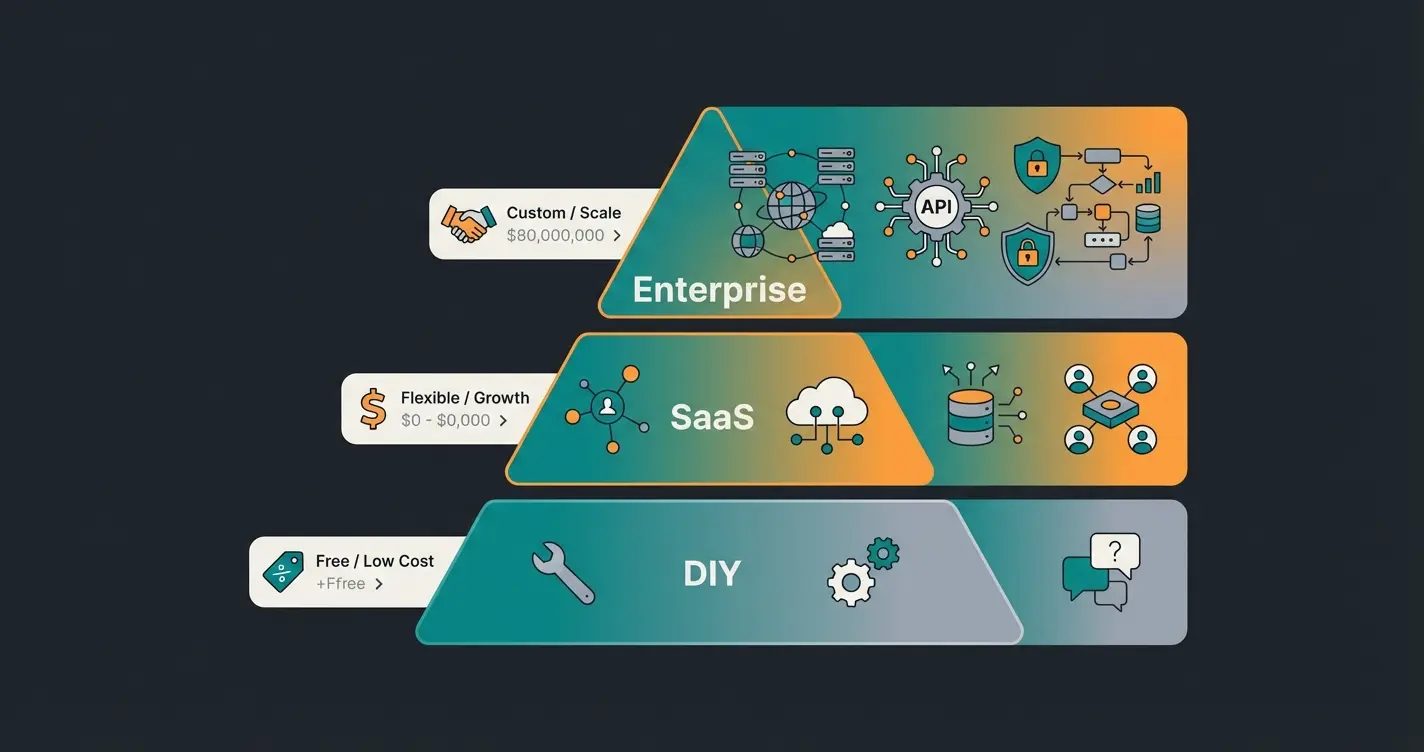
The 3 Pricing Models at a Glance: DIY vs. SaaS vs. Enterprise
To seriously answer the question "What does a chatbot cost?", you need to consider the technology tier. The market in 2026 is divided into three clear segments, each serving different business needs and budgets.
Comparison Table: Chatbot Prices & Features
| Feature | DIY / Click-Bot | Professional AI (SaaS) | Enterprise / Custom |
|---|---|---|---|
| Monthly Price Range | €0 – €100 | €500 – €2,500 | €5,000+ |
| Setup Costs (One-time) | €0 (Self-build) | €2,000 – €15,000 | €30,000 – €200,000 |
| Technology | Rule-based (If-Then) | NLP & Generative AI (RAG) | Custom LLMs |
| Focus | Simple FAQs, Navigation | Support Automation & Sales | Complex Corporate Processes |
| Data Integration | None / Manual | PIM, Shop System, CRM | Legacy Systems, SAP |
| Maintenance Effort | High (Manual Care) | Medium (AI Training) | High (Internal IT Required) |
| Typical Providers | ManyChat, Tidio (Basic) | moin.ai, Userlike, Cognigy | IBM Watson, Custom Dev |
1. The Entry-Level Model: DIY & Rule-Based Bots (€0-€100/Month)
These solutions are often the entry point for small businesses. They are based on rigid decision trees (button-click logic) that guide users through predefined paths.
- Advantage: Extremely affordable and quickly self-assembled without technical expertise.
- Disadvantage: The bot is "dumb." It doesn't understand free-form language. As soon as a customer asks a question that isn't exactly in the script ("I'm looking for something red for summer"), the bot fails completely.
- Cost Trap: The monthly fees are low, but the opportunity costs are high. Frustrated customers leave your site because the bot leads them into dead ends, directly impacting your conversion rates.
For businesses exploring basic automation, understanding FAQ automation tools can help determine if this entry-level approach meets your needs.
2. The Standard: Professional AI & SaaS Solutions (€500-€2,500/Month)
This is where the action happens for mid-sized businesses and ambitious e-commerce players. Providers like moin.ai, Userlike, or Cognigy offer platforms that use Natural Language Processing (NLP) and increasingly Generative AI (like GPT-4 integrations), as highlighted by lime-technologies.com.
- Performance: These bots understand context, typos, and synonyms. They can be connected to shop systems (Shopify, Shopware) via APIs.
- Pricing Model: Usually a monthly license fee (Base Fee) plus volume-dependent costs (per conversation or per API call).
- Why the Price Jump? You're not just paying for software here, but for the infrastructure (servers, data protection, LLM token costs) and integration depth.
The transformation from basic bots to intelligent assistants is significant. Learn more about how Chatbot AI transforms customer interactions and the technology behind these solutions.
3. The Premier League: Enterprise & Custom Development (€30,000+ Projects)
Large corporations with extremely specific requirements (e.g., banks with on-premise hosting mandates or deep SAP integrations) often have custom solutions built. According to xmethod.de, agencies charge hourly rates between €100 and €200 for custom development.
- Costs: A project can easily reach six-figure sums, as reported by decode.agency.
- Trend: More and more enterprise customers are switching from expensive custom developments to flexible SaaS solutions (Category 2), as these can be adapted faster through "no-code" approaches.
What Really Drives Chatbot Costs? (The 4 Cost Drivers)
When you request quotes, you'll notice that prices vary significantly. This is rarely due to provider "greed," but rather to four technical factors that determine the effort required. Understanding these factors helps you make an informed decision about your chatbot investment.
1. Intelligence Level: Script vs. NLP vs. Generative AI (RAG)
The "brain" of the bot is the biggest cost factor. According to coding9.de, the technology choice significantly impacts both pricing and capabilities.
- Script Bots: Cost almost no computing power but offer limited functionality.
- NLP (Natural Language Processing): Requires training of "intents" (intentions). A bot must learn that "Where is my package?" and "Delivery status?" mean the same thing. This training costs time (setup) and license fees.
- Generative AI (RAG - Retrieval Augmented Generation): This is the standard for 2026. The bot uses an LLM (like GPT-4o or Claude) to dynamically formulate answers based on your knowledge base.
For businesses looking to maximize their AI investment, proper AI chatbot training is essential for optimal performance and cost efficiency.
2. Integration Depth: The Difference Between "Support" and "Sales"
This is where you decide whether your bot is a cost center or a revenue machine. The integration depth fundamentally changes both what's possible and what you'll pay.
- Level 1 (Support Focus): The bot only knows text documents (FAQs, Terms & Conditions). It can answer questions like "What are the shipping costs?" The integration is cheap (PDF upload).
- Level 2 (Sales Focus): The bot is connected to your PIM (Product Information Management) or shop system (Shopify, Shopware 6). It knows in real-time: Is item "Ski Boot XY" available in size 43? What alternatives are there if it's sold out? What accessories go with it?
These interfaces (APIs) must be maintained and configured, which drives setup costs (often €5,000+). However, this is exactly where the ROI through conversion rate optimization is created, as highlighted by moin.ai. This deep integration enables true AI Product Consultation capabilities.
3. Channel Costs: The WhatsApp Trap
Many companies forget that the channel itself can cost money. A web chatbot on your site incurs no "postage costs." A WhatsApp chatbot, however, does. Meta (Facebook) introduced a complex pricing model for the WhatsApp Business API that has evolved in 2025/2026, according to brevo.com, lime-technologies.com, and chatarmin.com.
- Service Conversations: When the customer writes, the response within 24h is often free (or very cheap).
- Marketing Conversations: When you proactively contact the customer (e.g., "Your item is back in stock"), it costs approximately 11 cents per message in Germany.
- Utility Conversations: Transaction messages (shipping confirmation) cost approximately 4.5 cents.
4. Traffic & Volume (MAU)
Almost all professional providers scale their prices according to Monthly Active Users (MAU) or "Conversations." This is standard practice across the industry.
- Up to 1,000 users/month: Often included in the basic package (approx. €500).
- From 5,000 users/month: Upgrade to business packages required (approx. €1,000 - €1,500).
Standard range for professional AI chatbot platforms
One-time investment for quality implementation
Per-message cost for proactive outreach in Germany
Ongoing effort for optimization and content updates
Hidden Costs Nobody Talks About
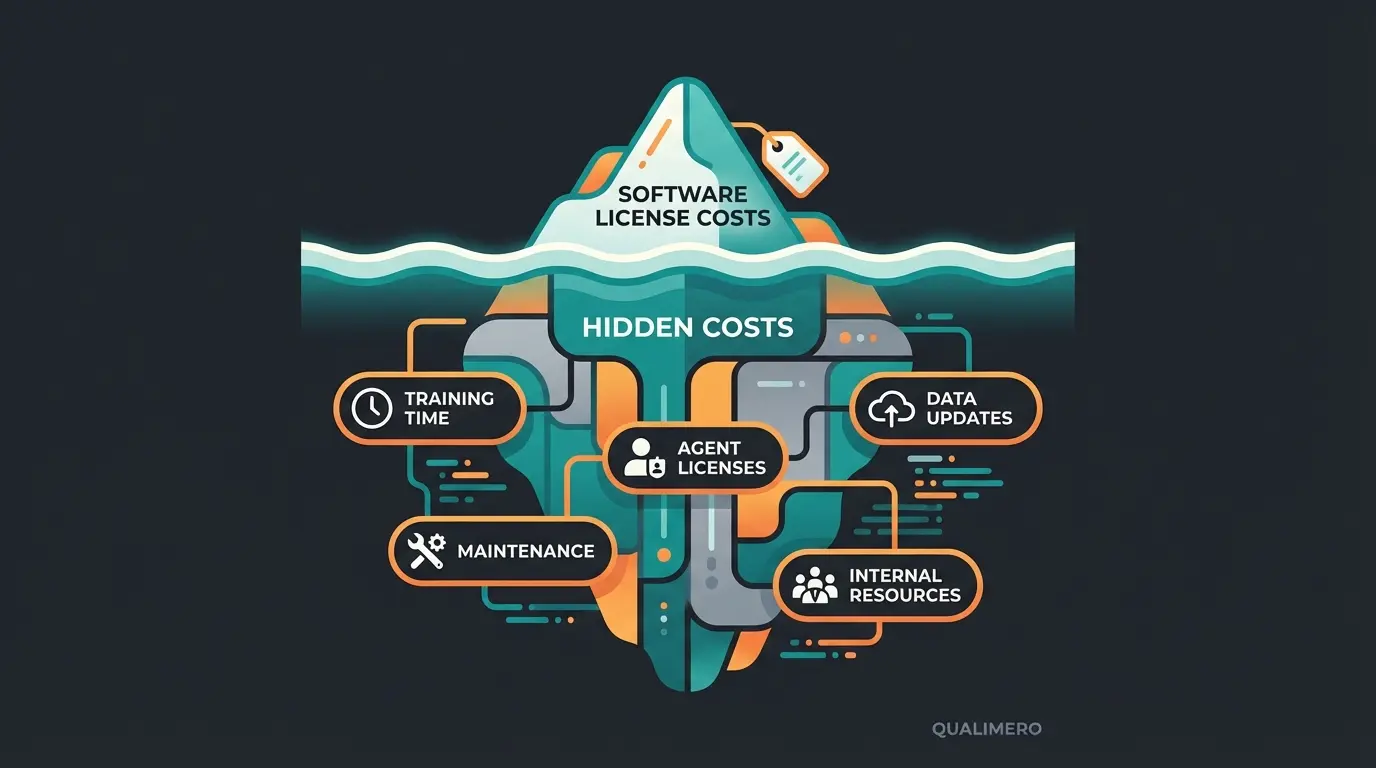
The glossy price lists from providers often lack items that can blow your budget. Plan for these "hidden costs" absolutely. Understanding the full cost picture is crucial for accurate budgeting and realistic ROI expectations.
1. The "Human-in-the-Loop" Effort
An AI chatbot is never "finished." It's like a new employee who needs to be trained and continuously developed. This ongoing investment is often underestimated in initial budget planning.
- Setup Phase: You don't have to program, but you must structure knowledge. Who writes the dialogues? Who defines the "tone of voice"? Plan for 2-4 weeks of internal project work before the bot goes live.
- Ongoing Maintenance: Products change. When you launch a new collection, the bot needs to know. With deep integration (see above), this happens automatically. With cheaper solutions, someone must manually replace PDFs or rewrite answers. That costs internal personnel resources (approx. 2-5 hours per week).
Effective AI Customer Service implementation requires this ongoing human oversight to maintain quality and relevance.
2. Agent Licenses (Seat Pricing)
A good chatbot hands over to a human when it can't proceed. Most chatbot platforms (like Userlike or Zendesk) charge costs per agent license. This is a critical budget item that many overlook.
3. Onboarding Fees
Reputable providers charge a setup fee (often €2,000 to €5,000), according to moin.ai. This investment ensures proper implementation.
Case Study: Costs vs. Benefits (ROI) – Why "Expensive" Is Often Cheaper
Here lies the crucial thinking error of many companies. They view the chatbot as a cost center (like insurance), not as an investment (like a marketing campaign). This mindset shift is essential for understanding true chatbot value.
Let's compare two scenarios for an online shop with 50,000 visitors per month. This comparison illustrates why the AI Agents comparison matters so much for your bottom line.
Scenario A: The "Penny Pincher" (Support Focus)
- Goal: Reduce support tickets and save on personnel costs.
- Solution: Simple FAQ bot (SaaS Basic).
- Costs: €300/month.
- Performance: Answers "Where is my package?" and "How do I return?"
- Result: Saves approx. 10 hours of support work per week (at €25/hour).
- Savings: approx. €1,000/month.
- Net Profit: +€700/month. (Solid, but unspectacular).
Scenario B: The "Revenue Booster" (Sales Focus)
- Goal: Increase conversion rate & grow basket sizes.
- Solution: AI product consultant with shop integration.
- Costs: €1,500/month (software) + €5,000 setup (amortized over 12 months = ~€400/month) = approx. €1,900/month.
- Performance: Actively advises customers ("Which tent fits for 3 people in Norway?"), suggests cross-sells ("You'll need these stakes for that").
- Result: Support savings: Also €1,000 (since it can handle FAQs too). Sales uplift: Increase in conversion rate by a conservative 0.5% among users who interact with the bot. With 5,000 bot users and €100 average cart = 25 additional sales = €2,500 additional revenue.
- Net Profit: €1,000 (savings) + €2,500 (revenue) - €1,900 (costs) = +€1,600/month.
Studies support this calculation: Companies like Velux were able to increase their conversion rate in chat to up to 38% through AI bots, as reported by moin.ai. Other case studies show an increase in lead conversion of 40%, according to lime-technologies.com. A sales bot finances itself through margin, not just savings.
Calculate support hours, missed sales opportunities, and customer churn from poor service
Select a sales-focused AI consultant with shop integration rather than basic FAQ bot
Connect to PIM/shop system for real-time product data and personalized recommendations
Track ticket deflection AND conversion rate improvements from bot interactions
Factor in support savings + additional revenue - total costs = net monthly profit
Discover how much additional revenue an AI product consultant could generate for your e-commerce business. Get a personalized analysis based on your traffic and conversion rates.
Get Free ROI AnalysisFAQ Bot vs. Sales Consultant: The Critical Comparison
Understanding the fundamental difference between these two bot types is essential for making the right investment decision. This comparison highlights why the pricing difference exists and what you get for your money.
| Aspect | FAQ Bot (Support Focus) | Sales Consultant (Revenue Focus) |
|---|---|---|
| Primary Goal | Ticket deflection, cost savings | Conversion optimization, revenue growth |
| Data Source | Static text documents, PDFs | Live product feed, PIM, shop system |
| Main KPI | Time saved, tickets deflected | Conversion rate, average order value |
| Cost Structure | Low monthly + minimal setup | Higher monthly + significant setup |
| Customer Experience | "Where is my order?" answers | "Which product fits my needs?" guidance |
| ROI Timeline | Immediate (cost reduction) | Medium-term (revenue multiplication) |
| Integration Complexity | Simple (upload documents) | Complex (API connections) |
| Maintenance Needs | Low (occasional updates) | Medium (product catalog sync) |
The AI product consultants category represents a fundamentally different approach to chatbot deployment—one focused on growing your business rather than just reducing costs.
Checklist: What Budget Should You Plan For?
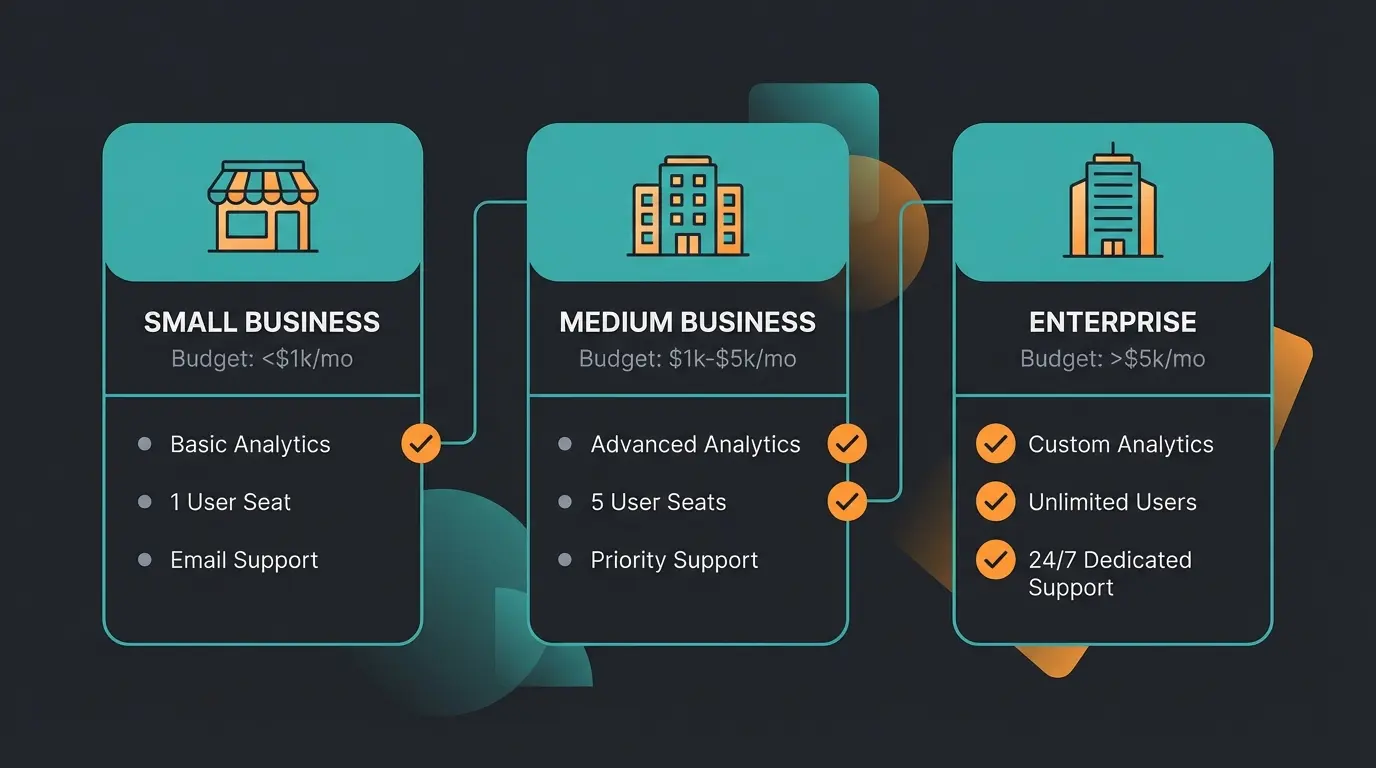
So you don't shoot at sparrows with cannons (or go to war with a water pistol), here's a guide for your budget planning in 2026. Match your investment to your business reality and goals.
1. Start-up / Small E-Commerce (up to €1M Revenue)
- Need: Relief from standard questions (opening hours, shipping), initial lead capture.
- Recommendation: Use integrated solutions from your shop system or affordable SaaS tools.
- Budget: €50 – €300 monthly.
- Setup: Self-service (DIY) with minimal external support.
2. Mid-Sized Business / Growth Shop (€1M – €50M Revenue)
- Need: Automation of 70-80% of service inquiries, active product consultation to differentiate from competition, connection to CRM (HubSpot, Salesforce) and Shopware/Shopify.
- Recommendation: Professional AI platform (moin.ai, Userlike, Chatarmin for WhatsApp).
- Budget: €800 – €2,000 monthly.
- Setup: €5,000 – €10,000 (one-time for professional onboarding & integration).
At this stage, investing in proper AI Customer Service automation becomes crucial for scaling efficiently. The right solution enables conversational commerce that drives real business results.
3. Enterprise / Corporation
- Need: Highest data protection requirements (servers in DE, ISO certification), integration into legacy IT, multilingualism (20+ languages), custom AI models.
- Recommendation: Enterprise suites or custom development.
- Budget: From €5,000 monthly.
- Setup: From €30,000 (project business).
Deep Dive: Why Product Consultation Costs More (But Is Worth More)
Many decision-makers flinch when they hear that a PIM integration (Product Information Management) increases the chatbot project by €5,000. Why is this the case? Understanding this helps justify the investment.
A standard chatbot (support) works with unstructured data. You upload a PDF ("Our return period is 30 days"). The AI reads it and responds. This is technically simple and requires minimal processing power.
A product consultation bot needs structured data. It must understand attributes:
- Product A has the property "Waterproof."
- Product B has the property "Water-resistant."
- Product C is "Sold out."
When a customer asks: "I need a waterproof jacket that's available", the bot must make a database query in real-time. It must not hallucinate or provide outdated information. This is where AI consulting e-commerce solutions prove their worth.
This integration must be configured and maintained. But this is exactly where the ROI through Conversion Rate Optimization is created. Anyone who saves here is just building a better answering machine, not a salesperson.
The Cost-Value Equation: Reframing Your Perspective
The fundamental shift required in evaluating chatbot costs is moving from "What does it cost?" to "What does it generate?" This reframing changes everything about how you evaluate options.
Achieved by Velux with AI product consultation bots
Reported improvement from AI sales assistant implementation
Realistic conversion rate improvement from product consultation
Profit difference between sales-focused vs support-only bots
The math is clear: a €2,000/month investment that generates €4,000+ in additional revenue and savings is dramatically more valuable than a €300/month solution that only saves €1,000. The cost perspective misses the entire revenue side of the equation.
Conclusion: Buy Cheap, Buy Twice
The landscape of chatbot costs has massively changed in 2026. It's no longer about whether you can afford a chatbot—there are solutions for every budget. The question is what role the bot should play in your business.
- Are you just looking for a "doorman" who deflects annoying questions? Then €300 - €500 per month is sufficient.
- Are you looking for a "top salesperson" who is available 24/7, knows your products, and converts visitors into customers? Then plan for €1,000 - €2,500 monthly and a solid setup budget.
Summary of Cost Factors 2026
- SaaS License: €500 - €2,500/month (The visible tip of the iceberg).
- Setup & Onboarding: €2,000 - €15,000 (One-time, essential for quality).
- Variable Costs: WhatsApp fees & AI tokens (Scale with success).
- Internal Resources: 2-5 hours/week for maintenance and optimization.
Disclaimer: The prices mentioned are based on market analyses and publicly available data (as of 2025/2026). Individual offers may vary depending on the provider and requirement profile.
Frequently Asked Questions About Chatbot Costs
Professional chatbot costs in 2026 range from €500 to €2,500 monthly for SaaS solutions, plus one-time setup fees of €2,000 to €15,000. DIY solutions can start as low as €50/month, while enterprise custom solutions can exceed €5,000/month with setup costs of €30,000+. The price depends primarily on intelligence level, integration depth, and expected traffic volume.
Product consultation bots require deep integration with your PIM (Product Information Management) system and shop platform to access real-time inventory, product attributes, and pricing. This technical complexity requires API configuration and ongoing maintenance. Support bots simply read static documents. The investment difference typically runs €3,000-8,000 in additional setup costs, but sales bots generate revenue rather than just saving costs.
Key hidden costs include: agent licenses for human handover (€40-80/agent/month), WhatsApp API fees for messaging (4.5-11 cents per message), ongoing AI token costs for generative models, and internal resource time (2-5 hours/week) for training and optimization. Professional onboarding fees (€2,000-5,000) are often overlooked but essential for quality implementation.
Calculate ROI by measuring both cost savings AND revenue generation. For support bots: multiply hours saved by hourly labor cost. For sales bots: track conversion rate improvement among bot users, multiply by traffic and average order value. A conservative 0.5% conversion lift on 5,000 monthly bot interactions with €100 AOV generates €2,500 in additional revenue—often exceeding the entire monthly cost.
Per-seat pricing charges based on how many human agents can access the platform (typically €40-80/seat/month). Per-conversation or per-message pricing scales with usage. High-volume businesses often prefer flat monthly fees with included conversation limits. Low-volume businesses may benefit from pay-per-use models. Always clarify whether 'conversations' means sessions or individual messages to avoid unexpected costs.
Stop treating chatbots as a cost center. Discover how an AI product consultant can become your highest-performing sales team member—available 24/7, never calls in sick, and scales infinitely.
Start Your Free Trial
Lasse is CEO and co-founder of Qualimero. After completing his MBA at WHU and scaling a company to seven-figure revenue, he founded Qualimero to build AI-powered digital employees for e-commerce. His focus: helping businesses measurably improve customer interaction through intelligent automation.