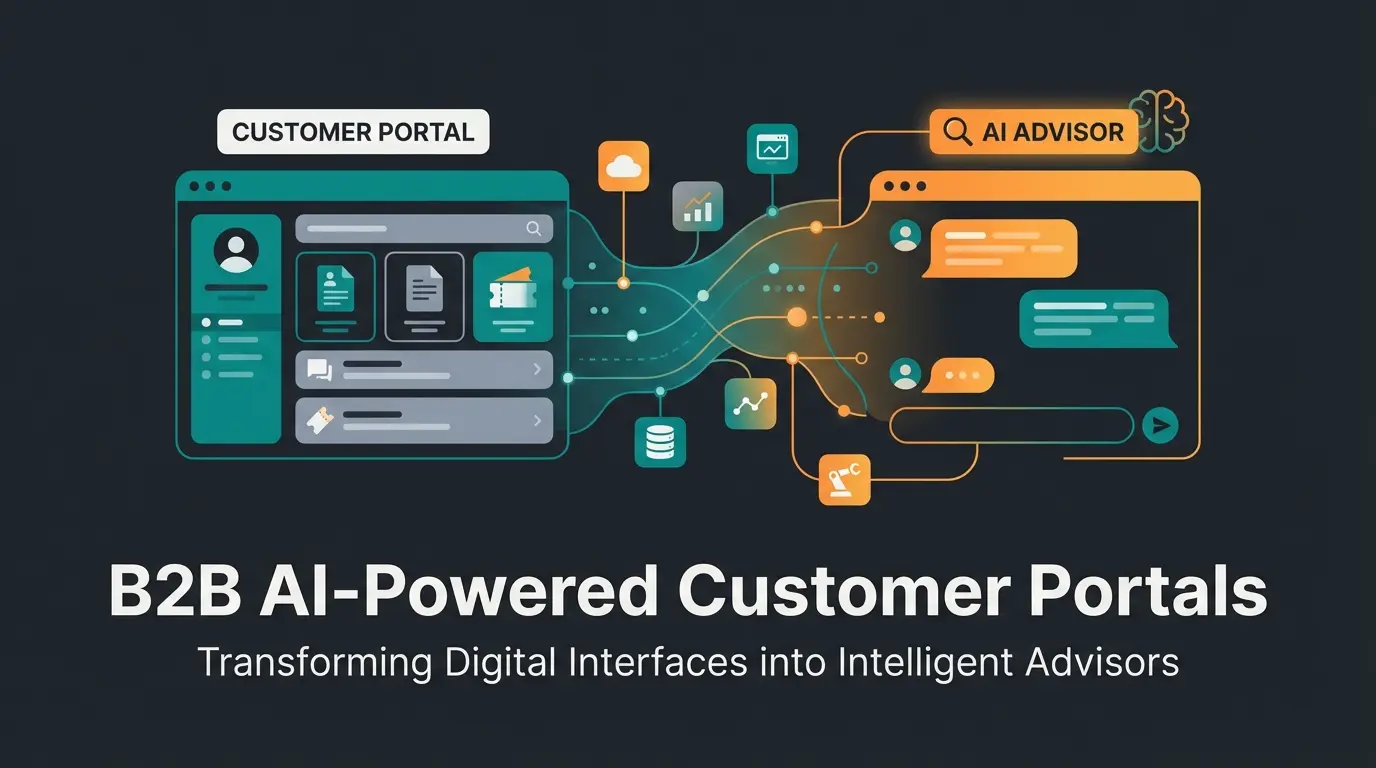
Introduction: Why Transactions Alone Are No Longer Enough
B2B e-commerce is undergoing a radical transformation. Just a few years ago, the goal of a Magento B2B shop was clearly defined: efficiency. The focus was on digitizing fax orders, automating reorders, and displaying customer-specific pricing. But in 2025, the playing field has changed dramatically.
According to current analyses from Gartner and 6sense, 75% of B2B buyers now prefer a rep-free purchasing experience. However, this doesn't mean they don't want consultation. On the contrary: they expect the expertise of an experienced engineer or sales representative—but immediately, digitally, and around the clock.
This is where many standard implementations hit their limits. Most articles about Magento B2B features merely list technical functions: Quick Order, Requisition Lists, Shared Catalogs. This is the foundation, but no longer the differentiating factor. As AI Selling is revolutionizing the industry, businesses must adapt their approach to meet evolving buyer expectations.
This article goes deeper. We don't just analyze the essential native Magento B2B features—we show you how to close the gap between a "silent" webshop and an intelligent, consultative sales platform. We examine how AI takes over technical consultation and what specific requirements the German market (DACH) places on your system.
Visualization: The B2B Maturity Model
To understand where your shop stands, it helps to look at the maturity model. Most competitors remain stuck at Level 2. Your goal must be Level 3.
| Level | Designation | Focus | Typical Features |
|---|---|---|---|
| Level 1 | Basic Shop | Price & Availability | Simple catalog, shopping cart, guest checkout |
| Level 2 | Self-Service Portal | Transaction Efficiency | Company accounts, quick order, requisition lists (current standard) |
| Level 3 | Intelligent Consultation | Solution Competence | AI sales consultants, guided selling, agentic commerce, predictive procurement |
Price display and simple purchasing—the digital catalog stage
Company accounts, quick ordering, and requisition lists for efficiency
AI-powered sales assistants that provide expert guidance 24/7
The Big 5: Native Magento B2B Features (Must-Haves)
Before we discuss AI and automation, the foundation must be solid. Adobe Commerce (formerly Magento Commerce) offers a robust suite of native features that are "table stakes"—minimum requirements—for every B2B merchant. Without these Magento B2B features, professional buyers won't take your shop seriously. Understanding these fundamentals is similar to understanding the history of chatbots—you need to know where you came from to understand where you're going.
1. Company Accounts & Hierarchy Management
In B2B business, you rarely sell to an individual—you sell to an organization. The native "Company Accounts" feature allows your customers to map their corporate structure in the frontend themselves, as detailed by NetSolutions and Transform Agency.
- Functionality: A customer-side administrator can create sub-accounts for employees, define teams, and build hierarchies.
- Roles & Permissions: Granular permissions can be assigned. Can the warehouse worker order or only prepare shopping carts? Can the department head purchase up to $5,000 without approval?
- Value: This massively relieves your customer service since customers handle their own employee management (e.g., when an employee leaves), as noted by Codilar.
2. Custom Catalogs (Shared Catalogs) & Custom Pricing
In business markets, it's common for long-standing partners not to pay list prices. Shared Catalogs are the heart of Magento B2B features for price differentiation, according to Unified and Adobe.
- The Principle: You maintain a master catalog but create virtual "views" of it.
- Application: Customer A sees the full range with 10% discount. Customer B sees only spare parts for machines they've actually purchased, at firmly negotiated net prices.
- Strategic Advantage: You prevent customers from ordering products that aren't compatible or for which they don't have certification.
3. Quick Order & Requisition Lists
Professional buyers don't "shop"—they procure. Time is the critical factor here, as highlighted by Webkul.
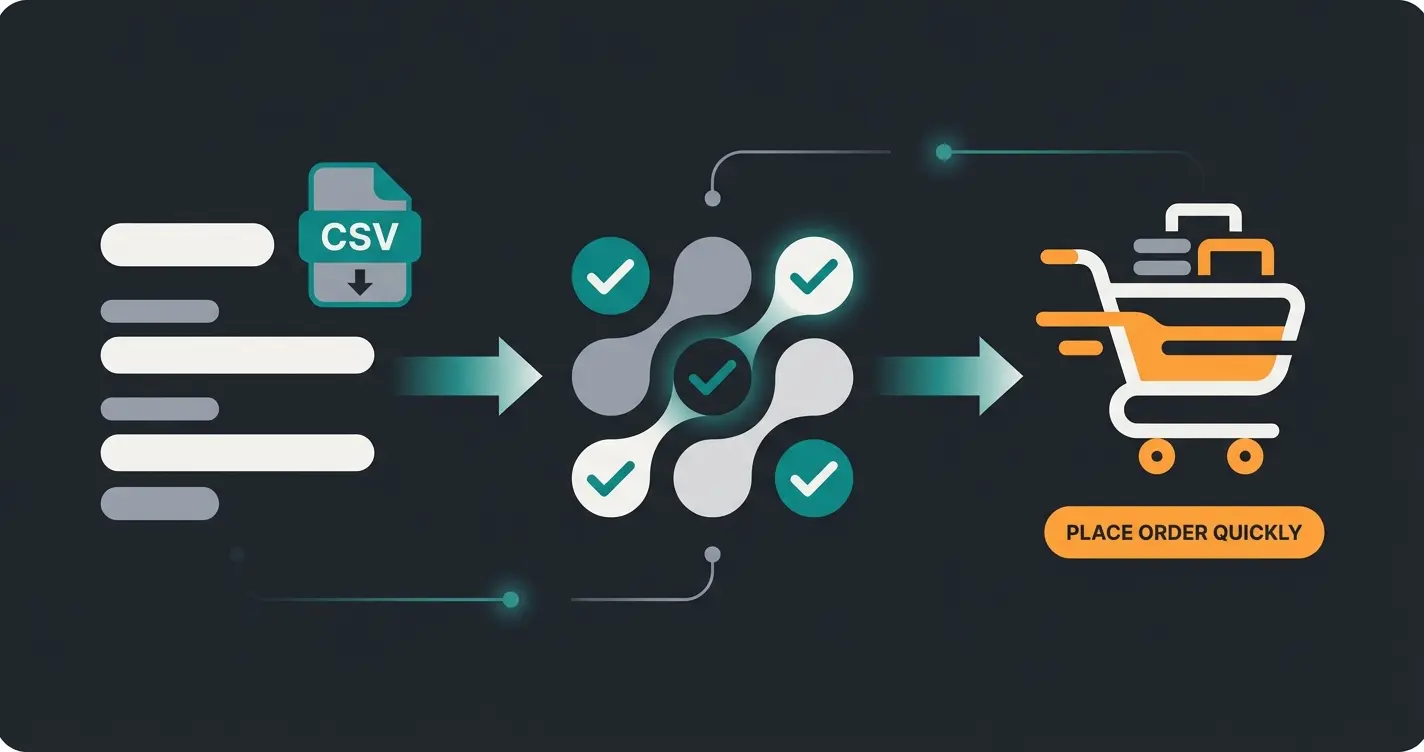
- Quick Order: Enables entering SKUs (article numbers) and quantities directly into a form or uploading a CSV file. The system validates availability in real-time.
- Requisition Lists: Unlike a wishlist where items disappear after purchase, items on a requisition list remain. Ideal for consumables that must be ordered weekly (e.g., screws, gloves, toner).
4. Quote Management (B2B Quotes)
The classic B2B sales path "call -> email quote -> negotiation -> order" is digitized here. This is one of the most powerful B2B features Magento offers for complex sales cycles, as documented by MGT Commerce.
- Workflow: A customer adds items to the cart but clicks "Request a Quote" instead of "Checkout." They can add a note (e.g., "We need 50 pieces—what can you do on price?").
- Backend: Your sales team sees the request in the Magento admin, calculates a discount, and sends the quote back. The customer sees the new quote in the portal and can convert it to an order with one click.
- Why This Matters: It prevents media breaks. The entire negotiation history is documented in the system, not in employees' personal email inboxes.
5. ERP Integration & Purchase Orders
No B2B shop is an island. Synchronization with the ERP (e.g., SAP, Microsoft Dynamics, Sage) is essential. This integration capability makes Magento a powerful hub, similar to how a Shopware B2B customer portal operates within its ecosystem.
- Purchase Orders (PO): B2B customers often don't pay immediately. They need the ability to enter their internal order number (PO Number) so the invoice can be correctly assigned later.
- Credit Limits: Magento can manage credit limits (often synchronized with the ERP). If a customer exceeds their limit, the order is blocked or automatically switched to "prepayment."
The Missing Link: From Transaction to Guided Consultation
The features mentioned above solve the problem of transaction. But they don't solve the problem of selection. This is where the real differentiation happens, and where understanding AI Product Consultation becomes crucial for forward-thinking businesses.
The Problem: "I Need a Pump, But Which One?"
Standard search in Magento (and most other shop systems) is excellent at finding products when you know the article number. However, it often fails when the customer has a problem but doesn't yet know the solution (the product).
This scenario plays out thousands of times daily across B2B operations. The buyer knows their problem but lacks the technical knowledge to translate it into a product search. Traditional navigation and filtering simply can't bridge this gap. Understanding Conversational AI evolves helps illustrate why this shift is inevitable.
The Solution: AI-Powered Product Consultation
This is where you differentiate yourself from the competition. Instead of just showing "Similar Products" (cross-selling), you integrate an AI that acts like a technical consultant. The approach is similar to how AI Chatbots in E-Commerce are transforming customer interactions across the industry.
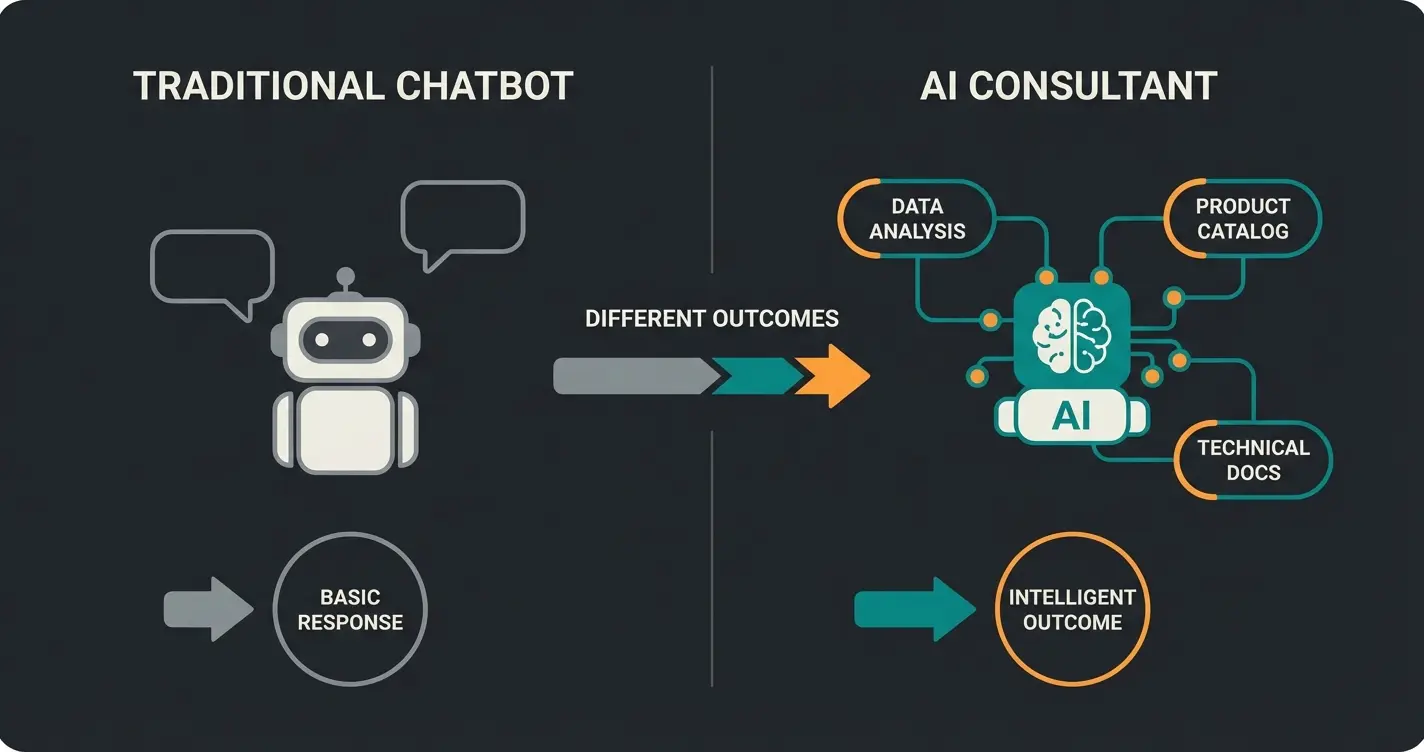
Difference: FAQ Bot vs. AI Consultant
| Feature | Standard Chatbot (Level 2) | AI Consultant (Level 3) |
|---|---|---|
| Data Source | Static scripts & FAQ texts | Live product catalog (PIM), tech datasheets, compatibility matrices |
| Capability | Answers: "What are your delivery times?" | Answers: "Which valve fits a DN50 pipe with acid exposure?" |
| Context | Forgets context after the session | Knows the customer's purchased machines (installed base) |
| Outcome | Link to a category page | Adds the exactly matching spare part to cart |
This fundamental difference explains why simple chatbots fail in B2B contexts while true Consultative AI succeeds. The technology has evolved dramatically, and businesses that understand this evolution gain significant competitive advantages.
German manufacturer achieved by implementing AI for technical spec questions
Rep-free purchasing experiences according to Gartner research
AI consultants provide around-the-clock technical guidance
Practical Example: A German machinery manufacturer implemented an AI assistant trained on the technical PDF datasheets of all 50,000 spare parts. Customers can now ask questions like: "What torque do I need for mounting Part X?" The AI delivers the answer and links to the appropriate tool. The result: 40% fewer support tickets for trivial technical questions.
Stop losing sales to the consultation gap. Our AI-powered product advisors provide expert guidance 24/7, reducing support tickets while increasing conversion rates.
Start Your AI JourneySpecific Requirements for the German Market (DACH)
Many Magento B2B modules and themes come from the USA. For success in Germany, Austria, and Switzerland, however, you must consider local specifics. The German B2B market is more conservative, legally stricter, and more demanding in processing. This differs significantly from markets where platforms like Shopware vs Shopify compete on different terms.
1. Payment Methods: The Dominance of Invoice Payment
While the company credit card dominates in the USA, purchase on invoice (Kauf auf Rechnung) is the undisputed number one in Germany. According to Cross Border Magazine and E-Commerce News EU, invoice payment dominates German B2B e-commerce with a 27-44% market share and significantly reduces checkout abandonment rates.
- Statistic: Invoice purchase dominates German B2B e-commerce with 27-44% market share and significantly reduces checkout abandonment rates.
- Challenge: The risk lies with the merchant.
- Solution: Integration of real-time credit checks (e.g., Creditreform, Schufa) directly in the Magento checkout, or use of B2B payment providers like Billie or Mondu who assume the default risk.
2. Legal Compliance & GDPR
Germany has among the strictest e-commerce laws. A standard Magento shop is often not legally compliant "out of the box." Proper configuration is essential, similar to how you might configure your Shopware customer account for compliance.
- The "Button Solution": The purchase button must be clearly labeled (e.g., "Order with payment obligation" or "Buy Now").
- Price Display: In B2B, prices often must be marked as "plus VAT and shipping." Special modules like German Market or German Law help place tax display and shipping cost notices directly at the price, as documented by Adobe and resources on GitHub.
- Data Protection: Cookies and tracking require clean Consent Management Platforms (CMP) in B2B contexts where personal data of employees is processed.
3. Logistics & Partial Deliveries
German buyers expect precision. "Delivery in 3-5 days" is often too vague for professional procurement teams.
- Exact Availability: Display of stock levels in real-time.
- Partial Deliveries: If only 80 of 100 items are available, the customer must be able to choose at checkout: "Wait for everything together" or "Partial delivery immediately." Magento supports this natively (Multi-Shipping) but often needs UX optimization.
Advanced B2B Features: Modules and Extensions
Even the powerful Adobe Commerce Cloud doesn't cover every niche requirement. This is where specialized Magento B2B modules come into play. For businesses considering platform alternatives, our Shopware B2B guide provides comprehensive insights into another leading solution.
1. PIM Integration (Product Information Management)
For technical products, Magento's attribute fields are often insufficient. A PIM (like Akeneo or Pimcore) is almost mandatory for B2B shops.
Why? You must maintain thousands of technical attributes (length, diameter, material, DIN standard) and make this data usable for faceted search in the shop. Without proper PIM integration, your Magento B2B features remain underutilized.
2. CPQ (Configure, Price, Quote)
For highly complex products (e.g., configurable forklifts or server cabinets), the native configurator isn't enough.
Extension: CPQ modules enable dependency logic (e.g., "If Motor A is selected, Gearbox B cannot be selected"). This prevents incorrect orders of technical goods and reduces costly returns and rework.
3. RMA (Return Merchandise Authorization)
Returns in B2B are complex (restocking fees, damage inspection). A professional RMA module allows customers to register returns with photos and justification in the portal before shipping the goods back. This streamlines the entire reverse logistics process.
The Future: Agentic Commerce & AI Automation
We stand on the threshold of a new era: Agentic Commerce. While today we still talk about humans using AI tools, soon AI agents will trade with AI agents. According to The Paypers and Automation Alley, this shift is already underway.
What Does This Mean for Your Magento Shop?
The evolution toward agentic commerce requires fundamental rethinking of how B2B shops operate. With multilingual AI chatbots becoming standard, the foundation for this transformation is already being laid.
- Machine-Readable Catalogs: In the future, not only humans will visit your shop, but your customer's AI purchasing bot. Your shop must provide APIs that deliver prices and availability to these bots in real-time without loading an HTML page.
- Automated Negotiation: Imagine the customer's purchasing bot inquires: "I need 10,000 units by Friday. My target price is X." Your sales bot checks inventory and margin and responds in milliseconds: "We can deliver 10,000, but not until Monday at price X. Or 5,000 by Friday at price Y."
- Predictive Reordering: AI analyzes the customer's order history and proactively suggests carts before the customer's warehouse runs empty. This transforms the shop from a reactive tool into a proactive partner.
Understanding how an AI Chatbot for E-Commerce works today helps prepare for the more sophisticated agentic systems of tomorrow. The trajectory is clear: from simple response systems to autonomous negotiating agents.
Conclusion & Implementation Checklist
Competition for B2B customers in 2025 will no longer be decided by price alone, but by process costs and consultation quality. A Magento shop that only functions as a digital catalog (Level 1) will lose against platforms that act as intelligent partners (Level 3). For businesses considering alternatives, a Magento to Shopware migration might be worth evaluating as part of your digital transformation strategy.
Summary: Your Path to the Intelligent B2B Shop
| Area | Standard Magento Store (Status Quo) | AI-Optimized B2B Store (Target State) |
|---|---|---|
| Search | Finds products by name/SKU | Finds solutions for technical problems |
| Support | Reactive chatbot / email | Proactive AI consultant with expertise |
| Ordering | Manual by buyer | Partially automated through demand analysis |
| Data | Silos (shop separate from ERP) | Integrated ecosystem (shop + ERP + PIM + AI) |
Recommended Action Plan
Start with the native Magento B2B features (Company Accounts, Shared Catalogs) to lay the foundation. But don't stop there. Invest in data quality (PIM) to make your products "AI-ready," and evaluate the use of Conversational AI to make your best sales representatives' knowledge digitally available around the clock.
Implement Company Accounts, Shared Catalogs, Quick Order, and Quote Management
Connect your Product Information Management system for AI-ready data
Deploy conversational AI that understands technical requirements and guides buyers
Build machine-readable interfaces for agentic commerce readiness
The Perfect Magento B2B Tech Stack
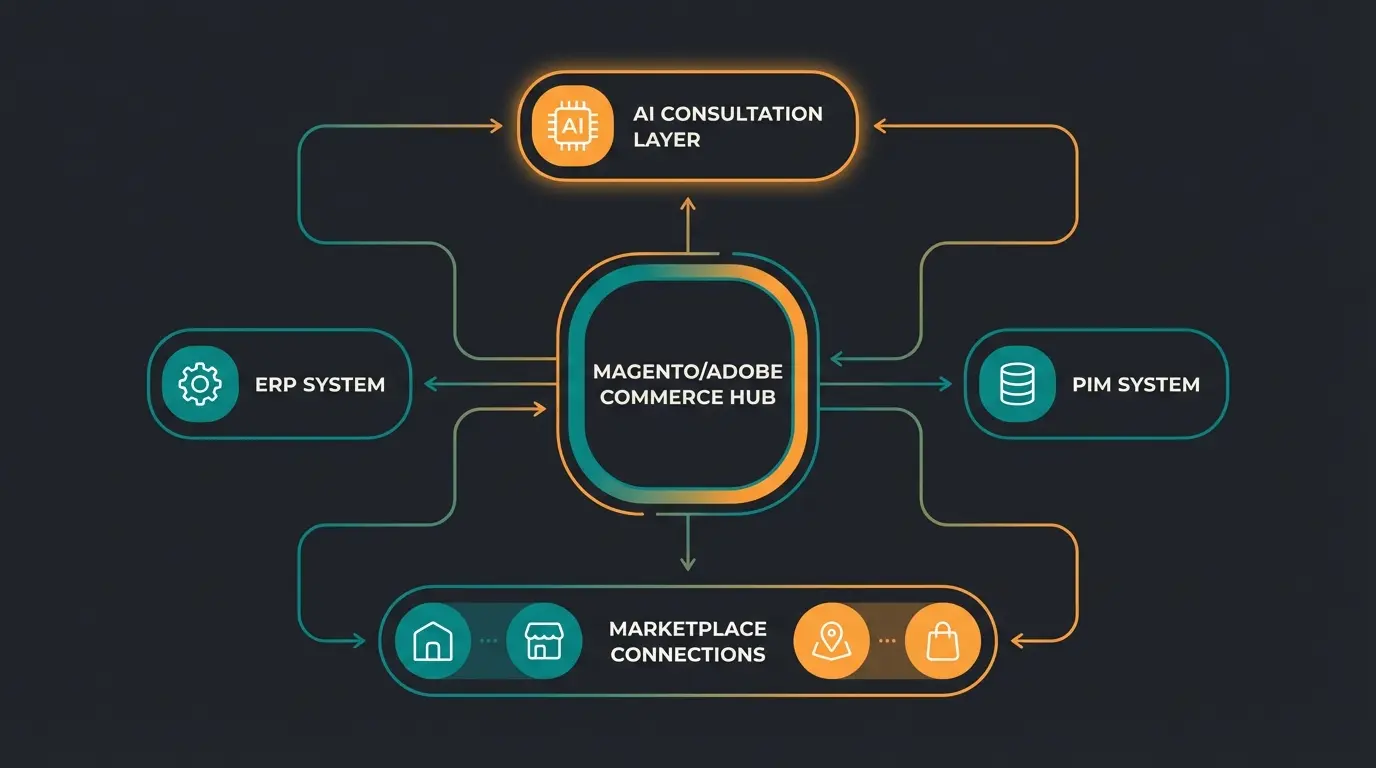
The ideal architecture places Adobe Commerce (Magento) at the center as the transaction engine. On the left (backend), ERP systems like SAP handle logistics and finances while PIM systems like Akeneo manage product data. At the top (frontend), the AI Consultation Layer sits between the customer and catalog, translating inquiries into solutions. On the right (market), connections to marketplaces and e-procurement systems (OCI/Punchout) complete the ecosystem.
Frequently Asked Questions About Magento B2B Features
Magento B2B (Adobe Commerce) includes specialized features like Company Accounts with role-based permissions, Shared Catalogs with customer-specific pricing, Quote Management for price negotiations, Requisition Lists for recurring orders, and credit limit management. B2C focuses on individual consumers with simpler checkout flows and standard pricing. B2B requires handling complex organizational buying processes, multiple decision-makers, and negotiated contracts.
Yes, through Shared Catalogs in Adobe Commerce. You create a master catalog and define virtual "views" that show specific products at specific prices to each customer group. This allows Customer A to see the full range with 10% off while Customer B only sees spare parts for their purchased machines at negotiated net prices. This is one of the core Magento B2B features for enterprise commerce.
Magento B2B offers Quick Order functionality that lets buyers enter multiple SKUs and quantities directly, or upload CSV files for bulk ordering. Combined with Requisition Lists (persistent shopping lists that don't clear after purchase), professional buyers can efficiently reorder consumables and standard items without browsing the catalog each time.
AI shouldn't replace your sales team—it should augment them. AI Product Consultation handles routine technical questions (40%+ of typical support tickets), product compatibility checks, and spec lookups 24/7. This frees your human experts for complex negotiations, relationship building, and strategic accounts. The result is better coverage without proportionally increasing headcount.
Both platforms offer strong B2B capabilities. Magento (Adobe Commerce) excels with its mature Company Accounts, Shared Catalogs, and enterprise integrations—especially for large-scale operations. Shopware offers a more modern architecture and is particularly strong in the DACH region with native German compliance features. The right choice depends on your existing tech stack, market focus, and specific feature requirements.
Join forward-thinking B2B companies using AI-powered consultation to increase conversions, reduce support costs, and deliver 24/7 expert guidance. See how our solution integrates with your Magento B2B features.
Get Started Today
Lasse is CEO and co-founder of Qualimero. After completing his MBA at WHU and scaling a company to seven-figure revenue, he founded Qualimero to build AI-powered digital employees for e-commerce. His focus: helping businesses measurably improve customer interaction through intelligent automation.