How much does WooCommerce really cost in 2026?
Open the analytics dashboard of any mid-sized WooCommerce store and you will find hosting invoices, plugin renewal notices, and transaction fees that tell a very different story from "free." WooCommerce powers roughly 37% of all online stores globally, according to Statista. That makes it the most widely used e-commerce platform on the planet. The plugin itself costs nothing. Everything around it does.
I have helped dozens of store owners plan their WooCommerce budgets over the past few years. The pattern is always the same: they budget for hosting and a theme, then get surprised by plugin renewals in month six and maintenance costs in month twelve. The real question is not whether WooCommerce is expensive. It is whether you know where the money actually goes before you commit.
For a broader overview of all WooCommerce cost categories, see our WooCommerce Costs guide. Below is the detailed pricing breakdown.
| Store Size | Annual Cost | Typical Setup |
|---|---|---|
| Starter | $150-500 | Shared hosting, free theme, basic plugins, under 100 products |
| Growing | $1,000-3,000 | Managed hosting, premium theme, 5-10 paid plugins, 100-1,000 products |
| Professional | $3,000-8,000 | Managed WooCommerce hosting, custom theme, 10+ plugins, dedicated support |
| Enterprise | $8,000-25,000+ | VPS/dedicated hosting, custom development, advanced integrations, 10,000+ products |
Is WooCommerce really free?
WooCommerce is a free, open-source plugin available on WordPress.org. You can download it, install it, and start building a store without paying a cent to Automattic, the company behind it. No subscription tiers, no revenue share, no transaction fees from the platform itself. That part is genuinely free.
The less straightforward part: "free" only covers the core plugin. You still need somewhere to host it, a domain to point at it, a theme to make it look professional, plugins to add the features your customers expect, and a payment gateway to actually collect money. Think of it as a free car engine. Powerful and well-maintained by a massive community. But you still need the chassis, the tires, the fuel, and insurance before you can drive anywhere.
- What is free: Core WooCommerce plugin, Storefront theme, community support forums, WooPayments plugin (no monthly fee), basic shipping options (flat rate, free shipping, local pickup)
- What costs money: Web hosting ($36-6,000+/year), domain registration ($12-20/year), premium themes ($49-150/year), premium plugins and extensions ($50-2,000+/year), payment processing fees (2.9% + $0.30/transaction), security tools, email marketing, custom development
WooCommerce hosting costs
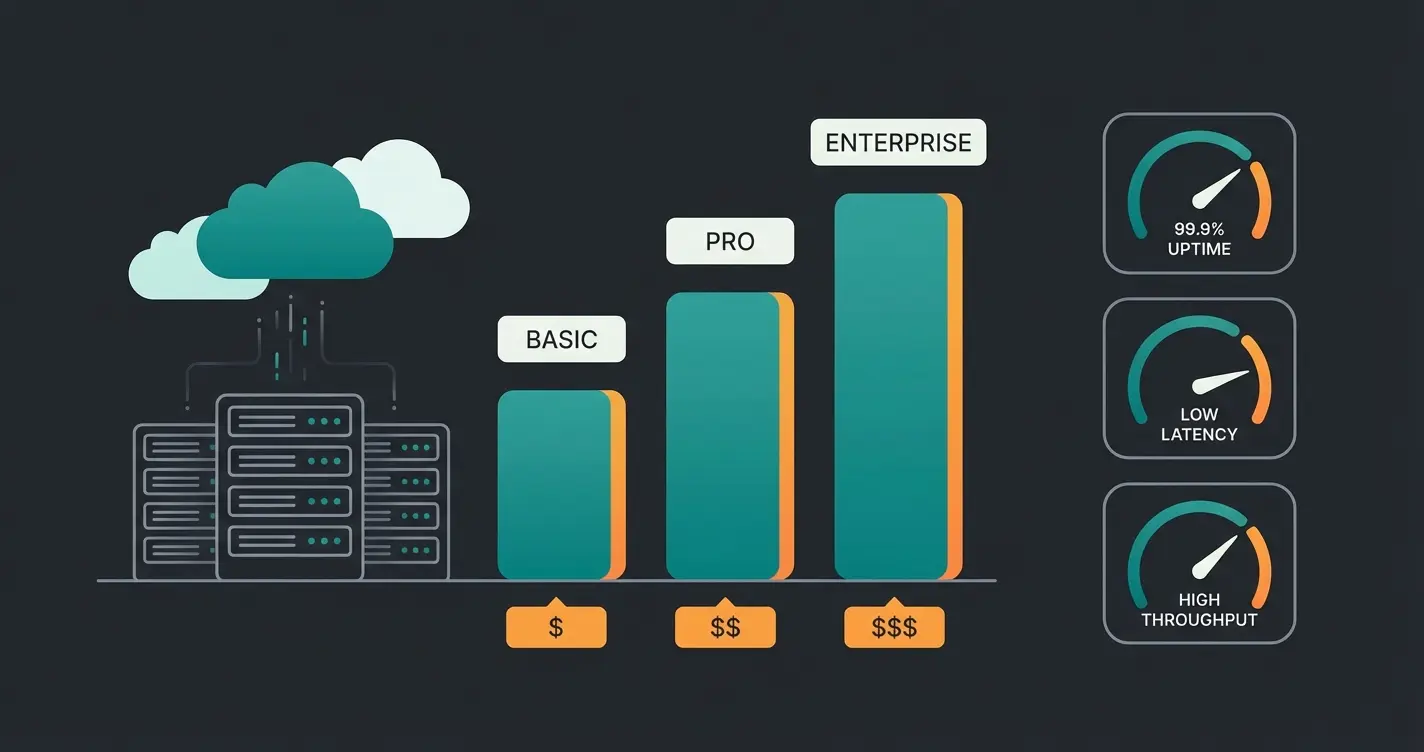
Hosting is the single largest fixed expense for any WooCommerce store. Your hosting choice directly impacts page load speed, checkout reliability, and ultimately your conversion rate. Research consistently shows that a one-second delay in page load can reduce conversions by up to 7%. Cheap hosting is often the most expensive decision a store owner makes.
I spoke with a WooCommerce store owner last month who was running a 2,000-product store on $4/month shared hosting. His checkout page took 6 seconds to load. He was losing an estimated 15-20% of his sales to abandonment before customers even reached the payment step. After switching to managed WooCommerce hosting at $80/month, his conversion rate jumped 23%. The hosting cost went up by $900/year. Revenue went up by $40,000.
| Hosting Type | Monthly Cost | Annual Cost | Best For |
|---|---|---|---|
| Shared hosting | $3-15/mo | $36-180/yr | Testing, side projects, under 500 visitors/day |
| Managed WordPress | $25-50/mo | $300-600/yr | Small to mid-sized stores, 500-2,000 visitors/day |
| Managed WooCommerce | $50-200/mo | $600-2,400/yr | Serious stores, built-in caching and staging, WooCommerce-specific optimization |
| VPS / Dedicated | $100-500+/mo | $1,200-6,000+/yr | High-traffic stores, 10,000+ visitors/day, full server control |
For a detailed comparison of hosting providers with performance benchmarks and recommendations by store size, see our WooCommerce Hosting Comparison.
Domain and SSL costs
A .com domain costs $12-20 per year from registrars like Namecheap, Cloudflare Registrar, or your hosting provider. Some hosts include a free domain for the first year, but renewals typically cost $15-20/year. Premium domains with short, keyword-rich names can cost hundreds or thousands, though that is a branding investment rather than a platform cost.
SSL certificates are effectively free in 2026. Most reputable hosts include Let's Encrypt SSL at no extra charge, and it renews automatically. Unless you need an extended validation (EV) certificate for enterprise compliance ($100-300/year), SSL is a cost you can safely cross off the list.
WooCommerce theme costs
Your theme controls how your store looks, how fast it loads, and how well it converts visitors into buyers. WooCommerce's default Storefront theme is free and functional. It works. But it also looks like every other WooCommerce store that never invested in design, and in e-commerce, trust is heavily influenced by first impressions.
| Option | Cost | Pros | Cons |
|---|---|---|---|
| Free theme (Storefront, Astra, Kadence) | $0 | No cost, regularly updated, lightweight | Generic design, limited customization options |
| Premium theme | $49-150/year | Professional design, more features, dedicated support | Annual renewal cost, potential performance bloat |
| Page builder + theme (Elementor, Divi) | $49-89/year | Full visual control, drag-and-drop editing | Learning curve, potential performance impact |
| Custom theme development | $2,000-10,000+ | Unique brand identity, optimized for your products | High upfront cost, requires ongoing maintenance |
For most stores doing under $500K in annual revenue, a premium theme at $49-150/year hits the sweet spot between cost and professional quality. Our Best WooCommerce Themes guide covers the top-performing options with speed benchmarks and conversion data.
Plugin and extension costs
This is where WooCommerce pricing gets real. The core plugin handles basic product listings, cart, and checkout. Everything else, subscriptions, bookings, advanced shipping rules, dynamic pricing, abandoned cart recovery, requires paid extensions. Most store owners end up with 5-15 paid plugins, each renewed annually. The costs compound faster than most people expect.
The real challenge with plugins is not just the cost per plugin. It is the management overhead. Every plugin needs updating. Every update can introduce conflicts with other plugins. I have seen stores break after routine updates because two plugins suddenly stopped being compatible. That is why a staging environment and regular backups are not optional, they are part of the real cost of running a plugin-heavy WooCommerce store.
| Plugin Category | Examples | Annual Cost |
|---|---|---|
| Subscriptions | WooCommerce Subscriptions | $259/yr |
| Bookings | WooCommerce Bookings | $249/yr |
| Dynamic pricing | Dynamic Pricing and Discounts | $79-129/yr |
| Product add-ons | Product Add-Ons, Product Bundles | $69-79/yr each |
| Shipping | Table Rate Shipping, ShipStation | $99-120/yr |
| SEO | Yoast SEO Premium, Rank Math Pro | $99-199/yr |
| Security | Wordfence Premium, Sucuri | $99-199/yr |
| Backup | UpdraftPlus Premium, BlogVault | $49-99/yr |
| Email marketing | Klaviyo, Mailchimp for WooCommerce | $0-500+/yr (scales with list size) |
| Abandoned cart recovery | CartFlows, Retainful | $79-199/yr |
Our Best WooCommerce Plugins guide reviews 25+ essential plugins with pricing, free alternatives, and recommendations by store size.

Payment processing fees
Every transaction through your WooCommerce store carries a processing fee. Unlike hosting or plugins, this cost scales directly with your revenue. At $10,000/month in sales, you are paying roughly $320-400/month in processing fees alone. At $100,000/month, that number crosses $3,000. This is the cost category that grows invisibly and often gets underestimated in budget planning.
| Gateway | Transaction Fee | Monthly Fee | Key Advantage |
|---|---|---|---|
| WooPayments | 2.9% + $0.30 | $0 | Deepest WooCommerce integration, built by Automattic |
| Stripe | 2.9% + $0.30 | $0 | Most popular processor, 135+ currencies, excellent API |
| PayPal | 3.49% + $0.49 | $0 | Customer trust and recognition, higher fees offset by conversion lift |
| Square | 2.6% + $0.10 | $0 | Best for omnichannel (online + point-of-sale) |
| Klarna | Variable (2.49-3.29%) | $0 | Buy now, pay later increases conversion on high-ticket items |
The industry standard setup is Stripe as your primary processor with PayPal as a secondary option. Most experienced store owners run both because customer payment preferences vary. For a full comparison including setup guides, international fees, and edge cases, see our WooCommerce Payment Gateways guide.
Developer and agency costs
You can build a basic WooCommerce store yourself. WordPress has a manageable learning curve, and most premium themes include visual page builders. But the moment you need custom functionality, a unique checkout flow, or complex integrations with ERP or CRM systems, you need professional help.
| Service | Freelancer Rate | Agency Rate |
|---|---|---|
| Basic store setup | $500-2,000 | $2,000-5,000 |
| Custom theme design | $2,000-5,000 | $5,000-15,000 |
| Custom plugin development | $1,000-5,000 | $3,000-10,000 |
| Full custom store build | $3,000-10,000 | $10,000-50,000+ |
| Ongoing maintenance retainer | $50-100/hr | $100-250/hr |
The DIY path works for starter stores. Once you cross $10,000/month in revenue, the cost of your own time troubleshooting plugin conflicts and wrestling with CSS usually exceeds what you would pay a professional. For step-by-step guidance on what to DIY versus when to hire, our WooCommerce Store Setup guide covers the full process.
Hidden costs most store owners miss
I expected hosting to be the cost that surprises people most. It is not. The costs that actually catch store owners off guard are the small recurring expenses that show up six months after launch, right when cash flow is tightest. None of them are large on their own. Together, they add $200-2,000/year that was never in the original budget.
- Security monitoring and malware scanning ($100-300/year): A single successful hack can cost $5,000+ in cleanup, lost revenue, and damaged customer trust. Prevention is cheaper than recovery.
- Performance optimization ($60-300/year): CDN service ($0-200/year), caching plugin ($0-99/year), image optimization ($60-240/year). Slow stores lose customers at every step of the funnel.
- Regular updates and maintenance ($200-500/month if outsourced): WordPress core, WooCommerce, themes, and every plugin need updating. Skip updates and you invite security vulnerabilities. Budget 2-4 hours/month minimum.
- Staging environment: Testing updates on a live store is asking for trouble. Most managed hosts include staging, but shared hosting typically does not. A separate staging setup can cost $10-50/month.
- Transactional email delivery ($10-30/month): Order confirmations, shipping notifications, password resets. Default WordPress email delivery is unreliable and frequently lands in spam. Services like Mailgun or Postmark solve this.
- Legal compliance ($0-2,000): GDPR cookie consent, terms of service, privacy policy, accessibility compliance. Free plugins cover the basics, but proper legal review of your store-specific terms costs $500-2,000.
WooCommerce total cost of ownership by store size
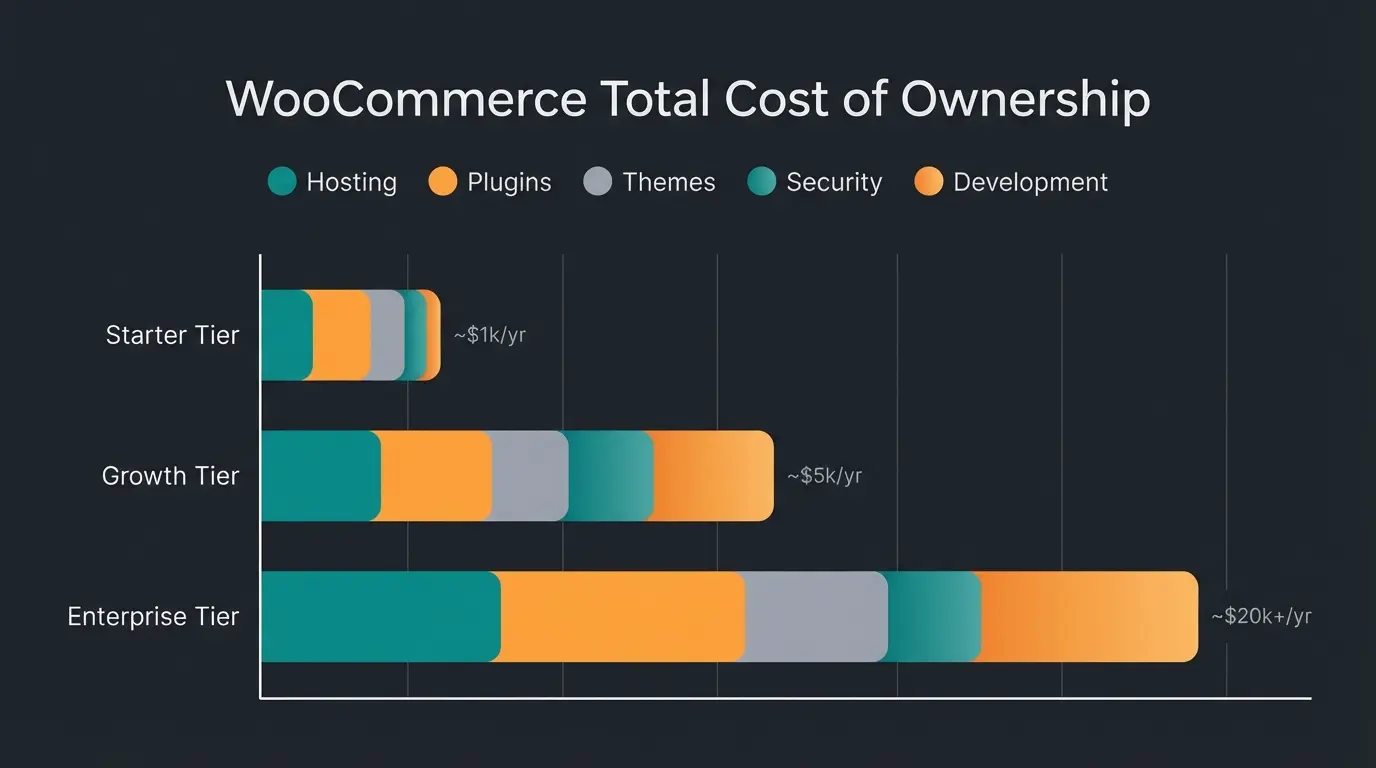
Total cost of ownership (TCO) combines every recurring expense into a single annual number. This is the figure that actually matters for budget planning. A store that costs $800 in year one will likely cost $600-700 every year after, assuming it does not grow. As revenue scales, hosting and plugin costs scale with it, and marketing costs typically grow fastest of all.
Here is what each tier looks like when you add everything together. For a broader perspective on how WooCommerce fits into the entire e-commerce ecosystem, see our complete WooCommerce Guide.
WooCommerce itself is free and open-source
Shared hosting, free theme, essential free plugins
Managed hosting, premium plugins, professional theme
Custom development, VPS hosting, advanced integrations
| Cost Category | Starter ($150-500/yr) | Growing ($1K-3K/yr) | Professional ($3K-8K/yr) | Enterprise ($8K-25K+/yr) |
|---|---|---|---|---|
| Hosting | $36-180 | $300-600 | $600-2,400 | $1,200-6,000+ |
| Domain + SSL | $12-20 | $12-20 | $15-50 | $15-300 |
| Theme | $0 | $49-150 | $49-150 | $2,000-10,000 (custom) |
| Plugins / Extensions | $0-100 | $350-800 | $800-2,000 | $2,000-5,000+ |
| Payment processing | 2.9% + $0.30/tx | 2.9% + $0.30/tx | 2.9% + $0.30/tx | 2.2-2.5% (negotiated) |
| Security + maintenance | $0-50 | $200-500 | $500-1,500 | $1,500-4,000+ |
| Email services | $0 | $100-300 | $300-600 | $600-2,000+ |
| Development (ongoing) | $0 | $0-500 | $1,000-3,000 | $3,000-10,000+ |
WooCommerce vs Shopify pricing comparison
This is the comparison everyone asks about. The short answer: WooCommerce costs less at low volume but requires more management time. Shopify costs more upfront but bundles hosting, security, and updates into one predictable bill. The right choice depends on whether you value cost control or time savings more.
| Factor | WooCommerce | Shopify |
|---|---|---|
| Platform cost | $0 (open source) | $39-399/month |
| Hosting | $3-500+/month (separate) | Included in all plans |
| Transaction fees | Gateway fees only (2.9% + $0.30) | Gateway fees + 0.5-2% if not using Shopify Payments |
| Themes | $0-150/year | $0-400 (mostly one-time purchase) |
| Apps / plugins | $0-5,000+/year | $0-5,000+/year |
| Total at $10K/mo revenue | ~$200-400/month all-in | ~$250-500/month all-in |
| Total at $100K/mo revenue | ~$500-1,500/month | ~$600-2,000/month |
| Data ownership | Full control, self-hosted | Platform-dependent, export possible |
| Customization ceiling | Unlimited (open source) | Limited by platform architecture |
The honest take: Shopify is the better choice for store owners who want to focus entirely on selling and are comfortable with a fixed monthly bill. WooCommerce is the better choice for stores that need deep customization, own their data completely, or have technical resources in-house. At scale ($500K+ annual revenue), WooCommerce often costs less in platform fees but more in development and management time.
What neither platform solves on its own is the customer interaction layer. Whether your store runs on WooCommerce or Shopify, the conversion rate depends heavily on how well you handle product questions and purchase hesitation in real time.
Whether you run WooCommerce or Shopify, the real conversion lever is how you advise customers in real time. Qualimero's AI employees turn product questions into purchases, with clients seeing up to 7x higher conversion rates and 35% larger cart values.
See how it worksHow to reduce WooCommerce costs with AI
The largest ongoing expense for most WooCommerce stores is not hosting or plugins. It is people. Customer service, product consultation, pre-sales support. One full-time support agent costs $30,000-50,000/year. During peak season, you need two or three. That is $60,000-150,000 in annual staffing costs for a function that directly determines your conversion rate.
AI-powered customer service changes that equation fundamentally. Gartenfreunde, an online retailer for garden and wellness products running on WooCommerce, handled up to 50 consultation-intensive inquiries per day with a single sales employee. After implementing an AI employee from Qualimero, trained specifically on their product catalog and expert knowledge, they achieved a 7x higher conversion rate and 6x ROI. Their AI employee handles product recommendations 24/7 with a 45% click-through rate on suggested items.
That is not a hosting optimization or a plugin upgrade. It is a structural cost reduction that simultaneously increases revenue. The kind of result that makes the entire WooCommerce pricing discussion look different.
Frequently asked questions
WooCommerce itself is free. Monthly costs come from hosting ($3-500+), plugins (varies widely), and payment processing fees (2.9% + $0.30 per transaction). A realistic budget for a small store is $20-50/month, a growing store $80-250/month, and enterprise stores $500-2,000+/month.
The core WooCommerce plugin is completely free and open-source. However, you need paid hosting, a domain name, and typically several premium plugins to run a functional production store. The "free" label applies to the software itself, not the infrastructure required to run it.
Most WooCommerce payment gateways charge 2.9% + $0.30 per transaction (WooPayments, Stripe). PayPal charges 3.49% + $0.49 per transaction. At high transaction volume ($50K+/month), you can negotiate custom enterprise rates that drop to 2.2-2.5% + $0.30.
At low to mid volume, WooCommerce is typically cheaper. A basic WooCommerce store costs $150-500/year versus Shopify Basic at $468/year. At higher volumes, the gap narrows because WooCommerce hosting and plugin costs scale. WooCommerce offers more cost control but requires more hands-on management time.
Start with shared hosting ($3-5/month), the free Storefront theme, WooPayments for payment processing (free plugin, pay only transaction fees), and free versions of essential plugins like Yoast SEO and Wordfence. Total first-year cost: roughly $50-80. Upgrade to managed hosting and premium plugins when revenue justifies the expense.
An AI employee from Qualimero answers product questions, recommends the right items, and converts browsers into buyers around the clock. No code changes required. Works with any WooCommerce setup.
Book a free demo
Lasse is CEO and co-founder of Qualimero. After completing his MBA at WHU and scaling a company to seven-figure revenue, he founded Qualimero to build AI-powered digital employees for e-commerce. His focus: helping businesses measurably improve customer interaction through intelligent automation.