Shopify plans overview 2026
Shopify offers five pricing plans in 2026, ranging from $5 to over $2,300 per month. Each plan targets a different stage of business growth, from social sellers to enterprise operations. All plans include unlimited bandwidth, a free SSL certificate, and access to Shopify Payments, according to the official Shopify pricing page.
The plan you choose affects more than your monthly bill. It determines your transaction fee rates, the number of staff accounts, reporting depth, and shipping discount levels. For a complete breakdown of all Shopify Costs, start with the subscription and work outward.
In early 2026, Shopify renamed its mid-tier plan from the "Shopify" plan to "Grow". Pricing and features stayed the same. If you see references to the "Shopify plan" at $105/mo elsewhere, that is now the Grow plan. If you are new to the platform, our Shopify overview explains what the system does before you pick a tier.
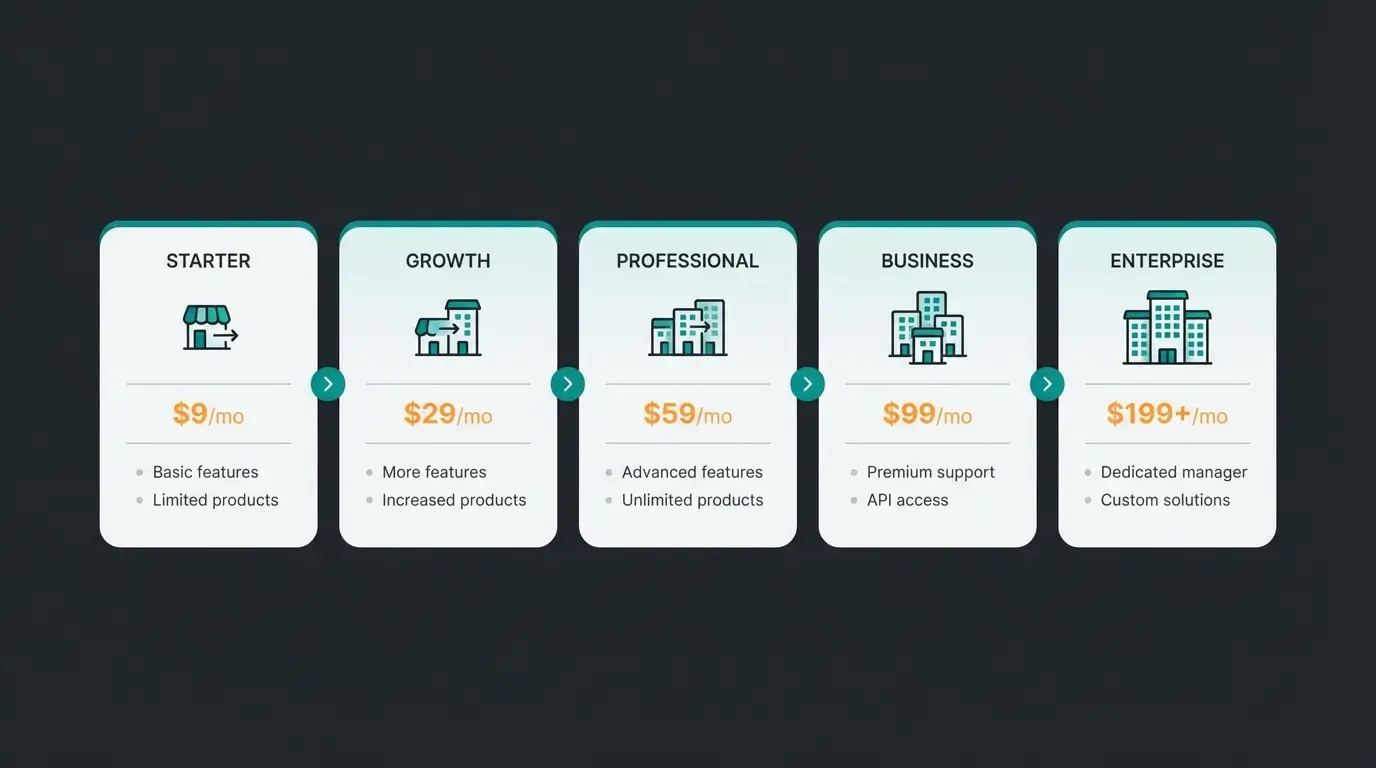
| Plan | Monthly | Annual | Card rate (Shopify Payments) | 3rd-party fee | Staff | Best for |
|---|---|---|---|---|---|---|
| Starter | $5 | $5 | 5% + $0.30 | N/A | 1 | Social selling, link-in-bio |
| Basic | $39 | $29/mo | 2.9% + $0.30 | +2.0% | 2 | Solo founders, small stores |
| Grow | $105 | $79/mo | 2.7% + $0.30 | +1.0% | 5 | Growing teams (2-10 staff) |
| Advanced | $399 | $299/mo | 2.5% + $0.30 | +0.6% | 15 | High-volume, international |
| Plus | $2,300+ | $2,300+ | Negotiated | +0.2% | Unlimited | Enterprise, custom checkout |
For a deeper look at how these prices break down month by month, including taxes and add-ons, see our Shopify Monthly Costs Breakdown. The subscription is only the starting point.
All Shopify plans in detail
Each Shopify plan is built for a specific type of seller. The differences go beyond price. Here is what you actually get at each tier, based on the Shopify Help Center documentation and our own testing.
Starter plan ($5/mo)
The Starter plan is not a traditional online store. It gives you a simple storefront and the ability to sell through social media, messaging apps, and link-in-bio pages. You get a basic product catalog, manual order creation, and Shopify Payments at 5% + $0.30 per transaction.
There is no full website builder, no custom domain, and no checkout customization. For sellers testing a product on Instagram or TikTok before committing to a full store, it works. For anything beyond that, it does not.
Basic plan ($39/mo)
Basic is where most new store owners start. You get a full online store with a custom domain, discount codes, abandoned cart recovery, and up to 2 staff accounts. Credit card processing runs at 2.9% + $0.30 through Shopify Payments, with an additional 2.0% surcharge if you use a third-party gateway.
Reporting is limited to basic dashboards. Shipping discounts of up to 77% through DHL Express, UPS, and USPS are included, along with Shopify POS Lite for in-person selling. The $39 monthly price drops to $29 when you pay annually, saving $120 per year. For a solo founder processing under $10,000/mo in orders, Basic covers the essentials without overpaying.
Grow plan ($105/mo)
Grow is the mid-tier option for teams scaling beyond a single operator. You get 5 staff accounts, professional reports, and lower transaction fees: 2.7% + $0.30 on Shopify Payments, plus only 1.0% for third-party gateways. The annual price is $79/mo.
The real upgrade is in reporting. Sales reports, customer reports, and marketing attribution that Basic does not offer. If your store processes $10,000-$50,000 monthly and you need your team to access the backend, Grow is the natural step up.
At higher volumes, the lower third-party gateway surcharge becomes a significant factor. On Basic, a store processing $30,000/mo through PayPal or Stripe pays a 2.0% surcharge of $600/mo. On Grow, the same volume costs 1.0%, or $300/mo. The $66 monthly price difference between plans is more than offset by $300 in surcharge savings.
Advanced plan ($399/mo)
Advanced targets high-volume stores selling internationally. Credit card rates drop to 2.5% + $0.30, and third-party gateway surcharges fall to 0.6%. You get 15 staff accounts, a custom report builder, third-party calculated shipping rates, and localized storefronts by market. The annual price is $299/mo.
At $50,000+ in monthly revenue, the lower transaction fees alone can offset the higher subscription cost. If you sell across multiple countries, the market-specific storefronts and duty/import tax calculations justify the step up from Grow. For stores with physical retail locations, Advanced also includes better POS analytics.
Plus plan (from $2,300/mo)
Shopify Plus is the enterprise tier. Pricing starts at $2,300/mo on a 1-3 year contract, but varies based on your gross merchandise volume and customization needs. You get unlimited staff accounts, 200 inventory locations, fully customizable checkout through Shopify Functions, B2B/wholesale features, and priority 24/7 phone support.
For Shopify POS Pricing, Plus includes up to 200 POS Pro locations. The real value is in Shopify Flow automations and the ability to handle flash sales without throttling. At $1M+ annual revenue with complex operations, Plus starts making financial sense.
Comparing Shopify plans: which one is right for you?
The right Shopify plan depends on three factors: your monthly revenue, your team size, and whether you sell internationally. A solo founder processing $3,000/mo in orders needs different tools than a 15-person team managing multiple warehouses across borders.
| Business stage | Monthly revenue | Team size | Recommended plan | Monthly cost |
|---|---|---|---|---|
| Side project / social seller | Under $1,000 | 1 | Starter | $5 |
| Solo founder launching | $1,000-$10,000 | 1-2 | Basic | $39 ($29 annual) |
| Growing store | $10,000-$50,000 | 2-5 | Grow | $105 ($79 annual) |
| Scaling internationally | $50,000-$200,000 | 5-15 | Advanced | $399 ($299 annual) |
| Enterprise / high-volume | $200,000+ | 15+ | Plus | $2,300+ |
Determine your monthly order volume and gross revenue
How many people need backend access to your store?
Do you sell internationally or need in-person POS?
Calculate whether lower transaction fees offset a higher plan cost
The most common mistake is choosing based on features you think you will need rather than features you use today. Start with Basic. When your reporting needs outgrow the basic dashboard, or when adding a third team member, that is the signal to upgrade to Grow. The transition takes minutes in your Shopify admin.
One exception: if you already process over $20,000/mo and use a third-party payment gateway, the math on Grow often works from day one. The 1.0% surcharge on Grow versus 2.0% on Basic saves $200 on every $20,000 in revenue. At $30,000/mo, that is $300 in monthly savings against a $66 price increase. The higher subscription pays for itself.
Hidden costs beyond your Shopify plan
Your Shopify subscription is not your total cost. Transaction fees, apps, themes, and add-on services can double or triple your monthly spend. The average Shopify merchant spends around $58/mo on apps alone. For mid-market stores running 8-12 paid apps, that number climbs to $240-$360/mo.
| Cost category | Typical range | Notes |
|---|---|---|
| Transaction fees (Shopify Payments) | 2.5%-2.9% + $0.30 | Per transaction, varies by plan |
| Third-party gateway surcharge | 0.2%-2.0% | Added on top of processor fees |
| Premium themes | $150-$400 one-time | Free themes available but limited |
| Apps and plugins | $50-$360/mo | Average store uses 6-8 paid apps |
| Custom domain | $10-$20/year | .com recommended for trust |
| Shopify Email (beyond 10k) | $1 per 1,000 emails | First 10,000 emails/mo included free |
| POS Pro | $89/mo per location | Required for full retail features |
| Shopify Tax (auto-filing) | 0.35% per order | After $100k annual sales threshold |
Basic plan, monthly billing
6 paid apps at ~$40/mo average
2.9% + $0.30 on $25,000 revenue via Shopify Payments
The subscription is only 3.4% of your real cost
The biggest variable is your payment processing setup. For a complete breakdown, see our guide on Shopify Fees. Using Shopify Payments eliminates the third-party surcharge entirely, as detailed in our Shopify Transaction Fees analysis. On a Basic plan processing $30,000/mo through a third-party gateway, that 2.0% surcharge costs $600/mo, more than the subscription itself.
Apps represent the second-largest hidden cost. Email marketing, reviews, upselling, SEO, and analytics tools add up quickly. Before upgrading your Shopify plan, audit your app stack. Consolidating from 10 apps to 5 often saves more than the price difference between Basic and Grow. For the full cost picture, see How Much Does Shopify Cost.
How to save money on Shopify plans
Reducing your Shopify costs does not always mean downgrading your plan. Often, the biggest savings come from how you configure payments, manage apps, and automate operations. I have worked with store owners who cut their monthly Shopify costs by 40% without changing their plan tier.
- Pay annually. Save 25% on Basic, Grow, and Advanced. On Advanced, that is $1,200/year.
- Use Shopify Payments. Eliminate the third-party gateway surcharge (0.6%-2.0%) entirely.
- Audit your app stack quarterly. Remove apps you no longer use. Look for multi-feature replacements that consolidate 2-3 single-purpose tools.
- Start with a free theme. Premium themes improve aesthetics, but free themes like Dawn are fast, mobile-optimized, and more than sufficient for launch.
- Take advantage of the $1/mo intro. Shopify offers $1/mo for 3 months on Basic and Grow. Use this period to validate your store economics before committing.
- Automate customer service. Support staffing is one of the largest operational costs for growing stores. An AI Customer Service solution can reduce support costs by up to 80%.
Online retailer Signed faced exactly this challenge. As their Instagram and TikTok sales grew, customer inquiries scaled faster than their team could handle. By deploying Qualimero's AI employee Alex as a product advisor, Signed automated 70% of customer support inquiries and achieved an 18x return on investment. Upselling increased by 30%. Not just lower costs, but higher revenue per customer.
A Qualimero AI employee handles product advice, order questions, and upselling across every channel. Our clients see up to 18x ROI.
Book a free demoShopify vs alternatives: price comparison
Shopify is not the only option. Depending on your technical skill, budget, and business model, alternatives like WooCommerce, Shopware, BigCommerce, or Wix may cost less or offer more flexibility. Shopify holds roughly 29% of the US e-commerce platform market as of 2026, making it the most popular choice. But popularity does not always equal best value.
| Platform | Monthly cost range | Transaction fees | Best for | Key tradeoff |
|---|---|---|---|---|
| Shopify | $5-$399+ | 2.5%-2.9% + $0.30 | Ease of use, app ecosystem | Higher total cost with apps |
| WooCommerce | $0 (plugin) + $10-$50 hosting | Payment processor only | Full customization on WordPress | Requires technical maintenance |
| Shopware | EUR 0-EUR 2,495 | Payment processor only | B2B and DACH market | Steeper learning curve |
| BigCommerce | $29-$299 | 2.5%-2.9% + $0.49 | Mid-market with built-in features | Smaller app ecosystem |
| Wix | $17-$35 | 2.9% + $0.30 | Simple stores with few products | Limited scalability |
Shopify wins on time-to-launch and ecosystem breadth. WooCommerce wins on flexibility and long-term cost control. Shopware is the strongest option for B2B sellers and the DACH region. BigCommerce includes more features natively, reducing app dependency. For broader market data, Statista E-Commerce Platforms tracks adoption trends across all major platforms.
The platform choice matters less than what you do with it. The difference between a store that converts at 1% and one that converts at 3% is not the platform. It is the customer experience, product presentation, and the quality of real-time advice you offer to visitors.
Worth noting: switching platforms is expensive and disruptive. Migration costs, retraining staff, rebuilding integrations, and potential SEO impact all factor in. If your current platform works, the smarter investment is usually in conversion optimization rather than platform hopping. If you do decide to leave, our guide on how to Cancel Shopify covers closing, pausing, and deleting a store, plus the data backup steps to run first.
Qualimero AI employees turn visitors into buyers with real-time product advice. Works with Shopify, Shopware, WooCommerce, and more.
See how it worksFrequently asked questions about Shopify plans
Shopify plans range from $5/mo (Starter) to $2,300+/mo (Plus). The three main plans are Basic at $39/mo, Grow at $105/mo, and Advanced at $399/mo. Annual billing saves 25% on Basic, Grow, and Advanced.
The Starter plan at $5/mo is the cheapest, but it only supports social selling and link-in-bio stores. For a full online store, Basic at $39/mo ($29/mo with annual billing) is the most affordable option.
Yes. Beyond your subscription, expect costs for apps ($50-$360/mo), premium themes ($150-$400), transaction fees (2.5%-2.9% per sale), and optional add-ons like POS Pro ($89/mo per location). The average store spends about $58/mo on apps alone.
Shopify offers a 3-day free trial, plus a promotional rate of $1/mo for the first 3 months on Basic and Grow plans. This gives you time to test the platform before committing to full pricing.
Basic at $39/mo is the best plan for beginners. It includes a full online store, custom domain support, abandoned cart recovery, and competitive shipping rates. Most new stores do not need the features in Grow or Advanced.
Grow adds 5 staff accounts (vs 2 on Basic), professional reporting, and lower transaction fees: 2.7% vs 2.9% on Shopify Payments, and 1.0% vs 2.0% for third-party gateways. The upgrade makes financial sense when you need team access or process over $20,000/mo.

Lasse is CEO and co-founder of Qualimero. After completing his MBA at WHU and scaling a company to seven-figure revenue, he founded Qualimero to build AI-powered digital employees for e-commerce. His focus: helping businesses measurably improve customer interaction through intelligent automation.