Shopify Transaction Fees in 2026: Every Fee by Plan, Real Costs, and How to Pay Less
Complete breakdown of Shopify transaction fees in 2026. Compare credit card rates, third-party provider fees, and PayPal costs by plan. Includes real cost calculations at $5k, $20k, and $100k monthly revenue.

What are Shopify transaction fees?
Shopify transaction fees are the per-sale charges Shopify applies every time a customer completes a purchase in your store. They come in two forms: credit card processing fees and additional transaction fees. Understanding the difference between the two is the key to keeping your costs under control.
Credit card processing fees apply to every online or in-person sale processed through Shopify Payments. These cover the cost of actually processing the card payment: interchange fees to the issuing bank, network assessment fees to Visa or Mastercard, and Shopify's processor markup. On the Basic plan, that amounts to 2.9% + 30¢ per online transaction.
Additional transaction fees only kick in when you use a third-party payment provider instead of Shopify Payments. Think of it as a platform surcharge: Shopify charges 0.6% to 2% on top of whatever your external processor already charges. This is the fee most merchants want to avoid, and it is entirely avoidable by using Shopify Payments.
These per-sale fees are separate from your monthly subscription ($39 to $2,300+/month) and separate from the broader Shopify fees landscape that includes apps, themes, and domain costs. If you need the full structure of what Shopify costs before you get to per-sale math, start there. This article focuses specifically on what you pay per transaction.
Transaction fees by Shopify plan
Every Shopify plan has a different fee structure. Higher Shopify plans cost more per month but charge lower per-transaction rates, which means the right plan depends entirely on your monthly revenue. Here is the complete fee breakdown for 2026, based on current Shopify pricing.
| Fee type | Basic ($39/mo) | Grow ($105/mo) | Advanced ($399/mo) | Plus ($2,300+/mo) |
|---|---|---|---|---|
| Online credit card rate | 2.9% + 30¢ | 2.7% + 30¢ | 2.5% + 30¢ | Negotiable |
| In-person (POS) rate | 2.6% + 10¢ | 2.5% + 10¢ | 2.4% + 10¢ | Negotiable |
| Third-party provider fee | 2.0% | 1.0% | 0.6% | 0.2% |
| International card surcharge | 1.5% | 1.5% | 1.5% | Negotiable |
| Currency conversion fee | 2.0% | 2.0% | 2.0% | Negotiable |
The pattern is straightforward: as your plan tier increases, your per-transaction cost decreases. The jump from Basic to Grow saves you 0.2 percentage points on every online sale through Shopify Payments and a full 1 percentage point on the third-party provider fee. For a store processing $15,000/month in online sales, that 0.2% difference alone saves $30/month, nearly covering the $66 subscription difference. At the top of the table, Shopify Plus stops publishing fixed rates altogether: card processing becomes negotiable and the third-party fee drops to 0.2%.
Shopify Payments vs third-party providers
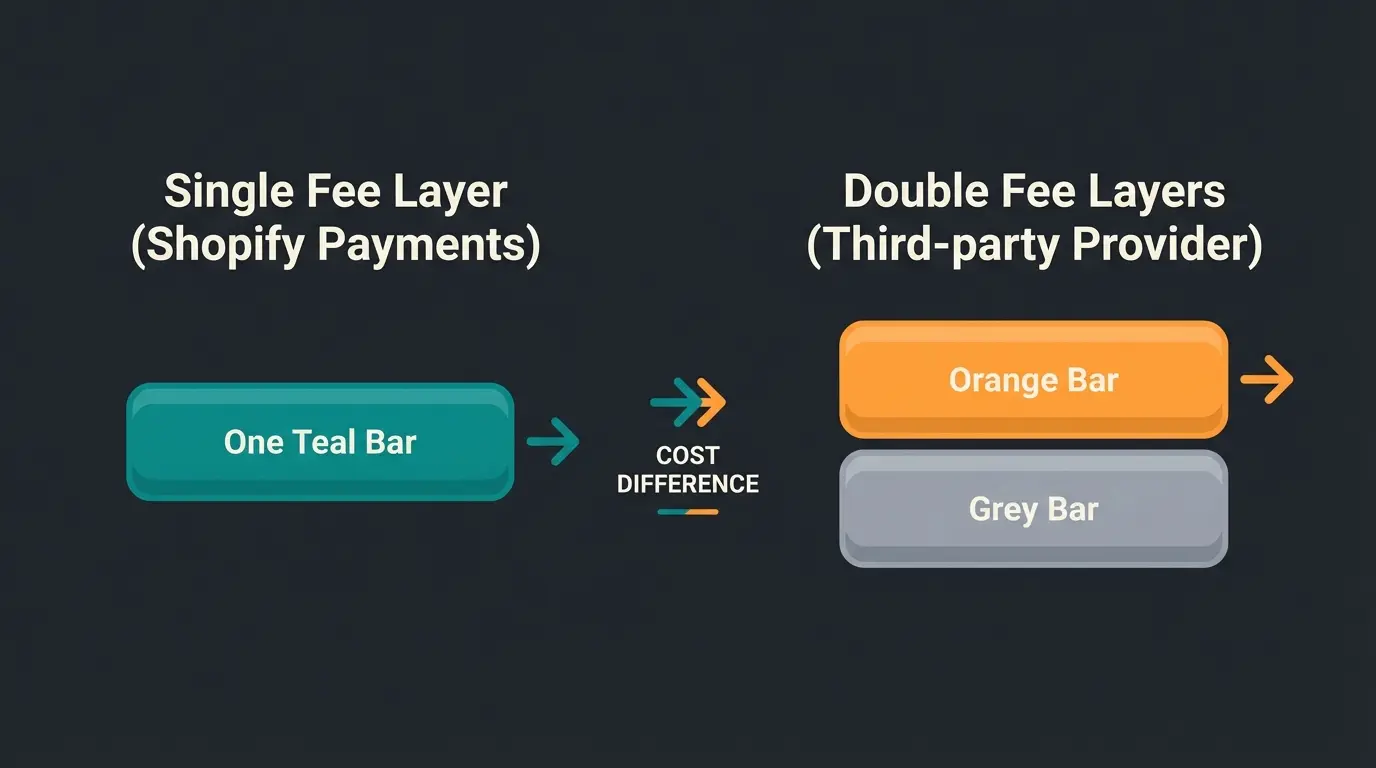
This is the single biggest decision affecting your transaction costs. Shopify Payments is Shopify's built-in payment processor, powered by Stripe. When you use it, you pay only the credit card processing rate for your plan. When you use any external provider, you pay their processing fee plus Shopify's additional transaction fee.
The math is clear. On a $100 online sale on the Basic plan: Shopify Payments costs you $3.20 (2.9% + 30¢). Using Stripe directly costs you $3.20 to Stripe plus $2.00 to Shopify, totaling $5.20. That is a 62% cost increase for the same transaction, according to official Shopify Payments fees.
| Plan | Shopify Payments total | Stripe (third-party) total | Extra cost with third-party |
|---|---|---|---|
| Basic | $3.20 | $5.20 (Stripe $3.20 + Shopify $2.00) | +$2.00 |
| Grow | $3.00 | $4.20 (Stripe $3.20 + Shopify $1.00) | +$1.00 |
| Advanced | $2.80 | $3.80 (Stripe $3.20 + Shopify $0.60) | +$0.60 |
| Plus | ~$2.45 (negotiated) | $3.40 (Stripe $3.20 + Shopify $0.20) | +$0.20 |
There are a few legitimate reasons to use a third-party provider despite the extra cost. If Shopify Payments is not available in your country (it currently supports 23 countries), you have no choice. If you sell subscription products and your subscription platform requires a specific processor, the integration may justify the fee. And if you negotiate enterprise-level rates with a processor like Adyen that drop below Shopify Payments' rates even after the surcharge, it can occasionally make sense at very high volume.
For the vast majority of merchants, though, Shopify Payments is the clear winner. No additional fees, no double billing, and seamless integration with Shopify's order management, analytics, and fraud tools. The same structure carries into retail, where Shopify POS pricing rewards keeping payments inside the Shopify stack.
PayPal fees on Shopify
PayPal is the most common secondary payment method on Shopify stores, and it is also where many merchants unknowingly overpay. PayPal's own processing fees are higher than Shopify Payments, and depending on your setup, you may be paying Shopify's additional transaction fee on top.
PayPal's current rates for online transactions: 2.99% + 49¢ for standard credit and debit card payments, and 3.49% + 49¢ for PayPal Checkout (when customers pay with their PayPal balance or linked bank account). Compare that to Shopify Payments' 2.5% to 2.9% + 30¢, and PayPal is already more expensive before any surcharge.
| Scenario | PayPal fee | Shopify additional fee | Total cost |
|---|---|---|---|
| Basic + PayPal (CC) | $3.48 | $2.00 | $5.48 |
| Grow + PayPal (CC) | $3.48 | $1.00 | $4.48 |
| Advanced + PayPal (CC) | $3.48 | $0.60 | $4.08 |
| Basic + PayPal Checkout | $3.98 | $2.00 | $5.98 |
| Basic + Shopify Payments (for comparison) | $3.20 | $0.00 | $3.20 |
The double-fee scenario is real. A merchant on the Basic plan who processes a $100 PayPal Checkout transaction pays $5.98 in total fees. The same transaction through Shopify Payments costs $3.20. That is an 87% premium for offering PayPal Checkout.
Calculate your Shopify fees: real-world examples
Percentages are abstract. Actual dollar amounts are not. Here is what Shopify transaction fees look like at three different revenue levels, assuming 100% online sales processed through Shopify Payments, with an average order value of $75. To see how much Shopify costs in total, layer subscription and app spend on top of these numbers.
2.9% + 30¢ per transaction, ~67 orders. Subscription: $39/mo. Total Shopify cost: $214/mo
2.7% + 30¢ per transaction, ~67 orders. Subscription: $105/mo. Total Shopify cost: $276/mo
2.9% + 30¢ per transaction, ~267 orders. Subscription: $39/mo. Total Shopify cost: $679/mo
2.7% + 30¢ per transaction, ~267 orders. Subscription: $105/mo. Total Shopify cost: $725/mo
2.5% + 30¢ per transaction, ~1,333 orders. Subscription: $399/mo. Total Shopify cost: $3,699/mo
| Monthly revenue | Basic ($39/mo) | Grow ($105/mo) | Advanced ($399/mo) |
|---|---|---|---|
| $5,000 | $214 (4.3%) | $276 (5.5%) | $549 (11.0%) |
| $20,000 | $679 (3.4%) | $725 (3.6%) | $999 (5.0%) |
| $50,000 | $1,619 (3.2%) | $1,585 (3.2%) | $1,699 (3.4%) |
| $100,000 | $3,149 (3.1%) | $2,905 (2.9%) | $3,199 (3.2%) |
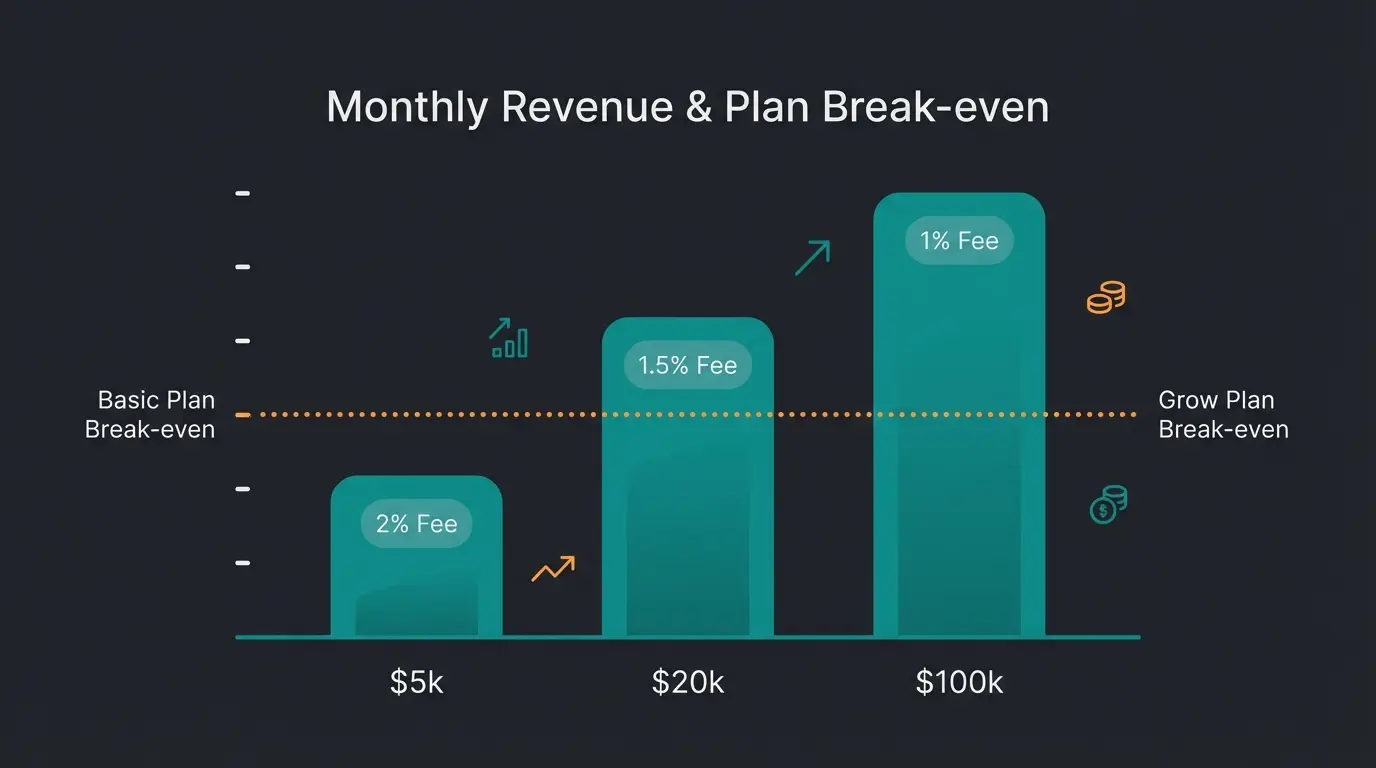
The break-even between Basic and Grow sits around $10,000/month in revenue. Below that, Basic wins on total cost because the lower subscription offsets the higher per-transaction rate. Above $10,000/month, Grow's lower transaction rate starts saving you more than the $66/month subscription difference costs.
The Advanced plan only makes financial sense above approximately $80,000/month in revenue. At $100,000/month, Advanced saves roughly $250/month compared to Basic, but you need that volume to justify the $399 subscription. For most small and mid-sized merchants, Grow is the sweet spot.
How to minimize transaction fees
You cannot eliminate transaction fees entirely, but you can reduce them significantly. Here are five strategies that work, ranked by impact.
- Use Shopify Payments as your primary processor. This eliminates the 0.6% to 2% additional transaction fee on every sale. It is the single highest-impact action you can take. If Shopify Payments is available in your country, there is almost no reason not to use it.
- Choose the right plan for your revenue level. Running a $30,000/month store on the Basic plan costs you more in transaction fees than upgrading to Grow would. Review your monthly revenue quarterly and upgrade when the per-transaction savings exceed the subscription increase.
- Consider annual billing. Shopify offers a 25% discount on annual subscriptions. Basic drops from $39 to $29/month, Grow from $105 to $79/month, Advanced from $399 to $299/month. That is $120 to $1,200 in annual savings on subscription alone.
- Optimize your payment method mix. Encourage customers to use lower-cost payment methods. Debit card transactions typically cost less than credit cards. Apple Pay and Google Pay process through Shopify Payments at the same rates as credit cards but have higher conversion rates, offsetting the fee through volume.
- Negotiate rates at volume. Shopify Plus merchants negotiate custom rates. But even on standard plans, merchants processing consistently high volume can contact Shopify support to discuss rate adjustments. It does not always work, but the conversation costs nothing.
Lower transaction fees keep more revenue in your pocket. But converting more visitors into buyers multiplies that revenue in the first place. Qualimero's AI employees provide real-time product advisory in your Shopify store, increasing average cart value by up to 35%. See it in action.
Book a free demoAre Shopify transaction fees tax deductible?
Yes. Shopify transaction fees, credit card processing fees, and subscription fees are all deductible as ordinary and necessary business expenses under IRS guidelines. This applies to sole proprietors, LLCs, S-corps, and C-corps alike. The same principle applies in most other jurisdictions: the UK (HMRC), Canada (CRA), Australia (ATO), and the EU.
To claim the deduction, you need proper documentation. Shopify provides detailed invoices for all subscription charges under Settings > Billing in your Shopify Admin. Transaction fees appear in your Shopify Payments payouts report, broken down by individual transaction.
One nuance: if you operate internationally, currency conversion fees (2% on most plans) are also deductible. Track these separately, as they can add up for merchants selling across borders.
FAQ: Shopify transaction fees
With Shopify Payments, Shopify charges 2.5% to 2.9% + 30¢ per online transaction, depending on your plan (Basic, Grow, or Advanced). If you use a third-party payment provider instead, Shopify adds an additional 0.6% to 2% surcharge on top of your provider's own processing fees.
Use Shopify Payments as your primary payment processor. This eliminates the additional transaction fee (0.6% to 2%) that Shopify charges when you use third-party providers like PayPal or Stripe. You will still pay credit card processing fees, as these apply to every online sale regardless of processor.
On the Basic plan with Shopify Payments, Shopify takes $3.20 from a $100 online sale (2.9% + 30¢). On the Grow plan, it is $3.00 (2.7% + 30¢). On the Advanced plan, $2.80 (2.5% + 30¢). Using a third-party provider adds 0.6% to 2% on top, bringing the total to $3.40 to $5.20.
Yes. All Shopify fees, including transaction fees, credit card processing fees, and subscription charges, qualify as deductible business expenses under IRS guidelines. You can find detailed fee breakdowns in your Shopify Admin under Settings > Billing and in your Shopify Payments payout reports.
Shopify Payments fees are the credit card processing rates (2.5% to 2.9% + 30¢) you pay on every sale processed through Shopify's built-in processor. Transaction fees are the additional 0.6% to 2% surcharge Shopify applies only when you use a third-party payment provider instead of Shopify Payments. Using Shopify Payments eliminates the additional transaction fee entirely.
Optimizing transaction fees saves you money on every sale. A Qualimero AI employee helps you make more sales in the first place, with real-time product advisory that increases checkout rates by up to 60%. Our merchants see an average 16x ROI.
See how it works
Lasse is CEO and co-founder of Qualimero. After completing his MBA at WHU and scaling a company to seven-figure revenue, he founded Qualimero to build AI-powered digital employees for e-commerce. His focus: helping businesses measurably improve customer interaction through intelligent automation.