Introduction: Why the 'Hidden Champion' Needs an Update
Germany is the land of engineers, innovators, and world market leaders operating under the radar. However, the success of recent decades—built on excellent hardware and personal sales relationships—is beginning to falter. The current DIHK Digitalization Survey 2025 paints a sobering picture: German businesses rate their own digitalization level at an average grade of only 2.8 according to DIHK. That's mediocrity where excellence is required, a finding confirmed by analysis from BZI Network.
Many managing directors in the SME sector still equate "digitalization" with "efficiency gains": scanning invoices, enabling home office, maintaining ERP systems. This saves costs but generates no new revenue.
True digital transformation for SMEs begins where the customer is. When your products are world-class but your sales process remains analog, slow, and personnel-intensive, you'll be overtaken by more agile competitors. This article shows you how to strategically leverage transformation—not just to save costs, but to conquer new markets through modern AI technologies in sales.
What Is Digital Transformation (And What It Isn't)?
Before we discuss strategies, we need to clear up a widespread misconception. In many mid-sized companies, the terms "digitalization" and "digital transformation" are used interchangeably. This is an expensive mistake.
Digitalization vs. Digital Transformation
Digitalization (Digitization): This is the process of converting analog information into digital formats.
- Example: You scan your paper invoices and save them as PDFs. Or: You make your printed product catalog available as a download on your website.
- Goal: Efficiency, cost reduction, less paper. The business model remains identical.
Digital Transformation: Here you use digital technologies to create new business processes, cultures, and customer experiences. It changes the way you create value.
- Example: Instead of a PDF catalog, you offer an AI-powered product configurator that advises customers 24/7, checks technical feasibility, and directly generates a quote.
- Goal: Revenue growth, competitive advantage, new markets.
Why German SMEs Must Act Now
Digital transformation for small and medium businesses is no longer a "nice-to-have" but a matter of survival. Three massive market forces are currently putting German SMEs under pressure:
1. Demographic Change in Sales (Skilled Labor Shortage)
The classic field sales representative who has been explaining products for 30 years and knows every customer personally is retiring. Successors are nearly impossible to find. According to current studies, 32% of companies see the shortage of IT and skilled workers as one of the biggest obstacles to digitalization. Who will explain your complex products in the future?
2. Changed Customer Expectations (B2B Is the New B2C)
Your B2B customers are privately accustomed to Amazon and Netflix. They expect immediate answers, simple processes, and 24/7 availability. According to Anne Breitner, Gartner predicts that by 2025 80% of all B2B sales interactions will be digital. Anyone who responds to an inquiry only after three days with a manual quote has often already lost the order.
3. The AI Revolution Is Here
For a long time, Artificial Intelligence (AI) was just a buzzword. This changed radically in 2024/2025. According to Bitkom, 36% of German companies now use AI (almost double compared to the previous year). Anyone who doesn't develop a digital transformation strategy for SMEs that integrates AI is competing against rivals who operate faster, more precisely, and more cost-effectively.
German businesses rate their own digital maturity as merely mediocre
German companies using AI—nearly doubled from previous year
Predicted share of B2B sales happening digitally by 2025
Companies citing IT/skilled worker shortage as top digitalization barrier
The 3 Pillars of a Successful SME Digitalization Strategy
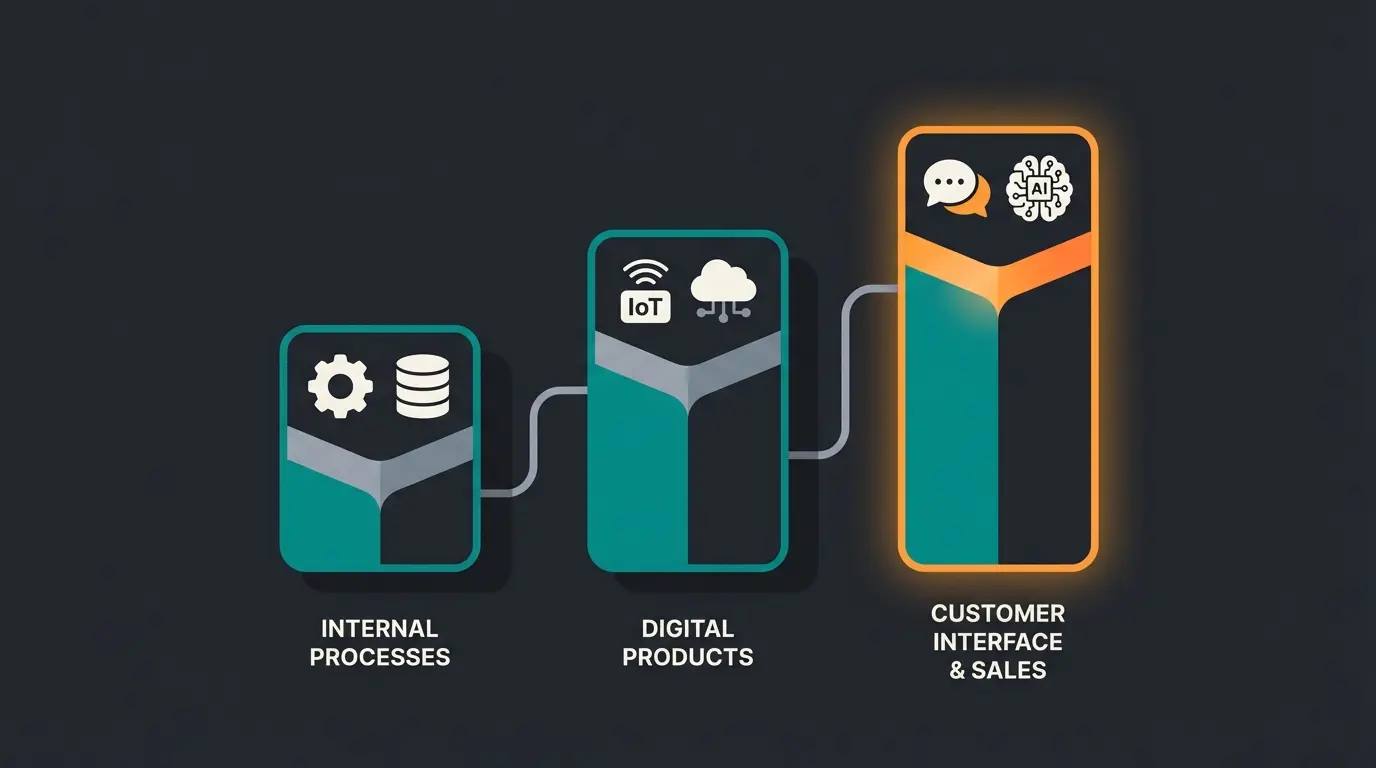
A robust strategy for digital transformation in small business rests on three pillars. Most SMEs focus 90% on Pillar 1. However, the greatest growth potential lies in Pillar 3.
Pillar 1: Internal Processes & Infrastructure (The Foundation)
This covers ERP, CRM, cloud migration, and IT security.
- Status: Already initiated in many SMEs.
- Goal: The 'engine room' must run. Without clean data in the CRM, no strategy works.
- Important: IT security is critical. 18% of SMEs reported significant security incidents in the last year.
Pillar 2: Digital Products & Services (The Added Value)
How can you enrich your physical product with digital services?
- Example: Sensors on a machine (IoT) that report maintenance needs (Predictive Maintenance).
- Goal: Transform from a pure hardware seller to a solutions provider.
Pillar 3: Customer Interface & Digital Sales (The Growth Engine)
This is where the biggest gap in German SMEs lies. Many companies have complex, explanation-intensive products (special machinery, components, chemicals) that simply don't fit into a standard online shop.
- The Problem: Sales is the bottleneck.
- The Solution: Digitalizing the consultation conversation.
Deep Dive: AI in Sales – The Underestimated Lever
Most articles on digital transformation for SMEs recommend an online shop. But when you're selling €50,000 industrial components, nobody simply clicks "Add to Cart." The customer needs consultation.
This is where "Consultative AI" comes into play. Forget the dumb chatbots of the past that only knew business hours. Modern Large Language Models (LLMs) can act as digital sales engineers.
The Concept of Consultative AI
Imagine you had an employee who:
- Knows your entire technical manual and all product datasheets by heart.
- Is available 24 hours a day, 7 days a week.
- Speaks 30 languages fluently.
- Is never annoyed, no matter how 'dumb' the customer's question is.
This is exactly what modern AI delivers when properly integrated into your SME digitalization strategy.
Comparison: Standard Chatbot vs. AI Product Consultant
| Feature | Standard Chatbot (Old) | AI Product Consultant (New) |
|---|---|---|
| Technology | Rule-based (If X, then Y) | LLM / RAG (Understands context & nuances) |
| Knowledge | Limited FAQ database | Access to all PDFs, CAD data & ERP |
| Capability | 'Please call us.' | 'For your 500kg load, I recommend Model X because...' |
| Goal | Reduce support tickets | Qualify leads & prepare sales |
The Hybrid Sales Model: Human + Machine
German SMEs often fear that AI will replace personal contact. The opposite is true.
- AI handles the groundwork: It clarifies technical specifications, checks inventory levels, and answers standard questions (80% of communication).
- Humans handle the close: The sales representative receives a perfectly pre-qualified lead ('Customer X needs System Y with Specification Z'). They can fully focus on relationship building and price negotiation.
Discover how AI-powered product consulting can handle unlimited customer inquiries while your sales team focuses on closing deals. Start your digital transformation journey today.
Get Started FreeStep-by-Step to Transformation (Practical Roadmap)
How do you implement this concretely? Here's a roadmap for digital transformation in the SME sector.
Analyze your customer process, not your IT. Identify where you lose customers and which questions your sales team answers repeatedly.
Start a lighthouse project with one product line. Implement a digital consulting assistant and measure leads and response times.
Connect the system to CRM/ERP, roll out to other product areas, and train sales teams on their new digital colleagues.
Take away the fear. Communicate clearly that AI supports rather than replaces. Foster digital competencies across the organization.
Phase 1: Assessment & Pain Points (Weeks 1-4)
Analyze not your IT, but your customer process.
- Where do you lose customers? (Often: Long waiting times for quotes).
- Which questions does your sales team answer repeatedly? (Ideal for AI automation).
- How clean is your product data? (Without data, no AI).
Phase 2: The Pilot Project (Weeks 5-12)
Don't try to transform the entire company at once. Start a "lighthouse project."
- Choose one product line or one customer group.
- Implement a digital consulting assistant or intelligent configurator here.
- Measure success: How many leads come in? How fast is the response time?
Phase 3: Scaling & Integration (Months 4-12)
When the pilot works:
- Connect the system to your CRM/ERP (create interfaces).
- Roll out the solution to other product areas.
- Train your sales team to work with their new 'digital colleagues.'
Phase 4: Culture & Mindset (Ongoing)
This is the hardest part. Take away the fear.
- Communicate clearly: 'AI isn't here to replace you, but to free your back for the important deals.'
- Foster digital competencies. According to studies from Maximal Digital, lack of know-how is often the biggest obstacle.
Funding & Grants: The Current Status in 2025
A critical point for any SME digitalization strategy is the budget. The landscape in Germany has changed drastically here.
Attention: 'Digital Jetzt' and 'Go-digital' Have Ended
Many older blog articles still recommend the federal program 'Digital Jetzt.' Warning: This program has expired (application stop was at the end of 2023, guideline expiration at the end of 2024) according to the Federal Ministry of Economics. The popular consulting program 'go-digital' was also discontinued as of December 31, 2024, as confirmed by Innovation Beratung Förderung and Seven Bytes. Don't rely on outdated information!
What Still Works in 2025?
1. ERP Digitalization and Innovation Credit (KfW):
- KfW offers low-interest loans for digitalization projects.
- New: Since February 2025, there are again partial repayment grants (money you don't have to pay back), depending on the current budget situation, as noted by Unternehmenswelt.
2. State-Specific Programs (The Insider Tip):
- Bavaria: The 'Digitalbonus Bayern' has been extended and runs until the end of 2027. It offers grants of up to 50% for hardware/software and IT security according to Digitalbonus Bayern.
- Baden-Württemberg: The 'Digitalisierungsprämie Plus' has been converted into a loan program with repayment grants, as detailed by L-Bank and AKBW.
- NRW: The program 'Mittelstand Innovativ & Digital' (MID) offers vouchers but is often oversubscribed (note lottery procedures/waiting lists) according to NRW Bank and Wirtschaft NRW.
Common Mistakes (And How to Avoid Them)
On the path to digital transformation, many SMEs stumble over the same stones.
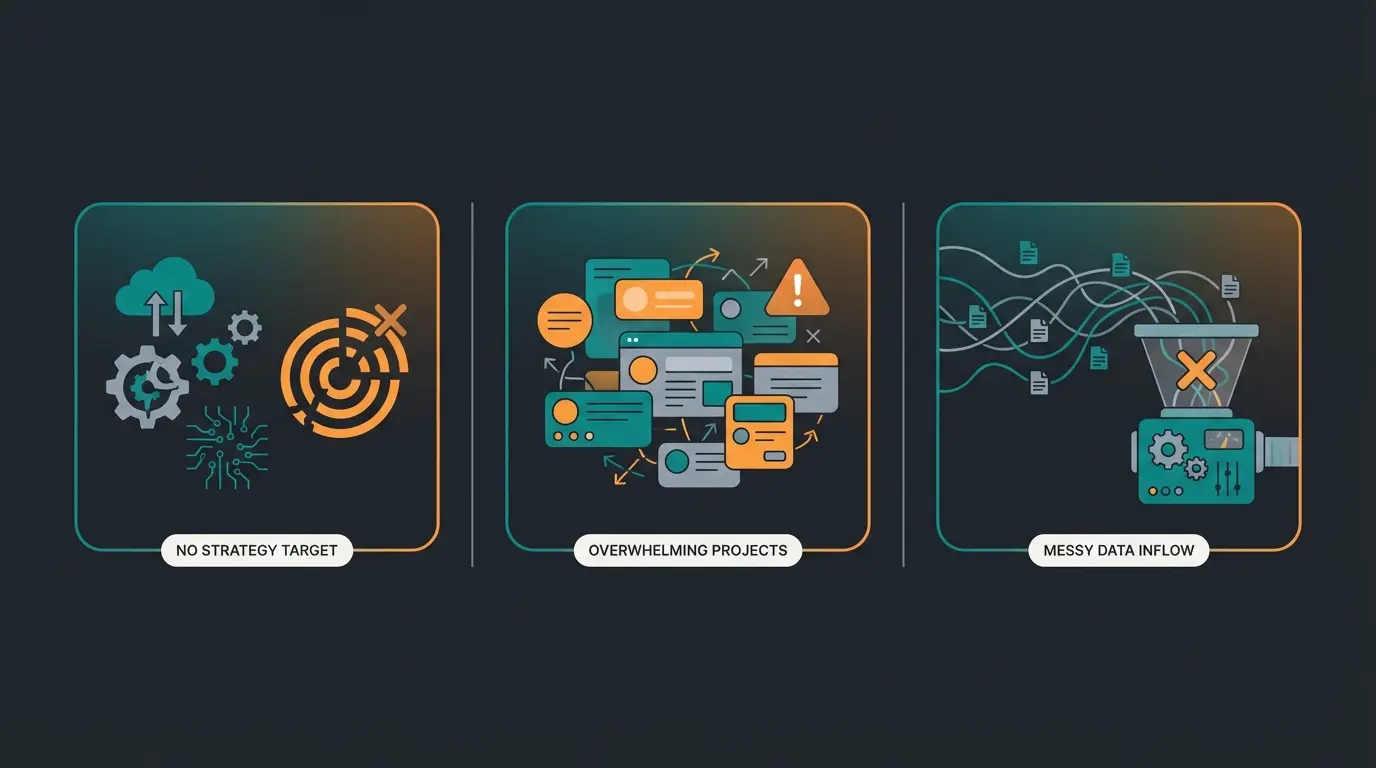
1. Technology Before Strategy
- Mistake: 'We need AI now!'—without knowing why.
- Solution: First define the business problem (e.g., 'Quote delivery time too long'), then search for the technology.
2. The 'Swiss Army Knife' Approach
- Mistake: A huge project that tries to change everything at once (ERP + Shop + AI + HR). Such projects fail 80% of the time.
- Solution: Think in small, fast steps (agility). A working pilot is better than a perfect plan in the drawer.
3. Underestimating Data Quality
- Mistake: Unleashing AI on unstructured, outdated data.
- Solution: 'Garbage in, Garbage out.' Before you automate, you must clean up your product data and customer master data.
Conclusion & Outlook: Courage to Close the Gap
Digital transformation for SMEs is not a sprint but a marathon. But the starting gun has long since been fired. The times when you could rest on your 'Hidden Champion' status are over.
But the good news is: German SMEs have the best prerequisites. You have the expertise, the products, and customer trust. When you now combine these strengths with modern digital tools—especially in sales—you not only secure your market position but expand it.
Action Items for This Week
- Talk to your sales manager: What 5 questions do customers ask repeatedly?
- Check whether these questions are answered immediately on your website.
- If not: You've found your first digitalization project.
Infographic: The Digital Maturity Ladder
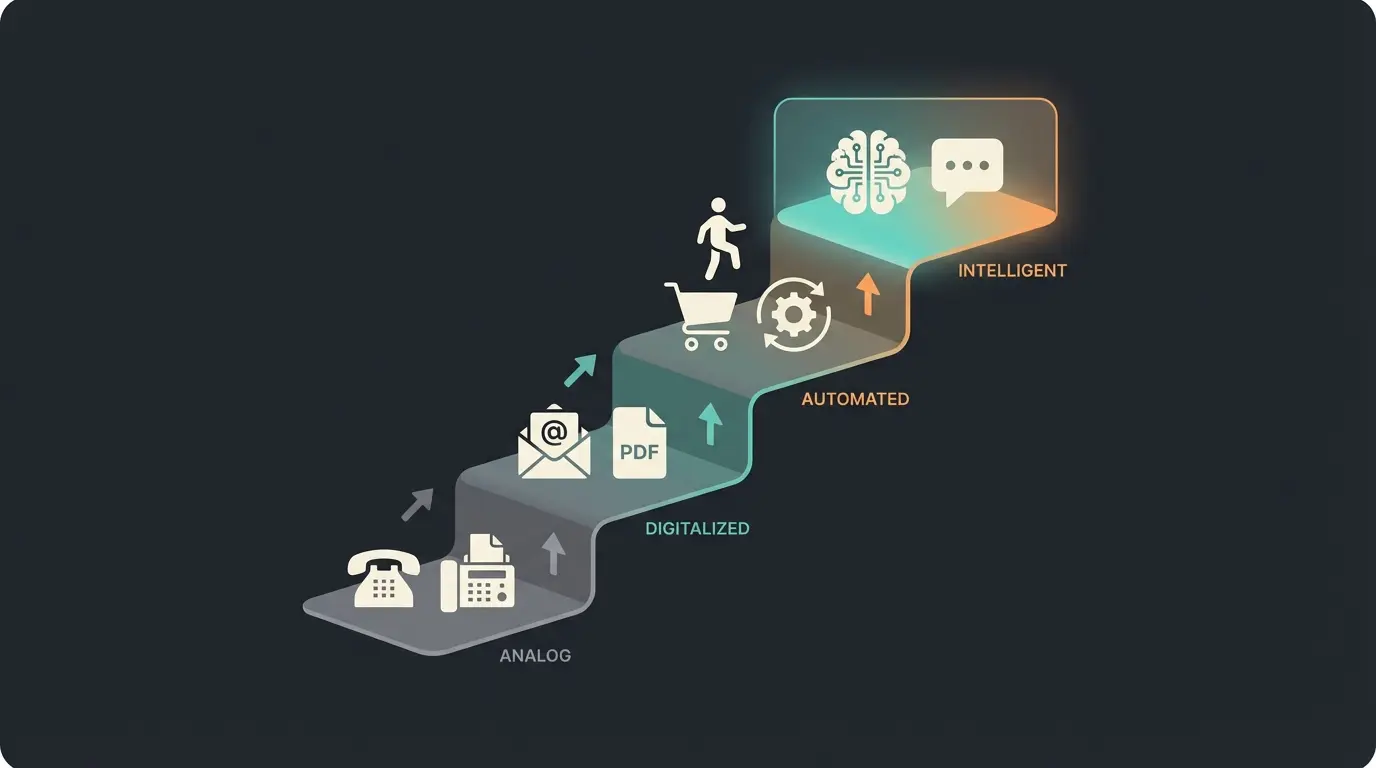
Understanding where your company stands on the digital maturity scale is crucial for planning your transformation journey. Most German SMEs find themselves on levels 1-2, while market leaders are rapidly climbing to level 4.
Level 1: Analog (The Traditionalist)
- Communication: Phone, fax, letter.
- Data: Paper files, local Excel lists.
- Sales: Only in-person, on-site.
Level 2: Digitalized (The Administrator)
- Communication: Email, Zoom.
- Data: PDF catalogs, simple CRM.
- Sales: Website as 'business card,' no interaction.
Level 3: Automated (The E-Commerce Starter)
- Communication: Newsletter automation.
- Data: ERP system, webshop for standard parts.
- Sales: Standard orders possible online.
Level 4: Intelligent (The Market Leader)
- Communication: Personalized approach in real-time.
- Data: Data lake, AI analysis.
- Sales: AI product consultant, predictive sales, hybrid sales model.
Frequently Asked Questions About Digital Transformation
Digitalization converts analog processes to digital (e.g., scanning invoices to PDFs)—it makes things faster but keeps your business model the same. Digital transformation fundamentally changes how you create value and serve customers (e.g., replacing a PDF catalog with an AI-powered product consultant that advises customers 24/7). Transformation drives revenue growth; digitalization drives cost savings.
Costs vary significantly based on scope. A pilot project with AI-powered sales consulting might start at €10,000-50,000, while comprehensive ERP integration can reach six figures. The key is starting small: begin with one product line or customer segment, prove ROI, then scale. In Germany, state-specific funding programs like Bavaria's Digitalbonus (up to 50% grants) can significantly reduce your investment.
Expect a pilot project to take 3-4 months from assessment to launch. Full transformation across the organization typically spans 12-24 months, broken into phases. The critical factor isn't speed but momentum—a working pilot in 3 months creates more value than a perfect plan that takes 2 years to implement.
No—the most successful model is hybrid. AI handles the groundwork: answering technical questions 24/7, pre-qualifying leads, and checking specifications (about 80% of communication volume). Human sales professionals then focus on relationship building, complex negotiations, and closing deals. This model typically increases sales capacity 5-10x without adding headcount.
Federal programs like 'Digital Jetzt' have expired. Current options include: KfW's ERP Digitalization Credit (low-interest loans with potential repayment grants), Bavaria's Digitalbonus (grants up to 50% through 2027), Baden-Württemberg's Digitalisierungsprämie Plus (loan with repayment grant), and NRW's MID program (vouchers, often oversubscribed). Always apply before starting your project—funding requires projects to not yet be initiated.
Don't let your competitors gain the AI advantage. See how our consultative AI solution can transform your sales process—handling unlimited product inquiries while your team focuses on closing deals.
Book Your Free Demo