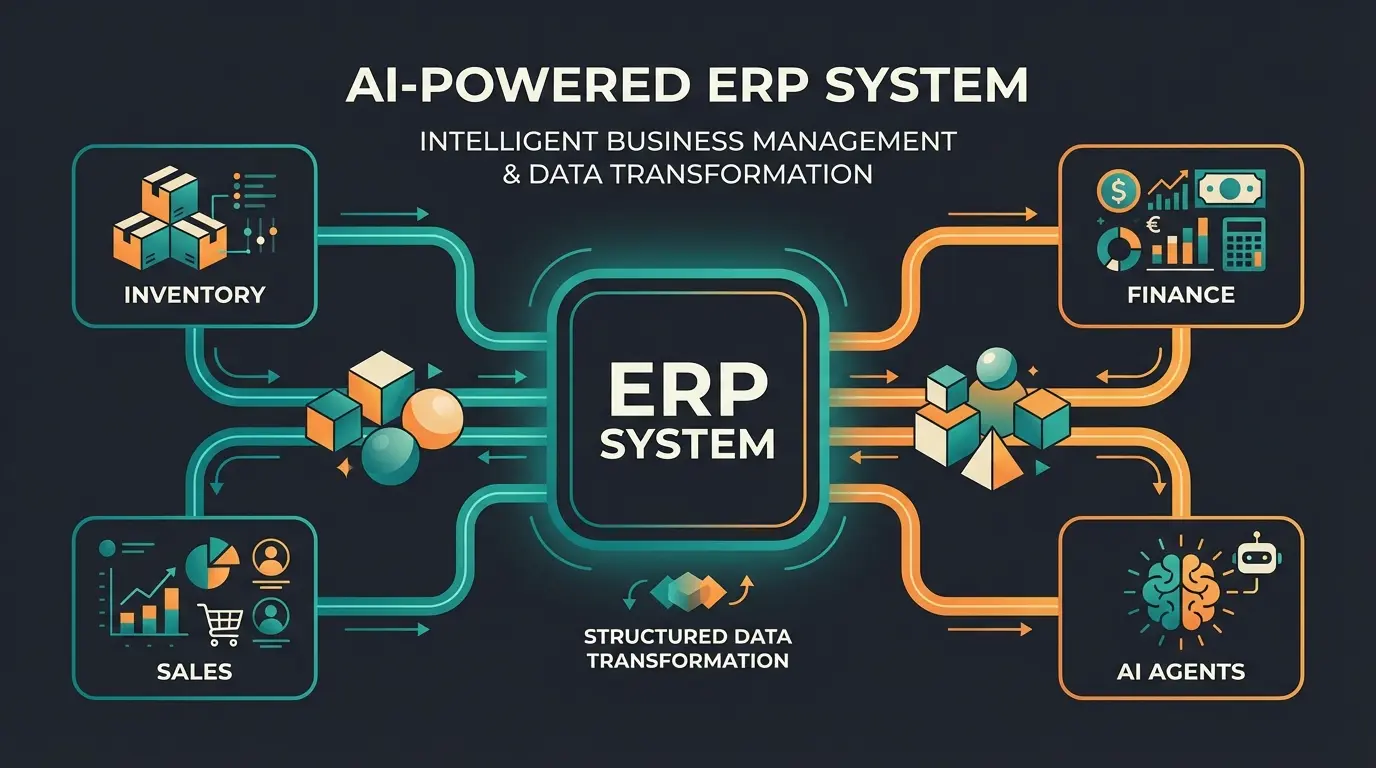
Introduction: The SMB Sector at a Crossroads
Choosing the right enterprise software is no longer an administrative task—it's a strategic survival question. In an era where AI agents manage supply chains and remote work is the standard, the server in the basement feels like a relic from the Stone Age. Yet the market remains opaque. This guide leads you through the jungle of cloud ERP providers, illuminates critical security aspects for businesses, and shows why artificial intelligence isn't just valuable inside the system, but is the decisive game-changer in selecting the system itself.
We're in 2026. Digital transformation is no longer a future project—it's lived reality. According to Gartner via volt-technologies.com, by the end of this year, 60% of all new ERP implementations will be "cloud-native." For small and medium-sized businesses, this means a radical shift.
For years, the mantra was: "My data stays on my server." But this attitude is crumbling—for good reason. Outdated on-premise systems have become innovation blockers. They are isolated data silos that cannot communicate with modern e-commerce platforms, IoT sensors, or AI tools. Companies that want to leverage AI product consultation or AI powered customer service find themselves hitting walls with legacy infrastructure.
However, anyone who decides to switch to the cloud faces a "wall of fog." The market is fragmented:
- The Global Giants (SAP, Microsoft) promise AI revolutions with unprecedented capabilities
- The Local Heroes (Haufe, weclapp) advertise German thoroughness and GoBD compliance
- Plus hundreds of niche providers targeting specific industries
The problem isn't a lack of options—it's the complexity of the decision. A wrong choice costs not just license fees but years of productivity. This article serves as your compass. We'll clarify not only what's technically possible but show you how, with the help of new, AI-supported analysis methods, you can find the needle in the haystack that exactly fits your business processes.
What is Cloud ERP? A Definition for Decision-Makers
Before we compare providers, we need to sharpen our terms. When vendors talk about "cloud," they often mean different things. For your strategy, however, the distinction is essential.
The Three Operating Models (Not All That Glitters is Gold)
To choose the right SaaS ERP (Software as a Service), you need to understand these nuances:
1. Public Cloud (True SaaS): All customers use the same software infrastructure and code base (multi-tenancy). This offers maximum scalability, instant updates, and the lowest entry costs. Innovations like AI features are immediately available to all users. Examples include Haufe X360, weclapp, SAP S/4HANA Cloud Public Edition, and Oracle NetSuite.
2. Private Cloud: You have a dedicated environment running only for you, but hosted in an external data center. This provides more control over updates and deeper customization possibilities. However, costs are higher and updates often more complex than with SaaS. Examples include Microsoft Dynamics 365 (in dedicated instances) and abas ERP (Hosted).
3. Hybrid ERP: A mixture of both approaches. Critical core data stays on-premise (e.g., production control in the factory), while CRM or HR moves to the cloud. This is often used by manufacturing companies that don't want to stop production lines during internet outages.
Do you have dedicated internal IT staff for server management?
Do you need DATEV integration or specific German compliance features?
Do you manufacture goods requiring offline production capability?
Do you need deep code-level customization or is configuration sufficient?
Match requirements to Public Cloud, Private Cloud, or Hybrid ERP
Cloud ERP vs. On-Premise: The Cost & Performance Comparison
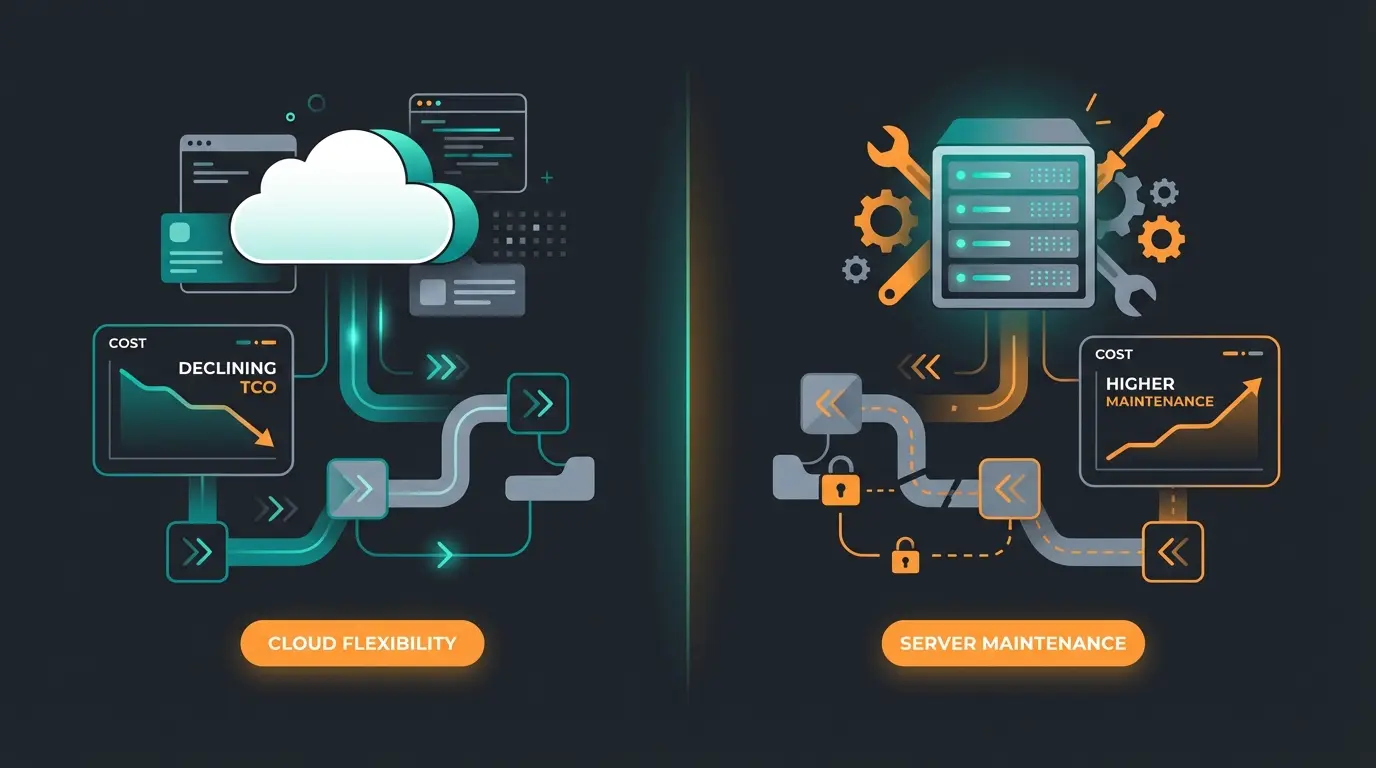
Many business leaders are put off by monthly subscription fees (OpEx) and believe that a one-time license purchase (CapEx) is cheaper. This is often a fallacy when you examine the Total Cost of Ownership (TCO) over 5 years.
| Criterion | On-Premise ERP (Local) | Cloud ERP / SaaS | Winner |
|---|---|---|---|
| Cost Structure | High initial investment (licenses + hardware). Annual maintenance fee (~20%) | Monthly subscription fee (pay-as-you-go). Low initial costs | Cloud (Cash flow friendly) |
| Hidden Costs | Electricity, server room cooling, IT personnel for backups & maintenance, hardware renewal every 3-5 years | None. Infrastructure included in price | Cloud |
| Updates & Innovation | Expensive, risky, rare. Often creates "update backlog" due to fear of losing customizations | Automatic and continuous. New features (e.g., AI) immediately available | Cloud |
| Access & Mobility | Usually complicated via VPN. Mobile apps often limited | Native web interface. Secure access from anywhere (home office, field service) | Cloud |
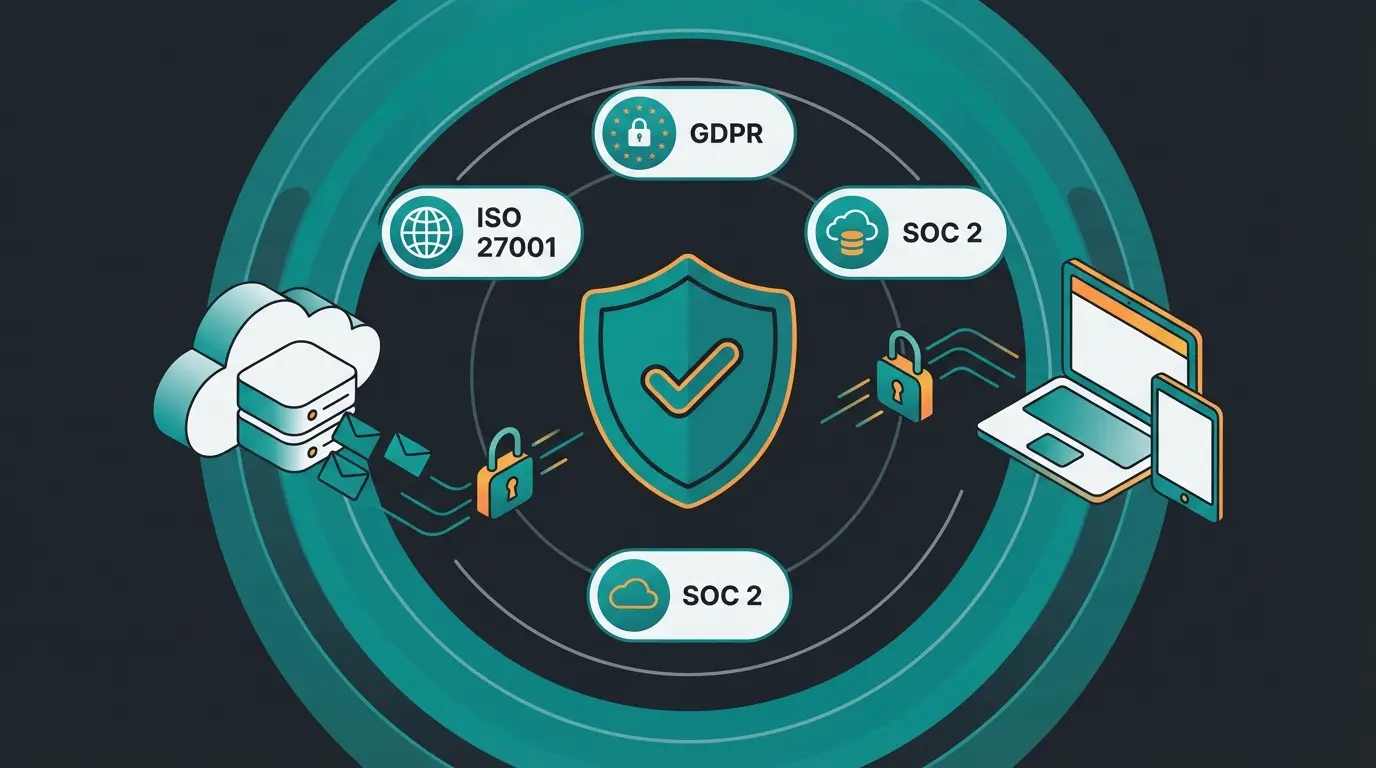
| Data Security | Dependent on your IT admin. Risk of break-in, fire, or ransomware | High-security data centers, geo-redundancy, ISO 27001 certification | Cloud (usually safer for SMBs) |
| Customizability | Extremely high (code level). Danger: "over-customization" of the system | Configuration instead of programming (No-Code/Low-Code). Keeps standard clean | Depends on needs |
Reality Check 2026: According to erpsoftwareblog.com, 70% of the market already relies on cloud deployments. The question is no longer if but when you switch. Anyone still investing in new on-premise hardware for ERP today is buying technology without a future.
The 5 Key Cloud ERP Benefits Beyond Marketing Buzzwords
Why are hidden champions massively switching to the cloud? It's not just about costs. It's about speed.
1. Scalability at the Push of a Button
A seasonal business (e.g., e-commerce during the holiday season) needs ten times the computing power in November compared to February. Cloud systems breathe with your business. You add or remove users and modules as needed. This flexibility is impossible with traditional on-premise infrastructure where you must plan capacity years in advance.
2. Access to AI and Innovation
This is the most important point for 2026. Providers like SAP and Microsoft are rolling out AI functions ("Joule" or "Copilot") exclusively or first in the cloud. According to it-matchmaker.com, this trend is accelerating dramatically.
Example: An on-premise system can display historical data. A cloud ERP with AI can use external weather and economic data to predict that your supply chain will break in 3 weeks—and suggests alternative suppliers (Agentic AI). This predictive capability, as highlighted by Forbes, represents the next frontier in enterprise resource management.
3. API Economy and Connectivity
Modern cloud ERP systems are no longer monoliths. They are hubs. They can be seamlessly connected via REST API with Shopify, Salesforce, DATEV, or your logistics software. On-premise interfaces are often expensive, maintenance-intensive custom jobs. Businesses looking to implement AI lead generation find cloud ERP integration significantly simpler.
4. Relief for Internal IT
The skills shortage hits IT hard. When your administrators spend 50% of their time patching servers and checking backups, that time is missing for process optimization. Cloud ERP outsources the boring operations to the provider ("Let Microsoft hire the security experts"). This frees your team to focus on strategic initiatives and digital innovation.
5. Business Continuity and Disaster Recovery
Cloud ERP providers maintain redundant systems across multiple geographic locations. If one data center experiences issues, your operations continue seamlessly from another location. This level of disaster recovery would cost millions to replicate with on-premise infrastructure. For growing businesses ready to hire an AI employee, cloud infrastructure provides the foundation for scalable operations.
Of new ERP implementations will be cloud-native by end of 2026
Of the ERP market already relies on cloud deployments
Average TCO savings over 5 years compared to on-premise
Cloud ERPs receive innovation updates faster than legacy systems
Security & Data Protection: GDPR, GoBD and Compliance
The "German Angst" about the cloud is legendary. "Is my data safe with a US provider?" is the most frequently asked question. Here are the facts for 2026.
GDPR and Server Location
Legal certainty is non-negotiable. Almost all major providers (including US corporations) now offer "Data Residency" in the EU or Germany.
- Microsoft & SAP: Operate huge data centers in Frankfurt/Main and contractually guarantee that data does not leave the EU region
- German Providers: Weclapp, Haufe, or Scopevisio typically host in German data centers (e.g., Open Telekom Cloud or Hetzner)
GoBD Compliance (The Tax Office in the Cloud)
A cloud ERP must support GoBD (Principles for Proper Management and Storage of Books, Records, and Documents in Electronic Form). As explained by hamburger-software.de, proper documentation is essential for compliance.
Important: It's not the software that gets certified, but your process with the software. Nevertheless, features like log immutability (audit trails) and procedure documentation help massively. Since the revision of GoBD, cloud systems are expressly permitted as long as data availability and auditor access are guaranteed. This has been confirmed by both teamdrive.com and controllingportal.de.
Cloud ERP Provider Overview 2026
The market is huge. To give you orientation, we categorize the cloud ERP providers by target groups.
Category A: The Global Giants (For Upper Mid-Market & Enterprises)
These systems are powerful, expensive, and can do almost everything.
1. SAP S/4HANA Cloud (Public Edition)
- Focus: The market leader. Extremely strong in manufacturing, complex supply chains, and international corporate structures
- AI Factor: Strong focus on "Joule" (AI assistant) for automation, as detailed on sap.com
- Target Group: Revenue > 50 million, international orientation
2. Microsoft Dynamics 365 Business Central
- Focus: Seamless integration into the Office world (Teams, Excel, Outlook). Very flexibly customizable
- AI Factor: Microsoft Copilot is deeply integrated (e.g., converting emails to quotes)
- Target Group: Companies already heavily invested in Microsoft
3. Oracle NetSuite
- Focus: The pioneer of Cloud ERP. Very strong with fast-growing startups and service providers
- Target Group: Scaling tech companies, international trade
Category B: SMB Specialists (For Small & Medium Business)
These providers understand the market, GoBD, and the DATEV interface better than any US corporation.
1. Haufe X360 (formerly lexbizz)
- Focus: 360-degree solution based on Acumatica's technological platform, but adapted for the German market. Very modern interface, as showcased on haufe-x360.de
- Advantage: Strong partner network for implementation
2. weclapp
- Focus: Popular "all-in-one" ERP. Very intuitive, quick to start. Strong in e-commerce and service sectors
- Advantage: Simple pricing model, high user-friendliness
3. Myfactory / Scopevisio
- Focus: Established solutions for classic SMB processes. Scopevisio positions itself strongly as cloud business software for service providers with integrated DMS, as shown on scopevisio.com
Category C: The Niche Players
- Xentral: The darling of the e-commerce scene. Perfectly connected to Shopify, Amazon FBA, and logistics providers. According to xentral.com, they've become the go-to solution for scaling D2C brands
- Aptean / proALPHA: Strong in discrete manufacturing and industry, where special production processes need to be mapped
The Buying Gap: Why 70% of ERP Projects Fail
Here lies the real problem: You now know the providers. But who fits you?
The Problem with Traditional Selection
Until now, you had two options:
1. The Expensive Consultant: You hire an ERP consulting firm. Cost: $20,000 to $50,000. Duration: 3-6 months. The result is well-founded but expensive and often subjective (every consultant has favorite systems due to partnerships).
2. DIY Research: You Google, read comparisons on portals, and download whitepapers. Risk: You're comparing apples to oranges. A feature comparison ("Does the system have a DATEV interface?") says nothing about the quality of that interface. Does it work in batch mode? Does it support document image service?
Neither approach addresses what we call the "Buying Complexity Gap"—most articles list providers but don't explain how to choose effectively without expensive human consultants. They list features but don't help users map features to their specific problems.
Don't waste months on manual comparisons. Get AI-powered analysis that goes deeper than any comparison table.
Start Your ERP AnalysisThe Revolution: AI as Your New ERP Consultant
In 2026, AI is changing not just the ERP itself, but the buying process. Imagine an AI that doesn't sit as a feature inside the ERP, but as a neutral architect in front of it.
How AI Revolutionizes the Selection Process
Needs Analysis Instead of Keyword Search: Instead of searching for "cloud ERP manufacturing," you can describe your process to a specialized AI: "We manufacture custom metal parts, need batch traceability for the automotive industry, use Salesforce for sales, and must transfer GoBD-compliant data to DATEV Enterprise online." This mirrors how AI Employee Flora helps customers find exactly what they need through intelligent conversation.
Matching Beyond Marketing: An AI can scan thousands of pages of technical documentation (not just marketing brochures). It knows that Provider A does have a Shopify interface, but it buckles under more than 10,000 orders per day—while Provider B doesn't. This depth of analysis is similar to how AI Employee Kira provides nuanced product recommendations.
Gap Analysis: AI can match your requirements specification against the standard scope of systems and immediately identify "gaps." "System X covers 90% of your requirements, but for customs processing you need a third-party add-on." The AI product consultation approach delivers this level of specificity.
Traditional Consultation vs. AI Product Consultation
| Feature | Human Consultant | Static Comparison Portals | AI-Powered Selection |
|---|---|---|---|
| Speed | Months | Minutes (research), weeks (analysis) | Seconds to minutes |
| Cost | High (day rates) | Free (but high time investment) | Cost-effective / Scalable |
| Depth | Very deep | Superficial (feature lists) | Deep & Context-aware |
| Neutrality | Often biased by partnerships | Biased by ad placements | Data-based neutrality |
| Currency | Knowledge ages quickly | Often outdated data | Real-time web research |
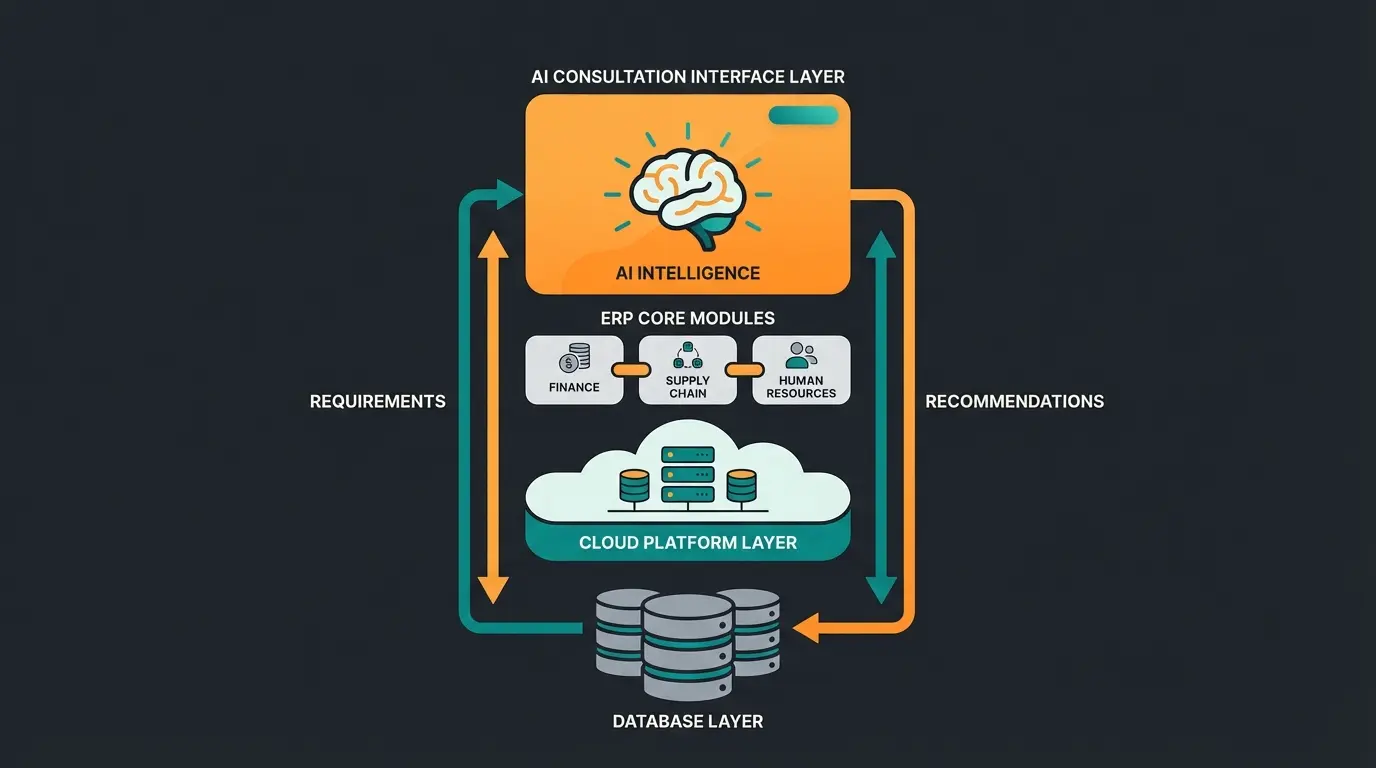
This consultation layer approach is exactly how AI Assistant Sophie transforms complex decision-making processes—by understanding context, not just keywords. Similarly, AI Employee Theresa demonstrates how AI can navigate intricate requirements to deliver precise recommendations.
The Tech Stack Layer Cake: Where AI Consultation Fits
Think of your enterprise technology as layers. At the bottom sits your database. Above that runs your cloud platform. The ERP core modules occupy the next layer. But at the very top—the layer that actually interacts with decision-makers—sits the AI consultation interface. This is where intelligent guidance happens, much like how AI chat solutions engage customers at the point of decision.
This architecture means you're not just buying an ERP with AI features inside it (like predictive analytics). You're using AI to architect the perfect ERP strategy before you commit. It's the difference between AI product consultation that guides you to the right choice versus generic chatbots that answer FAQ questions. Consider how AI Employee Alex provides this level of strategic guidance in practice.
Implementation Anxiety: What Happens in the First 30 Days
Here's what most cloud ERP content won't tell you: the first month after go-live is critical. German companies face specific friction points that generic guides ignore:
- Data Migration Complexity: Your historical data must transfer cleanly while maintaining GoBD audit trails
- DATEV Synchronization: The connection must work bidirectionally from day one—no "we'll fix it later"
- User Adoption Resistance: Teams comfortable with legacy systems need immediate wins to embrace change
- Process Documentation: Your procedure documentation (Verfahrensdokumentation) must be updated simultaneously
AI-powered consultation can simulate these first 30 days based on your specific configuration, identifying friction points before you commit. It's proactive guidance rather than reactive troubleshooting. This is why scheduling a free initial consultation can save months of pain.
Conclusion: How to Start Your Transformation
Switching to a cloud ERP system is essential for businesses in 2026 to remain competitive. The advantages in cost, security, and innovation speed are overwhelming.
But the danger lies not in the technology, but in the selection. Most ERP projects don't fail because of bad software, but because of poor "fit" between business processes and system logic.
Our Recommendation for Your Next Steps
- Clean up processes: Don't digitize a bad process. ("A shitty process digitalized is a shitty digital process")
- Define requirements specification: What are your "must-haves" (knockout criteria) and what are "nice-to-haves"?
- Use modern tools: Don't rely solely on vendor glossy brochures. Use AI-powered consulting approaches to create a shortlist that truly fits your DNA
Want to know which Cloud ERP exactly fits your requirements? Don't waste months on manual comparisons. Start an AI-powered analysis of your requirements now and receive an objective recommendation that goes deeper than any comparison table.
In terms of acquisition (initial costs), Cloud ERP is drastically cheaper. Calculated over 5-10 years (TCO), it's often also cheaper when you honestly factor in electricity, personnel, hardware replacement, and security measures for On-Premise systems.
With pure SaaS, you cannot work then. However: How often does your internet go down? And how often does the local server go down due to hardware failure or maintenance in comparison? For critical infrastructure (production), hybrid solutions are available that continue running offline.
The US "Cloud Act" is a topic. That's why providers like Microsoft and SAP offer trustee models or sovereign clouds where data remains physically and legally in Europe. For maximum independence, you can choose European providers like Haufe or weclapp.
Implementation timelines vary significantly based on complexity. Simple SaaS solutions like weclapp can be operational within 4-8 weeks. Mid-market solutions like Haufe X360 typically require 3-6 months. Enterprise implementations of SAP S/4HANA can take 12-18 months. AI-powered selection can significantly reduce the pre-implementation research phase.
Yes, all major cloud ERP providers offer migration tools and services. The key is ensuring your historical data maintains GoBD-compliant audit trails during transfer. This is where AI consultation proves valuable—identifying potential migration issues before they become costly problems.
Stop browsing endless lists. Start an intelligent consultation to find the exact system that matches your business DNA.
Start Your Free ERP Analysis