Introduction: The Truth About ERP Pricing
When you search Google for "what does an ERP system cost," you often find vague statements or "pricing upon request." This is frustrating, but understandable: an ERP system isn't an off-the-shelf product—it's the digital cardiovascular system of your company.
Nevertheless, clear price ranges can be identified for 2025. For a mid-sized company with solid cloud requirements, you should expect license costs between $25 and $150 per user per month, according to current market data from Xentral, Weclapp, and Microsoft. But be warned: these numbers are just the tip of the iceberg.
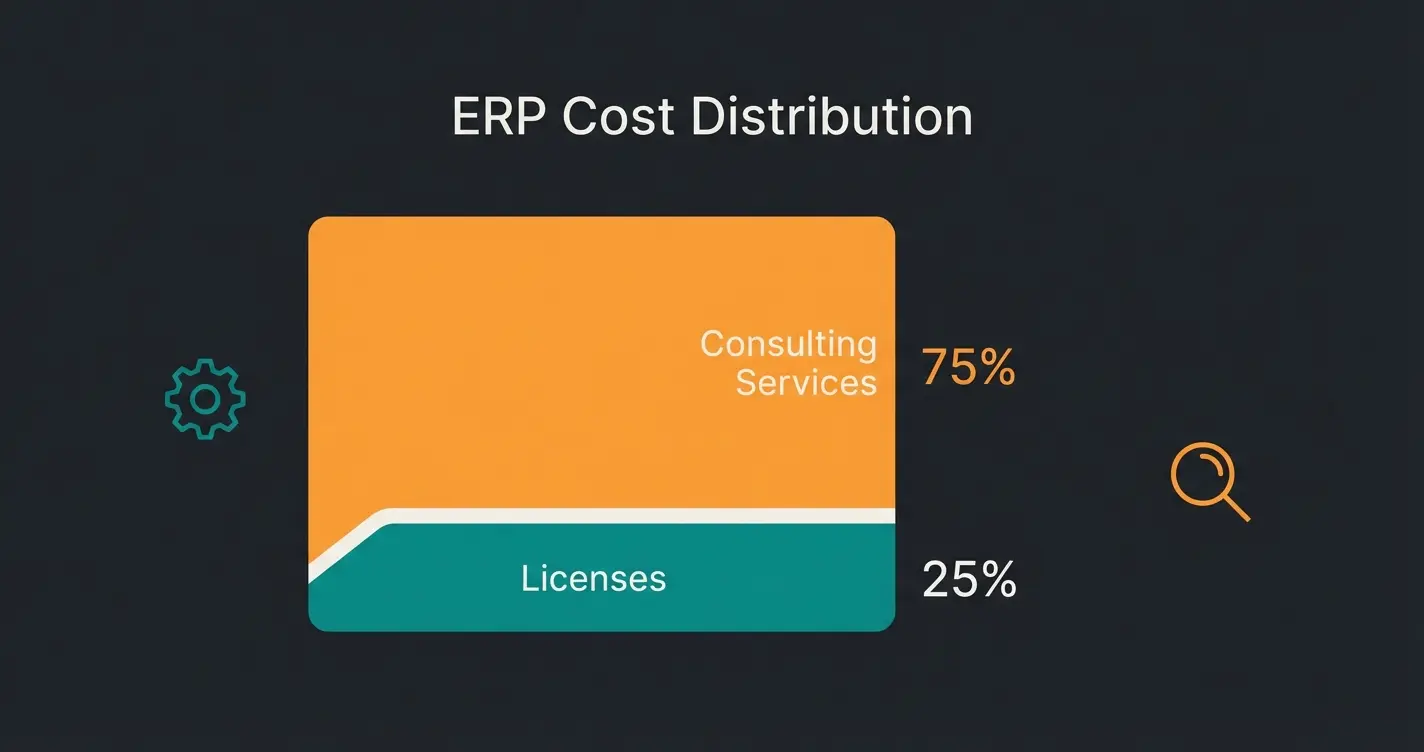
Most companies fall into a classic cost trap: they budget for the software but forget about the "service overhead." Studies and market analyses from ERP Scout show that implementation and consulting often cost double to triple the annual license fees.
In this article, we'll not only break down ERP system costs in detail but also show you a new perspective: how modern artificial intelligence (AI) can drastically reduce the most expensive component—human consulting and requirements analysis.
The Three Pillars of ERP Costs Explained
To understand how ERP system pricing is structured, we need to divide the Total Cost of Ownership (TCO) into three main pillars. Each pillar carries different weight depending on your chosen deployment model and implementation approach.
Pillar 1: License Costs (Software)
The market strictly distinguishes between two models here, with the 2025 trend moving massively toward cloud solutions.
Cloud ERP (SaaS)
You rent the software. Costs are operating expenses (OpEx).
- Cost Model: Monthly per user ("Named User")
- Price Range: $39 (entry-level) to $110+ (Premium/Enterprise) per month, as documented by Microsoft pricing
- Advantage: Low entry barrier, hosting and maintenance often included
- Disadvantage: Ongoing costs increase linearly with employee count
On-Premise ERP (Purchase)
You purchase the software and operate it on your own servers.
- Cost Model: One-time license fee + annual maintenance
- Price Range: Often $2,000 to $4,000 per user upfront + approximately 18–22% annual maintenance fee, according to SAP Business One consulting data
- Advantage: You own the license; often cheaper long-term for very long run times (7-10+ years)
- Disadvantage: High initial investment (CapEx), own IT infrastructure and server maintenance required
- Trend: Vendors like Microsoft actively push customers toward the cloud (e.g., through price increases or "cloud-first" features), as noted by DMS Systems
Pillar 2: Technical Implementation Costs
These are the "hard" technical costs that are often underestimated in initial budget planning.
- Data Migration: Transferring master data (customers, products, bills of materials) from legacy systems or Excel. Poor data quality is the biggest cost driver here.
- Interfaces (APIs): Connecting third-party systems like web shops (Shopify, Shopware), shipping providers, or accounting software.
- Customization: Technical adaptation of screens, fields, and reports to match your specific business processes.
Pillar 3: Consulting & Process Design (The "Black Box")
Here lies the greatest savings potential—and the greatest risk. Before a single line of code is configured, weeks of workshops take place. This is where traditional ERP implementations hemorrhage money.
- Cost Factor: Senior ERP consultants in developed markets command daily rates between $1,400 and $1,800, according to Consulting Life and Junior Consultant
- The Problem: Traditionally, consultants spend days in workshops capturing your processes (as-is analysis) and writing target concepts. With an implementation duration of 6 to 9 months for mid-market companies according to NetSuite and Ultra Consultants, these person-days quickly add up to $50,000 to $100,000 in pure consulting services
Hidden Costs: The Invisible Iceberg of ERP Expenses
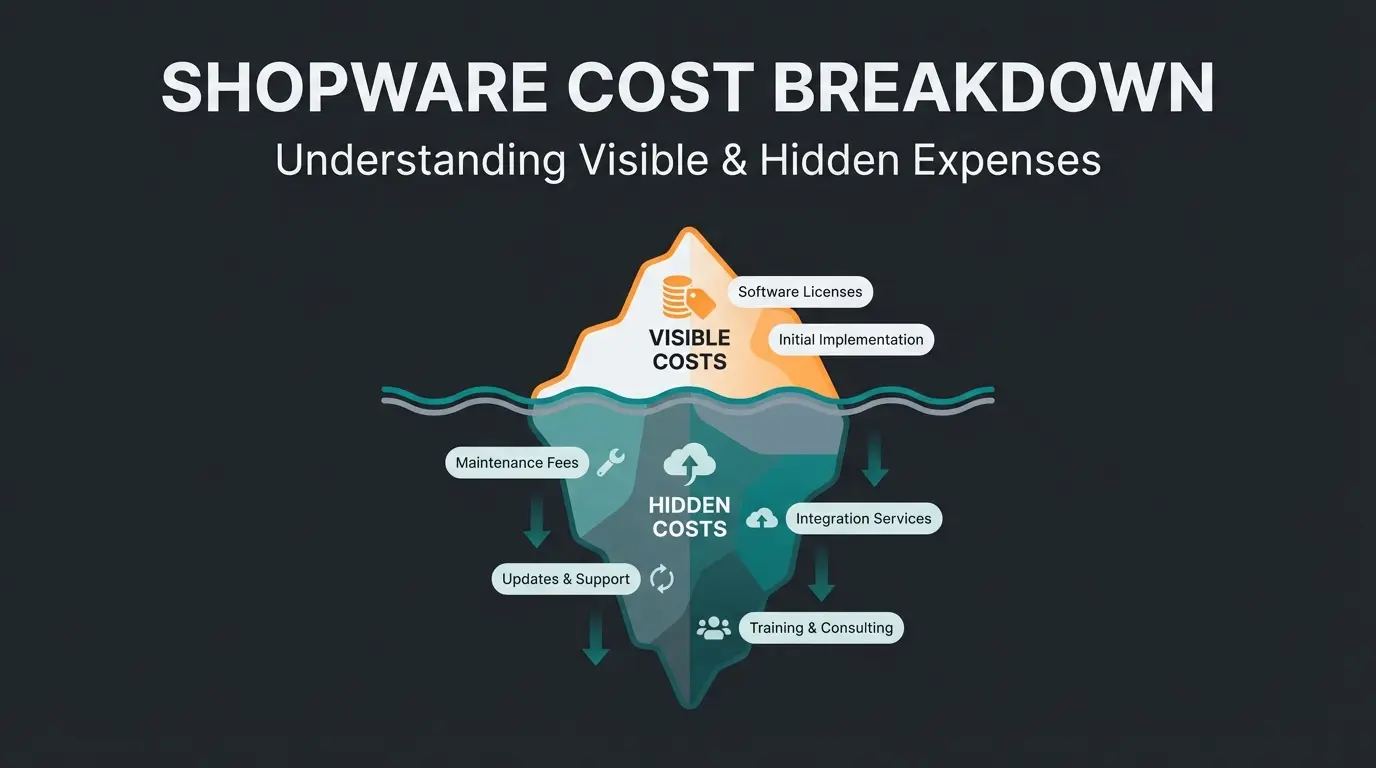
When you ask "what does an ERP system cost?" you cannot ignore internal costs. These don't appear on any vendor invoice but impact your operating results significantly. Understanding these hidden expenses is crucial for accurate budget planning.
What you see quoted in pricing—software licenses and subscriptions
Workshops, requirements analysis, process design, and implementation support
Percentage of employees showing initial resistance to new ERP systems
Yearly maintenance fees for on-premise solutions beyond the initial purchase
1. Key-User Productivity Loss
Your best employees (department heads, top salespeople) are appointed as "key users." They must define processes, conduct testing, and train colleagues. This represents a significant hidden cost that rarely appears in initial project budgets.
Sample Calculation: If a key user with a $60,000 annual salary is 50% committed to the ERP project for 6 months, this internally costs you $15,000—plus the lost revenue they would have generated during this time. Multiply this across multiple key users, and the impact becomes substantial.
2. Training and Change Management Investment
A new system generates resistance. Without professional change management, projects often fail or remain underutilized. According to research published by Forbes, around 82% of users initially show resistance to new ERP software.
- Training Costs: External trainers cost similar amounts as consultants. Additionally, work stops during training sessions.
- Productivity Dip: Expect 20-30% productivity loss during the first 3-6 months as employees learn the new system.
- Documentation Requirements: Creating internal documentation and process guides requires additional time investment from your team.
3. Maintenance and Updates (On-Premise Specific)
With purchase solutions (on-premise), companies often forget hardware costs. Servers must be renewed every 3-5 years, electricity and cooling cost money, and security updates for the operating system must be applied. According to Haufe X360, these costs largely disappear with SaaS solutions or are included in the rental price.
The Game Changer: Traditional vs. AI-Powered Selection
Here lies the strategic gap in most online comparisons. Competitors advise you to "negotiate well" or "reduce scopes." We say: Change the process through AI.
The most expensive element of an ERP implementation is uncertainty. "Do we need this module?" "Does this process fit?" To eliminate this uncertainty, expensive human consultants are traditionally deployed. But what if there was a better way?
The Problem with Human-Heavy Implementation
In a classic project, consultants spend weeks understanding your requirements (requirement engineering). This traditional approach has remained largely unchanged for decades despite technological advances.
- Time Investment: Weeks to months of interviews, workshops, and documentation
- Costs: High (daily rates of $1,400-$1,800 plus travel expenses)
- Quality: Dependent on the individual consultant's daily form, experience, and potential vendor biases
The AI Solution: Automated Requirements Analysis
Modern AI tools can revolutionize this process fundamentally. Instead of holding workshops, AI analyzes your existing data structures and process descriptions. It matches these requirements against thousands of ERP system features in seconds rather than weeks.
| Feature | Traditional Consultant (Human) | AI-Powered Analysis |
|---|---|---|
| Availability | Mon-Fri, 9-5 (by appointment) | 24/7 instant availability |
| Cost Structure | Daily rate (~$1,500) + travel costs | Flat fee or included in software subscription |
| Analysis Duration | Weeks (interviews, documentation) | Minutes to hours (data analysis) |
| Data Foundation | One person's experiential knowledge | Database with thousands of system specifications |
| Objectivity | Subjective (often vendor partnerships) | Data-driven and neutral |
| Output | Static requirements document | Dynamic matching & gap analysis |
The Savings Potential: By using AI in the pre-project phase (scoping), service costs can be reduced by up to 30-50%, according to research from Kovench. AI handles the heavy lifting (feature comparison, requirements document creation) while humans make only the final strategic decisions.
Why spend weeks in consulting sessions to define requirements? Let our AI analyze your needs and deliver a precise cost estimate in minutes, not months.
Start Your AI Analysis NowConcrete Price Examples for 2025
To make the question "ERP costs per user" tangible, let's examine three typical scenarios with current market data. These examples reflect real-world pricing structures you'll encounter when evaluating ERP solutions.
Scenario A: Small Business / Start-up
- Profile: 10 users, focus on trade/e-commerce, standard processes
- System Examples: Weclapp, Xentral
- Cost Calculation:
Licenses: According to Zeeg, Weclapp "ERP Trade" costs approximately $179/user/month (with monthly payment). Xentral "Business" ranges from approximately $100–$250/user/month depending on the package.
Implementation: Often "do-it-yourself" with onboarding packages (approximately $2,000–$5,000 one-time).
Total Costs Year 1: Approximately $25,000–$35,000.
Scenario B: Mid-Market (SMB)
- Profile: 50 users, production & trade, international entities
- System Examples: Microsoft Dynamics 365 Business Central, SAP Business One
License Calculation (Microsoft): "Premium" User: $110 USD (approximately $100–$105) from late 2025 (note the price increase!). 50 users × $105 × 12 months = $63,000/year according to Boss Info.
License Calculation (SAP B1 Cloud): Professional User: approximately $91/month according to Business One Consultancy.
Services (Traditional): Factor 1.5 of license costs = approximately $95,000.
Total Costs Year 1: Approximately $150,000–$180,000.
Savings Potential with AI: Reduction of services to approximately $50,000 → Total costs approximately $115,000.
Scenario C: Upper Mid-Market / Enterprise
- Profile: 200+ users, complex manufacturing, multi-site operations
- System Examples: SAP S/4HANA Public Cloud, Microsoft Dynamics 365 F&O
Costs: Blanket statements are difficult here. According to iTransition, ERP prices often range from $500,000 to over $1 million in the first year (licenses + implementation).
Special Consideration: Here the leverage of AI consulting is greatest, as poor decisions can cost millions and the complexity of requirements mapping increases exponentially.
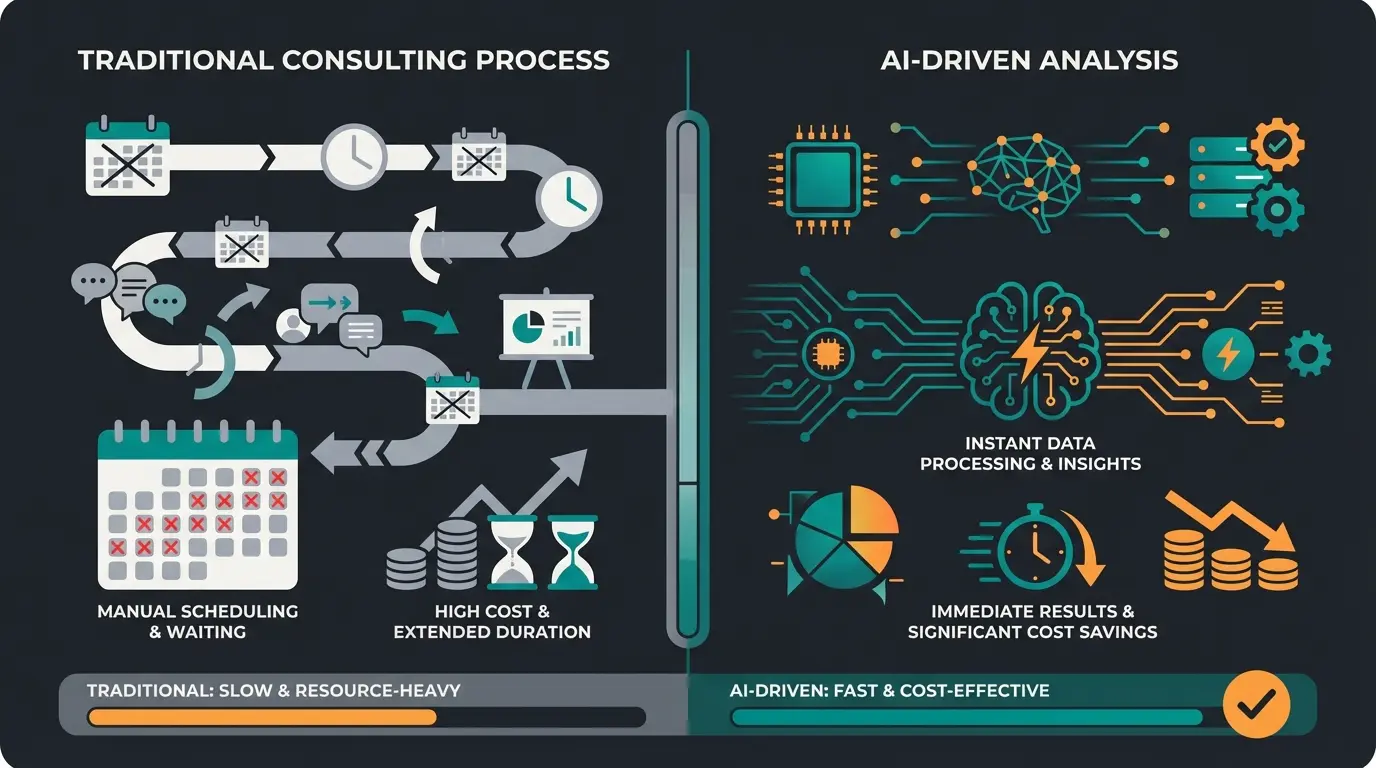
Weeks of on-site meetings with consultants at $1,500/day to document current processes
Consultants create lengthy specifications over 4-8 weeks based on workshop findings
Manual comparison of 3-5 vendors taking additional weeks of analysis
AI analyzes your existing systems and processes in hours, not weeks
Automated comparison against thousands of ERP features and specifications
Receive data-driven recommendations with cost estimates in minutes
ROI & Payback: When Does It Pay Off?
The question about costs must always be answered alongside the question about benefits (ROI). An ERP system typically pays for itself through measurable improvements across multiple business areas.
- Inventory Reduction: Less capital tied up in warehouse stock through better demand forecasting and planning
- Process Automation: Fewer manual interventions for orders, invoices, and routine transactions
- Error Prevention: Fewer returns due to incorrect deliveries, reduced data entry errors, and improved accuracy
The Critical Time Factor
Most companies expect ROI after 2 to 3 years. According to Smart Transformation Solutions, implementation timelines significantly impact overall project success and return on investment.
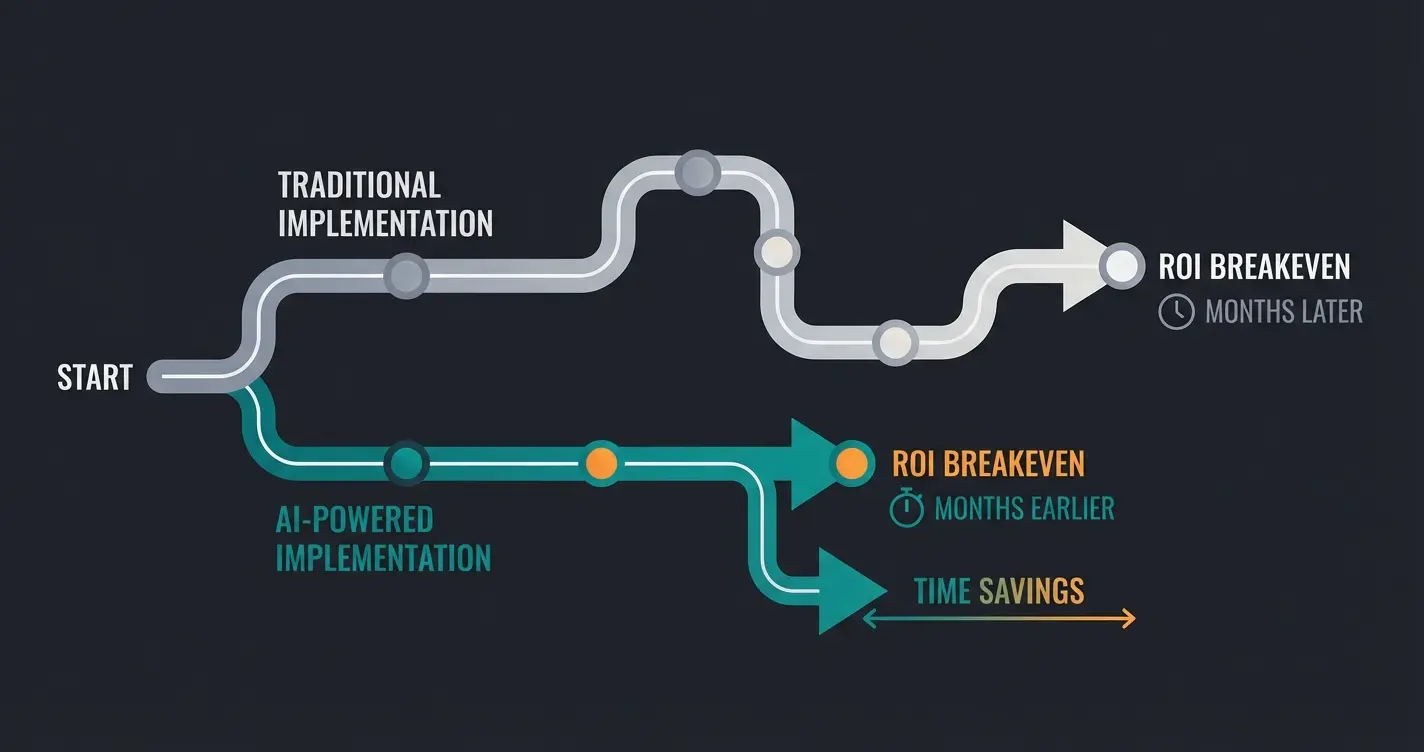
Here's where AI enters the equation again: If you shorten project duration from 9 months to 6 months through AI-assisted selection and implementation, your ROI begins three months earlier.
For a company achieving monthly efficiency gains of $10,000 through the ERP, a 3-month faster implementation means a direct gain of $30,000. This accelerated time-to-value represents pure additional profit from your investment. Research from Master of Code confirms that AI can significantly reduce operational costs across business processes.
Conclusion: Pay for Software, Not PowerPoint Slides
The answer to "What does an ERP system cost?" has evolved in 2025. While license costs (software) have become more transparent and flexible through cloud models, service costs remain the great unknown factor that can derail budgets.
The traditional equation "license costs × 2 = project budget" no longer has to apply. Companies that rely on AI-assisted requirements analysis and implementation can significantly reduce the most expensive factor—human consulting time—while achieving better outcomes.
Strategic Summary for Your Budget Planning
- Calculate Cloud Prices Realistically: Expect $80–$120 per "full user" for market leaders, and don't forget to factor in annual increases.
- Watch for Price Increases: Secure conditions before the price adjustments at the end of 2025 if possible (e.g., with Microsoft).
- Question Consulting Costs: Don't accept days-long workshops for standard topics that AI can handle in hours.
- Consider Total Cost of Ownership: Look beyond year one and calculate 5-year TCO including maintenance, upgrades, and scaling costs.
- Leverage AI for Scoping: Use AI-powered tools to dramatically reduce the requirements gathering phase.
Frequently Asked Questions About ERP System Costs
Cloud ERP systems typically cost between $25 and $150 per user per month, depending on the functionality tier. Entry-level solutions like Weclapp start around $39/user/month, while enterprise solutions like Microsoft Dynamics 365 Business Central Premium cost approximately $110/user/month. On-premise solutions require $2,000-$4,000 per user upfront plus 18-22% annual maintenance.
ERP consulting costs are high because traditional implementations require extensive human involvement in requirements gathering, process mapping, and change management. Senior consultants charge $1,400-$1,800 per day, and typical mid-market implementations require 6-9 months of this support. The consulting phase often consumes 40-60% of the total project budget because of the complexity of translating business needs into system configurations.
AI can reduce ERP implementation costs by 30-50% in the pre-project phase by automating requirements analysis, feature matching, and gap identification. Instead of weeks of workshops, AI analyzes your existing data structures and matches requirements against thousands of system specifications in hours. This eliminates expensive discovery sessions while providing more objective, data-driven recommendations.
Key hidden costs include: key-user productivity loss (employees spending 50% of their time on the project for 6+ months), training and change management (82% of users show initial resistance), data migration and cleanup, interface development for third-party systems, and for on-premise solutions, hardware refresh cycles every 3-5 years plus ongoing server maintenance and utilities.
Most companies achieve ERP ROI within 2-3 years through inventory reduction, process automation, and error prevention. However, AI-assisted implementations can accelerate this timeline by 3-6 months by shortening the implementation phase. For a company achieving $10,000 monthly efficiency gains, a 3-month faster implementation represents an additional $30,000 in value.
Why hold workshops for weeks to find out what you need? Let our AI analysis check your requirements in minutes instead of weeks and receive a precise cost estimate based on data rather than guesswork.
Start AI Analysis & Calculate ERP Costs Now