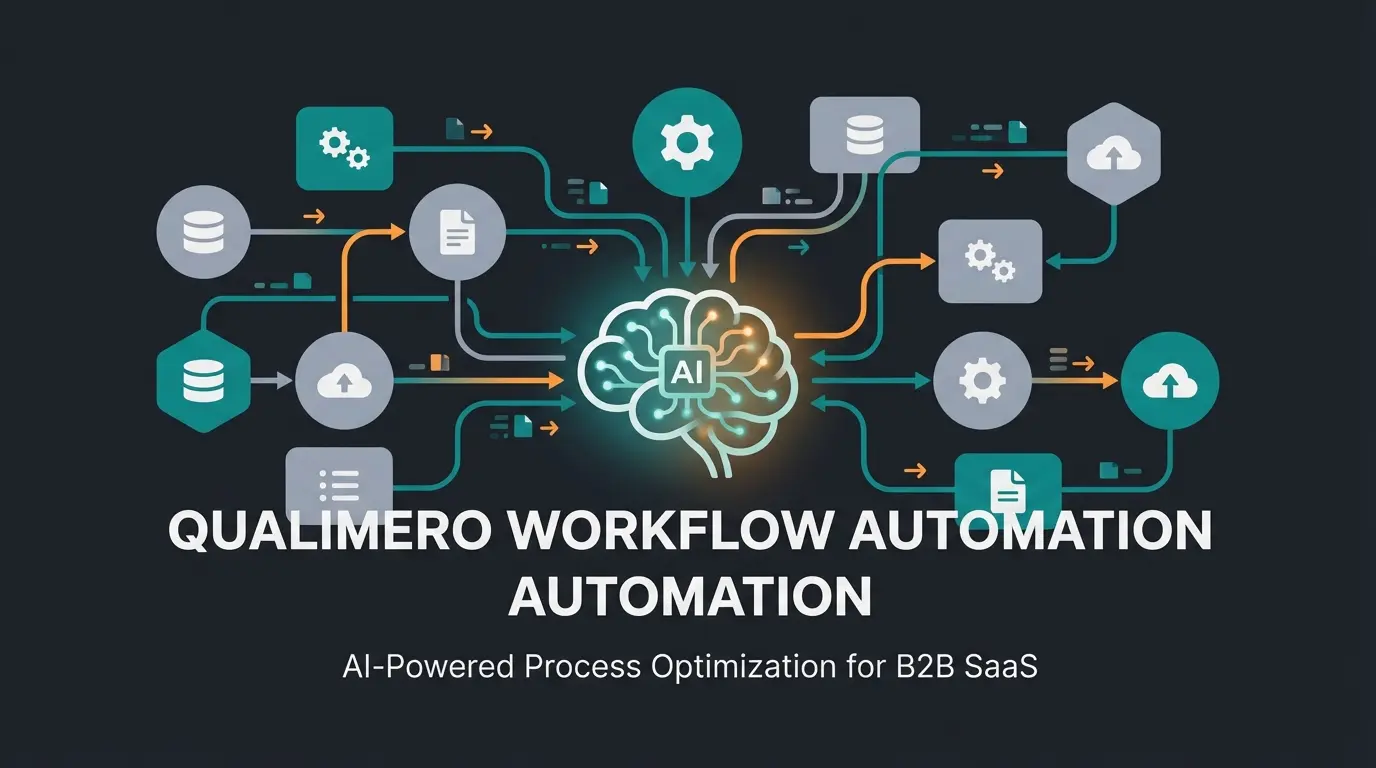
The Critical Turning Point in Digital Transformation
Digital transformation in Germany stands at a critical turning point. While we've spent years discussing how to achieve the paperless office, technology has advanced rapidly. Today, it's no longer just about pushing an invoice digitally from A to B. It's about automating cognitive processes that previously required human expertise.
Current data from industry association Bitkom paints an alarming picture: 82 percent of German companies view the current economic situation as a crisis of hesitant digitalization. Meanwhile, 73 percent report having already lost market share due to processes that are too slow. The pressure is real and intensifying.
But here lies the massive opportunity for 2025 and 2026: The next wave of automation—driven by Agentic AI—allows us for the first time to scale not just manual tasks, but decisions and consulting services. Organizations that can automate customer interaction effectively will gain unprecedented competitive advantages.
In this comprehensive article, you'll learn how to automate business processes, why you need to think beyond classic RPA (Robotic Process Automation), and how to transform your company from an administrative manager into an automated expert.
What Does Business Process Automation Mean Today?
To approach this topic strategically, we first need to sharpen our terminology. Many companies still equate automating business processes with simply digitizing paper documents. However, that's merely the first step in a much longer journey.
Business Process Automation (BPA) refers to using technology to execute recurring tasks or complex workflows that were previously performed manually by employees. The goal is to increase efficiency, reduce costs, and improve process stability. But modern BPA goes far beyond simple task automation.
The Evolution of Automation Definitions
- Past (BPM): Process management that was often still very document-heavy and manual
- Yesterday (RPA): Software robots that imitate mouse clicks and keystrokes to copy data between legacy systems (e.g., 'When email with subject Invoice arrives, save attachment to folder X')
- Today (Intelligent Automation / Agentic AI): Systems that don't just follow rules but pursue goals. They can understand unstructured data (like an email from an upset customer), analyze context, and make intelligent decisions
According to CloudEagle and TechTarget, the distinction between rule-based automation and AI-driven decision-making represents the fundamental shift in how businesses approach process optimization.
Why You Must Automate Business Processes Now
The question of 'why' has transformed from a 'nice-to-have' consideration into a survival strategy due to Germany's economic situation. According to McKinsey, we're at the transition from pilot projects to scaling. Companies that don't act now risk losing ground to the 'high performers' who are already significantly increasing their profits through AI.
Here are the hard facts and benefits that make automation essential for competitive businesses:
1. Massive Cost Reduction and Efficiency Gains
Studies from SystemSync demonstrate that companies can reduce their operating costs by up to 60% through automating recurring processes. In financial accounting alone, savings of up to 45% are realistic. This is capital you're missing for investments or crisis reserves if you continue working manually.
2. Combating the Skilled Labor Shortage
Germany faces a critical labor shortage. Bitkom President Dr. Ralf Wintergerst emphasizes that without digitalization, we will decline economically. When your qualified employees spend 30% of their time copying data from Excel to CRM or answering standard questions, you're wasting your most valuable resource.
Research from Vena Solutions reports that 74% of employees say automation allows them to work faster, and 82% of sales teams have more time for customer relationships thanks to automated workflows.
3. Error Reduction and Compliance
Humans are creative but error-prone when it comes to routine tasks. Typos in invoices or forgotten compliance checks can be expensive. Automated systems reduce data entry errors by up to 90%. A bot never forgets to check a GDPR checkbox or verify a mandatory field.
4. The New Game-Changer: Scalability of Expert Knowledge
This is the point most competitors overlook. Classic advantages focus on savings. The modern advantage is revenue generation. When you automate office processes, you save money. But when you automate consulting processes, you earn money—24/7.
- The Problem: Your best salesperson can only handle one customer conversation at a time. They sleep, get sick, and take vacations.
- The Solution: An AI trained with your best expert's knowledge can conduct 1,000 consulting conversations simultaneously—at night, on weekends, and in five languages parallel.
Potential savings through automating recurring processes
Decrease in data entry mistakes with automated systems
Sales teams report increased capacity for relationship building
AI consultation never sleeps or takes vacations
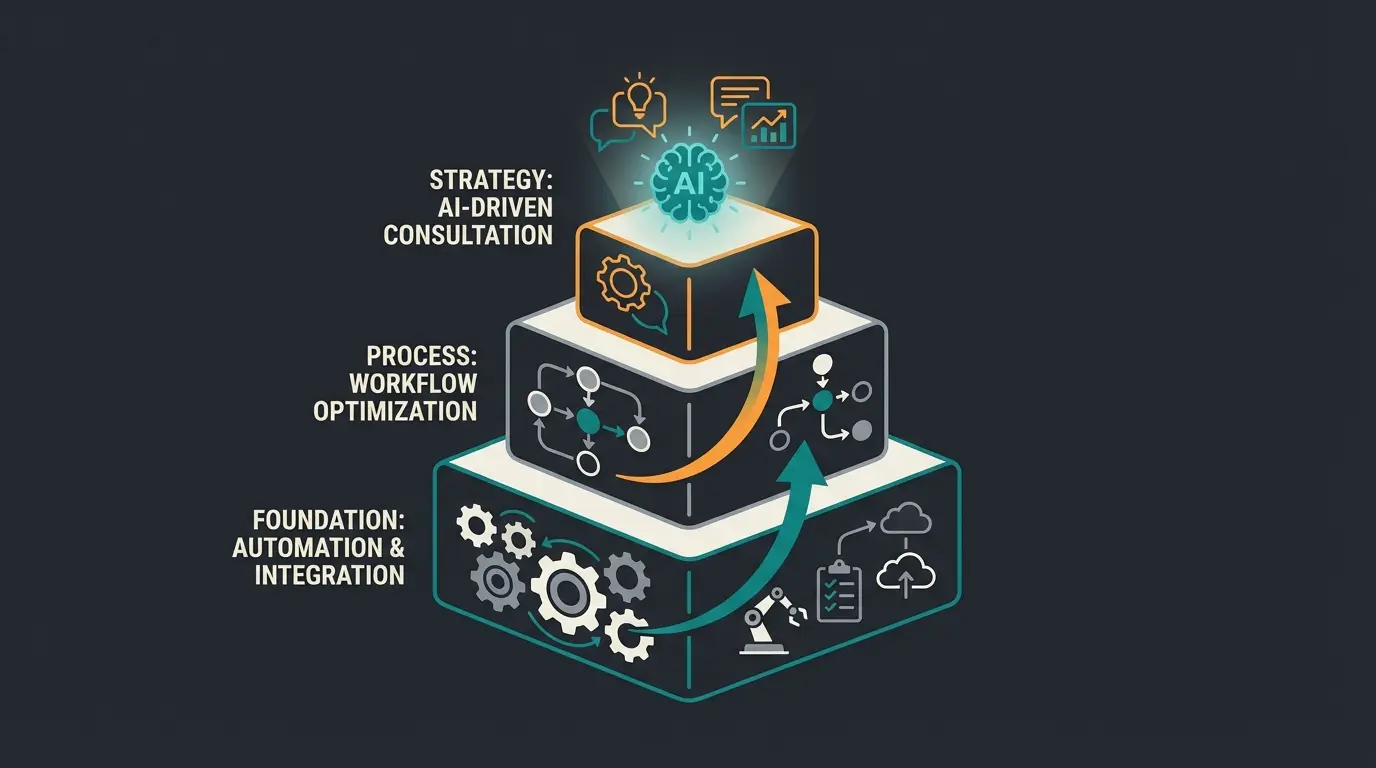
The 3 Stages of Automation: A Maturity Model
To automate administrative processes and grow beyond, it helps to position your company within a maturity model. Most German SMEs are currently between stages 1 and 2, missing significant opportunities at stage 3.
Stage 1: Task Automation
At this level, individual, isolated manual tasks are automated. There's no deep integration between systems or processes.
- An email out-of-office notification
- A Zapier script that automatically saves an email attachment to Dropbox
- Mail merge for document creation
- Basic calendar scheduling
Characteristics: Rule-based, simple, low ROI, but quick implementation. This is where most companies start their automation journey.
Stage 2: Process Automation (RPA & Workflows)
Here, entire chains of tasks are connected. This represents the status quo of many digitalization initiatives and encompasses what most people think of when they hear 'automation.'
- Invoice Processing: OCR reads invoice → Data transfers to ERP → Approval workflow to department head → Payment trigger
- Employee Onboarding: New employee created in HR system → IT tickets for hardware automatically generated → Welcome email sent
Characteristics: Efficient but rigid. If the invoice format changes or an edge case occurs, the process breaks and requires human intervention. This is where traditional RPA solutions excel but also hit their limits.
Stage 3: Decision & Consultation Automation (Agentic AI)
This is the future (and for pioneers, the present). Here we don't automate the workflow, but the outcome. We use Agentic AI—AI agents that autonomously pursue goals as described by McKinsey's latest research.
- Intelligent Customer Support: A customer asks: 'I need a solution for Problem X.' The AI analyzes the problem, checks inventory, compares technical datasheets, and proactively recommends the appropriate product including accessories—exactly like a human expert would.
- Dynamic Dispatch: A truck breaks down. The AI doesn't just calculate the delay—it autonomously books a replacement service provider and informs the customer with an adapted solution.
Characteristics: Adaptive, learning-capable, revenue-impacting. This is where AI product consultation creates genuine competitive advantage.
Individual manual tasks automated with simple rules and triggers
Connected workflow chains with RPA handling structured data
Agentic AI pursuing goals and handling unstructured conversations
Practical Examples: Which Processes Can Be Automated?
Let's get specific. Where should you start? We'll divide this into the classic 'must-do' tasks (back-office) and the modern 'differentiator' (front-office).
Back-Office: Automating Administrative Processes
This is the foundation. Without these fundamentals, scaling becomes difficult. Most companies have already addressed some of these areas, but optimization opportunities remain.
Accounting & Finance
- Invoice Verification: Incoming invoices are read by AI, matched with order numbers, and automatically posted when matching. (Savings potential: High)
- Dunning Process: Automatic sending of payment reminders based on due dates
- Expense Management: Receipt scanning, categorization, and reimbursement workflows
HR (Human Resources)
- Vacation Requests: Approval workflows without paper
- Applicant Management: Automatic parsing of resumes and sending of acknowledgments or rejections
- Onboarding: Provision of access and documents without IT manually intervening each time
IT & Service
- Password Resets: The classic. A bot resets passwords, which often accounts for 30-40% of helpdesk tickets
- Access Provisioning: Automated account creation and permission assignment
- System Monitoring: Automated alerts and initial diagnostic responses
Front-Office: Automating Sales and Consulting Processes
Here lies the untapped potential. Many companies shy away from automating direct customer contact, fearing quality loss. With modern AI, the opposite is true: quality increases through availability and consistency.
Product Consultation in E-Commerce & B2B
Instead of a static product filter ('Color: Red', 'Size: L'), an AI Sales Agent conducts a needs analysis: 'What do you need the machine for? What's your expected utilization?' Based on the answers, the agent recommends the technically appropriate solution. This is Automated Product Advice in action.
The AI product consultation success story from Rasendoktor demonstrates how companies can scale their expert knowledge through intelligent consultation systems. Similarly, the AI employee solution at Gartenfreunde shows how consultation automation works in practice.
Quote Generation (CPQ - Configure, Price, Quote)
Complex B2B quotes often take days to prepare. An AI can create an initial draft within seconds based on customer requirements and current price tables—the sales team only needs to approve it.
Lead Qualification
Before an expensive sales representative picks up the phone, an AI agent can handle pre-qualification via chat or email: Budget, timeline, and decision-making authority are elegantly queried. Only qualified leads land in the team's calendar. This is exactly what AI lead generation enables for forward-thinking organizations.
Discover how AI-powered consultation can transform your customer interactions and drive revenue 24/7. See how leading companies automate their advisory processes.
Start Your Free TrialTechnology Deep-Dive: RPA vs. Agentic AI
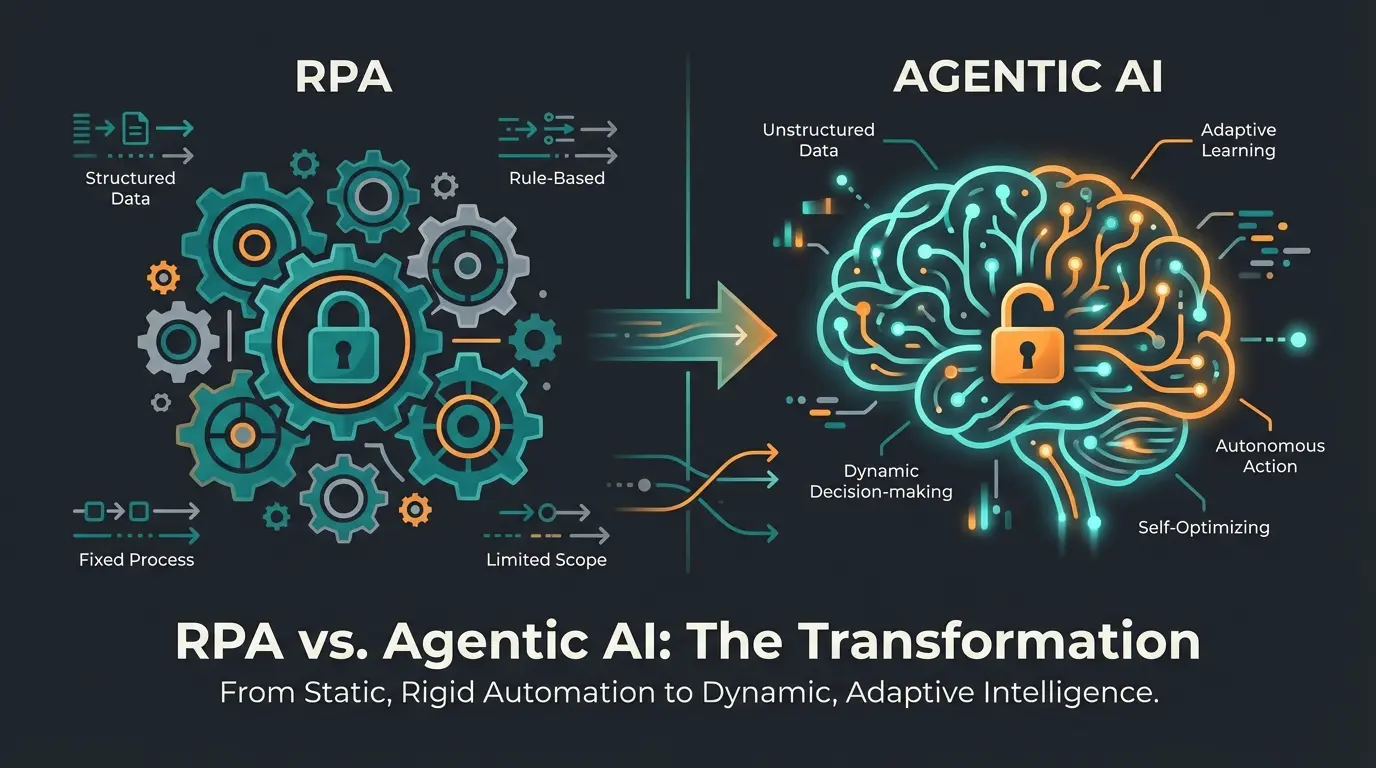
To make the right decision, you need to understand the technological difference. Why might the software you bought in 2020 no longer be sufficient for today's automation challenges?
| Feature | RPA (Robotic Process Automation) | Agentic AI |
|---|---|---|
| Working Method | Rule-based ('If X, then Y') | Goal-oriented ('Solve Problem Z') |
| Data Basis | Structured data (Excel, databases) | Unstructured data (emails, speech, PDFs) |
| Flexibility | Rigid (breaks with unexpected changes) | Adaptive (learns and adapts) |
| Application Area | Data entry, forms, migration | Consultation, analysis, complex decisions |
| Example | Copying an address from email to CRM | Understanding a complaint and formulating a response |
| Future Perspective | Stagnating (becoming 'legacy' technology) | Growth driver 2026 |
The Insight: RPA is excellently suited for automating enterprise processes that never change and have high volumes. But for everything that requires human interaction or judgment, you need Agentic AI. The research from CRM Software Blog confirms this technological shift is well underway.
The trend in 2025/2026 is moving massively toward Multi-Agent Systems, where specialized AI agents collaborate (e.g., one agent for research, one for text creation, one for quality control). This represents the future of AI-powered customer service.
The Challenge: Why Simple Chatbots Fail
Perhaps you're thinking: 'We already have a chatbot.' But honestly: How good is it really? The KI Mitarbeiterin Flora case study reveals the stark difference between traditional chatbots and AI-powered consultation.
Most first-generation chatbots (2018–2023) are nothing more than masked FAQs. They work according to a rigid decision tree that quickly frustrates customers:
- Customer: 'I'm looking for something different.'
- Bot: 'I didn't understand that. Please select from the menu.'
This frustrates customers and damages the brand. Consider the experience delivered by AI employee Theresa versus a traditional rule-based system—the difference in customer satisfaction is remarkable.
Why Do Traditional Chatbots Fail?
- Lack of Context Understanding: They don't know what the customer said 2 minutes ago or what products they've viewed
- No Expert Knowledge: They can't access deep product data, manuals, or technical specifications
- No Reasoning Capability: They can't explain why Product A is better than Product B for a specific use case
The Solution: RAG (Retrieval Augmented Generation)
Modern AI systems use RAG technology. The language model (like GPT-4) is linked with your internal company knowledge (PDFs, databases, wikis) as explained by Medium's technical analysis and Grid Dynamics research.
- The customer asks a question
- The system searches your documents for the answer (Retrieval)
- The AI formulates a precise, human-like response based on these facts (Generation)
This eliminates the risk of 'hallucinations' (making up facts) and makes your company's knowledge available around the clock. The AI assistant Sophie demonstrates this capability in a healthcare context, while AI chat implementations show effectiveness across various industries.
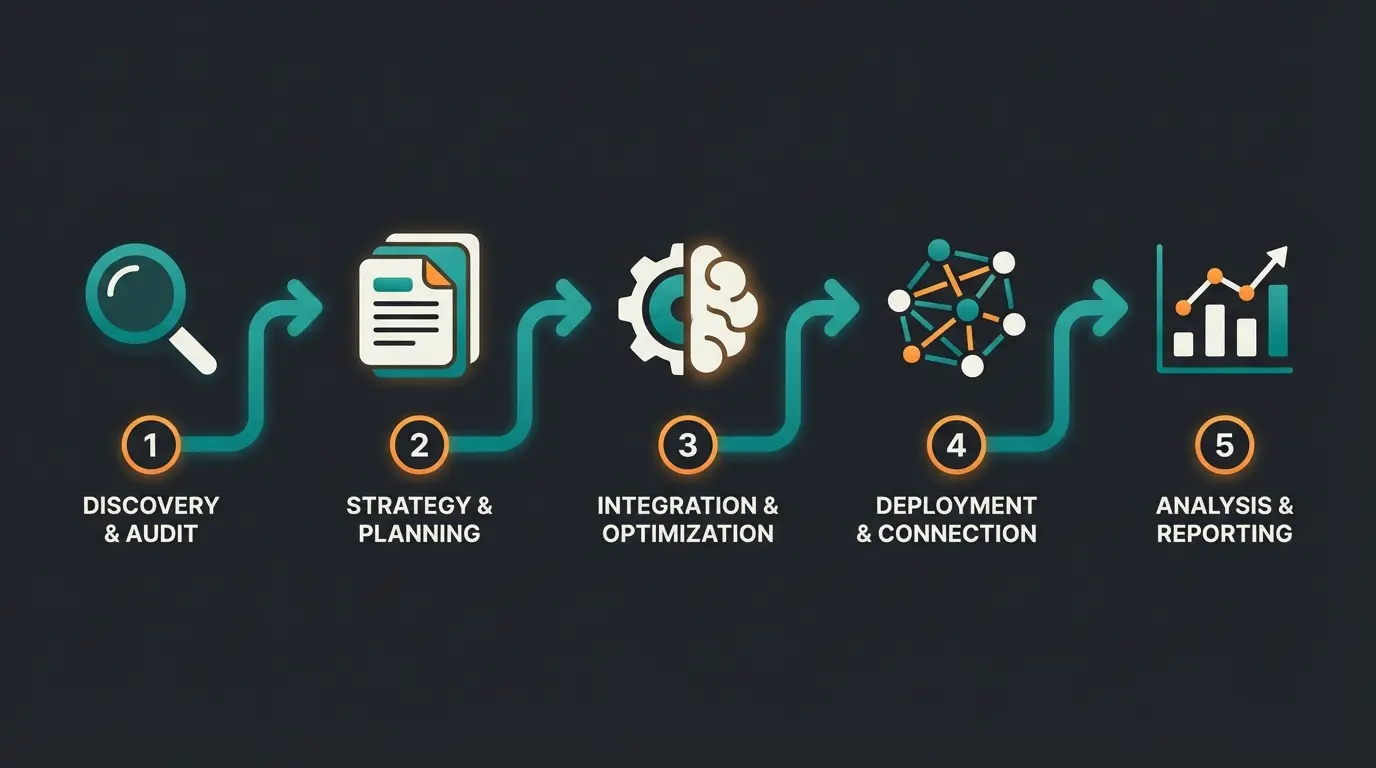
Guide: 5 Steps to Automated Consultation
You want to move away from manual work toward automated expertise? Here's your implementation roadmap based on best practices from Autonmis.
Step 1: Identify the Consultation Bottleneck
Don't look for the process that uses the most paper, but the one that holds back your experts the most. Consider these diagnostic questions:
- What questions does your support team answer 50 times a day?
- Where do customers have to wait because no advisor is available?
- What product knowledge exists only in the heads of a few employees ('knowledge monopolies')?
Step 2: Digitize Expert Knowledge (Data Preparation)
AI needs data. Before you can automate business processes, you must make the knowledge accessible and structured.
- Collect product catalogs, technical datasheets, internal wikis, and past support tickets
- Clean the data: Delete outdated price lists and contradictory documents
- Quality over quantity ('Garbage in, garbage out')
Step 3: Choose the Right Engine (Not Just ChatGPT)
A simple ChatGPT account isn't sufficient for enterprise data (privacy concerns!). You need an Agentic AI solution that meets specific criteria:
- GDPR-compliant data handling and storage
- RAG technology (see above) integrated natively
- Embeddable in your existing website or shop
- Trainable on your specific tone of voice and brand guidelines
Step 4: Integration into the Workflow
The AI must not be an island. According to VStorm integration research, proper integration is critical for success:
- Level 1 Integration: A chat widget on the website
- Level 2 Integration: When the AI can't proceed, it seamlessly hands over to a human (Human-in-the-Loop) and creates a conversation summary beforehand
- Level 3 Integration: The AI can directly trigger actions (e.g., book an appointment in the sales rep's calendar or fill a shopping cart)
For product consultation implementations and AI Recruiter solutions, Level 2 and 3 integrations prove most valuable.
Step 5: Test, Measure, and Refine
Don't start immediately with 100% of your traffic. A phased approach minimizes risk:
- Use a 'Silent Mode' where the AI generates responses that are first reviewed by an employee
- Measure KPIs that matter: Not 'number of chats' but 'successful problem resolutions' or 'conversion rate after consultation'
- Iterate based on real user feedback and edge cases discovered
Conclusion: The Future Is Automated Expertise
Anyone still thinking in 2026 about whether to automate administrative processes has already missed the starting signal. The technology is mature, and the cost benefits are proven across industries.
But the real revolution is happening now: The step from pure processing to intelligent consultation. Companies that manage to scale their expert knowledge through AI will secure an insurmountable competitive advantage. They break free from the linear dependency between employee count and revenue.
The transformation from basic workflow automation to sophisticated AI consultation represents the greatest opportunity for business growth in the coming years. Organizations ready to schedule a demo and explore these possibilities will find themselves well-positioned for the future.
Your Next Steps
- Stop seeing automation only as a cost-cutter—view it as a revenue multiplier
- Identify a consulting process that currently slows down your sales team
- Start a pilot project with Agentic AI to make this knowledge available 24/7
The question is no longer whether an AI will advise your customers—but whether it will be your AI or your competitor's.
RPA (Robotic Process Automation) follows rigid, rule-based logic ('If X, then Y') and works best with structured data like spreadsheets and databases. Agentic AI, on the other hand, is goal-oriented ('Solve Problem Z'), can handle unstructured data like emails and conversations, and adapts to new situations. While RPA excels at repetitive data entry tasks, Agentic AI can manage complex decisions, customer consultations, and nuanced problem-solving.
Studies show that companies can reduce operational costs by up to 60% through automating recurring processes. In financial accounting specifically, savings of up to 45% are achievable. Beyond cost savings, automation reduces data entry errors by up to 90% and enables employees to focus on higher-value activities, with 82% of sales teams reporting more time for customer relationships.
First-generation chatbots (2018-2023) are essentially masked FAQs operating on rigid decision trees. They fail because they lack context understanding (forgetting what customers said minutes ago), have no access to deep product knowledge, and cannot explain reasoning. Modern AI systems using RAG (Retrieval Augmented Generation) solve these issues by connecting language models with your internal knowledge base for accurate, contextual responses.
Stage 1 is Task Automation—individual manual tasks like email autoresponders or simple file transfers. Stage 2 is Process Automation (RPA)—connected workflow chains handling invoice processing or employee onboarding. Stage 3 is Decision & Consultation Automation using Agentic AI—systems that autonomously pursue goals, conduct intelligent customer consultations, and make complex decisions. Most companies are stuck between stages 1 and 2.
Follow five key steps: First, identify your 'consultation bottleneck'—the process that most holds back your experts. Second, digitize expert knowledge by collecting and cleaning your product catalogs, technical docs, and support tickets. Third, choose a GDPR-compliant Agentic AI solution with RAG technology. Fourth, integrate it properly into your workflow with human-in-the-loop capabilities. Finally, test in 'silent mode,' measure meaningful KPIs like conversion rates, and continuously refine.
Join leading companies that have automated their expert knowledge and scaled customer interactions 24/7. Experience the power of Agentic AI for your business.
Get Started Free