The Ultimate Guide to Order Management Software
The way companies manage orders is facing a radical transformation. For years, the equation was simple: order management software = digital filing system. The goal was to cleanly enter what the customer ordered into a system, generate an invoice, and initiate shipping. But in 2025, this reactive approach is no longer sufficient.
Why? Because the real pain point in B2B business is no longer managing data—it's the creation of that data. Studies from Sana Commerce show that 75% of B2B buyers would switch suppliers if another provider offers a better, error-free online purchasing experience. The tolerance for errors in order entry is approaching zero, while product complexity continues to rise.
In this comprehensive guide, you'll discover why classic ERP modules and isolated order management software often fall short, how Artificial Intelligence (AI) bridges the gap between technical consultation and commercial processing, and what to look for when selecting a future-proof solution. Our AI employees are already transforming how businesses handle complex order workflows.
B2B buyers willing to change suppliers for better ordering experience
Administrative time spent on pre-order clarification
B2B customers experiencing efficiency losses from order errors
Companies reporting direct revenue losses from order mistakes
What Is Order Management Software? (And What It Isn't)
Before we look to the future of order management, we need to clarify the foundation. At its core, order management software (often part of an ERP system or as a standalone solution) serves to digitally map the entire lifecycle of an order—from quote to archive.
The Status Quo: Why Excel and Email Chains Fail
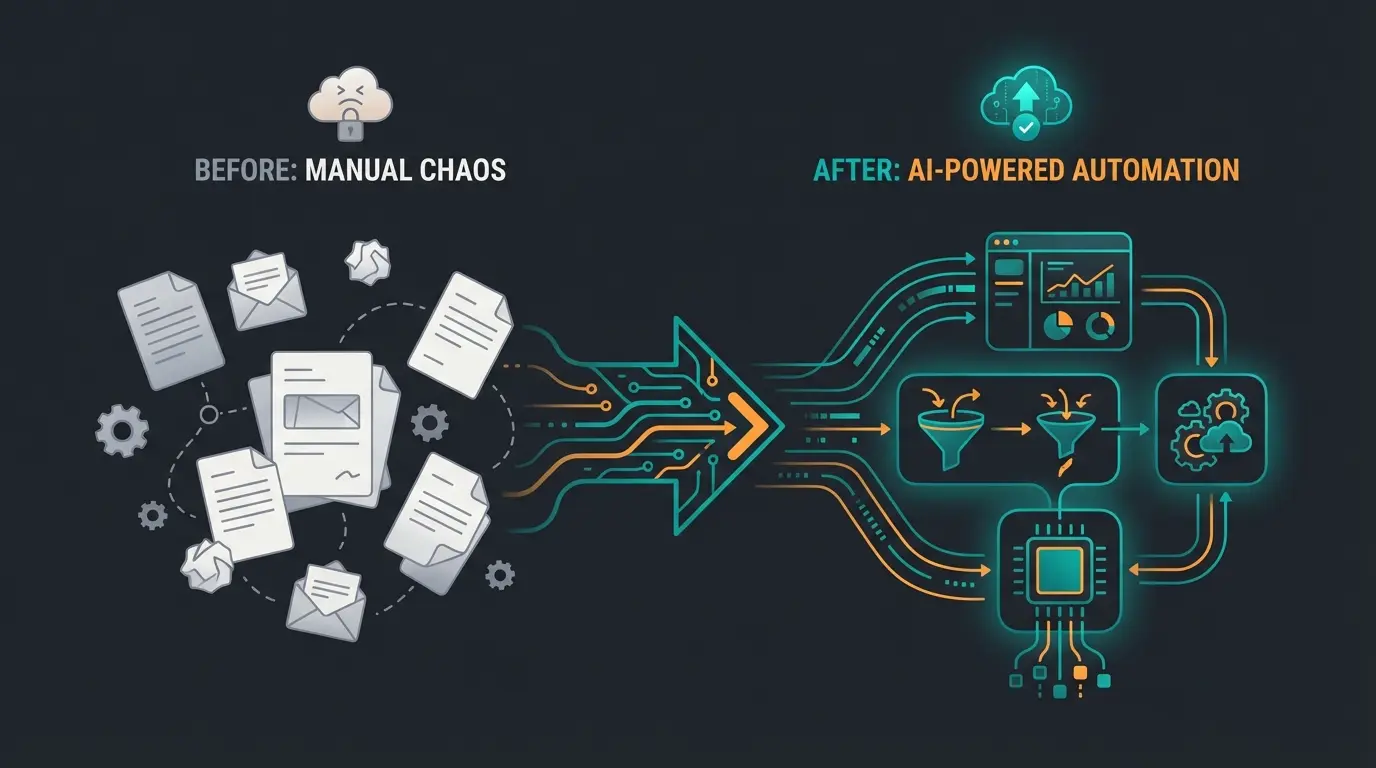
Many small and medium-sized enterprises (SMEs) still rely on a combination of Excel spreadsheets, email threads, and manual notes to manage orders. This inevitably leads to data silos that cripple operational efficiency.
A typical scenario without professional software:
- Sales creates a quote in Word
- Customer orders via email (often with change requests)
- Back office manually enters data into the accounting system
- Warehouse receives a slip of paper or separate email
This "system" is not only slow but a breeding ground for errors. According to research published on E-Commerce Times, these manual processes contribute significantly to order errors and customer churn. A proper order management software centralizes these steps and eliminates redundant data entry.
Standard Features of a Modern Solution
When you search for an order management program today, the following features are considered absolute standard (commodity):
- Quote Generation: Transform inquiries into professional quotes with just a few clicks
- Order Confirmation & Delivery Notes: Automated document generation from quote data
- Invoicing & Dunning: Seamless transition from delivery note to invoice (billing)
- Interfaces (API): Connection to online shops, CRM systems, and financial accounting (e.g., DATEV)
- Inventory Management: Real-time stock reconciliation upon order receipt
The Hidden Problem: Why Managing Orders Is No Longer Enough
Most software providers on the market—from established ERP giants to lean cloud tools—focus on the process after the order is placed. They assume the order is "clean" and ready for processing. The reality in the B2B sector looks quite different.
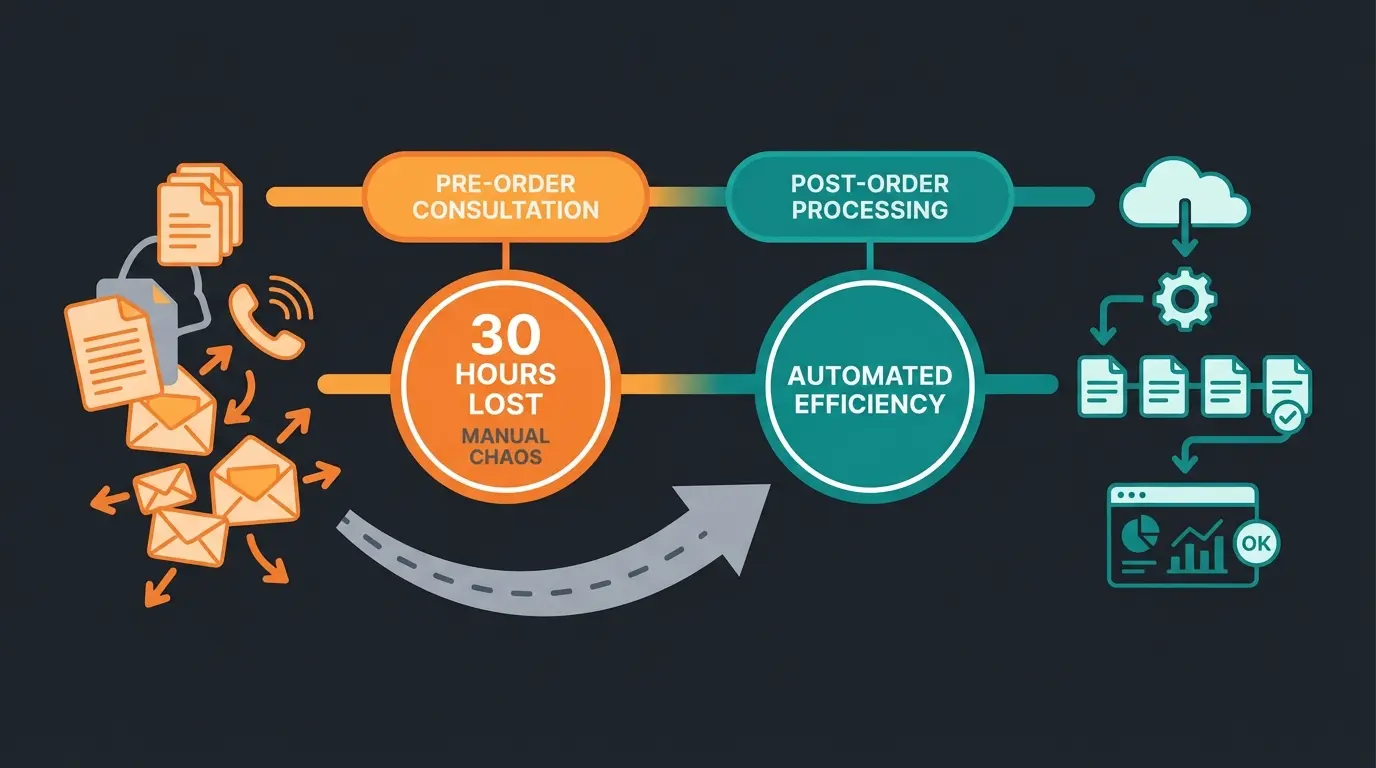
The Pre-Order Chaos
Before an order even lands in order entry software, a chaotic clarification process often takes place. Especially in consultation-intensive industries (mechanical engineering, wholesale, IT system houses), it's rarely clear what exactly needs to be ordered.
- The Gap: Classic tools only start working when the item number (SKU) is determined
- The Reality: 30 to 50% of administrative time in sales back office flows into pre-clarification
- The Evidence: Emails like "Does component A fit on flange B?" or "Is this available in RAL 7016?" dominate daily operations
When this information is transferred manually, errors occur. According to research from Industrie.de, errors in the ordering process lead to efficiency losses for 84% of B2B customers and direct revenue losses for 78%.
The Costs of Faulty Order Entry
An error in order management is expensive. It's not just the time for correcting the invoice—it's a cascade of costly consequences.
- Return Costs: Incorrectly configured goods must be taken back, often at significant expense
- Process Costs: A faulty order goes through the process on average three times (Order → Error Detection → Cancellation/Credit Note → Reorder)
- Customer Churn: As mentioned, 75% of buyers are ready to switch providers if the ordering process is unreliable
This is where the massive content gap of current market leaders lies: they optimize the processing of the error instead of preventing the error through intelligent consultation before entry. Companies leveraging AI-powered customer service are already seeing dramatic reductions in these costly mistakes.
AI in Order Management: Beyond OCR and Basic Chatbots
When we talk about order management software in 2025, we must discuss Artificial Intelligence (AI). But not yesterday's AI—we're talking about a fundamental shift in how intelligent systems support business operations.
OCR vs. Generative AI vs. Agentic AI
It's important to distinguish between the different development stages of AI in order processing to properly evaluate marketing promises from software vendors:
Tools read PDFs and transfer data to ERP. They digitize errors faster but can't detect them.
Chatbots answer questions but often isolated from inventory systems. Can advise but can't trigger orders.
Autonomous AI agents understand context and goals. Proactively correct orders before they're booked.
Stage 1: OCR (Optical Character Recognition)
Tools like Workist or classic DMS solutions read PDFs (e.g., orders via email) and transfer the data into the ERP. Their limitation: They can only process what's on paper. If the customer orders "Screw X," but "Nut Y" is technically necessary, the OCR doesn't notice. It merely digitizes the error faster.
Stage 2: Generative AI (Chatbots)
A chatbot that answers questions represents the second stage. The limitation here: Often isolated from the inventory management system. It can advise, but it cannot trigger an order or validate technical specifications.
Stage 3: Agentic AI (Consultation AI)
This represents the future (2025+): autonomous AI agents. These systems don't just understand text—they understand context and goals. According to McKinsey and insights from GappsGroup, this represents the most significant shift in business process automation.
An AI agent in order management software checks the customer's order against technical rule sets. It recognizes: "The customer is ordering Machine A but has selected the wrong connection cable." The agent proactively contacts the customer (or suggests the correction to the sales representative) and corrects the data before it's booked as an order.
Use Case: From Consultation to Valid Order
Imagine your order management software functions as a technical consultant. Here's how the transformation works in practice:
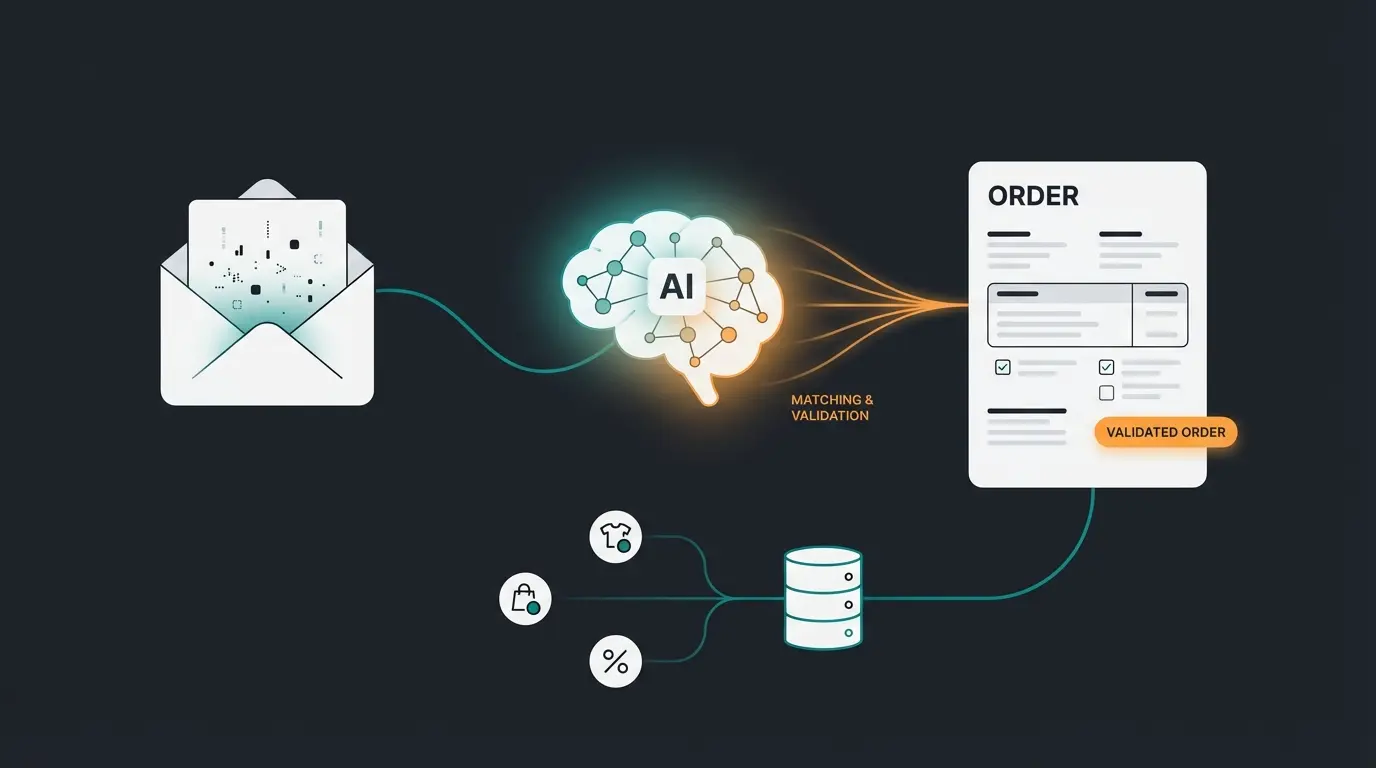
Scenario: A customer inquires via email: "I need a pump for 5000 liters throughput, acid-resistant."
Traditional Way: The sales rep searches the catalog, calls the customer, writes a note, types the quote. Duration: 2 hours to 2 days of back-and-forth communication.
AI Way: The software analyzes the inquiry, matches it with technical data sheets and inventory. It generates a quote draft with the technically suitable pump and necessary accessories (seals). The sales rep only needs to click "Release."
Result: Orders practically manage themselves, but with technical intelligence, not just through mindless automation. This is precisely what our AI product consultation delivers for complex product catalogs.
Stop managing errors. Start preventing them. See how AI consultation can reduce your order processing time by 80% while eliminating costly mistakes.
Start Free TrialKey Criteria for Choosing the Right Software
The market for order management programs is confusing. From huge ERP suites to small SaaS tools, everything is available. What must you pay attention to so you don't invest in a dead end?
1. Integration Capability (The API Question)
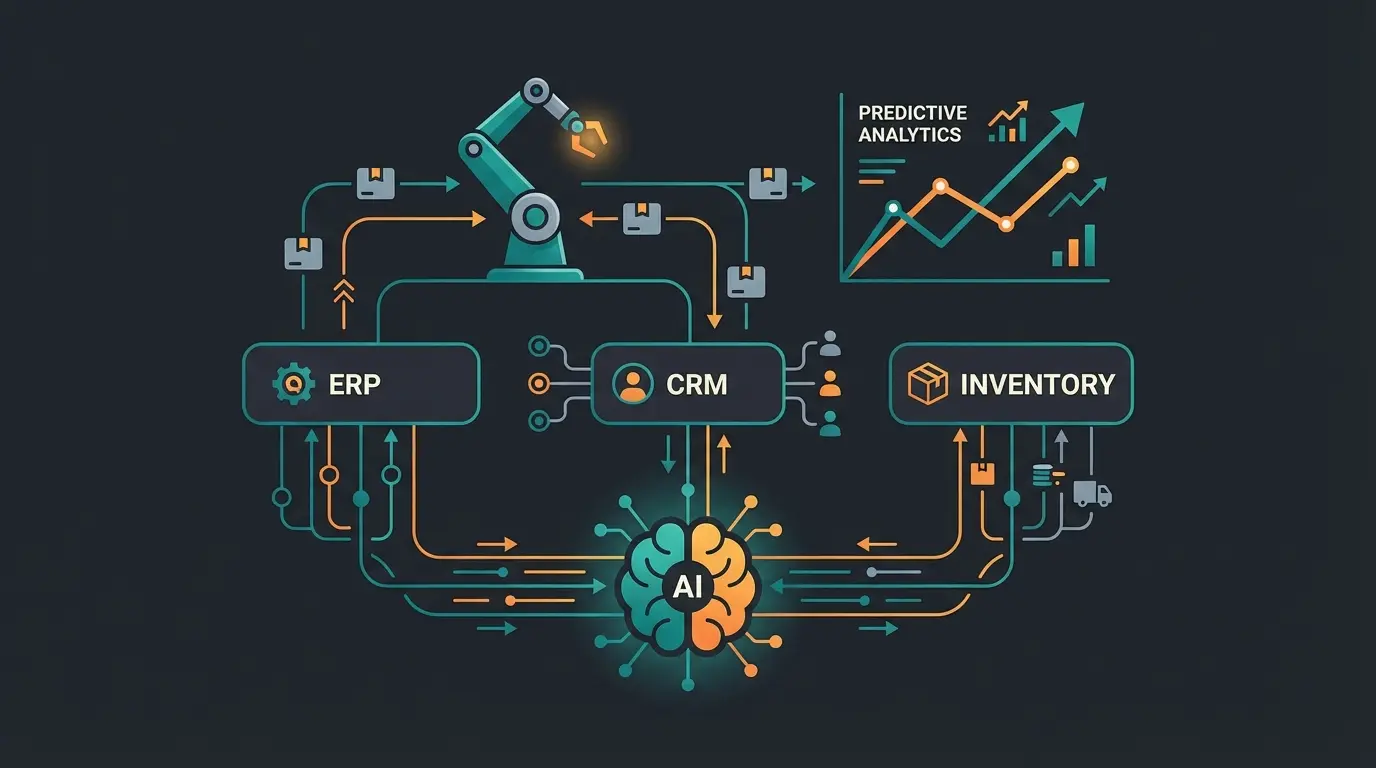
An island solution is the death of efficiency. Your new software must absolutely communicate with existing systems.
- Financial Accounting: Interfaces to DATEV or Lexware are mandatory in Germany and similar connectors are essential for other markets
- E-Commerce: If you sell via Shopify, Shopware, or Amazon, orders must be imported automatically
- CRM: Order data must flow back into the CRM so sales knows what the customer has purchased
The best solutions integrate seamlessly across your entire tech stack. For example, our AI Employee 'Kira' demonstrates how AI can bridge multiple systems to create a unified order experience.
2. Compliance and Legal Security
In Germany, GoBD (Principles for the Proper Management and Storage of Books, Records, and Documents in Electronic Form) sets the standard. According to Hamburger Software and Lexware, the requirements for software have become increasingly stringent.
Checklist for Your Software Selection:
- Immutability: Can an invoice be changed afterwards without being logged? (Must not be possible!)
- Procedure Documentation: Does the manufacturer offer templates?
- Document Security: Are digital documents archived in an audit-proof manner?
- Hosting: Is data stored in certified data centers (ideally EU/Germany) according to GDPR?
As noted by IT-Daily, data security and compliance are non-negotiable factors in modern software selection.
3. Usability and Mobility
The days when order management software only ran on a gray desktop PC in the office are over. Modern teams expect flexible access.
- Can field sales capture an order directly at the customer's site on a tablet?
- Is there an app for craftsmen or service technicians (like mfr or weclapp)?
- Is the interface intuitive, or do you need 3-day training to create a quote?
4. Intelligence Level (The New Criterion)
Ask the provider: "Does your software only help me store data, or does it help me create data?"
Software that doesn't offer AI components for data validation or automation (e.g., automatic reading of email orders) in 2025 is already outdated. Solutions like our AI product consultation showcase how intelligent systems answer questions and guide customers to the right product configuration.
Comparison: Classic ERP Modules vs. AI Solutions
Many companies face the choice: Use the "Order" module in the existing ERP or introduce a specialized solution? Here's a direct comparison to help you decide.
| Feature | Classic ERP Module | Modern AI Order Management |
|---|---|---|
| Focus | Administration & Booking | Process Optimization & Consultation |
| Data Entry | Manual or rigid import | AI-supported (OCR + Context) |
| Error Culture | Errors corrected afterwards | Errors detected preventively |
| Flexibility | Rigid, high customization costs | Agile, often No-Code/Low-Code |
| Pre-Sales | Starts only at order | Integrates quote & consultation |
| Learning Curve | High (often complex) | Low (User-Centric Design) |
Companies already leveraging AI-driven consultation see dramatic improvements. The Product Consultation Automated case study demonstrates how automated product advice transforms the ordering process from reactive to proactive.
Future Outlook: The Self-Driving Order Process
Where is the journey heading? Analysts and studies predict the rise of "Agentic AI" for 2025 and beyond, as documented by Agent32. This means software is no longer just a tool that humans operate—it's a colleague that takes over tasks autonomously.
From Clerk to Customer Success Manager
Through the automation of order management, the role of back-office staff is changing massively:
- Today: 80% time for data entry, 20% for customer contact
- Tomorrow: 10% monitoring AI agents, 90% proactive customer care
The software will be able to predict seasonal fluctuations (Predictive Management) and autonomously adjust inventory levels before the customer even places an order. This shift is already visible in companies using AI Employee Theresa, where staff focus on relationship building rather than data entry.
Research from Absatzwirtschaft and SoPro confirms that businesses still relying on manual processes face significant competitive disadvantages.
FAQ: Common Questions About Order Management Software
Here we answer the questions users most frequently ask on Google ("People Also Ask").
For small businesses, cloud solutions that scale with the company are ideal. Important factors include ease of use and a fair pricing model (SaaS). Tools like Lexware, sevDesk, or weclapp are often first points of contact, though you should check whether industry-specific functions (e.g., for trades) are needed. For companies with complex products requiring consultation, AI-enhanced solutions provide significant advantages by reducing the pre-order clarification burden.
AI improves order processing at multiple levels. Basic OCR reads and digitizes incoming orders automatically. Advanced generative AI can answer customer questions and suggest products. The newest agentic AI goes further by understanding context, validating technical requirements, and proactively correcting errors before orders are booked—reducing returns and queries by up to 80%.
Order management software focuses on the process from quote to order to invoice. An ERP (Enterprise Resource Planning) is the 'big picture' and additionally includes HR, production, complex financial accounting, and often marketing tools. For many SMEs, good order management is the first step toward ERP. However, modern AI-enhanced order management tools can often replace the need for complex ERP modules by handling consultation and validation intelligently.
Yes, typically even more secure than a local server in the basement that isn't regularly maintained. Reputable providers host in certified data centers (ISO 27001) and guarantee compliance with regulatory requirements through automatic backups and immutability protocols. Always verify the server location (EU/Germany preferred) and ask for compliance certifications before making a decision.
Absolutely. Modern solutions use AI to read emails and PDFs (OCR) and transfer the data in a structured way into the system. The next generation (Generative AI) can even logically supplement missing information or formulate follow-up questions to the customer. Agentic AI takes this further by validating orders against technical specifications and inventory before processing.
Conclusion: Are You Still Managing or Already Optimizing?
The search for the right order management software in 2025 is no longer a pure IT decision—it's a strategic turning point. Those who continue to rely on manual processes and rigid systems risk not only high process costs but losing customers to competitors who deliver faster and more precisely.
The AI Chat and product consultation success stories demonstrate what's possible when businesses embrace intelligent automation. Similarly, AI Paul shows how AI agents can transform customer interactions from the very first touchpoint.
Don't invest in software that only manages yesterday's problems. Invest in a solution that secures tomorrow's orders through intelligent consultation and proactive error prevention.
The transformation from administrative order processing to consultative order optimization represents the biggest shift in B2B commerce since the introduction of ERP systems. Companies that embrace AI lead generation and AI-powered order management today will define the competitive landscape of tomorrow.
Don't just manage orders—optimize the consultation that leads to them. Schedule your free demo and discover how AI can reduce errors, accelerate processing, and delight your customers.
Book Your Free DemoTake the next step toward intelligent order management. Schedule a free initial consultation to see how AI-powered solutions can transform your business operations and give you the competitive edge in 2025 and beyond.