What is a chatbot? (And what it cannot do)
A chatbot is a software application that simulates conversation through pre-programmed rules or basic NLP. It handles simple, repetitive queries like FAQs and order status checks, but fails when customers ask complex, context-dependent questions that require reasoning or action beyond text responses.
Most chatbots fall into two categories: rule-based systems that follow rigid decision trees, and keyword-based systems that match user input to predefined triggers. Both share the same fundamental limitation: they cannot learn, remember previous conversations, or take actions outside their script. When a customer asks something unexpected, the conversation breaks. A comprehensive AI chatbot guide would cover the full spectrum from these basic systems to more advanced conversational AI, but the core constraint remains.
According to Gartner, agentic AI will autonomously resolve 80% of common customer service issues by 2029. Traditional chatbots, by contrast, resolve only 20-30% of customer queries without human escalation (Zoom). That gap defines the problem: most businesses deploy chatbots expecting AI-level results, then wonder why customers leave frustrated.
Chatbots have their place. For types of chatbots that handle opening hours, shipping status, or return policies, a rule-based system works fine. The question is whether conversation automation alone matches what your customers actually need. For most e-commerce businesses with consultation-intensive products, the answer is no. The real question becomes: is a chatbot really AI, or just a script wearing a chat interface?
What is an AI agent?
An AI agent is an autonomous software system that can reason, plan multi-step tasks, and take actions using external tools and APIs. Unlike chatbots that only respond to prompts, AI agents proactively execute workflows, updating CRMs, scheduling meetings, and making decisions based on real-time data without constant human direction.
Gartner defines AI agents as "goal-driven software entities that use AI techniques to perceive, make decisions, take actions and achieve goals." The critical distinction from chatbots: an AI agent does not just respond. It acts. It can break a complex request into steps, decide which tools to use, execute those steps, and evaluate whether the result meets the original goal.
The agent receives input and gathers context from connected systems (CRM, inventory, order history)
It breaks the request into sub-tasks, identifies dependencies, and plans an execution sequence
It executes each step using external tools and APIs: querying databases, updating records, triggering workflows
It checks whether the outcome matches the goal. If not, it adjusts and retries with a different approach
Behind every AI agent sits a stack of interdependent technologies: large language models (LLMs) for natural language understanding, machine learning pipelines for continuous improvement, and API integrations for executing actions across connected systems. Natural language processing handles the cognitive layer, understanding what a user means even when they phrase it ambiguously. The API layer handles execution, reading from and writing to CRM, ERP, and inventory databases in real time. This combination of cognitive and executive capability is what separates agents from chatbots architecturally, not just functionally.
McKinsey estimates that generative AI could add between $2.6 and $4.4 trillion annually to global GDP, with AI agents powering over 60% of the increased value in marketing and sales deployments. By end of 2026, Gartner predicts 40% of enterprise applications will include task-specific AI agents, up from under 5% in 2025. The AI agent market itself is expected to grow from roughly $12-15 billion in 2025 to $80-100 billion by 2030 (McKinsey).
AI agents represent a genuine leap over chatbots. But they have a blind spot for e-commerce: most AI agents are built for internal workflow automation, not for customer-facing product consultation. They can route a support ticket or update a CRM record, but they cannot tell a customer which lawn care product works best for clay soil in northern Germany. That requires something more specialized.
The third tier: what is an AI employee?
An AI employee is a persistent digital team member that combines AI agent autonomy with deep product knowledge, customer memory, and revenue-driving capabilities. Unlike generic AI agents, AI employees understand your entire product catalog, remember returning customers, and actively increase cart values, functioning as expert consultants rather than task executors.
This is where every competitor article stops: they frame the choice as chatbot vs AI agent, two tiers. Microsoft, Salesforce, Ada, Cognigy, all present the same binary comparison. But for e-commerce businesses selling consultation-intensive products, there is a third tier that neither chatbots nor generic AI agents cover. An AI employee sits in the product catalog, knows that Product A works best with Accessory B, remembers that this customer bought Product C six months ago, and proactively recommends upgrades.
- Persistent memory: Remembers individual customers across sessions and channels, not just within a single conversation
- Deep product expertise: Trained on the complete product catalog with application knowledge, not just FAQ answers
- Cross-channel presence: Web chat, WhatsApp, email, all with the same context and memory
- Revenue generation: Actively upsells and cross-sells based on customer needs, not just deflects tickets
- Brand personality: Communicates in your brand voice with domain-specific expertise
Qualimero clients see measurable results from this third tier: +35% average cart value increase, +60% higher checkout rates, and 16x ROI across deployments. These are not chatbot metrics. Chatbots measure deflection rates and cost savings. AI employees measure revenue generated and customer lifetime value increased.
AI agent vs chatbot vs AI employee: feature comparison
The core difference is capability depth: chatbots answer questions, AI agents execute tasks, and AI employees drive revenue. A chatbot follows scripts, an AI agent reasons and acts autonomously, and an AI employee combines autonomous action with deep product expertise, customer memory, and measurable business outcomes like higher cart values.
| Feature | Chatbot | AI Agent | AI Employee |
|---|---|---|---|
| Autonomy | None. Follows pre-set rules | High. Plans and executes multi-step tasks | High. Plus proactive upselling and consultation |
| Memory | None across sessions | Limited context within workflow | Persistent memory of individual customers across channels |
| Product knowledge | FAQ-level only | Can query product databases on demand | Deep catalog expertise with application context and cross-sell logic |
| Action capability | Text responses only | Executes workflows, updates systems | Full transaction handling: recommend, sell, process orders |
| Revenue impact | Cost reduction (ticket deflection) | Efficiency gains (process automation) | Direct revenue increase (+35% cart value, +60% checkout rate) |
| Learning | No learning capability | Improves through feedback loops | Learns customer preferences and product associations over time |
| Channels | Typically webchat only | Backend/API integrations | Web chat, WhatsApp, email, social media with unified context |
| Setup complexity | Low (days) | Medium to high (weeks to months) | Medium (days with done-for-you service) |
| Best for | Simple FAQ automation under 100 tickets/month | Internal workflow automation across enterprise tools | Consultation-intensive e-commerce with 3,000+ monthly visitors |
The comparison table above mirrors the format Google uses in its AI Overview for "ai agent vs chatbot," but adds the third column that no competitor includes. While Salesforce, Microsoft, and Ada all present binary chatbot vs AI agent comparisons, the real decision for e-commerce businesses involves a third option that combines both capabilities with domain-specific product expertise.
A practical example illustrates the difference. A customer messages your webshop asking which fertilizer works best for their sandy soil in a shaded garden. A chatbot returns a generic FAQ link. An AI agent could query your product database and return matching items. An AI employee asks about the garden size, checks what the customer bought last spring, recommends a specific fertilizer with the correct application rate, and adds a complementary soil conditioner to the cart, increasing the order value by 40%.
Why most chatbots fail in e-commerce
Most chatbots fail in e-commerce because they cannot understand product context, remember customer preferences, or handle consultation-intensive purchase decisions. When a customer asks which garden product solves their specific pest problem, a rule-based chatbot can only point to a help article. It cannot diagnose, recommend, and guide to checkout.
The failure modes are predictable and consistent across industries. No product expertise: the chatbot knows return policies but not which product solves which problem. No cross-sell capability: it cannot suggest complementary items because it does not understand product relationships. No personalization: every customer gets the same scripted response regardless of purchase history or individual needs. No context retention: a returning customer must explain their situation from scratch every single time.
These limitations have real costs. According to Baymard Institute, 53% of customers abandon purchases when they cannot get quick answers. The average e-commerce cart abandonment rate sits at 70.22%. Zoom research found that 45% of users abandon chatbot conversations after three failed attempts, with over 65% of abandonment caused by poor escalation design. For consultation-intensive products, where the purchase decision depends on expert guidance, chatbots actively harm conversion.
This is why businesses need more than an FAQ bot. The gap between what chatbots deliver and what customers expect grows wider as product complexity increases. A customer buying a standard t-shirt does not need consultation. A customer choosing between five different lawn treatment programs for their specific soil type, climate zone, and pest situation absolutely does.
The evolution: chatbot to AI agent to AI employee
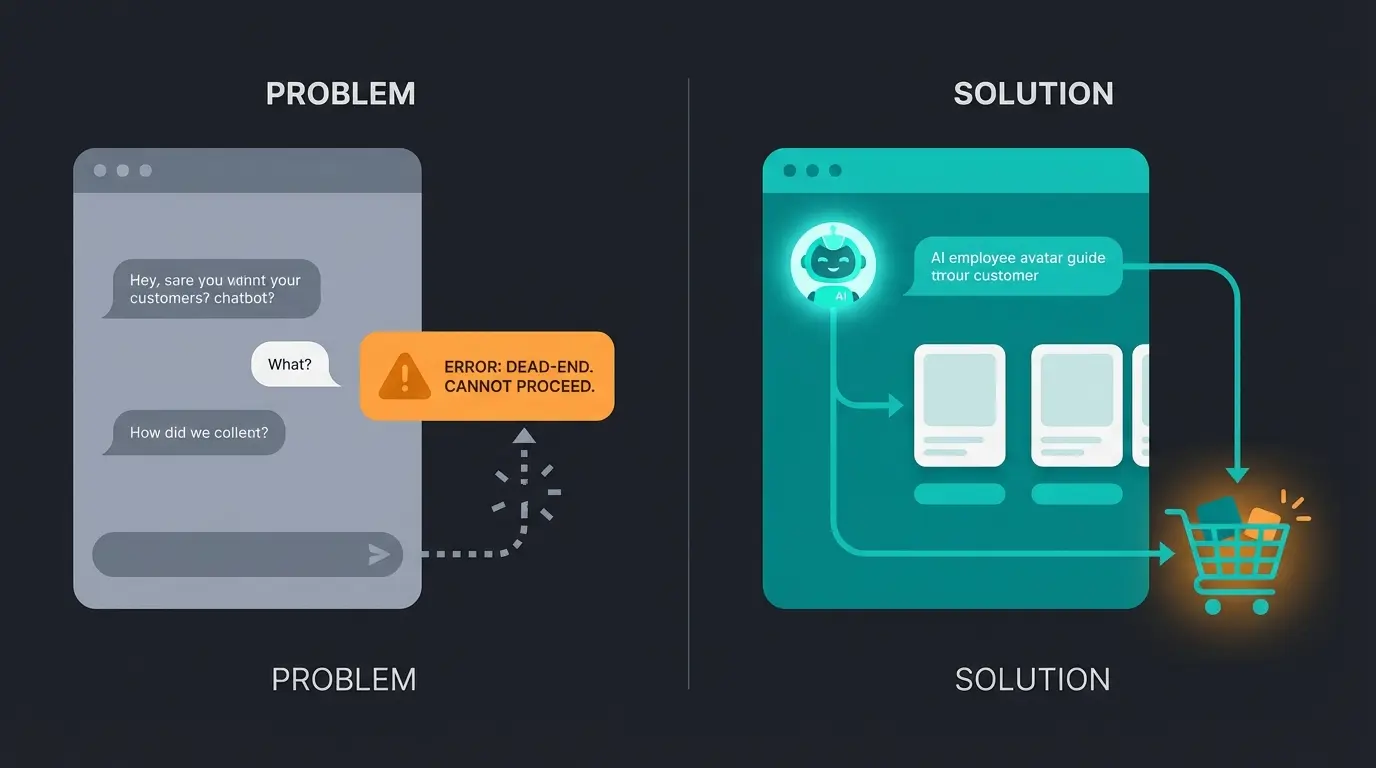
The evolution from chatbot to AI agent to AI employee mirrors the shift from automated FAQ pages to autonomous digital team members. Each generation solves the previous one's core limitation: chatbots added conversation to static FAQs, AI agents added autonomy to conversation, and AI employees added product expertise and revenue impact to autonomy.
Script-driven FAQ automation. 20-30% resolution rate without escalation. Primary metric: cost reduction through ticket deflection
NLP and LLM-driven conversation with tool usage. Up to 65% resolution without human intervention. Primary metric: workflow automation efficiency
Autonomous product consultants with persistent memory and revenue goals. Up to 100% automation rate (Rasendoktor). Primary metric: revenue generated per interaction
McKinsey identifies AI agents as "the next frontier of generative AI," estimating that agentic AI powers over 60% of AI's value generation in marketing and sales. The evolution of chatbot technology has been rapid: from rigid scripts to systems that can reason, plan, and act on behalf of users. As of Q2 2026, the industry has moved beyond the binary chatbot-vs-agent debate. AI employees represent the current frontier, purpose-built for e-commerce businesses where product consultation directly drives revenue.
By 2028, Gartner predicts 60% of brands will use agentic AI for streamlined one-to-one interactions. The question is no longer whether to adopt AI-powered customer interaction, but at which tier to invest. For e-commerce SMEs with consultation-intensive products, the third tier delivers the clearest ROI.
AI employee in action: real results
AI employees deliver measurable revenue impact that neither chatbots nor basic AI agents can match. Rasendoktor, a lawn care e-commerce company, deployed an AI employee that achieved a 16x return on investment and 100% automation of product consultations, results impossible with a traditional chatbot or generic AI agent.
Rasendoktor receives 2,000-3,000 consultation-intensive inquiries during peak season. Their AI employee Hektor handles every webchat inquiry automatically, delivering precise product recommendations 24/7 while considering regional soil conditions and seasonal factors. The result: 40% reduction in support costs while maintaining expert-level consultation quality. That is not ticket deflection, it is genuine product advisory at scale. Read the full Rasendoktor case study.
Signed, an online retailer for custom decorative signs, deployed AI employee Alex across Instagram and TikTok. Alex automated 70% of customer inquiries on social media and achieved an 18x ROI with 30% increase in upselling. The AI employee transformed social media interactions into targeted sales opportunities, a capability that no chatbot and no generic AI agent provides. See the full Signed success story.
Return on investment from AI product consultation
Return on investment from social commerce AI employee
Webchat inquiries handled without human intervention (Rasendoktor)
Cross-sell and upsell revenue lift (Signed)
Which solution is right for your business?
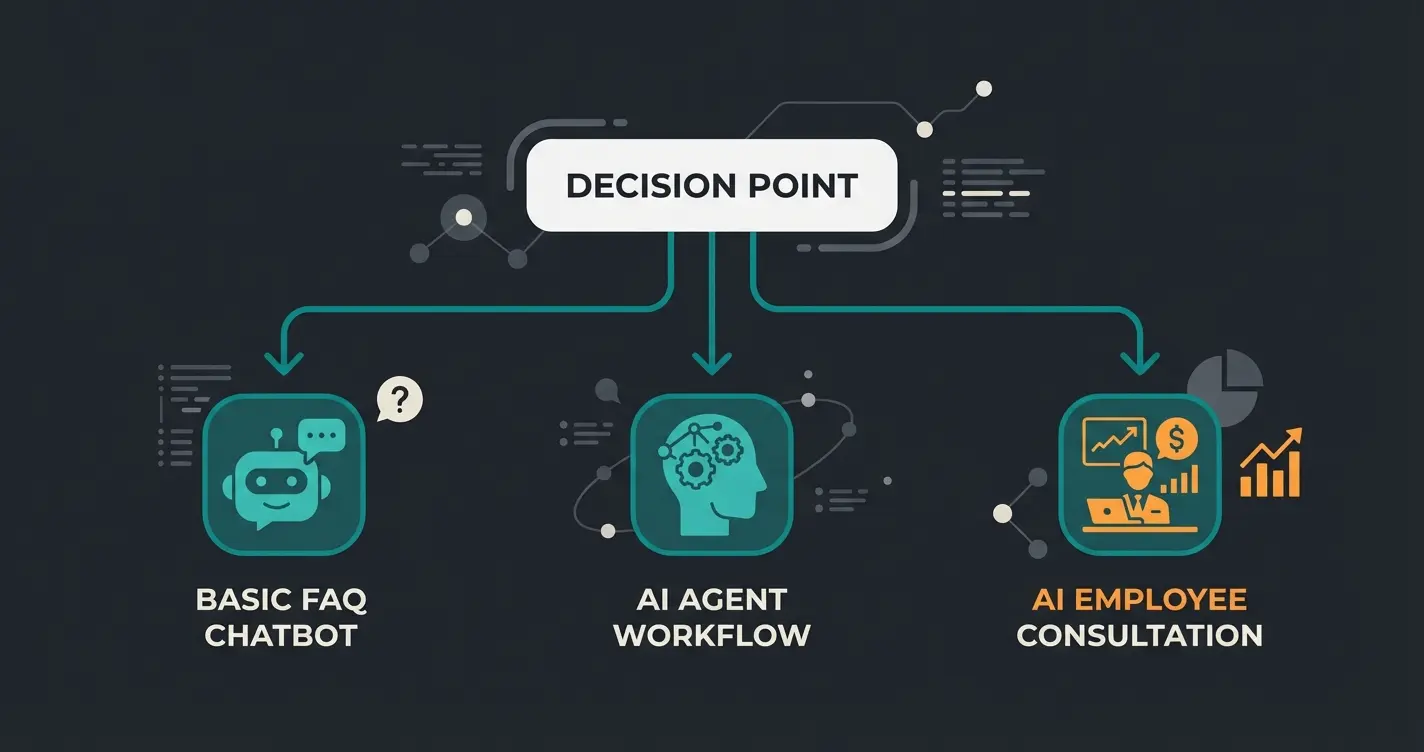
Choose a chatbot for simple FAQ automation under 100 monthly support tickets. Choose an AI agent for multi-step workflow automation across internal tools. Choose an AI employee when you sell consultation-intensive products, have 3,000+ monthly visitors, and want to increase revenue per customer, not just deflect support tickets.
| Your situation | Best fit | Why |
|---|---|---|
| Under 100 monthly support tickets, simple products | Chatbot | Low volume does not justify advanced automation. A chatbot handles FAQ queries cost-effectively |
| Internal workflow automation (CRM, ERP, scheduling) | AI Agent | AI agents excel at connecting systems and automating multi-step internal processes |
| Consultation-intensive products, 3,000+ monthly visitors | AI Employee | Product expertise and customer memory directly increase revenue per visitor |
| Social commerce (Instagram, TikTok, WhatsApp) | AI Employee | Cross-channel presence with persistent context turns social interactions into sales |
| High cart abandonment, low conversion despite traffic | AI Employee | Guided product consultation reduces abandonment and increases checkout rates by up to 60% |
The investment decision also depends on where you want to see ROI. Chatbots save support costs. AI agents save process time. AI employees generate revenue. For SMEs in e-commerce with consultation-intensive products, the math favors AI employees: when your average customer needs guidance before purchasing, every visitor your AI employee converts is direct incremental revenue.
A common concern across all three tiers: trust and accuracy. Chatbots are predictable but rigid, so they rarely hallucinate but also cannot adapt. AI agents carry the risk of LLM-generated errors when handling open-ended tasks. AI employees mitigate this through domain-specific training and citation features, where every product recommendation references the actual catalog data that backs it. Leading platforms also offer GDPR-compliant European hosting and configurable guardrails that prevent hallucination on critical specifications like dosage, compatibility, or regulatory requirements.
Deployment timelines vary significantly across tiers. Chatbot platforms launch in hours with pre-built templates. AI agents require weeks to months for custom workflow design and system integration. AI employee platforms like Qualimero offer a done-for-you approach: days from kickoff to live deployment, with the vendor handling product data ingestion, training, and channel setup. Starting with webchat and expanding to WhatsApp and social media afterward is the fastest path to measurable results.
Explore how AI customer service works in practice, or see what AI product consultation looks like for your specific product category. Both approaches complement each other: customer service automation handles the reactive queries, while product consultation drives the proactive revenue generation.
FAQ
ChatGPT is a conversational AI assistant, not a true AI agent. It generates text responses based on prompts but cannot autonomously plan multi-step tasks, use external tools, or take actions in connected systems. An AI agent can update your CRM, process a refund, or schedule a delivery. ChatGPT can only describe how those actions would work.
According to IBM, there are five main types: simple reflex agents, model-based reflex agents, goal-based agents, utility-based agents, and learning agents. For e-commerce, learning agents with goal-based capabilities are the most relevant, as they improve over time and pursue specific business objectives like increasing cart value.
Not by upgrading. Chatbots and AI agents are architecturally different. A chatbot processes conversation turns within pre-set rules. An AI agent orchestrates multi-step workflows using reasoning, planning, and tool usage. Gartner emphasizes that adding task specialization capabilities evolves AI assistants into AI agents, but this requires rebuilding, not patching.
An AI employee is an AI agent specialized for customer-facing e-commerce work. It adds persistent customer memory, deep product catalog expertise, and revenue-generating capabilities to the standard AI agent toolkit. While a generic AI agent automates internal workflows, an AI employee conducts product consultations, recommends items, and processes orders. Qualimero clients report 16x-18x ROI from this specialization.
Chatbot platforms typically cost EUR 50-500 per month for basic FAQ automation. AI employee solutions are SaaS subscriptions priced based on interaction volume and integration depth. The key metric is ROI, not subscription cost: Qualimero clients report 16x-18x returns, meaning the AI employee generates far more revenue than it costs.
With a done-for-you service approach, deployment takes days rather than months. The main variables are integration complexity with existing platforms (Shopware, Shopify, WooCommerce), catalog size, and number of channels. Starting with webchat and expanding to WhatsApp and social media afterward is the fastest path to measurable results.
An AI employee turns your visitors into buyers. Qualimero clients see 16x-18x ROI, +35% cart value, and +60% checkout rates. See what an AI employee would do in your shop.
Book a demo
Kevin is CTO and co-founder of Qualimero. As an AI architect with over 15 years of experience as CTO and CPO in the tech industry, he designs the AI systems that automate tens of thousands of customer interactions daily for Qualimero's clients — reliably, securely, and at scale.