The 'Free' Trap and How to Escape It
It's 2026, and the search for an open source ERP is more tempting than ever for German businesses. The promises sound fantastic: No license fees, complete control over the source code, and a community driving innovation faster than any corporation. However, for many CEOs and IT managers in Germany, the dream of a 'free ERP' often ends in a nightmare of warnings, missing interfaces, and exploding consultant costs.
Why does this happen? Because most 'Top 10 ERP Lists' you find on Google make a critical mistake: They ignore the German market entirely.
An American open-source system may be technically brilliant, but if it doesn't offer GoBD-compliant record locking or can't generate a DATEV export for your tax advisor, it's practically worthless for a German GmbH. More than that: it's a liability risk. According to muchconsulting.com, many businesses discover these compliance gaps only after implementation.
Your advantage with this guide: We don't simply list software. We analyze the open source ERP landscape of 2026 specifically through the German lens. We answer the questions that static comparison portals cannot answer for you:
- Is the 'Community Edition' actually legally usable in Germany?
- What are the actual costs (TCO) after hosting and customization?
- Which system fits your business model?
What Makes an ERP 'Germany-Ready'? The Compliance Foundation
Before we compare Odoo, ERPNext, or Dolibarr, we must define the criteria where American and Asian software often fails. When you search for 'open source ERP deutsch', these three pillars must be firmly established.
1. GoBD Compliance: More Than Just a Buzzword
The Grundsätze zur ordnungsmäßigen Führung und Aufbewahrung von Büchern (GoBD) – Principles for Proper Management and Storage of Books – is the sword of Damocles hanging over every German accounting system. An ERP system must ensure that bookings are immutably locked.
The Problem: Many open source solutions allow subsequent deletion or modification of journal entries in their default configuration. This is often acceptable in the USA ('Draft Mode'), but in Germany, it leads to the rejection of your bookkeeping by the tax authorities.
The Requirement: The system must have an 'Audit Trail' and may only allow changes through reversal bookings once a period is closed.
2. The DATEV Interface: Your Tax Advisor's Best Friend
In Germany, the absolute majority of tax advisors use DATEV. An ERP system that cannot export data in DATEV format (CSV/XML) causes massive manual overhead costs.
The Reality Check: If your free ERP has no DATEV interface, you'll pay double and triple the saved money in accounting costs because your tax advisor has to manually type every invoice. Look for support for SKR03 and SKR04 chart of accounts.
3. GDPR and Data Sovereignty
Open source offers a huge advantage here: You can operate the system on your own servers (on-premise) or with a German cloud host (e.g., Hetzner, IONOS). This avoids the issues with the US CLOUD Act that often cause headaches with proprietary SaaS solutions (like NetSuite or Salesforce).
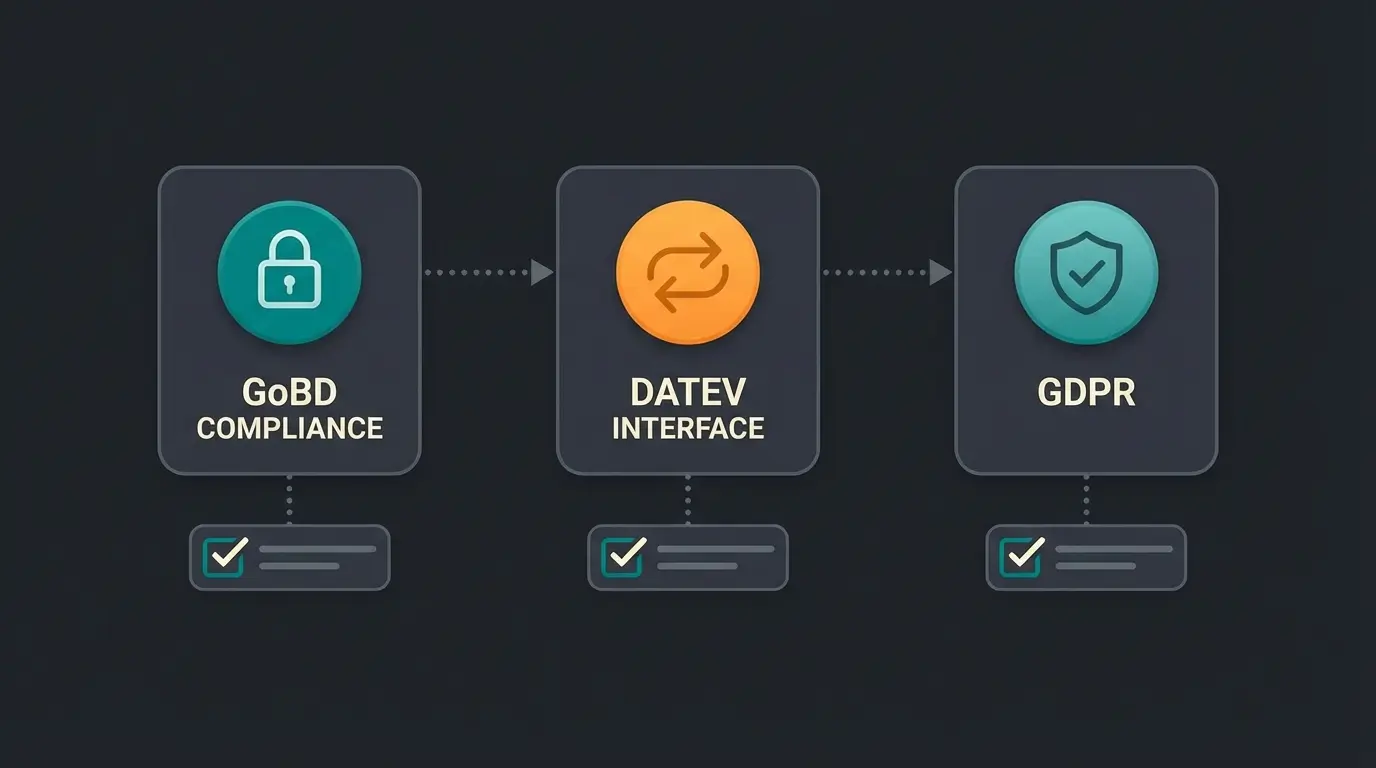
All German businesses must maintain immutable financial records
Integration is essential for seamless tax reporting
Average cost of bookkeeping rejection by tax authorities
Top 5 Open Source ERP Systems Tested (2026 Edition)
Based on the releases from late 2025 and early 2026 (Odoo 19, ERPNext v16, Dolibarr v22), we have analyzed the most relevant players for the German market.
1. Odoo (Version 19) – The Market Leader with a 'But'
Odoo ERP is undisputedly the market leader. With Version 19 (released late 2025) and the upcoming Version 20 (expected Fall 2026), Odoo sets standards in UX and AI integration. As noted by ksolves.com, the new features significantly enhance business automation capabilities.
Overview: Odoo impresses with its modular app concept. CRM, e-commerce, warehouse, and accounting work seamlessly together. The interface is as modern as an iPhone.
German Suitability (High/Medium):
- Enterprise Edition: High. Odoo 18/19 Enterprise is certified according to IDW PS 880 and GoBD-compliant. According to intero-technologies.de, it contains native DATEV exports and Elster interfaces.
- Community Edition: Low. The full accounting module is missing here. Without third-party apps, the free version is hardly usable for balance sheet-obligated companies in Germany.
Hidden Costs: The Community Edition is license-free, but to make it 'Germany-ready,' you often need paid modules from providers like syscoon or equitania, or you must upgrade to the paid Enterprise version.
Conclusion: The best choice for companies willing to pay for comfort or those with strong internal developers. Much like how AI Employee Kira streamlines operations, Odoo Enterprise can transform your business processes.
2. ERPNext (Version 16) – The 100% Open Source Rebel
ERPNext is considered the most serious 'true' open-source alternative to Odoo. Version 16 (released January 2026) brings massive performance boosts through a new caching layer and improved UI. As reported by frappe.io, the new version significantly improves manufacturing workflows.
Overview: Unlike Odoo, there's no 'Open Core' model here. The entire code – including accounting, HR, and manufacturing – is 100% open source (GPL license). According to dexciss.io, it's particularly strong in manufacturing and offers a very clean structure.
German Suitability (Medium/High):
- The community (especially the ERPNext German Community) is very active.
- There are apps for DATEV XML/CSV Export (e.g., from alyf or tueit) that are actively maintained. As documented on github.com and alyf.de, these integrations continue to improve.
- GoBD compliance is possible through 'Immutability' settings but requires correct configuration.
USP: No license costs per user. You only pay for hosting or support. Ideal for companies with many employees where Odoo licenses would become expensive.
3. Metasfresh – The Hidden Champion 'Made in Germany'
While other systems operate globally, metasfresh comes from Germany (Bonn) and is a fork of the legendary ADempiere. It explicitly targets mid-market companies and wholesale trade. As detailed on metasfresh.com, the system is specifically designed for German business requirements.
Overview: Metasfresh is less of a 'toolkit' and more of a 'high-performance machine.' It specializes in mass data processing, wholesale, and fresh-food logistics.
German Suitability (Very High):
- Since it's developed in Germany, GoBD, SKR03/04, and DATEV are part of its DNA, not just plugins. As confirmed by metasfresh.org, native compliance is a core feature.
- It's updated weekly and validated by Fraunhofer IML.
Disadvantages: The learning curve is steeper than with Odoo. The UI is functional but less 'playful.'
Conclusion: The best choice for German wholesale businesses with €10M+ revenue that don't want to pay license fees.
4. Dolibarr (Version 22) – The Favorite for Freelancers
With Version 22 (released Winter 2025/2026), Dolibarr has stabilized its WebPortal and modernized the UX. According to nextgestion.com, the new version brings significant usability improvements.
Overview: Dolibarr is modular like Odoo but technically less complex (PHP-based). It runs on any cheap shared hosting.
German Suitability (Medium):
- There are active German modules for GoBD (immutability of logs) and extended accounting, as detailed by syscoon.com.
- By default, it's more of an 'invoicing program with CRM' than an enterprise ERP. For balance sheet-obligated GmbHs, it's often too 'light'; for EÜR filers (freelancers), it's perfect.
Hidden Costs: Almost none. Hosting costs €5/month. This makes it an excellent free ERP option for solopreneurs.
5. Tryton – The Stable Foundation for Developers
Tryton (Release 7.8, December 2025) is a framework on which you build ERPs, as explained on tryton.org.
Overview: Very lean, very stable, Python-based. It has no unnecessary features and is extremely modular.
Suitability: Only for companies with their own IT department or a specialized service provider. If you're looking for 'out of the box,' this isn't for you. But if you want to build a customized process for 20 years, this is the right choice.
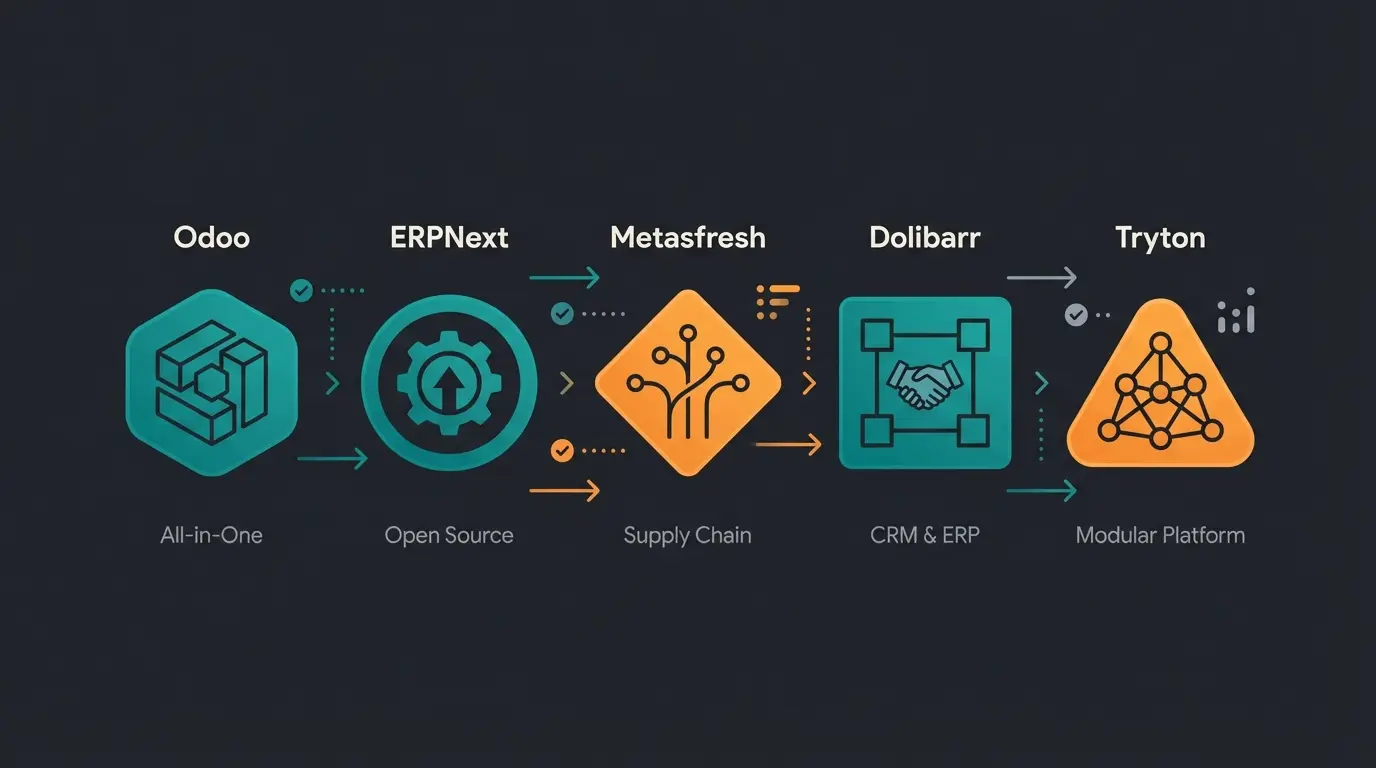
Odoo vs. ERPNext vs. Dolibarr: The Direct Comparison
Here you can see at a glance how the systems perform in the critical German categories. This comparison helps you choose the right open source ERP for your specific needs.
| Feature | Odoo (Enterprise) | Odoo (Community) | ERPNext (v16) | Metasfresh | Dolibarr (v22) |
|---|---|---|---|---|---|
| License Model | Annual Fees | Open Source (LGPL) | 100% Open Source (GPL) | 100% Open Source (GPL) | 100% Open Source (GPL) |
| Target Audience | SME to Enterprise | Tech-Savvy Startups | Mid-Market / Manufacturing | Wholesale / Food | Freelancers / Small SME |
| GoBD Out-of-Box | ✅ Yes (Certified) | ⚠️ No (Plugin needed) | ⚠️ Configuration needed | ✅ Yes (Native) | ⚠️ Module needed |
| DATEV Export | ✅ Native | ❌ Third-party App | ✅ Third-party App | ✅ Native | ✅ Third-party Module |
| Usability (UI) | ⭐⭐⭐⭐⭐ (Top) | ⭐⭐⭐⭐ | ⭐⭐⭐⭐ | ⭐⭐⭐ (Functional) | ⭐⭐⭐ (Simple) |
| Hosting | Cloud / On-Premise | Self-Hosted | Cloud / Self-Hosted | Cloud / Self-Hosted | Shared Hosting OK |
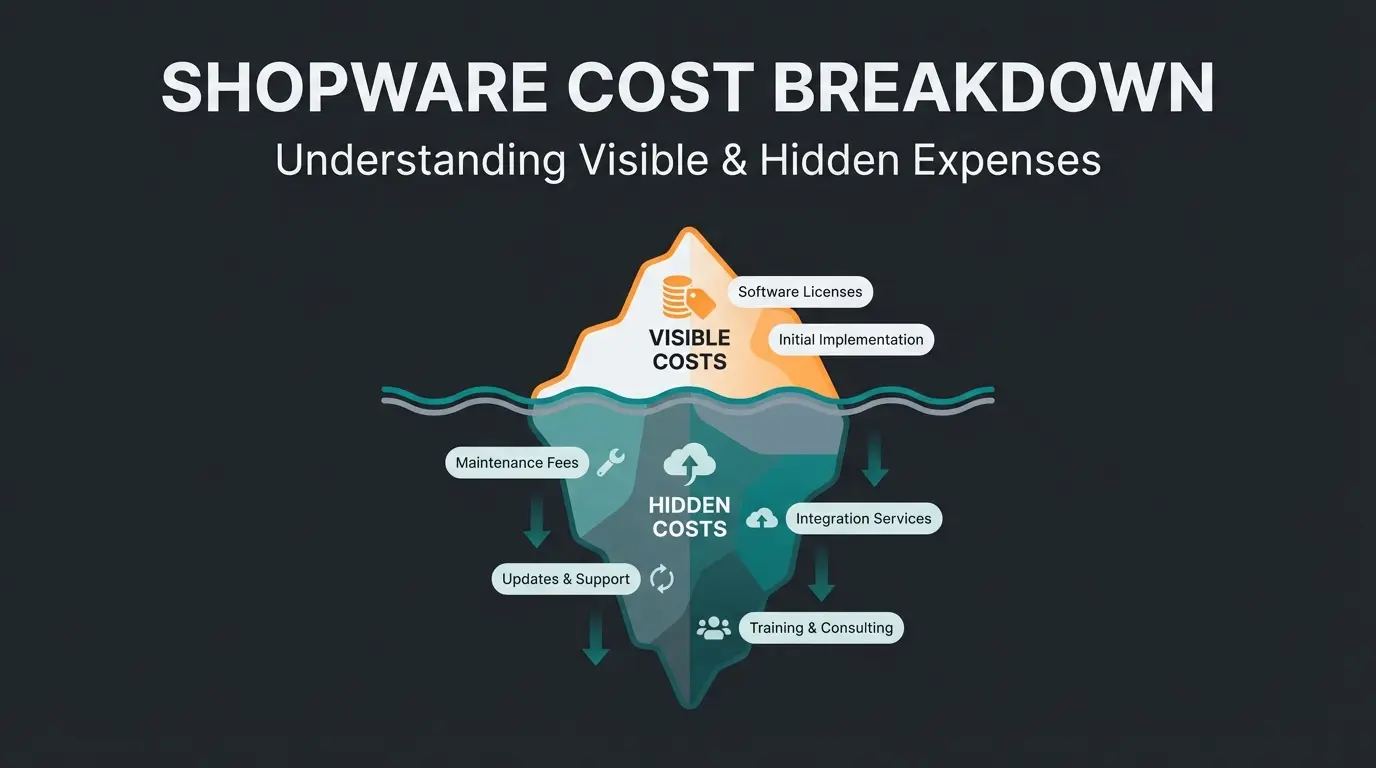
The 'Hidden' Costs of Free ERP Software
As an experienced implementation partner, we often see customers who select software based only on license costs. This is a fatal mistake. An open source ERP is like a 'free' plot of land: You pay nothing for the ground, but you have to build the house yourself.
Here's the reality of the cost structure (Total Cost of Ownership):
1. Implementation & Configuration (The Biggest Block)
An ERP doesn't install itself. You must:
- Map chart of accounts (SKR03/04).
- Customize letterhead and invoice layouts (mandatory information!).
- Define workflows (What happens when goods are missing?).
Costs: Expect 3 to 10 days of external consulting or internal work. At an hourly rate of €120, that quickly adds up to €3,000 - €10,000. This is where solutions like AI product consultation can help streamline the decision-making process.
2. Hosting & Maintenance
Odoo and ERPNext need server resources (RAM/CPU).
- Shared hosting (€5/month) is often insufficient for Odoo/ERPNext (Java/Python processes). You need a VPS.
- Costs: approximately €20 - €50 per month for managed hosting + backups.
3. Updates & Migration
The year 2026 brings Odoo 20 and ERPNext v17. Who performs the update?
- Open source updates are often complex (database migrations).
- Risk: If you've customized the core code, the update will 'crash.'
- Solution: Use Docker to cleanly separate environments and document every customization.
€0 for Community Edition (but €30-50/user/month for Enterprise)
€3,000-€10,000 for configuration, data migration, and training
€1,000-€5,000 for GoBD/DATEV modules and compliance setup
€240-€600/year for VPS, backups, and maintenance
€1,000-€3,000/year for updates, bug fixes, and consulting
Stop guessing about implementation expenses. Our AI consultant analyzes your specific business requirements and provides accurate cost projections for each ERP option – including German compliance modules.
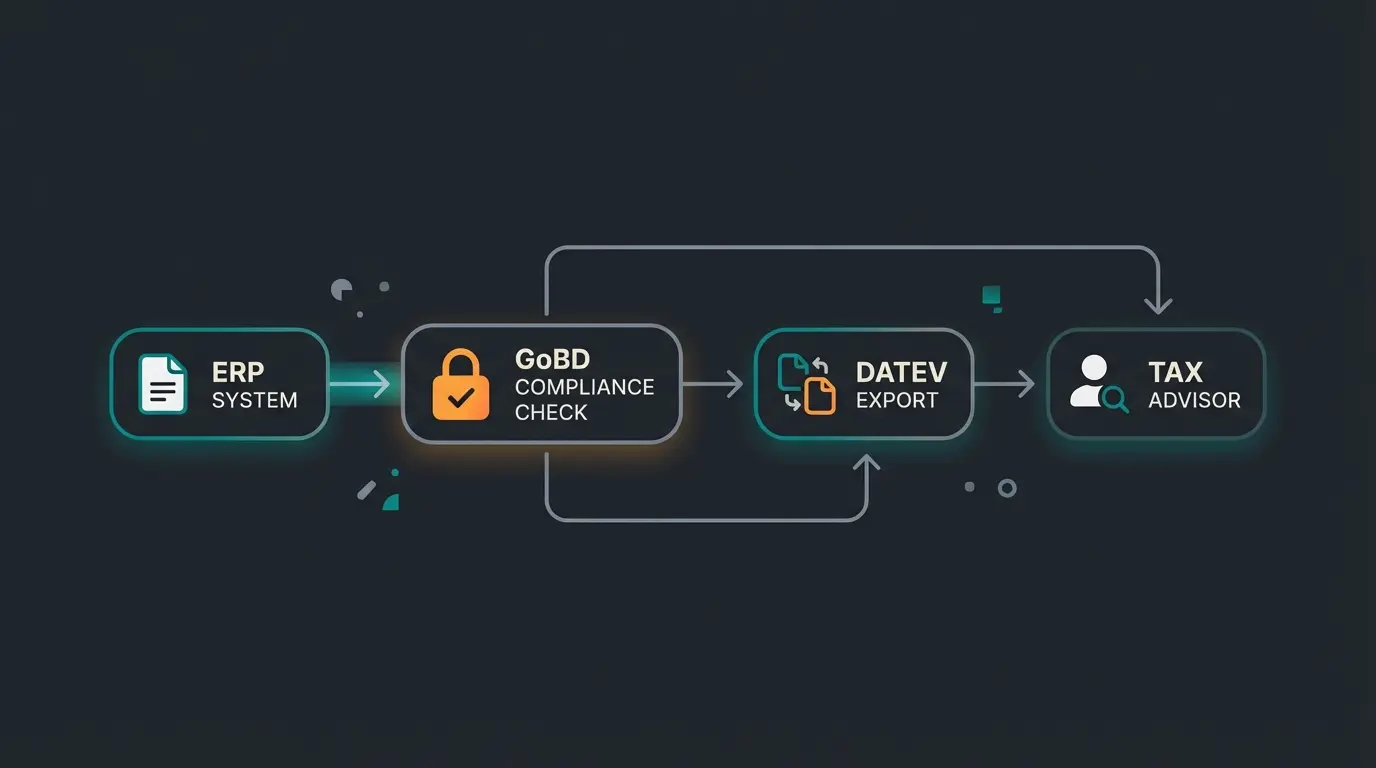
Get Your Free Cost AnalysisGoBD & DATEV: Why American ERPs Fail in Germany
In our research, we've seen that many US lists recommend tools like Apache OFBiz or xTuple. Caution! These systems don't understand German VAT advance returns.
The 'Record Locking' Problem (The Implementation Trap)
Many systems allow users to simply edit a posted invoice to correct a typo.
- Germany: Forbidden! A posted invoice must be canceled and recreated.
- The Fix: In ERPNext and Odoo, you must set the permission management so strictly that 'Delete' and 'Cancel' are deactivated for normal users after posting. Look for the 'Immutable Ledger' setting.
The DATEV Workflow
Your tax advisor doesn't want PDF invoices. They want a structured data set (posting batch) that links document image and posting record.
- The Fix for Odoo Community: Use modules like the DATEV Export from the Odoo Community Association (OCA).
- The Fix for ERPNext: Install the DATEV Integration App from the Frappe Marketplace. As documented on frappe.io, this allows export of debtors/creditors in DATEV format.
How to Choose: A Consultative Framework
Instead of counting features, look at your business scenario. Which profile are you? This approach is similar to how AI Chat solutions help customers find the right products through intelligent questioning.
Scenario A: The Solo-Preneur or Small Service Provider
Profile: You sell services, write 20 invoices per month, use cash-basis accounting (EÜR).
Recommendation: Dolibarr.
Why? It's overkill to set up Odoo for 3 invoices. Dolibarr is fast, simple, and immediately ready with the 'EÜR' module. It's the perfect free ERP for getting started.
Scenario B: The E-Commerce Startup (Growth!)
Profile: Shopify/WooCommerce shop, 5-20 employees, warehouse management needed.
Recommendation: Odoo (Enterprise) or ERPNext.
Why? You need strong connectors to DHL, Shipstation, and Shopify. Odoo is the market leader here. If budget is tight: ERPNext has excellent integrations 'out of the box.' For product consultation needs, AI-powered solutions can complement your ERP setup.
Scenario C: Classic Mid-Market / Manufacturing
Profile: 50+ employees, manufacturing, own servers, strict compliance requirements.
Recommendation: Metasfresh or ERPNext.
Why? License costs matter massively here. Metasfresh is built for high volume. ERPNext offers a fantastic manufacturing module (BOM, Workstations) for free – something you'd pay millions for at SAP. Much like how AI Employee Theresa handles complex care coordination, ERPNext can manage intricate manufacturing workflows.
Average savings vs. proprietary solutions over 5 years
Consider open source for their next ERP implementation
Faster deployment with pre-configured German modules
Total investment for a mid-sized German company
Conclusion & Next Steps
The market for open source ERP in Germany is more mature than ever in 2026. With Odoo 19 and ERPNext v16, you have tools at your disposal that functionally compete with SAP or Microsoft Dynamics – at a fraction of the cost.
However, 'open source' means freedom, not 'free beer.' The investment shifts from licenses to knowledge and configuration.
Summary of Recommendations:
- Choose Metasfresh if you're in wholesale and want 'German-First.'
- Choose Odoo Enterprise if you have budget and want the best UX.
- Choose ERPNext if you seek maximum freedom and feature variety without license costs.
- Choose Dolibarr if you want to stay small and agile.
ERP Startup Checklist
- Is the chart of accounts SKR03 or SKR04 available?
- Is there an export for DATEV (CSV/XML format)?
- Are bookings immutably locked (Immutable)?
- Is the data stored on servers in the EU (GDPR)?
- Is there a local service provider for emergencies?
The decision-making process can feel overwhelming, much like how healthcare providers felt before implementing solutions like AI Assistant Sophie. The right technology partner makes all the difference.
Frequently Asked Questions About Open Source ERP
The software license is free, but you'll invest €3,000-€10,000+ in implementation, German localization modules (GoBD, DATEV), hosting, and ongoing maintenance. The total cost of ownership is significantly lower than proprietary solutions, but 'free' refers only to the license, not the complete solution.
Metasfresh offers the best out-of-box GoBD compliance as it's developed in Germany specifically for the German market. Odoo Enterprise is also certified (IDW PS 880) but requires a paid license. ERPNext and Dolibarr require additional configuration or third-party modules for full compliance.
Technically yes, but it's challenging. The Community Edition lacks the full accounting module and native DATEV export. You'll need third-party apps (costing €1,000-€5,000) from providers like syscoon or equitania to make it compliant. For balance sheet-obligated companies, Enterprise or ERPNext is often more economical.
A basic implementation takes 2-4 weeks for small businesses and 2-6 months for mid-sized companies with complex requirements. This includes data migration, German localization, user training, and workflow configuration. Using Docker and proper documentation can significantly speed up future updates.
ERPNext is 100% open source with no paid 'Enterprise' tier – all features including manufacturing are free. Odoo has a freemium model where critical features (like proper accounting) require the paid Enterprise version. ERPNext needs DATEV plugins; Odoo Enterprise includes them natively. ERPNext is often better for companies with many users due to no per-user licensing.
Making the right ERP choice is similar to how companies approach hiring – you want the perfect fit. Just as an AI recruiter can streamline finding the right candidates, the right ERP consultation can match you with the perfect system for your needs.
Why spend hours with Excel comparisons? Our AI Product Consultant asks you 5 targeted questions about your business and instantly generates a customized ERP architecture recommendation including hosting plan and plugin list for Germany.
Start Your Free AI ERP Audit

Lasse is CEO and co-founder of Qualimero. After completing his MBA at WHU and scaling a company to seven-figure revenue, he founded Qualimero to build AI-powered digital employees for e-commerce. His focus: helping businesses measurably improve customer interaction through intelligent automation.