Key Insights Before We Dive In
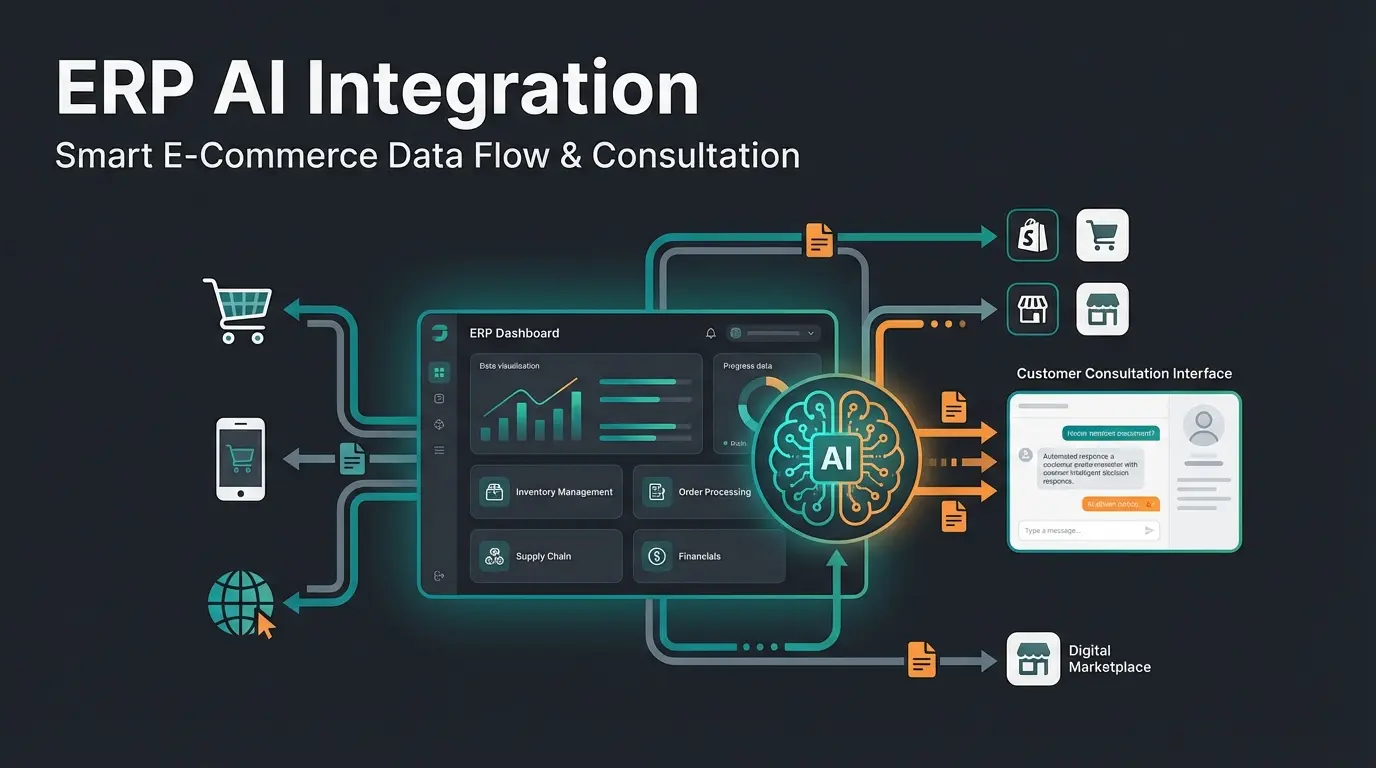
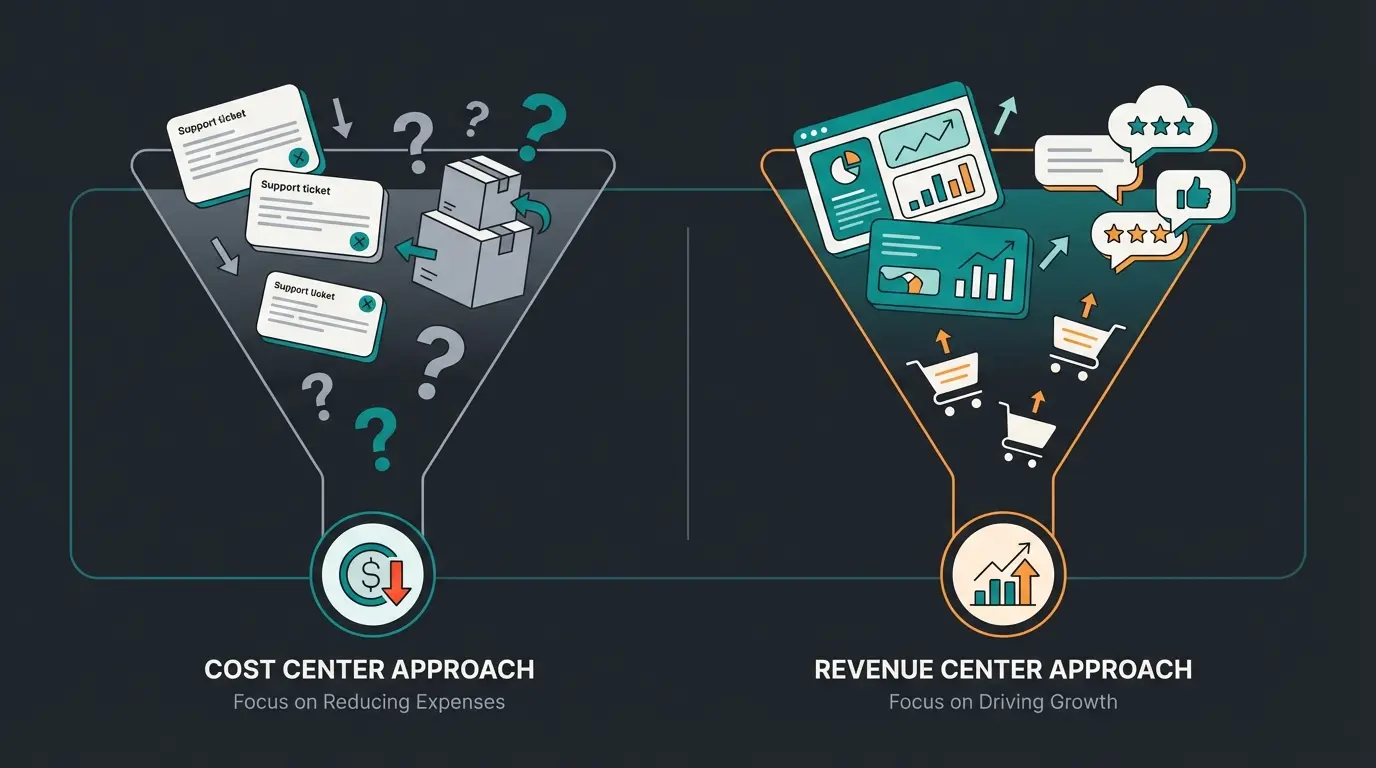
Paradigm shift in e-commerce: The traditional Shopify helpdesk is evolving from a pure cost center to a revenue driver. While classic ticket systems reactively solve problems, modern AI solutions proactively act as sales consultants, fundamentally changing how AI Customer Service delivers value.
AI acceptance is skyrocketing: Data from Adobe shows that traffic from generative AI to retail sites increased by an astounding 4,700% year-over-year in July 2025. Customers are increasingly using AI for product research, not just complaints.
The conversion gap is closing: While AI traffic previously converted poorly, the conversion rate of AI-assisted visitors now nearly matches traditional sources. According to research from HelloRep.ai, AI chats can increase conversion rates by 4x.
German market specifics: The German market operates differently. Data protection (GDPR) and efficiency come first. According to Going.International, 88% of German customers expect problem resolution within 15 minutes. At the same time, skepticism toward "dumb" chatbots is high, and expectations for competent, near-human consultation are rising.
The Untapped Revenue Lever in Customer Support
Imagine walking into a physical store. You're looking for running shoes but unsure about your pronation type. You look around. No one is there to advise you. Only in the back, behind a counter labeled "Returns," sits someone waiting for you to bring back a shoe. Would you buy from this store? Probably not.
Yet this is exactly how most Shopify stores operate today. They invest massively in traffic (ads, SEO), then leave customers alone with the product catalog. The "support" is often just a Shopify helpdesk designed to handle problems after the purchase – "Where is my package?" or "How do I return this?"
In 2025, this is no longer enough. The e-commerce market is saturated, and Customer Acquisition Costs (CAC) are rising. The solution isn't more traffic—it's better utilization of existing visitors. This is where the crucial difference between a classic ticket system and AI-powered product consultation comes into play, transforming how AI Chatbots transform customer interactions.
This article is your comprehensive guide. We'll analyze not only the best Shopify support apps like Gorgias or Zendesk but also show you why you need to shift your strategy from "processing tickets" to "advising customers" to stay competitive in the market.
What Is a Shopify Helpdesk (And What Is It Missing?)
To understand why we need an evolution in support, we must first define the status quo.
The Definition: The Classic Ticket System
A Shopify helpdesk (or ticket system) is software that consolidates customer inquiries from various channels (email, live chat, social media) in one central location. The goal is efficiency and organization.
The core functions are typically:
- Centralization: Emails, Instagram DMs, and chat messages land in one inbox.
- Shopify Integration: The support agent sees the customer's order data (order history) alongside the message.
- Automation (Macros): Pre-written responses for common questions like "Where is my order?" (WISMO - Where Is My Order).
The Support Trap: Reactive Instead of Proactive
The problem with these systems isn't their functionality—they do exactly what they were built for: management. They're optimized to close tickets as quickly as possible.
Gap analysis of current market leaders reveals a clear picture:
- Focus on Post-Purchase: 90% of features revolve around problems after the purchase (returns, shipping status).
- Cost Focus: Support is seen as a necessary evil that generates costs. The goal is cost reduction through automating standard responses.
- Lack of Consultation Competence: A classic ticket system cannot sell. When a customer asks: "Which moisturizer suits my combination skin?" a standard macro cannot provide an intelligent answer.
The result: You have efficient complaint management but lose revenue daily because ready-to-buy customers can't find consultation in your shop and abandon their carts.
The Evolution: From FAQ Bot to AI Product Consultant
We're in the middle of a technological revolution. Until recently, "automation" in support meant simple decision trees (If customer clicks X, show text Y). Today, we're talking about Generative AI and how AI Agents evolve into sophisticated sales assistants.
Static Chatbots vs. Generative AI
The difference is dramatic and often decides between purchase and abandonment.
| Feature | Static Chatbot (The "Clerk") | Generative AI (The "Consultant") |
|---|---|---|
| Technology | Rule-based (If/Then), Keywords | Large Language Models (LLM), Semantic Understanding |
| Context | Often doesn't understand context ("I don't understand the question") | Understands nuances, sarcasm, and complex questions |
| Knowledge | Limited to pre-programmed FAQs | Knows the entire product catalog and its attributes |
| Goal | Avoid ticket / send link | Guide customer to the right product |
| Example | Customer: "Do you have anything for dry skin?" Bot: "Here's a link to our skincare category." | Customer: "Do you have anything for dry skin?" AI: "Yes, for dry skin I recommend our 'Hydro-Boost' series with hyaluronic acid. The night cream is particularly popular. Would you like me to explain the difference to the day cream?" |
Why This Matters Now: 2025 Data and Facts
Acceptance of AI in the shopping process is exploding. According to Adobe Analytics, traffic from generative AI sources to retail sites has increased massively. Customers are actively using AI for research.
Companies using AI chatbots see 4x higher conversion rates (12.3% vs 3.1%)
Customers who interact with AI and return spend 25% more on average
McKinsey estimates generative AI can unlock up to $390 billion in retail value
According to research from HelloRep.ai, the conversion boost is remarkable, while Code-B highlights McKinsey's estimate that generative AI could unlock massive value in retail through personalized consultation.
This means: Anyone still relying on pure FAQ bots is ignoring the behavior of modern consumers who expect a conversation and consultation before they buy. Understanding AI capabilities is essential for staying competitive.
Top 5 Shopify Helpdesk and Support Apps: Market Overview
To make an informed decision, you need to know the "big players." These tools excel at what they do—but they have different focus areas. Here's an analysis of the top solutions for 2025, categorized by their primary benefit.
1. Gorgias – The E-Commerce Specialist
Best for: Automating order-related inquiries (Post-Purchase).
Gorgias is the dominant player in the Shopify ecosystem. It's deeply integrated, allowing support agents to process, cancel, or refund orders directly in the chat.
- Advantages: Extremely deep Shopify integration, recognizes customer intents (Intent Detection), strong macro functions.
- Disadvantages: The pricing model is based on "Billable Tickets." Every response counts, which can quickly become expensive at high volumes according to Eesel.ai. AI features often cost extra.
- Verdict: Perfect for clearing your back with logistics questions, but primarily an administrative tool.
2. Zendesk – The Enterprise All-Rounder
Best for: Large companies with complex requirements beyond e-commerce.
Zendesk is the giant among ticket systems. It can do everything but is often "overkill" for pure Shopify merchants.
- Advantages: Endless customization options, omnichannel (phone, email, chat, social), very detailed reporting as noted by Tidio.
- Disadvantages: Expensive, complex setup, often feels "sluggish." The Shopify integration is good but not as seamless as Gorgias.
- Verdict: If you have 50+ support agents and also offer phone support, Zendesk is the standard. Learn more about AI Selling revolutionizing traditional support approaches.
3. Shopify Inbox – The Free Entry Point
Best for: Startups and small shops with low volume.
Shopify Inbox is the in-house solution. It's free and directly integrated into the admin area.
- Advantages: Free, immediately ready to use, shows customer cart contents as highlighted by RendrHQ.
- Disadvantages: Very rudimentary. No real ticket management, hardly any automation, no advanced AI consultation.
- Verdict: Good for getting started, but not scalable.
4. Tidio – The SMB Solution with Chatbot Focus
Best for: Small to medium shops that want simple chatbots.
Tidio is known for its ease of use and focus on chatbots ("Lyro" AI).
- Advantages: Affordable entry point, visual chatbot builder, solid AI responses to FAQs as noted in Eesel.ai's comparison.
- Disadvantages: Integration with Shopify isn't as deep as Gorgias (e.g., order management in chat is more difficult).
- Verdict: A good intermediate solution for shops wanting automation without an enterprise budget.
5. AI Product Consultation – The Revenue Generator
Best for: Product consultation, sales enablement, and revenue growth.
This is where AI product consultation solutions position themselves. While other tools primarily manage tickets, AI consultation tools are designed to generate sales.
- USP: Uses generative AI to recommend products based on customer needs, instead of just sending links to policies.
- Focus: Pre-purchase consultation. The AI acts like an experienced salesperson in the store.
- Verdict: The necessary complement (or alternative) to the classic helpdesk when the goal is growth. See how KI Produktberatung compares to traditional approaches.
Stop losing revenue to unanswered product questions. Our AI consultation tool transforms browsers into buyers with intelligent, personalized recommendations.
Start Free TrialComparison Table: Support vs. Consultation Strategy
Many merchants ask: "Do I need a helpdesk OR AI consultation?" Often the answer is: You need both, or a tool that shifts the focus. This table clarifies the strategic difference and shows how AI in customer service can deliver cost savings while driving revenue.
| Feature | Classic Helpdesk (e.g., Zendesk/Gorgias) | AI Product Consultation (Sales AI) |
|---|---|---|
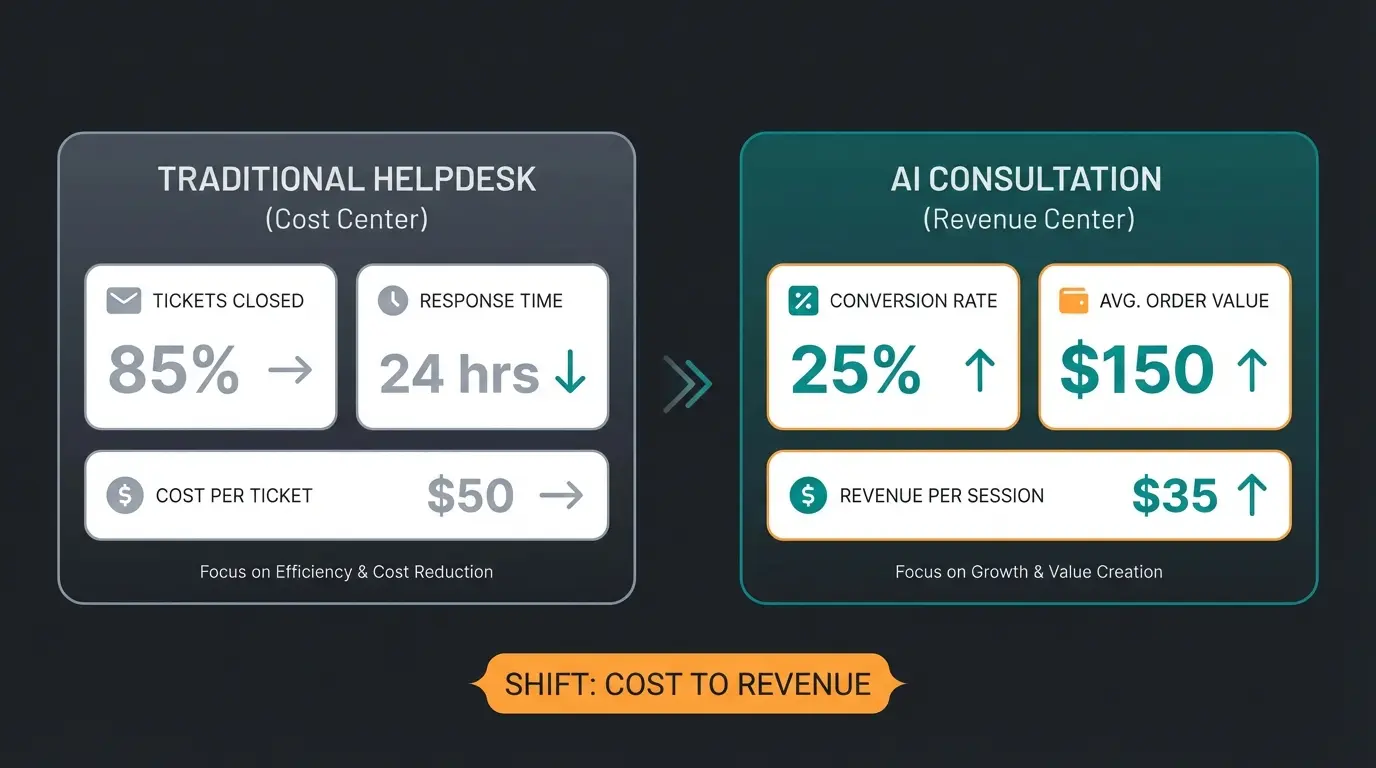
| Primary Goal | Reduce ticket volume, increase efficiency | Increase conversion rate, boost cart value |
| Timing | Mostly after purchase (Post-Purchase) | Mostly before purchase (Pre-Purchase) |
| AI Capability | "Smart Answers" for FAQs (shipping, returns) | Generative consultation ("Which product suits me?") |
| Customer Feeling | "I'm being processed" (Administration) | "I'm being understood" (Consultation) |
| ROI Metric | Cost per Ticket (reduce costs) | Revenue per Session (increase revenue) |
| Data Usage | Order history & tracking data | Product attributes, customer preferences, user behavior |
The strategic gap: Most shops are over-optimized in the left area (helpdesk) but leave massive potential untapped in the right area (consultation).
German Market Specifics: What DACH Merchants Must Know
The German e-commerce market is one of the most demanding worldwide. What works in the US can fail in Germany. When implementing a helpdesk for Shopify or an AI solution, the following points are non-negotiable for the DACH region (Germany, Austria, Switzerland).
1. Data Protection and GDPR Compliance
In Germany, data protection isn't a "nice-to-have"—it's a knockout criterion.
- Server Location: German customers and data protection officers prefer hosting in the EU.
- Transparency: Chatbots must be clearly identified as such.
- WhatsApp: WhatsApp is the most popular messenger in Germany (over 80% usage) according to Going.International. But be careful: Using the regular WhatsApp Business App is often not GDPR-compliant, as metadata (phone book) is synchronized. For professional support, the WhatsApp Business API through a certified provider is mandatory to remain GDPR-compliant according to TimelinesAI and Heydata.
2. The Service Desert and High Expectations
German customers are critical. According to Olark, 71% still perceive Germany as a "service desert."
- Speed: 88% expect a solution within 15 minutes.
- Quality over Fake Empathy: German customers hate it when a bot pretends to be human but then answers stupidly. They prefer an honest AI ("I'm a digital assistant") that delivers precise and factually correct answers.
- Efficiency: Small talk is less important than a correct, fast answer according to Callnovo.
3. Trust in AI Technology
Interestingly, Germans are more skeptical of AI than Britons or Americans (only 65% trust AI information vs. 80% in UK/US) according to NIM Research.
- However: In specific situations, like objective advice, almost 40% of Germans prefer AI to human advice because they don't feel "judged" (e.g., with sensitive products) according to MeinBavaria.
- Strategy: Your AI must radiate competence. It must not hallucinate. Fact-based consultation (based on your product data) is the key to trust.
Strategy: Support as Revenue Driver (Revenue Center)
How do you transform your support from a cost center into a money-making machine? Here's the battle plan for 2025, incorporating AI prevention strategies to reduce costs while driving revenue.
Step 1: Separate Service from Sales
Analyze your tickets.
- Are 80% questions like "Where is my package?" -> Here you need automation (Gorgias, Zendesk, tracking tools).
- Are 20% questions like "Does this part fit my bike?" or "What size do I need?" -> These are sales leads! They shouldn't die in a ticket system queue.
Step 2: Implement Pre-Purchase AI
Deploy an AI trained on your product catalog. It must be present on product pages (PDP), not just on the "Contact" page. See how AI employee Flora demonstrates this approach in action.
- Scenario: A customer lingers for 30 seconds on an expensive coffee machine.
- Action: The AI opens proactively: "Not sure if this machine suits your coffee beans? I can explain the difference to Model X."
- Result: You catch the customer at the moment of uncertainty and guide them to purchase.
Separate post-purchase logistics questions (80%) from pre-purchase product questions (20%)
Implement AI trained on your catalog, positioned on product pages—not just contact pages
Store customer preferences from AI conversations for personalized marketing campaigns
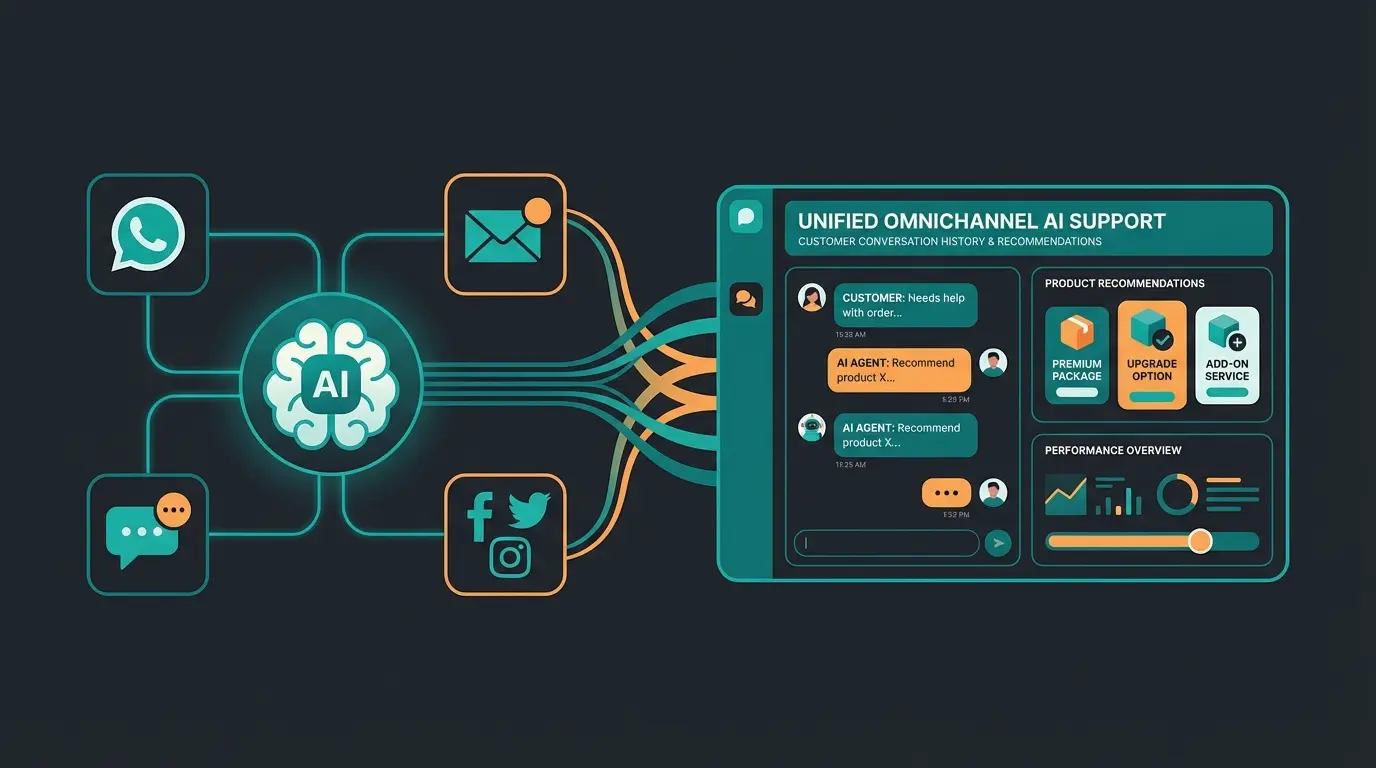
Integrate WhatsApp API and other channels where customers prefer to engage
Step 3: Use Data for Personalization
A ticket system stores complaints. An AI consultant stores preferences.
If the AI knows the customer has "dry skin" (from the chat), this information can be used for future marketing campaigns (Klaviyo integration). This massively increases Customer Lifetime Value (CLV).
Step 4: Omnichannel for the German Market
Offer support where Germans are. Integrate WhatsApp (via API) for quick inquiries. An AI can also handle the initial contact here and qualify before a human takes over.
Conclusion: The Future Belongs to Consultation
The term "Shopify helpdesk" is actually outdated. It implies that customers need help with problems. In reality, customers need help with decisions.
The tools of the past (Zendesk, Freshdesk) solved the problem of "ticket management." The tools of the future (Generative AI) solve the problem of "conversion optimization."
Summary:
- If you only want to efficiently process returns, use Gorgias or Zendesk.
- If you have a small budget, start with Shopify Inbox.
- If you want to scale your shop and convert visitors into buyers, you need AI product consultation that understands your customers and actively sells.
The market in 2025 no longer forgives poor service. But it rewards excellent, fast, and precise consultation with high loyalty and full shopping carts.
Are you ready to transform your support from a cost factor into a revenue driver?
Frequently Asked Questions About Shopify Helpdesk
A traditional Shopify helpdesk focuses on managing post-purchase inquiries like shipping status, returns, and complaints. It's designed to close tickets efficiently—a cost center approach. AI product consultation, on the other hand, focuses on pre-purchase engagement, actively guiding customers to products that match their needs. It transforms support from a cost center into a revenue driver by increasing conversions and average order values.
For small stores with limited budgets, Shopify Inbox offers a free starting point with basic chat functionality. However, it lacks advanced automation and AI capabilities. Tidio provides a good middle ground with affordable plans and simple chatbot builders. If your goal is not just support but also increasing sales, consider AI consultation tools that can recommend products and guide purchasing decisions from day one.
Gorgias is specifically built for e-commerce and offers deeper Shopify integration, making it ideal for stores focused on automating order-related inquiries. Zendesk is more versatile and suits larger enterprises with complex, multi-channel requirements beyond e-commerce. However, both tools primarily focus on post-purchase support—if pre-purchase consultation is your priority, you'll need a complementary AI solution.
GDPR compliance is critical for German e-commerce. Your helpdesk solution must offer EU-based server hosting, clear bot identification, and proper data processing agreements. If you're using WhatsApp for support, the standard WhatsApp Business App isn't GDPR-compliant—you need the WhatsApp Business API through a certified provider. Always verify where customer data is stored and processed before implementation.
Yes, significantly. Research shows that companies using AI chatbots see conversion rates 4x higher than those without (12.3% vs. 3.1%). Additionally, customers who interact with AI and return spend approximately 25% more on average. The key is deploying generative AI that can understand customer needs and recommend products, not just basic FAQ bots that send generic links.
Join leading e-commerce brands using AI product consultation to boost conversion rates and customer satisfaction. See the difference intelligent selling makes.
Get Started Free