Introduction to AI in Human Resources
The integration of artificial intelligence in human resources is rapidly gaining importance. According to current figures from the Federal Statistical Office, 12% of German companies already use AI technologies, with large enterprises at 35% adopting AI significantly more frequently than small and medium-sized enterprises at 10-16%.
The skills shortage (Fachkräftemangel) is the number one pain point driving German companies to seek AI solutions in HR. With HR departments stretched thin handling administrative tasks, strategic workforce planning often takes a back seat. This is precisely where AI transforms the game—not just by answering questions, but by providing genuine consultation.
AI-powered HR processes are based on various technologies such as Machine Learning, Natural Language Processing, and Computer Vision. These technologies enable the automation of routine tasks and data-driven decision-making in human resource management. However, the real breakthrough lies in moving beyond simple automation to intelligent consultation.
The AI integration in the HR sector offers numerous advantages: process optimization, cost reduction, and improved employee experience. At the same time, challenges arise such as data protection, ethical questions, and the necessary competency development of HR employees. Understanding these dynamics is crucial for successful implementation.
The Evolution: FAQ Chatbots vs. AI Consultants
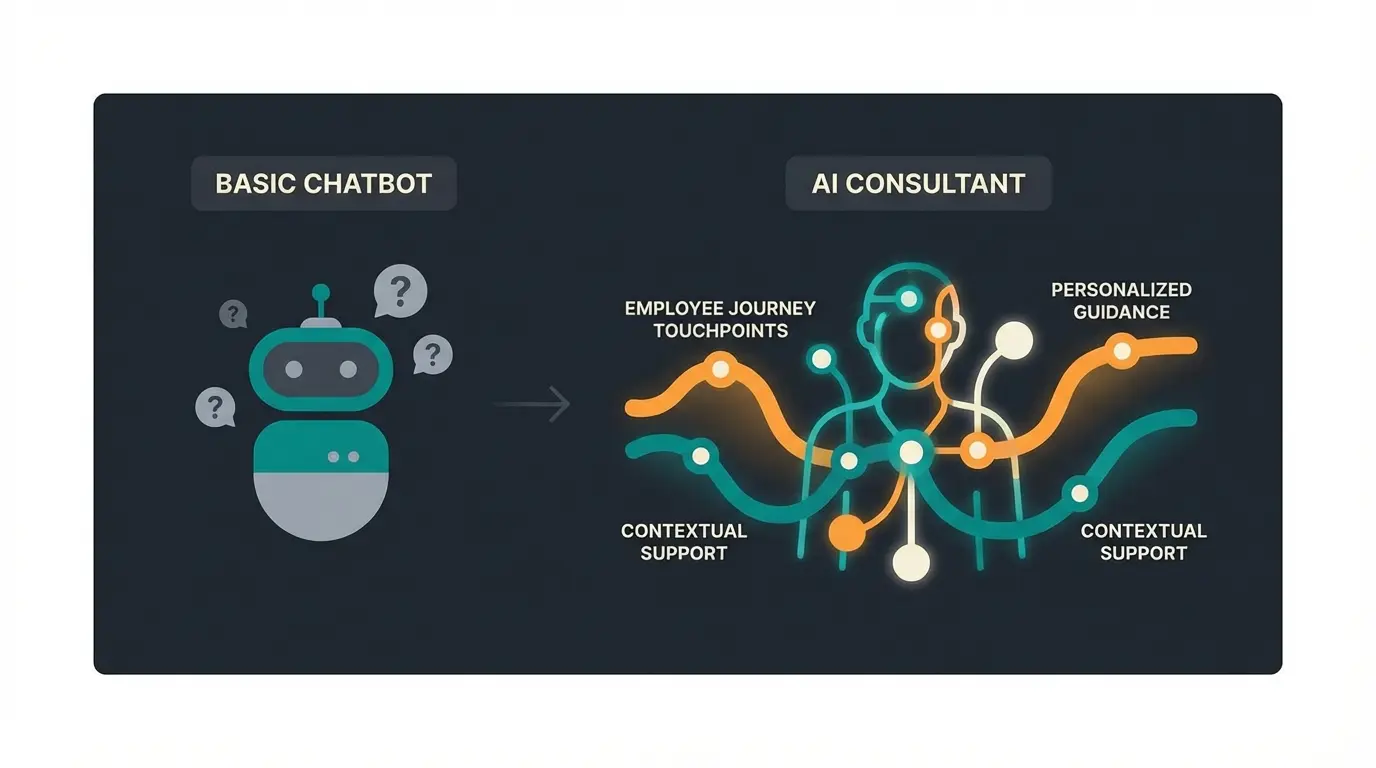
Understanding the distinction between first-generation FAQ bots and second-generation AI consultants is essential for making informed technology decisions. This evolution represents a fundamental shift in how AI supports both HR teams and employees.
| Feature | Gen 1: Rule-Based Chatbots | Gen 2: AI Consultants |
|---|---|---|
| Context Understanding | None - keyword matching only | Deep understanding of user intent and situation |
| Handling Complexity | Single-step queries only | Multi-layered problems with follow-up questions |
| Response Type | Links to documents or fixed answers | Personalized guidance based on individual circumstances |
| User Satisfaction | Often frustrating, leads to ticket escalation | High satisfaction through relevant, contextual support |
| Knowledge Base | Static, manually updated FAQs | Dynamic access to all company documents via RAG |
| Example Interaction | 'Here is the travel policy PDF' | 'Did you travel by train or car? Based on your contract type, here's your specific refund process' |
The key differentiator lies in how these systems retrieve and present information. While Gen 1 chatbots rely on keyword matching and pre-programmed responses, Gen 2 AI consultants use Retrieval Augmented Generation (RAG) to access company documents, understand the employee's specific context, and synthesize personalized advice. This addresses the 'Black Box' problem—employees understand where the information comes from and why it applies to their situation.
Current State: Where Does AI in HR Stand Today?
Before diving into specific applications, it's important to distinguish between the two main types of AI transforming HR processes. This distinction helps organizations choose the right tools for their specific needs.
Discriminative AI excels at classification and sorting tasks. In HR, this means screening CVs, ranking candidates based on qualifications, and identifying patterns in employee data. These systems answer the question: 'Which category does this belong to?'
Generative AI creates new content and enables consultation. This includes writing job advertisements, generating personalized learning recommendations, and providing contextual employee support. These systems answer the question: 'What should I create or advise based on this input?'
German companies currently using AI technologies
Significantly higher adoption in companies over 250 employees
Companies citing lack of expertise as main implementation obstacle
Organizations facing technical integration challenges
The Four Pillars of AI-Driven HR Transformation
AI transformation in human resources spans four critical areas, each offering unique opportunities for automation and enhancement. Understanding these pillars helps organizations prioritize their AI investments strategically.
Pillar 1: Recruiting Automation
In recruiting, the potential of AI is particularly evident. The current Recruiting Report 2024 confirms that 34% of companies already have positive experiences with AI-supported personnel selection. The AI-powered application analysis enables fast and objective pre-selection of suitable candidates.
Intelligent matching uses advanced algorithms to compare applicant profiles with job requirements. This reduces manual effort and increases the hit rate in candidate selection. The automated candidate communication through AI chatbots ensures fast response times and constant availability.
However, the focus shouldn't solely be on quantity—screening 1,000 CVs quickly. The real value lies in delivering quality interactions. AI can engage candidates in meaningful conversations, answer their questions about company culture, and provide transparency about the hiring process, creating a positive candidate experience from first contact.
- Automated CV screening with bias detection capabilities
- AI-generated job advertisements optimized for target audiences
- Intelligent candidate matching based on skills and cultural fit
- 24/7 chatbot communication for candidate queries
- Predictive analytics for candidate success probability
Pillar 2: Personnel Development (The Consultative Approach)
AI-based learning platforms enable personalized training offerings that are tailored to the individual needs and learning behavior of employees. The AI analyzes competencies and identifies development potential. This results in precise career path prognoses that provide orientation for both employees and the company.
This is where the consultative approach truly shines. Instead of simply presenting a catalog of available courses, an AI consultant analyzes the employee's current skill set, compares it against their career goals and industry trends, and recommends specific learning paths. The conversation might go: 'Based on your project management experience and interest in data analytics, here are three development paths that align with our upcoming digital transformation initiatives.'
Skill gap analysis becomes proactive rather than reactive. The AI identifies emerging skill requirements in the market, maps them against the current workforce capabilities, and suggests targeted interventions before the gaps become critical business issues.
Pillar 3: HR Service and Support (The Hero Section)
This pillar represents the most significant opportunity for differentiation through consultative AI. Automated document processing through AI significantly accelerates administrative processes. Workflows are intelligently controlled and optimized. AI-powered chatbots answer employee questions about HR topics quickly and reliably, noticeably relieving the HR department.
But the real transformation happens when we move beyond simple Q&A. Consider this scenario: An employee asks about parental leave. A Gen 1 chatbot would respond with a link to the parental leave policy document. A Gen 2 AI consultant asks clarifying questions: 'Are you the birth parent or partner? What is your current contract type? Are you planning to take the leave consecutively or split it?' Based on the answers, it provides personalized guidance: 'Given your part-time contract and your plan to split the leave, here are your specific options and the steps you need to take.'
Pillar 4: Workforce Planning and Analytics
Modern AI systems open new dimensions of data analysis for human resources. Through advanced analytical methods, HR departments can make decisions based on well-founded insights. Predictive analytics enable more accurate forecasts of employee turnover and staffing needs.
- Predictive Analytics: Forecasting resignation probabilities and staffing requirements
- People Analytics: Evaluation of employee data to optimize HR processes
- Performance Tracking: AI-supported performance assessment and development potential analysis
- Skill Mapping: Automatic capture and assignment of employee competencies
- Churn Prediction: Early warning systems for flight risk employees
These analytical capabilities transform HR from a reactive function to a strategic partner. By identifying patterns in employee data, organizations can proactively address retention risks, optimize team compositions, and align workforce capabilities with future business needs.
Move beyond simple chatbots to intelligent employee consultation. See how AI can deliver personalized guidance while freeing your HR team for strategic work.
Request Your DemoLegal Framework and GDPR Compliance for HR AI
The legal aspects of using AI in HR processes are of fundamental importance. A current analysis by the Federal Statistical Office shows that 72% of companies cite uncertainties about legal issues as the main obstacle to AI implementation.
GDPR Compliance Requirements
Compliance with GDPR places special requirements on AI systems in human resources. Central points are the transparent processing of personal data and the right to human review of automated decisions. Companies must ensure that their AI systems meet these requirements.
Personal data must be particularly protected when processing through AI systems. This applies especially to applicant data in AI-supported recruiting processes, performance data in personnel development, and health data in occupational health management. The GDPR-compliant implementation stands at the forefront of every HR AI initiative.
- Transparency: Clear communication about the type and scope of AI usage
- Consent: Active agreement from employees for data processing
- Documentation: Complete logging of all AI-supported decisions
- Data Security: Encryption and access controls for AI systems
- Right to Explanation: Employees can request human review of AI decisions
The EU AI Act and High-Risk Classification
The EU AI Regulation sets new standards for the use of AI in human resources. HR professionals should monitor these developments and adapt their systems accordingly. Critically, recruiting AI is classified as 'High Risk' under the EU AI Act, which brings significant compliance obligations.
High-risk classification means organizations must implement robust risk management systems, ensure high-quality training data to minimize bias, maintain detailed technical documentation, provide transparency to affected individuals, enable human oversight capabilities, and meet accuracy and cybersecurity requirements.
Article 88 GDPR and § 26 BDSG (German Federal Data Protection Act) provide the specific legal framework for employee data processing. These regulations require that data processing serves legitimate employment purposes and that employee rights are protected throughout the AI-assisted process.
Works Council (Betriebsrat) Strategy
When integrating AI-supported HR systems, various labor law aspects must be observed. This particularly concerns the co-determination rights of the works council and the transparency of automated decisions. The introduction of AI systems often requires a works agreement that regulates the following points:
- Area of Application: Clear definition of AI-supported processes
- Data Protection: Regulations on data collection and storage
- Control: Definition of monitoring limits
- Co-determination: Involvement of employee representation
- Human Override: Clear escalation paths for contested decisions
Engage works council during AI evaluation phase, not after selection
Share AI capabilities, data usage, and decision-making processes
Co-create governance policies and escalation procedures
Allow works council to observe and provide feedback during pilots
Establish regular review meetings and adjustment mechanisms
Implementation Best Practices and Strategies
The successful integration of AI in HR processes requires a well-thought-out strategy. Studies on AI implementation show that structured approaches significantly increase the chances of success.
Data Readiness Assessment
You can't consult if your data and documents are messy. Before implementing AI consultation capabilities, organizations must assess their data readiness. This foundational step determines whether AI systems can access accurate, comprehensive information to provide reliable guidance.
The following checklist helps assess organizational readiness for AI implementation:
- Are policies digitized? All HR policies, procedures, and guidelines should exist in searchable digital formats
- Are documents text-searchable? PDFs and other documents must be OCR-processed for AI to read and understand them
- Is information current? Outdated policies lead to incorrect AI advice—establish update protocols
- Is the works council informed? Early engagement prevents implementation delays and builds trust
- Are data silos connected? AI consultants need access across systems to provide comprehensive guidance
Phased Implementation Approach
A step-by-step introduction of AI systems has proven to be particularly effective. Begin with individual pilot projects in clearly defined areas. Gather experience and systematically expand AI usage. Employee acceptance increases through positive experiences with smaller projects.
The most important success factors for implementation are:
- Analysis: Identification of suitable processes for AI support
- Pilot Phase: Testing in a limited area with clear success metrics
- Training: Intensive employee involvement and practical training
- Evaluation: Regular review of results against defined KPIs
- Optimization: Continuous adjustment of systems based on feedback
Change Management Excellence
Professional change management is the key to success. The basis for successful AI integration is the early involvement of employees. Studies on AI-supported HR work show that transparently communicated change processes significantly increase acceptance.
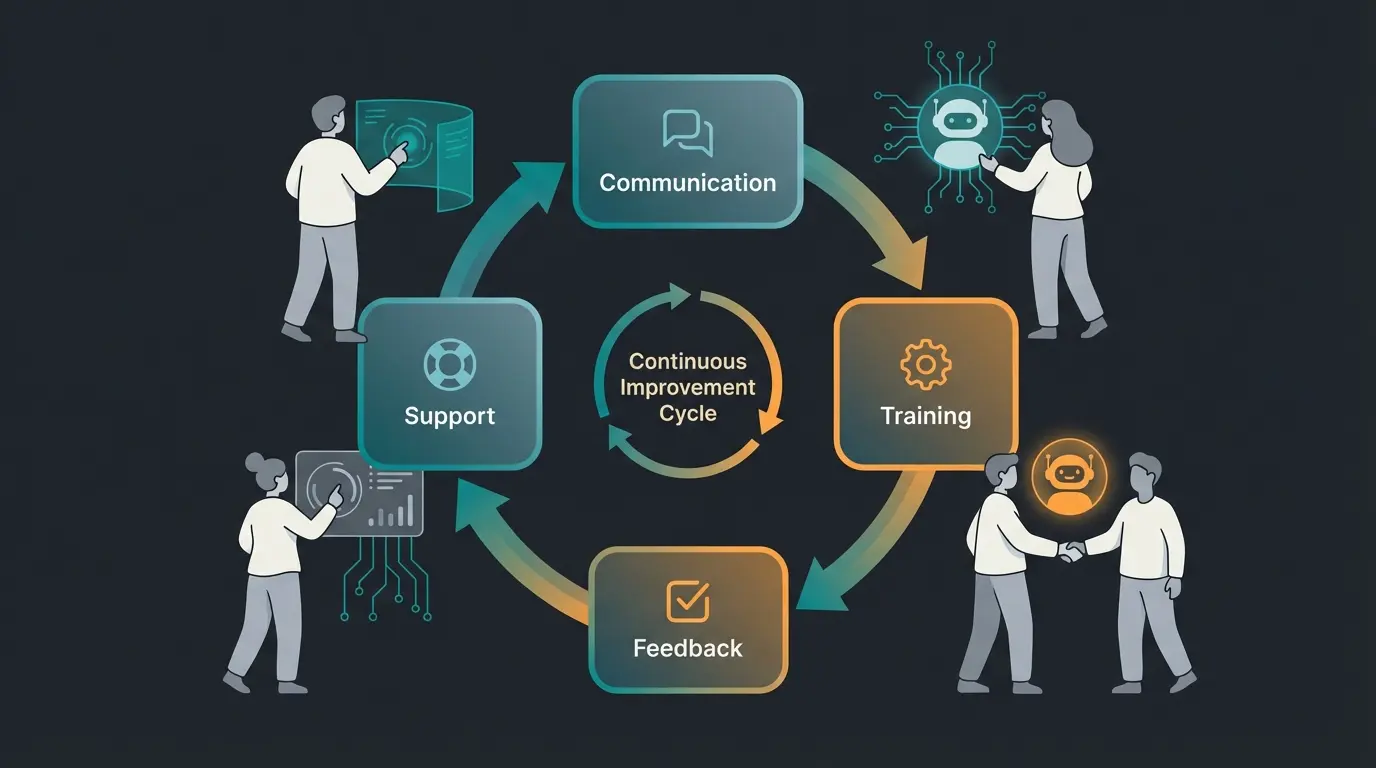
Modern change management concepts support successful introduction. An open communication about opportunities and limitations of AI systems is crucial. The following elements drive successful change:
- Training: Regular sessions for all users of AI systems covering both technical operation and understanding AI capabilities
- Communication: Transparent information about project goals, progress, and how AI decisions are made
- Feedback: Active involvement of employees in optimization—they're the experts on their daily workflows
- Support: Technical and professional assistance for questions, with clear escalation paths to human experts
Quality Assurance and Monitoring
Implement systematic monitoring of AI performance. Define clear KPIs and regularly check the quality of AI-supported processes. Pay particular attention to possible biases in the results.
Regular quality controls of AI systems are essential. The review of results by HR experts ensures that the systems work reliably and fairly. Key monitoring dimensions include response accuracy, user satisfaction scores, escalation rates, bias detection metrics, and compliance adherence.
Technical Integration Considerations
The integration into existing HR systems must be carefully planned. A smooth connection with existing databases and processes is crucial for success. Consider API compatibility, data synchronization requirements, security protocols, and user experience consistency across systems.
The Employee Journey with AI Support
Visualizing how AI consultants support employees throughout their entire journey helps organizations identify implementation priorities and measure impact across touchpoints.
AI screens applications, matches candidates, provides 24/7 chatbot communication, and schedules interviews automatically
AI consultant guides new hires through paperwork, answers policy questions, and provides personalized orientation paths
AI analyzes skill gaps, recommends learning paths, and provides career coaching based on individual goals
AI handles HR queries, processes requests, and provides contextual guidance on policies and benefits
AI manages exit processes, conducts preliminary exit interviews, and ensures compliance with departure procedures
Future Perspectives and Emerging Trends
The current developments show: AI will fundamentally change human resources. New technologies like Natural Language Processing and Machine Learning open further possibilities for the automation and optimization of HR processes.
Innovative AI Applications on the Horizon
Virtual reality for employee training, AI-supported career counseling, and automated skill analyses will play central roles. The personalization of HR services through AI will continue to increase.
Several emerging trends deserve attention: conversational AI that handles increasingly complex multi-turn dialogues, emotion recognition for understanding employee sentiment, predictive wellness programs that identify burnout risks, and AI-powered internal mobility platforms that match employees with opportunities across the organization.
The shift from transactional to consultative AI represents the most significant evolution. Organizations that embrace this shift will transform their HR functions from administrative cost centers to strategic value creators—handling routine inquiries automatically while empowering HR professionals to focus on high-impact work.
Frequently Asked Questions About AI in HR
No, AI augments rather than replaces HR professionals. AI handles routine, repetitive tasks like initial CV screening and answering common employee questions, freeing HR managers to focus on strategic work: complex employee relations, culture building, and organizational development. The human-in-the-loop principle ensures humans make final decisions on hiring, firing, and sensitive personnel matters.
Yes, when implemented correctly. GDPR requires transparency about AI usage, employee consent for data processing, the right to human review of automated decisions, and proper data security measures. Organizations must document AI decision-making processes and ensure employees can request explanations and human override of AI recommendations.
Engage early in the planning phase, not after implementation. Present AI as a tool that frees employees from tedious tasks rather than a monitoring mechanism. Co-develop governance frameworks, involve works council representatives in pilot programs, and establish clear escalation paths. Transparency about data usage and decision-making builds trust.
Traditional chatbots match keywords to pre-programmed responses and typically provide links to documents. AI consultants use Retrieval Augmented Generation (RAG) to read company documents, understand context, ask clarifying questions, and provide personalized advice based on the employee's specific situation, contract type, and circumstances.
Implementation timelines vary based on scope and data readiness. A focused pilot project (e.g., FAQ automation) can launch in 2-3 months. Comprehensive AI consultation systems typically require 6-12 months for full deployment, including data preparation, integration, testing, change management, and works council approval processes.
Move beyond basic automation to consultative AI that truly understands your employees' needs. Our solution integrates with your existing systems and complies with GDPR and EU AI Act requirements.
Start Your Free Trial
Lasse is CEO and co-founder of Qualimero. After completing his MBA at WHU and scaling a company to seven-figure revenue, he founded Qualimero to build AI-powered digital employees for e-commerce. His focus: helping businesses measurably improve customer interaction through intelligent automation.