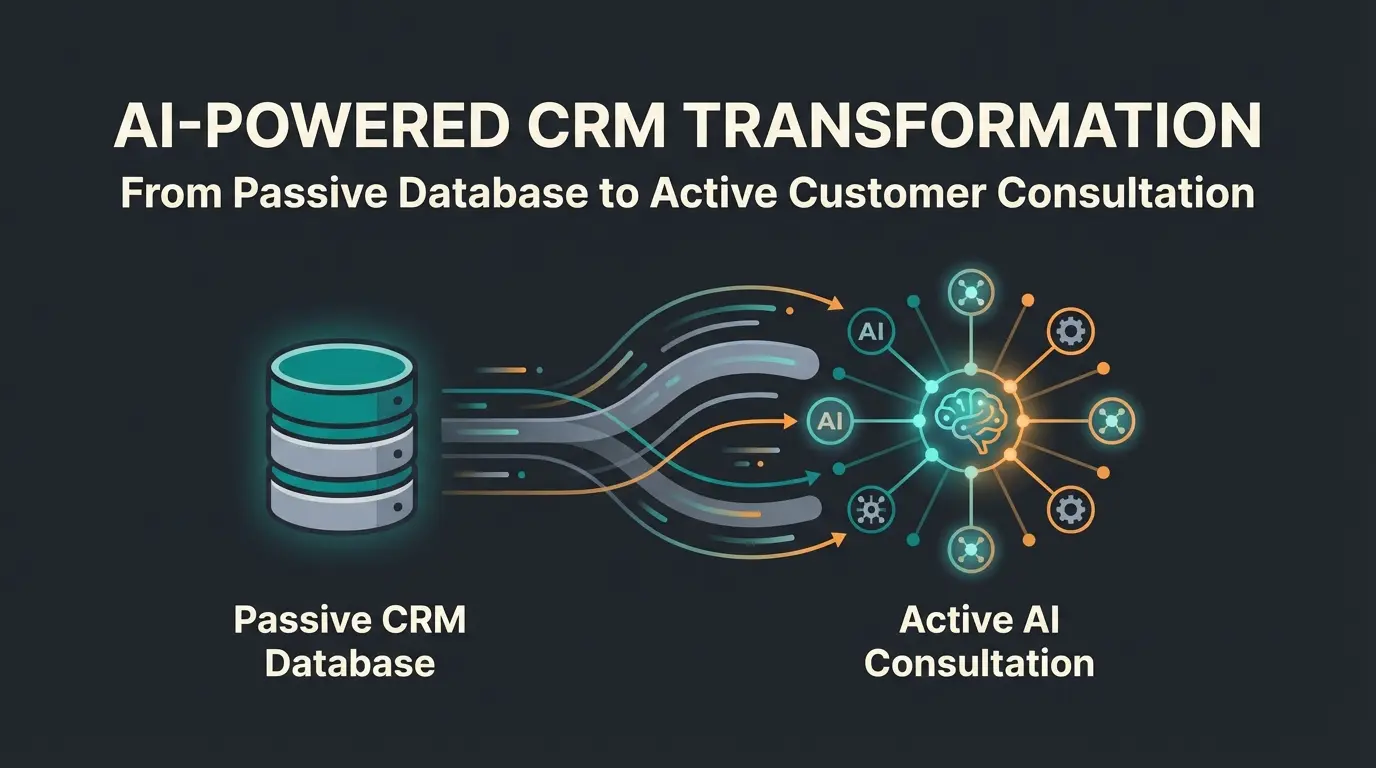
Key Takeaways at a Glance
When comparing Freshdesk vs Intercom, most articles reduce the decision to a simple binary: 'ticketing system vs live chat.' In reality, it's a choice between structured process management (Freshdesk) and expensive but modern user interaction (Intercom). According to SaaSPricePulse, Intercom's AI pricing model charges $0.99 per resolution—a figure that becomes economically unsustainable for consultation-intensive business models.
The AI cost trap represents one of the most significant hidden factors in this comparison. While Intercom's per-resolution pricing sounds fair initially, it punishes businesses that want meaningful, extended customer conversations. Freshdesk counters with session-based packages ($100 for 1,000 sessions), offering far more predictable budgeting as noted by Amplifying.ai.
From a German GDPR perspective, Freshdesk offers server locations in Frankfurt with easy selection during signup according to Freshdesk documentation. Intercom enables EU hosting (Dublin) only for new customers on expensive Advanced/Expert plans and doesn't allow migration of existing workspaces—a massive obstacle for established German companies as documented by eesel.ai.
The consultation gap remains the elephant in the room. Both tools primarily view AI as a means of 'ticket deflection.' However, if your goal is product consultation and sales enablement, both systems leave significant potential untapped. They're trained to end conversations quickly rather than guide them toward value creation—a critical distinction that AI Chatbots transform how businesses approach customer interactions.
Executive Summary: The Decision at a Glance
Anyone searching for a customer service solution in 2025 inevitably encounters the Freshdesk vs Intercom comparison. Search results overflow with feature lists suggesting you must choose between 'Reactive Support' (Freshdesk) and 'Proactive Engagement' (Intercom). Yet for many businesses—especially in e-commerce, SaaS, or consultation-intensive services—this comparison falls short.
While Freshdesk brings 'German orderliness' to your tickets and Intercom delivers the 'Silicon Valley feeling' to your chat, both often fail at the ultimate discipline: intelligent product consultation. Understanding how Conversational AI evolves helps explain why this gap exists and how forward-thinking companies are addressing it.
Here's the quick comparison for decision-makers who have no time to waste:
| Feature / Criterion | Freshdesk (Freshworks) | Intercom | Consultative AI (The 3rd Option) |
|---|---|---|---|
| Primary Focus | Reactive Support: Solving tickets, meeting SLAs, creating order | Engagement: Activating users, chatting, onboarding tours | Consultation & Sales: Understanding customers, recommending products, guiding purchase decisions |
| AI Pricing Model | Session-based: ~$0.10 per session (predictable) | Success-based: $0.99 per resolution (expensive at scale) | Value-based: Often flat rates or revenue-sharing (no penalty for long conversations) |
| AI Objective | Deflection: 'Keep the customer away from the agent' | Deflection: 'Answer the question immediately and close the chat' | Conversion: 'Conduct a sales conversation and advise the customer' |
| GDPR & Hosting | Frankfurt (DE): Available for all plans | Dublin (IE): Only for expensive new customer plans, no migration | Flexible: Often specialized in local compliance |
| Ideal for... | IT support, traditional customer service, cost-conscious teams | VC-funded SaaS startups, marketing teams | E-commerce, complex products, sales teams |
The Verdict: Choose Freshdesk if your main problem is 'inbox chaos.' Choose Intercom if you have a high budget and want to 'shake users awake' within your app. However, if you're looking for a solution that sells and advises, keep reading—because here both market leaders reveal significant weaknesses that only AI Product Consultation solutions can address.
The Core Conflict: Structure vs Speed
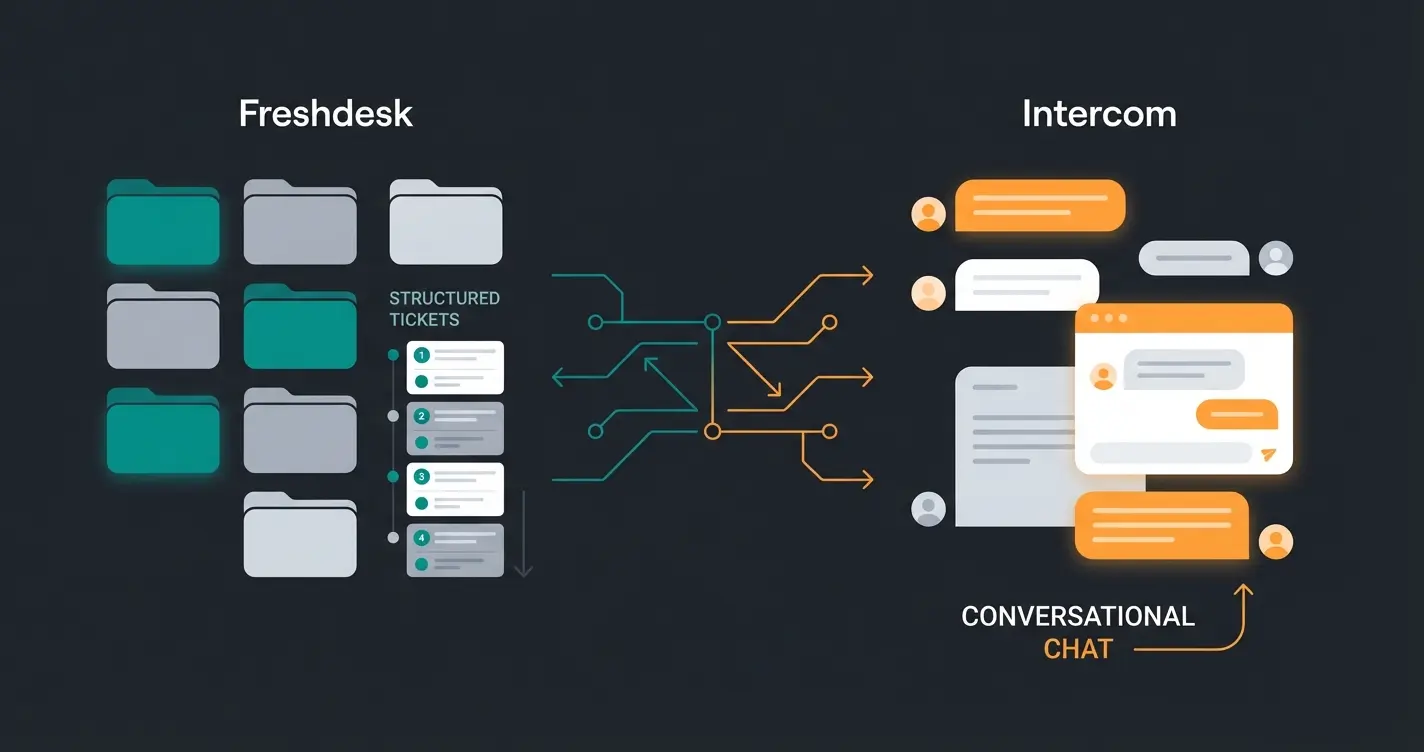
To make the right choice, we need to look deeper into the DNA of both tools. This isn't just a feature comparison—it's a comparison of philosophy. Understanding these fundamental differences in the intercom vs freshdesk comparison helps you align your tool choice with your business model.
Freshdesk: The Fortress of Order
Freshdesk (part of Freshworks) is fundamentally a classic helpdesk system. It thinks in 'tickets.' Every inquiry receives a number, a status, and an owner. According to CRM.org, Freshdesk offers a free tier for up to 10 agents and a very affordable 'Growth' plan (~$15/agent), making it the price-performance winner for SMBs.
- Strengths: Unbeatable for SLAs (Service Level Agreements). You can precisely define: 'If a VIP customer writes, a response must be sent within 1 hour, or the ticket escalates to the manager.'
- The German Perspective: Freshdesk fits excellently with the German work style. It's structured, hierarchical, and thorough. The user interface is functional and optimized for efficiency.
- Entry Price: With a free tier and an affordable 'Growth' plan (~$15/agent), it's the price-performance champion for SMBs.
Intercom: The Messenger for the Web
Intercom invented the 'Business Messenger.' The philosophy: support should feel like WhatsApp—fast, informal, and fluid. According to Cloudstride.io, there's no free plan available. Entry begins at approximately $39 per seat, but many essential functions (like WhatsApp integration or advanced workflows) are hidden in more expensive plans (~$99).
- Strengths: Intercom excels at user engagement. It's not just support but also marketing. You can deploy pop-ups ('Hey, check out our new feature!') and build product tours. The 'Inbox' design is modern and optimized for speed.
- The Weakness: When complex problems arise that span multiple days and departments, the 'chat stream' quickly becomes confusing. The strict ticket structure is missing.
- Entry Price: No free plan exists. Entry ('Essential') begins at ~$39 per seat, with many essential functions locked behind more expensive plans (~$99).
Why Support vs Chat No Longer Suffices
Most Freshdesk vs Intercom comparison articles stop here. But in 2025, the market has changed. Customers don't just want problems solved (support) or to be chatted at (engagement). They want to be consulted. This is where understanding the EU AI Act becomes relevant for compliance-conscious implementation.
A customer asking: 'Which e-bike suits me if I have back problems?' isn't a support case. They're a sales lead.
- Freshdesk turns this into Ticket #12345.
- Intercom tries to deflect them with an FAQ article about 'return policies.'
- What's missing is Consultation Intelligence.
This gap is precisely why Consultative AI solutions are emerging to bridge the divide between traditional support tools and revenue-generating customer interactions.
The Hidden Costs of AI: Session vs Resolution
Here lies perhaps the most important difference for your 2025 budget planning. Both providers have invested massively in AI (Freshdesk 'Freddy AI' and Intercom 'Fin'). However, the billing models couldn't be more different—and one of them is a cost trap for consultation-intensive companies. Understanding Intercom pricing in detail is essential before committing.
Intercom's 'Fin AI': The $0.99 Trap
Intercom charges $0.99 per resolution for its AI agent 'Fin' according to Fin.ai documentation. This sounds fair ('I only pay when it works'), but there's a catch:
- What counts as a resolution? When the bot provides an answer and the customer leaves the chat or clicks 'thumbs up,' it's considered resolved.
- The calculation example: Let's say you operate an online shop for premium coffee machines. A customer asks: 'Is the machine loud?' → Bot says 'No, 50dB'. → Cost: $0.99. The customer doesn't buy immediately but returns tomorrow: 'Will a tall mug fit under it?' → Bot says 'Yes'. → Cost: $0.99. If you have 5,000 such inquiries per month, you're paying $4,950 just for the bot—on top of license fees of ~$99 per employee according to Featurebase.
- The risk: For consultation-intensive products, you want long conversations. You want the customer to ask 5, 6, or 10 questions to feel confident. Intercom's model financially punishes you for intensive interaction.
Freshdesk's 'Freddy AI': The Flat-Rate Model
Freshdesk uses a session-based model (Session Packs) as documented by eesel.ai.
- Price: A package of 1,000 sessions costs $100 (so $0.10 per session).
- What counts as a session? All interactions within 24 hours count as one session according to Freshdesk documentation.
- The advantage: The customer can ask the bot 50 questions about the coffee machine. As long as it happens within 24 hours, you pay a one-time 10 cents.
For 2,000 consultative conversations at $0.99 per resolution
For 2,000 consultative conversations using session packs
Intercom can cost up to 10 times more for consultation-intensive scenarios
| Cost Factor | Intercom (Fin) | Freshdesk (Freddy) | Consultative AI (Alternative) |
|---|---|---|---|
| Base License (5 Agents) | ~$495 (Advanced Plan) | ~$245 (Pro Plan) | Variable |
| AI Cost Model | $0.99 per resolution | $100 per 1,000 sessions | Often flat-rate / value-based |
| Cost for 2,000 Chats | $1,980 (at 100% resolution rate) | $200 (2 packages) | Included / Fixed |
| Total Monthly Cost | ~$2,475 | ~$445 | Predictable |
| Risk | Uncontrollable costs during traffic spikes | Costs scale linearly and affordably | Full cost control |
According to eesel.ai analysis, traffic spikes can cause uncontrollable cost increases with Intercom's per-resolution model, making budget forecasting nearly impossible for growing businesses.
Feature Deep Dive: Where Both Fail at Consultation
We've established that Freshdesk is cheaper and Intercom is more modern. But do they close the gap identified in our content analysis? Can they sell? Understanding how AI Customer Service fundamentally works helps explain these limitations.
The Problem with 'Deflection AI'
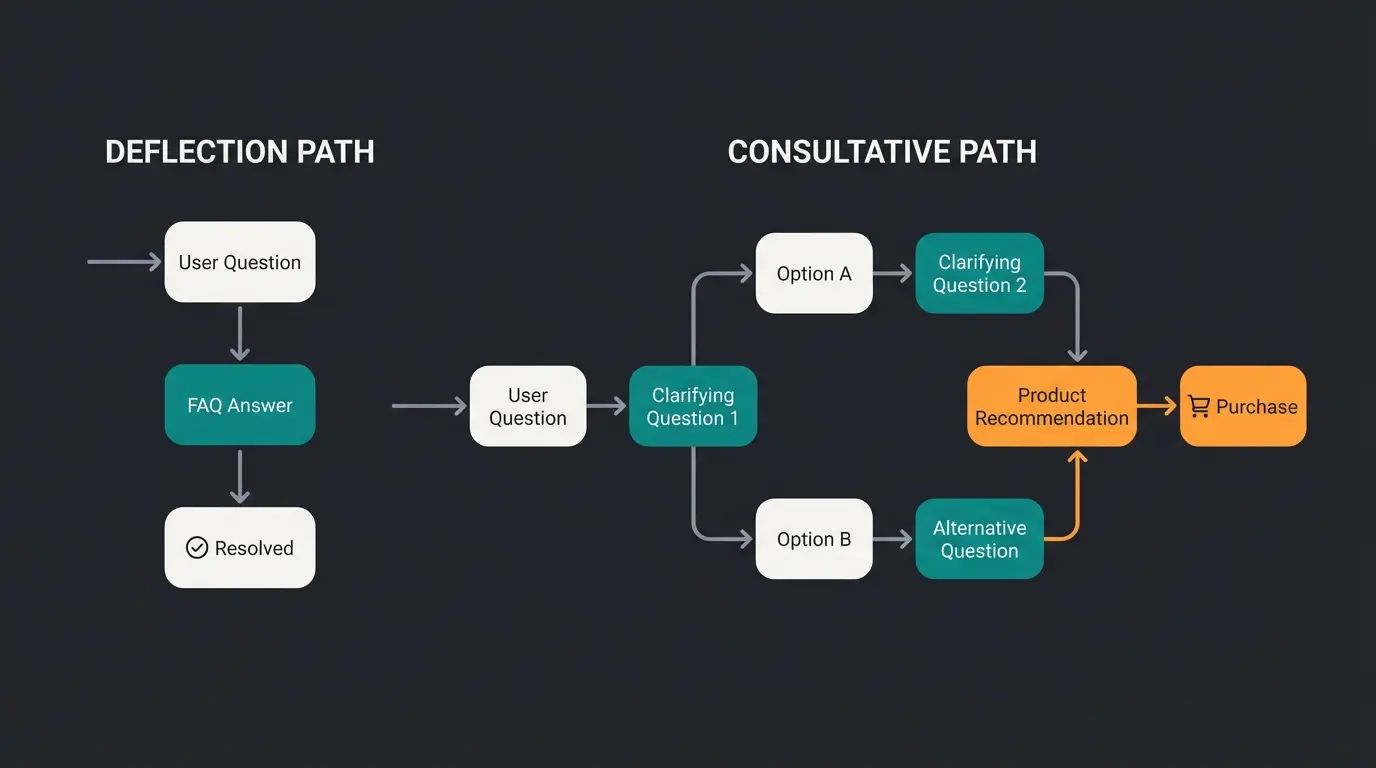
Both 'Freddy' and 'Fin' are based on RAG (Retrieval Augmented Generation). They scan your Knowledge Base (FAQ) and formulate answers from it. Their goal is Deflection: Avoiding human contact.
- Scenario: A customer is looking for running shoes.
- Intercom Fin / Freshdesk Freddy: The customer asks: 'Do you have waterproof shoes?' → Bot searches the FAQ → Answer: 'Yes, Model X and Y are waterproof.' → End of interaction.
The Consultative AI Approach
A true consultation AI (Consultative AI) would act differently. It wouldn't just answer but ask back, like a good salesperson in a store. This approach aligns with how modern AI sales strategies are transforming customer interactions.
- Consultative AI: 'Yes, Model X and Y are waterproof. Are you looking for the shoes more for trail running in the forest or for the street in the rain?'
- Customer: 'For the forest.'
- Consultative AI: 'Then I recommend Model X—it has a non-slip sole. What shoe size do you normally wear?'
The Gap Both Tools Leave Open
Neither Freshdesk nor Intercom offers this proactive sales logic 'out of the box.' With Intercom, you'd need to build complex 'Custom Bots' manually (if-then logic), which is extremely time-consuming. With Freshdesk, the bot is often too rigidly focused on support tickets. If you're exploring Intercom alternatives, this limitation should factor heavily into your evaluation.
So if you want to not only reduce support costs but increase revenue, you need a solution that acts as a 'Consultant Layer' between the customer and the ticketing system. This is where digital sales consultants come into play, offering capabilities that traditional support tools simply don't provide.
Handle tickets, returns, and technical issues. Focus on SLAs and resolution times. Best for post-purchase problem solving.
User activation, feature announcements, and onboarding tours. Marketing-focused communication within apps.
Pre-purchase product advice, needs assessment, and personalized recommendations. Revenue-generating conversations that convert visitors to customers.
Discover how intelligent product consultation can transform your customer conversations from cost centers into revenue drivers. Experience AI that sells, not just deflects.
Start Your Free AI ConsultationTrust & Compliance: The German GDPR Check
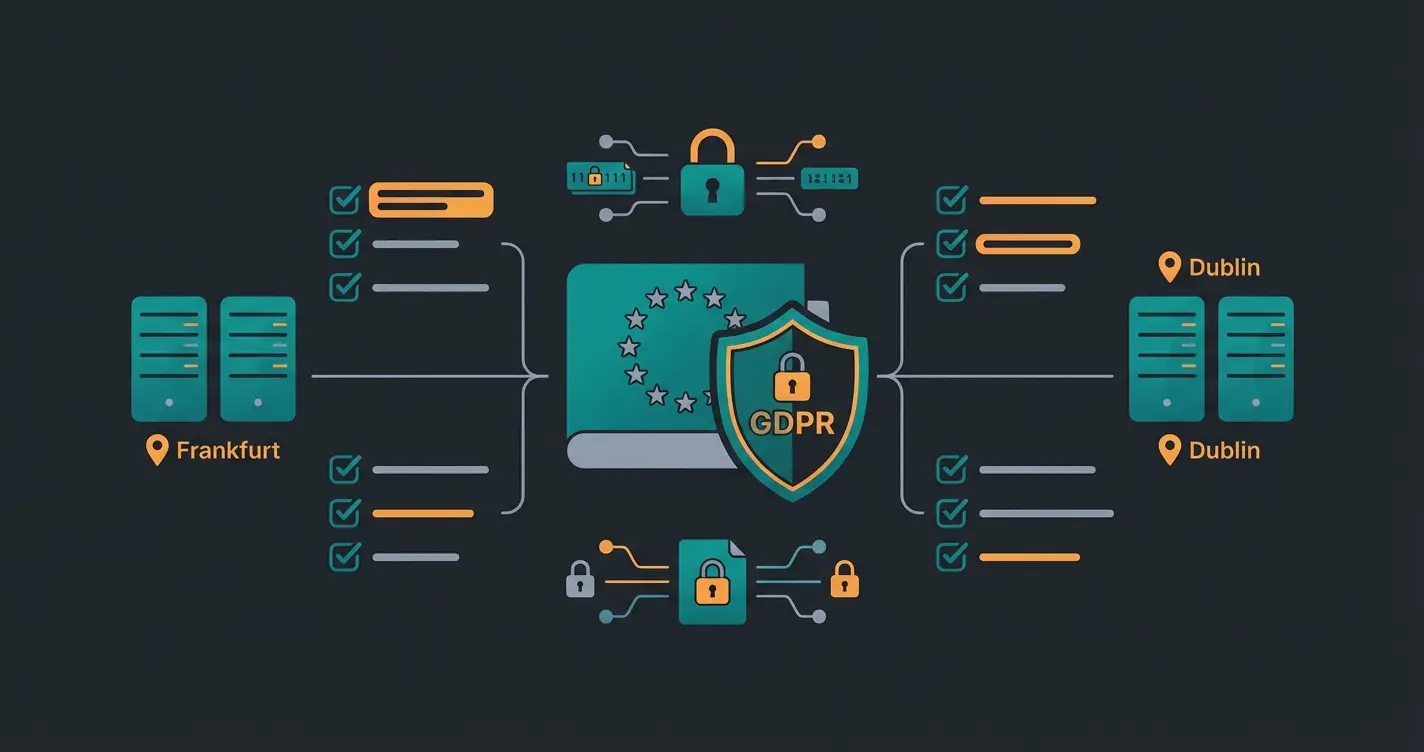
For German businesses, the question 'Where is my data stored?' is often more important than any feature. Here, there are massive differences between Freshdesk and Intercom in 2025. Working with AI product consultants who understand local compliance requirements becomes essential.
Intercom: The 'New Customer Trap' for EU Hosting
Intercom advertises EU hosting, but the fine print reveals significant catches:
- Only for new customers: If you already use Intercom (on US servers), you cannot migrate your data to the EU. Intercom offers no migration tools according to eesel.ai analysis.
- The solution? You'd have to cancel your account, lose all data (or manually export as CSV), and open a completely new account. Your customers' chat histories would be gone.
- Expensive plans: EU hosting is often tied to the more expensive 'Advanced' or 'Expert' plans as noted by Intercom documentation.
- Server location: Data resides at AWS in Dublin, Ireland. That's GDPR-compliant, but many German data protection officers prefer servers on German soil.
Freshdesk: Frankfurt as Standard
Freshdesk (Freshworks) has done its homework better for the DACH market according to Freshservice documentation.
- Location choice: You can select 'Europe' (Frankfurt) as your data center right during signup.
- Transparency: Freshworks communicates very openly about its sub-processors and data centers (AWS Frankfurt).
- Migration: Freshdesk has historically performed migrations from Dublin to Frankfurt for customers to address Brexit uncertainties and GDPR requirements.
Language and Tone: 'Sie' or 'Du'?
An often underestimated factor in the DACH region is formal vs. informal address. This consideration matters for AI Customer Service implementations targeting German-speaking markets.
- Intercom Fin: Has recently improved. There's now a setting for 'Pronoun Formality.' You can choose between 'Formal' (Sie), 'Informal' (Du), or 'Let Fin decide' (adapts to the customer) according to Intercom's documentation. This is a strong feature for modern brands that want to appear casual but remain professional during complaints.
- Freshdesk Freddy: Supports German solidly, but fine-tuning tonality is often less granular in standard settings than Intercom's new feature. It relies more heavily on the tonality of the underlying Knowledge Base articles according to Freshworks.
| Criterion | Freshdesk | Intercom |
|---|---|---|
| Server Location | Frankfurt (DE) 🇩🇪 | Dublin (IE) 🇮🇪 (US for existing customers) |
| EU Migration Possible? | Yes (historically proven) | No (account recreation required) |
| Imprint Requirement in Chat | Easily integrable | Possible, but often requires workarounds |
| Language Nuances (Sie/Du) | Good (based on content) | Very good (explicit setting) |
Practical Tips for Implementation
Regardless of which tool you choose, success depends on execution. Here are three tips to avoid typical mistakes. These insights apply whether you're implementing traditional support tools or exploring KI E-Commerce solutions.
Tip 1: Use the 'Workflow Triangle' Strategy
Understand that no tool can do everything. Build your tech stack as a triangle:
- Corner 1 (Support): Use Freshdesk for everything that needs a ticket (returns, defects).
- Corner 2 (Engagement): Use Intercom (or cheaper alternatives like Brevo/HubSpot) to send newsletters and updates.
- Corner 3 (Consultation): Deploy a specialized AI in front that advises the customer before a ticket is created.
Tip 2: Calculate the 'Worst Case' with Intercom
If you decide on Intercom, absolutely set hard limits in the 'Fin AI' dashboard as recommended by Fin.ai documentation.
- Specify: 'Maximum $500 per month for AI.'
- Without this limit, a viral post or technical outage (many inquiries) can explode your monthly bill.
Tip 3: The Knowledge Base Dilemma
AI is only as smart as your FAQ.
- Freshdesk: Forces you into a very structured Knowledge Base. This is work initially but pays off for AI quality.
- Intercom: Allows the integration of PDFs and websites according to GPTBots.ai. This is faster ('just throw in the URL'), but often leads to inaccurate answers because the AI scans too much irrelevant material. Curate your content strictly even with Intercom!
Conclusion & Recommendation: Which Tool for Whom?
The battle of Freshdesk vs Intercom has no universal winner, but clear losers when you use the wrong tool for the wrong purpose.
Choose Freshdesk If:
- You are a classic support team (IT, after-sales, complaints).
- You need budget certainty (flat rates & session packs).
- Your data must reside in Germany (Frankfurt).
- You prioritize order and structure over design and 'fancy features'.
Choose Intercom If:
- You are a SaaS company and your product is purely digital.
- Budget plays a secondary role and growth/engagement is the goal.
- You're starting fresh (no data migration needed) and can go directly to the EU server.
- You embrace the modern informal culture and want to proactively address users within your product.
The 3rd Option: When You Need a Specialized Solution
If you find that you actually don't want to 'manage tickets' or 'chat at users,' but rather sell products and advise customers, then neither tool is sufficient.
Both Freshdesk and Intercom are post-purchase tools (focused on problems after the purchase). For the pre-purchase phase (consultation before the purchase), you need Consultative AI. This can often be seamlessly connected with Freshdesk or Intercom: The AI handles consultation and sales, and only when there's a real problem is a ticket created in the helpdesk.
My recommendation for 2025: Start with Freshdesk as a solid backbone for your support (because of costs and GDPR). However, don't supplement it with expensive add-ons, but with a specialized consultation solution that converts your website visitors into customers, instead of just managing them as 'tickets.'
Frequently Asked Questions
Freshdesk uses a session-based AI pricing model at approximately $0.10 per session (with 24-hour windows counting as one session), while Intercom charges $0.99 per resolution. For businesses with consultation-intensive customer interactions, this can mean Intercom costs 10x more for the same number of conversations. Freshdesk also offers a free tier for up to 10 agents, whereas Intercom has no free plan and starts at ~$39 per seat.
Freshdesk offers Frankfurt (Germany) server hosting for all plans, selectable directly during signup. Intercom only provides EU hosting (Dublin, Ireland) for new customers on expensive Advanced/Expert plans, with no migration path for existing accounts. For businesses requiring data residency on German soil or facing strict GDPR requirements, Freshdesk is the more compliant choice.
Neither tool is optimized for pre-purchase product consultation. Both use 'deflection AI' designed to answer questions quickly and close conversations rather than guide customers through purchase decisions. For true sales consultation—where AI asks follow-up questions, understands customer needs, and recommends products—you need a specialized Consultative AI solution that can integrate with either platform.
Intercom recently added 'Pronoun Formality' settings allowing you to choose between formal (Sie), informal (Du), or adaptive modes. Freshdesk's Freddy AI supports German well but relies more on the tonality of your Knowledge Base content for formality. For businesses requiring precise control over formal/informal address in customer communications, Intercom's explicit setting offers an advantage.
With Intercom's per-resolution pricing at $0.99 each, traffic spikes from viral content, marketing campaigns, or technical issues can cause your monthly AI costs to explode unexpectedly. It's critical to set hard spending limits in the Fin AI dashboard. Freshdesk's session-based pricing scales more predictably since all interactions within 24 hours count as a single session.
Stop choosing between expensive engagement tools and rigid ticket systems. Experience AI that consults, recommends, and converts—while integrating seamlessly with your existing support infrastructure.
Get Started with Consultative AIDisclaimer: Prices and features are based on the status as of early 2025 and may change. Please verify current terms directly with the providers.

Lasse is CEO and co-founder of Qualimero. After completing his MBA at WHU and scaling a company to seven-figure revenue, he founded Qualimero to build AI-powered digital employees for e-commerce. His focus: helping businesses measurably improve customer interaction through intelligent automation.