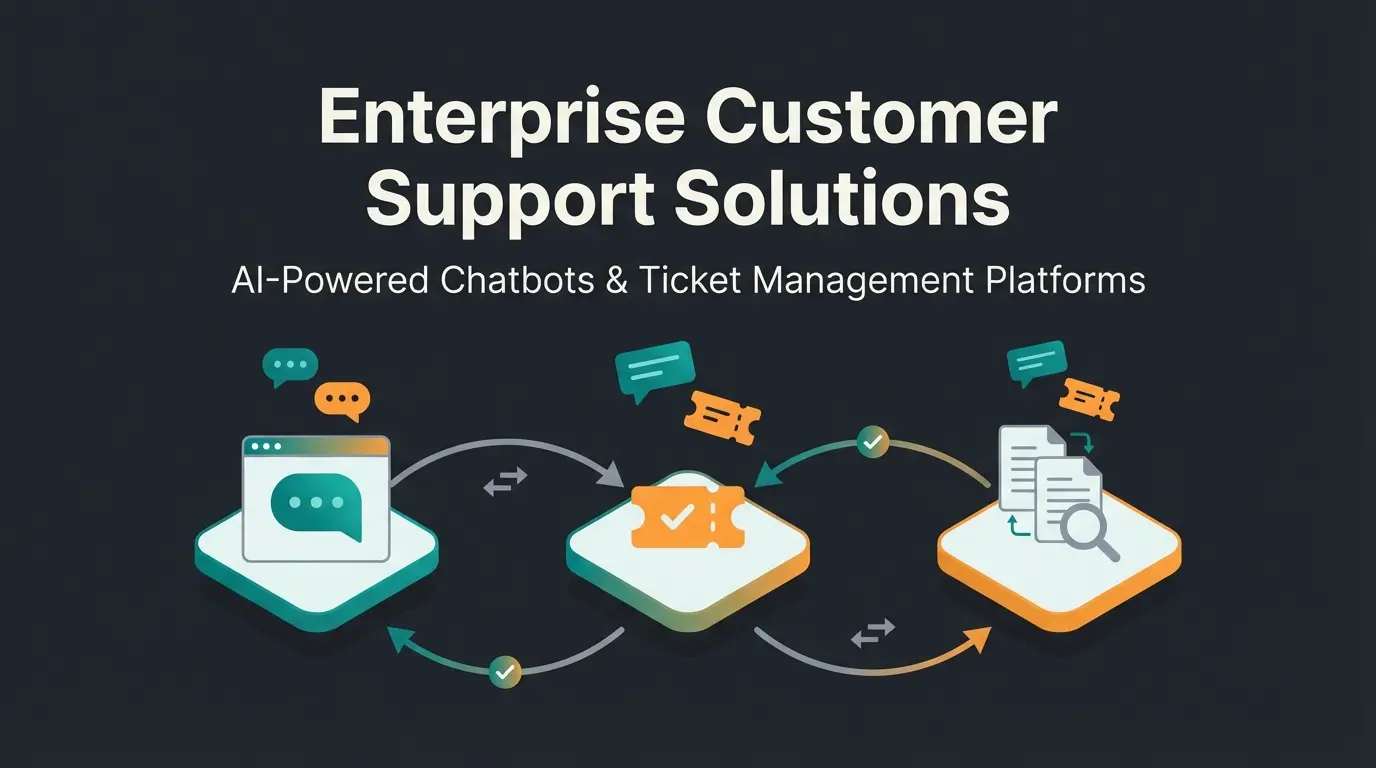
Why Support Must Be Redefined in 2025
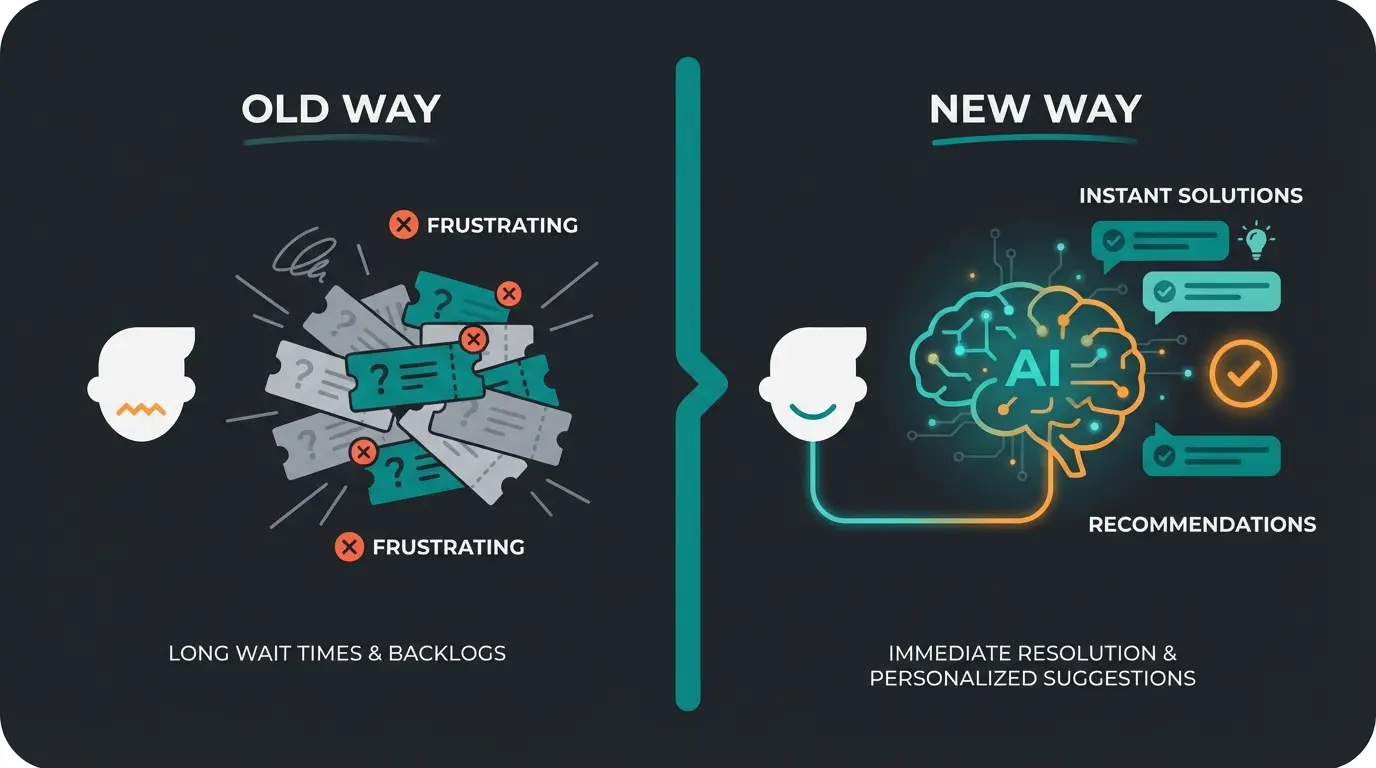
Imagine walking into a store where the salesperson ignores you until you shout: "I have a problem!" For decades, that was the model of traditional customer support: reactive, problem-oriented, and often frustratingly slow.
But in 2025, the tables have turned. Customers no longer expect hold queues or unintelligent chatbots that merely link to FAQ articles. According to current projections from Fullview, approximately 95% of all customer interactions will be AI-powered by the end of 2025. But the technology has changed: it's no longer about keeping tickets away from humans (deflection), but about proactively advising customers before a problem even arises.
In this ultimate guide to helpdesk software, we analyze not only the best tools like Zendesk or Zammad. We'll show you why German companies need to be cautious with US providers due to the current GDPR situation, and how you can transform your support department from a cost center into a revenue driver. Understanding the fundamentals of AI Customer Service is essential for making the right choice in today's market.
What Is Helpdesk Software Today? A New Definition
The Classic Definition (Legacy)
Traditionally, helpdesk software (or a ticket system) is defined as a tool that centralizes customer inquiries from various channels (email, phone, chat), converts them into "tickets," and manages their processing by agents. The focus was on efficiency: How quickly can we close the ticket?
The 2025 Definition: The Consultation Layer
Modern support software is much more than that. It functions as a Consultation Layer between your product and the customer. Instead of just fixing broken things, modern systems—powered by generative AI and LLMs (Large Language Models)—understand the user's context.
This shift represents a fundamental change in how we think about customer service software. It's no longer about deflecting inquiries but about creating value through every interaction.
Key Criteria for German Companies in 2025
The German market operates differently. While US reviews often only compare features, DACH companies (Germany, Austria, Switzerland) must navigate legal and cultural hurdles.
1. GDPR and the Unstable Data Privacy Framework
Data privacy is more critical than ever in 2025. While the EU-US Data Privacy Framework (DPF) succeeded "Privacy Shield," the legal situation remains extremely unstable.
- The Risk: Experts warn that US cloud providers (like AWS or Microsoft Azure, which many helpdesks run on) remain problematic due to US surveillance laws (FISA 702). The European Court of Justice (ECJ) could overturn the agreement at any time, similar to Schrems I and II decisions, as noted by legal experts at Heuking and Nextcloud.
- The Consequence: For German companies, a server location in Germany or at least the EU (without access by US parent companies) is a massive competitive advantage and often a compliance necessity, according to VPNhaus.
2. Language Nuances: Formal vs. Informal Address
Global help desk software often translates literally from English. This leads to awkward moments when an upset B2B customer suddenly receives informal language where formal address is expected.
- Requirement: The tool must offer configurable language profiles that can distinguish between formal and informal address.
- Dialect Understanding: Good AI tools in 2025 also recognize regional language variations and understand the intent behind them.
3. The German Ecosystem (Integrations)
A helpdesk is an island if it doesn't communicate with your other tools. In Germany, these are often different players than in the USA:
- E-Commerce: Shopware (not just Shopify), as highlighted by Herodesk
- Marketplaces: Otto.de and Kaufland (alongside Amazon), according to eDesk
- Accounting: DATEV interfaces are essential for resolving refund or billing questions directly without switching tools, as noted by Shopware and AccountOne
Projected customer interactions using AI by end of 2025
German companies prioritizing EU data hosting
More local integrations required vs. US market
Top Helpdesk Software Compared (2025)
Here we analyze the most important players in the market. We distinguish between the "giants," the "challengers," and the new "AI class."
Feature & Hosting Comparison Table
| Feature | Zendesk (The Giant) | Freshdesk (The All-Rounder) | Zammad (The German) | AI Product Consultant (The Future) |
|---|---|---|---|---|
| Target Audience | Enterprise / Corporations | SMB / Startups | Tech-savvy / Privacy Focus | E-Commerce & Sales Focus |
| Server Location | USA / Global (EU Option) | USA / Global | Germany (Self-Hosted possible) | Germany / EU |
| Pricing Model | High (per agent) | Moderate / Freemium | Fair / Open Source | Value-based / Hybrid |
| AI Type | Assistance (text suggestions) | Assistance (Freddy AI) | Basic automation | Proactive consultation |
| Setup Time | Long (weeks/months) | Fast (days) | Medium (tech knowledge needed) | Very fast (Plug & Play) |
| GDPR Security | Medium (US corporation) | Medium (US corporation) | Very High | High |
1. Zendesk: The Enterprise Standard
Zendesk is the market leader and offers an overwhelming wealth of features.
- Advantages: Extremely scalable, thousands of integrations, powerful reporting according to Kustomer.
- Disadvantages: Very expensive, complex setup, support often slow. For many German mid-sized companies, it's "overkill." Additionally, the US data issue remains, as noted by Nuacom.
- Best for: Corporations with dedicated IT teams.
2. Freshdesk (Freshworks): The SMB Solution
Freshdesk positions itself as the simpler, more affordable alternative to Zendesk.
- Advantages: Intuitive interface, freemium model for startups, good "Freddy AI" for agent support according to Freshworks.
- Disadvantages: Reporting hits limits with complex requirements. Also here: US provider.
- Best for: Startups and small teams that want to get started quickly.
3. Zammad: The German Open-Source Fortress
Zammad was developed by the founder of OTRS (Martin Edenhofer) and is very popular in Germany, as documented on Zammad's website.
- Advantages: Server in Germany, open source (code is viewable), self-hosting possible (maximum data sovereignty), very modern interface compared to old OTRS according to Textstore and Zammad documentation.
- Disadvantages: Fewer "fancy" AI features than US competition, focus is heavily on ticket management, less on sales.
- Best for: Government agencies, NGOs, and companies with strictest data protection requirements.
4. OTRS: The Classic
OTRS is the original ticket system pioneer.
- Advantages: Extremely customizable, ITIL-compliant (important for IT departments), high security as detailed on OTRS.com.
- Disadvantages: Outdated user interface, complex maintenance. Zammad is increasingly outpacing it according to StackShare.
- Best for: Internal IT helpdesks and technical departments.
5. AI Product Consultants: The Future Generation
While the tools mentioned above are primarily "management tools" for tickets, the new generation of helpdesk software goes a step further. This is where AI Chatbots transform the entire customer experience paradigm.
- The Approach: Don't wait until a ticket is created. The software uses product data to assist customers consultatively via chat or email.
- USP: Understands not just "keywords" but product relationships. Can perform upselling (e.g., "You'll also need cable Y for that").
- Best for: E-commerce brands and companies that see support as a sales channel.
Understanding different types of chatbots, including Consultative AI, helps you make the right choice for your specific needs.
Deep Dive: FAQ Bot vs. AI Product Consultant
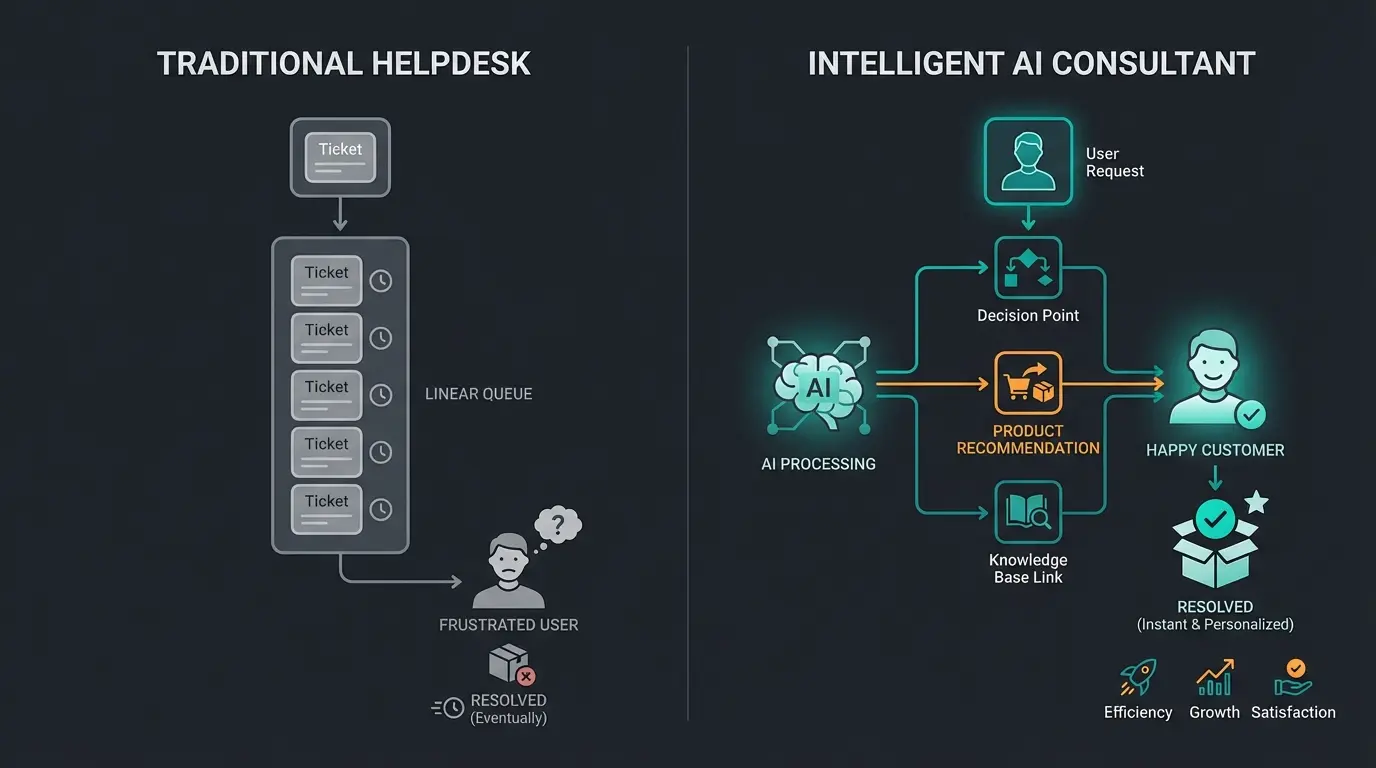
Many companies believe they have "AI" because they have a chatbot. But there's an enormous difference between a bot from 2020 and an AI Consultant from 2025. The evolution of conversational AI has been dramatic.
The FAQ Bot (The Past)
- How it works: Based on decision trees (if A, then B) or simple keyword recognition.
- Scenario: Customer asks: "Is the pants waterproof?" → Bot searches for "waterproof" in the description → Answer: "Yes."
- Problem: It's unintelligent. If the customer asks: "Can I use these pants for skiing at -10 degrees?", the bot fails because the word "skiing" isn't in the text. This limitation is well-documented by experts at Qualimero and Salesforce.
The AI Product Consultant (The Present)
- How it works: Uses LLMs (like GPT-4o or specialized models) and has access to your entire product knowledge (PIM) and contextual knowledge.
- Scenario: Customer asks: "Can I use these pants for skiing?"
- Consultant's response: "The pants are waterproof but not lined. For -10 degrees skiing, I recommend our 'Alpin-Pro' model instead, or you could wear this thermal underwear underneath."
- Result: The customer feels advised, not dismissed. Conversion probability increases massively. This is the difference between support and sales enablement.
This is exactly what AI product consultation delivers: understanding customer intent and providing genuinely helpful recommendations rather than just deflecting questions.
Phone-based support with long wait times and limited hours
Email and chat added, but still reactive ticket management
Keyword matching and decision trees, limited understanding
Reasoning engines that understand context and drive sales
Stop managing tickets and start creating customer success. Our AI product consultants understand your products and actively drive conversions.
Start Your Free TrialBuying Guide: How to Choose the Right Software
Before deciding on a tool, go through this checklist. The right AI customer service automation strategy depends on your specific goals.
1. Define Your Goal: Deflection or Retention?
Do you simply want to save costs and keep tickets away from humans (deflection)? Then a simple bot is sufficient. Do you want to retain customers and increase cart value (retention & sales)? Then you need an AI Consultant.
2. The Time-to-Value Check
Many enterprise tools like Zendesk require months for implementation. Ask providers:
- "How long does it take until the AI understands my products?"
- "Do I have to manually build decision trees?" (If yes: stay away! That's yesterday's technology), as noted by Fullview.
3. The Integration Reality
A helpdesk without data is blind.
- For E-Commerce: Can the tool display order status, tracking numbers, and return status from Shopware/Shopify in real-time?
- For B2B: Is there a connection to your CRM (HubSpot, Salesforce) so the agent knows how much revenue the customer generates?
For businesses using messaging platforms, WhatsApp AI chatbots offer another powerful channel for customer consultation.
4. Avoiding Cost Traps
Pay attention to the pricing model.
- Per Agent: Expensive if you need to scale seasonally (e.g., during holiday shopping).
- Per Ticket/Conversation: Often fairer since you only pay for actual success.
- Add-ons: Be cautious with "base prices." Features like "AI," "Reporting," or "Social Media Channels" often cost extra with providers like Zendesk.
Future Trends: The End of Tier 1 Support
We're facing a paradigm shift. Classic "First Level Support" (Tier 1)—agents who reset passwords or answer "Where's my package?"—is dying out.
Humans Become Experts (Tier 2 & 3)
AI will completely take over routine tasks in 2025. This doesn't mean humans become obsolete. On the contrary: the role of support staff is being elevated.
- From "Ticket Pusher" to "Customer Success Manager": Agents only handle complex, emotional cases (escalations, goodwill decisions, complex technical problems), according to Kustomer and Plivo.
- Empathy as Currency: AI can deliver facts, but (still) can't show genuine empathy to an angry customer. This is where human value lies, as highlighted by The Midtown Group.
The comparison between AI Sales Consultants shows how different AI approaches serve different business needs.
The Human-AI Handoff
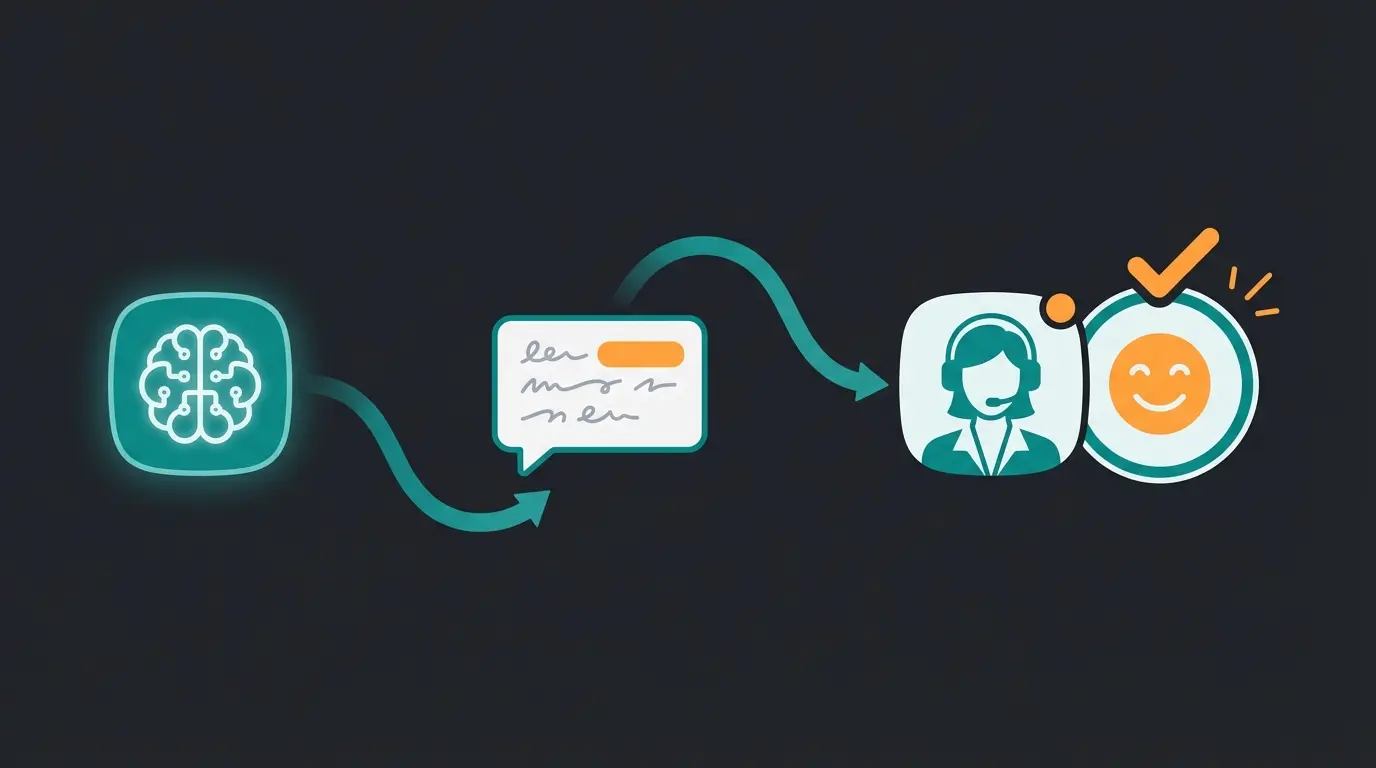
The most critical moment in the customer journey is the handoff from AI to human.
- Bad: The customer has to tell the human everything again that they already told the bot.
- Good (2025 Standard): The AI Consultant summarizes the conversation, analyzes sentiment (mood), and already gives the agent a solution suggestion. The agent takes over seamlessly, as documented by Everworker.
Understanding the difference between KI Mitarbeiter (AI employees) and traditional chatbots is crucial for implementing effective handoff strategies.
Conclusion: Stop Managing Tickets, Start Enabling Success
The market for helpdesk software in Germany is divided in 2025. On one side stand the old giants trying to upgrade their complex ticket systems with AI. On the other side stand agile, privacy-compliant solutions that rethink support: as proactive consultation.
Our Recommendations
- If you're a corporation and need ITIL processes: Look at Zendesk or OTRS.
- If you need maximum data security: Go with Zammad.
- If you're in e-commerce or modern B2B and want to use support as a revenue lever: Opt for an AI Product Consultant that understands, advises, and sells to your customers—24/7, in your language, and GDPR-compliant.
The question is no longer "Which tool can sort tickets?" but "Which tool helps my customers succeed?"
FAQ: Common Questions About Helpdesk Software
Prices vary significantly. Simple solutions like Freshdesk start free. Professional tools typically range between $45 and $110 per agent/month. Enterprise solutions can quickly cost several thousand dollars per month. The key is understanding whether you're paying per agent, per ticket, or for a value-based model that scales with your actual usage.
It's a gray area. With the shaky "Data Privacy Framework," companies are taking a risk. Legal experts often advise using Standard Contractual Clauses (SCCs) and additional protective measures, or going directly with European providers. According to Datenschutzticker, the safest approach is hosting within the EU without US parent company access.
No, but it changes their work. AI replaces the "robot portion" in humans (copy-paste answers). For empathy and complex problem-solving, humans remain indispensable. The future role of support staff shifts from ticket processors to customer success experts.
A traditional chatbot matches keywords and follows decision trees—it can only answer questions it was explicitly programmed for. An AI consultant uses large language models to understand context, ask clarifying questions, and provide personalized recommendations based on your product catalog and customer history.
Traditional enterprise helpdesks like Zendesk can take weeks or months to fully implement. Modern AI-powered solutions with plug-and-play capabilities can be operational within days. The key factor is whether the system requires manual decision tree building (slow) or learns from your product data automatically (fast).
Join forward-thinking companies using AI product consultation to turn support conversations into sales opportunities. GDPR-compliant, German-hosted, and ready in days.
Get Started Free Today