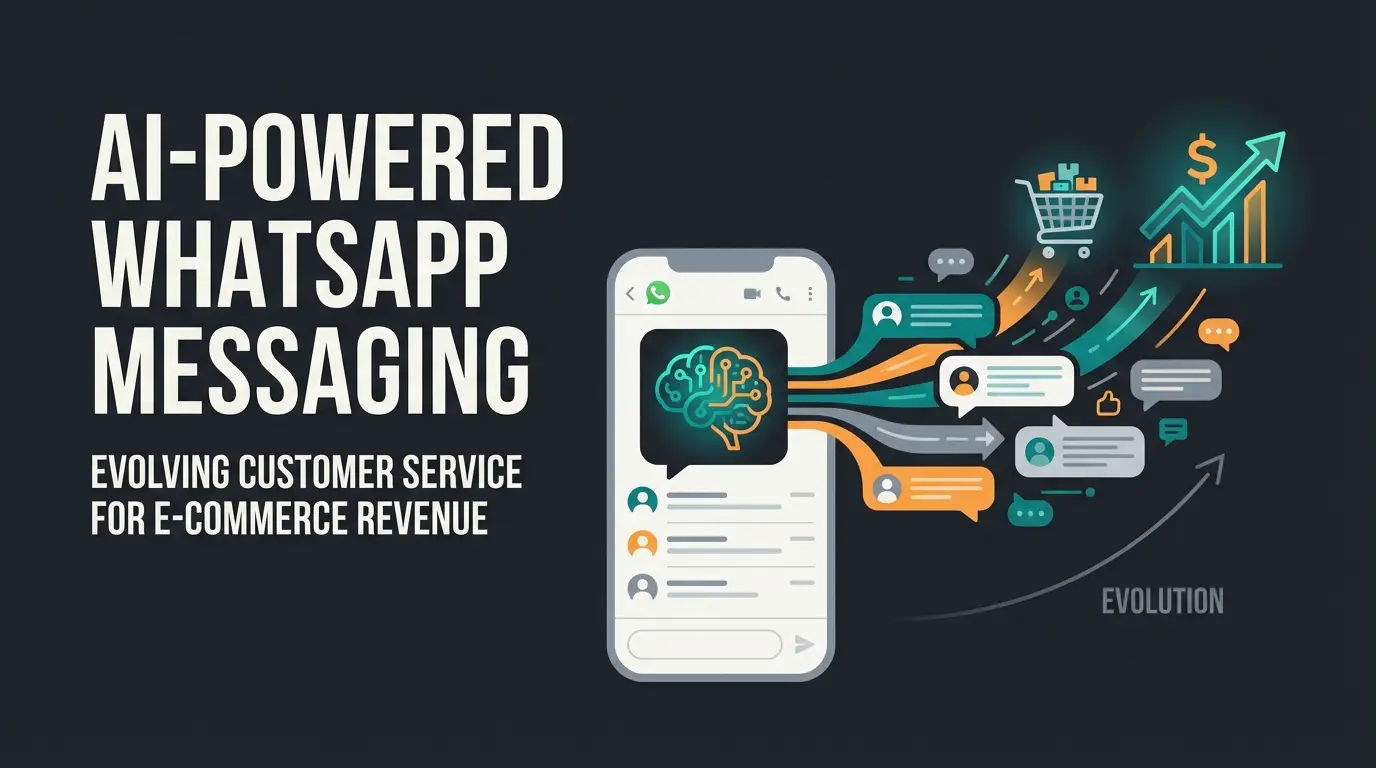
Why Traditional Customer Support Has Become Obsolete
Imagine walking into a store with an urgent question about a product, and the salesperson hands you a form saying: "Fill this out, we'll get back to you by mail in 24 hours." Absurd, right? Yet this is exactly the reality in online customer service, which still relies heavily on email tickets and static contact forms.
Customers have long since evolved. They live in a world of instant gratification and real-time communication. When a response takes longer than a few minutes, the purchase impulse has often already vanished. This is where using WhatsApp for customer service comes into play – not as a nice-to-have, but as a survival-critical channel for modern businesses.
However, most companies are only scratching the surface. They use WhatsApp merely for "ticket deflection" – handling questions like "Where is my package?" While this saves costs, it completely wastes the channel's true potential. Companies that want to optimize customer service need to think beyond simple FAQ responses.
In this comprehensive guide, we'll show you how to leverage WhatsApp customer service to not only solve problems but to scale genuine product consultation. We'll analyze the technological leap from "dumb" chatbots to intelligent AI advisors and demonstrate how to transform your support from a cost center into a profit center.
Why WhatsApp Is the Most Important Customer Service Channel
In Germany and many European markets, WhatsApp dominates the messaging landscape. While the US still relies heavily on iMessage or SMS, WhatsApp has become the undisputed market leader in Europe. The numbers speak for themselves and explain why no WhatsApp support strategy can afford to ignore this channel.
The Dominance in Numbers
- User Base: Over 60 million people use WhatsApp daily in Germany alone, according to Superchat. This represents nearly the entire purchasing-power population.
- Open Rates: While email marketing struggles with 20% open rates, WhatsApp messages achieve 98% open rates according to BusinessChat.
- Speed: The average user response time on WhatsApp is under 60 seconds, as reported by Digital Marketing Solutions Summit. Email response times often take hours or days.
- Conversion Power: Marketing and consultation campaigns via WhatsApp achieve click-through rates of 45-60%, while email often languishes in single digits according to Amra and Elma and SendWo.
Active WhatsApp users in Germany representing the entire purchasing-power population
WhatsApp message open rates compared to 20% for email marketing
Average user response time on WhatsApp vs. hours/days for email
CTR for WhatsApp campaigns compared to single digits for email
The Psychological Advantage: Chat vs. Ticket
Customers perceive email as formal, slow, and distant. WhatsApp, however, is the channel where they communicate with friends and family. When a company is present here, the barrier to contact drops dramatically.
This means for you: Customer service via WhatsApp is not perceived as a bureaucratic act but as a fluid conversation. This creates the ideal breeding ground for what we call "Conversational Commerce" – selling through conversation. Understanding this shift is crucial for implementing AI customer service effectively.
The 3 Levels of WhatsApp Customer Service: A Maturity Model
To understand where the potential lies, we need to analyze the status quo. Most companies are still at Level 1 or 2. Your goal should be Level 3.
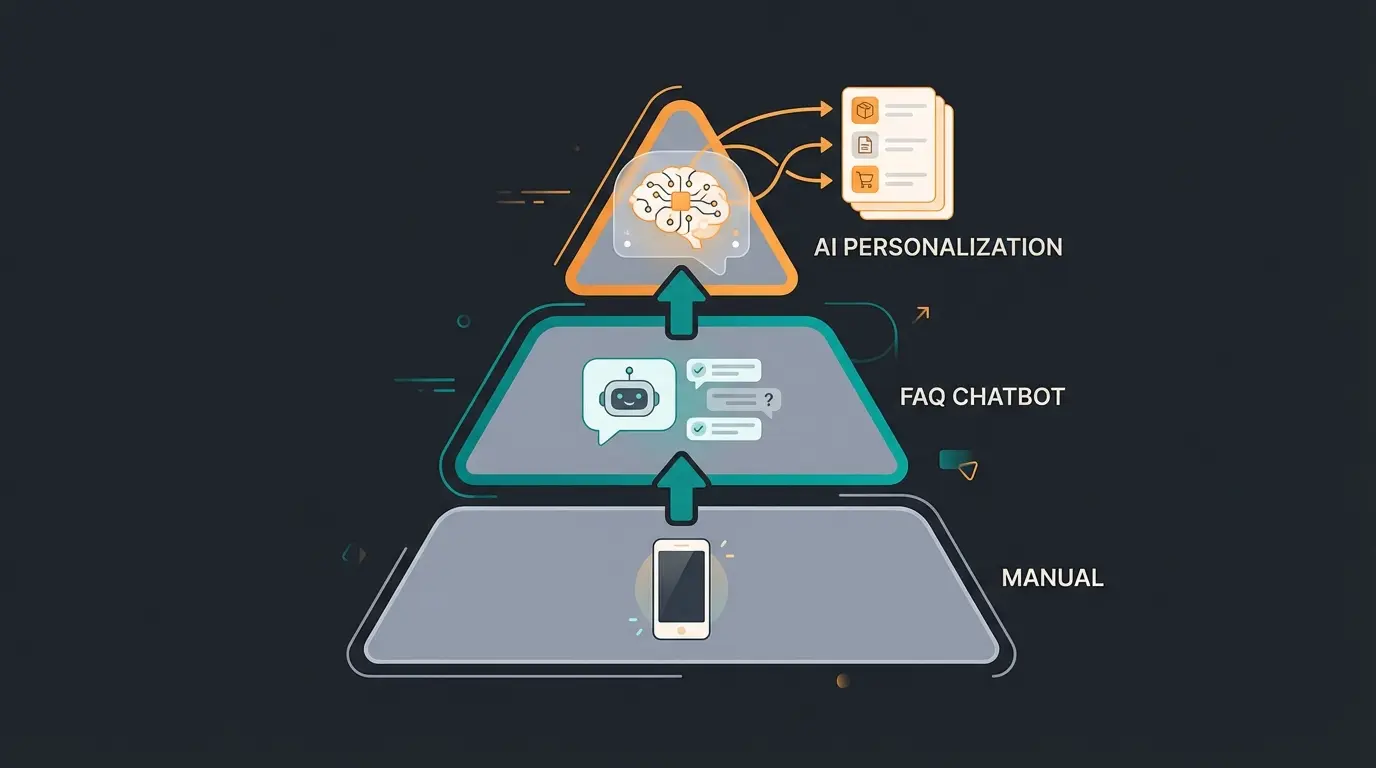
Level 1: Manual & Chaotic (The Pizza Shop Method)
Here, a company uses the free WhatsApp Business App on a single smartphone.
- Workflow: One employee manually types responses
- Problem: Not scalable. When the phone goes on vacation, service stops. Additionally, this is usually not GDPR-compliant since metadata (phone book) is transmitted to US servers, as noted by HelloMateo.
- Suitable for: The local hairdresser or kiosk, but not for e-commerce brands
Level 2: Reactive & Standardized (The Ticket Deflector)
The company uses the WhatsApp Business API through a software platform (e.g., Zendesk, Userlike, Mateo).
- Workflow: A simple chatbot (based on keywords or decision trees) intercepts standard questions ("Opening hours", "Return label"). More complex cases go to agents.
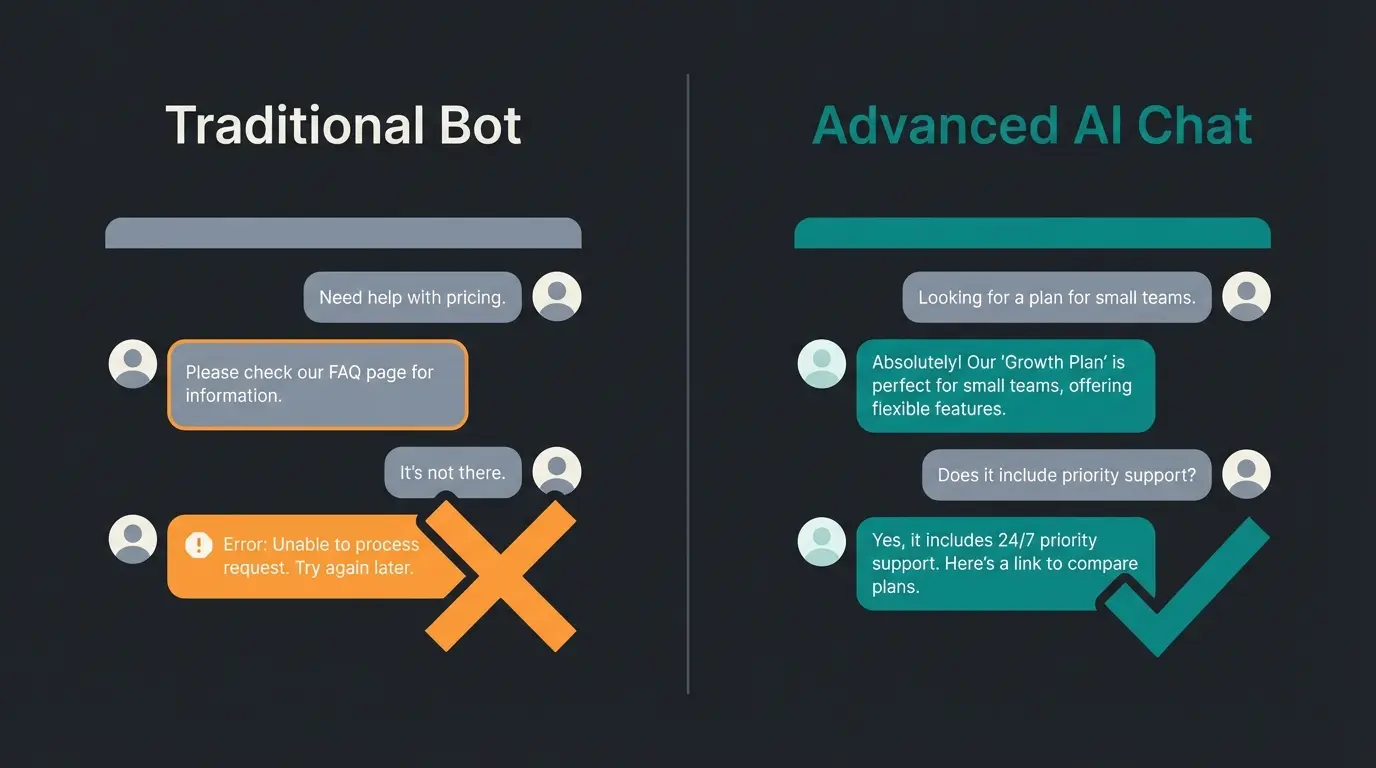
- Problem: The bot is "dumb." It doesn't understand context. If a customer asks: "Do you have something for dry skin?", the bot often responds: "I didn't understand you. Here's our FAQ link."
- Status: This is the current industry standard. Efficient, but weak on revenue.
Level 3: Proactive & Consultative (The AI Sales Consultant)
This is where Generative AI (LLMs) comes into play. The system is deeply integrated with the product catalog and represents the future of AI chatbots for customer service.
- Workflow: The customer asks a vague question ("I need hiking boots for wide feet"). The AI understands the nuance, asks follow-up questions ("Do you hike more in flat terrain or in the Alps?"), and recommends specific products with purchase links.
- Vorteil: This is no longer "ticket processing" – this is digital sales consultation.
- Goal: Maximum conversion and customer satisfaction through hyper-personalization
Single smartphone, one employee typing, no scalability, GDPR risks with the free app
API-based keyword bots, FAQ deflection, standard responses, limited context understanding
LLM-powered advisors, product catalog integration, personalized recommendations, revenue generation
App vs. API: The Technical Foundation for Professional Service
Before we dive deep into AI strategy, we need to clarify the technical foundation. Many companies fail because they try to deliver professional service with the free app. This fundamental understanding is essential before implementing any WhatsApp Business setup.
Here's a direct comparison showing why ambitious companies must use the WhatsApp Business API:
| Feature | WhatsApp Business App | WhatsApp Business API |
|---|---|---|
| Target Audience | Small business owners, solopreneurs | SMBs, Enterprises, E-Commerce |
| Costs | Free | Paid (Software + Messages) |
| User Count | 1 Smartphone + 4 Web Devices | Unlimited Users & Devices |
| Data Protection (GDPR) | Critical (reads phone book) | Secure (no contact access, EU servers possible) |
| Automation | Only simple greeting/away messages | Full chatbots, AI integration, ERP connection |
| Mass Messaging | Max 256 contacts (broadcast lists) | Unlimited (Newsletter/Marketing) |
| Verification | No "Green Checkmark" | "Green Checkmark" possible (Official Business Account) |
The New 2025 Pricing Model (Important!)
Since mid-2025, Meta has drastically changed the pricing model for the API. It's no longer charged flat per conversation but more granularly, according to ControlHippo and Omnichat:
- Service Conversations: When a customer messages you, responses within a 24-hour window are often free (or very cheap), as long as no marketing templates are used. This massively promotes customer service.
- Utility Templates: Messages like shipping confirmations are now often free within the service window, as reported by YCloud.
- Marketing Templates: These are always paid and more expensive.
Strategy: Using WhatsApp for Product Consultation
Now let's get to the core: How do you transform the channel from a cost center into a revenue machine? The answer lies in redefining the term "support."
The Problem with Traditional Chatbots
Conventional chatbots are based on "if-then" logic:
Customer: "I'm looking for a gift for my wife." Old Bot: "Please select a category: 1. Women's Fashion, 2. Gift Cards, 3. Accessories."
This isn't consultation – it's an interactive search bar. The customer doesn't feel understood and abandons the conversation. This is precisely where modern AI product consultation makes all the difference.
The Solution: The AI Product Consultant
By integrating Large Language Models (like GPT-4o or Claude) into the WhatsApp API, the bot can understand context and act like an experienced salesperson. This represents the WhatsApp Bot AI Revolution that's transforming e-commerce.
Practical Scenario: The Outdoor Shop
Let's deepen the example from the introduction.
The dialogue with a modern AI:
What happened here?
- Needs Analysis: The AI asked about the intended use (Alps/scree)
- Problem Understanding: It recognized and addressed the specific problem (wide feet)
- Expert Knowledge: It applied category knowledge (B/C shoes)
- Cross-Selling: It proactively offered socks
This is customer service via WhatsApp at Level 3. The customer feels advised, not "processed." This approach aligns perfectly with how AI-powered sales consultants should operate.
Best Practices for Implementation
Introducing such a WhatsApp support strategy requires planning. Here are the most important steps and pitfalls to avoid.
1. Data Protection (GDPR) as the Foundation
In Europe, data protection is non-negotiable. This is especially critical when implementing WhatsApp AI bots.
- No App: As mentioned, the app is off-limits for professional use
- DPA: Sign a Data Processing Agreement (DPA) with your WhatsApp software provider (BSP - Business Solution Provider)
- Server Location: Ensure your provider uses servers in the EU (e.g., Frankfurt) to guarantee data sovereignty
- Opt-in: For outgoing messages (newsletters), you need explicit opt-in (similar to email double opt-in), as outlined by Brevo
2. Tone of Voice & Persona
Your AI must not sound like a robot.
- Define a persona (e.g., "Max, the Outdoor Expert")
- Use emojis, but professionally
- Keep messages short. WhatsApp is a "snackable" medium. Nobody reads walls of text.
3. Human-in-the-Loop (Escalation)
Even the best AI has limits. A seamless handoff to a human is critical for maintaining customer satisfaction. Understanding the balance between AI Agents and digital consultants is essential.
- Sentiment Analysis: When the AI detects the customer is getting angry (e.g., through negative words or ALL CAPS), it must immediately hand off to a human agent
- Context Handoff: The human agent must see the previous chat history so the customer doesn't have to repeat their problem. This is the most common frustration point in support.
4. Leverage Click-to-WhatsApp Ads
To fill the channel, you can run ads on Facebook or Instagram that don't lead to a landing page but directly open a WhatsApp chat.
Advantage: Since the 2025 price change, the 72-hour window for conversations started via ads is often free for all message types, according to LinkMobility. This is a massive financial incentive for marketing teams exploring AI sales consultation approaches.
Discover how AI-powered WhatsApp consultation can turn your support team into revenue generators with conversion rates up to 60%.
Start Your Free TrialSuccess Measurement: Beyond Just Response Time
When you use WhatsApp as a consultation channel, your KPIs (Key Performance Indicators) must change. Old metrics from the call center era fall short here.
Outdated Metrics (Cost Center Thinking)
- Average Handling Time (AHT): How quickly can I get rid of the customer? (Wrong approach for consultation!)
- Ticket Volume: How many tickets do we have?
New Metrics (Profit Center Thinking)
- Conversion Rate per Conversation: What percentage of chats lead to a purchase? Benchmarks range from 45-60% according to AISensy.
- Revenue per Chat: What revenue does an average consultation generate?
- Retention Rate: Customers served via WhatsApp often have higher repeat purchase rates because the channel is "sticky," as reported by Interakt.
- CSAT (Customer Satisfaction): Query satisfaction directly in the chat (e.g., through 1-5 star buttons)
Percentage of WhatsApp consultations that lead to purchases
Average increase in revenue per chat with AI consultation vs. standard support
Higher repeat purchase rates for customers served via WhatsApp
Average customer satisfaction rating for AI-assisted WhatsApp support
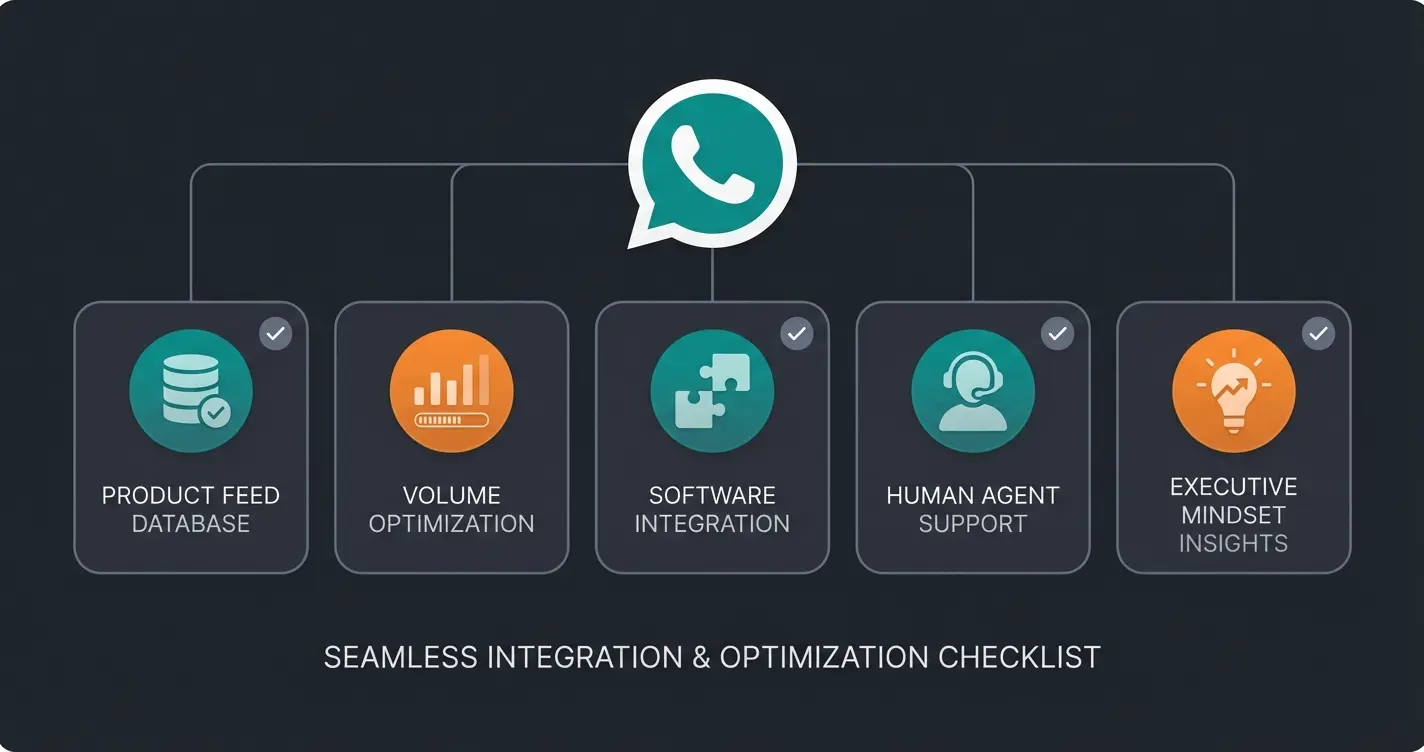
Checklist: Is Your Business Ready for AI Consultation?
Before you start, check these 5 points to determine your readiness for implementing advanced WhatsApp consultation:
- Product Data: Do you have a clean product feed (e.g., Google Shopping Feed) that the AI can read? Without data, there's no consultation.
- Volume: Do you have enough inquiries (at least 30-50 per day) to make automation worthwhile?
- Software: Are you already using a WhatsApp API platform (e.g., Charles, Userlike, Superchat) or are you ready to implement one?
- Resources: Do you have human agents who can handle complex cases (2nd level support)?
- Mindset: Is management ready to see support as a sales channel?
Real-World Success: AI Employee Flora in Action
To understand how AI-powered WhatsApp consultation works in practice, consider the success story of AI Employee Flora. This implementation demonstrates how businesses can achieve remarkable results by combining the WhatsApp channel with intelligent product consultation.
Flora represents the new generation of AI employees that don't just answer questions but actively guide customers through complex purchase decisions. By understanding product attributes, customer preferences, and contextual needs, AI consultants like Flora achieve conversion rates that traditional support channels simply cannot match.
Conclusion: The Future Is Conversational
The question is no longer whether you should use WhatsApp for customer service, but how intelligently you do it. Simply exchanging text messages to clarify delivery status is just a hygiene factor in today's market.
The true competitive advantage lies in the transformation to Conversational Commerce. Companies that meet their customers where they feel comfortable (in chat) and provide consultation that rivals in-store experiences will be the winners of the coming years.
The technology for this – generative AI and the WhatsApp Business API – is now mature and available. Don't start with the goal of reducing support costs. Start with the goal of creating the best shopping experience in your industry.
Ready for the next step? Review your current support landscape. If you're still playing email ping-pong, today is the best day to take the first step toward WhatsApp consultation.
Frequently Asked Questions (FAQ)
Yes, but only when using the WhatsApp Business API through a verified partner (BSP) and with a correct Data Processing Agreement. Using the app on a private phone is generally not compliant. Ensure your provider operates EU-based servers and has proper data handling procedures in place.
Costs consist of the software fee from the provider (monthly) and variable per-message costs to Meta. Since July 2025, service responses are often free, while marketing messages are paid. The exact pricing depends on message volume and your chosen BSP.
No, it shouldn't replace them but augment (enhance) them. The AI handles 80% of standard and consultation requests, allowing humans to focus on complex, emotional, or high-value cases. This human-in-the-loop approach ensures quality while maximizing efficiency.
No. You typically use a "no-code" software interface from providers like Superchat, Charles, or Userlike, which handle the technical API connection for you. These platforms offer visual builders and pre-built templates to get started quickly.
Implementation typically takes 2-4 weeks depending on your existing infrastructure. This includes API setup, product catalog integration, AI training on your specific products, and testing. Most businesses see initial results within the first month of operation.
Join leading e-commerce brands using AI-powered consultation to turn every chat into a conversion opportunity. Start your journey from cost center to profit center today.
Get Started Free
Lasse is CEO and co-founder of Qualimero. After completing his MBA at WHU and scaling a company to seven-figure revenue, he founded Qualimero to build AI-powered digital employees for e-commerce. His focus: helping businesses measurably improve customer interaction through intelligent automation.