How to Hire a Shopify Developer: The Complete Buyer's Guide for 2026
Learn how to hire a Shopify developer in 2026. Independent guide with cost ranges, vetting checklist, red flags, and a comparison of hiring channels for store owners.

What does a Shopify developer do?
A Shopify developer builds, customizes, and maintains online stores on the Shopify platform. That sounds simple. In practice, the role covers a wide spectrum of technical work, and understanding the scope helps you hire the right person for the right job.
The core responsibilities break down into six areas:
- Theme customization - modifying existing Shopify themes using Liquid, HTML, CSS, and JavaScript to match your brand and UX requirements. This includes custom sections, dynamic content blocks, and responsive adjustments that go beyond what the theme editor offers.
- Custom app development - building private or public Shopify apps that extend store functionality beyond what off-the-shelf apps offer. Common examples: custom product configurators, B2B pricing engines, and subscription management tools.
- Store setup and configuration - launching new stores with proper product data structure, payment gateways, shipping rules, and tax configuration. A catalog with 800+ SKUs requires particularly careful planning around metafields, collections, and variant structures.
- Platform migrations - moving stores from WooCommerce, Magento, or other platforms to Shopify, including data migration, URL redirect mapping, and SEO preservation. Poorly executed migrations can destroy organic rankings overnight.
- Third-party integrations - connecting your store to ERP systems, CRM tools, marketing platforms, and fulfillment services via APIs. The complexity here depends on whether pre-built connectors exist or custom API work is needed.
- Performance optimization - improving page speed, reducing app bloat, cleaning up render-blocking scripts, and optimizing the checkout experience for higher conversion rates. This often involves auditing installed apps and removing redundant ones.
One important distinction: a Shopify developer is not the same as a Shopify designer. Developers write code. Designers create visual layouts and brand experiences. Some professionals do both, but most specialize. If your project is primarily visual, you may need a designer first. If it involves custom functionality, integrations, or migrations, a Shopify Developer is your starting point.
Why hire a certified Shopify developer?
Anyone can call themselves a Shopify developer. Certification through the Shopify Partner Program changes that. It is not a guarantee of excellence, but it is a meaningful baseline that reduces your risk as a buyer.
Certified Shopify Partners gain access to tools and resources that directly benefit your project. They get unlimited development stores for safe staging and testing, early access to new Shopify APIs and platform features, dedicated partner support channels with faster response times, and structured training through Shopify Academy with formal certifications. Partners also earn recurring revenue from Shopify, which incentivizes long-term platform expertise rather than platform-hopping.
As of 2026, the Shopify Partner Directory lists over 100,000 vetted partners across more than 50 countries. You can filter by service type, budget range, location, language, and partner tier. Each listing includes verified reviews, work samples, and service descriptions, which gives you a structured starting point for evaluation.
For Shopify Plus merchants, the bar is higher. Shopify's Certified Technology Partner Program requires formal third-party security assessments, proven infrastructure performance, a minimum 4.0 app store rating after five reviews, and compliance with the latest API standards. As of 2026, this includes mandatory Bulk API implementation by July 2026. These requirements exist because Plus merchants run high-volume operations where technical failures have immediate revenue impact.
Where to find Shopify developers
The hiring channel you choose shapes the talent pool, cost, and level of accountability you get. After working with merchants across multiple industries, I have seen every channel succeed and every channel fail. The difference is matching the channel to your project type and budget.
| Channel | Typical cost | Best for | Watch out for |
|---|---|---|---|
| Shopify Partner Directory | $50-150/hr | Vetted developers with Shopify certification, all project types | Large directory can be overwhelming without clear project requirements |
| Freelance marketplaces (Upwork, Fiverr) | $15-80/hr | Smaller tasks, theme tweaks, budget-conscious projects under $2,000 | Variable quality, significant time spent vetting, platform fees of 5-20% |
| Shopify-specific platforms (Storetasker) | $75-150/hr | Pre-vetted Shopify specialists, mid-size projects | Smaller talent pool, commission-based pricing, limited availability |
| Full-service agencies | $100-250/hr | Complex projects, Shopify Plus migrations, ongoing partnerships | Higher cost, potential for over-scoping, PM overhead |
| Direct hire (full-time employee) | $70k-120k/yr (US) | Ongoing development needs, large catalogs, continuous optimization | Recruitment cost, benefits overhead, requires technical management |
The Shopify Partner Directory is the natural starting point for most merchants. You can filter by service type, location, budget, industry experience, and partner tier. Every listed partner has completed Shopify's vetting process. For a deeper understanding of working with Shopify agencies specifically, see our Shopify Agency Guide.
Freelance marketplaces like Upwork offer the widest talent pool and the lowest entry price, but they also require the most vetting effort on your side. Shopify-specific platforms like Storetasker pre-vet their developers, which saves time but limits your options. Agencies provide the most structured experience but at a premium. The right Shopify Partner depends on your project scope.
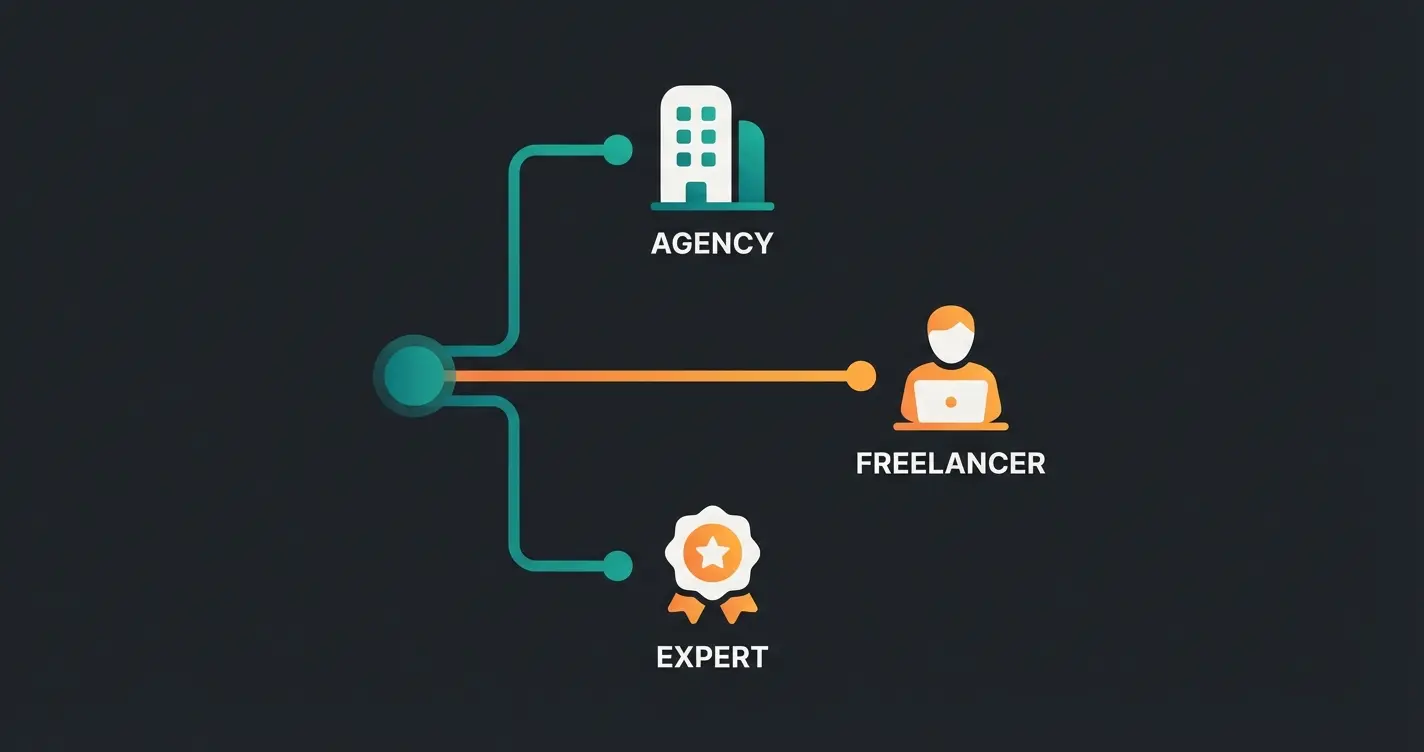
Agency vs. freelancer vs. expert
This is the decision that trips up most merchants. Whether you hire an agency, a Shopify Freelancer, or an independent Shopify expert, each model has structural advantages and trade-offs that go well beyond the hourly rate.
| Factor | Agency | Freelancer | Shopify Expert |
|---|---|---|---|
| Typical hourly rate | $100-250 | $15-100 | $75-200 |
| Availability | Structured, business hours | Flexible, varies by individual | Moderate, often booked weeks out |
| Expertise depth | Multi-discipline team (dev, design, PM, QA) | Specialized, narrow focus | Deep Shopify platform knowledge |
| Accountability | Contractual, PM layer, escalation paths | Individual, direct | Individual, reputation-driven |
| Scalability | High, can add team members | Limited to one person | Limited to moderate |
| Communication | PM as intermediary (can slow decisions) | Direct with the person writing code | Direct, strategic conversations |
| Best project type | Complex multi-phase builds, Plus migrations | Defined tasks, theme work, tight budgets | Strategic Shopify decisions, audits, optimization |
The honest answer: there is no universally correct choice. A freelancer who has built 50 Shopify stores in your industry will outperform an agency that treats your project as one of twenty concurrent engagements. Conversely, a complex Shopify Plus migration with custom ERP integration and multi-language support requires the multi-discipline structure an agency provides.
One pattern I see repeatedly: merchants hire a freelancer for what turns out to be an agency-sized project, then spend months managing scope creep and communication gaps. Or they hire an expensive agency for a simple theme customization that a Shopify Expert could have completed in a week at a fraction of the cost. Match the hiring model to the actual project complexity, not to your comfort level or your largest competitor's approach.
How much does it cost to hire a Shopify developer?
Cost transparency is rare in this space. Most marketplace listings and agency pages avoid specific numbers, or bury them behind "contact us" forms. Here are the real ranges based on 2026 market data and observed project outcomes across different regions.
Hourly rates by experience level and region
| Experience level | South Asia | Eastern Europe | Latin America | North America / Western Europe |
|---|---|---|---|---|
| Junior (0-2 years) | $15-30 | $20-40 | $25-45 | $40-70 |
| Mid-level (2-5 years) | $30-50 | $40-70 | $45-75 | $75-120 |
| Senior (5+ years) | $50-80 | $70-100 | $75-110 | $100-200+ |
The average annual pay for a Shopify developer in the United States is $109,905, which works out to approximately $52.84 per hour (ZipRecruiter, March 2026). US-based agencies typically charge $125-250 per hour for senior work, which includes project management and QA overhead on top of the raw development rate.
A critical nuance: lower hourly rates do not always mean lower total cost. A senior developer charging $120 per hour who completes a migration in 40 hours costs $4,800. A junior developer at $25 per hour who takes 200 hours and introduces bugs that require another 40 hours to fix costs $6,000 and delays your launch by weeks. Always evaluate total project cost, not just the rate.
Project-based pricing by scope
| Project type | Cost range | Timeline | Key variables |
|---|---|---|---|
| Basic store setup | $500-2,000 | 1-2 weeks | Number of products, payment/shipping complexity |
| Custom theme development | $2,000-10,000 | 3-8 weeks | Design complexity, number of custom sections, responsive requirements |
| Custom app development | $5,000-25,000+ | 4-12 weeks | Functionality scope, API integrations, testing requirements |
| Platform migration | $3,000-15,000 | 2-6 weeks | Catalog size, URL redirect mapping, SEO preservation needs |
| Ongoing maintenance | $500-2,000/mo | Ongoing | Store complexity, update frequency, support response time SLA |
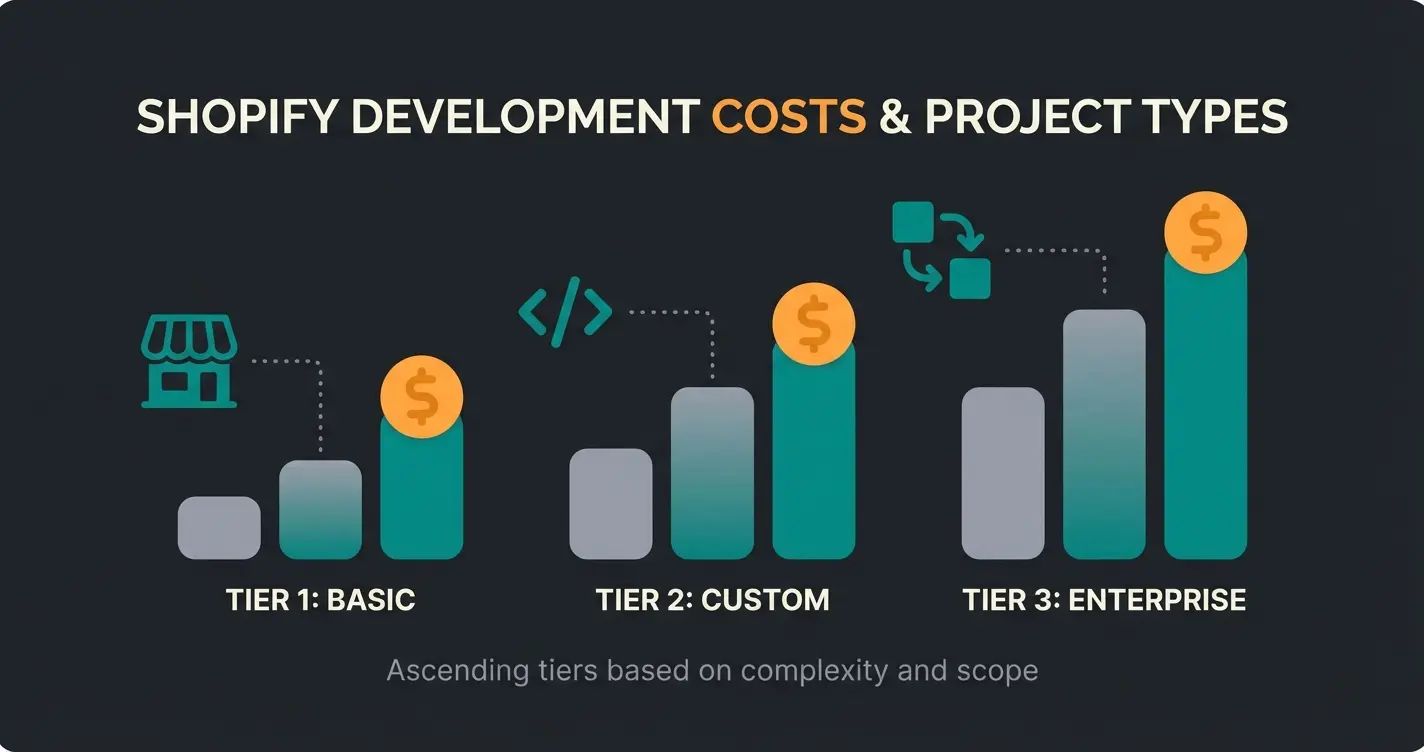
Source: ZipRecruiter, March 2026
From basic store setup to custom app development
Including design, development, and QA testing
How to vet a Shopify developer: 10-point checklist
Vetting is where most hiring processes fail. Merchants look at portfolios and rates, skip the deeper evaluation, and discover problems three weeks into the project when the deposit is spent and the timeline is slipping. This checklist covers the ten areas that consistently predict project success or failure.
- Shopify Partner certification - Verified in the Shopify Partner Directory with active partner status and a visible track record
- Portfolio with live stores - Not mockups or screenshots. Load the live URLs on your phone, test the checkout flow, check mobile UX, and run a quick PageSpeed Insights test
- Client references in your industry - Ask for 2-3 references from similar projects. Call them. Ask specifically what went wrong, not just what went right
- Technical assessment - Can they explain Shopify's Liquid templating language, API rate limits, checkout extensibility constraints, and the Scripts-to-Functions migration? Strong candidates mention staging themes, version control with Git, and rollback procedures
- Communication responsiveness - How fast do they respond during the vetting phase? Track their response time. This is the single best predictor of communication quality during the actual project
- Clear project scoping - Do they ask detailed questions about your requirements before quoting? Good developers scope before they price. If they quote within 24 hours of a vague brief, they are either underestimating or padding
- IP and code ownership agreement - Who owns the custom code after the project? Who owns the theme customizations? This must be explicit and in writing before any work begins
- Post-launch support plan - What happens after go-live? Bug fixes, monitoring, Shopify platform updates, and small feature additions should be defined upfront, ideally as a separate maintenance retainer
- Transparent pricing structure - Fixed price, hourly, or milestone-based? Each model has different risk profiles. The developer should explain which model fits your project type and why they recommend it
- Performance track record - Ask for specific examples of speed optimization work: image compression strategies, app audit and cleanup, script reduction, Core Web Vitals improvements with before/after data
A developer who passes all ten points is rare. Eight out of ten is a strong signal. Below six, keep looking. The time you invest in vetting saves multiples in avoided rework, missed deadlines, and project restarts.
Red flags when hiring a Shopify developer
Some warning signs are subtle and only visible if you know what to look for. Others should end the conversation immediately.
- No portfolio or only mockups - If a developer cannot show live stores they have built and maintained, they either lack real experience or their previous clients removed their work. Neither is a good sign. Ask for live URLs and check them yourself.
- Reluctance to provide references - Every experienced developer has at least two or three clients willing to speak on their behalf. If they hesitate or offer only written testimonials, ask why. Written testimonials can be fabricated. Phone calls cannot.
- No written contract - This is non-negotiable. No contract means no legal recourse if the project goes sideways, no defined scope, and no IP protection. Walk away.
- Unrealistically low pricing - A custom Shopify theme for $300 is not a bargain. It is a signal that the developer will apply a free theme with minimal modifications, or that the project will stall after the deposit is collected. If a quote is less than half the market rate, investigate why before celebrating.
- No version control - If the answer to "Do you use Git?" is "We edit directly in the Shopify admin," you are looking at a developer who cannot safely manage changes, cannot roll back mistakes, and has no audit trail. This is disqualifying for any project beyond minor text changes.
- Poor communication during discovery - If they are slow to respond, vague about their process, or dismissive of your questions before the project starts, expect significantly worse during the build. The vetting phase is when developers are at their most responsive. It only goes downhill from there.
How to structure the engagement
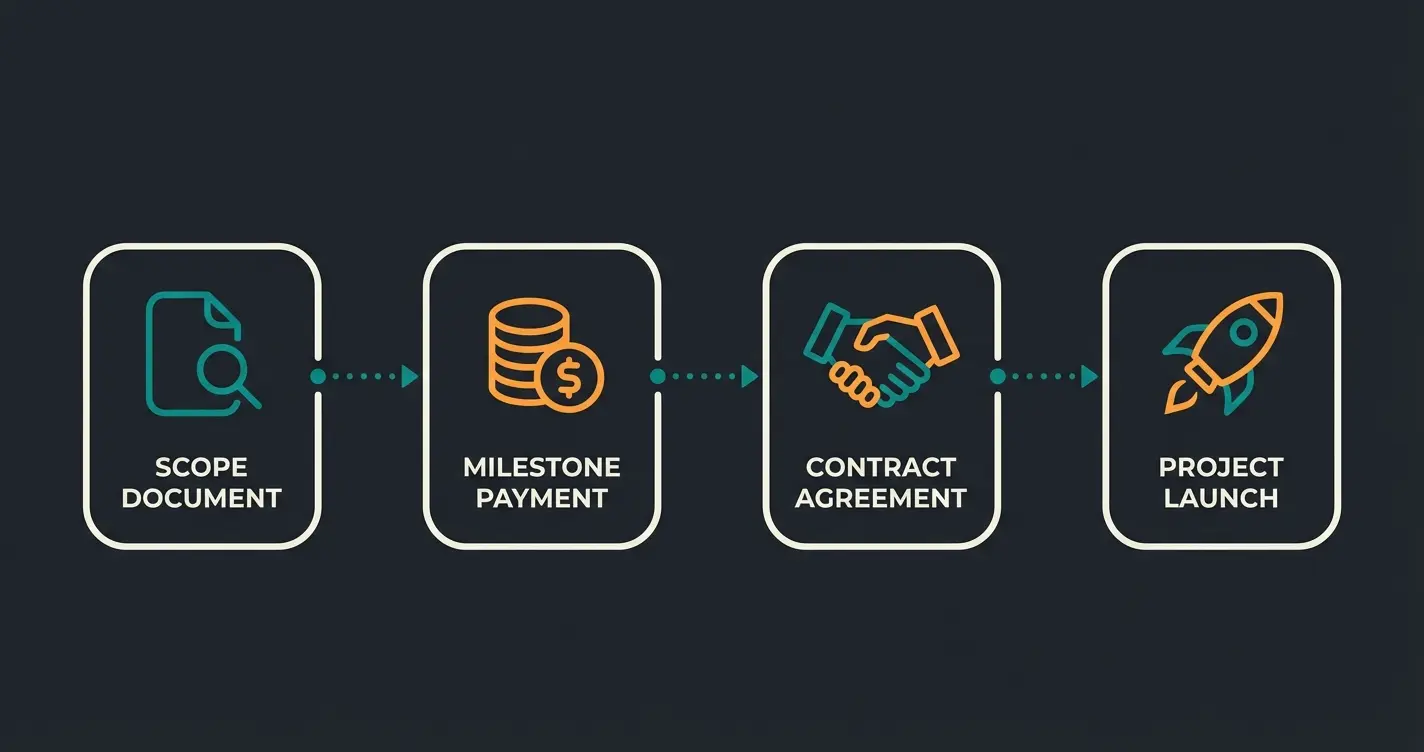
Finding the right developer is half the job. Structuring the engagement correctly determines whether the project actually delivers on time and within budget. These six elements should be defined and agreed upon before any code is written.
- Project scoping document - A detailed brief that defines goals, deliverables, timeline, and acceptance criteria. The developer should contribute to this document, not just receive it. If they do not ask clarifying questions about your requirements, that itself is a red flag.
- Milestone-based payments - Never pay 100% upfront. A typical structure: 25% at contract signing, 25% at design approval, 25% at development completion, 25% at launch and QA sign-off. This aligns incentives and gives you control at each stage.
- Contract with IP clauses - The contract should specify code ownership, confidentiality terms, termination conditions, and dispute resolution. For custom app development, ensure the contract explicitly states that all custom code becomes your property upon final payment. Do not assume this. Many standard developer contracts retain IP with the developer.
- Communication cadence - Weekly status updates at minimum. Define the tools (Slack, email, project management software) and expected response times for different priority levels. Async communication works well for development, but establish a regular sync call to maintain strategic alignment.
- Review and approval workflow - Define how you will review work before it goes live. Staging environments, user acceptance testing procedures, and formal sign-off steps prevent surprises at launch. Every change should be reviewable on a staging URL before touching the production store.
- Post-launch maintenance agreement - Separate from the project contract. This covers ongoing bug fixes, security updates, Shopify platform updates, and small feature additions. Typical retainer range: $500-2,000 per month depending on store complexity and support SLA requirements.
A well-built Shopify store brings visitors. An AI employee turns them into buyers. Qualimero's AI employees deliver real-time product advice, guided selling, and 24/7 customer support, increasing cart values by up to 35% for e-commerce stores.
Book a free demoHiring a Shopify developer is one of the highest-impact decisions you will make for your online store. The right developer accelerates your time to market, builds a technical foundation that scales with your business, and avoids the hidden costs of rework and technical debt. The wrong hire can set you back months and thousands of dollars. Take the time to define your project scope clearly, use the vetting checklist above, and match your hiring channel to your actual project complexity. The extra effort in the hiring process pays for itself many times over in project outcomes.
FAQ
Hourly rates range from $15-50 for junior developers to $100-200+ for senior specialists, depending on region and experience. Project-based pricing varies by scope: basic store setup costs $500-2,000, custom theme development $2,000-10,000, and custom app development $5,000-25,000+. The US average salary for a Shopify developer is approximately $109,905 per year (ZipRecruiter, March 2026).
The Shopify Partner Directory is the best starting point, with filters for location, service type, budget, and language. For a broader overview of working with Shopify agencies, see our Shopify Agency Guide. Platforms like Clutch.co also offer location-based filtering with verified reviews. That said, most Shopify development work can be done remotely, so proximity matters less than expertise, communication quality, and timezone overlap.
For anything beyond basic theme adjustments, yes. Certified Shopify Partners and experts bring platform-specific knowledge that generalist web developers lack: Liquid templating, Shopify's API ecosystem, checkout extensibility, and performance optimization patterns specific to the platform. The upfront cost is higher, but the reduced risk of technical debt and rework typically makes it the more economical choice over the project lifecycle.
A Shopify developer is anyone who writes code on the Shopify platform. A Shopify Expert is a professional who has been vetted and certified through Shopify's partner ecosystem, with demonstrated experience across multiple merchant projects and a verified track record. Experts typically offer strategic guidance alongside technical execution, while developers focus primarily on code implementation.
A basic store setup using an existing theme takes 1-2 weeks. Custom theme development requires 3-8 weeks depending on design complexity. Full custom builds with app development and third-party integrations can take 8-16 weeks. Platform migrations from WooCommerce or Magento typically run 2-6 weeks depending on catalog size and data complexity. Add 1-2 weeks for QA and soft launch.
Once your store is built, an AI employee handles product advice, cross-selling, and customer support around the clock. Qualimero clients see up to 7x higher conversion rates and 60% more completed checkouts.
Try Qualimero free for 14 days
Lasse is CEO and co-founder of Qualimero. After completing his MBA at WHU and scaling a company to seven-figure revenue, he founded Qualimero to build AI-powered digital employees for e-commerce. His focus: helping businesses measurably improve customer interaction through intelligent automation.