Shopify Partner 2026: Program, Tiers, Costs, and How to Find the Right One
Complete guide to the Shopify Partner ecosystem in 2026. Partner tiers, certification, costs, services, and how to find and evaluate the right partner for your store.

The Shopify Partner Program overview
The Shopify Partner Program is the official network Shopify runs for agencies, freelancers, developers, and consultants who build, manage, or extend stores on the platform. Registration is free, there are no monthly fees, and every partner gets immediate access to unlimited development stores with Advanced plan functionality. If you are still weighing up the platform itself, start with what Shopify is and how the hosted model works before you evaluate partners.
As of 2026, the ecosystem includes over 700,000 partners worldwide, 37,300 active app partners offering more than 16,000 public apps, and a total ecosystem revenue of $12.5 billion annually. The Shopify Partner Program splits into two tracks: the Service Track (agencies and freelancers) and the Technology Track (app and theme developers).
For merchants, this means access to a massive pool of specialists. For those looking to become a Shopify Partner, it means access to millions of Shopify merchants who need help with setup, design, development, or optimization. Shopify's GMV crossed $1 trillion cumulative in 2024, with $292 billion in that year alone, and revenue hit $8.88 billion, up 26% year-over-year. The platform is not slowing down, and neither is demand for qualified partners.
Shopify Partner tiers explained
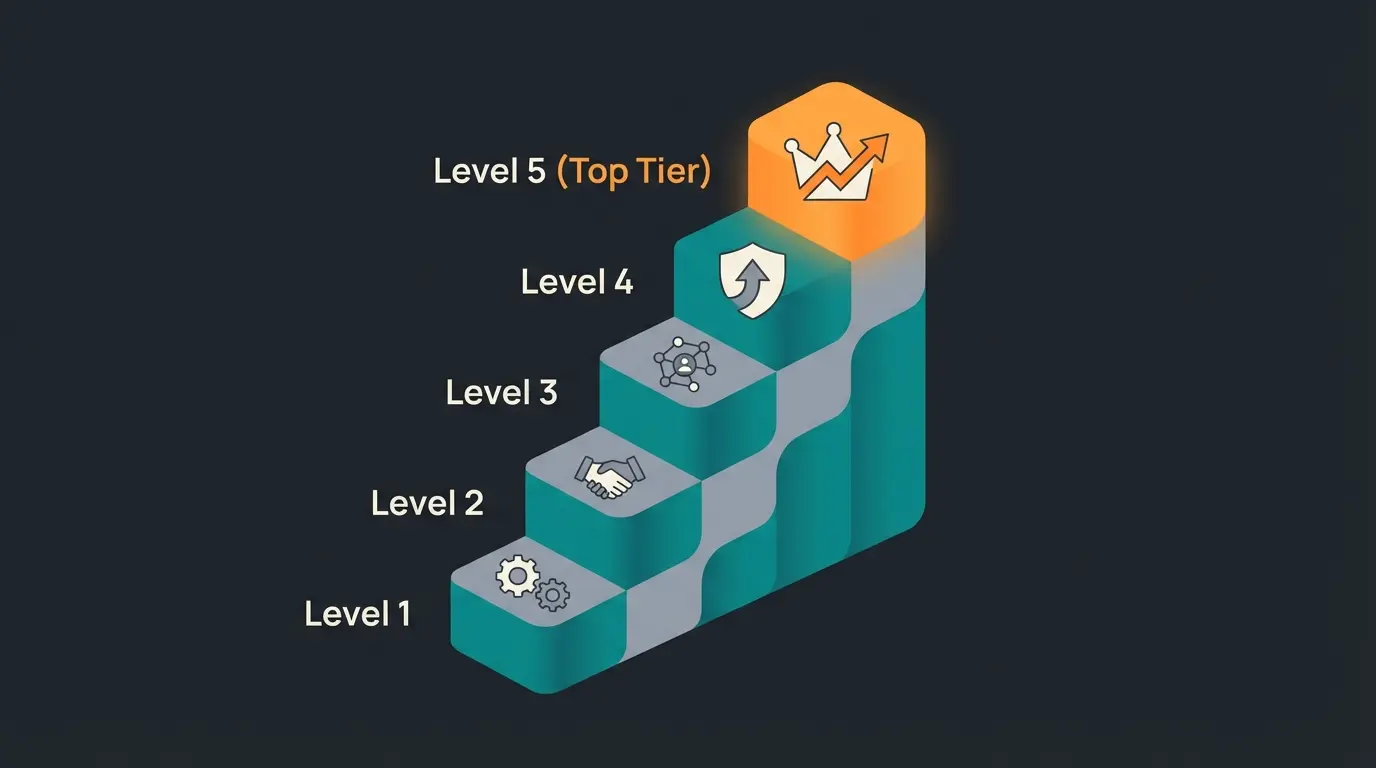
Shopify restructured its partner tiers in late 2024, replacing the old system with five levels in the Service Track. The tier a partner holds signals their volume of Shopify business and team certification level. It does not, on its own, guarantee quality for your specific project, but it narrows the field.
| Tier | Partners Worldwide | Requirements | Key Benefits |
|---|---|---|---|
| Registered | Entry level | Free sign-up | Dev stores, Academy, Dashboard |
| Select | ~505 | $500K+ cumulative revenue + Verified Skills | Directory listing, tier badge, priority support |
| Plus | ~451 | 5+ active Plus merchants + certifications | Plus Directory, co-sell, enhanced commissions |
| Premier | ~42 | Invitation only, enterprise-level | Personal account management, co-marketing |
| Platinum | ~14 | Invitation only, global enterprise | Bespoke growth, prioritized enterprise co-sell |
The tier assessment is based on two categories: Commercial Impact (trailing revenue attributed to Shopify from referred merchants over the past five years) and Credential Attainment (percentage of team members with Verified Skills). Both factors must meet minimum thresholds to advance. For more detail on how the program works, see the official partner program documentation.
The honest assessment from working with partners across all tiers: Select and Plus partners tend to deliver consistently because the tier requirements filter for operational maturity. But I have seen Registered partners with exceptional niche expertise outperform Premier partners on specific projects. Tier is a signal, not a guarantee.
Shopify Plus Partners: when you need one
If you are on Shopify Plus or planning the upgrade (starting at $2,300/month), you need a partner with Plus-specific experience. Shopify Functions, Checkout Extensions, B2B features, Script Editor, and multi-store setups are Plus-exclusive capabilities that require specialized knowledge. A regular partner without Plus experience will hit limitations quickly.
There are approximately 451 Plus Partners worldwide, which shows how selective this tier is: over 700,000 partners total, but fewer than 0.1% reach Plus status. The requirement is at least five active Shopify Plus clients with demonstrated positive outcomes. In the DACH region, well-known Plus Partners include Latori (Platinum tier), Tante-E, TOWA, valantic, and TechDivision.
Certification and Verified Skills
Shopify offers Verified Skills through the Partner Academy, covering Selling Fundamentals, Solution Planning, Development Fundamentals, and App Development. Each exam costs $99 per attempt, is online and proctored, with an 80% passing threshold. The courses themselves are free. Since the late 2024 restructure, Verified Skills are directly tied to tier advancement: without certified team members, no progress beyond Registered.
For merchants, certification is a trust signal but not a quality guarantee. I have seen certified partners deliver mediocre work and uncertified freelancers with excellent output. Certification proves someone knows the theory. References and portfolio prove they can deliver. Ask for both.
One detail worth knowing: since late 2024, Shopify has replaced the old 'Shopify Experts Marketplace' with the Partner Directory. The terminology shift matters because some partners still market themselves as 'Shopify Experts' based on the old system. The current equivalent is a Partner with Verified Skills at the Select tier or above. If someone claims 'Expert' status, ask which specific Verified Skills they hold and what tier they have reached.
Benefits of working with a Shopify Partner
The most direct benefit: expertise you do not have in-house. A qualified Shopify Partner has built dozens or hundreds of stores, encountered the same setup challenges you are facing, and solved them before. That accumulated experience translates directly into faster project timelines and fewer costly mistakes.
- Access to development stores where your partner builds and tests before anything goes live, reducing risk
- Priority Shopify support through partners at Select tier and above, meaning faster resolution when issues arise
- Partner-exclusive tools including Shopify Partner Dashboard, advanced analytics, and early access to new features
- Ongoing optimization through data-driven recommendations that a one-time setup cannot provide
- Faster implementation based on the EY Future Proofing Retail report, Shopify POS merchants see 20% faster implementation and 21% lower training costs when working with certified partners
- Reduced ongoing costs: the same EY report found 16% lower ongoing costs and 47% more cost-effective middleware expenses compared to competitor platforms
According to Shopify, one in three merchants on the platform actively seeks services from a partner for setup, design, or optimization. That ratio tells you something: even experienced e-commerce operators find value in specialized help. The complexity of modern Shopify stores, with apps, integrations, checkout customizations, and multi-market setups, has grown beyond what most merchants can efficiently manage alone.
The revenue share model (for aspiring partners)
Partners earn 20% recurring commission on every referred merchant's monthly subscription fee, indefinitely. Ten merchants on the Grow plan ($105/month) generate $210 in monthly passive income. A single Shopify Plus referral ($2,300/month) means roughly $460/month in recurring commission. On top of that, a current promotion (until March 2026) offers a $500 bonus per referral, capped at ten referrals ($5,000 total).
App developers pay 0% revenue share on the first $1 million in lifetime earnings (changed in January 2025 from an annual reset to a lifetime cap), then 15% above that threshold. Theme developers pay 15% on sales through the Shopify Theme Store, or 30% on self-distributed themes outside the store. For most developers, the store's built-in distribution makes the 15% cut worthwhile despite strict review requirements.
What services do Shopify Partners offer?
Shopify Partners cover the full spectrum of e-commerce services. The most common categories:
Store setup and migration is the entry point for most merchants. This includes theme selection and customization, product data migration from another platform, payment gateway configuration, and legal compliance (especially critical in EU/DACH markets). Increasingly it also covers sales channel connections, from Instagram Shopping to WhatsApp Business, which merchants selling into DACH markets often want configured before launch. A typical setup project runs $3,000-$15,000 depending on complexity.
Custom development covers everything beyond standard configuration: custom Shopify apps, API integrations with ERP/CRM systems, headless commerce builds, and checkout extensions using Shopify Functions. This is where you need a dedicated Hire Shopify Developer or Shopify Developer with deep technical expertise.
Ongoing optimization includes conversion rate optimization (CRO), SEO, A/B testing, app audits, and performance tuning. This is typically delivered through retainer agreements where a partner dedicates a fixed number of hours per month to your store. The ROI on optimization work is often higher than on the initial build: a 0.5% improvement in conversion rate on a store doing $500,000/year in revenue generates $2,500 in additional annual sales for every percentage point. A growing share of partners now bundle in AI assistants delivered as a service, which answer product questions directly in the storefront without adding headcount.
Strategic consulting means a partner evaluates your entire e-commerce operation, identifies bottlenecks, recommends solutions, and builds a roadmap. Engagements usually open with an audit of your current stack and close with a prioritized backlog you can execute in phases rather than all at once.
Maintenance and support is the service category most merchants underestimate at the start. After launch, your store needs regular updates: app compatibility checks, theme patches, Shopify platform updates, security audits, and seasonal preparation (Black Friday, holiday peaks). Stores that receive ongoing maintenance for at least six months post-launch consistently outperform those that do not, not because the initial code is better, but because someone is watching the data and making adjustments.
Migration services cover the technical process of moving from another platform (WooCommerce, Magento, BigCommerce, or a custom solution) to Shopify. This includes product data, customer records, order history, SEO redirects, and payment configuration. A botched migration can lose years of SEO equity overnight if 301 redirects are not handled correctly. This is one area where paying for experienced help genuinely pays for itself.
How much does a Shopify Partner cost?
Partner costs depend on three factors: the type of work, the partner's tier and experience level, and whether you are paying hourly, per project, or on retainer. Here is the realistic range:
| Service | Price Range | Typical Provider |
|---|---|---|
| Basic store setup (template-based) | $2,500-$7,000 | Freelancer or junior agency |
| Professional store build | $5,000-$15,000 | Agency |
| Custom theme development | $8,000-$25,000 | Specialized agency |
| Complex project (API, ERP, multilingual) | $15,000-$50,000+ | Plus Partner or dev team |
| Ongoing retainer (monthly) | $1,000-$5,000/month | Agency or expert |
| Single optimization (speed, SEO, CRO) | $1,000-$5,000 | Freelancer or expert |
| Hourly rate (US/EU agency) | $80-$200/hour | Full-service agency |
| Hourly rate (freelancer) | $50-$150/hour | Independent specialist |
One merchant I worked with expected $3,000 total for a Grow-plan store with custom integrations. The actual cost after app setup, legal compliance, and two rounds of design revisions: $8,500. The lesson: budget for 20-30% above initial estimates, especially for first-time builds.
Ongoing costs after launch
The store build is a one-time investment. The operation is a recurring cost. Shopify subscription ($39-$399/month), app stack ($50-$300/month), payment processing fees (2.4-2.9% + per-transaction fee), and optional maintenance retainers ($1,000-$5,000/month). Budget for these before committing to a partner, so you understand the total cost of ownership.
Three billing models dominate: project pricing (fixed fee for defined deliverables, risk sits with the partner), hourly billing (flexible but requires tight scope management), and retainer (monthly hour allocation, ideal for ongoing optimization). My recommendation: project pricing for the initial build with milestone-based payments, then a retainer for post-launch support.
Finding a Shopify Partner
The official starting point is the Shopify Partner Directory. Partners at Select tier and above can be listed there, filterable by specialization, region, pricing, and rating. The directory is useful for creating a shortlist, but it has limitations: many excellent smaller agencies and freelancers are not listed because the directory requires active application and at least five successful referrals in the last 12 months.
Beyond the directory, referrals from other merchants in your industry are often the best source. Industry-specific Slack communities, e-commerce conferences, and LinkedIn are where specialized partners tend to be visible. If you are searching in a specific German city, our guide to picking a Shopify Agency Munich walks through an evaluation process you can apply anywhere in the DACH region.
One thing the directory does not show: many excellent partners are not listed there. The listing requirement includes active application and at least five successful referrals in the last 12 months. Smaller, highly specialized agencies and freelancers often do not meet that volume threshold but deliver outstanding work in their niche. Do not limit your search to the directory alone.
How to evaluate potential partners
Four criteria separate good partners from mediocre ones. First: industry experience. A partner who has built stores in your niche knows the typical challenges (product data structures, consultation-heavy categories, seasonal patterns) and does not need to learn on your project.
Second: transparent pricing. Any serious partner can give you a binding quote with a clear scope of work before the project starts. If the answer to your budget question is "it depends" without a concrete range, keep looking.
Third: references with measurable results. Not just screenshots of attractive stores, but numbers: conversion rate before and after, page speed improvement, revenue growth post-launch. Fourth: structured communication. Regular updates, defined points of contact, documented decisions. A project without structured communication almost always ends in delays and frustration.
A fifth criterion that often gets overlooked: post-launch support model. Ask before signing: what happens after the store goes live? Is there a warranty period for bugs found after launch? What are the terms for ongoing support? How quickly do they respond to urgent issues? The answers reveal whether you are getting a transactional vendor or a genuine long-term partner.
Developers, designers, agencies, and consultants
Available in the Shopify App Store, 4x larger than any competitor
Annual total revenue generated by Shopify Partners
Earned on every referred merchant's subscription, indefinitely
Shopify Partner vs Freelancer vs Agency
This is the decision that determines whether you overspend or underspend on your Shopify project. The most common mistake: hiring a full-service agency for a task a freelancer could handle in ten hours. Or the reverse: bringing in a cheap freelancer for a project that requires strategic consulting and ongoing support. The choice depends on project complexity, budget, and how much internal capability you have.
| Factor | Freelancer | Agency | Shopify Expert |
|---|---|---|---|
| Best for | Defined tasks, clear scope | Full-service, complex builds | Specialized challenges |
| Typical cost | $50-$150/hour | $80-$200/hour | $75-$175/hour |
| Project size | $1,000-$7,000 | $5,000-$50,000+ | $2,000-$15,000 |
| Communication | Direct, fast | Account manager, structured | Direct, expert-level |
| Ongoing support | Ad-hoc, limited | Retainer model, comprehensive | Project-based |
| Team depth | Solo, one skill set | Multi-disciplinary team | Deep in one domain |
| Risk | Single point of failure | Lower (team coverage) | Low for specialized work |
| Ideal merchant | Budget-conscious, clear requirements | No internal team, needs strategy | Knows what they need fixed |
The rule of thumb: the more complex the project and the less internal know-how you have, the more you need a Shopify Agency or certified Shopify Expert. For well-defined technical tasks with a clear deliverable, a Shopify Freelancer is the better choice because overhead is lower and communication is faster.
A nuance worth noting: many merchants start with a freelancer for the initial setup, then transition to an agency once the store generates enough revenue to justify a retainer. This staged approach controls costs in the early phase while ensuring professional support scales with the business. The key is planning for that transition from the start, so you do not end up locked into a freelancer setup that does not scale.
For merchants with very specific technical needs, such as a custom app for inventory management or a headless commerce build, the right choice is often a specialized developer rather than a generalist agency. An agency will subcontract that work anyway and mark it up. Going directly to a Shopify Developer for technical builds can save 20-40% on development costs while getting more direct communication with the person actually writing the code.
Checklist: choosing the right Shopify Partner
- At least three reference projects of similar size and industry
- Transparent quote with defined scope and timeline
- Verified Skills or certifications in the relevant area
- Clearly defined points of contact and communication cadence
- Experience with your Shopify plan level (Basic, Plus, etc.)
- Measurable results: conversion rate, page speed, revenue impact
- Post-launch support model defined (retainer, ad-hoc, managed)
- EU/DACH compliance knowledge if selling in those markets
A Shopify Partner builds your store. An AI employee from Qualimero advises your customers in real-time, recommends products, and increases cart value by up to 35%. Our clients see 7x higher conversion rates.
Book a free demoFAQ
The Shopify Partner Program is Shopify's official network for agencies, freelancers, and developers who build and manage Shopify stores. It is free to join, includes unlimited development stores, and offers 20% recurring commission on referred merchants.
Agency rates range from $80-$200/hour, freelancers charge $50-$150/hour. Project-based pricing starts at $2,500 for a basic store setup and goes to $50,000+ for complex builds with custom integrations. Monthly retainers typically cost $1,000-$5,000.
A Shopify Plus Partner is a tier-three partner (out of five) who has demonstrated success working with at least five active Shopify Plus merchants. There are approximately 451 Plus Partners worldwide. They have access to the Plus Directory, enhanced co-sell opportunities, and dedicated Shopify support.
For a basic store with a standard theme and few products, Shopify's own documentation may be enough. Once you need custom design, integrations, legal compliance for EU/DACH markets, or ongoing optimization, a partner saves time and avoids costly mistakes that are harder to fix later.
Start with the Shopify Partner Directory (shopify.com/partners/find-a-partner), which lists partners from Select tier and above. For regional specialists, ask for referrals from other merchants in your industry, check LinkedIn, or attend e-commerce events and meetups.
Every Shopify Partner has registered for the program. A Shopify Expert has earned Verified Skills (certifications), has a proven track record, and is often specialized in a specific area like conversion optimization, theme development, or ERP integration. The Expert designation signals tested knowledge.
A great Shopify Partner builds your store. An AI employee turns visitors into buyers. Qualimero advises customers automatically, recognizes purchase intent, and increases checkout rates by up to 60%.
See how it works
Lasse is CEO and co-founder of Qualimero. After completing his MBA at WHU and scaling a company to seven-figure revenue, he founded Qualimero to build AI-powered digital employees for e-commerce. His focus: helping businesses measurably improve customer interaction through intelligent automation.