Shopify Dropshipping: The Ultimate Guide for High-Conversion Stores
Master Shopify dropshipping in 2026: Learn consultative selling, AI sales agents, legal requirements, and conversion strategies for sustainable success.

Why the Old Dropshipping Model Is Dead (And What Works Now)
If you search for Shopify dropshipping in 2026, you'll likely be bombarded with YouTube videos promising overnight riches through trendy gadgets. The reality, however, looks quite different. The e-commerce market has become one of the most demanding in the world. Customers are skeptical, price-sensitive, and exceptionally well-protected by privacy regulations and consumer protection laws.
The "old" model—cheap goods via AliExpress, long shipping times, and generic product descriptions—is dying out. Customer Acquisition Costs (CAC) on platforms like Meta and TikTok have skyrocketed, and without a strong conversion strategy, you're simply burning money. According to industry research from Bitkom, return rates have become a significant profit killer for online retailers.
The good news: Dropshipping as a logistics model is more alive than ever. But the strategy has fundamentally shifted. We're now in the era of "Consultative Dropshipping." Instead of simply throwing customers onto a product page, successful stores in 2026 use artificial intelligence to actively advise customers, similar to a salesperson in a brick-and-mortar retail store. Implementing AI e-commerce strategies has become essential for staying competitive.
This guide isn't a get-rich-quick manual. It's a blueprint for building a sustainable, legally compliant e-commerce business that relies on trust, technology, and genuine value creation.
What Is Shopify Dropshipping? (The 2026 Fundamentals)
Before we dive into advanced strategies, let's clarify the foundation. Shopify dropshipping is a business model where you operate an online store without physically storing the products.
- The customer places an order in your Shopify store (e.g., an ergonomic office chair for $400).
- Your store automatically forwards the order to the supplier.
- The supplier packages and ships the product directly to the customer.
Pros and Cons in the Modern E-Commerce Context
| Advantages | Disadvantages & Risks |
|---|---|
| Low startup capital: No warehouse costs, no upfront inventory purchases. | Return rates: Customers return approximately 11% of all goods. You bear the risk and cost of returns. |
| Scalability: With Shopify, you can expand your product range in minutes. | Shipping times: Customers expect delivery in 1-3 days. Direct shipping from China is barely accepted anymore. |
| Location independence: The business can be managed from anywhere. | Legal hurdles: Imprint requirements, packaging regulations, and warranty obligations fall on you, not the supplier. |
Is Dropshipping Legal? (The Trust Factor)
One of the most common questions is: "Is dropshipping legal?" The answer is a clear yes—provided you follow the rules. Customers often check the imprint first before making a purchase. Legal compliance isn't just protection against cease-and-desist letters; it's a massive conversion lever. According to Shopify's official guidelines, following proper business setup procedures is essential for success.
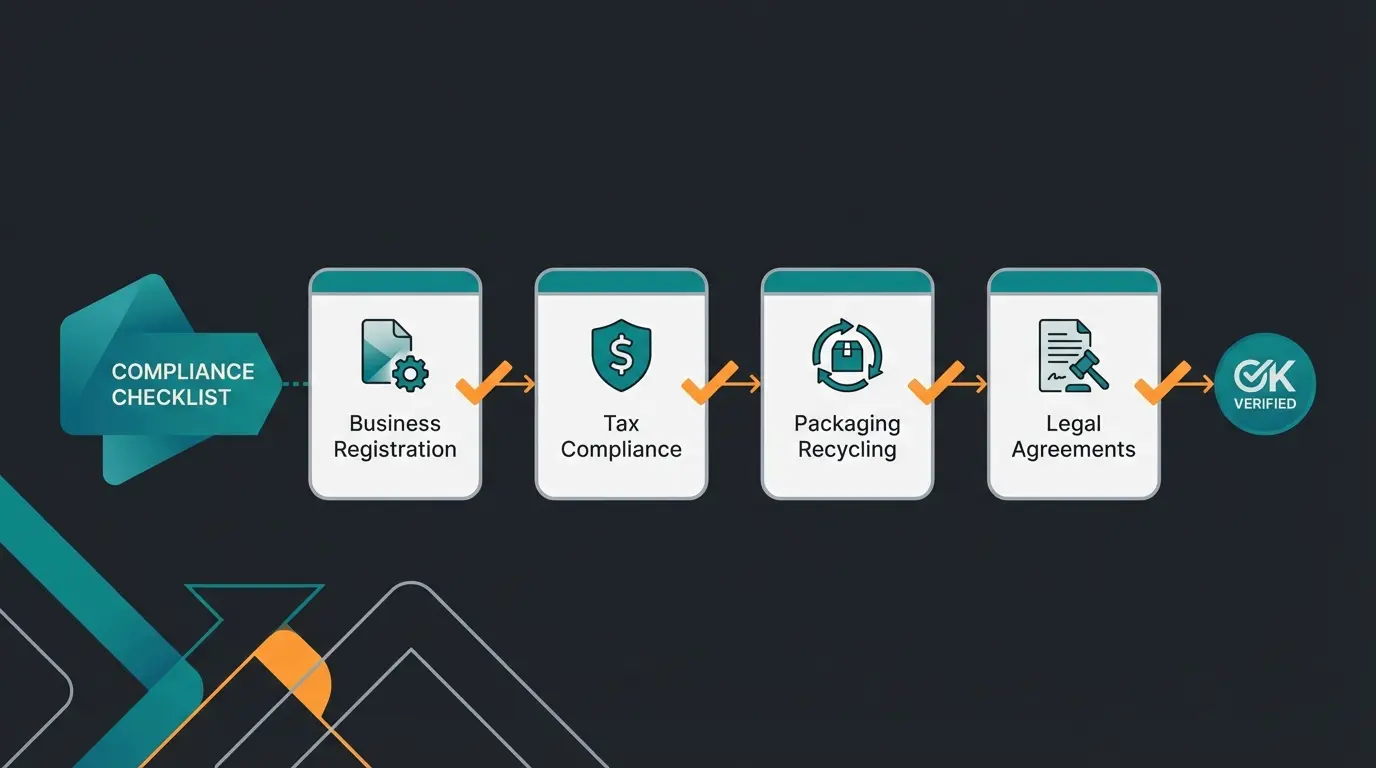
Here's your checklist for a legal start, supported by resources from easySync and Finom:
1. Business Registration
Before you earn your first dollar, you must register your business. Depending on your jurisdiction, this might be at your local business registration office, often available online. Costs typically range between $15 and $65, depending on the municipality, as noted by FTD. The registration process is straightforward—you'll automatically receive correspondence from tax authorities for fiscal registration afterward.
2. Tax Registration & Sales Tax Procedures
You must collect and remit sales tax. If you're selling goods internationally, familiarize yourself with the relevant tax procedures for your target markets. In the EU, for example, the OSS (One-Stop-Shop) procedure allows you to centrally report VAT across different EU countries.
3. Packaging Regulations
Anyone shipping goods (or having them shipped) must pay for packaging disposal. According to Deutsche Recycling, this typically involves registration with a packaging registry and licensing with a dual system provider. Costs often start at around $25-100 per year depending on volume, according to Recycling Dual. Without proper registration, you risk significant fines and sales bans.
4. Legal Texts (Imprint, Terms, Cancellation Policy)
Never copy terms and conditions from other sites. Use professional legal services that offer Shopify integrations and automatically update your texts when laws change. This protects you from expensive legal disputes and builds customer trust.
Step-by-Step Shopify Dropshipping Guide: Building Professional Stores
Forget the "20-minute shop setup" videos. A Shopify dropshipping business that survives 2026 requires a solid foundation. Following this comprehensive step-by-step approach will set you up for long-term success.
Step 1: Niche Selection – High-Ticket & Problem Solvers
The market for cheap gadgets (like "Galaxy Rose" or "UFO Drone") is oversaturated. The margins are too small to cover rising advertising costs.
The strategy: Focus on high-ticket dropshipping (products with selling prices of $150+) or specialized niches. Research from Dropship Stores Down Under confirms this approach yields better results.
Potential niches for 2026:
- Home Office Ergonomics: Height-adjustable desks, ergonomic chairs (customers need advice on body size/weight capacity).
- Specialized Hobbies: Pottery kilns, CNC machines for DIY enthusiasts, high-quality hydroponic systems.
- Mobility: E-bike accessories or high-quality automotive parts (e.g., carports).
Another compelling model gaining traction is Print on Demand with Shopify, where you sell custom-designed products without holding inventory. It combines creative freedom with the dropshipping logistics advantage and works especially well in niches like personalized home decor or branded fitness accessories.
Why high-ticket? With a $500 product and 30% margin, you have $150 for advertising (CPA). With a $20 product at 30% margin, you only have $6—that's barely enough for a click on Facebook/Instagram anymore.
Step 2: Shopify Setup & Costs
Shopify remains the best platform for dropshipping. According to WeDoWebsites and Ecom Flow, here's what you need to know:
- Plan: The "Basic Shopify" plan is completely sufficient for starting out.
- Costs 2025/2026: Expect approximately $27 to $36 per month for the Basic plan.
- Important: Choose a fast, clean theme (e.g., "Dawn" - free). Overloaded themes kill conversion rates on mobile devices.
Step 3: Finding Suppliers (EU vs. China)
To guarantee 1-3 day shipping times, you should prefer European suppliers or use agents who hold inventory in EU warehouses. A well-structured Shopify fulfillment strategy is essential for keeping delivery promises.
- Tools: Zendrop, Spocket, or Syncee offer filters for "Ships from EU/Germany."
- Quality check: Always order a test product. If the quality isn't right, your business is dead before it starts.
Step 4: The Game Changer – Your Sales Infrastructure
This is where most fail. They build a shop, import products, and run ads. The problem: A visitor comes to your page, has a question ("Does this roof rack fit my 2022 Audi?"), finds no answer, and leaves. The solution: Install an AI sales consultant (see next section). This is where Shopify AI sales strategies become critical for success.
Choose high-ticket products ($150+) or specialized niches where customers need consultation before buying.
Set up Basic plan ($27-36/month), select fast theme, configure payment options and legal pages.
Connect with EU-based suppliers via Zendrop/Spocket, order test products for quality verification.
Install AI product consultant to answer customer questions instantly and guide purchasing decisions.
Marketing & Conversion: The Consultation First Strategy
This is your "Blue Ocean." While your competition tries to sell on price, you sell through consultation. Understanding how to optimize customer service is essential for implementing this approach effectively.
The Problem: The "Silent" Website
In brick-and-mortar retail, visitors convert at 20-30% because a salesperson approaches them. In e-commerce, the conversion rate is often only 1-3%, according to WebIProg, because customers are left alone with their questions.
The Solution: AI Sales Agents
Use apps like Rep AI, Tidio Lyro, or Vanchat as recommended by Shopify's app marketplace and reviewed by AskTimmy AI. These aren't dumb chatbots that only answer "Where is my order?" They're sales assistants based on GPT-4 or similar models that know your entire product catalog. For more insights on choosing the right solution, explore the best Shopify Apps available today.
The difference between basic automation and intelligent AI product consultation is substantial. While rule-based bots follow rigid scripts, AI sales agents understand context and provide personalized recommendations.
Standard Chatbot vs. AI Sales Agent Comparison
| Feature | Standard Chatbot (Rule-Based) | AI Sales Agent (2026 Standard) |
|---|---|---|
| How It Works | Responds to keywords ("shipping", "return"). | Understands context and complex questions. |
| Goal | Reduce support tickets. | Close the sale (conversion). |
| User Experience | "Press 1 for shipping." (Frustrating) | "For your back pain, I recommend Model X because it has lumbar support." |
| Impact | Neutral to negative for sales. | Significantly increases conversion rate. |
Why This Reduces Returns
The return rate in online retail averages around 11%, with fashion reaching up to 50%. The main reasons are "doesn't fit" or "article not as expected." When an AI consultant helps customers before purchase to choose the right size or model, the likelihood of a wrong decision drops dramatically. Implementing AI-powered prevention strategies and AI prevention strategies has proven highly effective.
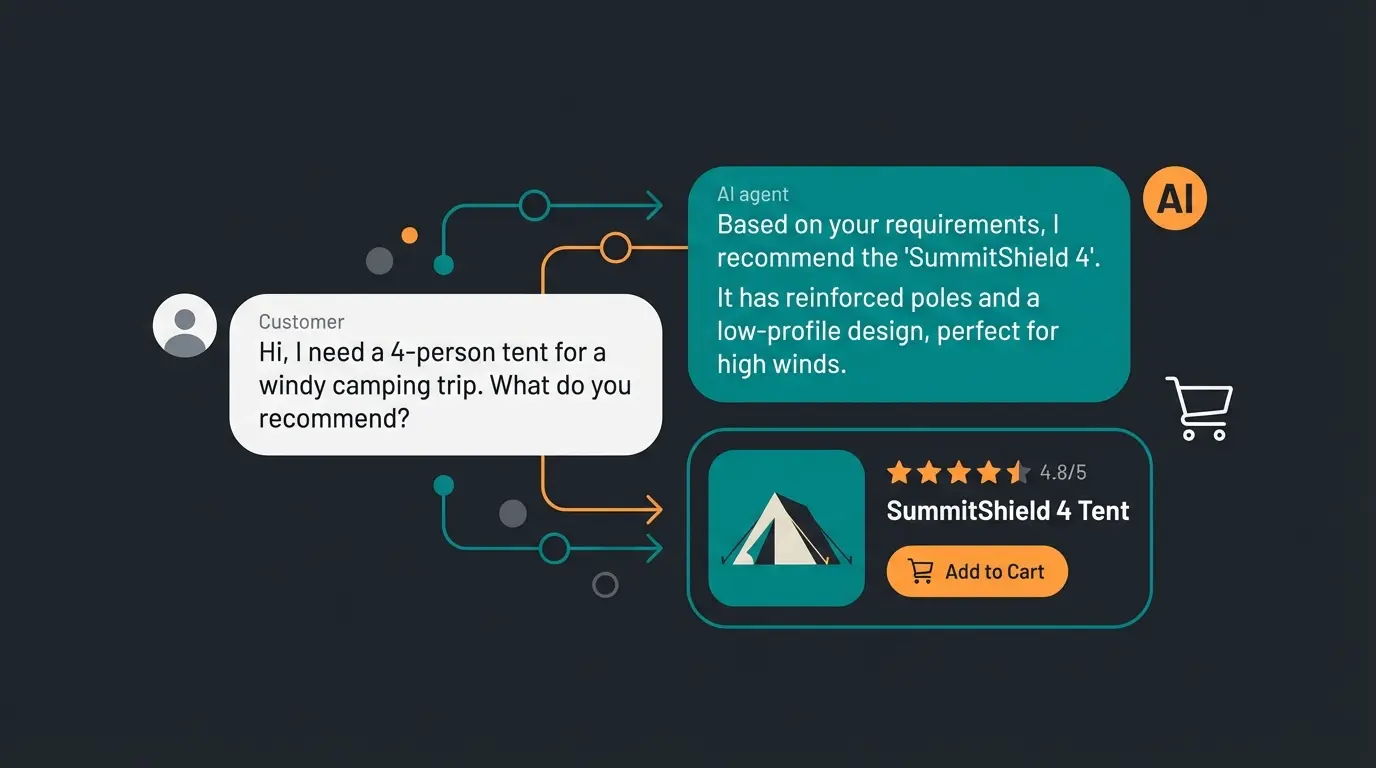
Scenario: A customer is looking for a tent.
- Without AI: They buy the cheapest one, realize during setup it's not waterproof enough -> Return.
- With AI: The bot asks: "What will you use the tent for?" Customer: "Festival, it might rain." Bot: "Then don't take Model A, but Model B with 3000mm water column." -> Satisfied customer, no return.
Brick-and-mortar retail conversion rate with sales assistance
Typical online store conversion without consultation
Decrease in returns with AI pre-purchase consultation
AI agent answer speed vs. 24h email wait
Stop losing customers to unanswered questions. Our AI sales consultant answers product queries instantly, recommends the right products, and reduces returns—all while you sleep.
Start Your Free TrialScaling Your Dropshipping Business
Once the first sales from your dropshipping with Shopify store are generated, it's time for optimization. This is where AI customer service capabilities become invaluable for growth. Merchants exploring wholesale channels may also benefit from Shopify B2B functionality.
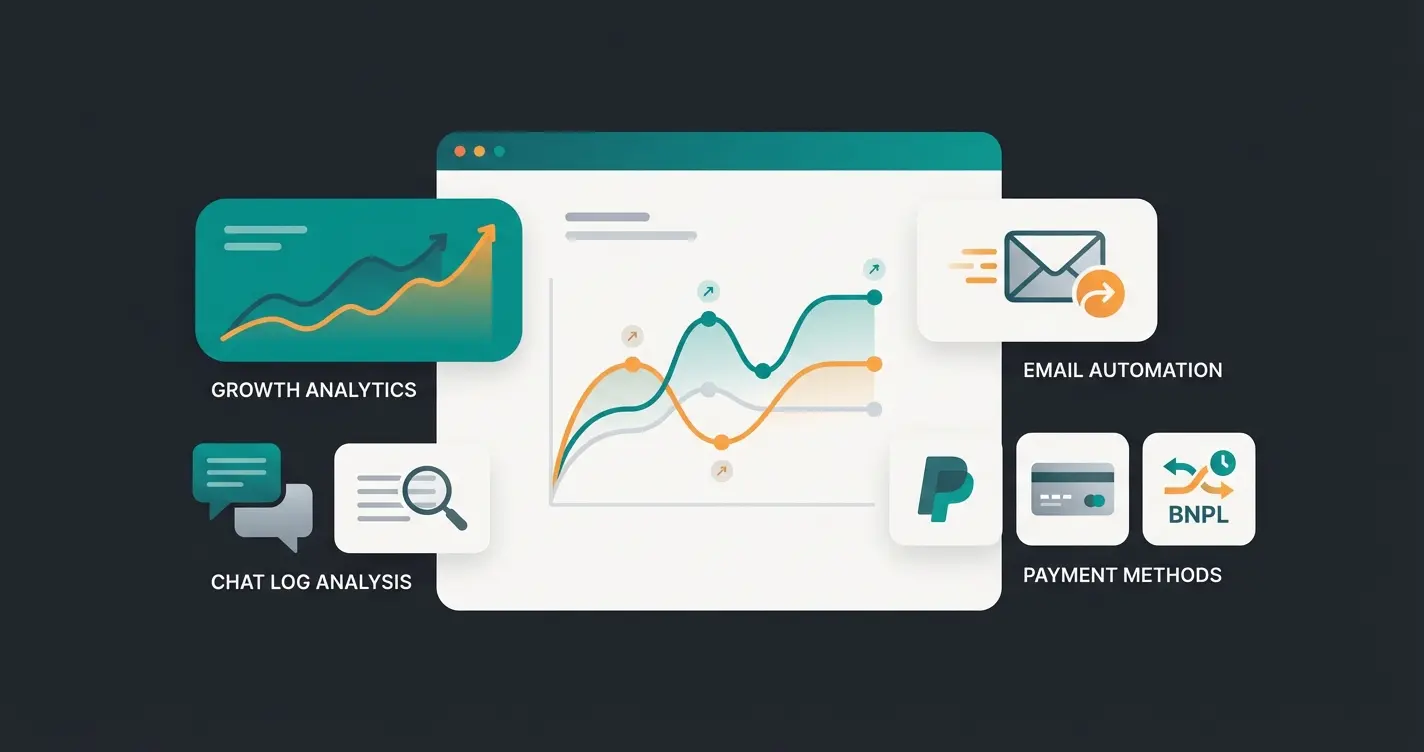
1. Data Analysis from Chat Logs
Your AI chatbots are a goldmine for market research. Read the chat logs carefully. Implementing AI consultation boosts your ability to understand customer needs.
- Do customers repeatedly ask about a product's weight? -> Add this info prominently to the product description.
- Do customers often compare your product with a competitor? -> Create a comparison table on the landing page.
2. Post-Cookie Marketing
Since tracking has become more difficult due to privacy regulations and iOS updates, "first-party data" has become more important. When a customer chats with your AI, they're engaging. Use tools like Klaviyo to continue nurturing these leads (with permission) via email if they don't buy immediately. AI sales consultation can also extend to messaging platforms for continued engagement.
3. Optimizing Payment Methods
The checkout process is critical. According to Frisbii and EHI, payment preferences vary significantly by market:
- PayPal: A must-have. Over 90% of consumers use it. It's the most popular payment method in many markets.
- Buy Now, Pay Later: Extremely popular (often ranking #2 by revenue). Through Shopify Payments or Klarna, this can be integrated risk-free (Klarna assumes the default risk).
- Credit Card: Important but less dominant than in the US, particularly in European markets, as confirmed by Websei.
Exploring AI integration sales channels and AI product consultation tools can further enhance your scaling efforts.
The Evolution of Dropshipping: From Ads to AI
Understanding how dropshipping has evolved helps contextualize why consultative selling is now essential. The market has undergone dramatic shifts in strategy and customer expectations.
Mass advertising on Facebook, cheap products from China, minimal customer service, race-to-the-bottom pricing.
Social proof through influencers, branded dropshipping, improved product quality, but still lacking personalization.
iOS updates and GDPR disrupted tracking, CAC increased significantly, first-party data became valuable.
AI sales agents provide instant expertise, consultative selling reduces returns, customer experience drives conversion.
Standard Store vs. AI-Enhanced Store Comparison
To truly understand the competitive advantage of AI-enhanced stores, let's compare the customer experience across key touchpoints:
| Scenario | Standard Store | AI-Enhanced Store |
|---|---|---|
| Customer has a product question | Sends email, waits 24 hours for response | Gets answer and product link in 5 seconds |
| Complex product comparison needed | Browses multiple pages, often leaves confused | AI asks clarifying questions, recommends best fit |
| Customer unsure about sizing | Checks size chart, often guesses wrong | AI asks about body measurements, confirms compatibility |
| Post-purchase support | Ticket system with 1-2 day response | Instant tracking, troubleshooting, and satisfaction check |
| Monthly support costs | $500-2000 for human agents | $50-200 for AI with human escalation |
| Conversion rate impact | Baseline 1-3% | 3-8% with active AI engagement |
FAQ: Common Questions About Shopify Dropshipping
Realistically, you should start with $500 to $1,000 in 2026. This breaks down to: Business registration & legal texts (~$100), Shopify Basic for 3 months (~$100), Apps & tools (~$50), Test orders (~$50-100), and Advertising budget for testing (~$200-500). It's possible to start with less, but that increases the risk of failure due to insufficient testing and marketing budget.
The Basic Shopify Plan (approximately $27-36/month) is sufficient for 99% of all beginners. Only upgrade to the "Shopify" or "Advanced" plan when your revenue is high enough that the lower transaction fees of the more expensive plans justify the higher monthly costs (usually from around $5,000-10,000 monthly revenue).
Focus on four key areas: 1) Precise product descriptions with hard facts (dimensions, material, weight) instead of marketing fluff. 2) High-quality images/videos showing the product in use, not just renderings. 3) Active consultation using AI tools to clarify questions before purchase. 4) Quality control by testing every product yourself before selling it.
Yes, but the margins in the "low-ticket" segment (cheap impulse purchases) have been eaten up by advertising costs. High-ticket dropshipping and consultative dropshipping are the profitable models of the future because they enable higher average order values (AOV) and better customer retention.
Regular chatbots are rule-based and respond to specific keywords with pre-programmed answers. AI sales agents use advanced language models to understand context, ask clarifying questions, and provide personalized product recommendations. They act like knowledgeable salespeople rather than FAQ databases, actively driving conversions instead of just deflecting support tickets.
Conclusion: Your Path to E-Commerce Success
Shopify dropshipping has evolved from a "get-rich-quick" scheme to a serious e-commerce entry point. The key to success in 2026 no longer lies in finding a "secret product" but in building trust.
By cleanly navigating legal hurdles, focusing on quality, and using artificial intelligence to provide genuine consultation to your customers, you differentiate yourself from 90% of the competition. You're not building a "dropshipping store"—you're building a specialty shop that happens to use dropshipping as logistics.
Start today:
- Register your business and ensure legal compliance.
- Choose a niche where consultation adds real value.
- Integrate an AI sales agent into your Shopify store.
The market is waiting for merchants who solve problems instead of just pushing products. Be one of them.
Join thousands of successful store owners using AI-powered sales consultation to increase conversions and reduce returns. Get started in minutes with our easy integration.
Launch Your AI Sales Agent
Lasse is CEO and co-founder of Qualimero. After completing his MBA at WHU and scaling a company to seven-figure revenue, he founded Qualimero to build AI-powered digital employees for e-commerce. His focus: helping businesses measurably improve customer interaction through intelligent automation.