Shopify Print on Demand: Apps, Costs, and Setup
Compare the best Shopify print on demand apps with real profit margins and step-by-step store setup. Includes provider comparison table and cost breakdown for 2026.

What is print on demand with Shopify?
Print on demand is a fulfillment model where products are manufactured only after a customer places an order. You design the product, a third-party provider prints it, and they ship it directly to the buyer. No warehouse, no bulk purchasing, no unsold inventory gathering dust in a spare room.
Shopify connects to over 200 POD apps through its Shopify Print on Demand Marketplace, making it the largest platform ecosystem for this business model. When a customer buys a custom hoodie from your store, the order routes automatically to your chosen provider. They print it, pack it, and ship it under your brand name, and you never touch the product. If you are still weighing up the platform itself, start with what Shopify is and how its pricing tiers work.
The difference between POD and traditional Shopify Dropshipping comes down to customization. Standard dropshipping resells existing products from suppliers. POD lets you create original designs on blank products, from t-shirts to phone cases to wall art. That means stronger brand identity, higher margins, and products that cannot be directly price-compared on Amazon.
Upload artwork to your POD provider's mockup generator. Preview how it looks on each product type.
Sync products with one click. Set your retail price, write descriptions, and publish the listing.
Shopify processes the payment and automatically forwards the order details to your POD provider.
The provider manufactures the product, packs it with your branding, and ships it directly to the customer.
You keep the difference between your retail price and the provider's base cost plus platform fees.
The global print on demand market reached $12.96 billion in 2025 and is projected to grow at a compound annual rate of 23-26% through 2034 (Precedence Research). North America accounts for 36% of that market (Grand View Research, 2025). This is not a speculative niche anymore. It is a proven e-commerce model with a maturing infrastructure.
The risk profile is genuinely different from traditional e-commerce. You pay nothing until a sale happens. No minimum order quantities, no dead stock risk, no upfront manufacturing investment. The tradeoff: lower per-unit margins compared to bulk wholesale, and less control over production timelines. That tradeoff is worth it for most sellers who are testing a brand concept or entering e-commerce for the first time.
Best print on demand apps for Shopify
I have tested dozens of POD providers over the past three years, building test stores and ordering samples from each one. Most of them promise the same things. The differences show up in print quality consistency, fulfillment speed under real load, and how smoothly the Shopify integration handles edge cases like address errors or out-of-stock variants. Here are the six providers that consistently deliver.
| Provider | Products | Base price (t-shirt) | Fulfillment | Global reach | Shopify rating | Free plan |
|---|---|---|---|---|---|---|
| [Printful](https://www.printful.com) | 340+ | $8.95-$13.95 | 2-5 days | US, EU, MX facilities | 4.8/5 (2,400+ reviews) | Yes |
| [Printify](https://printify.com) | 1,300+ | $5.32-$12.68 | 2-7 days | 90+ print providers worldwide | 4.8/5 (2,500+ reviews) | Yes (Premium $24.99/mo) |
| Gelato | 500+ | $7.64-$11.50 | 3-5 days | 140+ facilities in 32 countries | 4.8/5 (575+ reviews) | Yes (Plus $32/mo) |
| SPOD | 200+ | $6.50-$9.00 | 48 hours avg | US and EU | 4.5/5 (130+ reviews) | Yes |
| Gooten | 500+ | $6.00-$12.00 | 1-4 days | Vetted global partner network | 3.5/5 (130+ reviews) | Yes |
| CustomCat | 300+ | $7.00-$10.50 | 2-3 days | US-focused, international available | 4.5/5 (90+ reviews) | Yes |
Printful: best for brand control and quality
Printful manufactures everything in-house across facilities in the US, Europe, and Mexico. That means consistent print quality across orders, which matters more than most beginners realize. One bad print on a $30 hoodie does not just cost you the refund. It costs you the customer and the review.
Their mockup generator is the best in the industry, their branding options (custom labels, pack-ins, branded packaging) are unmatched, and their Shopify integration runs without surprises. The design tools include an AI upscaler and a comprehensive template library.
The downside: Printful's base prices are the highest on this list. A basic t-shirt starts around $8.95. If you are competing purely on price, that eats into your margins. If you are building a brand where quality and unboxing experience justify a premium retail price, Printful earns every cent.
Printify: best product variety and pricing flexibility
Printify takes a marketplace approach. Instead of printing in-house, they connect you to over 90 third-party print providers worldwide. The advantage: 1,300+ products (the largest catalog in the POD space by a wide margin), competitive base prices, and the ability to choose suppliers by location, speed, or quality rating.
The tradeoff is consistency. Quality varies between suppliers. I have had excellent results with some Printify partners and mediocre results with others. Always order samples before committing to a supplier. Their Premium plan at $24.99/month unlocks up to 20% discount on all products, which pays for itself quickly once you are doing more than a handful of orders per week.
Gelato: best for international fulfillment
Gelato operates 140+ production facilities across 32 countries. Their routing algorithm matches each order to the closest facility, which cuts both delivery times and carbon emissions. About 90% of Gelato orders reach customers within 5 days. If your audience is spread across multiple countries, Gelato consistently delivers the fastest international shipping of any provider on this list.
SPOD, Gooten, and CustomCat: specialized alternatives
SPOD (by Spreadshirt) averages 48-hour production times, making it the fastest provider for US and EU orders. Gooten offers 500+ products including 150 exclusive items not available elsewhere, particularly strong in home decor. CustomCat stands out with its proprietary DIGISOFT printing technology for more vibrant, durable prints, and unique access to branded products from companies like Under Armour and Puma.
How much does print on demand cost on Shopify?
The real cost of running a POD store on Shopify is not a single number. It is a stack of fees that compound differently depending on your plan, your provider, and your sales volume. Here is the full breakdown with actual dollar amounts. For the complete platform fee structure, see the detailed Shopify Fees guide.
| Cost category | Amount | Notes |
|---|---|---|
| Shopify subscription | $39/month (Basic) | Starter plan at $5/mo lacks a full online store. Basic is the minimum for serious POD selling. |
| POD app subscription | $0-$32/month | Printful and Printify free plans cover most needs. Gelato Plus at $32/mo and Printify Premium at $24.99/mo add discounts and features. |
| Transaction fees | 2.9% + $0.30 per sale | Using Shopify Payments on Basic. Lower on higher plans: 2.6% + $0.30 on Shopify ($105/mo), 2.4% + $0.30 on Advanced ($399/mo). |
| Per-item production | $5-$28 per product | T-shirt: $6-$14. Hoodie: $18-$28. Mug: $4-$8. Poster: $3.50-$8. This is your largest variable cost. |
| Shipping | $3-$8 domestic, $8-$20 intl | Most sellers build shipping into retail price or offer free shipping above a threshold. |
| Domain | ~$14/year | A custom .com domain is essential for brand credibility. Available directly through Shopify. |
Real margin calculations
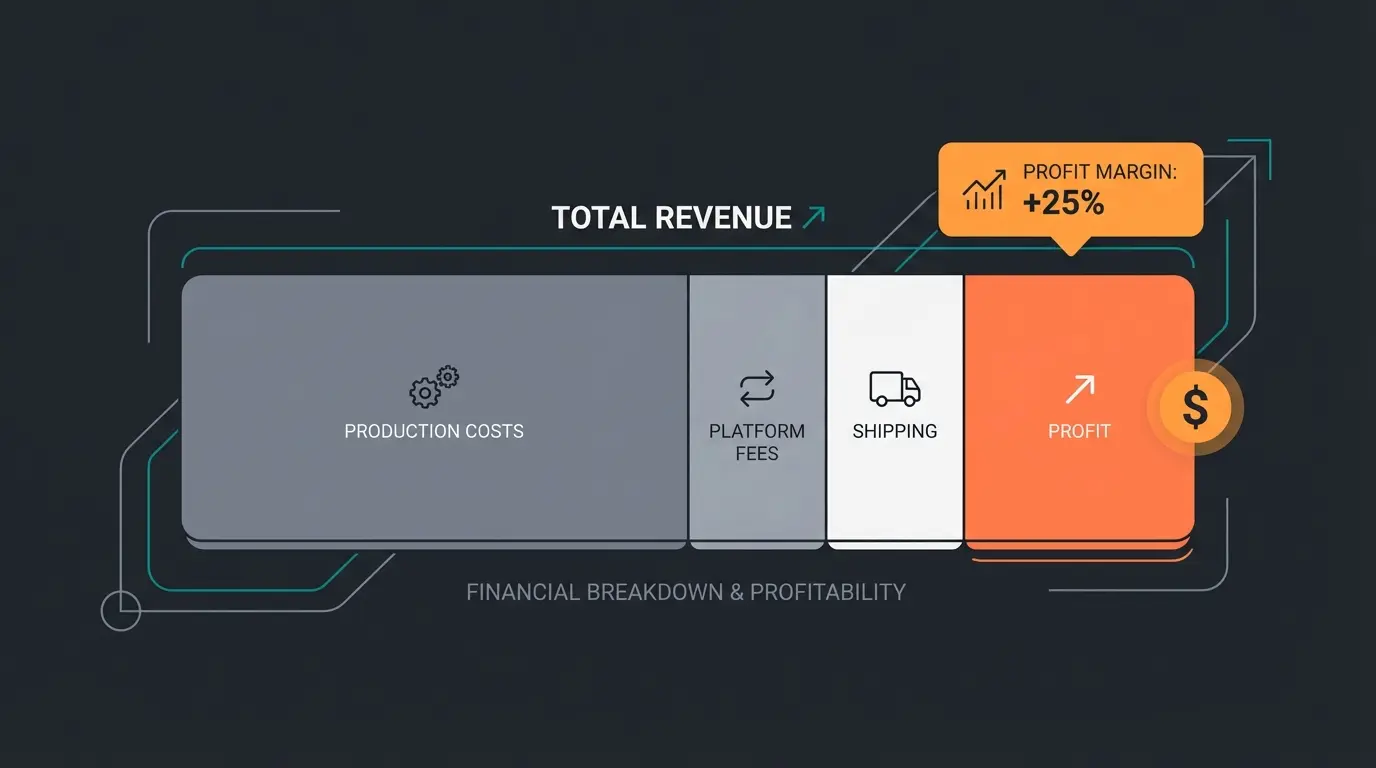
Numbers talk. Here is a real margin breakdown for a custom t-shirt, the most common POD product. Retail price: $29.99. Printful base cost: $9.95. Shopify transaction fee at 2.9% + $0.30: approximately $1.17. That leaves $18.87 gross profit per sale, a 63% gross margin before marketing costs.
Now the honest part. Marketing eats most of that margin for new stores. If you spend $10 per customer acquisition through Meta or Google ads, your net profit drops to $8.87 per shirt. At 100 shirts per month, that is $887 net against roughly $70 in fixed costs (Shopify subscription plus POD app). Profitable, but modest. The economics change meaningfully once you build organic traffic through SEO and social media, or develop a repeat customer base that does not require paid acquisition.
Here is the same product on Printify instead. Base cost: $7.24 (with a lower-cost supplier). Same $29.99 retail price. Transaction fee: $1.17. Gross profit: $21.58 per shirt. That extra $2.71 per unit adds up to $271 more profit per hundred units. Provider selection is not a minor detail.
For established POD stores with organic traffic (Printful, 2026)
Stickers, mugs, and posters with strong brand positioning
Growing at 23-26% CAGR through 2034 (Precedence Research)
~13% of all 2.85 million Shopify merchants (Printful, 2026)
Step-by-step: setting up a POD store on Shopify
I have set up over a dozen Shopify POD stores for testing purposes. The process has gotten significantly faster since Shopify introduced AI-assisted store building in late 2025. Here is the sequence that works, with the unnecessary steps removed.
- Sign up for Shopify and select the Basic plan ($39/month after the free trial). Skip the Starter plan entirely. You need a full online store with product pages, a proper checkout, and analytics.
- Choose your niche before your provider. Pick a target audience you understand. "Minimalist hiking gear designs" is a niche. "Custom apparel" is not. Specific niches let you build a focused brand and market to communities rather than broad demographics.
- Install your POD app. Go to the Shopify App Store, search for your provider (Printful, Printify, or Gelato are the safest starting choices), and click install. The integration takes under two minutes. The app syncs with your store automatically.
- Design your first 5-10 products. Upload your designs to the provider's mockup generator. No design skills? Use Printify's built-in AI image generator or commission a freelance designer for $20-$50 per design. Start focused, not broad.
- Configure product listings. Write keyword-rich titles and descriptions. Set retail prices using the margin calculator built into your POD app. Upload the auto-generated mockup images. Add size charts for all apparel items.
- Set up payments and shipping. Enable Shopify Payments for the lowest transaction fees. Configure shipping rates: flat rate or free shipping with a minimum order value ($50 threshold works well for most POD stores).
- Place a test order. Order at least one product yourself. Check print quality, packaging, delivery speed, and the unboxing experience. This step is non-negotiable. Do not launch a store selling a product you have never held in your hands.
The entire setup process takes 2-4 hours for someone who has never used Shopify. If you already have a Shopify store and just want to add POD products, installing the app and listing your first product takes under 30 minutes. The bottleneck is never the technical setup. It is the design work and niche selection.
Best products to sell with Shopify print on demand
Not all POD products are created equal. The margin difference between a custom sticker and a custom hoodie can determine whether you are running a sustainable business or an expensive hobby. Here is what the numbers actually show.
| Product | Typical base cost | Typical retail price | Gross margin | Best for |
|---|---|---|---|---|
| Stickers | $1.50-$3.00 | $5-$10 | 60-70% | Low-cost add-ons, repeat purchases |
| Mugs | $4.00-$8.00 | $15-$25 | 50-65% | Gift market, niche designs |
| Posters and wall art | $3.50-$8.00 | $15-$35 | 55-70% | Artists, photographers, niche communities |
| Phone cases | $5.00-$9.00 | $18-$30 | 50-65% | Tech-savvy audiences, trend-driven designs |
| Tote bags | $6.00-$10.00 | $20-$30 | 50-60% | Eco-conscious audiences, events |
| T-shirts | $6.00-$14.00 | $25-$35 | 40-55% | Volume driver, brand staple product |
| Hoodies | $18.00-$28.00 | $45-$65 | 35-45% | Higher average order value, seasonal |
| Canvas prints | $10.00-$20.00 | $40-$80 | 50-65% | Premium positioning, home decor niche |
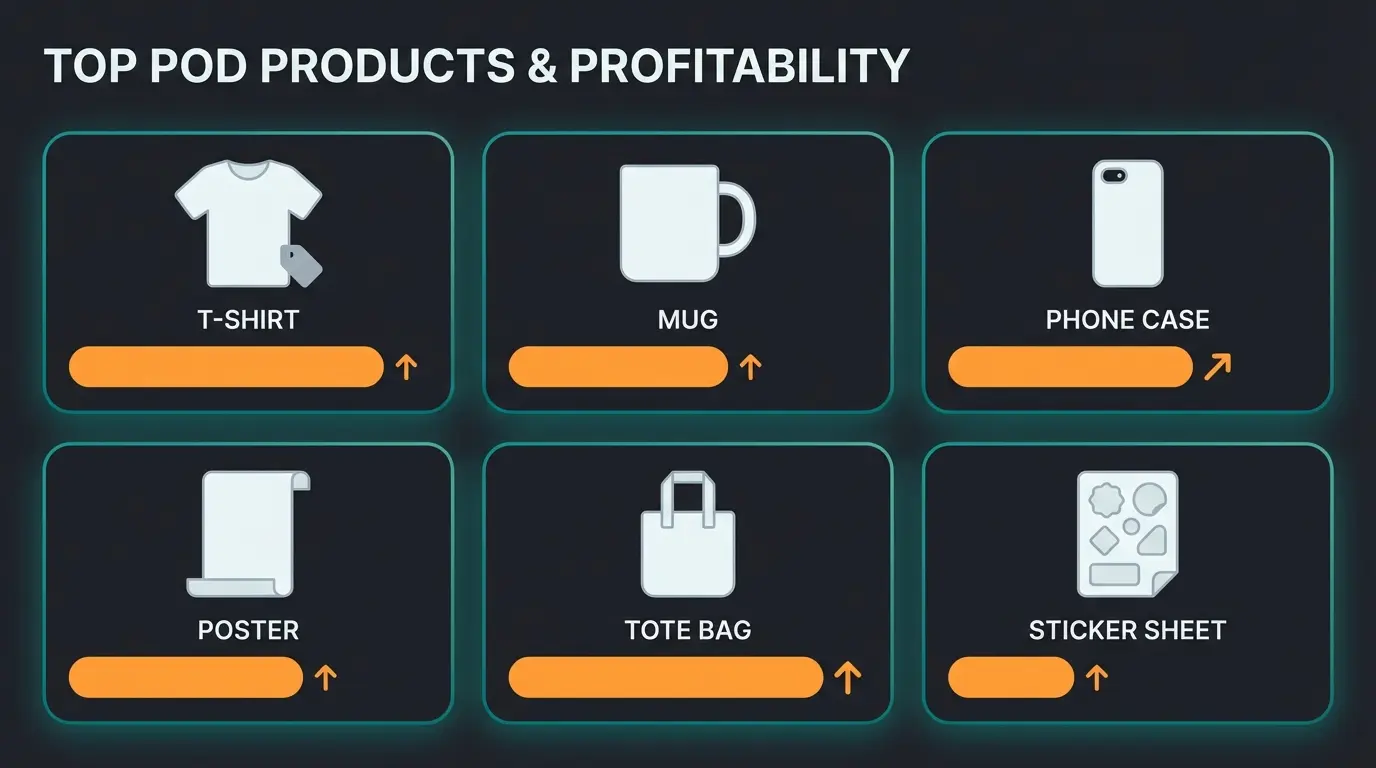
The pattern is straightforward: lower base-cost items with strong perceived value (stickers, mugs, posters) offer the best percentage margins. T-shirts remain the highest-volume POD product, accounting for a significant portion of the 39.5% apparel share of global POD revenue (Grand View Research, 2025). But relying exclusively on apparel is a pattern I see in most struggling POD stores.
The top-performing stores I have observed combine a core apparel line with 2-3 high-margin accessory products. A customer buying a $30 t-shirt who adds a $7 sticker pack and a $20 mug just tripled your profit on that order. The accessories have higher margins and near-zero additional acquisition cost since the customer is already on your site.
Shipping and fulfillment for Shopify POD
Shipping is where most POD store owners lose customers without realizing it. The gap between what buyers expect (Amazon-speed two-day delivery) and what POD actually delivers (production time plus shipping time) is the single biggest friction point in this business model. For a deeper look at configuring shipping rates and zones, see the full Shopify Shipping guide.
| Provider | Production | US delivery | EU delivery | Rest of world |
|---|---|---|---|---|
| Printful | 2-5 days | 3-5 days | 3-7 days | 7-20 days |
| Printify | 2-7 days (varies) | 3-8 days | 5-10 days | 10-25 days |
| Gelato | 2-4 days | 3-5 days | 2-5 days | 5-12 days |
| SPOD | 1-2 days | 3-5 days | 3-7 days | Limited |
| Gooten | 1-3 days | 3-5 days | 5-8 days | 8-20 days |
| CustomCat | 2-3 days | 3-7 days | N/A | 10-15 days |
Total delivery time is production plus shipping. A Printful t-shirt shipped domestically in the US takes 5-10 business days end-to-end. That is 2-3x slower than Amazon Prime. This is not a flaw. It is inherent to made-to-order production. The solution is transparency, not apologies.
Set accurate delivery expectations on your product pages, in your confirmation emails, and on a dedicated "Shipping and Delivery" page. Include a note that items are custom-made to order. Customers who know upfront that delivery takes 7-10 days rarely complain. Customers who expected 3 days and receive their order after 10 will request a refund, leave a negative review, or both.
Shopify vs. other platforms for print on demand
Shopify is not the only option for selling POD products. But after running stores on multiple platforms, I can say the differences are significant enough to change your business trajectory. Our full Shopify Guide covers the platform beyond print on demand, from themes to apps to checkout. Here is how the main options stack up.
| Factor | Shopify | WooCommerce | Etsy | Amazon Merch |
|---|---|---|---|---|
| Monthly cost | $39+ (Basic plan) | $0 (self-hosted) + hosting $10-30/mo | $0 (per-listing fees) | $0 (invite-only program) |
| Transaction fees | 2.9% + $0.30 | Payment processor dependent (~2.9%) | 6.5% + $0.20 + 3% processing | Amazon retains 60-70% of retail price |
| Brand control | Full: your domain, design, customer data | Full: you own everything, self-hosted | Limited: Etsy marketplace framing | None: Amazon branding dominates |
| POD integrations | 200+ apps in Shopify App Store | 50+ plugins | Direct Printify and Printful integration | Amazon handles all production |
| SEO control | Strong: custom domain, full meta control | Strong: WordPress SEO ecosystem | Built-in marketplace search traffic | Amazon search algorithm |
| Best for | Building a standalone brand you own | Technical users wanting maximum control | Reaching existing buyers quickly | Volume sales at slim margins |
Shopify wins for sellers who want to build a brand they fully own. You control the customer data, the checkout experience, and the entire marketing stack. Etsy wins for sellers who want instant access to an existing buyer audience but accept trading brand control for marketplace traffic. WooCommerce suits technically confident sellers who want zero platform lock-in.
The smartest approach I have seen: use Shopify as your home base and primary brand, then expand to Etsy and Amazon as additional sales channels using Printify's or Printful's multi-channel sync. You capture marketplace traffic without depending on it.
Automating customer service for your POD store
Here is the part most POD guides skip entirely. Once your store starts processing 10+ orders per day, customer service becomes a real operational problem. "Where is my order?" "Can I change the size?" "The print looks different from the mockup." These questions repeat endlessly, and answering them manually costs either your time or a support hire's salary.
This is where AI employees change the economics of running an e-commerce store. A trained AI employee can handle order status inquiries, size recommendations, shipping timeline questions, and return policy explanations in under 5 seconds, around the clock. Not a scripted FAQ page, and not a generic chatbot-as-a-service subscription. An actual conversational team member that understands context and pulls live order data from your systems.
We have seen this play out with e-commerce clients selling custom products. Signed, an online retailer for custom decorative signs, automated 70% of customer inquiries through their AI employee Alex. The result: 18x return on investment, a 30% increase in upselling, and response times under 5 seconds that no human support team could sustain at that consistency.
For POD stores specifically, AI employees solve three problems simultaneously. They answer pre-sale questions that increase conversion ("Which size should I order for an oversized fit?"). They handle post-sale inquiries on whichever channel your buyers actually use, whether that is live chat, email, or WhatsApp Business ("When will my custom hoodie arrive?"). And they recommend complementary products in the same conversation, increasing average order value without additional ad spend.
An AI employee turns your Shopify visitors into buyers and handles post-sale support 24/7. Our e-commerce clients see up to 7x higher conversion rates and 35% larger carts. See how it works for your store.
Book a free demoFAQ: print on demand with Shopify
Yes, with realistic expectations. Most successful POD sellers earn 20-40% net profit margins once they have established organic traffic. A t-shirt selling at $29.99 with a $9.95 base cost and $1.17 in transaction fees yields roughly $18.87 gross profit before marketing. Profitability depends primarily on customer acquisition efficiency.
Printful and Printify both offer robust free plans. Printful is stronger for quality control and branding options. Printify provides access to 1,300+ products and lower base prices through its supplier network. For beginners testing the model, Printify's free plan offers the most flexibility.
On the Basic plan ($39/month), Shopify charges 2.9% + $0.30 per transaction through Shopify Payments. On a $30 sale, that comes to approximately $1.17. Higher-tier plans reduce the percentage rate. See the complete Shopify Fees breakdown for all plan tiers.
Total delivery time is production (2-5 days) plus shipping (3-8 days domestic US, 7-20 days international). Most US customers receive their orders within 7-12 business days. Gelato offers the fastest international fulfillment through local production, while SPOD leads in domestic speed with 48-hour average production.
Yes, and many experienced sellers do exactly that. A common approach is using Printful for apparel (consistent quality) and Printify for accessories (wider variety, lower base costs). Each POD app manages its own product catalog and fulfillment independently, and Shopify routes orders to the correct provider automatically.
Shopify is better for building a standalone brand with full control over customer data, store design, and marketing. Etsy provides built-in marketplace traffic but charges higher combined fees (6.5% transaction + payment processing) and limits branding. The most effective strategy: use Shopify as your primary store and list on Etsy as an additional sales channel.
Stickers (60-70% margin), mugs (50-65%), and posters (55-70%) offer the highest percentage margins. T-shirts remain the highest-volume product at 40-55% margin. Top-performing stores combine core apparel with high-margin accessories like stickers and mugs to maximize overall order profitability.
An AI employee handles customer inquiries around the clock, recommends products in real time, and increases your conversion rate from day one. Qualimero clients see measurable results within 30 days.
Start your free trial
Lasse is CEO and co-founder of Qualimero. After completing his MBA at WHU and scaling a company to seven-figure revenue, he founded Qualimero to build AI-powered digital employees for e-commerce. His focus: helping businesses measurably improve customer interaction through intelligent automation.