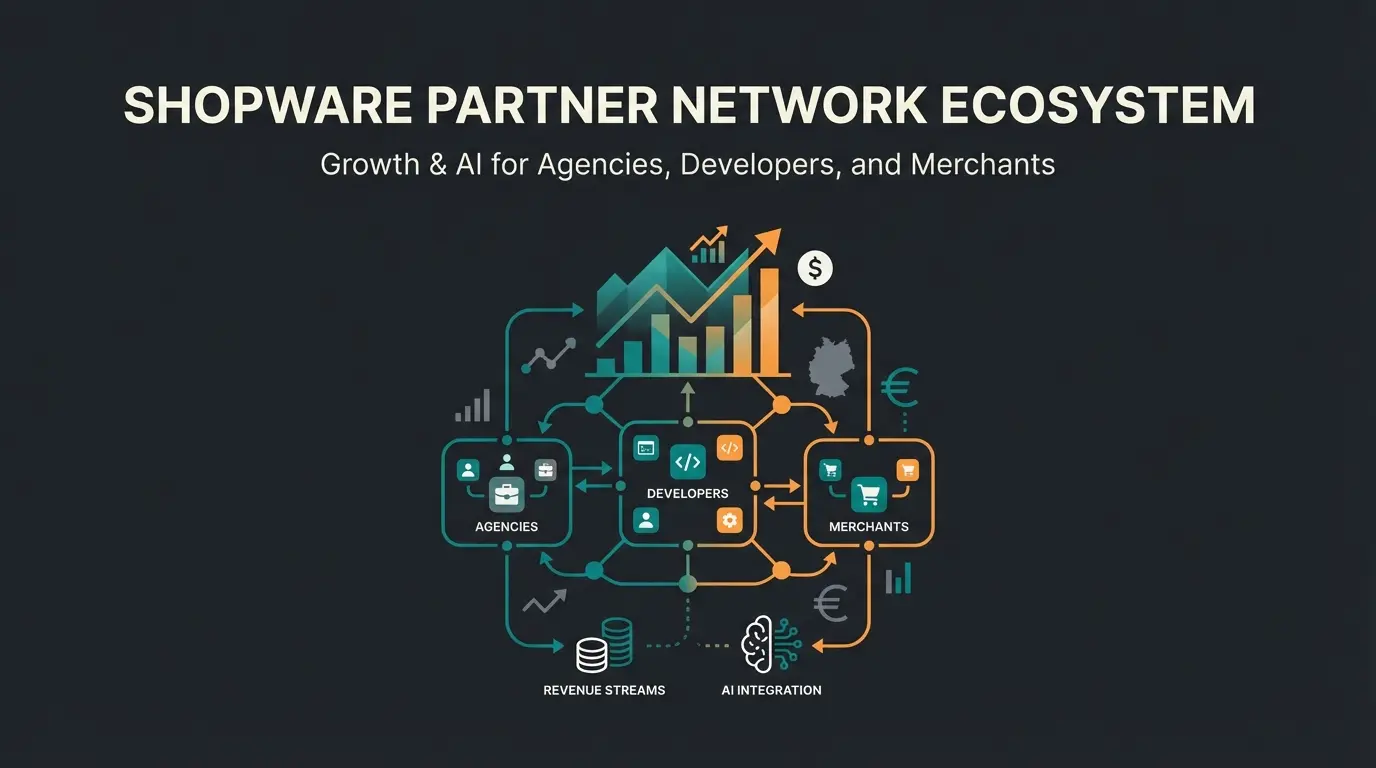
Why a Shopware relaunch is unavoidable in 2026
Shopware 5 stopped receiving security patches on 31 July 2024, so any shop still running it is operating unpatched payment and customer-data infrastructure. Shopware 6.7 shipped in June 2025 and carries security support until 28 February 2028. Relaunching now buys a support horizon measured in years, not months.
Three terms get used interchangeably, and they are not the same thing. A Shopware update is an in-place version bump inside the same major line, usually a few hours of work. A migration moves data from one system into another. A relaunch is the whole project: migration plus new templates, a new URL structure, new hosting, and in most cases a redesign. Only the relaunch changes what the customer actually sees.
That distinction decides your budget. Confusing the three is the most common reason a relaunch quote comes in at three times what the merchant expected.
The duty: security and licensing exposure
The version data is not ambiguous. According to endoflife.date, Shopware 5.7 received its final patch on 5 June 2025 and its security support ended on 31 July 2024. Commercial long-term support exists, but only through the third-party vendor safefive, not from Shopware AG. Shopware 6.6 lost active support on 17 June 2025, the day 6.7 landed. The current line as of August 2026 is 6.7, at patch 6.7.12.2 released on 23 July 2026, running on PHP 8.2 through 8.5.
There is a second exposure most relaunch plans miss entirely, and it is a licensing one. Since 24 March 2025, Shopware's Fair Usage Policy caps the free Community Edition at 1 million EUR annual GMV. Shopware's own FAQ is explicit about how that interacts with a migration:
The opportunity: the platform moved while you waited
Shopware 6 is API-first. That is the boring architectural fact that makes an external AI advisor possible at all, and it is why Shopware 5 shops cannot have one. The interesting part is what shipped recently. The 6.7.10.0 release in May 2026 introduced a dedicated Agentic Commerce sales channel: a native JSONL product feed that pushes your catalog to platforms like ChatGPT, plus referral tracking for orders that originate from AI traffic (Shopware release news).
Read that again if you are still on Shopware 5. Your platform vendor now ships a first-class channel for AI-driven discovery, and you cannot use any of it. That is the real cost of standing still. Not the security risk, which is abstract until it isn't, but the compounding feature gap.
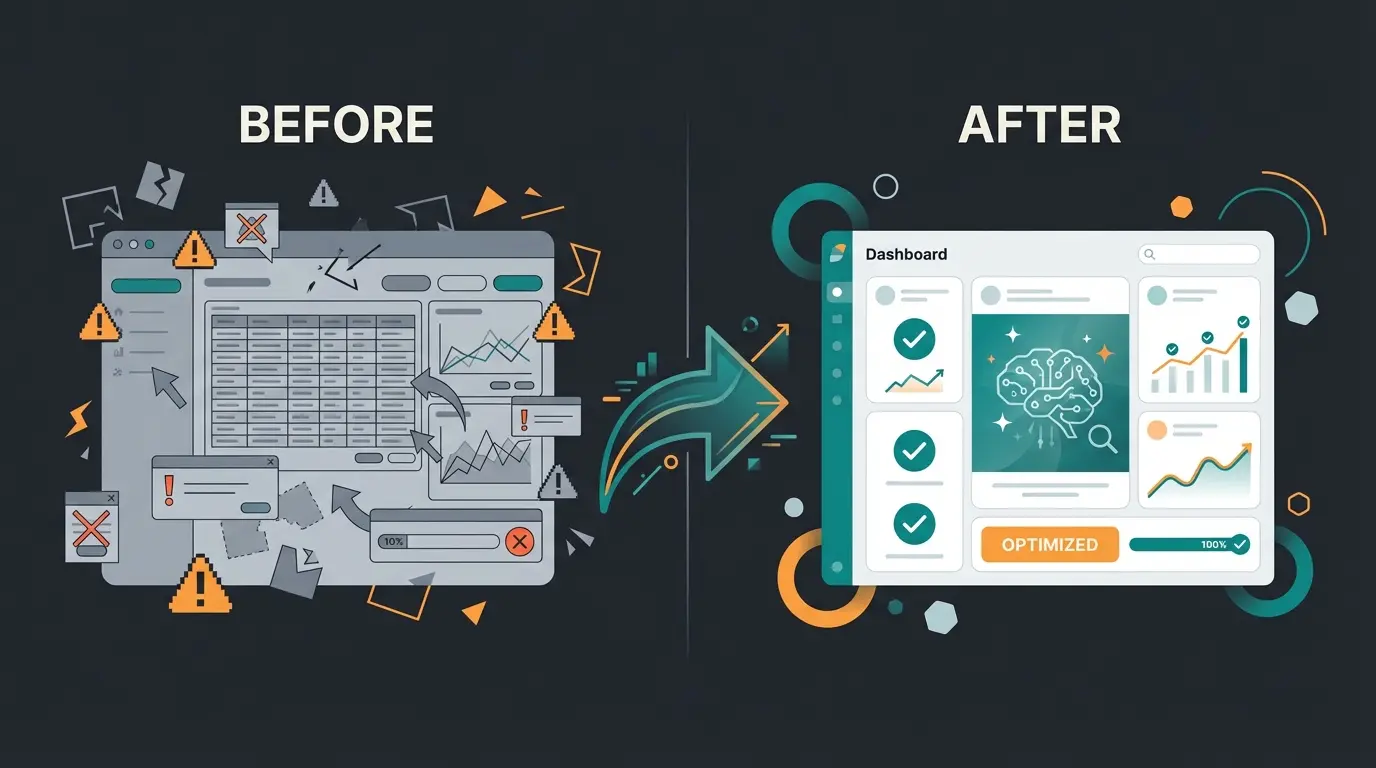
The Shopware relaunch checklist: four phases
A Shopware relaunch runs in four phases: audit and clean-up, technical migration, design and UX, and AI readiness. The audit phase decides the budget, because the volume of legacy custom plugins and dirty product data determines how much of the migration the Shopware Migration Assistant can automate and how much a developer has to rebuild by hand.
Phase 1: Audit and clean-up
Clean before you move. Garbage in Shopware 5 becomes expensive chaos in Shopware 6, because you pay to migrate it and then pay again to fix it.
The output of this phase is not a slide deck. It is four artefacts: a plugin inventory with a keep-rebuild-drop decision per entry, a data-quality report on your product attributes, a full crawl of the old shop, and a 1:1 redirect map. Before any of it runs, get a verified Shopware backup of the database and media directory, and restore it once into a scratch environment. An untested backup is not a backup.
- Full database and media backup taken and test-restored into a staging environment
- Plugin inventory complete, each entry marked keep, rebuild, or drop
- Product attributes normalised (no 'Blue' and 'Dark blue' as separate free-text values)
- Full crawl of the live shop exported, with sessions and revenue per URL attached
- Zombie pages identified and explicitly excluded from the migration scope
- Draft 1:1 redirect map built for every URL with traffic in the last 12 months
One honest warning from our own projects: this phase always overruns. Merchants budget two weeks for data clean-up and spend five. It is still the cheapest time in the whole project to fix data, because every hour you skip here comes back as three hours of rework in Phase 4.
Phase 2: The technical migration
The Shopware Migration Assistant does the heavy lifting, but its scope is narrower than most quotes assume. Shopware's own documentation states plainly: "With Shopware 6, the basic architecture has been completely redesigned ...] it is not possible to reuse your old templates or migrate them to Shopware 6" ([Shopware migration docs). Shopware 5 ran on Smarty; Shopware 6 runs on Twig. That is a rebuild, not a transfer.
| Asset | Migration Assistant | What you still have to do |
|---|---|---|
| Products, properties, variants | Automated | Normalise attributes before the run, not after |
| Customers, orders, order documents | Automated | Verify customer group and number range mapping |
| SEO URLs | Automated | Still build a manual 301 map for everything the run skips |
| Payment and shipping methods | Manual mapping | Create them in Shopware 6 first. You cannot remap after a reset |
| Shipping cost rules | Not migrated | Rebuild in the Rule Builder |
| Shopping Worlds and shop pages | Not migrated | Rebuild in Shopping Experiences |
| Theme and email templates | Not migrated | Rebuild in Twig |
| Custom plugins and B2B Suite data | Not migrated | Rebuild as Shopware 6 plugins or apps |
Set the environment up before you touch the assistant. Shopware 6.7 needs PHP 8.2 to 8.5, MySQL 8.0 or MariaDB 10.11 upwards, and Node.js for the storefront build; the full matrix is in our Shopware server requirements guide. Plan Redis for sessions and cart, and an HTTP cache layer, from day one rather than after the first load test. For reproducible local and CI environments, Shopware Docker images remove most of the 'works on my machine' class of migration bug, and the step-by-step setup is covered in our Shopware installation walkthrough.
Where you host it is a decision, not a detail. Self-managed infrastructure gives you full control over the message queue workers and search cluster, while Shopware Cloud hands the operations to the vendor and removes update work from your team. Between the two sits Shopware cloud hosting with a specialist provider, which is where most SME relaunches land.
Phase 3: Design and UX
The temptation here is a pixel-perfect rebuild of the old theme. Resist it. You are paying for a Twig rebuild either way, so rebuilding the 2018 layout costs exactly as much as building something that converts better.
Start from the Shopware 6.7 default theme rather than a marketplace theme. It is already tuned for asynchronous loading, and it gives your Shopware performance optimization work a clean baseline instead of a plugin stack you did not write. If your roadmap includes a decoupled frontend, decide now and not in month four: a Shopware headless architecture built on Shopware Frontends changes the entire template budget, and retrofitting it after go-live means paying for the storefront twice.
Reserve layout space for the AI advisor while the templates are still being built. A component planned into the category and product templates costs an afternoon. The same component bolted on six months later costs a sprint.
Phase 4: AI readiness
This phase is missing from almost every relaunch quote, and it is the one that decides whether the new shop just looks new or actually sells better. An AI advisor is only as good as the product data behind it.
- Enrich technical attributes with use-case tags. 'Water column: 10,000mm' means nothing to a buyer. 'Suitable for heavy rain' does. Create these as custom fields during the migration, while you are touching every product anyway.
- Make unstructured content retrievable. Datasheets, manuals and installation guides sit in PDFs today. Export them in a structured form so they can be indexed for retrieval later.
- Define the refusal boundaries. Decide in writing which questions the AI must not answer: structural, electrical, legal, anything with liability attached. This is a product decision, not a prompt-engineering afterthought.
- Instrument a control group from day one. If you cannot measure the AI against a holdout, you cannot prove the investment, and in twelve months nobody will remember what the baseline was.
Backup, plugin inventory, data-quality report, full crawl, draft redirect map
PHP 8.2 or higher, database, Redis, HTTP cache, staging that mirrors production
Migration Assistant run, manual mapping of payment and shipping, attribute enrichment
Twig theme from the 6.7 default, Shopping Experiences rebuilt, AI advisor slot reserved
Redirect map verified URL by URL, load test, hallucination test on the AI advisor
DNS switch, daily crawl-error review for four weeks, revenue tracked against the control group
Redefining customer experience: AI product consultation
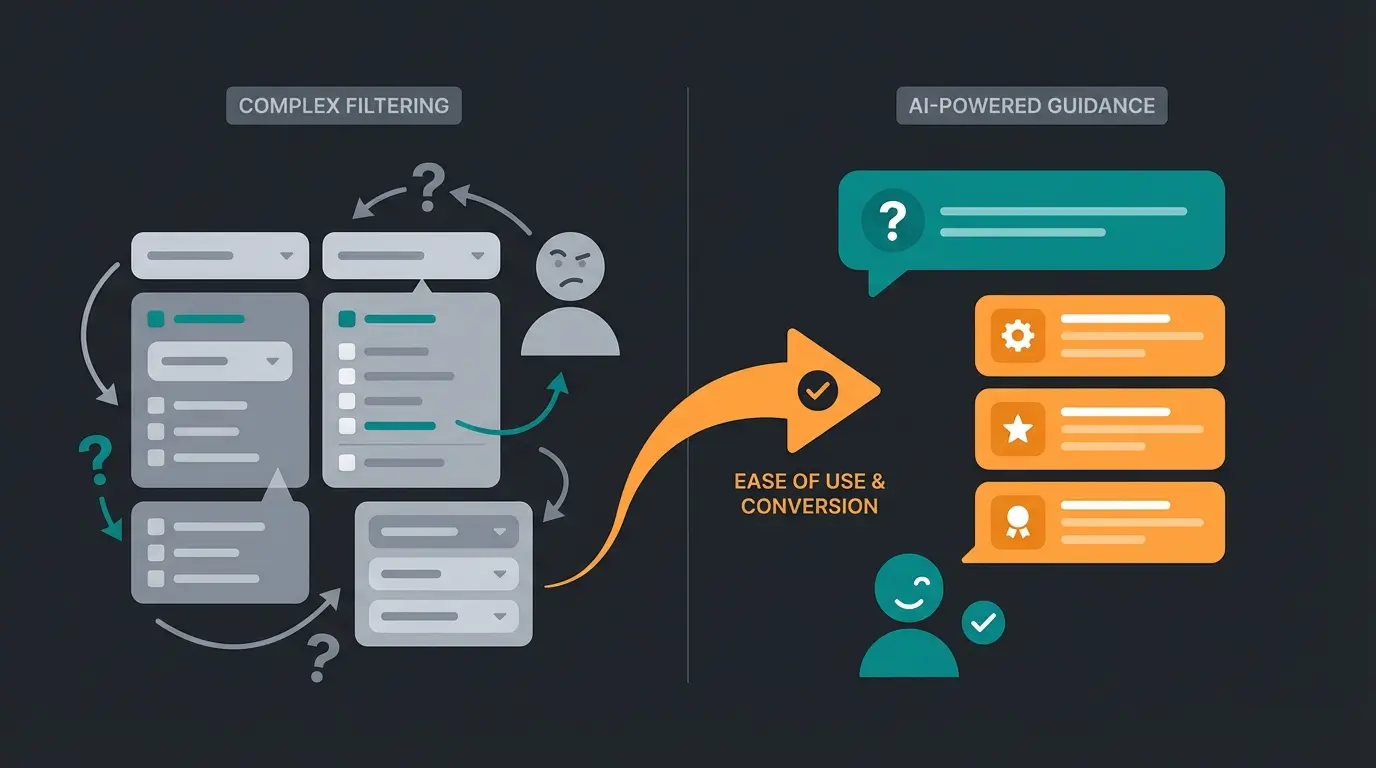
The relaunch is the cheapest moment to add AI product consultation, because the product data is already being cleaned and remapped. A filter-based catalog forces the customer to know the right specification in advance. An AI advisor asks about the use case instead and recommends the product that fits.
The problem with filters
Filters require the customer to already have the expertise they came to your shop to get. Somebody buying a laptop does not know whether they need an i5 or an i7. They know they want to edit video and have battery life that survives a train journey. Filters cannot make that translation.
Same pattern in every consultation-heavy category. Pool chemistry, plant protection, auxiliary vehicle lighting, heating systems. The specification sheet is not the question the customer is asking.
The solution: the AI sales agent
A concrete example, on Shopware 6. Pooldoktor is a family-run pool specialist in Linz, Austria, ten employees, 13,500 pools sold since 2005. Roughly half of their 1,161 monthly chat conversations are genuine product consultation: basin geometry, water chemistry, filter sizing. Peak-season traffic runs 117% above the low season, and pool expertise is not something you hire for three months.
Franz, their AI product advisor, went live in January 2026 after 4.5 hours of setup effort on the Pooldoktor side. Six months of live operation: 13 seconds average response time, 19% of started chats ending in a completed order, and +18.75% incremental revenue per visitor measured causally against a 10% control group across 2,214 buyers and 136,183 users. That works out to 33x return on investment.
| Capability | Standard Shopware 6 relaunch | AI-enhanced relaunch |
|---|---|---|
| Product discovery | Keyword search plus facet filters | Use-case dialogue: 'a pump for a 30 m3 pool' |
| Consultation depth | Static filters and a specification table | Expert-level answers in seconds, 24/7 |
| Out-of-hours demand | Contact form, answered next business day | Answered immediately, when the decision is made |
| Seasonal peaks | Support queue lengthens or you hire | Capacity decoupled from headcount |
| Proof of impact | Conversion rate before and after, confounded | Causal A/B measurement against a holdout group |
Integration in Shopware 6
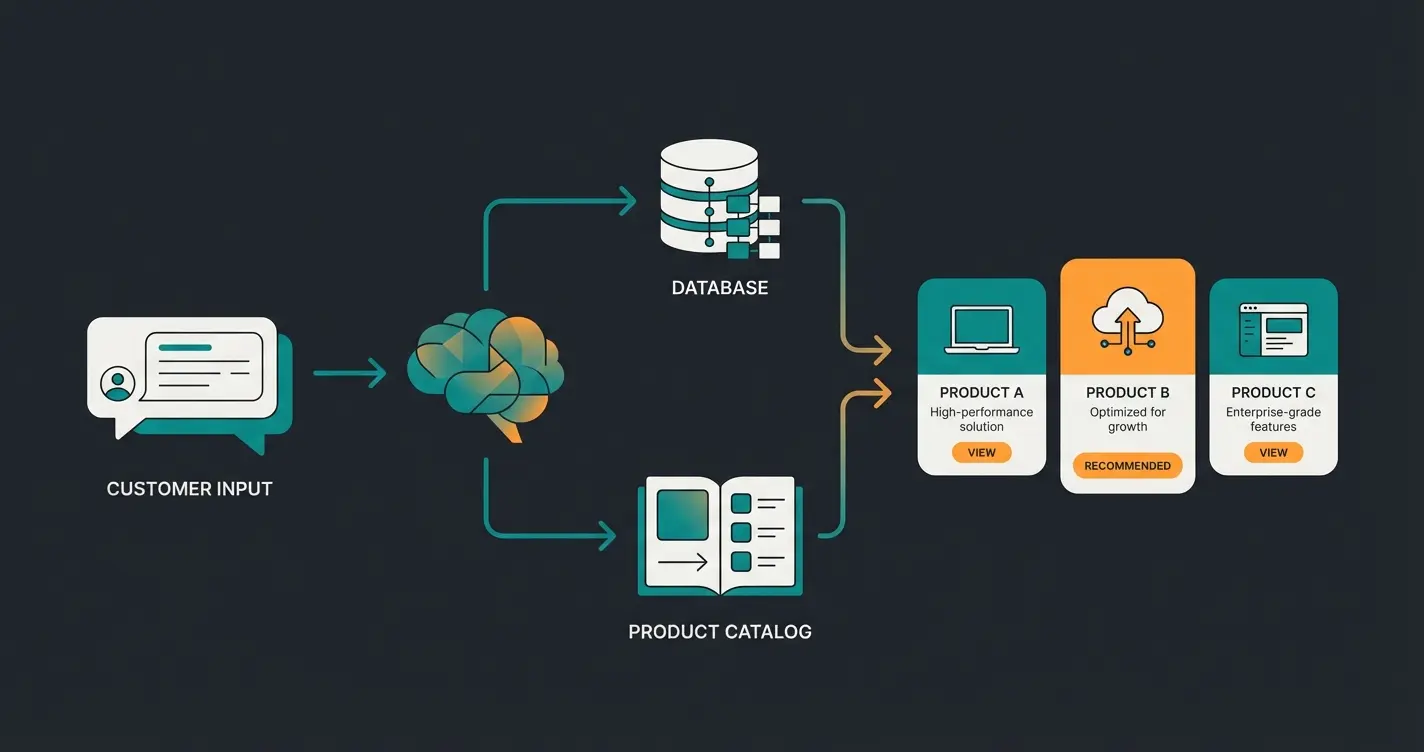
Technically this is the least difficult part of a relaunch, which surprises people. The Shopware API exposes products, categories, properties and customer groups, and the Store API is the read path an advisor needs at runtime.
# Read path an AI advisor uses at runtime: fetch products with their properties
curl -X POST 'https://your-shop.example/store-api/product' \
  -H 'sw-access-key: SWSCXXXXXXXXXXXXXXXXXX' \
  -H 'Content-Type: application/json' \
  -d '{
        "limit": 25,
        "associations": { "properties": {}, "manufacturer": {} },
        "includes": { "product": ["id", "name", "description", "calculatedPrice", "properties"] }
      }'
Shopware's app system is the cleaner integration route for anything hosted externally. Apps run outside the shop process and talk to it over signed webhooks and APIs, which means no core patches and no update conflicts. The app documentation now also covers an MCP server extension for exposing AI-callable capabilities over HMAC-signed webhooks (Shopware developer documentation). Plugins still exist and still make sense for deep storefront work. Apps are the better default for AI services.
The four most expensive relaunch mistakes
The single most expensive relaunch mistake is an incomplete 301 redirect map: rankings built over years disappear within weeks of go-live and take months to rebuild. The other three are underestimating hosting requirements, walking into the Community Edition licence cap, and migrating dirty product data unchanged.
1. The forgotten 301 redirects
Shopware 5 and Shopware 6 build SEO URLs differently, so URL structures rarely survive a relaunch untouched. The Migration Assistant can carry SEO URLs across, but only for the entities it migrates. Anything else, and that includes your CMS pages, landing pages and Shopping Worlds, has no counterpart on the other side, because those are precisely the objects Shopware states cannot be transferred.
Do not blanket-redirect to the homepage. Google treats that as a soft 404 and you lose the ranking anyway. Every old product URL points at the exact new product or its named successor. Every dead product points at its category. Verify the map URL by URL on staging, then re-crawl on go-live day and again 48 hours later.
2. Underestimating hosting requirements
Shopware 6 is materially hungrier than Shopware 5. The message queue worker needs dedicated resources, and catalogs beyond roughly 50,000 products need a search cluster rather than database search. A 5 EUR shared package that carried Shopware 5 will not carry Shopware 6 through a campaign peak.
Plan for two to three times the previous hosting spend. Our Shopware hosting overview covers the architecture, the best Shopware hosting comparison ranks providers by shop size, and if you have no in-house operations capacity, Shopware managed hosting moves patching and scaling to the provider. Managed hosting costs more per month and less per incident. For most SME shops with no dedicated sysadmin, that trade is worth making.
3. The Community Edition licence cap
Since 24 March 2025, Community Edition merchants must report their annual GMV to Shopware, and shops above 1 million EUR GMV have to move to Rise, Evolve or Beyond to keep access to the Shopware Account and Store (Shopware). GMV here includes returns and shipping, subtracts discounts, and excludes tax.
The trap is the timing. On Shopware 5 the policy does not apply to you. The day you go live on Shopware 6 Community Edition, it does. If you are anywhere near the threshold, price Rise at 600 EUR per month into the relaunch business case from the start.
4. Migrating dirty product data unchanged
This is the cheapest mistake to avoid and the most common one to make, because it never shows up as a broken page. Everything works. It just does not sell.
Free-text attributes that should be properties, three spellings of the same manufacturer, units in the description instead of a field, variant relations that never got maintained. None of that blocks a migration. All of it breaks faceted navigation, breaks the Agentic Commerce product feed, and makes an AI advisor guess. You are touching every product record during the migration anyway. Fixing attributes then costs a fraction of fixing them in a live catalog.
Shopware relaunch cost and timeline in 2026
A Shopware relaunch costs 15,000 to 60,000 EUR for a typical SME shop and takes 8 to 16 weeks. Simple catalog migrations on a standard theme sit at the lower end. Shops with ERP integration, rebuilt custom plugins and multi-language catalogs sit at the upper end, and B2B projects run past it.
| Tier | Typical scope | Agency cost | Duration |
|---|---|---|---|
| Small | Standard theme, under 2,000 SKUs, no ERP link, catalog and customers via Migration Assistant | 15,000 - 25,000 EUR | 8 - 12 weeks |
| Mid-size | Custom Twig theme, 2,000 to 20,000 SKUs, one ERP or PIM integration, two to five plugins rebuilt | 25,000 - 60,000 EUR | 12 - 20 weeks |
| Complex | B2B logic, multi-language and multi-channel, headless storefront, several custom plugins rebuilt from scratch | 60,000 - 150,000 EUR and up | 6 - 12 months |
Day rates for a qualified Shopware developer in the DACH market run roughly 950 to 1,400 EUR, which is where the spread inside each tier comes from. A freelance Shopware programmer is cheaper per day and carries more delivery risk on a project with this many moving parts. That is a real trade-off, not a soft one: on a relaunch, a missed go-live costs more than the rate difference.
Three cost lines run after go-live and belong in the same business case. Licence: Community Edition free below 1 million EUR GMV, Rise from 600 EUR per month, Evolve from roughly 2,400 EUR per month. Hosting: 300 to 1,000 EUR per month for a properly resourced setup. AI product consultation: a fraction of one support salary, and the only line of the three that shows up on the revenue side of the ledger.
Released 17 June 2025, current patch 6.7.12.2
Fair Usage Policy, in force since 24 March 2025
Small and mid-size tiers, excluding B2B projects
Frequently asked questions
Between 15,000 and 60,000 EUR for a typical SME shop, and 60,000 EUR upwards for B2B or headless projects. The main cost drivers are the number of custom plugins that need rebuilding and the state of your product data. Add licence costs from 600 EUR per month if your shop clears 1 million EUR annual GMV.
8 to 12 weeks for a small shop on a standard theme, 12 to 20 weeks for a mid-size shop with a custom theme and an ERP integration, and 6 to 12 months for complex B2B projects. Data clean-up is the phase that overruns most often, so budget buffer there rather than in development.
Yes, but only with a complete 1:1 redirect map. The Migration Assistant carries SEO URLs for the entities it migrates, while CMS pages, landing pages and Shopping Worlds have no automatic counterpart in Shopware 6 and need manual redirects. Never blanket-redirect to the homepage, because Google treats that as a soft 404.
Shopware 5 has received no security patches from Shopware AG since 31 July 2024, and commercial long-term support is only available through the third-party vendor safefive. Beyond the security exposure, the plugin ecosystem has moved on and new platform capabilities such as the Agentic Commerce feed introduced in May 2026 are Shopware 6 only.
Yes, below 1 million EUR annual GMV. Above that threshold the Fair Usage Policy, in force since 24 March 2025, requires a move to Rise, Evolve or Beyond to retain access to the Shopware Account and Store. Shopware 5 Community Edition shops are exempt until the moment they migrate to Shopware 6.
For a small catalog migration on the default theme, an experienced in-house developer can handle it in 8 to 12 weeks. Once custom plugin rebuilds, an ERP integration or a headless storefront are in scope, agency support pays for itself in avoided go-live delays. Day rates in the DACH market run roughly 950 to 1,400 EUR.
Conclusion: what to do in the next two weeks
If you are still on Shopware 5, the decision is no longer whether to relaunch. It is whether you plan it or whether an incident plans it for you.
Two concrete next steps, in order. First, run the Phase 1 audit as a standalone piece of work, independent of any agency pitch: plugin inventory, data-quality report, full crawl. It costs a fraction of the project, and it converts every quote you receive from a guess into a comparable number. Second, decide on AI product consultation before the templates are built, not after. Retrofitting it is the single most avoidable cost in this entire list.
The thing worth arguing about: I would rather ship a relaunch with a plain default theme and a working advisor than a beautiful custom storefront with the same filters as 2018. One of those changes the conversion rate. The other changes the screenshot.

A new storefront brings visitors. It does not answer the question that stops them from buying. Qualimero's AI employees advise your customers on Shopware 6 in seconds, and we measure the revenue impact against a control group. Pooldoktor sees +18.75% revenue per visitor and 33x ROI.
Book a 30-minute demo
Kevin is CTO and co-founder of Qualimero. As an AI architect with over 15 years of experience as CTO and CPO in the tech industry, he designs the AI systems that automate tens of thousands of customer interactions daily for Qualimero's clients — reliably, securely, and at scale.