What does a Shopware developer do?
A Shopware developer builds, customizes, and maintains online stores on the Shopware 6 platform. They write plugins and themes, connect APIs and ERP or CRM systems, run migrations and updates, and tune performance. Most work in PHP, Symfony, and Twig, with JavaScript and Vue.js for the admin interface.
The role splits by project type. Some jobs touch the core, others only the surface. Six areas cover almost everything a merchant needs.
- Plugin development: custom business logic, pricing rules, and checkout changes
- Theme and storefront work: layout, usability, and Shopping Experiences
- API and ERP/CRM integration: connecting SAP, Pickware, or Microsoft Dynamics through the Shopware API
- Data migration: moving products, customers, and content between versions
- Performance work: query tuning, caching, and load handling, covered in Shopware performance optimization
- Headless and Composable Frontends: decoupled storefronts, often built with Shopware Frontends
The line between a Shopware programmer and a Shopware developer is mostly scope, not skill. A programmer writes the code you specify. A developer also decides what should be built, what should be integrated, and what should be left alone. On a commercial project, that judgment is worth more than raw coding speed.
Not every store runs the standard storefront. Some use a Shopware headless setup with a decoupled frontend, which changes the skill set you need. It also changes what breaks at every version jump. The 6.6 to 6.7 upgrade cycle is a good example: custom plugins have to be retested against each minor release, which is exactly the kind of work a clean Shopware update path is meant to minimize.
Shopware developer costs: freelancer vs agency vs in-house
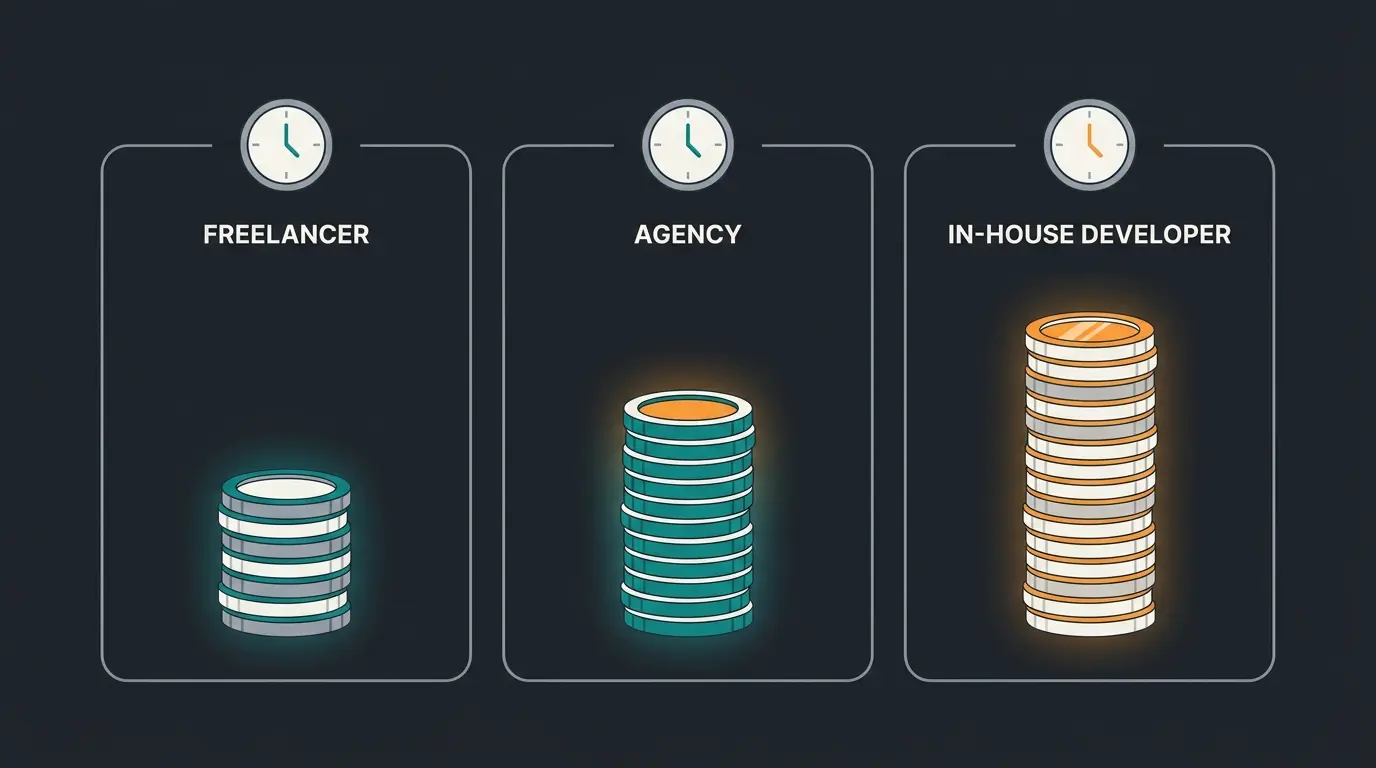
Shopware developer costs depend on the engagement model. Freelancers typically charge 60 to 120 EUR per hour, specialized agencies 100 to 180 EUR per hour, and a full-time in-house developer runs roughly 60,000 to 90,000 EUR per year plus overhead. Agencies cost more per hour but bundle project management, QA, and continuity into the rate.
Those bands hold across the 2026 market. Freelance marketplaces such as freelancermap list Shopware specialists starting near 30 per hour for offshore junior work and rising past 120 for senior integration experts. Certified agencies in Germany sit between 100 and 180 EUR per hour, with Platinum partners and firms in Munich or Hamburg at the top of that range.
The hourly rate is the visible number. The hidden costs decide the total. A cheap rate that ships fragile code gets expensive at the next migration, when a plugin has to be rewritten to survive a version jump. Scope drives price more than the rate does: a single shipping plugin is a fixed job, whereas a full store relaunch runs 15,000 to 25,000 EUR through an agency, depending on data volume and integrations. A freelancer suits one defined task; an agency covers a relaunch where frontend, backend, and data migration all run at once.
Cheap rarely wins on efficiency. A senior developer at 120 EUR who solves a problem in two hours costs 240 EUR. A junior at 70 EUR who needs eight hours costs 560 EUR, and often leaves code that the next update breaks. Rate times hours is the wrong metric. Outcome per euro is the right one.
Infrastructure sits inside the cost too. Development time drops when the store runs on stable Shopware hosting instead of an overloaded shared server, because the developer spends fewer hours chasing environment bugs that have nothing to do with your actual feature.
| Engagement model | Typical rate (2026) | Best for | Watch out for |
|---|---|---|---|
| Freelancer (junior) | 60 to 85 EUR/hour | Small fixes, CSS, updates | Limited architectural view, single point of failure |
| Freelancer (senior) | 90 to 120 EUR/hour | Complex plugins, performance work, emergencies | Booked out weeks ahead, no cover during illness |
| Specialized agency | 100 to 180 EUR/hour | Relaunches, migrations, long-term support | Higher rate, project-management overhead |
| In-house developer | 60,000 to 90,000 EUR/year + overhead | Continuous roadmap, deep product knowledge | Fixed cost even at low utilization, hiring lead time |
Skills and certifications to look for
When you evaluate a Shopware developer, verify Shopware 6 certification, hands-on PHP and Symfony experience, familiarity with the plugin system and API, and a portfolio of live stores. Shopware runs four official certification tracks. Certification confirms platform-specific competence that a general PHP background does not guarantee.
Shopware splits certification into a developer path and a template-designer path, each with a standard and an advanced level. According to Shopware, a Certified Developer "has basic knowledge of the technology behind Shopware and its application in projects", while the Advanced Developer track covers complex customization and integration. You can confirm the current tracks in the official Shopware developer documentation and the Shopware certification program.
| Certification | What it proves |
|---|---|
| Shopware 6 Certified Developer | Core platform knowledge: plugin basics, data model, and development workflow |
| Shopware 6 Certified Advanced Developer | Complex customization, integration, and architecture for larger projects |
| Certified Template Designer | Theme creation and storefront customization |
| Advanced Template Designer | Advanced theming and Composable Frontend work |
Certification is a signal, not a guarantee. Pair it with evidence you can check yourself.
- Live portfolio: at least two Shopware 6 stores you can open and inspect
- Symfony and PHP depth: real backend work, not only template edits
- API fluency: experience with the Sync and Admin APIs for integrations
- Environment setup: comfort with Shopware Docker and a clean Shopware installation
- Infrastructure awareness: understands Shopware server requirements and a working Shopware backup routine
- Version control: Git and a deployment pipeline, not manual FTP uploads
Where to find qualified Shopware developers
Find qualified Shopware developers through the official Shopware partner and community directories, specialized agencies, and developer job platforms. For an established store, a vetted agency lowers project risk. For a small, well-defined change, a certified freelancer is faster and cheaper.
Start at the source. The Shopware developer community and the official partner directory list certified agencies and contributors, which filters out most of the noise. Freelance platforms and job boards widen the pool but shift the vetting work back to you. An agency gives you cover for illness and holidays that a solo freelancer cannot, whereas a freelancer gives you direct contact without a project manager in between.
Match the channel to the job. A full Shopware relaunch or a version migration needs a team, because frontend, backend, data, and SEO run in parallel. Infrastructure belongs in the same conversation: the pillar guide on Shopware hosting and the comparison of the best Shopware hosting options shape what the developer has to work with. A store on the wrong plan burns developer hours on avoidable problems.
Before you sign, ask for a live reference store, a code sample, and how they handle version updates. If the answer to updates is vague, expect maintenance surprises later.
When AI integration beats custom development
For customer-facing smart features like product consultation, service automation, and lead qualification, an AI employee often delivers results faster and cheaper than custom Shopware development. Instead of a multi-week custom build, an AI integration goes live in days and keeps improving without more developer hours.
Here is where money leaks. The common reflex is to treat every feature as a development task: I need a product advisor, so my developer builds one. For guided selling and consultation, that reflex is usually the expensive option. A hand-built advisor is a decision tree, not AI. Every new product has to be tagged by hand, and every Shopware version jump means retesting the plugin.
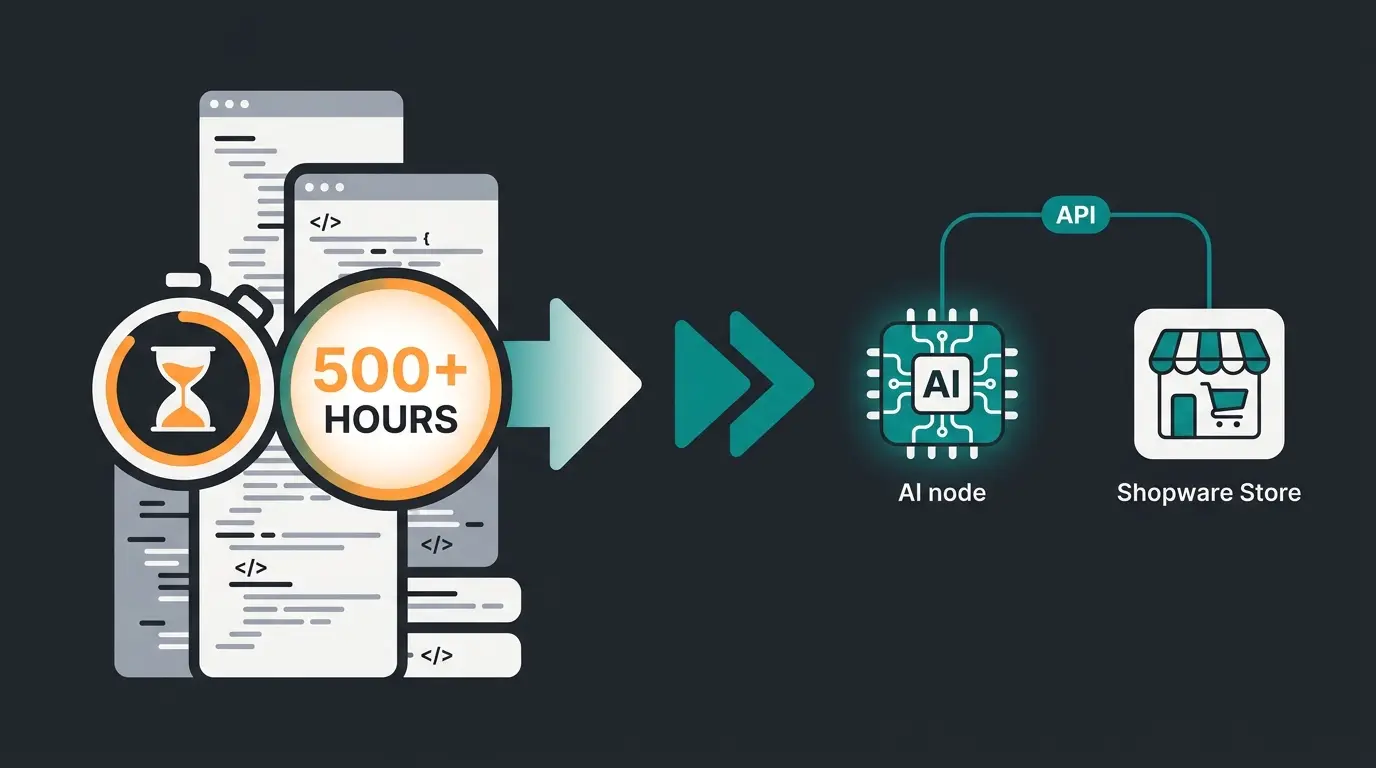
The numbers are blunt. A custom product-advisor plugin runs concept, backend, frontend, and testing to roughly 55 developer hours, about 5,500 EUR at 100 EUR per hour, plus yearly maintenance. Connecting a specialized AI product advisor through the API takes about 6 hours of setup, near 600 EUR, with updates handled by the vendor. Same feature. Roughly one tenth of the build cost. Custom code gives you full control over the data pipeline, whereas a SaaS AI employee trades some control for near-zero maintenance and continuous improvement.
| Requirement | Custom development | App-store extension | AI employee (integration) |
|---|---|---|---|
| Deep platform logic (pricing, ERP) | Best fit | Limited | Not designed for this |
| Standard feature (payment, shipping) | Overkill | Best fit | Not applicable |
| Product consultation, guided selling | Slow and costly | Rigid rule trees | Best fit |
| Service automation, lead qualification | High maintenance | Rarely available | Best fit |
| Time to launch | Weeks | Days | Days |
| Ongoing maintenance | Developer hours per update | Vendor-dependent | Self-updating SaaS |
This is not theory. The Rasendoktor AI product advisor case study reports a 16x return on investment, 100% automation of webchat inquiries, and 40% lower support cost. For garden-care retailer Neudorff, the published case study on Neudorff AI advisor Flora states the AI advisor delivers "97% accuracy in product recommendations" with an average response time under five seconds and a 99% cut in cost per chat. Both run an AI product consultation layer on top of the existing store, not a rebuilt one.
Rasendoktor with AI employee Hektor
Rasendoktor webchat inquiries handled automatically
Neudorff AI advisor Flora
Neudorff, response time under five seconds
Custom development still wins where it should. Deep pricing logic, ERP-specific workflows, and platform changes belong in code. Infrastructure decisions like managed hosting or a cloud setup stay a developer job. The point is not to stop hiring developers. It is to stop spending their hours on features an integration delivers better.
Frequently asked questions
A Shopware developer builds, customizes, and maintains stores on the Shopware 6 platform, working mainly in PHP, Symfony, and Twig. The role covers plugins, themes, API and ERP integration, migrations, and performance. Larger projects often split the work between backend and frontend specialists.
Shopware is an open-source e-commerce platform used to run online stores, from small shops to large B2B and B2C operations. Shopware 6 is built on the Symfony framework with an API-first architecture. Merchants use it for product management, checkout, content, and integrations with ERP, CRM, and marketing tools.
No. Shopware is an e-commerce platform, not an ERP system. It manages storefront, catalog, and orders, and connects to ERP systems like SAP, Microsoft Dynamics, or Pickware through the API. A developer usually handles that integration so stock and invoicing stay in sync.
In 2026, freelancers charge roughly 60 to 120 EUR per hour, specialized agencies 100 to 180 EUR per hour, and an in-house developer costs about 60,000 to 90,000 EUR per year plus overhead. A full store relaunch through an agency starts around 15,000 to 25,000 EUR depending on scope.
Usually not for customer-facing AI like product consultation. An AI employee integrates through the API in about six hours of setup and improves without ongoing developer work. You still need a developer for deep platform logic, ERP workflows, and custom plugins.
Before you brief a developer for a product advisor, see what an AI employee does in your store. It consults customers in real time, lifts basket value by up to 35%, and goes live in days.
Book a demo
Kevin is CTO and co-founder of Qualimero. As an AI architect with over 15 years of experience as CTO and CPO in the tech industry, he designs the AI systems that automate tens of thousands of customer interactions daily for Qualimero's clients — reliably, securely, and at scale.