Shopify Hydrogen: The Complete Guide to Headless Commerce in 2026
Learn what Shopify Hydrogen is, when it beats Liquid themes, and how to build your first headless storefront. Covers architecture, Oxygen hosting, AI integration, and migration.

What is Shopify Hydrogen?
Shopify Hydrogen is a React-based framework for building custom headless storefronts. It separates the frontend (what your customers see) from the backend (Shopify's commerce engine), connecting the two through the Shopify API. The result: complete control over every pixel of your store's user experience.
Traditional Shopify storefronts run on Liquid, a template language that renders pages on Shopify's servers. Hydrogen takes a fundamentally different approach. Your frontend is a standalone React application that fetches product data, cart state, and checkout flows through Shopify's Storefront API. Server-side rendering ensures fast initial page loads. Client-side React handles the interactivity.
Why did Shopify build this? Three reasons. First, brands wanted design freedom that Liquid templates could not provide. Second, React is the most widely adopted frontend framework, with a massive developer ecosystem. Third, headless architecture had become the standard for enterprise commerce. According to industry data, 73% of businesses now operate on headless architecture, a 14% increase since 2021 (source: Alokai). Shopify needed a first-party answer.
As of early 2026, Hydrogen runs on React Router v7 (the evolution of Remix), uses Vite as its build tool, and ships with built-in utilities for caching, streaming SSR, and Storefront API queries. The 2026.1 release updated key dependencies including React Router 7.9.2 and Miniflare v3, plus support for the Storefront API 2025-07. The official Shopify Hydrogen documentation covers the full API reference. This guide focuses on the decisions you need to make as a store owner or technical lead evaluating headless commerce.
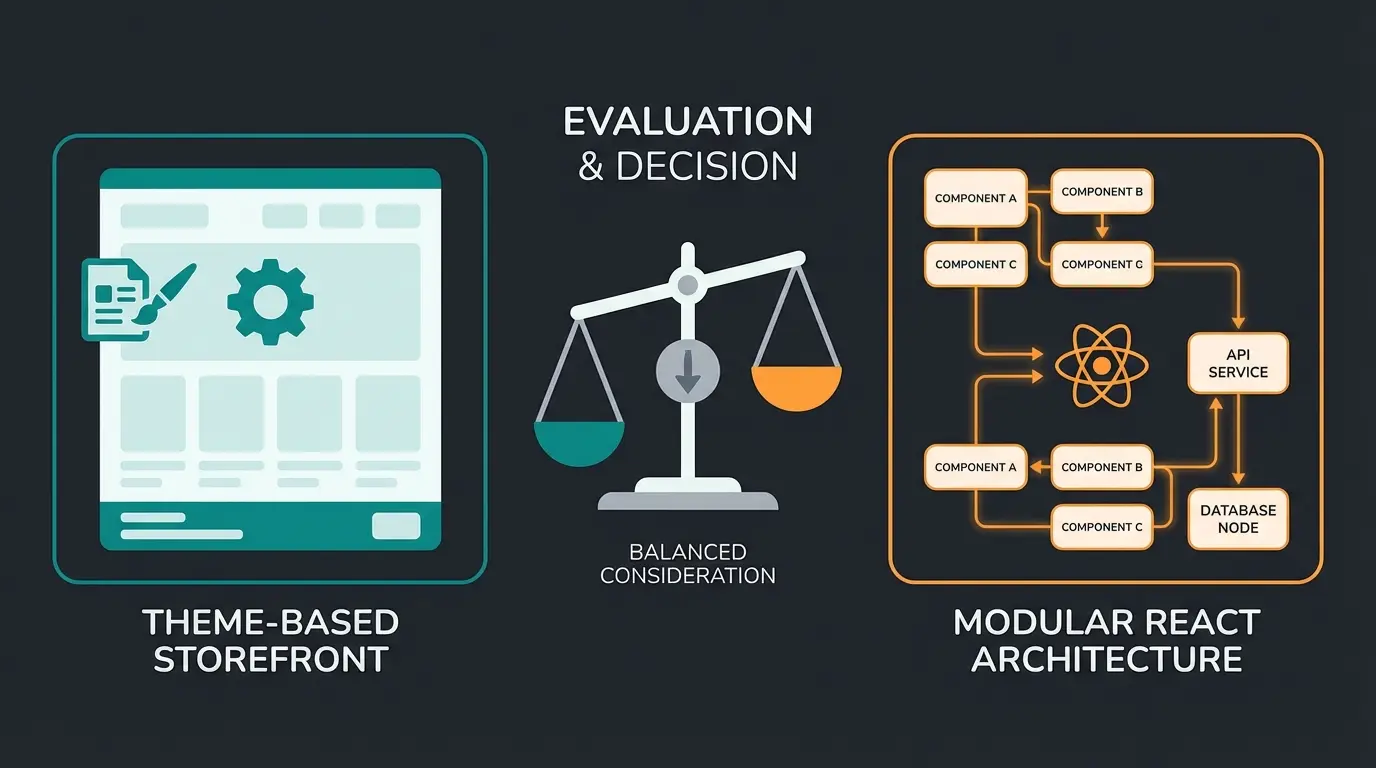
Hydrogen vs Liquid: when does headless make sense?
I have had this conversation with dozens of Shopify merchants over the past year. The answer is almost never "you should definitely switch to Hydrogen." More often, it is "Liquid is still the right choice for your store." That honesty matters, because a bad migration costs more than a slow website.
Here is the decision framework we use. Hydrogen makes sense when you need custom UX that Liquid cannot deliver: interactive product configurators, dynamic personalization across pages, or multi-brand storefronts from a single Shopify backend. It also makes sense when your team already includes React developers who would be slowed down by learning Liquid.
Liquid wins when your store runs on a well-built theme, your team does not include dedicated frontend developers, and your customization needs stay within what Shopify's theme editor provides. According to Shopify's own performance data, 78% of Shopify domains have good TTFB performance, which is higher than the average across the entire web (source: Shopify Performance Blog). That is not a number to dismiss.
The cost equation matters too. A full Hydrogen storefront for a mid-size store typically runs between EUR 15,000 and EUR 50,000 in development costs. A well-customized Liquid theme costs a fraction of that. Hydrogen only delivers positive ROI when the frontend limitations of Liquid are directly costing you conversions.
| Criteria | Liquid Themes | Shopify Hydrogen |
|---|---|---|
| Setup complexity | Low. Install theme, customize in editor. | High. Requires React project, CI/CD, deployment pipeline. |
| Developer requirements | Liquid, HTML, CSS. Shopify theme docs. | React, TypeScript, GraphQL. Full-stack experience. |
| Design freedom | Limited to theme architecture and sections. | Unlimited. Build any UI component from scratch. |
| Performance (default) | Fast out of the box. No tuning needed. | Requires caching optimization for comparable speed. |
| Performance (optimized) | Good, but ceiling is lower for complex UX. | Sub-second loads with SSR and edge caching. |
| Hosting cost | Included in Shopify plan. | Included via Oxygen, or self-host on Vercel/Netlify. |
| App ecosystem | Full access to 8,000+ Shopify apps. | Limited. Many apps require custom integration work. |
| AI integration | Basic, through third-party scripts. | Native MCP support for AI agents and assistants. |
| Maintenance cost | Low. Theme updates handled by provider. | High. Your team owns the frontend codebase. |
| Best for | Most stores. Especially under 500 products. | Custom UX, multi-brand, React teams, 500+ products. |
Technical architecture
Hydrogen's architecture is clean once you see the layers. At the base sits Shopify's Storefront API, a GraphQL endpoint that exposes product data, collections, cart operations, and customer accounts. Hydrogen wraps this API with React components and server-side rendering for performance.
The framework runs on React Router v7, the successor to Remix that Shopify adopted in early 2025. React Router v7 handles routing, data loading, and server rendering in a unified model. Vite powers the build toolchain, providing fast hot module replacement during development and optimized production builds.
On the server side, Hydrogen uses streaming SSR to send HTML to the browser as data arrives, rather than waiting for the entire page to be ready. This is what enables sub-second first contentful paint on optimized stores. Combined with granular caching utilities, you can cache individual API responses, full pages, or specific components independently.
Data flows through GraphQL queries to the Storefront API. For real-time inventory updates and order events, Shopify Webhooks push data to your application asynchronously. The Shopify GraphQL API provides the query language, while Hydrogen adds the rendering layer, caching strategies, and developer experience on top. The full source code, starter templates, and example implementations are available on the Hydrogen GitHub Repository.
Not every integration needs custom webhook code. For lighter automations, such as pushing new orders into a spreadsheet or notifying a fulfilment partner, a Shopify Zapier integration routes the same events into tools your team already uses without adding surface area to your Hydrogen codebase.
React Router v7 handles routing, components render the UI, Vite builds the application
Streaming SSR sends HTML to the browser progressively. Caching utilities reduce redundant API calls
Products, collections, carts, and customer data flow through Shopify's GraphQL endpoint
Inventory, orders, payments, and fulfillment. The commerce engine remains unchanged regardless of frontend
Global deployment across 100+ edge locations. Sub-100ms response times for visitors worldwide
Setting up a Hydrogen project
Getting started with Hydrogen requires three things: Node.js (version 18 or higher), a Shopify Partner account (free), and comfort with React and TypeScript. If the platform itself is still new to you, our guide to what Shopify is explains the plan tiers and admin structure you will be building against. If your team checks those boxes, the initial setup takes under 30 minutes.
- Install the Shopify CLI: Run `npm install -g @shopify/cli` to get the command-line tools for managing Hydrogen projects
- Create a new Hydrogen project: Run `shopify hydrogen init` and select a starter template. The demo store template includes product pages, collections, cart, and checkout out of the box
- Connect to your Shopify store: Add your Storefront API credentials to the `.env` file. You need a Storefront API access token from your Shopify admin under Apps > Develop apps
- Start the development server: Run `npm run dev` to launch the local development environment with hot module reloading. Your store runs at localhost:3000
- Customize your routes: Each page is a React component in the `/app/routes` directory. Product pages, collection pages, and the homepage each get their own route file with data loaders
- Configure your domain: For Shopify Custom Domain Setup, add your domain in the Shopify admin after deploying
- Deploy to Oxygen: Run `shopify hydrogen deploy` to push your storefront live on Shopify's edge network. Deployments complete in under two minutes
The Shopify Hydrogen Getting Started Guide walks through each step with full code examples. New projects generated with the Shopify CLI now use React Router v7 by default, with config-based routing via the `routes.ts` file.
// Example: Fetching products in a Hydrogen route
import { useLoaderData } from '@shopify/hydrogen';
import type { LoaderFunctionArgs } from '@shopify/hydrogen';

export async function loader({ context }: LoaderFunctionArgs) {
  const { products } = await context.storefront.query(PRODUCTS_QUERY);
  return { products };
}

export default function ProductsPage() {
  const { products } = useLoaderData<typeof loader>();
  return (
    <div className="product-grid">
      {products.nodes.map((product) => (
        <ProductCard key={product.id} product={product} />
      ))}
    </div>
  );
}Hosting with Shopify Oxygen
Shopify Oxygen is the hosting platform built specifically for Hydrogen storefronts. It deploys your application across a global edge network, serving pages from the location closest to each visitor. The most important detail for your budget: Oxygen is included at no additional cost with every paid Shopify plan.
That means no separate hosting bills for bandwidth, storage, or compute. Whether you are on the Basic plan at $39/month or Shopify Plus at $2,300/month, Oxygen hosting is part of the package. This is a significant advantage over self-hosting on Vercel, Netlify, or Cloudflare Workers, where costs scale with traffic and can become substantial for high-volume stores during peak seasons.
Oxygen provides built-in CI/CD through the Shopify CLI. Running `shopify hydrogen deploy` pushes your code to production in under two minutes. Preview deployments let you test changes before they go live. For a deeper look at Oxygen's capabilities and performance limits, see our Shopify Oxygen Hosting guide.
| Feature | Shopify Oxygen | Vercel | Netlify |
|---|---|---|---|
| Cost | Included with Shopify plan | Free tier, then usage-based | Free tier, then usage-based |
| Edge locations | 100+ global locations | Varies by plan | Varies by plan |
| Shopify integration | Native. One-click deploy via CLI. | Requires adapter configuration | Requires adapter configuration |
| Custom domains | Managed via Shopify admin | Managed in Vercel dashboard | Managed in Netlify dashboard |
| CI/CD | Built into Shopify CLI | GitHub integration | GitHub integration |
| Best for | Most Hydrogen stores | Teams already invested in Vercel | Teams already invested in Netlify |

AI integration with Hydrogen
This is where headless architecture gets interesting for store owners thinking about the next 12 months. In mid-2025, Shopify rolled out built-in MCP (Model Context Protocol) support across all stores. Every Shopify store now exposes an MCP endpoint at `/api/mcp`, enabling AI agents to query products, manage carts, answer customer questions, and initiate checkout, all in real time.
Three specialized MCP servers handle different functions. The Storefront MCP server answers product and policy questions using your catalog data. The Customer Accounts MCP server handles order tracking and account management. The Checkout MCP server manages the full purchase flow. For Hydrogen storefronts, this means AI-powered features are native to the architecture, not bolted on through third-party scripts.
That native access is what separates this from the older AI assistant as a managed service model, where a vendor script sat on top of the storefront and inferred your catalog from whatever it could scrape off the page. With MCP, the AI reads the same Storefront API your frontend reads. Same data, same freshness, no drift.
I have seen this shift firsthand. At Qualimero, we deploy AI employees across Shopify stores that handle product advisory, customer service, and guided selling. On a traditional Liquid storefront, integrating an AI assistant requires workarounds and script injections. On a Hydrogen storefront, the AI agent communicates directly with the Storefront API through MCP, accessing real-time product data, inventory levels, and customer context without friction. The result across our client base: an average 35% increase in cart value and conversion rates up to 7x higher than stores without AI-powered product advice.
The same AI employee does not have to stay on the storefront. Once it has product and order context through the API, the identical logic can answer on WhatsApp Business or by email, so a customer who starts a question mid-checkout can finish it in the channel they already use.
Shopify also announced the Universal Commerce Protocol (UCP), co-developed with Google, which extends MCP for agentic commerce at scale. Merchants can now sell directly through AI Mode in Google Search and the Gemini app, managed centrally from the Shopify Admin through a new "Agentic Storefronts" section. The global headless commerce market reflects this direction: projected to grow from $1.74 billion in 2025 to $7.16 billion by 2032 at a 22.4% CAGR (source: Coherent Market Insights).
A 14% increase since 2021. Source: Alokai Headless Commerce Statistics 2025
22.4% CAGR from $1.74B in 2025. Source: Coherent Market Insights
Average across Qualimero client stores using AI employees for guided selling on Shopify
Storefront, Customer Accounts, and Checkout. Available on every paid Shopify plan since mid-2025
Hydrogen gives you speed and design freedom. An AI employee from Qualimero turns that into revenue, with real-time product advice that increases cart values by up to 35%. Our clients like Gartenfreunde achieved a 7x higher conversion rate after adding an AI employee to their store.
See how it worksMigrating to Hydrogen
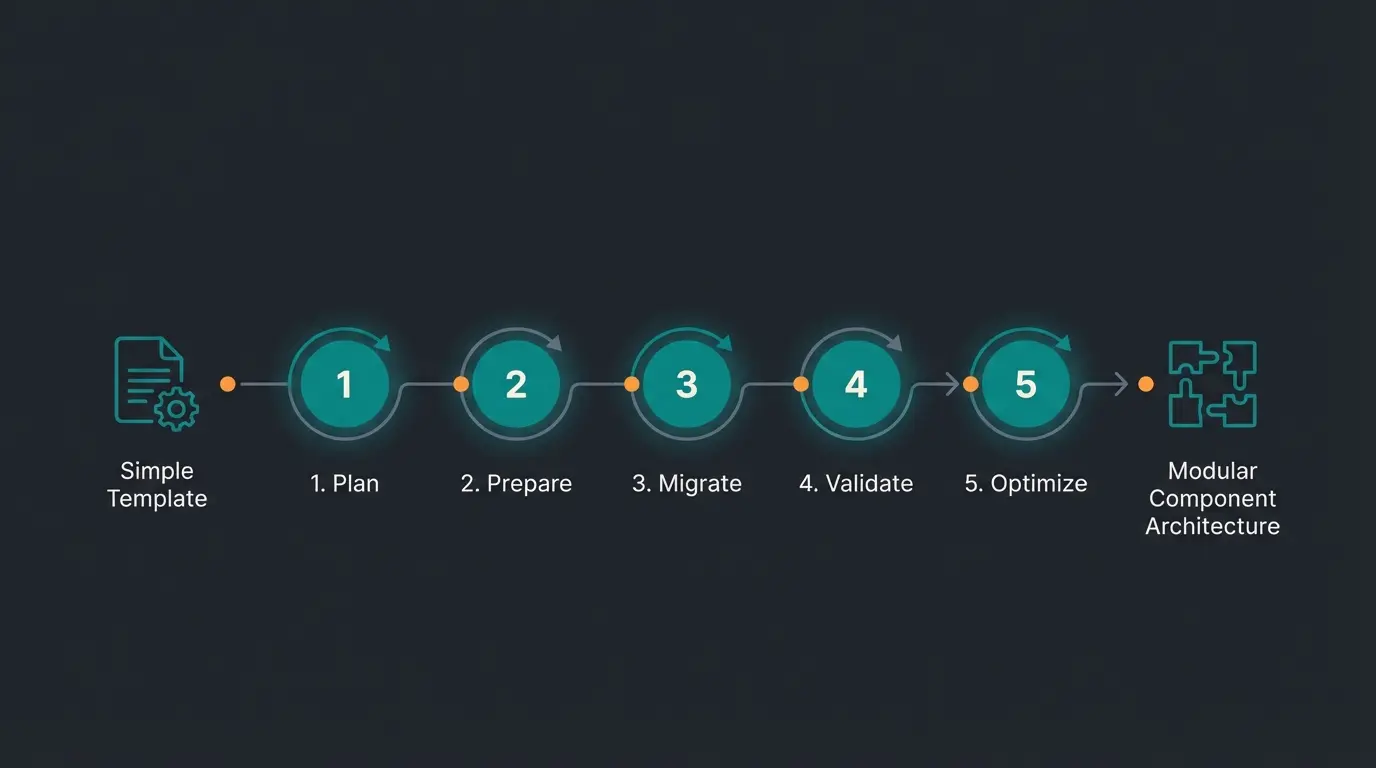
If you are running a Liquid store and considering the switch, do not try to migrate everything at once. The most successful migrations follow a phased approach: start with one high-impact page, prove the value, then expand. Attempting a full rewrite in one go is how budgets spiral and timelines slip.
- Start with a single page. A custom product detail page or landing page is ideal. Build it in Hydrogen, deploy it on a subdomain or specific route, and measure the performance difference against your Liquid version
- Run both systems in parallel. Shopify supports serving Liquid pages and Hydrogen routes from the same store. Use this to migrate gradually without disrupting your live store or breaking existing SEO
- Move collections and product pages next. These are the pages where custom UX and performance optimization have the biggest measurable impact on conversion rates
- Migrate the full storefront last. Cart, checkout, account pages, and search. Only do this once your team is confident with the Hydrogen development workflow and has established testing patterns
- Plan for 3 to 6 months. A realistic migration timeline for a store with 500+ products, including development, QA, performance testing, and 301 redirects for SEO preservation
Each phase carries its own technical details: URL redirects, SEO considerations, and app compatibility. Common pitfalls include losing SEO equity from incorrect redirects, breaking third-party app integrations that depend on Liquid, and underestimating the development time for custom components that your theme provided out of the box.
Frequently asked questions about Shopify Hydrogen
Hydrogen itself is free and open-source. You need a paid Shopify plan (starting at $39/month) to access the Storefront API and Oxygen hosting. There are no separate fees for Hydrogen or Oxygen beyond your Shopify subscription.
Yes. Hydrogen is a React framework built on React Router v7 and TypeScript. Your team needs solid React experience to build and maintain a Hydrogen storefront. Liquid theme development is a fundamentally different skill set and does not transfer.
Some Shopify apps work out of the box through the Storefront API. Many others require custom integration because they were built for Liquid themes. Check each app's documentation for headless compatibility before committing to a Hydrogen migration.
Liquid stores are faster by default without optimization. A well-optimized Hydrogen store with server-side rendering, edge caching, and streaming SSR can achieve sub-second load times, potentially outperforming Liquid. The key difference is that Hydrogen performance requires active tuning by experienced developers.
Yes. Hydrogen has been in general availability since 2023. The 2026.1 release with React Router v7 is a mature, stable framework used by brands like Allbirds and Gymshark in production. It is no longer early-adopter technology.
Hydrogen is the frontend framework (React-based, open-source). Oxygen is the hosting platform where you deploy your Hydrogen storefront. Hydrogen is the code, Oxygen is the server. Both are maintained by Shopify and designed to work together.
Yes. Shopify's native MCP (Model Context Protocol) support enables AI agents to interact with any Shopify store, including Hydrogen storefronts. AI employees can access real-time product data, manage carts, and provide personalized product advice through the Storefront MCP endpoint.
Qualimero's AI employees integrate directly with Shopify's Storefront API to provide real-time product advice, handle customer inquiries, and increase cart values. 14-day free trial, no code required.
Start your free trial
Lasse is CEO and co-founder of Qualimero. After completing his MBA at WHU and scaling a company to seven-figure revenue, he founded Qualimero to build AI-powered digital employees for e-commerce. His focus: helping businesses measurably improve customer interaction through intelligent automation.