Shopify marketing: 7 channels that actually drive revenue in 2026
A complete guide to the 7 key Shopify marketing channels. Data-backed strategies for SEO, email, social commerce, paid ads, content, AI automation, and budget planning.

Why marketing is essential for Shopify stores
Open the analytics dashboard of any new Shopify store and you will see the same pattern: a spike of initial traffic from friends and family, then a slow decline toward zero. Shopify handles the infrastructure. It does not handle the customers.
As of early 2026, there are over 4.8 million live Shopify stores competing for attention. The platform makes it easy to launch. That is precisely the problem. Every niche is crowded, and the stores that grow are the ones investing in marketing channels that compound over time.
The real risk is channel dependency. One algorithm update, one CPM spike, one deliverability issue, and revenue drops overnight. I have watched stores lose 40% of their traffic in a single Google core update because organic search was their only channel. The ones that survived had email lists, paid campaigns, and content strategies running in parallel.
This guide covers seven channels. Not because seven is a magic number, but because these are the seven that consistently produce measurable returns for Shopify stores right now.
Global average $36, US e-commerce $72. Source: Omnisend, 2025
The 7 key Shopify marketing channels at a glance
Before diving into each channel, here is a quick comparison. The right mix depends on your budget, team size, and growth stage. No single channel works for every store.
| Channel | Monthly cost | Time to results | Difficulty | Best for |
|---|---|---|---|---|
| SEO | $0-2,000 | 3-6 months | Medium | Sustainable organic traffic |
| Email marketing | $50-500 | 1-4 weeks | Low-Medium | Retention, repeat purchases |
| Social commerce | $0-1,000 | 1-3 months | Medium | Brand awareness, younger audiences |
| Paid advertising | $500-10,000+ | Immediate | High | Scaling fast, product launches |
| Content marketing | $0-1,500 | 3-9 months | Medium | Authority, long-tail traffic |
| AI automation | $200-800 | 1-2 weeks | Low | Conversion, customer engagement |
| Built-in Shopify tools | $0-50 | 1-2 weeks | Low | Stores just starting out |
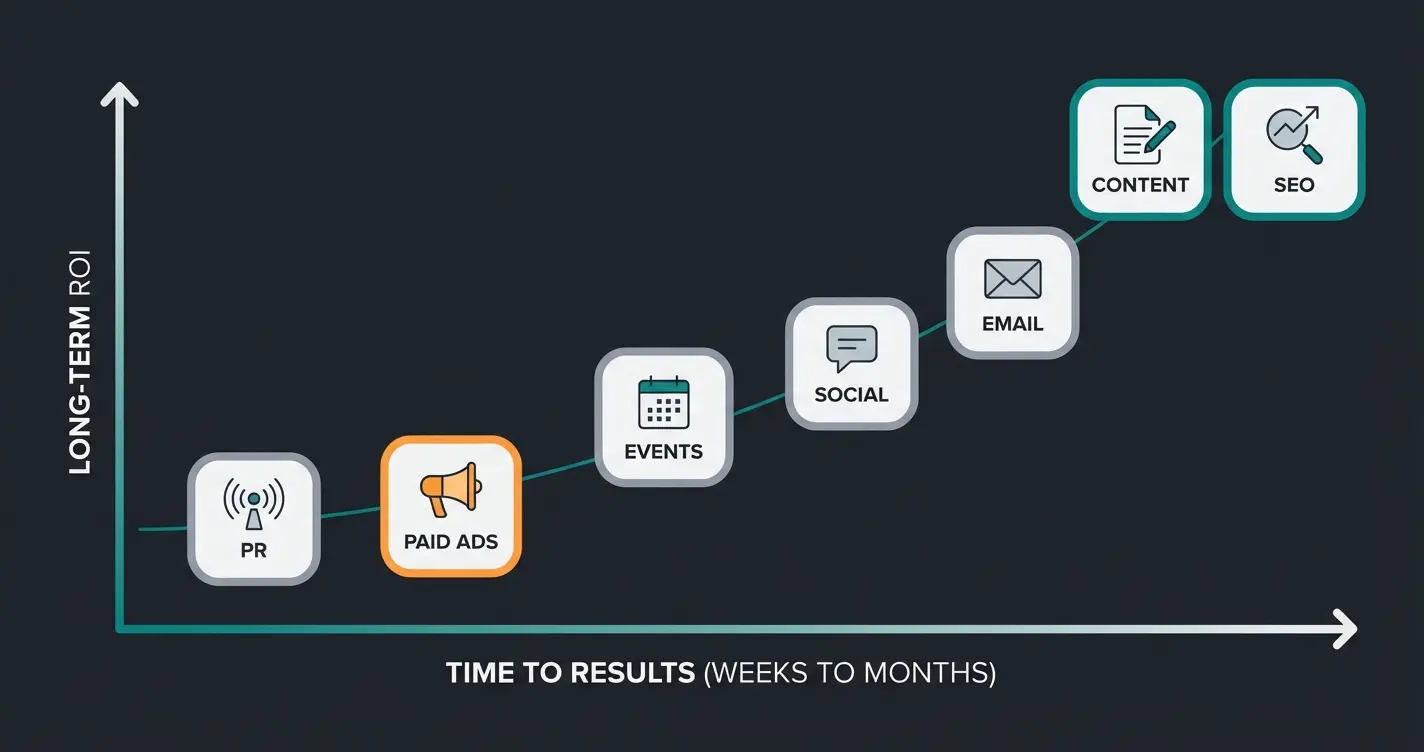
The table reveals a pattern: channels with the fastest results cost the most. Channels with the best long-term ROI require patience. The smartest approach combines both, using paid channels to generate immediate cash flow while building owned channels that compound over months.
SEO as a marketing channel
Organic search accounts for 43% of all e-commerce traffic and drives 23.6% of online orders (BrightEdge/Salesforce, 2025). For Shopify stores specifically, SEO delivers a 317% average ROI over three years with a nine-month break-even point (First Page Sage, 2026). No other channel offers that combination of scale and compounding returns.
What makes SEO particularly valuable is the flywheel effect. A blog post that ranks today keeps driving traffic for months or years without additional spend. Paid ads stop the moment you stop paying. The tradeoff is patience: meaningful organic traffic takes 3-6 months to build.
- Optimize product page titles and meta descriptions for buyer-intent keywords
- Build a topic cluster strategy around your core product categories
- Fix technical fundamentals: Shopify page speed, mobile responsiveness, canonical tags
- Earn backlinks through original data, in-depth guides, and industry commentary
- Monitor GEO (Generative Engine Optimization) as AI search engines grow in market share
The rise of AI-powered search is worth watching. ChatGPT-referred traffic already converts 31% higher than standard non-branded organic search (SearchEngineLand, 2025). Structuring your content for LLM extraction, with clear definitions, sourced claims, and self-contained FAQ answers, is no longer optional.
Email marketing and automation
Email is the quiet workhorse of e-commerce marketing. It generates between $36 and $40 for every dollar spent globally, with US e-commerce brands seeing returns as high as $72 per dollar (Omnisend, 2025). You own the channel. No algorithm changes, no rising CPMs, no platform dependency.
The real leverage is in automation. Automated flows account for just 2% of email sends but drive 30% of total email revenue, earning 16x more per send than scheduled campaigns (Omnisend, 2025). Three flows matter most when starting out.
| Flow | Trigger | Avg. conversion | Purpose |
|---|---|---|---|
| Welcome series | First signup | 3-5% | Brand introduction, first purchase incentive |
| Abandoned cart | Cart abandonment | 3.3% (top: 7.7%) | Recover lost revenue |
| Post-purchase | Order confirmed | 1-2% | Reviews, cross-sells, retention |
- Choose your platform: Klaviyo, Omnisend, or Shopify Email for smaller stores
- Build welcome, abandoned cart, and post-purchase flows before sending any campaigns
- Segment by purchase history, browse behavior, and engagement level
- A/B test subject lines and send times consistently
- Maintain list hygiene: remove inactive subscribers quarterly
One pattern I see repeatedly: stores send campaigns but ignore automations. The store that builds three solid flows before sending a single newsletter will outperform the one sending weekly blasts to an unsegmented list. Every time. For a deeper dive into flows, segmentation, and platform selection, see our dedicated Shopify Email Marketing guide, and for list building and campaign setup start with our Shopify newsletter walkthrough.
Social commerce and influencer marketing
Social commerce crossed $1.2 trillion in global sales in 2025 and is projected to represent 22% of all e-commerce revenue by the end of 2026 (eMarketer). In the US alone, social commerce will surpass $100 billion this year for the first time.
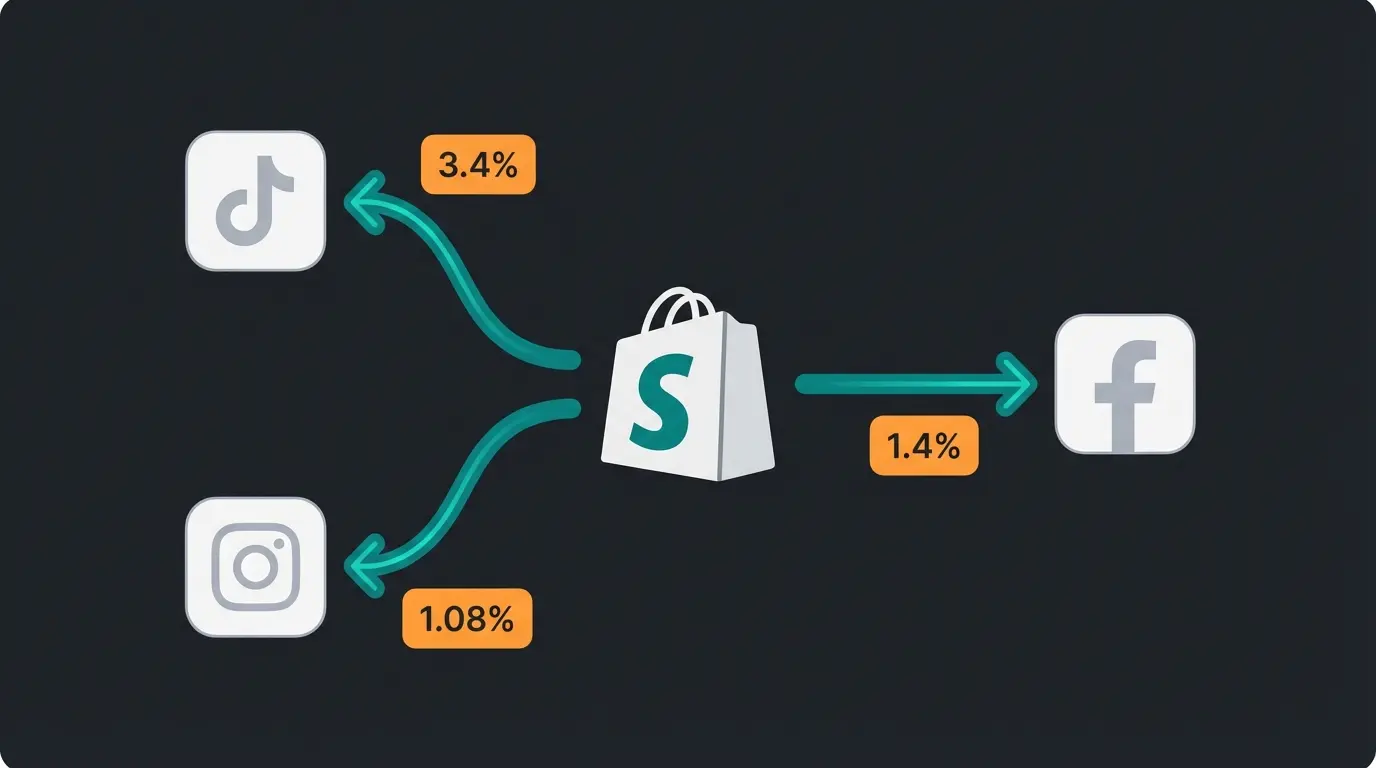
The platform dynamics have shifted. TikTok Shop tripled its GMV year-over-year to $32 billion in 2025, with a 3.4% average conversion rate. That is higher than Instagram at 1.08% and YouTube at 1.4%. For Shopify store owners, TikTok Shop integration has moved from experimental to essential.
- Connect your Shopify catalog to TikTok Shop, Instagram Shopping, and Facebook Shops
- Prioritize short-form video: product demonstrations, behind-the-scenes, customer stories
- Work with micro-influencers (5,000-50,000 followers) in your niche rather than chasing large accounts
- Use Shopify Collabs to find and manage influencer partnerships directly from your admin
- Track attribution carefully with UTM parameters and unique discount codes
The honest assessment: social commerce works best for visually compelling, impulse-friendly products under $100. If you sell complex, high-ticket items, social channels serve brand awareness better than direct conversion. The exception is live shopping, which is gaining traction for considered purchases in specific niches.
Paid advertising (Google Ads, Meta Ads, Shopping)
Paid advertising is the fastest way to drive traffic to a Shopify store. It is also the fastest way to burn through a budget. The average e-commerce ROAS dropped to 2.87:1 in 2025 (UpCounting), meaning most stores earn less than $3 for every $1 spent on ads.
Google Ads outperforms the average. Search campaigns deliver a 5.17:1 ROAS because they capture high-intent buyers actively searching for products. Google Shopping campaigns convert particularly well for Shopify stores with optimized product feeds, returning 4.0-5.0:1 on average.
| Platform | Avg. ROAS | Best for | Key advantage |
|---|---|---|---|
| Google Search | 5.17:1 | High-intent buyers | Captures active demand |
| Google Shopping | 4.0-5.0:1 | Product discovery | Visual, price-driven results |
| Meta (Facebook/Instagram) | 2.5-3.5:1 | Awareness, retargeting | Detailed audience targeting |
| TikTok Ads | 2.0-3.0:1 | Younger demographics | High engagement, lower CPMs |
For stores ready to scale into product listing ads, feed quality decides more than bidding does. Accurate product titles, valid GTINs, and correctly mapped product types determine whether Google Shopping surfaces your items at all. In the first three months, a clean feed beats a clever bid strategy almost every time.
More visitors are only half the equation. A Qualimero AI employee turns browsers into buyers with real-time product advice, increasing conversion rates by up to 7x. See it in action.
Book a demoContent marketing and blogging
Content marketing through Shopify's built-in blog is one of the most underused channels. Most store owners treat it as an afterthought, publishing product announcements nobody searches for. The stores that build a real content strategy see compounding organic traffic over 6-12 months.
The approach that works is topic clusters. Pick your core product categories, build a comprehensive guide for each (your pillar page), then write specific articles targeting long-tail keywords around each pillar. This is exactly how the most successful content-led Shopify stores structure their blogs.
- Identify 3-5 core topics aligned with your product catalog
- Research long-tail keywords your customers actually search for
- Create one pillar guide (2,000-3,000 words) per core topic
- Write 5-10 supporting articles per pillar targeting specific questions
- Interlink everything: supporting articles link to the pillar, pillar links back
- Publish consistently: 2-4 posts per month is sustainable for most teams
Content does double duty. A single well-researched blog post drives organic traffic today and feeds your email campaigns, social media calendar, and ad creative tomorrow. One article becomes an email series, five social posts, and a retargeting audience.
AI-powered marketing and automation with Qualimero
Most marketing channels bring visitors to your store. What happens after they arrive determines whether that investment pays off. The average Shopify store converts between 1.4% and 1.8% of visitors. That means 98 out of 100 people leave without buying.
This is where AI-powered customer engagement changes the math. Not a scripted FAQ tool that deflects questions, but a digital team member that understands your product catalog, recognizes customer needs, and provides real-time product advice. The difference between a generic response and a genuine Shopify conversion optimization strategy.
Gartenfreunde, a German retailer specializing in premium garden houses, faced exactly this gap. Complex products, high ticket prices, and a single employee handling up to 50 consultation-intensive inquiries per day during peak season. After implementing Qualimero's AI employee Kira, trained exclusively on their product data and expert knowledge, they measured a 7x higher conversion rate for customers interacting with the AI, a 6x ROI, and a 45% click-through rate on product recommendations (Qualimero, 2025).
- Real-time product consultation based on trained expert knowledge, not generic scripts
- Intelligent cross-selling and upselling with contextual recommendations
- Automated handling of recurring inquiries around the clock
- WhatsApp and web chat engagement without human intervention
- Continuous learning from every customer interaction, improving accuracy over time
The friction point is worth stating honestly: AI employees work best for consultation-intensive products where customers need guidance before purchasing. Garden houses, technical equipment, configurable products, premium goods. If you sell simple, low-consideration items, the conversion impact will be smaller. For stores where product advice matters, results are typically measurable within two weeks.
Gartenfreunde achieved 7x higher conversion rates and 6x ROI. Book a 30-minute demo tailored to your product catalog and see the impact for yourself.
Book your demoMarketing tools built into Shopify
Shopify includes a suite of marketing tools that many store owners either overlook or outgrow quickly. Understanding what is built in versus what needs a third-party app saves you from paying for features you already have. The Shopify marketing documentation covers the full feature set, and Shopify's own e-commerce marketing guide provides a broader strategic framework.
| Feature | Shopify built-in | When to upgrade | Recommended alternative |
|---|---|---|---|
| Email campaigns | Shopify Email (free up to 10k/month) | Advanced automation needed | Klaviyo, Omnisend |
| SEO | Basic meta fields, sitemap | Technical audits required | Ahrefs, SEMrush |
| Social selling | Facebook/Instagram channels | TikTok Shop needed | Native TikTok integration |
| Ads | Shopify Audiences (Plus only) | Granular control needed | Google Ads, Meta Ads Manager |
| Analytics | Shopify Analytics | Attribution modeling needed | Google Analytics 4, Triple Whale |
Start with the built-in tools if your store generates under $10,000 per month. The savings matter more than advanced features at that stage. Upgrade channel by channel as each becomes a proven revenue driver.
Planning your Shopify marketing budget
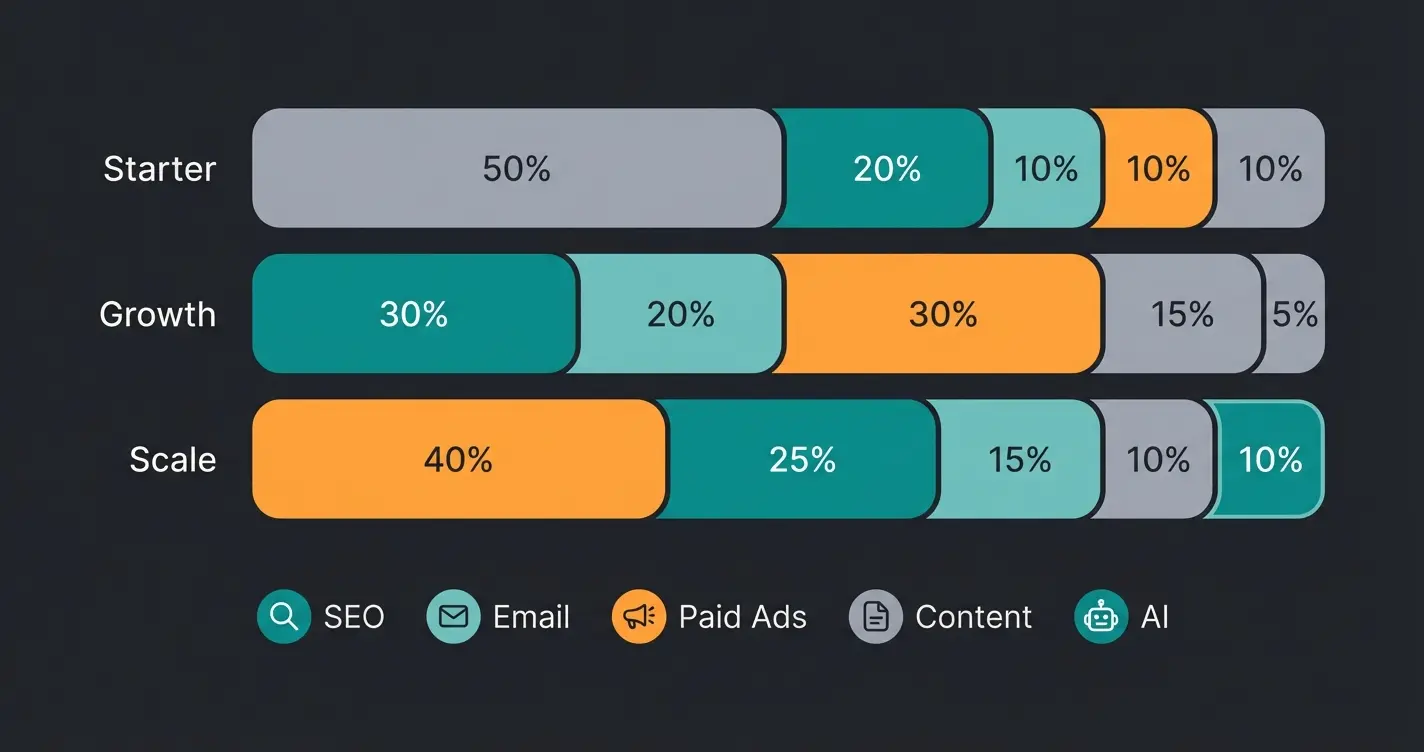
E-commerce brands typically allocate 10-20% of revenue to marketing (Gartner, 2025). The exact percentage depends on your growth stage, competitive landscape, and margin structure. Here is a practical framework.
| Stage | Monthly revenue | Marketing budget | Priority channels |
|---|---|---|---|
| Starter | Under $10,000 | 15-20% ($1,500-2,000) | SEO, email, organic social |
| Growth | $10,000-50,000 | 12-15% ($1,200-7,500) | Add paid ads, content marketing |
| Scale | $50,000+ | 10-12% ($5,000-6,000+) | All channels, AI automation, influencer |
Two principles matter more than exact percentages. First, invest in owned channels (SEO, email, content) before rented ones (paid ads, social). Owned channels compound over time. Rented channels reset to zero when you stop spending.
Second, track customer acquisition cost by channel and shift budget toward whatever produces the lowest CAC-to-LTV ratio. The mistake I see most often: stores spending 80% of budget on paid ads and 0% on retention, when acquiring a new customer costs 5-7x more than retaining an existing one.
FAQ
Marketing costs vary by growth stage. Starter stores should budget 15-20% of revenue ($1,500-2,000/month), while established stores typically spend 10-12%. Free channels like SEO and organic social require time investment rather than direct spend.
Start with Shopify Email and the built-in analytics. As you grow, Klaviyo (email automation), Ahrefs or SEMrush (SEO), and Google Analytics 4 (attribution) are the most widely recommended tools among successful Shopify merchants.
Start doing it yourself to understand what works for your store. Outsource specific channels, typically SEO or paid ads, once they prove profitable and you need specialist expertise to scale further. Never outsource everything at once.
Paid ads deliver traffic immediately. Email automation shows results within 2-4 weeks. SEO and content marketing need 3-6 months for meaningful organic traffic. Plan for a 6-month horizon before judging your overall marketing performance.
Email marketing delivers the highest ROI at $36-72 per dollar spent, but organic search drives the most traffic at 43% of all e-commerce visits. The most effective approach combines both: SEO brings visitors, email converts and retains them.
Qualimero's AI employees provide real-time product advice that increases conversion rates by up to 7x. Our clients see 35% higher average order values within the first month.
Start your free trial
Lasse is CEO and co-founder of Qualimero. After completing his MBA at WHU and scaling a company to seven-figure revenue, he founded Qualimero to build AI-powered digital employees for e-commerce. His focus: helping businesses measurably improve customer interaction through intelligent automation.