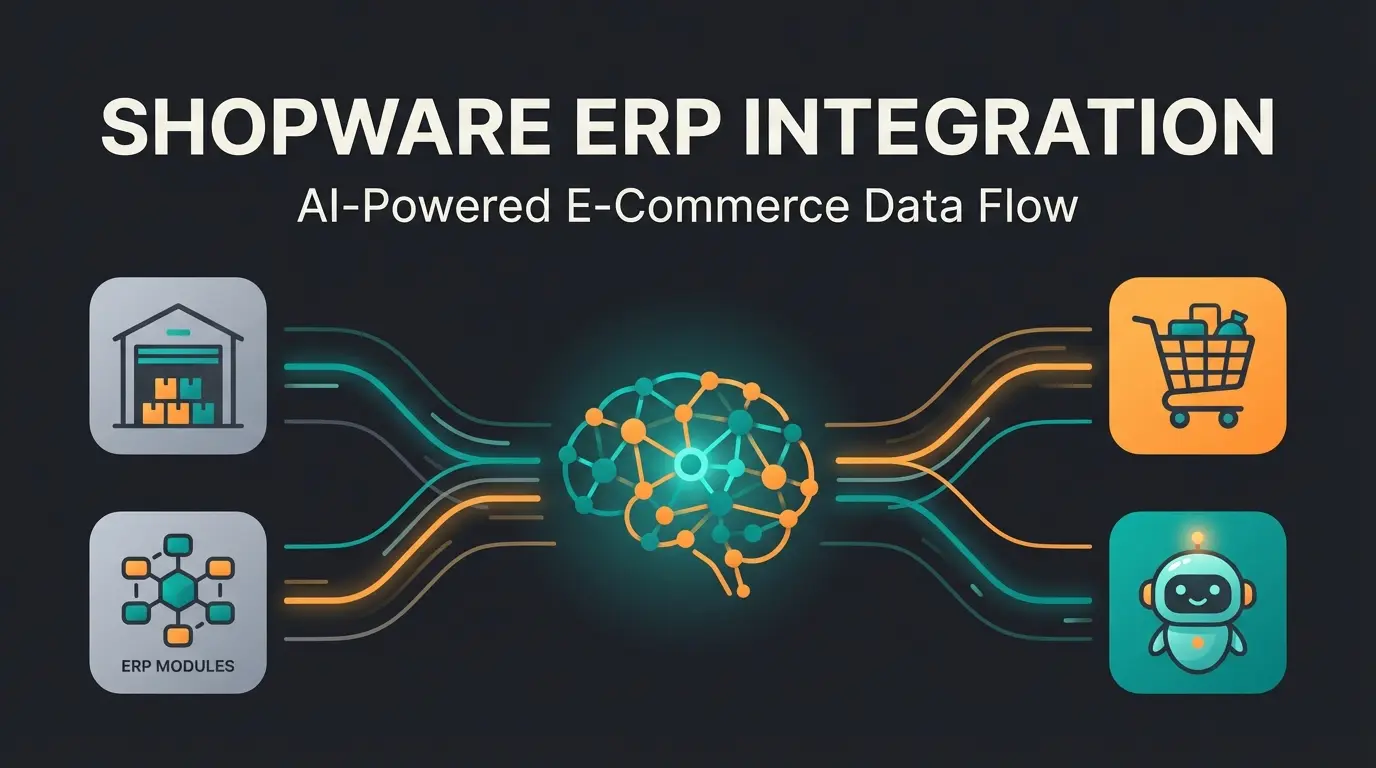
The End of Pure Warehouse Management
The role of Enterprise Resource Planning (ERP) in e-commerce has fundamentally transformed. Just a few years ago, Shopware inventory management was primarily a back-office tool: counting stock, printing invoices, managing returns. Those searching for a Shopware ERP integration asked about stability and synchronization speed.
In 2026, that's no longer sufficient. We're in an era where online shops aren't just digital catalogs—they've become active salespeople through AI-powered consultation (AI Sales Consultants). Your ERP system is no longer just the "memory" for inventory levels; it's the "brain" that feeds knowledge to your AI sales representatives. According to applus-erp.de, this paradigm shift is reshaping how businesses approach their technology stack.
The Problem: The "Silent" ERP
Most online retailers still use their Shopware 6 ERP systems like digital filing cabinets. The data is structured for logistics processes: item number, weight, purchase price, storage location. However, when you plan to deploy modern AI tools like the Shopware AI Copilot or external AI sales bots, you hit a wall. An AI cannot conduct emotional sales consultation with "Item No. 12345, Cotton, Blue." This insight from Qualimero's research highlights the critical gap between traditional ERP data and AI requirements.
The Solution: From Administrator to Consultant
This guide is different from typical "best of" lists. We don't just evaluate Shopware WaWi systems based on how well they label packages—we take that for granted. We analyze which system is ready to deliver the data infrastructure for your AI offensive. Organizations leveraging AI product consultation understand that the foundation starts with proper ERP configuration.
We examine current market leaders like JTL, Pickware, Xentral, and Microsoft Dynamics 365 from the perspective of AI Readiness. We also take a critical look at cost structures that have changed drastically through updates in 2024 and 2025—such as the new JTL editions or Microsoft's price increases. For more details, see our detailed ERP comparison for Shopware. This article is your roadmap for a Shopware ERP strategy that doesn't just manage but actively sells.
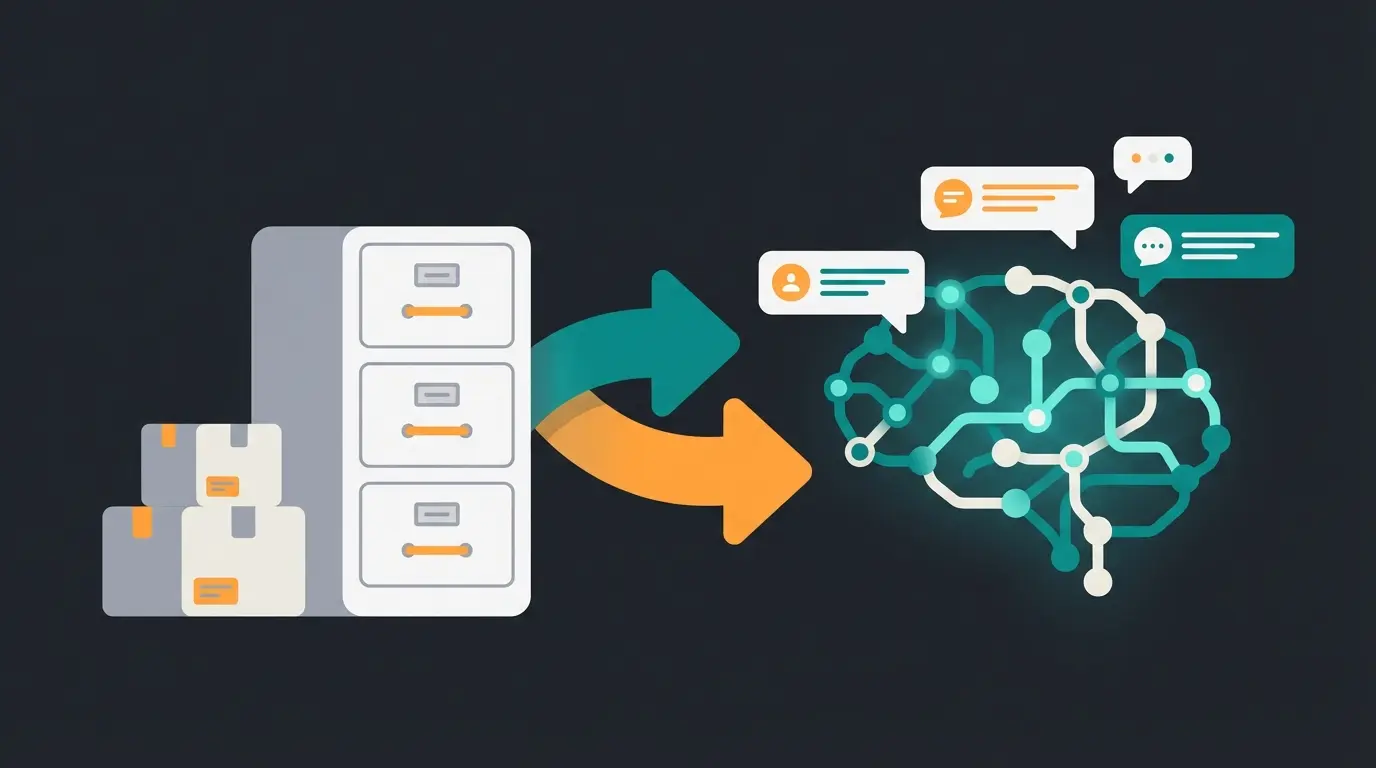
The "Big 3" Categories of Shopware ERP Systems
The market for Shopware inventory management is confusing. To simplify selection, we categorize systems not by feature lists but by their "DNA" and ideal use case. Understanding these categories helps businesses choose the right foundation for AI powered customer service implementations.
Category A: The Native Solution (Pickware)
Best for: Pure Shopware Users & D2C Brands
[Pickware](/blog/pickware) occupies a special position as it's directly integrated into Shopware. No external connector is necessary; the ERP lives in the Shopware backend. As documented on Pickware's official site, this native approach eliminates synchronization barriers entirely.
- Integration & Technology: Since Pickware runs natively in Shopware, there are no synchronization delays. Data is available in real-time. This is an enormous advantage for Shopware 6 ERP setups that depend on absolute data consistency.
- AI Status: Pickware benefits directly from Shopware AI Copilot features. Since it uses the Shopware database, features like the "AI Export Assistant" or "AI-generated product properties" work seamlessly, as detailed on Shopware.com.
- Updates & Costs: Pickware WMS is now firmly established in the Shopware 6 world, with features like digital pick lists and mobile barcode scanner support (App in the Apple Store).
- Verdict: Those who only use Shopware and don't have complex marketplace structures outside the shop will find here the cleanest data foundation for AI applications, as no "translation losses" occur through interfaces.
Category B: The All-Rounders (JTL, Xentral, Billbee)
Best for: Multichannel Retailers & Scalers
These systems are designed to centrally control multiple sales channels (Amazon, eBay, Kaufland, Shopware, Shopify). For businesses exploring AI lead generation, these platforms offer the multichannel data aggregation needed for comprehensive customer insights.
1. JTL-Wawi
JTL is the dominant player in the German-speaking region but has caused a stir with pricing changes in 2024. According to JTL Software, the transition to edition-based pricing represents a fundamental shift in their business model.
- 2025 Price Model: The introduction of "Editions" (Start, Advanced, Pro, Enterprise) and billing by order volume has ended the former "free" image. However, there's a price guarantee for these editions until December 31, 2025, as confirmed by Webstollen.
- AI Features: JTL actively integrates AI. There are functions for translating and optimizing product descriptions directly in the Wawi ("JTL-eazyAI"), as well as SEO optimization through AI, as shown on JTL Software's feature page.
- Shopware Integration: The connector is robust but a "black box" between systems. For AI projects, you must ensure all attributes ("Custom Fields") are cleanly mapped to Shopware.
2. Xentral
Xentral positions itself as a "Lean ERP" for modern e-commerce brands. As documented on Xentral.com, their cloud-native approach appeals to growing businesses.
- Technology: Cloud-native. This means no server installation like with JTL (On-Premise).
- AI Status: Xentral heavily promotes its AI Copilot (Beta), which primarily helps with reporting ("Show me yesterday's revenue"). This enables evaluations without SQL knowledge, according to Xentral's AI documentation.
- Focus: Process automation. Xentral is excellent for teams wanting to minimize operational burdens to focus on growth, as highlighted in their automation features.
3. Billbee
A lean solution, often the entry point for smaller retailers. According to Trusted.de and OMR Reviews, Billbee offers an attractive transaction-based model for startups.
- Costs: Transaction-based model, making it very attractive for startups (base fee + cost per order).
- Limits: Billbee is strong in fulfillment (invoice creation, shipping labels) but less deep in complex warehouse logistics or production planning than JTL or Xentral.
Category C: Enterprise Solutions (Microsoft Dynamics 365, SAP)
Best for: B2B, Corporate Structures & Complex Manufacturing
When Shopware is "just" the sales channel of an industrial company, these powerhouses come into play. Companies like AI Employee Kira demonstrate how enterprise-level integration can support sophisticated AI implementations.
Microsoft Dynamics 365 Business Central:
- Price Development: Attention to budget planning for 2026. According to Levelshift.com, Microsoft is increasing prices as of November 1, 2025 (e.g., Premium from $100 to $110, Essentials from $70 to $80). Supplychain247 provides additional context on these pricing changes.
- AI Power: Microsoft integrates "Copilot" extremely deeply. It helps not only with texts but also with analyzing financial data, supply chain problems, and cash flow forecasts. The integration into the Office world (Excel, Outlook) is unmatched, as noted by Integro.pl and Navision Partner resources.
- Shopware Integration: Here, middleware or a specialized connector partner (like Tinx or various agency solutions) is almost always necessary. The complexity of data integration is high.
New monthly price starting November 2025 (up from $100)
Start, Advanced, Pro, Enterprise pricing tiers introduced in 2024
Required for AI consultation to prevent out-of-stock recommendations
Rate limit exceeded - common issue when AI queries ERP too frequently
The Missing Link: ERP Data & AI Consultation
This is the crucial section explaining why many AI projects in e-commerce fail. Most retailers focus on Shopware ERP integration from a logistics perspective. That's important for shipping but deadly for AI sales. According to Trialta.de, the "Garbage In, Garbage Out" principle applies critically to AI implementations.
The "Logistics vs. Consulting" Data Dilemma
An ERP system traditionally stores data for logistics and Shopware accounting. However, an AI needs data for context. This fundamental difference is what separates successful AI implementations from failed ones. Success stories like KI Mitarbeiterin Flora demonstrate what's possible with properly structured consultation data.
| Data Type | Logistics Focus (Standard ERP) | Consulting Focus (AI-Ready ERP) |
|---|---|---|
| Product Name | "NIKE_PEG_39_BLU_42" | "Nike Air Zoom Pegasus 39 Men's Running Shoe Blue" |
| Description | "Upper: Synth., Sole: Rubber" | "Breathable mesh upper, ideal for marathon training and neutral runners." |
| Attributes | Weight: 250g, EAN: 12345678 | Cushioning: High, Surface: Asphalt, Pronation: Neutral |
| Purpose | Identification & Shipping | Consultation & Persuasion |
The Problem: If you feed your Shopware AI Copilot or an external chatbot with data from the left column, the bot will answer the question "Which shoe is good for my marathon training?" with: "I found NIKE_PEG_39_BLU_42." That's not consultation—that's a database query. Solutions like KI Produktberatung show how proper data structure enables meaningful product recommendations.
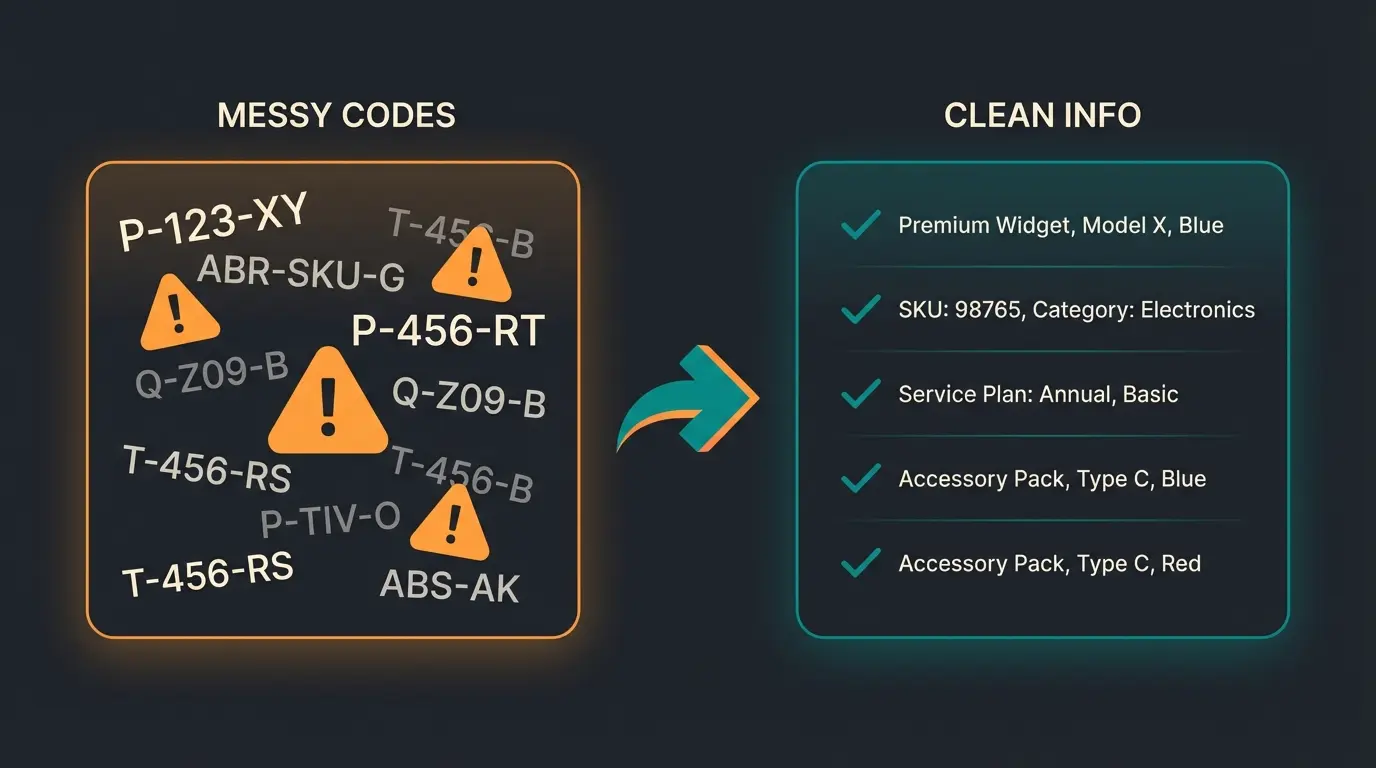
The "Dirty Data" Trap
AI models are extremely sensitive to unstructured or "dirty" data ("Garbage In, Garbage Out"). This principle, as explained by Deutscher Presseindex, is the foundation of all successful AI data strategies.
- Abbreviations: ERPs love abbreviations (e.g., "UOM" instead of "Unit of Measure"). AIs often hallucinate when they have to interpret abbreviations.
- Missing Contexts: An ERP knows that a cable is "USB-C." It often doesn't know that this cable is not suitable for the iPhone 14 (consultation knowledge).
The Solution: The ERP as "Brain"
To succeed in 2026, you need to configure your Shopware inventory management system to store "Consulting Fields." Companies implementing AI employees understand that data structure is the foundation of AI performance.
- Using "Custom Fields": Systems like JTL (documented on JTL Software's custom fields page) and Shopware (via Pickware) allow Custom Fields. Use these for attributes like "Occasion," "Style," "Compatibility."
- PIM Functionality: Many modern ERPs (JTL, Xentral) integrate PIM (Product Information Management) functions. Use these to separate technical data from marketing data.
- AI for Data Enrichment: Use the AI features of ERPs (like JTL's eazyAI or Shopware's AI Copilot) to generate flowing consultation texts from cryptic logistics data within the ERP, before syncing to the shop.
Abbreviated codes, technical specs, logistics attributes (NIKE_PEG_39_BLU_42)
AI tools transform cryptic data into rich product descriptions with context
Usage scenarios, customer benefits, compatibility info structured for AI
Natural conversation powered by context-rich data that persuades customers
Don't let dirty data sabotage your AI investment. Our AI employees can transform how you engage customers—but only with the right data foundation.
Start Your Data AuditTechnical Integration: Speed & Structure
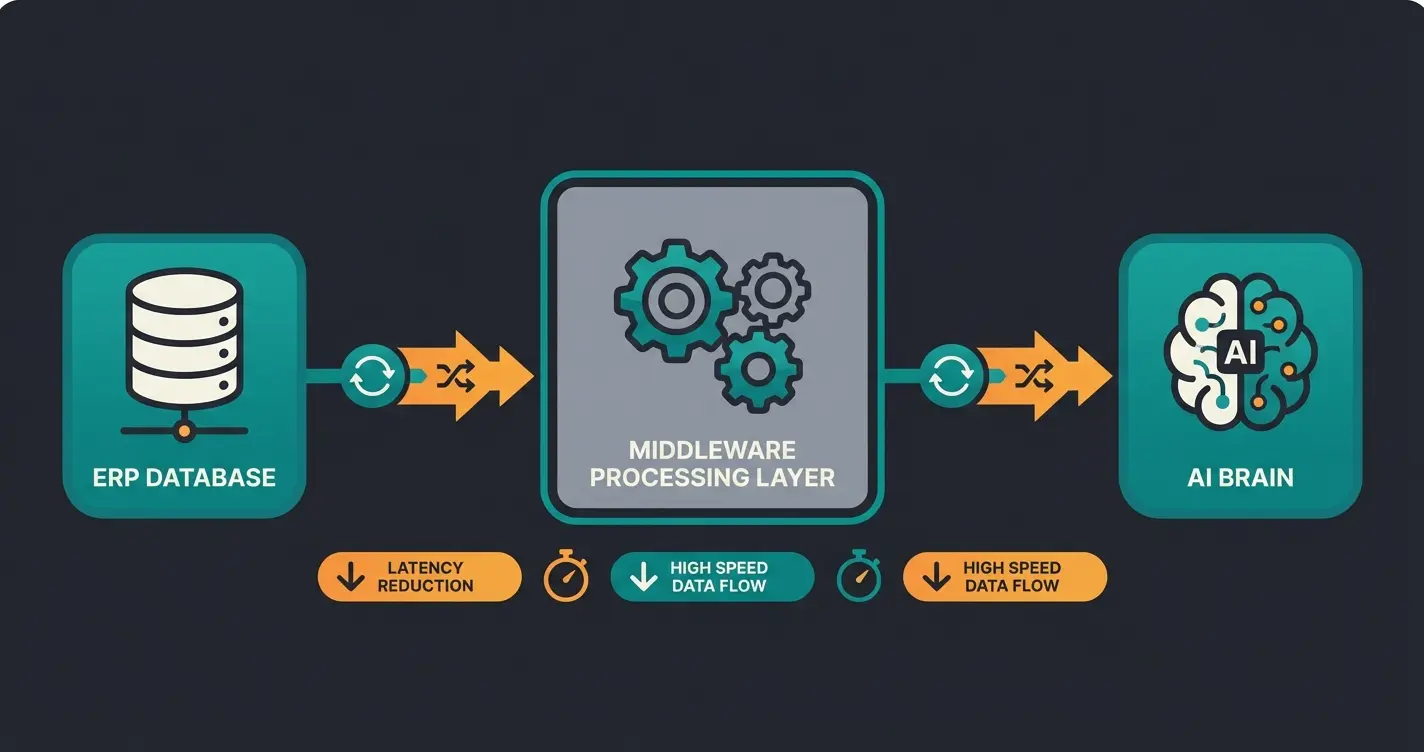
A successful Shopware ERP integration for AI applications depends on two technical factors: latency and API limits. Our Integration Methods Guide covers the specific connection approaches in detail. As outlined by Atwix, understanding these technical requirements is essential for any Shopware ERP integration project.
Real-time vs. Batched: The "Out-of-Stock" Nightmare
Classic connectors often sync only every 15 or 60 minutes. According to Appseconnect, this creates significant challenges for real-time AI applications.
- Scenario: A customer asks your AI bot about a product. The bot checks inventory (as of 45 minutes ago) and recommends it. The customer clicks—and the product is sold out.
- Consequence: Frustration and loss of trust.
- Solution: For AI consultation, you need a Shopware 6 ERP connection that allows inventory queries via API in real-time (Real-time Lookups). Native solutions like Pickware have a systemic advantage here. With external ERPs (JTL, Business Central), the interface must be performant enough to allow live queries during the chat.
Implementations like AI chat showcase how real-time data access creates seamless customer experiences. The technical foundation from Solution25 emphasizes that native integrations eliminate these synchronization challenges entirely.
API Limits and Middleware
Shopware 6 has built-in "Rate Limits" for the API to prevent overload, as documented in Shopware's official API documentation and the rate limiting guidelines.
- If your AI bot queries hundreds of product details for each customer, you risk running into a "429 Too Many Requests" limit.
- Best Practice: Use a Middleware (e.g., Synesty, Xentral Connect, or proprietary solutions) that buffers data and delivers it structured to the AI, instead of letting the AI hammer directly on the ERP. This cleans the data and protects API limits.
Selection Checklist (DACH Market Focus)
Before deciding on a Shopware ERP, check these criteria for the German market and 2026. Companies looking to implement social media support or comprehensive AI solutions need to ensure their ERP foundation meets these requirements.
1. Compliance & Legal Security
- GoBD Compliance: The system must absolutely fulfill the principles for proper management and storage of books (German accounting regulations).
- DATEV Interface: Without a clean DATEV export, your tax advisor will despair (or become very expensive). Pickware (as noted on Pickware's compliance page) and JTL offer established standards here.
- RKSV / TSS: Essential for POS systems (cash registers) in Germany/Austria (Technical Security Device).
2. AI-Readiness (The New Criterion)
- API Access to Attributes: Can "Custom Fields" (e.g., "Care Instructions") be easily read via API?
- Integrated AI Tools: Does the ERP itself offer AI functions (e.g., JTL eazyAI, Xentral Copilot) for data maintenance?
- Data Structure: Does the system allow a clean separation of logistics master data and marketing content?
3. Costs & Scalability
- Transaction Costs: Carefully examine the costs per order. With JTL (new editions) and Billbee, costs grow with success.
- Price Security: Note announced increases (e.g., Microsoft Business Central in Nov 2025).
Comparison Table: Logistics vs. Consultation Capabilities
Here you can see how the top systems differ when shifting focus from pure logistics to AI consultation. This comparison helps businesses evaluate which ERP best supports implementations like AI Employee Theresa.
| ERP System | Type | Logistics Strength | Consultation Data Depth (AI Potential) | API Flexibility | Special Feature |
|---|---|---|---|---|---|
| Pickware | Native | ⭐⭐⭐⭐ | ⭐⭐⭐⭐⭐ | Native (Shopware Core) | Direct access to all Shopware attributes without sync loss |
| JTL-Wawi | All-Rounder | ⭐⭐⭐⭐⭐ | ⭐⭐⭐⭐ | High (but complex) | Strong integrated PIM; AI text generation "eazyAI" helps with data enrichment |
| Xentral | Cloud | ⭐⭐⭐⭐ | ⭐⭐⭐ | Medium (REST API) | "No-Code" reporting via AI Copilot; strong in process automation |
| Business Central | Enterprise | ⭐⭐⭐⭐⭐ | ⭐⭐⭐⭐⭐ | Very High (OData/API) | Copilot deeply integrated; extremely powerful data structure, but high setup costs |
| Billbee | Lean | ⭐⭐⭐ | ⭐⭐ | Medium | Good for starting, but limited depth for complex consultation data |
Conclusion: Invest in the "Brain," Not Just the Warehouse
The market for Shopware ERP systems is in upheaval. The days when an ERP just had to be stable are over. In 2026 and beyond, your ERP is the decisive factor for the quality of your customer experience. If you're ready to hire an AI employee, ensure your data foundation can support intelligent conversations.
- If your data in the ERP is "dirty," your AI in the shop will be "dumb."
- If your interfaces are too slow, your AI will sell products that are no longer in stock.
Our Recommendation
- For pure Shopware users who want maximum AI power: Pickware, since the data barrier is eliminated.
- For multichannel retailers: JTL or Xentral, but only with a clear data governance strategy that defines how consultation data is maintained.
- For Enterprise: Microsoft Business Central, if the budget for a clean middleware architecture is available.
To see these principles in action, schedule a demo and discover how proper ERP-AI integration transforms customer engagement.
Frequently Asked Questions
In the German market, these terms are used interchangeably. "WaWi" (Warenwirtschaft/inventory management) traditionally refers to basic inventory and order management, while "ERP" (Enterprise Resource Planning) suggests a more comprehensive system including finance, HR, and CRM. For Shopware integrations, both terms typically refer to systems managing inventory, orders, and basic business processes.
For pure Shopware users, Pickware offers the cleanest data foundation since it runs natively within Shopware—no sync delays or data translation losses. For multichannel operations, JTL with its eazyAI features provides strong AI text generation capabilities. The key factor isn't which ERP you choose, but how you configure it to store "consultation fields" with context-rich product information.
Costs vary significantly: Billbee starts with a transaction-based model ideal for small businesses. JTL's new edition pricing (Start, Advanced, Pro, Enterprise) scales with order volume. Microsoft Business Central prices are increasing in November 2025 (Premium to $110/month, Essentials to $80/month). Factor in middleware costs if you need real-time AI integration with external ERPs.
Most failures stem from inadequate data, not AI technology. Standard ERP data contains logistics information (weight, EAN, abbreviated codes) but lacks "consultation attributes" (usage scenarios, customer benefits, compatibility). When an AI only has access to "NIKE_PEG_39_BLU_42," it cannot explain why this shoe is perfect for marathon training. The solution is enriching ERP data with context before it reaches the AI.
Real-time or near-real-time API access is essential. Traditional batch syncs (every 15-60 minutes) create the "out-of-stock nightmare" where AI recommends products that have since sold out. Native solutions like Pickware have systemic advantages here. For external ERPs, ensure your connector supports real-time inventory lookups during customer conversations.
Your ERP data is either your AI's greatest asset or its biggest weakness. Let's ensure your data foundation is ready to power intelligent product consultation that converts.
Get Your AI Readiness AssessmentDisclaimer: Prices and feature scopes are based on research from early 2025. Please check current conditions from providers, especially regarding the dynamic pricing models of JTL and Microsoft.

Lasse is CEO and co-founder of Qualimero. After completing his MBA at WHU and scaling a company to seven-figure revenue, he founded Qualimero to build AI-powered digital employees for e-commerce. His focus: helping businesses measurably improve customer interaction through intelligent automation.