Why Your ERP Integration Needs a Complete Rethink
When you think about [Shopware](/blog/shopware) ERP integration, what comes to mind first? Probably synchronized inventory levels, automated invoices through Shopware accounting integrations, and the hope that no order disappears into digital oblivion. That's understandable. For the past decade, connecting a warehouse management system (WaWi) to your online shop was primarily an exercise in operational efficiency. The goal was saving time and avoiding errors.
But in 2025, the game has fundamentally changed. We're standing at the threshold of Agentic Commerce – an era where not only humans shop in your store, but increasingly autonomous AI agents search for, compare, and purchase products according to digitalcommerce360.com. At the same time, human customers expect a depth of consultation that static product descriptions can no longer deliver. According to Shopware, this shift toward AI-driven shopping experiences represents one of the most significant transformations in e-commerce history.
Your ERP system integration is suddenly no longer just the "engine room update" – it's the decisive factor for your Sales Intelligence. A successful Shopware ERP integration today determines whether your shop remains "dumb" (only displaying what's in stock) or becomes "intelligent" (actively advising customers). Understanding Shopware AI features is essential for leveraging this transformation effectively.
In this comprehensive guide, you'll learn not only how to technically connect leading systems like JTL, Pickware, or Xentral. More importantly, we'll show you how to use this integration to prepare your data for the next generation of e-commerce. For more details, see our Pickware vs JTL vs Xentral comparison.
The Basics: Why Clean ERP Integration Is Non-Negotiable
Before we dive into the world of AI algorithms, we need to do our homework. A solid ERP connection is the backbone of every scaling e-commerce business. Without it, growth beyond a certain point is simply impossible.
Operational Efficiency and Error Prevention
The most obvious reason for integration is automating manual processes. When orders from Shopware 6 must be manually transferred to the warehouse management system, the cost per order increases linearly with revenue. According to Shopware's documentation, a proper integration ensures:
- Automated order creation: Orders land in the ERP in real-time
- Error-free [Shopware inventory management](/blog/shopware-inventory-management): Overselling is prevented because Shopware stock is immediately blocked when an item sells in the warehouse (or on another channel like Amazon)
- Faster shipping: Shipping labels and tracking codes are automatically generated and sent back to customers
Single Source of Truth (SSOT)
In a fragmented system landscape (shop, marketplaces, POS), the question "How many red t-shirts do we have left?" is often difficult to answer. The ERP must be the single source of truth. Shopware 6 is predestined for this with its API-First architecture, as highlighted by umwawium.de and confirmed by Qualimero's research, serving as the frontend while the ERP maintains data sovereignty.
Scalability Across Channels
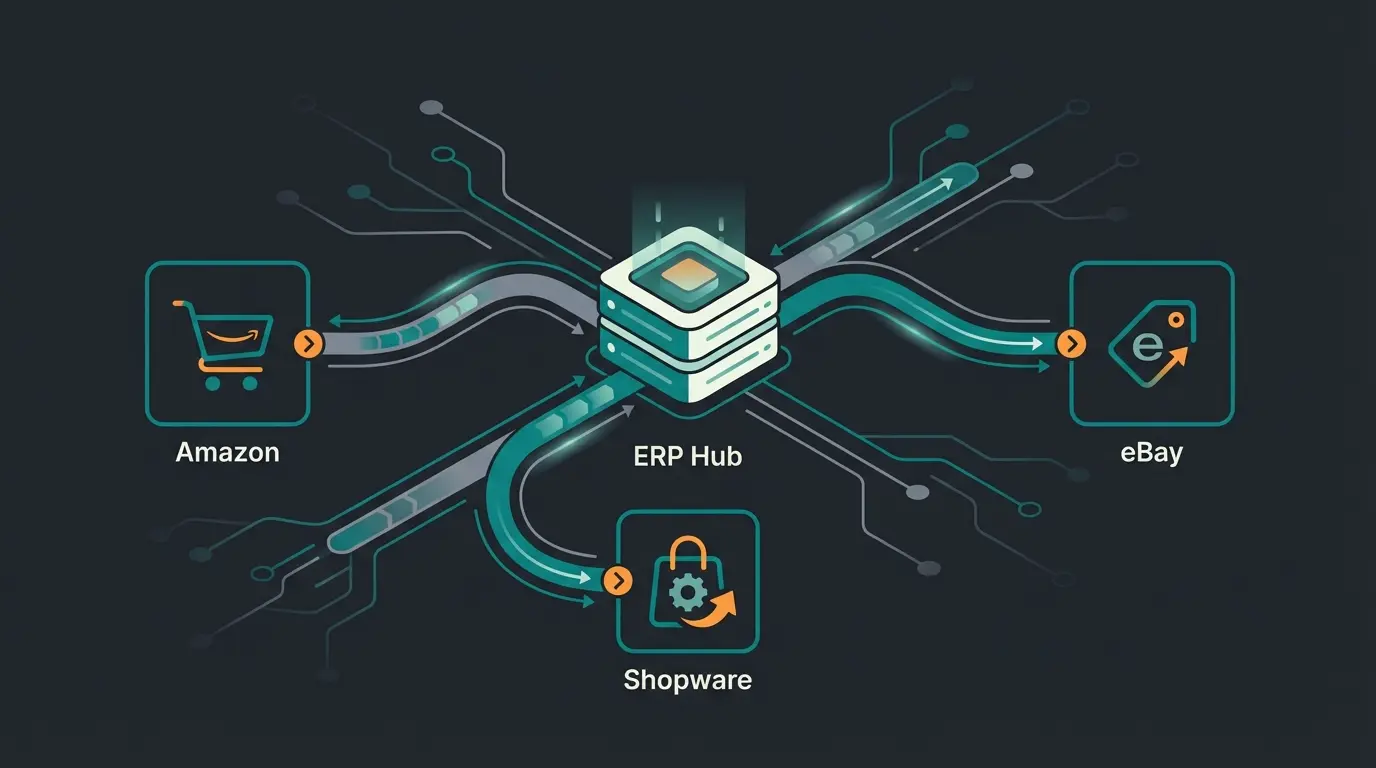
Those who rely on Shopware today often don't sell only there. Systems like JTL-Wawi or Xentral are designed to function as a central hub for multi-channel sales. According to erock-marketing.de, they synchronize the Shopware channel parallel to Amazon, eBay, and Kaufland. Without a central ERP integration, multi-channel commerce inevitably leads to chaos. For a deeper comparison of platform capabilities, see our analysis on Shopware vs JTL.
Top Shopware 6 ERP Systems Compared (2025 Edition)
The market for Shopware-compatible warehouse management systems is enormous. For context on the broader Shopware ERP landscape, not every system fits every strategy – especially when focusing on AI-readiness. Here's an analysis of the most important players for the German-speaking market.
Pickware: The Native Solution
Target audience: Small to medium-sized merchants seeking seamless integration.
Pickware holds a special position as it's integrated directly within Shopware. There's no external interface that needs maintenance. According to solution25.com and Shopware's marketplace, the advantages include:
- Real-time data without sync delays since the Shopware database and ERP database are identical
- Perfect for omnichannel with integrated POS capabilities
- Native Shopware data fields mean Shopware's own AI features (like the AI Copilot) often access this data more seamlessly than with external connectors, as noted by exwe.de
Limitations: For extremely high order volumes or complex multi-warehouse structures outside the Shopware ecosystem, it may hit limitations compared to dedicated enterprise ERPs.
JTL-Wawi: The E-Commerce Classic
Target audience: Merchants focused on marketplaces and high logistics efficiency.
JTL is the market leader in Germany for online merchants. The base version is free, which facilitates entry. According to JTL-Software, the connection happens via the JTL-Connector (SaaS), which synchronizes products, inventory, and orders.
- Advantages: Extremely powerful logistics (JTL-WMS), strong marketplace connection (eazyAuction)
- Challenge: JTL's data structure (characteristics/attributes) must be cleanly mapped to Shopware's structure (properties/custom fields). This is where problems often arise, for example when characteristics don't correctly arrive as filters in Shopware, according to Shopware community forums and JTL documentation
- AI Factor: JTL is strong in structured data, but transferring this "knowledge data" to the shop often requires configuration effort so that an AI can utilize it
Xentral: The New Generation Cloud ERP
Target audience: D2C brands, startups, and growing companies that want to work cloud-native.
Xentral has established itself as a modern alternative that's particularly popular with emerging brands, as documented by Shopware and Xentral's own resources.
- Integration: Offers modern APIs and deep integration into Shopware 6
- Advantages: Browser-based (no server installation like JTL), very flexible, strong process management
- AI Factor: Due to its modern architecture and open APIs, AI tools can often be docked more easily than with legacy systems
Enterprise & Middleware (SAP, Microsoft, WeClapp)
For corporations, paths often lead inevitably to SAP or Microsoft Dynamics 365. Here, direct integration is often too rigid. Instead, middleware solutions (iPaaS) like Synesty or n8n are used to transform data streams, as explained by Synesty and techwishes.com.
| ERP System | Type | Best Fit | Integration Depth | AI Potential (Data Access) |
|---|---|---|---|---|
| Pickware | Native (Plugin) | SMB, Omnichannel | Very High (Native DB) | High (Direct Access) |
| JTL-Wawi | On-Premise | Marketplace Focus, Logistics | Medium (Connector) | Medium (Mapping Required) |
| Xentral | Cloud (SaaS) | D2C, Startups | High (API) | High (Modern API) |
| SAP / MS | Enterprise | Corporations | Variable (Usually Middleware) | Depends on Middleware |
Automated order processing eliminates data entry mistakes
Real-time sync accelerates fulfillment workflows
Live stock updates prevent overselling across channels
Automation reduces labor-intensive backend tasks
The Hidden Value: ERP Data as Fuel for AI
This is where the wheat separates from the chaff in 2025. Most agencies sell you an ERP integration to reduce costs (less warehouse staff). We're telling you: integrate your ERP to increase revenue.
The Problem: "Dumb" Data in the Frontend
In many shops, ERP data is heavily filtered. The ERP might know 50 technical attributes of a product (material composition, compatibility, care instructions, customs tariff numbers). In the Shopware frontend, often only price, stock, title, and a description text arrive. For a classic search bar, that was sufficient. For an AI sales agent, it's fatal.
The Solution: Deep Data Integration
Modern AI tools, like the Shopware AI Copilot or external chatbots, need context. When a customer asks: "Does this spare part fit my 2019 machine?", the AI can only answer if the compatibility data from the ERP is also structured in the Shopware data model (e.g., in "Properties" or "Custom Fields"). Understanding how AI transforms rules in modern e-commerce is crucial for implementing this effectively.
Holds the technical truth including parts lists and technical drawing data
Decides what is logistics data waste and what is sales knowledge
Stores knowledge in Properties (for filters/AI) and Custom Fields (for specific AI prompts)
Uses this data for consultation, cross-selling, and support
Practical Example: JTL Characteristics vs. Shopware Properties
A common technical problem illustrates the relevance of this topic: In JTL-Wawi, you maintain "Characteristics" (e.g., "Color: Red", "Material: Cotton"). The JTL-Connector must be configured so that it doesn't just paste these as text into the description, but creates them as filterable Properties in Shopware, as documented by wawi.ch.
Only when "Cotton" is stored as a Property-ID can an AI understand that this product belongs to the "Natural Fibers" category and recommend it to a customer who wants "no plastic." Text-based descriptions are readable for AIs, but structured data is essential for precision (hallucination avoidance). This is where AI product consultation becomes a game-changer for customer experience.
Stop syncing just inventory numbers. Start syncing product knowledge that powers intelligent customer consultation.
Get Started FreeIntegration Methods: How to Connect Systems "Smart"
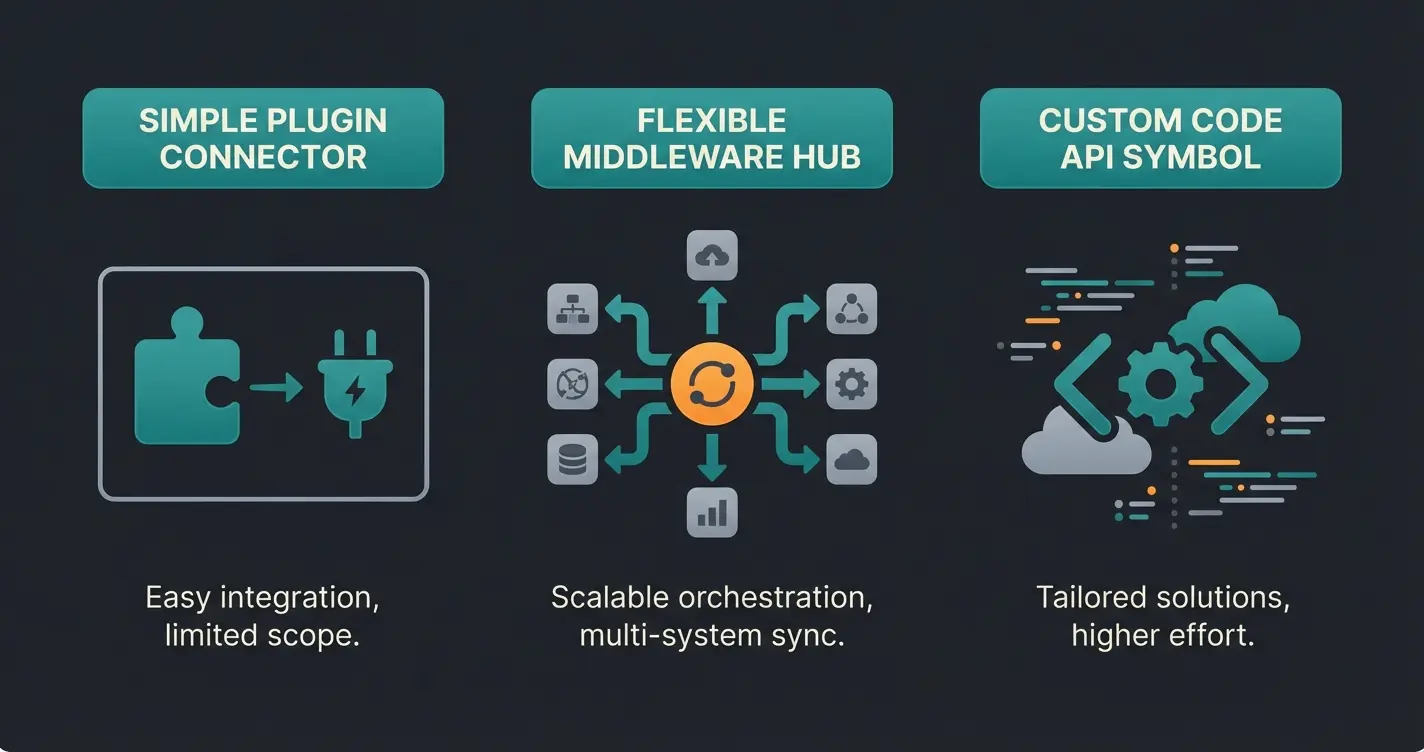
There are three main ways to connect Shopware with an ERP. Your choice determines how "AI-Ready" you are. For a detailed breakdown, see our ERP Connection Methods Compared guide.
The Standard Connector (Plugin)
Providers like JTL or Xentral offer ready-made plugins. As described by JTL-Software, these offer quick installation at low cost. However, they're often a "Black Box" – you can hardly influence which data fields are mapped and how. If the plugin doesn't transfer the "Country of Origin" field, it's missing for your AI.
Middleware / iPaaS (Synesty, n8n)
This is the royal road for AI-driven companies. Tools like Synesty or n8n switch between ERP and Shopware, offering what Synesty calls intelligent data transformation.
The AI Trick: You can enrich data during the transfer. Consider this scenario: The ERP sends a raw product name ("Pants K200 blue"). The middleware sends this name to the OpenAI API, generates an emotional description and SEO tags as shown in reddit automation discussions, and Shopware receives the finished, enriched data set.
Advantage: Maximum flexibility. You can retrieve data from the ERP, run it through an AI, and store it refined in Shopware. For shops leveraging AI Chatbots, this approach ensures the chatbot has rich, contextual data to work with.
Custom API Integration
For enterprise customers. Here, a custom interface is programmed. Expensive, but allows full control over every data bit.
Checklist: Is Your Data Structure "AI-Ready"?
Before investing in expensive AI tools, check your ERP integration against these points. If you check "No" here, your AI will fail.
1. Structured Attributes Instead of Free Text
- Status Quo: Is technical data (size, weight, material) only in the description text?
- AI-Ready: Is this data maintained in separate fields (JTL Characteristics -> Shopware Properties)? AIs can compare structured data better
2. Use of Custom Fields
- Status Quo: Do you use Shopware Custom Fields only for internal notes?
- AI-Ready: Do you use Custom Fields for AI context? (e.g., a field "AI-Persona" that defines who the product is for: "Beginner", "Pro"). The Shopware AI Copilot can access these fields according to emizentech.com and Shopware documentation
3. Real-Time Availability
- Status Quo: Is stock only synced once at night?
- AI-Ready: Is the sync real-time or near-real-time? An AI agent recommending a sold-out product massively frustrates customers
4. Data Hygiene
- Status Quo: Do you have duplicates or cryptic abbreviations ("Pants_Long_V2_Final") in the ERP?
- AI-Ready: Are the names "human-readable"? LLMs (Large Language Models) understand natural language. Cryptic ERP codes confuse the AI, as noted by Synesty's best practices
Deep Dive: Shopware AI Copilot & ERP Data
Shopware has introduced powerful tools with the AI Copilot that directly depend on your ERP integration. Let's look at why data quality is decisive here. Mastering AI product consultation requires understanding these dependencies.
AI-Generated Product Properties
Shopware can automatically generate properties from product descriptions, according to Shopware and Atwix. The ERP Link: If your ERP only delivers sparse descriptions, the AI hallucinates properties or finds none. A good integration provides the Copilot with "fuel" in the form of detailed long texts from which it can then extract structured filters.
AI Review Summaries
The Copilot summarizes reviews as shown in YouTube demonstrations and explained by brainstreamtechnolabs.com. The ERP Link: Often, return reasons are stored in the ERP ("Customer says: fit too small"). An advanced integration could play these return reasons anonymized as "feedback" into the shop, so the AI can generate warnings from them ("Attention: Runs small"). That's real value-add.
Agentic Commerce Alliance
Shopware has founded the Agentic Commerce Alliance to create standards for how AI agents shop, as announced on Shopware. Significance: In the future, your shop will be visited by a bot shopping on behalf of a human. This bot doesn't read beautiful design – it reads JSON data. Your ERP integration must therefore deliver data that is machine-readable and standardized.
The rise of Conversational AI means your shop data must be structured for both human and machine consumption. This is where proper ERP integration becomes the foundation for AI employees that can genuinely assist customers.
Practical Implementation Tips for AI-Ready Integration
Tip 1: Use n8n for Data Enrichment
Don't wait for your ERP manufacturer to build AI features. Use n8n (a workflow automation tool) to close gaps, as demonstrated in various leanware.co implementations.
Sample Workflow: New item in ERP -> Webhook to n8n -> n8n asks ChatGPT: "Create an SEO description based on this technical data" -> n8n writes the result via API to Shopware. Result: Your shop has better content than your ERP, fully automatically. Implementing an AI chatbot integration can further leverage this enriched data.
Tip 2: Map "Knowledge Data"
Go through your ERP fields. Everything that helps the customer with their decision (e.g., "Application Area", "Difficulty Level") must arrive in Shopware as a Property or Custom Field. Fight to ensure this data doesn't drown in the "Description" blob. An AI product finder depends on this structured data to deliver accurate recommendations.
Tip 3: Think B2B
In B2B, ERP integrations are more complex (individual prices, customer groups). Systems like Agiqon offer specialized solutions (OCI/Punchout) according to agiqon-shopware.de. Ensure that your AI also understands these logics – an AI must never quote a B2C price to a B2B customer. For international operations, multilingual AI chatbots add another layer of complexity that requires clean data structures.
From Warehouse Manager to Data Architect: The Future
Shopware ERP Integration in 2025 is far more than laying digital pipes between warehouse and shop. It's the foundation of your digital strategy.
- Those who only sync inventory save costs
- Those who sync knowledge enable revenue
The era of "dumb" online shops is ending. AI copilots, chatbots, and autonomous agents need clean, structured, and rich data. This data lies in your ERP – but it's trapped there. Your task is to free this data through intelligent integration and make it usable for the customer experience.
Look at your current interface. Does it only transfer numbers (prices, stock)? Or does it transfer information? If not, it's time to think about middleware or reconfiguration. Your AI sales agent will thank you – and your customers will too. Exploring KI E-Commerce strategies can help you envision the possibilities.
The key insight is this: your ERP holds the master data, but how that data flows into your storefront determines whether you can implement cutting-edge AI chatbot for E-Commerce solutions that actually understand your products and serve your customers intelligently.
Frequently Asked Questions
There is no "best" ERP, only the most suitable one for your specific needs. For seamless integration and small teams, Pickware is ideal as it's natively integrated. For logistics-heavy merchants with marketplace focus, JTL-Wawi is the leading choice. Cloud-native startups often choose Xentral for its modern API architecture and flexibility. The key differentiator in 2025 is AI-readiness: how easily can the ERP's data be structured for AI consumption?
Properties are designed for filters and variants (e.g., size, color) and are visible to customers in the frontend for filtering products. Custom Fields are for arbitrary additional information (e.g., internal notes, AI prompts, specific metadata) and can be used more flexibly behind the scenes. For AI applications, both are important but must be correctly mapped from your ERP. As documented by Shopware, Properties drive the filterable product experience while Custom Fields provide the contextual depth AI needs for intelligent recommendations.
Yes, absolutely. Through the use of middleware like Synesty or n8n, you can extract data from old ERPs, process it (e.g., enrich through AI), and then inject it modernly into Shopware. This approach lets you keep your proven backend systems while preparing your frontend for AI-powered customer experiences. The middleware acts as a translation layer that can transform legacy data structures into AI-ready formats.
ERP integration directly impacts AI recommendation quality. When your ERP only syncs basic data (price, stock), AI recommendations are superficial. When you sync rich product knowledge (compatibility data, technical specs, use cases), AI can provide expert-level consultation. The difference is between an AI that says "this is in stock" versus one that says "this specific model fits your 2019 machine and includes the upgraded motor housing you mentioned needing."
The Agentic Commerce Alliance is a Shopware initiative creating standards for how autonomous AI agents will shop on behalf of humans. This means your shop will increasingly be visited by bots that read JSON data rather than browse visually. Your ERP integration must therefore deliver machine-readable, standardized data to participate in this new commerce paradigm where AI agents become the primary shoppers.
Don't just integrate your ERP to count boxes. Integrate it to sell more. See how our AI solution uses your ERP data to consult customers like a pro.
Start Your Free Trial
Lasse is CEO and co-founder of Qualimero. After completing his MBA at WHU and scaling a company to seven-figure revenue, he founded Qualimero to build AI-powered digital employees for e-commerce. His focus: helping businesses measurably improve customer interaction through intelligent automation.