Introduction: Why Your ERP Must Do More Than Count
Have you been treating your ERP system as nothing more than a digital stock ledger? Then you're leaving money on the table.
In the world of e-commerce, the role of Magento ERP integration (known as Warenwirtschaft in German markets) has transformed dramatically. Just a few years ago, the primary focus was synchronizing inventory, creating GoBD-compliant invoices (German accounting standards), and generating shipping labels. In 2026, these functions are merely table stakes—the real competitive advantage lies in activating this data for sales.
In this comprehensive guide, you'll discover not only which ERP system for Magento (Adobe Commerce) best fits your business model, but also how to transform your ERP from a passive data warehouse into an active AI-powered sales engine. We'll analyze the top systems in the German market, uncover the hidden champions of automation, and show you how to prepare your data structure for the artificial intelligence era. For additional context on similar integrations, check out our complete ERP integration guide.
The Paradigm Shift: Reactive vs. Proactive ERP Systems
The market for Magento ERP solutions is overwhelming. From free open-source tools to powerful enterprise suites, every vendor promises "seamless integration." But reality often tells a different story: data silos, asynchronous inventory levels, and missing interfaces stifle growth.
Yet the biggest problem is often not technical but strategic in nature. Most merchants use their Magento ERP integration only reactively: an order comes in, inventory gets booked.
What you'll learn in this article:
- Which German ERP systems (JTL, Vario, Tricoma, Xentral) truly harmonize seamlessly with Magento 2
- How to close the content gap: from managing inventory to driving sales
- How to use RAG (Retrieval-Augmented Generation) to leverage your ERP data for training AI sales consultants
- Practical checklists for system selection and data preparation
The Basics: Why Magento Needs a Specialized ERP System
Before we look toward the AI future, the fundamentals must be solid. Magento (Adobe Commerce) is a complex beast. Simple integration via standard plugins often isn't sufficient, especially within the German legal framework.
The Must-Haves of a Magento Interface
A Magento ERP system must master the following core processes flawlessly:
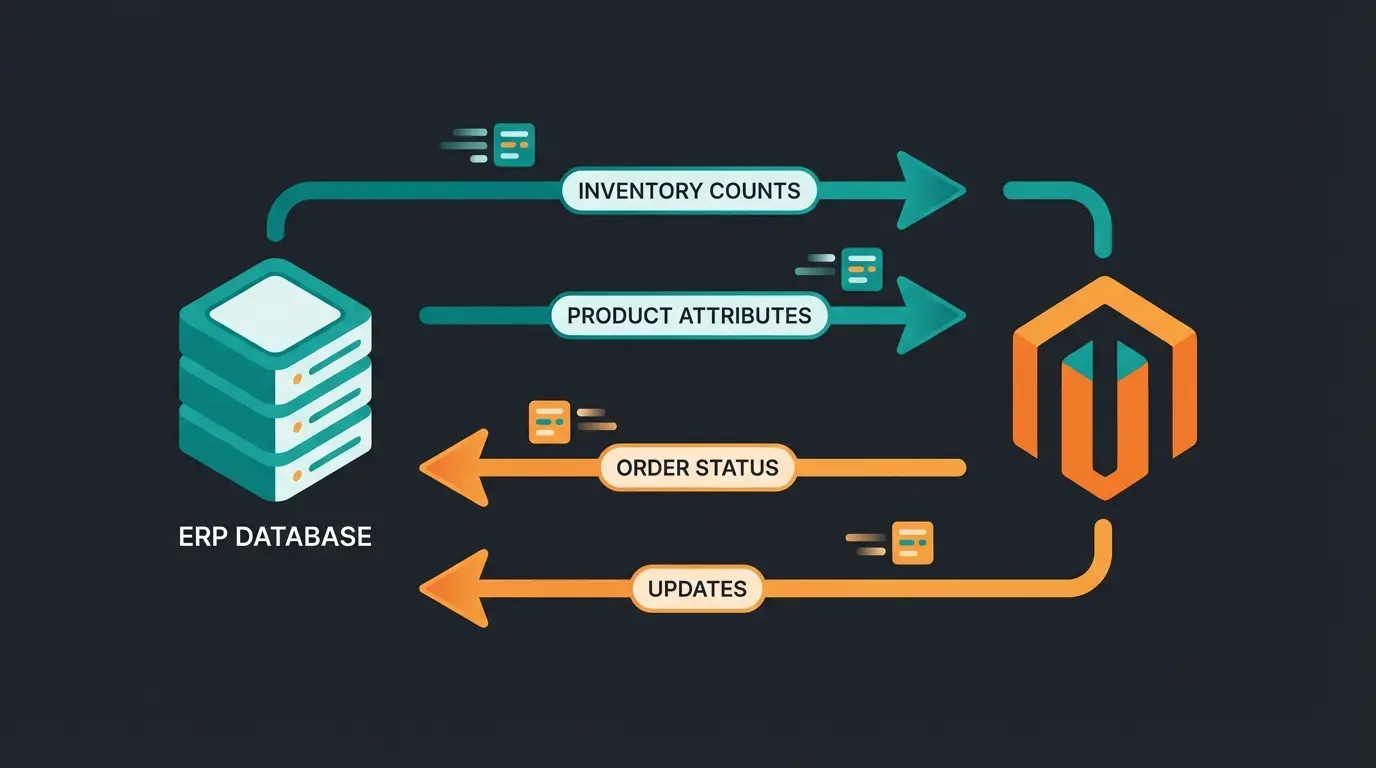
1. Bidirectional Synchronization
- Inventory: Real-time synchronization to prevent overselling (especially critical for multi-channel sales on Amazon/eBay)
- Order Status: When shipment occurs in the ERP, Magento must immediately receive the "Shipped" status and tracking ID
2. Attribute Mapping
Magento thrives on complex attribute sets (color, size, technical specifications). The ERP must be able to mirror this structure without losing data. According to tricoma.de, proper attribute mapping is essential for maintaining data integrity across systems. Additional insights from wawi.ch confirm that multi-source inventory support is becoming increasingly critical.
3. German Compliance (GoBD & DATEV)
Magento itself is not an accounting system. The ERP must mandatorily create GoBD-compliant invoices and deliver clean DATEV exports for your tax advisor.
4. B2B Functionalities (Optional but Important)
Individual price lists, customer group pricing, and quote generation are essential in the B2B Magento environment. Many simple ERP systems fail here due to the complexity of Magento's pricing rules. For B2B-specific strategies, explore our AI powered B2B guide.
Market Overview: Top ERP Systems for Magento in Germany
Based on current market research and user feedback, we've analyzed the most relevant systems for the German market. We categorize these not only by size but also by their "Data Readiness" for modern AI applications.
JTL-Wawi: The Standard for Beginners and Growing Businesses
JTL-Wawi is the market leader in the German-speaking region for small to medium-sized online retailers. The software itself is free in its basic version; costs arise from hosting, support, and extensions.
- Integration: Connection occurs via the JTL Connector for Magento 2. This synchronizes products, categories, images, inventory, and prices according to jtl-software.de.
- Strengths: Enormous community and many service partners, free entry-level model, strong marketplace integration (eazyAuction)
- Weaknesses: The connector is a "third-party" module (often maintained by partners like Umwawium or Sysgrade as noted by umwawium.de), which can lead to delays during Magento updates. The UI is functional but not "cloud-native."
- AI Potential: Medium. JTL offers solid data structures, but AI features often need to be connected via external tools (middleware).
For a detailed comparison with similar systems, see our Shopware JTL Wawi integration guide.
Vario 8: The All-Rounder for Mid-Market Companies
Vario positions itself as a robust solution for retailers who need more than just "moving boxes." Vario is particularly strong in technical products and B2B processes.
- Integration: Vario uses a deeply integrated interface that directly accesses the Magento REST API. It supports multi-shop environments and complex attribute mappings according to vario-software.de.
- Strengths: Excellent mapping of Magento attributes and variants, strong logistics processes (chaotic warehouse management), own REST API for extensions as documented by vario-software.de.
- AI Potential: High. Due to its open architecture and clean data management, Vario is well-suited as a data source for AI projects.
Tricoma: The Automation Pioneer with AI Focus
Tricoma clearly differentiates itself from classic desktop applications. It's web-based and places extreme focus on automation and, more recently, on artificial intelligence with tricoma.AI as highlighted by tricoma.de.
- Integration: The "Magento 2 Connector" is integrated as an app in the Tricoma system and allows very granular control of synchronization (e.g., variant transfer, attribute sets) according to tricoma.de.
- Strengths: Native AI Integration: Tricoma has integrated its own AI platform (tricoma.AI) that can generate product texts, optimize images, and categorize data as showcased on tricoma.ai. Cloud-based and browser-independent with strong focus on process automation.
- AI Potential: Very High. Tricoma is currently one of the few providers that has integrated generative AI ("GenAI") directly into the interface for automatically creating product descriptions or translations.
Xentral: The Cloud Solution for D2C Brands
Xentral (known from the German TV show "Die Höhle der Löwen") targets modern startups and D2C brands. It's lean, modern, and designed API-first.
- Integration: Offers a solid Magento 2 interface that imports orders, syncs tracking numbers, and reconciles inventory according to xentral.com.
- Strengths: Very modern user interface (UX), "Xentral Connect" as no-code middleware for simple integrations as reviewed by g2.com, ideal for remote teams.
- AI Potential: Good. Thanks to the API-first approach, Xentral can be excellently connected with modern tools like OpenAI or n8n.
Similar cloud-first approaches are discussed in our WooCommerce ERP guide.
Comparison Table: Magento ERP Systems 2026
| Feature | JTL-Wawi | Vario 8 | Tricoma | Xentral |
|---|---|---|---|---|
| Target Audience | Beginners to Mid-Market | Mid-Market & B2B | Automation & AI Fans | Startups & D2C |
| Architecture | On-Premise / Hosted | On-Premise / Hybrid | Cloud / Web-based | Cloud-Native |
| Magento Integration | Connector (Ext. Plugin) | REST-API Integration | Native App / Connector | Native Integration |
| Native AI Features | Low (via Partners) | Medium (Roadmap) | Very High (tricoma.AI) | Medium (via API) |
| Data Readiness | ⭐⭐⭐ | ⭐⭐⭐⭐ | ⭐⭐⭐⭐⭐ | ⭐⭐⭐⭐ |
| Pricing Model | Free (Basic) + Modules | License / Rental | Rental / Cloud Subscription | Monthly Subscription |
The Missing Link: Activating ERP Data Through AI
This is where the wheat separates from the chaff. Most articles on Magento ERP systems end at inventory management. But in 2026, that's not enough. Your ERP is sitting on a treasure trove of data that you need to unlock.
The Problem: The Passive Warehouse
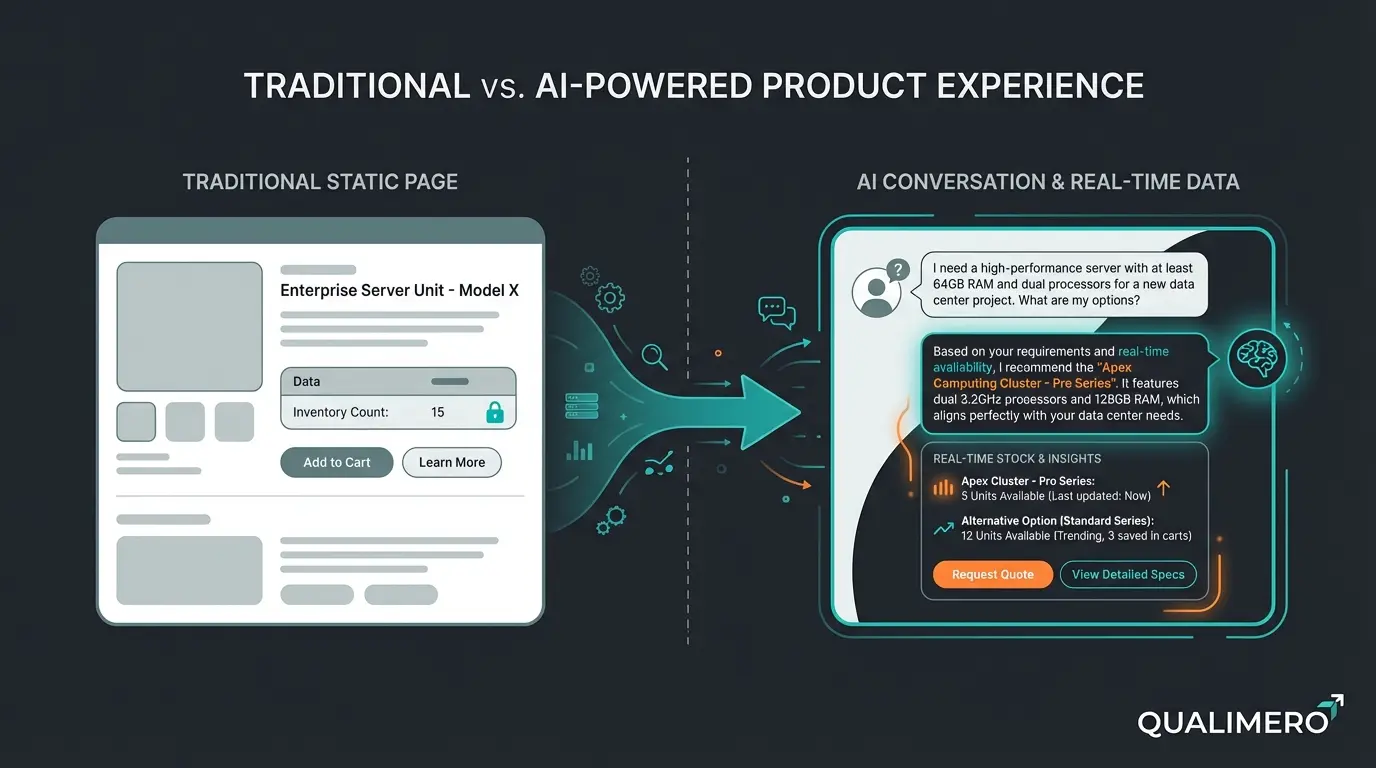
In a classic configuration, the ERP sends data to Magento. The customer sees:
- Product Name: "Laptop XYZ"
- Attribute: "16GB RAM"
- Stock: "In Stock"
But customers often don't search for technical specifications—they search for solutions: "I need a laptop for video editing that's available tomorrow." The classic Magento search often fails here or requires complex filters.
The Solution: The Active Inventory Approach (RAG)
This is where Retrieval-Augmented Generation (RAG) comes into play. RAG is a technique where an AI (like GPT-4) gains access to your own live data from the ERP to precisely answer customer inquiries. Research from amazon.science and medium.com demonstrates the transformative potential of this approach, while webkul.com provides practical implementation guidance.
How it works (simplified):
Your ERP (e.g., Vario or Tricoma) exports not just title and price, but also internal notes, return reasons, and detailed specifications
This data is converted into an AI-readable format (embeddings) for semantic understanding
A chatbot or intelligent search in your Magento shop accesses this knowledge base in real-time
The AI provides personalized recommendations based on inventory, compatibility, and customer needs
Scenario: A customer asks the chatbot: "Which power adapter fits my old printer model X?"
- Without AI-ERP integration: "No results for 'old printer model X'."
- With AI-ERP integration: The AI checks compatibility lists in the ERP data (often hidden in free-text fields) and current inventory. Response: "For model X, the power adapter Y is compatible. We have 3 units in stock—if you order now, it ships today."
Learn more about implementing AI product consultation in your e-commerce stack.
Passive vs. Active Inventory Management Comparison
| Feature | Standard ERP Setup (Passive) | ERP + AI Consultant (Active) |
|---|---|---|
| Out-of-Stock Handling | Simply displays "Sold Out." Customer abandons. | AI immediately suggests the best available alternative from the ERP. |
| Complex Queries | Customer must set filters manually ("Color: Red", "Size: L"). | AI understands intent: "I'm looking for a red summer dress in L." |
| Returns | Processed after purchase. | AI warns before purchase: "This model runs small (based on return reasons in ERP), consider taking XL." |
| Data Maintenance | Manual typing of product texts. | AI generates SEO texts based on technical attributes from the ERP according to magestore.com. |
This transformation from passive data storage to active selling represents the core opportunity for merchants using AI powered consultation technology.
Discover how AI product consultants can leverage your existing inventory data to increase conversions by up to 35%. Get personalized recommendations for your Magento integration.
Start Your Free TrialData Readiness: Preparing Your ERP Data for AI
An AI is only as smart as the data you feed it ("Garbage In, Garbage Out"). Before selecting or upgrading an ERP for Magento, check these critical points. Insights from contentgecko.io confirm that structured data significantly improves AI performance.
1. Structured Attributes Over Free-Text Deserts
Many merchants write important information in the flowing description text.
- Bad: Description text: "This shoe is made of leather and is waterproof."
- Good: ERP Attribute `Material`: "Leather", ERP Attribute `Feature`: "Waterproof"
Why? Structured data can be filtered better by Magento and processed more precisely by AI. This principle is fundamental to conversational commerce success.
2. Maintaining Use-Case Fields
Create new fields in your ERP (e.g., via "Free Fields" in Vario) that describe the intended use:
- Field `Occasion`: "Wedding, Business, Casual"
- Field `Skill-Level`: "Beginner, Professional"
This data is often not displayed in the shop but is invaluable for the AI consultant to make recommendations.
3. Clean Variant Logic
Ensure your ERP passes variants (Configurable Products) cleanly to Magento. Tricoma and Vario offer strong tools to ensure that "T-Shirt Red L" is correctly recognized as a child article of "T-Shirt Basic." A fragmented variant structure confuses both the AI and the customer.
Structured attributes vs. free-text descriptions for AI interpretation
Clean variant logic reduces AI model training time significantly
Use-case fields enable more relevant product suggestions
Implementation: The Modern Tech Stack
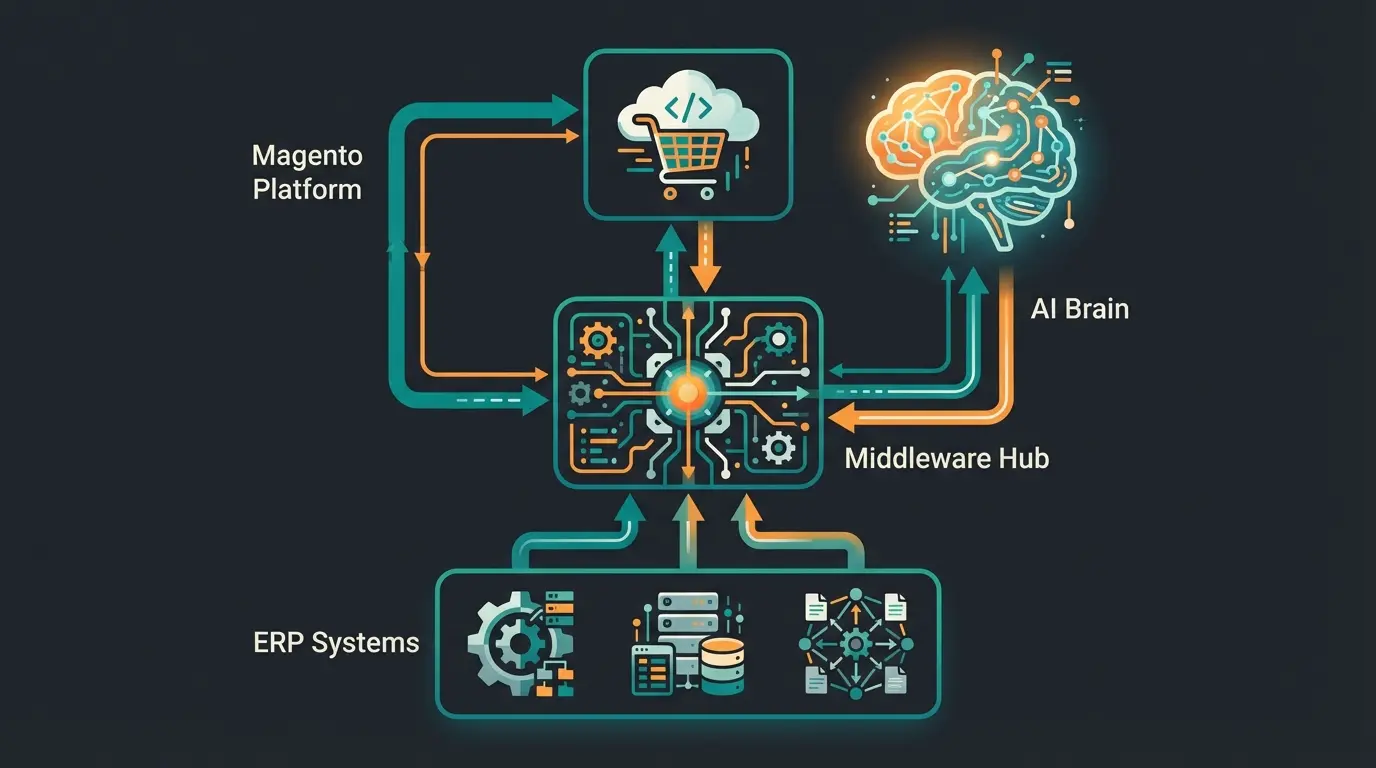
How do you now connect Magento, ERP, and AI? There are three paths, each with distinct advantages for different business scenarios. Understanding API automation is crucial—explore our AI sales consultant guide for deeper insights.
Path A: The All-in-One Approach (e.g., Tricoma)
You use a system like Tricoma that already has AI functions (tricoma.AI) integrated.
- Advantage: Everything from one source, no interface problems.
- Disadvantage: You're bound to the vendor's ecosystem.
Path B: The Connector Approach (e.g., JTL/Vario + Plugins)
You use a classic ERP and install Magento extensions for AI search (e.g., Algolia, Klevu) or chatbots.
- Advantage: You can choose "best-of-breed" tools.
- Disadvantage: Data often needs to be maintained twice or synchronized elaborately.
Path C: The Middleware Approach (The Pro Solution 2026)
You use an automation platform like n8n or Synesty between your ERP and Magento.
- n8n: A workflow tool that reacts to events. Example: New article created in ERP -> n8n sends data to OpenAI -> OpenAI writes SEO text -> n8n saves text in Magento. This approach is documented by eesel.ai and visualwebs.eu.
- Synesty: Specializes in data feeds and mass processing. Ideal for preparing poor supplier data before it goes into the shop according to synesty.com.
For customer service automation specifically, explore our guide on intelligent sales consultants.
German Market Checklist for ERP Selection
Before making your decision, check your desired ERP against these "German Market" criteria. This is essential for understanding the AI consultation gap in the current market:
- ☐ DATEV Interface: Is direct export to the tax advisor possible (including document images)?
- ☐ OSS Procedure (One-Stop-Shop): Can the ERP correctly calculate and export tax rates for EU deliveries?
- ☐ Magento MSI Support: Does the interface support "Multi Source Inventory" (multiple warehouse locations in Magento)?
- ☐ API Limitations: Are there restrictions on the number of API calls per minute? (Important for real-time AI)
- ☐ Returns Portal: Is there a workflow that seamlessly books returns from Magento back into inventory?
Future Outlook: ERP as the AI Commerce Hub
The trajectory is clear: ERP systems are evolving from back-office necessities into central intelligence hubs for e-commerce operations. By 2027, we expect to see:
- Predictive inventory management using AI demand forecasting directly integrated into ERP dashboards
- Automated pricing optimization based on real-time competitor data and inventory levels
- Natural language querying of ERP data by non-technical staff
- Seamless [AI sales consultation](/blog/shopware-pickware) powered by live inventory and customer data
The businesses that prepare their data infrastructure now will have a significant competitive advantage. Those still treating their ERP as a simple stock ledger will struggle to catch up as AI-native competitors emerge. Explore our comprehensive AI product consultation guide for migration strategies.
Conclusion and Strategic Recommendations
The search for the perfect Magento ERP is no longer just an administrative question in 2026. It's a decision about your technological future readiness.
- For Starters: JTL-Wawi remains unbeaten in price-performance ratio but requires discipline in data maintenance.
- For Automation Enthusiasts: Tricoma offers an exciting lead with its native AI integration if you're ready to go all-in on the cloud.
- For Mid-Market Companies: Vario is the rock in the storm that can map even the most complex B2B scenarios and is open to AI extensions via its API.
For broader e-commerce AI strategies, explore our KI E-Commerce resource center.
FAQ: Common Questions About Magento ERP Integration
Theoretically yes, but it's not recommended. Magento is not an ERP. As soon as you have more than 10 orders per day or sell on marketplaces like Amazon, you need centralized inventory management to avoid overselling and create invoices correctly.
The spectrum ranges from free (JTL, plus hosting/support) to monthly rentals of €100-500 (Xentral, Tricoma) to five-figure project costs for enterprise solutions (Vario, SAP). Total cost of ownership should include integration, training, and ongoing maintenance.
AI can predict inventory needs (Demand Planning), automatically create product texts from attributes, analyze return reasons to improve product descriptions, and serve as a "Shopping Assistant" in the frontend answering customer questions based on live inventory data.
Tricoma currently leads with its native tricoma.AI platform. However, for maximum flexibility, a middleware approach using tools like n8n with any solid ERP (JTL, Vario, Xentral) allows you to integrate best-in-class AI solutions regardless of the ERP's native capabilities.
Basic integrations can be completed in 2-4 weeks. However, AI-ready implementations with proper data structuring, attribute mapping, and consultant training typically require 6-12 weeks. Enterprise B2B scenarios with complex pricing and multi-warehouse setups may extend to 3-6 months.
Join leading e-commerce businesses using AI-powered product consultation to convert ERP data into sales. Our experts will analyze your current setup and show you the fastest path to implementation.
Get Your Free ConsultationNote: This article is based on the technology status of 2025/2026. Always check the current versions of interfaces (connectors), as Adobe Commerce (Magento) APIs continue to evolve.

Lasse is CEO and co-founder of Qualimero. After completing his MBA at WHU and scaling a company to seven-figure revenue, he founded Qualimero to build AI-powered digital employees for e-commerce. His focus: helping businesses measurably improve customer interaction through intelligent automation.