Why a Shopware-Amazon Strategy Is Vital for Survival
E-commerce has changed dramatically in recent years. It's no longer enough to run an excellent Shopware 6 store and wait for Google to deliver traffic. On the other side stands Amazon – the giant that in Germany is often used as the number one product search engine, even before Google.
Many retailers face a dilemma: If they sell on Amazon, they give up a significant portion of their margin and lose direct customer contact. If they ignore Amazon, they miss out on millions of potential buyers.
The solution isn't "either-or" but rather "both-and." However, most guides online stop at the technical installation of a plugin. This article goes further. We don't just cover how to connect Shopware to Amazon (the technical part), but also how to develop a strategy that uses Amazon as a lead channel while building your own Shopware store into the ultimate consultation and revenue machine.
We analyze the best Shopware Amazon connectors for 2024/2025, illuminate the cost traps, and show you how to build consultation competence with Artificial Intelligence (AI) that Amazon can never offer with its static algorithms. If you're comparing platforms, our comprehensive Shopware vs Shopify analysis helps you understand which solution fits your complex products best.
The Technical Part: Connecting Shopware to Amazon
Before we discuss strategies to outperform Amazon, we need to establish the basics: Your products need to be on the marketplace. The days of manually uploading CSV files in Amazon Seller Central are thankfully over.
A professional Shopware Amazon integration must automate the following core tasks:
- Product Export: Transfer of title, description, images, and EAN/ASIN
- Inventory Sync: When an item sells in your store, the stock on Amazon must be reduced immediately (and vice versa) to avoid overselling
- Price Synchronization: Strategic price adjustments (e.g., Amazon price = Shop price + 15%)
- Order Import: Orders from Amazon must land as orders in Shopware (or your ERP) for further processing
- Status Updates: Tracking numbers must be reported from Shopware back to Amazon
Here are the three leading solutions that dominate the German market in detailed comparison.
Magnalister: The Classic for Direct Integration
Magnalister is one of the most well-known plugins in the Shopware ecosystem. It integrates directly into the Shopware backend. This means you don't leave your familiar Shopware interface to manage Amazon listings, as confirmed by integration specialists at Hubyte.
How it works: It hooks into the product management. You can mark products and send them directly to Amazon. Orders are imported as if they were placed in your shop.
Advantages:
- Native Integration: No external dashboard required
- Price: Relatively affordable entry point (starting around €29/month), making it attractive for small to medium shops according to the Shopware Store
- Features: Also supports eBay, OTTO, Kaufland, enabling central management in the Shopware backend
Disadvantages: With very large data volumes or extremely complex variant structures, the Shopware backend performance may suffer since everything is processed "in-house." Community forum reports occasionally indicate challenges with complex attribute mappings.
Channable: The Feed Management Specialist
Channable takes a different approach. It's an external tool (SaaS) that pulls a data feed from Shopware, manipulates it, and then sends it to Amazon, as detailed by Inovanet.
How it works: You export your data to Channable. There you use "if-then" logic (e.g., "If brand = Adidas, then set title to [Brand] + [Title] + [Color]").
Advantages:
- Rule Engine: Extremely powerful for optimizing product data without changing them in Shopware. Perfect for Amazon SEO
- Multichannel: Can use the same feed for Google Shopping or Facebook Ads
- Offloading: The computing load is on Channable's servers, not your shop
Disadvantages: It's an external tool requiring separate login. Costs can increase with many SKUs (Stock Keeping Units) as noted by Digiware.
Brickfox: The Middleware for Professionals
Brickfox is more than just a connector; it's an e-commerce middleware that often sits between ERP, Shopware, and marketplaces.
How it works: Brickfox functions as a central data hub. It's designed to bundle complex data streams from various sources (e.g., supplier feeds + ERP data) and then distribute them to Shopware and Amazon.
Advantages:
- High-End: Ideal for merchants with complex logistics, multiple warehouses, or dropshipping scenarios
- PIM Functionality: Offers proprietary functions for enriching product data
Disadvantages: Higher complexity in setup and higher costs, more suited for enterprise customers or ambitious mid-sized businesses.
Comparison Table: Top Tools for Shopware & Amazon
| Feature | Magnalister | Channable | Brickfox |
|---|---|---|---|
| Type | Shopware Plugin (Backend) | SaaS (Feed Management) | Middleware / Multichannel Hub |
| Integration Depth | High (direct in Shopware) | Medium (via Feed/API) | Very High (central control) |
| Difficulty Level | Beginner to Advanced | Advanced (rule logic) | Experts / Enterprise |
| Pricing Model | Monthly flat rate + transaction fees | Monthly based on items/projects | Project-based / Enterprise Pricing |
| Special Feature | Shopware look & feel | Excellent data optimization | Strong Order Management & PIM |
| Shopware 6 Ready? | Yes | Yes | Yes |
The Strategy: Avoiding the Amazon Trap
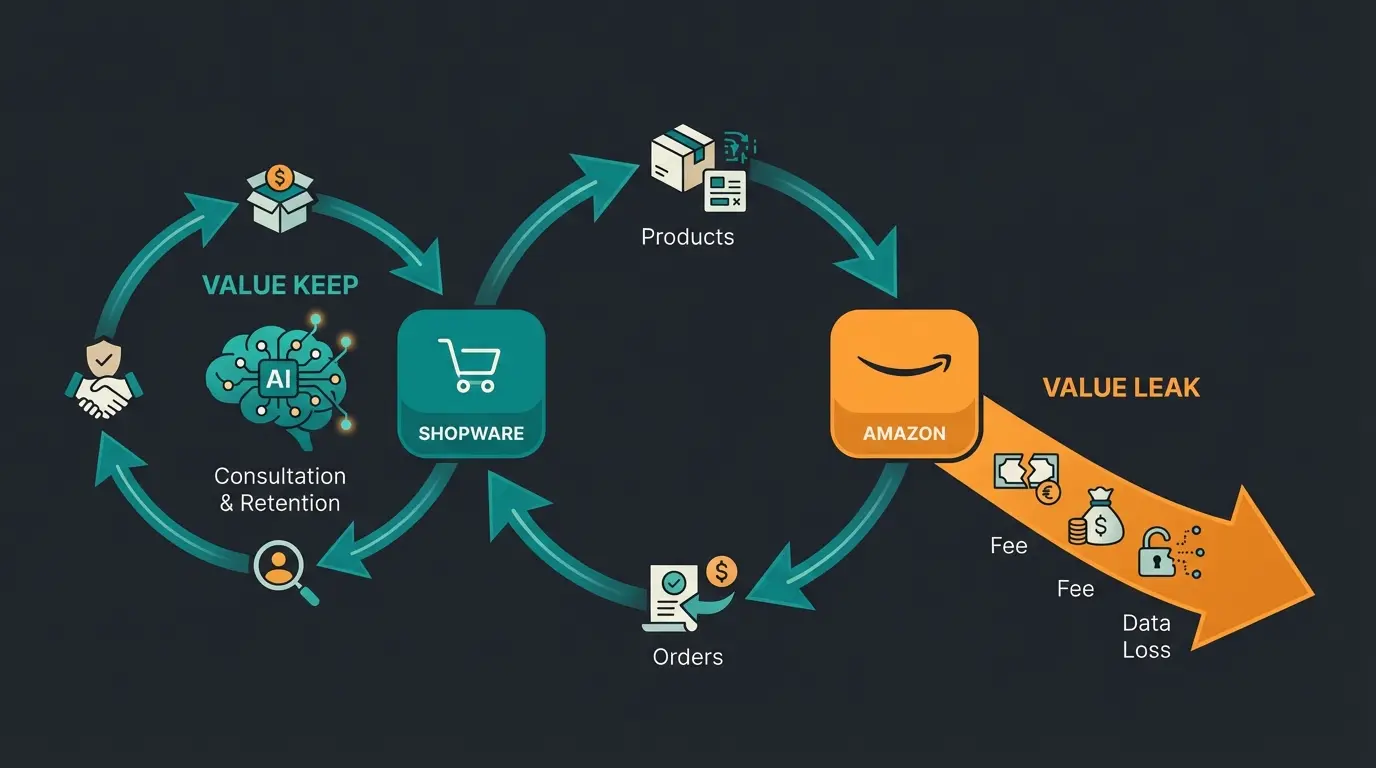
Now that the technical connection is established, many merchants make a strategic mistake: They treat Amazon as just another sales channel without calculating the risks.
The Problem: Fees and Data Loss
When you sell on Amazon through Shopware, you pay a price for customer access.
Amazon charges commission on gross sales price depending on category
Reduced fees for clothing items under €15 starting 2025/2026
You receive no customer email addresses for marketing purposes
According to Amazon's seller fee structure, sales fees typically range between 8% and 15% commission on the gross sales price (depending on category). For clothing and accessories, fees have been partially adjusted (e.g., reduction for items under €15 to 5% starting 2025/2026), but the basic burden remains high.
FBA Fees: If you use "Fulfillment by Amazon" (FBA), storage and shipping fees are added. Newer fees like the "Low Inventory Level Fee" increase pressure for perfect inventory management, as reported by OnlineMarketing.de and Händlerbund.
The Biggest Loss: You receive no customer email addresses for marketing purposes. The customer belongs to Amazon, not you. A repeat purchase (Customer Lifetime Value) often happens again on Amazon, where you pay fees once more.
Why Amazon Still Converts
Why do customers buy there, even though your Shopware store might be more beautiful?
- Trust: Amazon Pay and A-to-z Guarantee create fundamental trust
- Convenience: "One-Click-Buy" and Prime shipping are learned standards
- Information Density: Amazon product pages are full of User Generated Content (questions, answers, reviews)
The Bridge: Amazon Pay in Your Own Store
A first step to bring the "Amazon Experience" to your store is integrating Amazon Pay. Studies and case studies (e.g., Ankerkraut or DeLife) show that integrating Amazon Pay can significantly increase conversion rates, as documented by Tikal and Amazon case studies. Customers don't need to enter address data or create a new account. This drastically reduces cart abandonment.
Tip: Use the official Amazon Pay plugin for Shopware 6 to bring this trust advantage to your own checkout, as recommended by Shopware's official documentation.
Discover how AI-powered product consultation transforms your Shopware store into a conversion machine that Amazon can't match.
Start Your AI Consultation JourneyYour USP: Beating Amazon Quality with AI Consultation
Here lies your real opportunity. Most search results for "Shopware Amazon" stop at technology. But to be truly successful, you need to give customers a reason to buy from you and not from the marketplace.
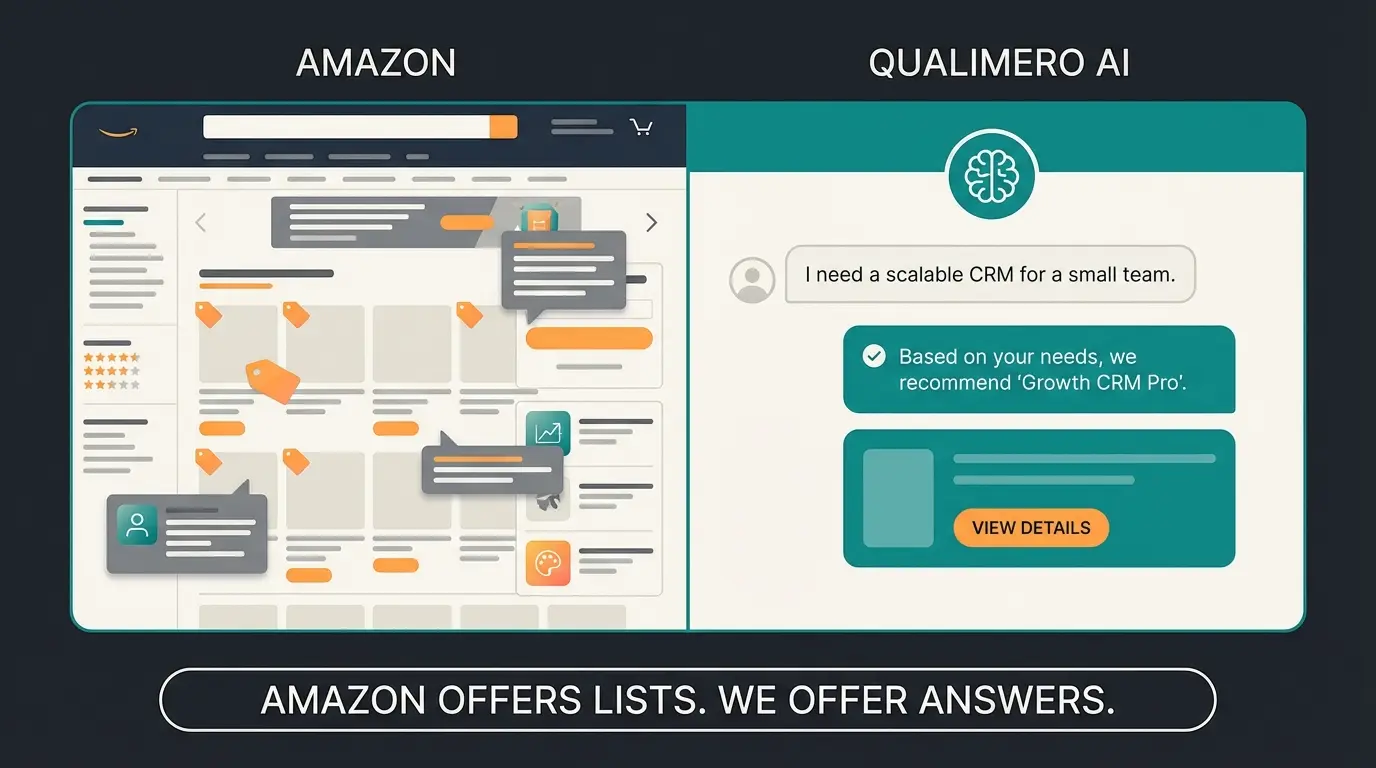
Amazon is a product search engine, but not a consultant. When a customer knows exactly what they want ("Samsung Galaxy S23 case black"), Amazon wins. But when the customer has a problem ("Which case protects best during construction work?"), Amazon only offers confusing lists and often fake reviews.
The Gap: Consultation Competence
Shopware stores often appear static. There are categories and filters, but no real interaction. This is where Artificial Intelligence comes into play. Not as a gimmick, but as a strategic tool for customer retention. Understanding Conversational Commerce is essential for implementing this strategy effectively.
The Solution: The AI Product Consultant
Imagine your Shopware store had a salesperson available 24/7 who knows your entire product range and responds empathetically to customer questions. This is exactly what AI-powered product consultation enables.
Scenario Comparison:
- Amazon: Customer searches "quiet vacuum cleaner." Result: List with 50 devices, all claiming to be "quiet." The customer must read 20 reviews to find out if the device is really quiet enough for a sleeping baby.
- Your Shopware Store with AI: Customer asks in chat: "I'm looking for a vacuum cleaner that won't wake my sleeping baby but still removes dog hair from the carpet." Result: The AI responds: "For this combination, I recommend [Model X]. It has a special 'Silent Mode' with only 65dB but a turbo brush for pet hair. Here's the link to the product."
Technical Implementation in Shopware 6
There are now plugins and integrations that enable exactly this. Shopware itself offers strong backend features with the AI Copilot (text creation, image generation, review summarization) as highlighted by Agiqon Shopware and demonstrated in Shopware's official channels. For frontend consultation (Conversational Commerce), there are solutions that connect ChatGPT or Claude via API, as explained by Coding9. Explore the full range of Shopware AI features to understand what's possible.
Advantages of This Strategy:
- Higher Conversion Rate: Targeted consultation leads to faster purchase decisions than endless scrolling. Learn more about implementing an AI product finder for guided selling.
- Return Avoidance: When customers are precisely advised before purchase (e.g., about fit), the probability of returns decreases
- Data Sovereignty: Through chat logs, you learn exactly what moves your customers and what language they use – invaluable for your SEO. Get actionable insights from every customer interaction.
Use Amazon for initial customer acquisition and brand awareness
Deploy AI-powered guidance that answers complex questions instantly
Customers purchase directly where they receive the best advice
Own customer data enables personalized marketing and repeat purchases
Avoid fees while increasing customer loyalty and margins
Practical Tips: Implementing the Strategy
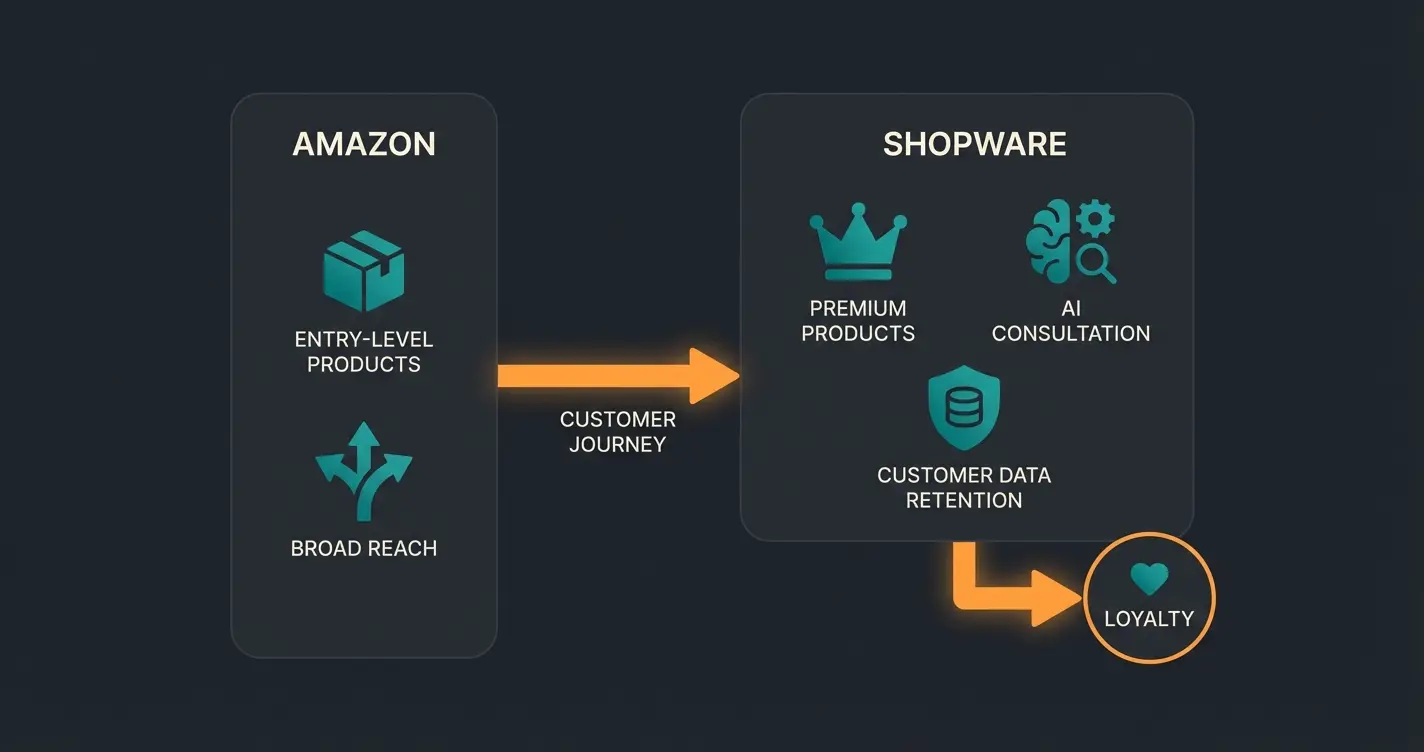
To implement this "hybrid strategy" (Amazon for reach, Shopware + AI for margin), follow this plan:
Step 1: Selective Listing
Don't blindly list your entire product range on Amazon.
- Entry Products (Loss Leaders): Place inexpensive, popular items on Amazon to build brand awareness
- Premium Bundles: Sell exclusive sets or consultation-intensive high-end products only in your Shopware store
- Flyer in Package: Include a flyer in every Amazon order pointing to the "premium support" or "AI consultant" in your web shop (Caution: Observe Amazon TOS regarding customer poaching, stay subtle, e.g., through warranty extension upon registration)
Step 2: Pricing Strategy & Fee Calculation
Use the repricing functions of tools like Channable or Magnalister.
- Calculate Amazon fees into the price. It's legitimate to be more expensive on Amazon than in your own store
- Use "strike-through prices" in your own store to highlight the price advantage over the marketplace
Step 3: Content Optimization with AI
Use the Shopware AI Copilot Features as detailed by Rhiem Intermedia to make your product data fit for Amazon:
- Property Extraction: Let the AI extract technical data from description texts to correctly populate Amazon filters
- Review Summary: Use the AI to summarize Amazon reviews (if imported) and display them on your Shopware page as "Customer Opinion" (Social Proof)
For deeper optimization strategies, consult our comprehensive Shopware SEO guide covering technical basics and AI-powered rankings.
Future Outlook: Shopware + AI vs. Amazon
E-commerce is moving away from pure "distribution of goods" toward "curating solutions." Amazon will always remain the place for quick necessity purchases ("I need batteries"). But for passion purchases, complex products, and brand loyalty, the specialized Shopware store will win – if it offers more than just an add-to-cart button.
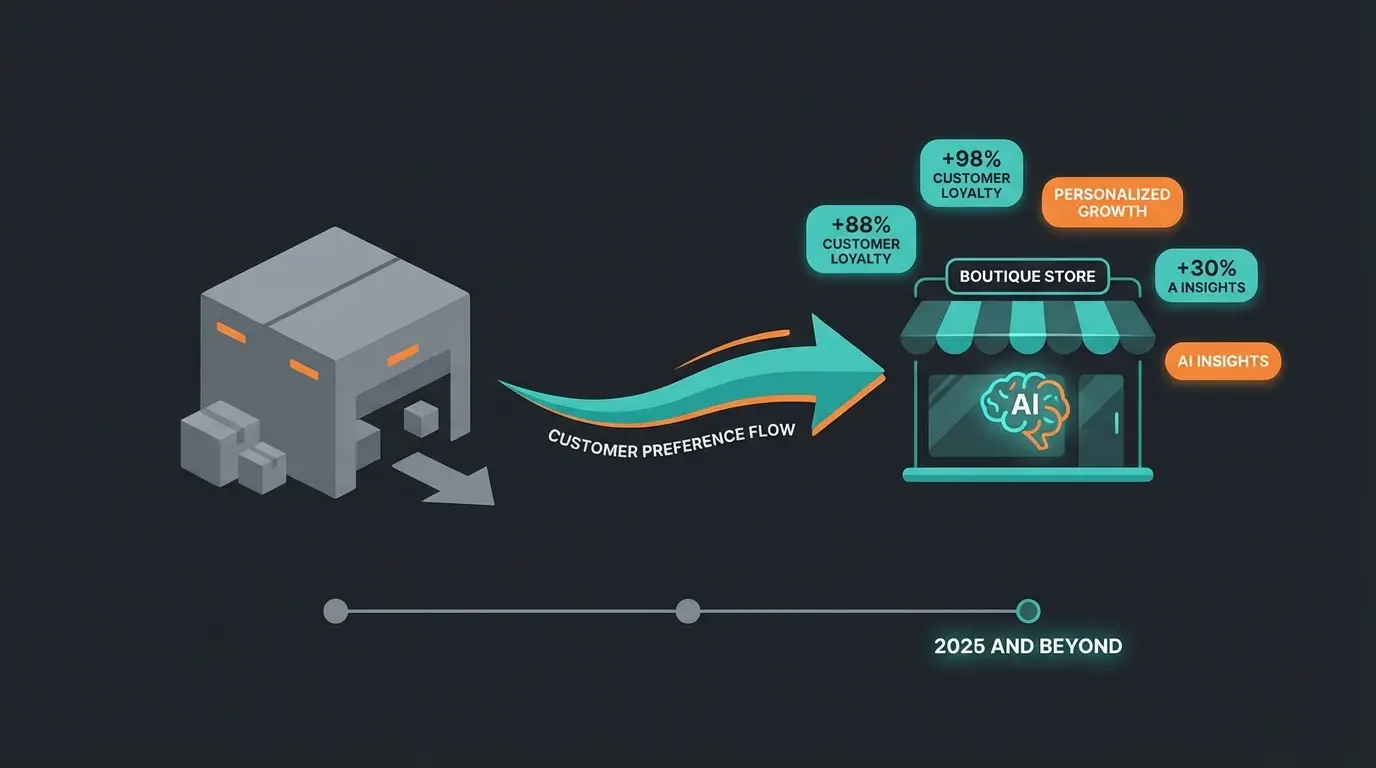
The combination of a solid technical Shopware Amazon connector (for reach) and an AI-powered consultation strategy (for retention) is the key to profitable growth in 2025 and beyond. Understanding AI-driven product consultation is becoming essential for modern e-commerce success.
Specialized shops win by offering better advice than Amazon's generalist algorithms. When you implement AI Product Consultation effectively, you create an experience that the marketplace giant simply cannot replicate.
Whether you're looking for AI-powered product advice through a full-service agency or want to implement Shopware 6 chatbots yourself, the technology is mature and ready for deployment.
Regarding Shopware Markets
The native solution "Shopware Markets" was heavily promoted in the past but according to community feedback and current developments has lost significance or been transferred to other structures. Based on forum discussions on Shopware's community platform, it's currently recommended to rely on established partner solutions like Magnalister or Channable, which offer dedicated support for marketplace changes.
For businesses exploring AI consulting for e-commerce, understanding these marketplace dynamics is crucial for making informed platform decisions.
FAQ: Common Questions About Shopware and Amazon
It depends on your needs. For beginners and small to medium shops, Magnalister is often the price-performance recommendation. When complex data adjustments are needed, Channable is superior. For enterprise solutions with ERP integration, Brickfox is leading.
Yes, absolutely. Amazon Pay is purely a payment service provider. You can integrate it into Shopware even if you don't list any products on Amazon. It's a strong trust anchor for your checkout.
This is the job of "Inventory Sync." Tools like Magnalister synchronize stock often every 15-30 minutes. Real-time synchronization is technically more demanding. For fast-moving items, plan a "buffer stock" that isn't reported to Amazon to avoid cancellations.
Amazon typically charges between 8% and 15% commission on the gross sales price, depending on the product category. Additional FBA fees apply if you use Fulfillment by Amazon. New fees like the Low Inventory Level Fee add further cost considerations.
AI consultation provides personalized, context-aware product recommendations that Amazon's static search cannot match. When customers have complex questions or need guidance, your AI can provide specific answers, reducing decision fatigue and building trust that leads to higher conversion rates and lower returns.
Stop losing customers to Amazon. Implement AI-powered product consultation that converts browsers into buyers and builds lasting customer relationships.
Get Started with AI Consultation
Lasse is CEO and co-founder of Qualimero. After completing his MBA at WHU and scaling a company to seven-figure revenue, he founded Qualimero to build AI-powered digital employees for e-commerce. His focus: helping businesses measurably improve customer interaction through intelligent automation.