Introduction: The Consultation Gap in German SMEs
German B2B e-commerce is growing dynamically. According to recent figures from IFH Köln, B2B internet commerce (shops and marketplaces) recently grew by 11.7% to 476 billion euros. However, behind these impressive numbers lies a structural problem that affects many 'Hidden Champions' and wholesalers: We have successfully digitized the fax machine, but we have forgotten the sales engineer.
Traditional Magento B2B shops excel at processing transactions. They master complex price lists, tiered pricing, and quick reorders. But what happens when a buyer doesn't know exactly what they need? This is where the 'Consultation Gap' emerges. A classic online shop responds to the question 'Which replacement valve fits my 2015 pump?' usually with '0 results.' The customer picks up the phone – or switches to the competition.
This article is not another generic feature comparison. It is a strategic guide for e-commerce managers in the DACH region who want to understand Magento business to business not just as a processing machine, but as a digital sales representative. We will explore how you can secure market leadership with Adobe Commerce B2B or a highly equipped open-source variant, combined with modern AI and German compliance standards (e-invoicing 2025). The emerging field of AI product consultation represents a fundamental shift in how B2B companies interact with their customers online.
The Foundation: Essential Magento B2B Features
Before we discuss artificial intelligence, the foundation must be solid. Magento (both in the Open Source and Adobe Commerce variants) is so popular in the B2B environment because it can natively map the complex hierarchies and processes of German medium-sized businesses. Here is a compact overview of the features that Google and your customers today expect as hygiene factors, as documented by Net Solutions and BSS Commerce.
Company Accounts & Hierarchy Management
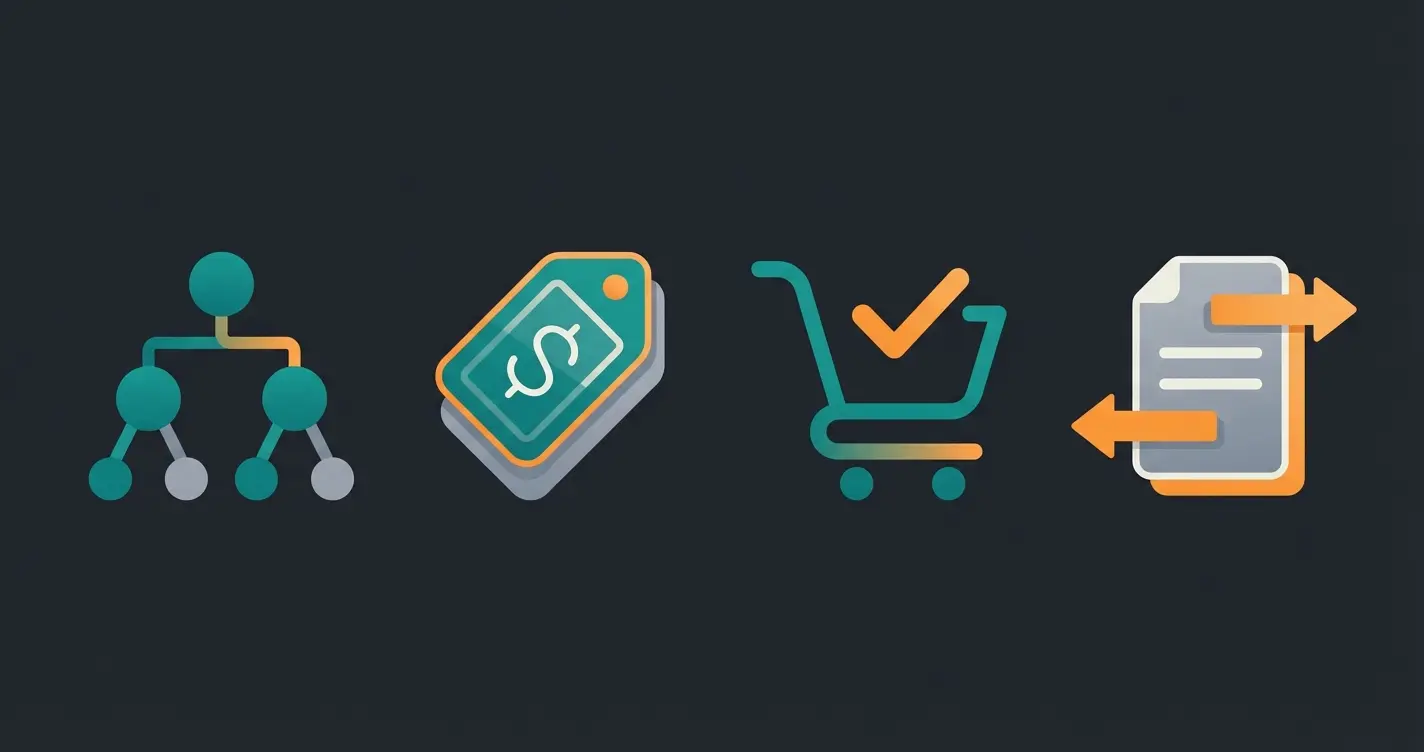
In B2B business, you rarely sell to an individual. You sell to an organization. Magento enables the mapping of complex corporate structures that are essential for German 'Mittelstand' hierarchies:
- Self-administration: The customer (e.g., a department head) can create their employees themselves in the portal.
- Rights & Roles: An apprentice may fill the shopping cart but not place orders. The purchasing manager must approve orders over €5,000.
- Cost Centers: Assignment of budgets to specific departments or projects.
Customer-Specific Pricing (Shared Catalogs)
This is the heart of Magento B2B. In Germany, there is almost never 'one price.' The shared catalogs feature enables sophisticated pricing strategies:
- Individual Price Lists: Customer A sees Price List X (base -10%), Customer B sees Price List Y (base -15% + special conditions on product group Z).
- Visibility Control: Exclusive products that are only visible to certified partners can be controlled via Shared Catalogs.
Frictionless Reordering (Quick Order)
B2B buyers are professionals. They don't want to browse; they want to get things done efficiently. The quick order functionality addresses this need directly:
- Quick Order: Entry of SKUs and quantities directly into a form or upload of a CSV file.
- Requisition Lists: Unlike a wish list, products here are not deleted after purchase. Perfect for consumables that are ordered weekly.
Quote Processes (Negotiable Quotes)
Not every price is fixed. Magento allows the customer to convert a shopping cart into a quote and request a discount. The sales representative sees this in the backend, calculates accordingly, and sends the quote back digitally. This digitizes the classic negotiation process without media discontinuity.
The Dilemma: Open Source vs. Adobe Commerce
One of the most common questions from German companies is: 'Do I really need the expensive Adobe Commerce license (formerly Enterprise), or is Magento Open Source enough?' The answer is more nuanced than many agencies will admit.
The Reality of License Costs
Adobe Commerce often starts at license costs of approximately €20,000 - €30,000 per year and scales with revenue (Gross Merchandise Value). For many medium-sized companies, this is a hurdle. Magento Open Source is license-free but does not offer B2B modules (such as company accounts or quotes) 'out of the box,' as explained by Univio.
The Hybrid Approach: Open Source + B2B Extensions
It is an open secret that you can build an excellent B2B shop with Magento Open Source. The strategy involves using the free core and retrofitting the missing B2B functions via third-party modules (e.g., Amasty, Mageplaza, BSS Commerce). This approach offers massive cost savings on licenses, though you must ensure that the modules are compatible with each other and that updates are installed cleanly.
When Adobe Commerce Cloud Is Indispensable
Adobe Commerce is worthwhile if you have extremely high order volumes and need the database splitting features of the Commerce Edition, want an integrated solution without 'patchwork' from 20 different module providers, wish to use the native AI features for search and product recommendations through Adobe Sensei, or require the native B2B suite from Adobe which is deeply integrated into the system and often more stable than third-party rebuilds.
| Feature | Magento Open Source + Extensions | Adobe Commerce (B2B Edition) |
|---|---|---|
| License Costs | €0 (only hosting & maintenance) | From approx. $22k/year (revenue-dependent) |
| B2B Functions | Must be purchased via plugins | Natively integrated & supported |
| Search | Standard Elasticsearch / OpenSearch | Live Search (Adobe Sensei AI) |
| Support | Community & Agency | Adobe Support (SLA) + Agency |
| Hosting | Freely selectable (On-Premise/Cloud) | Adobe Cloud or On-Premise |
| Target Group | SMEs to upper mid-market | Enterprise & Corporations |
The Missing Link: AI Product Consultation
Most competitors talk about AI in Magento B2B shops only in terms of personalized product recommendations ('Customers who bought X also bought Y'). That is 2010s technology. The real game-changer for 2026 is Generative AI and RAG (Retrieval-Augmented Generation). Understanding AI readiness is crucial for positioning your business ahead of the competition.
The Problem with Traditional Search
Imagine a customer is looking for a gasket for a machine. With classic search, they type 'gasket 50mm' and get 500 results. They have to set filters. They are frustrated. The problem is that search does not understand the context. It only matches keywords. This represents a fundamental failure in the customer journey that costs businesses millions in lost sales and customer defection.
The Solution: The Silent Salesman (RAG Architecture)
With modern LLMs (Large Language Models like GPT-4 or Claude) and a RAG architecture, you can transform Magento into a technical consultant, as explored in research by Medium and HackerNoon. This approach to AI e-commerce fundamentally changes the customer experience.
Feed a vector database not only with product data from Magento, but also with your PDF data sheets, installation instructions, and compatibility lists.
The customer asks in the chatbot or search bar: 'I need a spare part for pump Model X-200 that is acid-resistant.'
The system searches the PDFs for 'Pump Model X-200' and finds the parts list. It identifies the matching gaskets.
The AI responds: 'For the X-200 pump, you need gasket D-55. Since you need acid resistance, I recommend the Viton variant (item number 12345), not the standard NBR gasket.'
This type of AI-driven product consultation represents the future of B2B sales. Companies implementing AI selling strategies are seeing dramatic improvements in conversion rates and customer satisfaction. The role of digital product consultants becomes increasingly important in this context.
| Feature | Standard Magento Search (Elasticsearch) | AI Product Consultant (RAG + LLM) |
|---|---|---|
| Input | Keywords ('gasket 50mm') | Natural language / problem description |
| Data Basis | Product attributes (name, SKU, color) | Attributes + PDFs + instructions + FAQ |
| Understanding | Syntax (word matching) | Semantics (meaning & technical context) |
| Result | List with 50 products | 1 concrete recommendation with explanation |
| Added Value | Shows products | Solves technical problems |
Discover how AI-powered product consultation can close the consultation gap and dramatically increase your B2B conversion rates.
Start Your AI JourneyGerman Market Specifics: Compliance & Processes
A Magento B2B shop for the US market does not work in Germany. This is where many international templates fail. To be successful in Germany (and to rank on Google for local keywords), you must address the following topics. Implementing proper AI consultation that respects these local requirements is essential for market success.
E-Invoicing Mandate from January 1, 2025
This is currently the hottest topic in German B2B. From January 2025, all German companies must be able to receive e-invoices. From 2027/2028, sending will also become mandatory in B2B, as detailed by Online Shop Support, Splendid Internet, and Seeburger.
What this means: A PDF by email is no longer sufficient. It must be a structured format (ZUGFeRD 2.x or XRechnung). Standard Magento sends HTML/PDF invoices. You must install a module that embeds XML data in the invoice (ZUGFeRD) or generates separate XML files (XRechnung).
Payment Methods: Invoice Payment Is King
In the USA, B2B often pays by credit card. In Germany, almost everything runs via 'purchase on account' with payment terms (e.g., 30 days net). This presents a risk: as a merchant, you bear the default risk. The solution is to integrate specialized B2B payment providers like Mondu or Billie. These offer ready-made Magento plugins. They take over the risk and dunning, while the customer pays on account as usual. This massively increases the conversion rate at checkout.
GDPR (DSGVO) & Hosting Considerations
German B2B buyers are sensitive about data. You should host your Magento shop in Germany or the EU (e.g., with Hetzner, Maxcluster, or specialized Magento hosters). Use tools like Usercentrics or Cookiebot that are cleanly integrated into Magento for consent management. The Hyvä Theme advantage is that it requires fewer tracking scripts and third-party code than the old Luma theme, making it often easier to remain GDPR-compliant.
All German B2B companies must accept structured e-invoices
Mandatory outbound e-invoicing for all B2B transactions
German B2B buyers prefer 'Kauf auf Rechnung' over credit cards
Strict data protection requirements for B2B customer portals
Technical Architecture: Hyvä as Performance Turbo
We have discussed features and AI. But what does all this run on? Understanding the technical foundation is critical for long-term success. Working with AI product consultants can help you navigate these architectural decisions.
The End of Luma and the Rise of Hyvä
The standard frontend of Magento (Luma) is outdated, slow, and expensive to develop. For B2B shops in 2025/2026, there is hardly any way around Hyvä Themes, as discussed by Fluid Commerce and Foundation Commerce.
- Performance: Hyvä often achieves 90-100 points in Google Core Web Vitals (important for SEO).
- B2B Compatibility: With Hyvä Enterprise, there is full compatibility with the Adobe Commerce B2B Suite (Company Accounts, Requisition Lists, etc.), as confirmed by Aureate Labs and Hyvä.
- Costs: Development is often 30-50% faster than with Luma or PWA solutions.
The Modern Architecture Blueprint
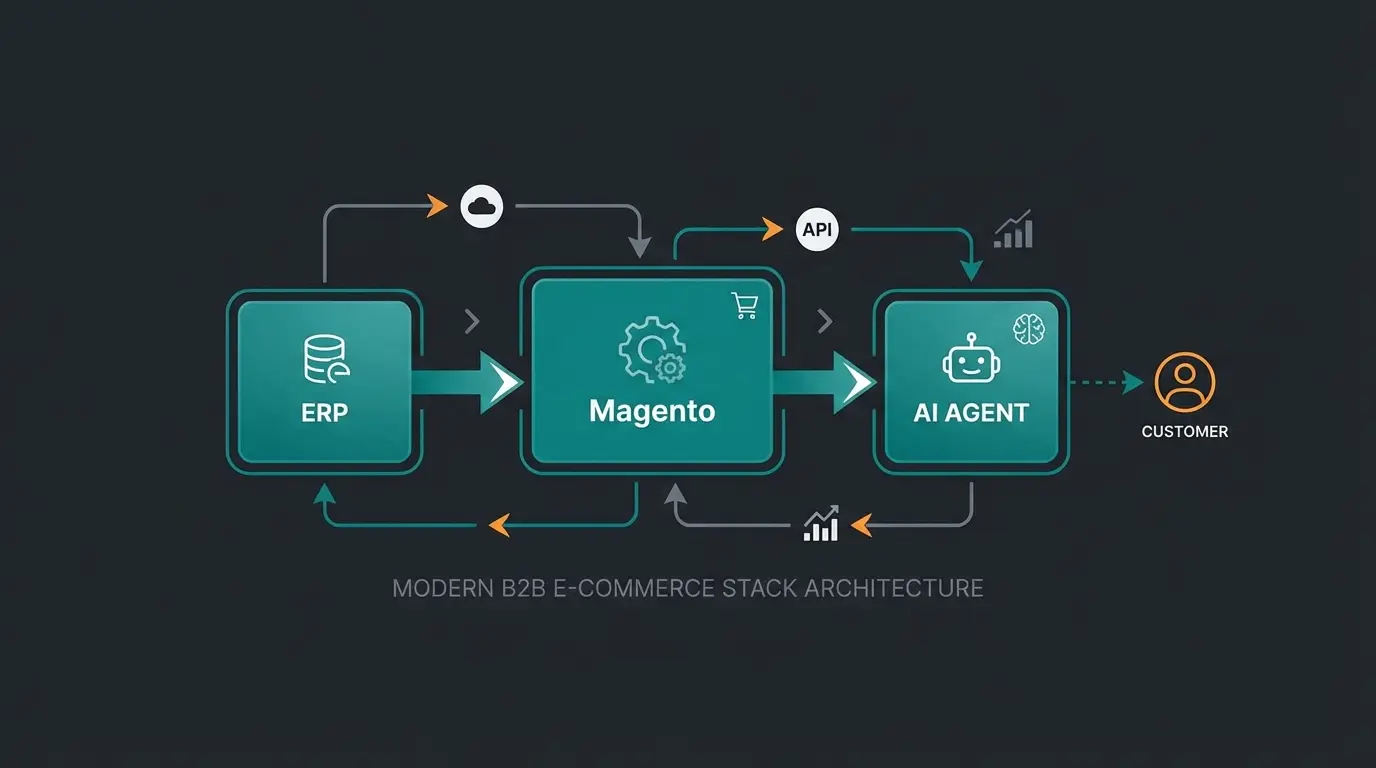
This is what a future-proof tech stack for a German B2B market leader looks like. Implementing an AI-powered digital sales consultant within this architecture creates a powerful competitive advantage.
Magento Open Source (or Adobe Commerce) as 'Headless' or monolithic base
Hyvä Theme for maximum speed and mobile UX, achieving 90-100 Core Web Vitals scores
ERP (SAP, Microsoft Dynamics) synchronizes prices and inventory in real-time
Vector database (RAG) that provides product data for the AI chatbot consultant
ZUGFeRD module for e-invoices and B2B payment gateway (Mondu/Billie)
Conclusion: Build an Assistant, Not Just a Shop
The market for Magento B2B solutions is mature, but it is changing radically. Anyone who tries to win customers in 2026 with just a 'digital price list' will lose. Understanding AI consultation principles is no longer optional—it's essential for competitive survival. Those considering AI product consultation strategies are already positioning themselves for the future.
The winners will be those companies that close the Consultation Gap by using AI to make technical knowledge available around the clock, perfectly serve German standards (e-invoicing, invoice payment) to build trust, and rely on a performant basis (Hyvä) to not lose users through loading times.
Frequently Asked Questions About Magento B2B
Yes, absolutely. With the right extensions and the Hyvä Theme, even complex B2B scenarios can be mapped, often more cost-effectively than with the Enterprise license. The key is selecting compatible modules and ensuring proper integration with your existing systems.
The e-invoicing obligation (reception) comes into force on January 1, 2025. Shops must be technically capable of providing structured invoice data (ZUGFeRD/XRechnung) if they are active in the B2B sector. Sending requirements follow in 2027/2028.
Start with strategic implementation, not gimmicks. Use RAG (Retrieval-Augmented Generation) to make your product data sheets searchable and offer genuine technical consultation via chat. This requires connecting your product database, PDFs, and technical documentation to a vector database that powers an LLM-based assistant.
Magento Open Source has zero license costs (you only pay for hosting and maintenance), while Adobe Commerce starts at approximately $22,000 per year and scales with your revenue. However, Open Source requires purchasing B2B functionality via third-party plugins, so total cost of ownership should be carefully calculated.
Hyvä delivers 90-100 points in Google Core Web Vitals, which is crucial for SEO rankings and user experience. It's 30-50% faster to develop than Luma, fully compatible with Adobe Commerce B2B Suite, and requires less third-party code, making GDPR compliance easier.
Transform your Magento B2B shop from a simple order portal into an intelligent AI sales consultant. Our experts will help you implement the right technology stack for the German market.
Schedule Your Free Consultation
Lasse is CEO and co-founder of Qualimero. After completing his MBA at WHU and scaling a company to seven-figure revenue, he founded Qualimero to build AI-powered digital employees for e-commerce. His focus: helping businesses measurably improve customer interaction through intelligent automation.