Why Your Server Determines AI Strategy Success
The e-commerce landscape is undergoing a radical transformation in 2025. While we've spent the last decade debating milliseconds of load time for product images, we now face a completely new challenge: Intelligent Commerce.
Magento (Adobe Commerce) has always been a resource-hungry beast. But with the integration of AI-powered product consultants, dynamic pricing algorithms, and real-time personalization, infrastructure requirements are growing exponentially. A "fast" server is no longer sufficient. You need intelligent infrastructure. Understanding why cheap hosting kills your conversion rates is the first step toward building a successful AI-powered store.
If your AI consultant takes 3 seconds to respond to a customer's question because the database query is hanging in the background, you've already lost that customer. In this comprehensive guide, we analyze the best Magento hosters for the German market, examine the critical technical requirements for Magento 2.4.8 (and beyond), and explain why inference latency is the new "Time to First Byte."
Quick Summary: Top 3 Magento Hosters at a Glance
For those in a hurry, here's our analysis summary for the German market (DACH region). These providers were selected based on performance, AI-readiness, and data privacy (GDPR) compliance.
| Category | Provider | Specialty | Ideal For |
|---|---|---|---|
| Performance & AI Winner | Maxcluster | E-Commerce stack, Redis optimization, AI/ML-ready | High-traffic shops, AI integrations, Enterprise |
| Best Nginx Performance | Timme Hosting | Pure Nginx hosting (no Apache overhead), extremely fast | Performance enthusiasts, tech-savvy teams |
| Best Flexibility for Agencies | Mittwald | vServers (Space-Server), mStudio, OpenSearch included | Agencies, growing shops, flexible setups |
Critical Requirements for Modern Magento Hosting
Before we dive into provider details, we need to understand what Magento actually requires in 2025. The days when a simple LAMP stack (Linux, Apache, MySQL, PHP) was sufficient are long gone. With the release of Magento 2.4.8 in April 2025, according to Amasty and MGT-Commerce, the standards have shifted dramatically.
Essential Infrastructure: The Must-Haves
Any Magento hoster that doesn't offer these basics should be immediately removed from your consideration list:
- PHP 8.3 / 8.4 Support: Magento 2.4.8 natively supports PHP 8.4. Older PHP versions are not only a security risk but significantly slower at code execution. PHP 8.4 brings substantial performance improvements through enhanced JIT (Just-In-Time) compiling.
- NVMe SSD Storage: Regular SSDs are good, but NVMe is mandatory. I/O rates (Input/Output Operations Per Second) are critical for Magento since the system reads and writes thousands of small files.
- Varnish Cache: A full-page cache is indispensable for Magento. Your hoster should not just "allow" Varnish but offer it as a managed, pre-configured service.
- Elasticsearch / OpenSearch: Since Magento 2.4, a search engine is mandatory. MySQL search no longer exists. Your hoster must provide OpenSearch or Elasticsearch as a service (ideally in current versions like OpenSearch 2.x or higher).
These requirements align closely with what you'd find in Shopware server requirements, demonstrating that modern e-commerce platforms share similar infrastructure demands.
The AI Factor: Why AI Creates New Requirements
This is where the wheat separates from the chaff. If you're planning to use AI features (like a chatbot that recommends products), the load profiles on your server change dramatically.
Latency and Inference Speed
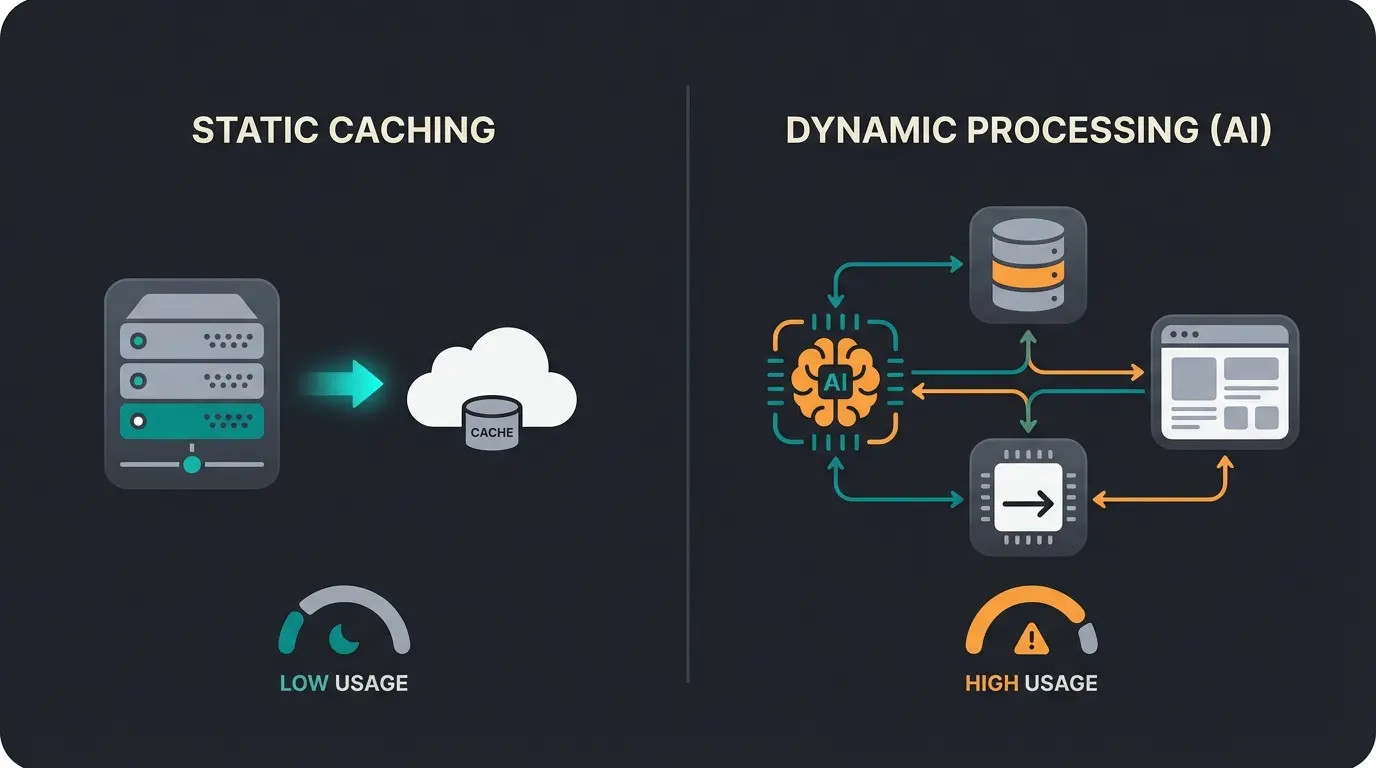
A classic shop delivers static content (images, text) from cache. An AI-powered shop performs dynamic calculations.
The Hosting Solution: You need extremely low latency between the web server (where Magento runs), the database, and the AI model. Hosting in Germany isn't just important for data privacy—it's physically necessary to keep ping times in the millisecond range. For similar optimization strategies, check out our Shopware page speed guide.
Redis and In-Memory Processing
AI conversations require "memory" (context). When a customer follows up with "Do you have that in red?", the system needs to know what was discussed previously.
The Requirement: This context is often stored in Redis (session storage). A standard Redis setup often isn't enough. You need high-performance Redis instances that aren't limited by disk storage but run entirely in RAM, as detailed by Maxcluster's documentation.
High IOPS for Vector Search
Modern product search uses vector databases (or vector extensions in OpenSearch/PostgreSQL). These searches are more computationally intensive than simple text matching. Your hoster must guarantee high CPU reserves and massive IOPS so that searches don't slow down the checkout process. Our performance optimization guide covers similar concepts that apply across platforms.
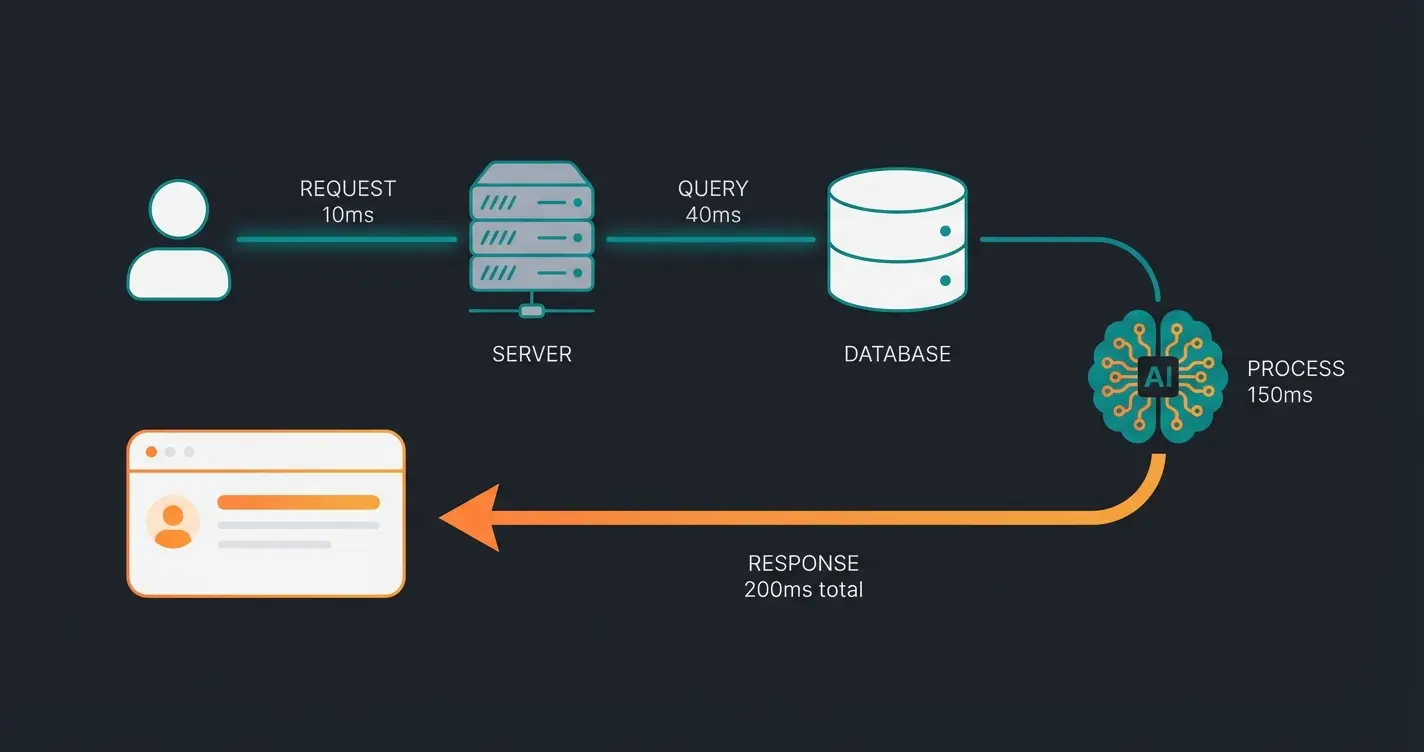
Customer query arrives at server (target: <10ms)
Web server processes and routes request (target: <20ms)
Product data retrieval via OpenSearch (target: <50ms)
LLM inference and context handling (target: <500ms)
Formatted answer sent to customer (target: <100ms)
Top Magento Hosting Providers: Detailed Comparison
We've examined the leading providers for the German market under the microscope. Here's our detailed analysis covering the best Magento hosting options available.
Maxcluster: The High-Performance Specialist
Maxcluster from Paderborn, Germany has built a reputation as a premium hoster for e-commerce. They don't focus on mass hosting but on highly available cluster solutions. According to Maxcluster's platform, their e-commerce-optimized stack sets them apart.
Technical Highlights:
- E-Commerce Stack: Maxcluster offers an optimized stack with Varnish, Redis, NGINX, and Elasticsearch/OpenSearch, specifically tuned for Magento
- Hardware: Intel XEON processors and NVMe SSDs in RAID configuration for reliability
- AI-Readiness: Maxcluster explicitly positions itself as a partner for AI and Machine Learning. Customers can integrate additional services for AI, ML, and serverless solutions. There's also a partnership with Hyvä (frontend) as noted on Hyva.io, which further boosts performance
Advantages:
- Managed Center: A powerful tool for managing services (PHP versions, Varnish config, Redis instances) with a single click
- Scalability: Clusters can dynamically scale during traffic spikes (e.g., Black Friday)
- Support: The support team consists of Linux admins with Magento experience—no call center scripts
- Data Privacy: Server location in Germany, ISO-certified, GDPR-compliant
- Immutable Backups: Protection against ransomware through unchangeable backup systems
Disadvantages:
- Price: Quality comes at a cost. Maxcluster is more expensive than a simple vServer but targets revenue-critical shops
- Focus: Less suitable for small hobby projects
Timme Hosting: The Nginx Pioneers
Timme Hosting is known for being one of the few hosters that exclusively relies on Nginx (no Apache in the background). This makes their servers extremely lean and fast. Their approach is documented extensively at Timme Hosting and analyzed by HostLecture.
Technical Highlights:
- Pure Nginx: Many hosters only use Nginx as a proxy in front of a slow Apache. Timme uses 'real' Nginx hosting, which massively reduces overhead
- ScaleServer: An interesting mix of cloud flexibility and dedicated power. Resources can be adjusted as needed
- NVMe & RAM: Generous RAM allocation (e.g., 192GB RAM in the large ScaleServer), which is ideal for in-memory databases (Redis/AI context)
Advantages:
- Speed: Often at the top in pure TTFB measurements
- Expertise: Deep knowledge of Nginx configurations (rewrite rules for Magento are complex—Timme handles this)
- Transparency: Clear communication about CPU cores and RAM allocation
Disadvantages:
- User Interface: More technically oriented, less 'click-pretty' than mass hosters (which is an advantage for professionals)
AI-Readiness Score: 8.5/10 — The raw performance is perfect for AI applications that need fast response times. The high RAM availability is a major plus for Redis-based AI sessions. For comparison with other platforms, see our analysis of Shopware vs Magento.
Mittwald: The Agency Favorite
Mittwald has completely rebuilt its portfolio and offers a very flexible solution with "vServers" (formerly Space-Server) that is particularly popular with agencies. Their container-based approach is detailed on Mittwald.de and reviewed by WebhostingVergleich.eu.
Technical Highlights:
- Container Architecture: Mittwald uses modern container technologies (Kubernetes in the background), enabling very clean resource separation
- mStudio: One of the best management interfaces on the market. Teams can easily share and manage projects
- OpenSearch Default: OpenSearch is provided as a standard instance, which is essential for Magento 2.4.8
Advantages:
- Flexibility: Resources (CPU/RAM) can be adjusted very granularly
- Agency Features: Free test environments, easy project cloning, permissions management for teams
- Price-Performance: Good entry point for growing shops
Disadvantages:
- Shared Resources (in smaller plans): In the smaller 'proSpace lite' plans, resources are shared, which could lead to bottlenecks for high-end AI applications. For AI shops, you should definitely choose the dedicated 'proSpace' or vServer plans
AI-Readiness Score: 8/10 — Solid foundation. The container technology is future-proof and allows easy addition of microservices (e.g., a Python container for AI logic). This flexibility is similar to what we discuss in modern Shopware hosting.
MGT-Commerce: The Cloud Alternative (AWS)
Those who need international scaling can hardly avoid MGT-Commerce. They offer managed hosting based on Amazon Web Services (AWS), as documented on MGT-Commerce and reviewed by Scalesta.
Technical Highlights:
- AWS Infrastructure: Access to the entire AWS arsenal (Auto Scaling, RDS, ElastiCache)
- Varnish Cache: Proprietary 'MGT Varnish' solution for high-speed caching
- Global: Data centers selectable worldwide
Advantages:
- Unlimited Scalability: If you have 10x more traffic tomorrow, AWS scales with you
- Technology: Access to AWS's own AI services (Bedrock, SageMaker) is easier since you're already in the AWS ecosystem
Disadvantages:
- Data Privacy: Even though AWS has servers in Frankfurt, the US Cloud Act issue is a red flag for some German data protection officers
- Complexity/Price: AWS costs can be opaque and escalate quickly
AI-Readiness Score: 9/10 — Technically top-notch since you're directly connected to cloud AI models. However, data privacy concerns require careful consideration.
Discover how AI-powered product consultation can transform your Magento store—but only with the right hosting infrastructure to support it.
Start Your AI JourneyDeep Dive: Why AI Product Consultation Needs Better Hosting
Many shop owners only think of Google PageSpeed Insights when considering "performance." But for an AI-powered shop (Smart Store), different rules apply. Let's walk through the scenario of an AI product consultant.
The Scenario: Consultation vs. Search
A user types into the chat: "I need an outfit for a summer wedding, not too expensive but classy."
The Slow Server Experience (Standard Hosting)
- Request: The server receives the text
- Database Timeout: The AI tries to match attributes like 'summer,' 'wedding,' 'price < X' in the database. A standard MySQL server on an HDD or slow SSD takes 500ms+ for this
- Context Loss: The user asks 'And which shoes would match?' The server has already offloaded the context (Redis) or is too slow reading. The AI responds generically: 'We have many shoes.'
- Result: The customer is frustrated. The 'intelligence' appears stupid because the server is slow
The Fast Server Experience (AI-Optimized Hosting)
- High-Speed I/O: The request is processed immediately. NVMe storage and optimized databases (MariaDB 11.4) deliver product data in <50ms
- In-Memory Context: The conversation history is in RAM (Redis). The AI immediately knows it's still about the 'summer wedding'
- Inference Speed: Since the server is in Germany with powerful CPUs, latency to the AI engine is minimal
- Result: The AI responds in fractions of a second: 'These beige sandals would perfectly match that blue dress.' → Conversion
Standard shops rely heavily on Varnish static caching
AI shops need sub-50ms database response times
AI context storage requires dedicated high-speed RAM
Vector search demands massive I/O operations per second
Data Privacy as Competitive Advantage
In Germany, trust in AI is still fragile. If you can guarantee your customers: "Our AI runs on servers in Germany. Your data never leaves the EU legal area", that's a massive sales argument.
Providers like Maxcluster or Timme Hosting guarantee exactly that. Your database and processing are physically located in Germany. With US cloud solutions, this proof is often more complicated. This consideration is especially relevant when comparing Shopware vs Shopify for European markets.
2026-Ready Checklist: Evaluate Your Hoster
Use this checklist to evaluate your current or future hoster. If more than 2 points are answered with "No," your shop will have problems with modern Magento versions and AI features.
PHP and Software Requirements
- Does the hoster support PHP 8.3 and 8.4? (Mandatory for Magento 2.4.8)
- Is MySQL 8.4 or MariaDB 11.4 available? (As confirmed by KiwiCommerce)
- Is Elasticsearch or OpenSearch offered as a managed service? (Verified by Hosterz.de)
Performance and Hardware Requirements
- Are NVMe SSDs in use (not just 'SSD')?
- Are there dedicated Redis instances for session and cache?
- Does the hoster guarantee RAM reserves for traffic spikes (e.g., boost mode)?
Magento-Specific Requirements
- Is Varnish cache pre-configured and linked with Magento (ESI tags)?
- Are CLI tools available (SSH, Composer 2, Magerun)?
- Are cron jobs executed reliably and every minute?
Security and AI Requirements
- Is the data center located in Germany/EU (GDPR)?
- Is there a Web Application Firewall (WAF) that also detects AI bots?
- Does the hoster offer backups that are immutable (protection against ransomware)?
For a complete technical foundation, our Shopware installation guide covers similar infrastructure considerations that apply to Magento environments.

Conclusion: Invest in Intelligence, Not Just Storage
The Magento hosting market has transformed. It's no longer just about who offers the cheapest web space. In 2025, hosting is the foundation of your digital intelligence.
- If you're seeking maximum performance and AI-readiness with the budget to match, Maxcluster is our top recommendation for the German market
- If you prefer technical excellence and Nginx speed, go with Timme Hosting
- For agencies and flexible projects, Mittwald remains the top choice
The investment in proper hosting pays dividends through improved conversion rates, better customer experiences, and the ability to leverage AI capabilities that differentiate your store. Whether you're evaluating Shopware B2B vs B2C models or planning a platform migration, infrastructure should be your foundation. For optimal search visibility, don't forget to implement Shopware structured data alongside your hosting upgrade. Our comprehensive Shopware SEO guide can help you maximize the return on your infrastructure investment.
FAQ: Common Questions About Magento Hosting
There's no one-size-fits-all answer, but for professional shops in Germany, Maxcluster and Timme Hosting lead the field. Both offer server locations in Germany, GDPR compliance, and specialized support. Maxcluster excels for AI-heavy implementations, while Timme Hosting offers superior raw performance through pure Nginx architecture.
For a pure Magento 2 shop, 4 GB RAM is the absolute minimum, with 8 GB+ recommended. If you're using AI services and intensive database queries (vector search), you should plan for at least 16 GB to 32 GB RAM to give Redis and Elasticsearch enough memory to operate entirely in RAM. According to MGT-Commerce and MagentoHosting.eu, these specifications are essential for optimal AI performance.
Shared Hosting: Absolutely unsuitable for Magento—too slow, too insecure. Managed vServer: The sweet spot for most shops, offering good performance at a fair price (e.g., Mittwald, Timme). Dedicated/Cluster: Mandatory for large shops with high revenue and AI integrations to have guaranteed resources (IOPS, CPU). Similar considerations apply when evaluating Shopware cloud hosting options.
Beyond data privacy (GDPR), latency is decisive. Every millisecond that data must travel across the Atlantic delays your AI's response. A server in Frankfurt or Berlin guarantees the fastest possible interaction with German customers. This physical proximity is essential for maintaining the conversational flow that makes AI consultation feel natural rather than sluggish.
Magento 2.4.8 (released April 2025) mandates PHP 8.3 or 8.4, Composer 2.8, OpenSearch 2.x/3.x (Elasticsearch is partially still supported, but OpenSearch is recommended), and MariaDB 11.4 / MySQL 8.4. According to Meetanshi, staying current with these requirements is essential for security and performance. Understanding Shopware shop development costs can help you budget for similar infrastructure investments across platforms.

Now that you understand what hosting infrastructure you need, discover how Qualimero's AI product consultant can help your customers find exactly what they're looking for—instantly.
Get Started Today
Kevin is CTO and co-founder of Qualimero. As an AI architect with over 15 years of experience as CTO and CPO in the tech industry, he designs the AI systems that automate tens of thousands of customer interactions daily for Qualimero's clients — reliably, securely, and at scale.