Why the "Cheapest" Hosting Ends Up Costing a Fortune
When you search for Shopware hosting costs, you'll quickly find offers starting at just €5.00 per month promising a quick entry into e-commerce. But let's be honest: a high-performance engine like Shopware 6 doesn't run on the chassis of a compact car.
In 2025, the e-commerce landscape has changed dramatically. It's no longer just about whether your shop is accessible. It's about whether it's fast enough to meet the expectations of impatient customers and powerful enough to support modern technologies like artificial intelligence (AI) and dynamic real-time product consultation.
According to fin.ai, even a 0.5-second delay can reduce traffic by 20%. This comprehensive guide looks beyond the naked numbers of monthly fees. We analyze the Total Cost of Ownership (TCO) and reveal why an apparent hosting bargain can destroy your conversion rate. We compare current market prices from shared hosting to enterprise clusters and introduce a new, crucial metric: Is your hosting "AI-Ready"?
What Does Shopware Hosting Actually Cost? (Market Overview 2025)
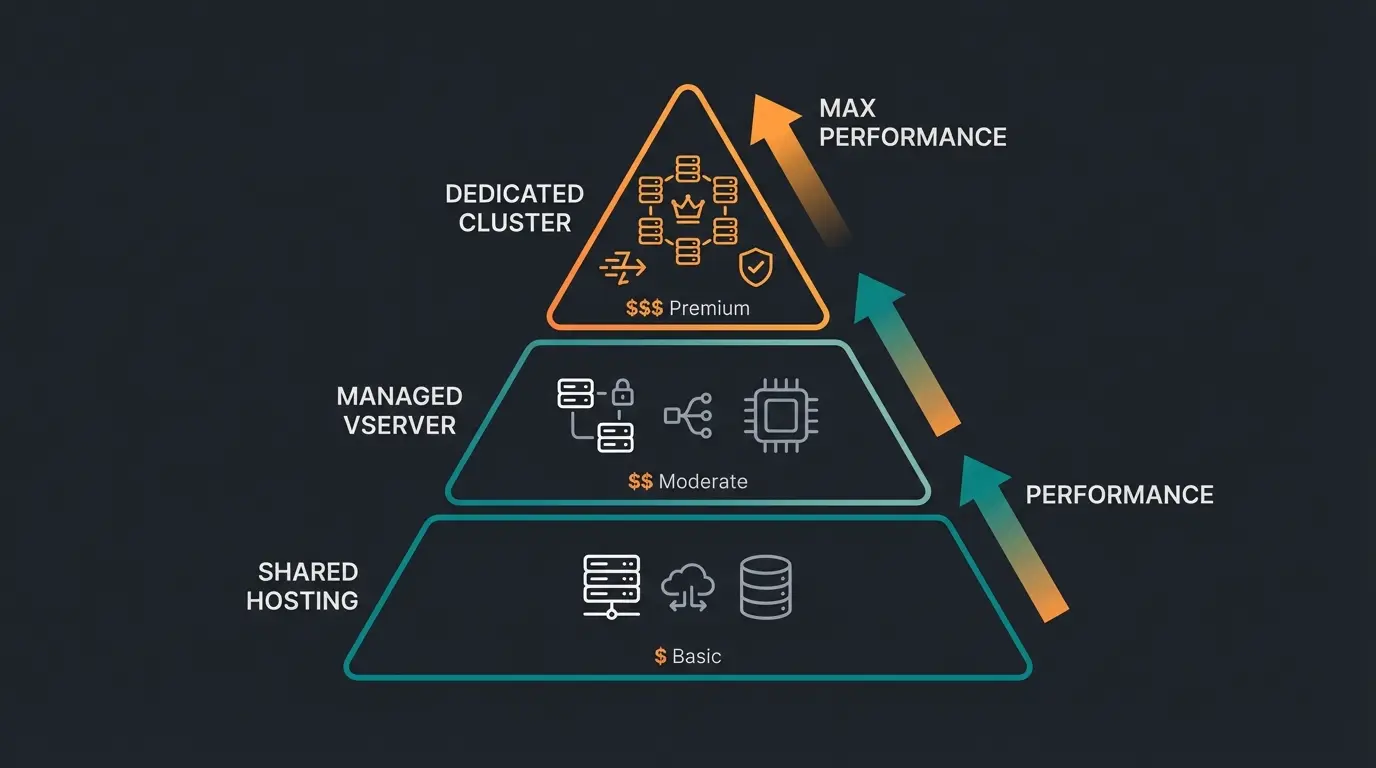
The price range for Shopware hosting is enormous. It ranges from pocket change to the budget of a mid-range car—monthly. To make an informed decision, we need to divide the offerings into three logical categories. Here is the current market overview based on leading German hosters (such as Timme Hosting, Maxcluster, Profihost, DM Solutions):
The Price Pyramid for Shopware 6
| Hosting Type | Monthly Price Range | Suitable For | Performance Level | AI-Readiness |
|---|---|---|---|---|
| Shared Hosting (Entry) | €10 – €30 | Dev environments, micro-shops, hobby projects | Low (shared resources) | 🔴 Critical |
| Managed vServer (Growth) | €50 – €150 | Ambitious startups, moderate traffic shops, initial plugins | Medium to High (dedicated resources) | 🟡 Conditional |
| Dedicated / Cluster (Scale) | €300 – €2,000+ | Established brands, high-traffic, B2B portals, AI integrations | Excellent (maximum power) | 🟢 Optimal |
Shared Hosting: The Beginner's Mistake?
Cost: approximately €10–30 per month
Providers like DM Solutions or entry-level plans from large mass hosters attract with prices that barely register. What you get is a spot on a server that you share with hundreds of other customers. The problem becomes apparent when your neighbor's shop runs a marketing campaign—your shop goes down with it.
Shopware 6 is resource-hungry. A `memory_limit` of 512 MB (the absolute minimum) often becomes a bottleneck here. When considering Shopware page speed optimization, shared hosting simply cannot deliver the consistent performance needed.
Bottom line: Acceptable for a staging environment, but negligent for a live shop that's supposed to generate revenue in 2025.
Managed vServer: The Sweet Spot
Cost: approximately €50–150 per month
This is where professional e-commerce hosting begins. Providers like Timme Hosting (known for Nginx performance) or Profihost offer virtual servers where CPU and RAM are guaranteed to be yours alone. The price-performance ratio is often excellent. You get SSD/NVMe storage and often access to performance tools like Redis or Varnish (sometimes for an additional fee).
In the context of AI: For simple AI tools (e.g., basic chatbots), this tier is often sufficient as long as traffic doesn't spike suddenly. Shops looking to implement AI-powered sales consultants should carefully evaluate whether this tier meets their concurrent user requirements.
Dedicated Servers & Clusters: The Enterprise Class
Cost: €300 – €2,000+ per month
Specialists like Maxcluster or premium plans from Timme Hosting offer dedicated hardware here. The machine belongs to you alone—no "noisy neighbors." Complex setups with load balancers and separate database servers are often possible at this tier.
Why this matters: If you plan to use Shopware Evolve or Beyond features or run intensive AI personalization, this is often the only option that guarantees stable response times under 200ms. When implementing comprehensive Shopware AI features, enterprise-grade hosting becomes essential.
Hidden Technical Requirements: Your Bridge to AI
Many shop operators only look at storage space and CPU cores. But Shopware hosting costs often consist of add-on modules that are indispensable for a modern shop. Those who save here pay later with poor performance.
Redis & Varnish: Not Optional, But Mandatory
Shopware 6 relies heavily on caching. Redis stores sessions and the shopping cart in fast memory instead of on the slow hard drive. Without Redis, your shop becomes noticeably slower with every "Add to Cart" click. Varnish is an HTTP accelerator that delivers pages extremely quickly.
Elasticsearch / OpenSearch for Scalable Search
Shopware's standard search (MySQL) reaches its limits at around 10,000 to 50,000 products. The search becomes slow, and customers leave. The solution is Elasticsearch or OpenSearch, but these services require significant RAM. A hosting package that can run Elasticsearch smoothly often needs at least 8 GB to 16 GB of additional RAM. This quickly drives the price from €50 to €100+.
The "AI Factor": Why Latency Decides Life and Death
Here lies the biggest content gap in most comparisons. If you plan to use [AI-powered product consultation](/blog/shopware-product-recommendations) (such as chatbots or dynamic recommendations), the hosting requirements change fundamentally.
Consider this scenario: A customer asks your AI bot: "Which bicycle suits me?" The AI must understand the request, access your product database via API, check availability, and generate a response. If your hosting has a high "Time to First Byte" (TTFB)—meaning it takes a long time to respond at all—this waiting time adds to the AI's processing time.
Here's the calculation: 0.8s server response time (poor hosting) + 1.5s AI thinking time = 2.3 seconds wait time. The consequence? The customer perceives the AI as "dumb" or "slow" and leaves the shop. Understanding how AI Chatbots transform customer service requires recognizing that infrastructure is the foundation.
Even half a second of delay can reduce traffic by 20%
AI-ready hosting must deliver API responses in under 200 milliseconds
Slow page loads directly correlate with abandoned shopping carts
Allocate 3-5% of your marketing budget to hosting infrastructure
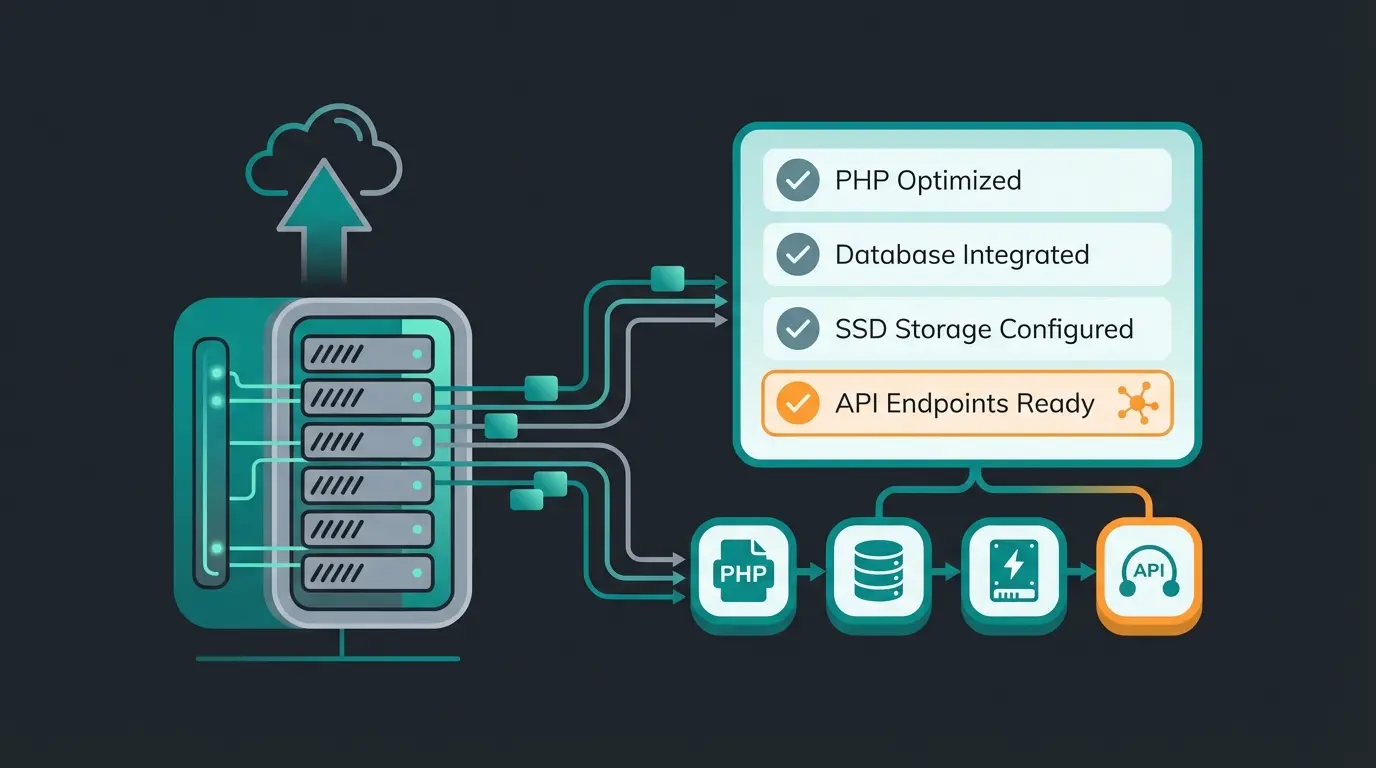
Remember: An "AI-Ready" host must be able to serve API requests in milliseconds. This requires NVMe SSDs and optimized PHP processes (PHP 8.2+), which are technically impossible with €10 hosting packages.
Self-Hosted vs. Shopware Cloud (SaaS): Cost Breakdown
Since the introduction of the new Shopware plans (Rise, Evolve, Beyond), merchants face a choice: Do I rent a server (Self-Hosted) or go directly into the Shopware Cloud (SaaS)? This has massive implications for the cost structure and your ability to integrate advanced tools.
Option A: Shopware Cloud (SaaS)
Here, hosting is included in the license price. You don't pay a separate hosting bill, but a higher monthly base price. According to Shopware's official documentation, the pricing tiers are structured as follows:
- Shopware Rise: From €600/month – Includes hosting, updates, and support. Limited flexibility for deep server customizations.
- Shopware Evolve: From approximately €2,400/month – Includes B2B features and Advanced Search capabilities.
- Shopware Beyond: From approximately €6,500/month – Full enterprise feature set.
The advantage is a "worry-free package" with no admin costs. The disadvantage is that with very high revenues or special AI integrations that require direct database access or special server libraries, you may encounter barriers.
Option B: Self-Hosted (Community or Commercial Edition)
You use the (free) Community Edition or purchase a license and rent hosting separately. Hosting costs run approximately €150/month for a very powerful managed vServer at providers like Maxcluster or Timme. License costs are €0 for Community Edition or individually negotiated for commercial licenses. You (or your agency) must apply updates yourself.
When comparing Shopware vs Shopify, the self-hosted option gives Shopware a significant edge for complex AI integrations that require backend customization.
Total Cost of Ownership Calculator: Investment vs. Cost
Let's stop viewing hosting as a "cost center." It's the foundation of your revenue. A TCO approach shows the true picture. Let's consider a shop with €1 million in annual revenue.
Scenario 1: The Budget Approach
- Hosting: €20/month (Shared Hosting)
- Shopware: Community Edition (€0)
- Maintenance: Minimal (self-managed)
- Performance: 3.5 second load time
- Outage Risk: High (during traffic spikes)
- Lost Revenue from Bounce Rate: Conservatively estimated at 5% due to poor UX = €50,000 loss per year
Scenario 2: The Performance Investment
- Hosting: €120/month (Managed vServer, NVMe, Redis)
- Shopware: Community Edition + AI Consultation Tool (€50/month)
- Performance: 0.8 second load time
- AI Experience: Smooth, immediate responses
- Additional Revenue: +10% through better conversion and AI upselling = €100,000 profit per year
Select infrastructure based on traffic projections and AI tool requirements
Enable Redis, Varnish, and Elasticsearch for optimal speed
Deploy product consultation AI that leverages fast backend responses
Track TTFB and conversion rates to validate ROI
Upgrade resources as traffic and AI complexity grow
The Bottom Line: The budget shopper saves €1,200 per year on hosting fees but loses €50,000 in revenue. The performance investor pays €1,440 for hosting but gains massively in market share. Understanding AI e-commerce fundamentals reveals why this infrastructure investment pays dividends.
Your hosting foundation determines whether AI consultation tools deliver instant, converting responses or frustrate customers with delays. Discover how our AI product consultant transforms visitor engagement.
Start Your Free AI TrialHosting Selection Checklist for 2025
Before signing any contract, examine the provider thoroughly. Use this comprehensive checklist to evaluate potential hosting partners:
Hard Facts: Must-Have Criteria
- PHP Versions: Are PHP 8.2, 8.3, and soon 8.4 supported? Shopware 6.6+ requires current PHP versions for security and speed according to Shopware system requirements.
- Database: MySQL 8.0+ or MariaDB 10.11+? Older versions are no longer compatible.
- Storage: NVMe-SSD (standard SSDs are now "normal," NVMe is the turbo).
- Web Server: Nginx or Apache with PHP-FPM? Nginx is often considered more performant for static assets.
Performance Boosters
- Redis Support: Is Redis included and easily activated?
- Elasticsearch/OpenSearch: Are there packages with integrated search servers?
- HTTP/2 or HTTP/3: For faster loading of many small files (images, scripts).
The AI Check: New for 2025
When evaluating AI readiness, these factors become critical differentiators:
- API Performance: Ask the hoster: "How many concurrent API requests can the server handle?" This is crucial for AI agents.
- Timeout Settings: Can `max_execution_time` and timeouts be flexibly adjusted? AI processes sometimes need more than 30 seconds.
- Scalability: Can I add RAM/CPU within minutes during a viral hit (e.g., through an AI feature)? Cloud scaling capability is essential.
Case Study: Shop A vs. Shop B – A Real Cost Calculation
Let's walk through a hypothetical but realistic scenario to put Shopware hosting costs in relation to success.
Starting Point: Both shops sell sporting goods, have 5,000 products, and use Shopware 6. Both want to introduce a new "AI advisor" tool that helps customers find the perfect running shoe.
Shop A: "Hosting Must Cost Nothing"
Shop A chooses a mass hoster for €19.90 per month. The server has no dedicated resources. When Google's crawler arrives, the shop slows down.
The AI Failure: The AI tool is installed. The customer asks: "I'm looking for shoes for asphalt." The AI script sends a request to the server to filter products. The server takes 2 seconds to process the database query (no Elasticsearch, no Redis). The AI tool loads... and loads.
Customer Reaction: The customer abandons the session. The bounce rate climbs to 60%. The investment in AI Product Consultation is completely wasted because the infrastructure cannot support it.
Shop B: "Performance as Foundation"
Shop B chooses a managed vServer from a Shopware partner (e.g., Maxcluster or Timme) for €89.00 per month. Redis caches the sessions, Elasticsearch indexes the products.
The AI Win: The same question ("shoes for asphalt") is asked. Thanks to Elasticsearch, the server delivers the filtered data to the AI tool in 0.1 seconds. The response appears instantly.
Customer Reaction: "Wow, that was fast." The customer clicks on the recommended shoe.
ROI: Shop B spent €70 more per month on hosting, but generated 20 additional sales at €150 each through the functioning AI consultation. Net gain: €2,930. This demonstrates how AI consultants boost conversion rates when properly supported by infrastructure.
| Metric | Shop A (Budget Hosting) | Shop B (Performance Hosting) |
|---|---|---|
| Monthly Hosting Cost | €19.90 | €89.00 |
| Server Response Time | 2+ seconds | 0.1 seconds |
| AI Tool Performance | Failed/Abandoned | Instant Response |
| Bounce Rate | 60% | 25% |
| Additional Monthly Sales | 0 | €3,000 |
| Net Monthly Impact | -€50,000/year loss | +€35,000/year gain |
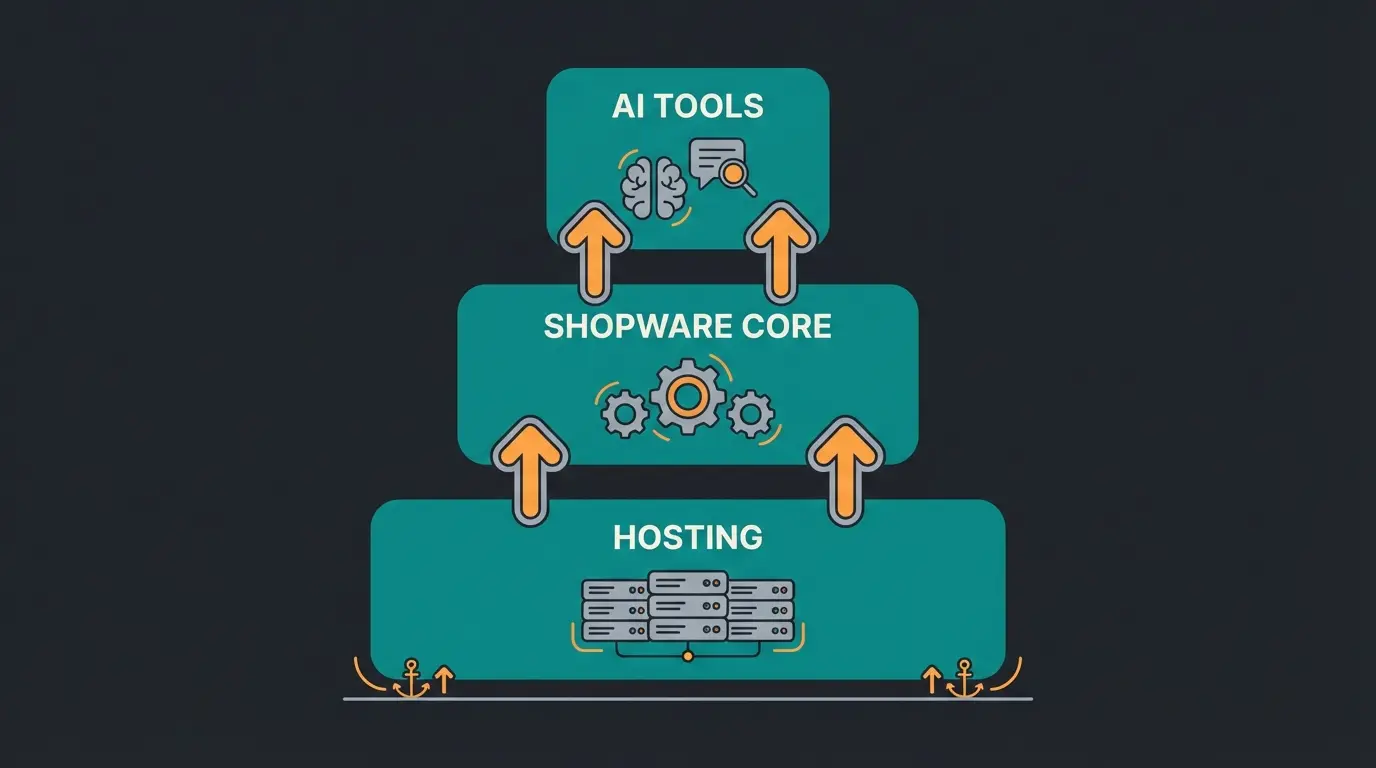
The Performance Stack Pyramid: Foundation Matters
Think of your e-commerce shop as a layered system where each tier depends on the one below it. Your AI product consultation capabilities are directly limited by your hosting foundation.
At the base sits your hosting infrastructure—the foundation that everything else rests upon. The middle layer is your Shopware Core with its configurations and plugins. At the top are your conversion tools, including AI consultation systems, personalization engines, and real-time recommendation systems.
When comparing platforms for AI readiness, the hosting infrastructure often becomes the deciding factor in which solution can actually deliver on AI promises.
Shopware 6 Hosting Price Comparison: Real Cost Analysis
Beyond the advertised monthly fees, the real cost structure includes several hidden elements that many comparison sites overlook. Understanding these helps evaluate whether platforms with better AI integration capabilities justify their higher infrastructure costs.
The Real Cost Calculator: Budget vs. Performance Host
| Cost Category | Cheap Host (€20/mo) | Performance Host (€120/mo) |
|---|---|---|
| Annual Hosting Cost | €240 | €1,440 |
| Redis/Elasticsearch Add-ons | Not Available | Included |
| Downtime During Peak Traffic | 5-10 hours/year | <1 hour/year |
| Lost Revenue from Slow Loading | €25,000-50,000/year | <€2,000/year |
| AI Tool Effectiveness | Unusable | Optimal |
| Support Response Time | 24-48 hours | 2-4 hours |
| Total True Annual Cost | €25,000+ | €3,500 |
The math is clear: saving €1,200 annually on hosting while losing €25,000+ in revenue and AI effectiveness represents a catastrophic false economy.
Frequently Asked Questions About Shopware Hosting Costs
For a revenue-generating shop in 2025, you should budget at least €50 per month. Anything below this threshold is technically underpowered for Shopware 6's requirements and will compromise performance, especially during traffic spikes or when running AI-powered features.
AI consultation tools require fast server response times (under 200ms) to feel responsive to users. When a customer asks an AI assistant a question, the tool must query your product database, process the request, and return results. Slow hosting adds seconds to this process, making even the smartest AI seem sluggish or unresponsive, causing customers to abandon the session.
Self-hosted solutions generally offer more flexibility for custom AI integrations. You can adjust server timeouts for longer AI processing, define custom caching rules for API routes, and have full access to logs for debugging. However, Shopware Cloud provides a worry-free managed experience if your AI requirements are standard.
Look for NVMe SSD storage, PHP 8.2 or higher, Redis for session caching, Elasticsearch for search performance, HTTP/2 or HTTP/3 support, configurable timeout settings, high concurrent connection capacity, and sub-200ms Time to First Byte (TTFB) guarantees.
Calculate Total Cost of Ownership (TCO) by adding monthly hosting fees, required add-ons (Redis, Elasticsearch), potential revenue loss from slow performance (typically 5-10% of annual sales for underperforming hosts), downtime costs during peak periods, and agency/maintenance costs. A €20/month host often costs €25,000+ annually when factoring in lost revenue.
Conclusion: Hosting Is Infrastructure, Not Commodity
The question of Shopware hosting costs in 2025 can no longer be answered with a simple number. Those who only look at price ignore the technological reality of modern e-commerce.
Summary of Recommendations
- Don't start under €50: Anything below this is technically underpowered for Shopware 6 and endangers your success.
- Pay attention to the tech stack: Redis and Elasticsearch are not "nice-to-haves" but mandatory for shops of a certain size.
- Think about AI: Your future tools (chatbots, personalization) are only as fast as your server. A slow server makes even the most intelligent AI useless.
- Choose specialists: Hosters like Timme, Maxcluster, or Profihost know Shopware inside and out. This support is worth its weight in gold when things go wrong.
Our advice: Invest in hosting that grows with you. A fast foundation is the best insurance against cart abandonment and the most important prerequisite for maximizing your conversion rate with AI tools.
Additional Resources
- Official Shopware System Requirements (Docs)
- Google PageSpeed Insights – Test your current shop performance
Once your hosting foundation is fast, upgrade your customer experience with intelligent product recommendations. Our AI consultant engages visitors, answers questions in real-time, and drives conversions.
Get Started Free TodayNote: The prices mentioned are snapshots (as of 2025) and may vary by provider and individual configuration. We always recommend obtaining a customized quote.

Kevin is CTO and co-founder of Qualimero. As an AI architect with over 15 years of experience as CTO and CPO in the tech industry, he designs the AI systems that automate tens of thousands of customer interactions daily for Qualimero's clients — reliably, securely, and at scale.