Introduction: Why 'Big vs Small' No Longer Cuts It
Anyone facing the choice between Shopware vs Gambio in 2025 reads the same conclusion in most comparisons: 'Choose Gambio if you're small and want to save money. Choose Shopware if you're big and have the budget.'
This rule of thumb isn't wrong—but it's outdated.
E-commerce has transformed fundamentally. It's no longer just about placing products on a digital shelf (transaction). It's about advising customers digitally as effectively as in a brick-and-mortar specialty store (interaction). In an era where Artificial Intelligence (AI) and automation determine success, we need to examine these two German market leaders through a new lens:
Which system enables not just selling, but intelligent consultation of your customers?
In this comprehensive comparison, we analyze Shopware 6 and Gambio GX4 not only by price and features, but by their future-readiness in an era where 'Consultation Capability' is the new competitive advantage. For businesses exploring how AI product consultation can transform their customer experience, understanding platform capabilities is crucial.
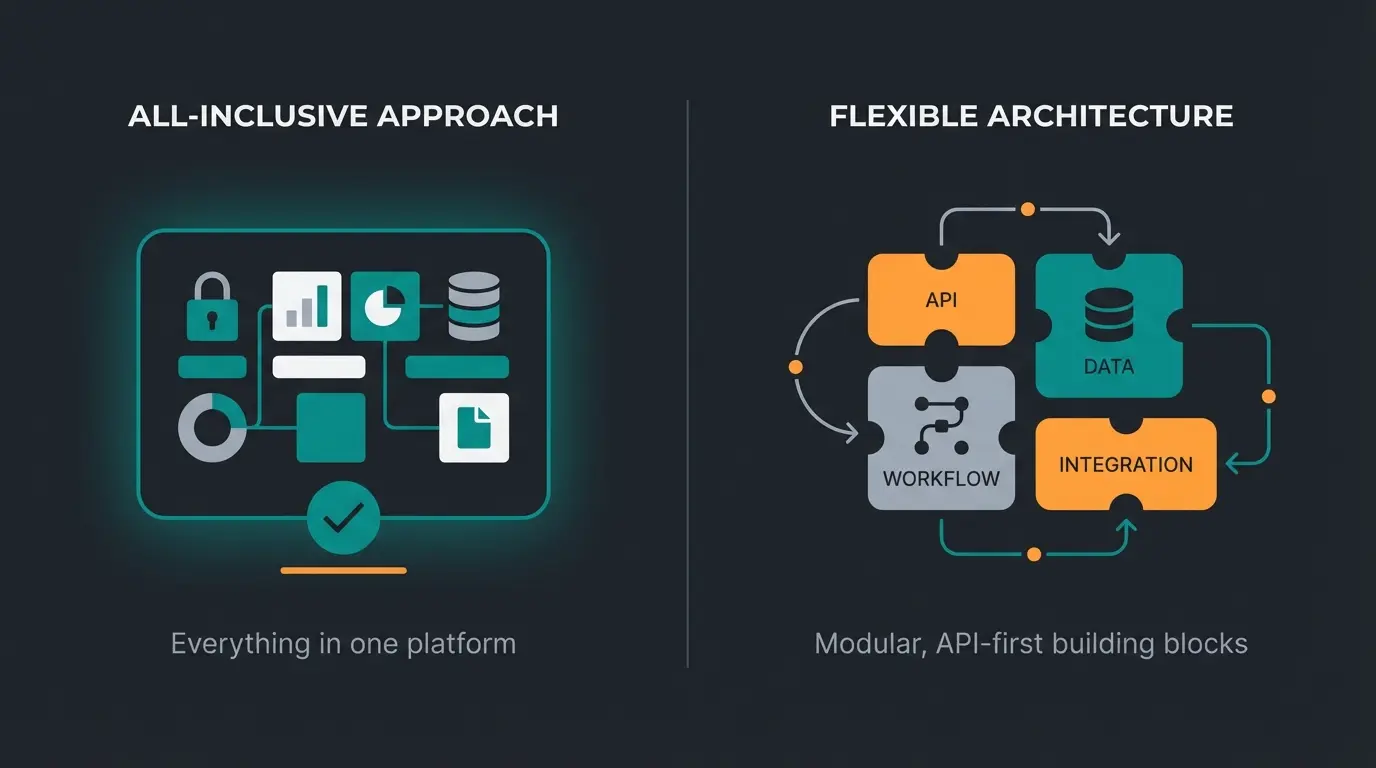
The Core Philosophy: All-Inclusive vs Architect's House
To understand why these systems function so differently, you must examine their DNA. Both are 'Made in Germany' and GDPR-compliant according to BrandCrock and webshop-anbieter.de, but this is often where the similarities end.
Gambio: The All-Inclusive Resort
Gambio is designed to make getting started as easy as possible for merchants. It's a monolithic system where everything comes 'out of the box.'
- The Advantage: You check in, the buffet is set up, the pool is full. You don't need to worry about technology. Legal texts, shipping modules (DHL, Hermes), and common payment methods are pre-installed as noted by compareyourtech.com.
- The Disadvantage: If you don't like the buffet or want a private pool on the roof, you have a problem. Deep system customizations are difficult because the architecture is less modular than modern enterprise solutions.
Shopware: The Architect's House
Shopware 6 follows an API-first approach. This means the system is modularly constructed. The frontend (what the customer sees) and the backend (administration) are technically decoupled (headless capability) as detailed by Shopware.
- The Advantage: You can move every wall. You can connect the system to any ERP, any AI, or any marketplace. It grows with you, no matter how complex your requirements become. This makes it ideal for Shopware AI powered implementations.
- The Disadvantage: You need an architect (developer/agency). Moving in takes longer and costs more according to LitExtension and Naturaily.
Detailed Comparison: Hard Facts for 2025
Before diving deep into AI integration, here's a direct comparison of the 'must-haves' for every online merchant.
Comparison Table: Shopware vs Gambio
| Feature | Gambio (Cloud & Self-Hosted) | Shopware 6 (Rise, Evolve, Beyond) |
|---|---|---|
| Target Audience | Beginners, SMBs, Solopreneurs | Mid-market, Enterprise, Scalers |
| Costs (License) | Affordable (approx. €25 - €130/month) | Premium (from €600/month for Rise) |
| Setup | Very easy (No-Code / Low-Code) | Complex (Often requires agency/devs) |
| Technology | Monolithic (PHP), stable but older | Modern (Symfony, Vue.js), API-First |
| B2B Functions | Basic (mostly via plugins) | Strong (Customer-specific prices, roles) |
| AI Integration | Basic (Widgets, texts via external tools) | Native 'AI Copilot' & deep API integration |
| Headless | No (or very limited) | Yes (Native architecture) |
| Support | Included in Cloud plans (DE/EN) | Included in commercial plans |
Costs and Pricing Models
This is often the first stumbling block when comparing Shopware vs Gambio.
Gambio: Scores with transparency. The Cloud plans ('Start-Up', 'Small Business', 'Professional') range between approximately €25 and €130 monthly in 2025 as reported by OMR and MerchantMachine. There are no hidden revenue shares. The Self-Hosted variant is extremely affordable (approximately €199 per year including support) according to Gambio.
Shopware: This is where it gets more complex.
- Community Edition: Free (Open Source), but you pay for hosting, maintenance, and often expensive plugins as noted by LitExtension.
- Commercial Plans: Start with 'Rise' at €600/month. 'Evolve' and 'Beyond' (for Enterprise) cost significantly more (€2,400 - €6,500+) and are often based on GMV (Gross Merchandise Volume) according to Shopware pricing.
Usability and Design
Gambio: With 'StyleEdit', Gambio offers a solid drag-and-drop tool. It's not the most modern on the market, but absolutely manageable for non-technical users. This extends to Shopware mobile optimization considerations where both platforms offer responsive templates.
Shopware: The 'Shopping Experiences' (Erlebniswelten) are powerful. You can build landing pages that merge content and commerce seamlessly. However, the learning curve is steeper.
Transparent cloud pricing with no hidden fees
Starting price for commercial plans
Annual cost including support
Open source but requires dev resources
The Missing Metric: Consultation Capability & AI
Here lies the actual difference for 2025. Most comparisons ignore this point, but it's crucial for your conversion rate and return rate. Understanding Conversational Commerce fundamentals helps frame this discussion.
Why Simple FAQ Bots Are Dead
Today's customers no longer want to click through 50 filters ('Color: Red', 'Size: L', 'Material: Cotton') only to see 20 products without knowing which one fits. They want an answer to the question: 'I'm looking for a bicycle part for my mountain bike that allows safe braking even in the rain.'
Gambio and AI: The Widget Solution
Gambio is a more closed system. AI integrations are often limited to:
- Text Generation: External tools write product descriptions that you copy in.
- Widgets: Tools like 'All in One Accessibility' (AI for accessibility) can be easily installed as overlays according to Skynet Technologies.
- Limitations: Since Gambio isn't 'API-First', it's harder to let an intelligent AI agent deeply interact with the shopping cart or customer history. An AI bot in Gambio is often just a 'layer' over the shop that doesn't really 'know' what the customer is currently viewing or has purchased.
Shopware and AI: Deep Integration & The AI Copilot
Shopware has natively integrated AI into its core, making it perfect for AI consulting e-commerce implementations.
1. Shopware AI Copilot (Backend): In 2025, Shopware already offers native features like AI-generated product descriptions, image keyword analysis, review summaries, and AI-based customer classification as documented by Qualimero, Folio3, and Atwix. This saves massive time in the admin area.
2. API-First for Frontend Agents (The Game Changer): Since Shopware is completely controllable via APIs (interfaces), you can connect external AI agents (like OpenAI-based custom bots) that can:
- Read the customer's shopping cart
- Add products to the cart based on a conversation
- Access order histories
- Provide personalized recommendations based on browsing behavior
This is why businesses exploring Shopware B2B B2C strategies find the platform's AI capabilities increasingly compelling for complex product catalogs.
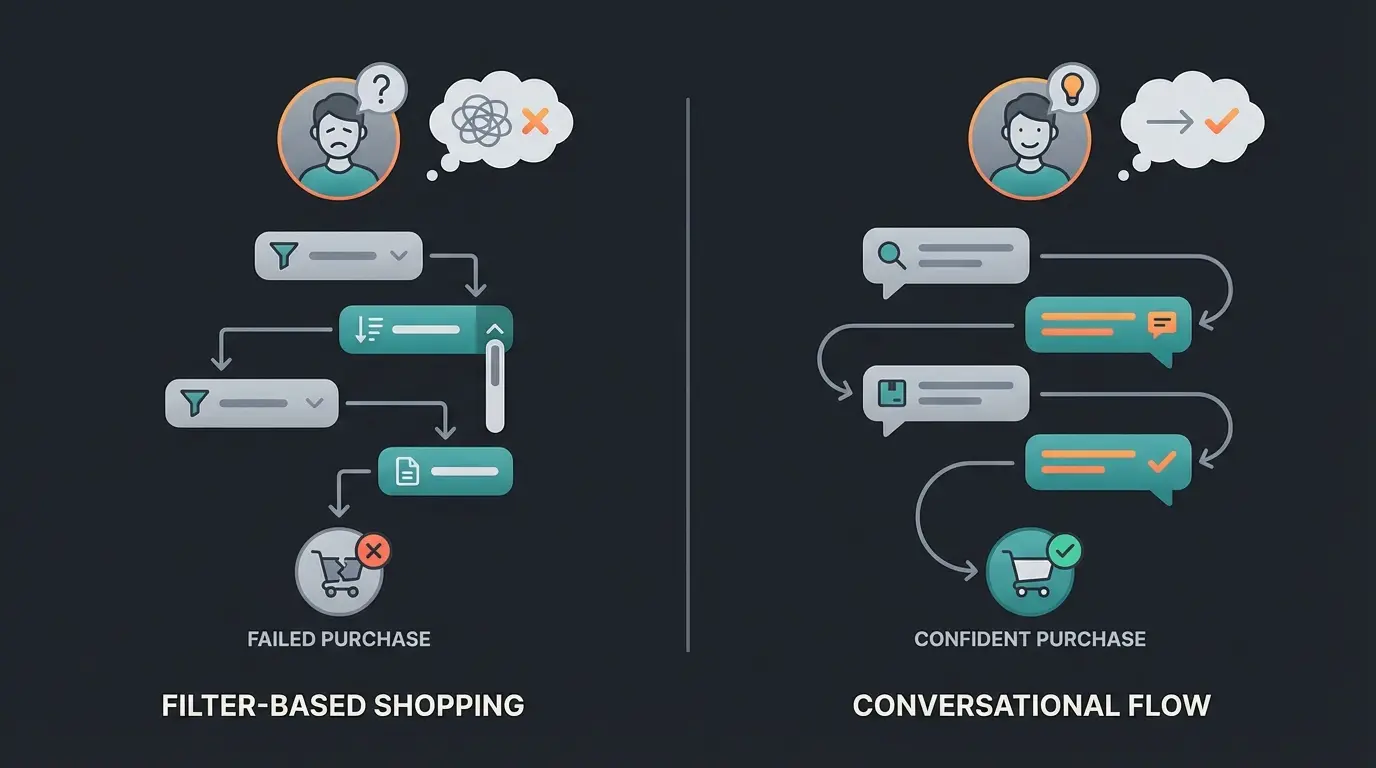
Static vs Conversational: The Customer Journey Revolution
The difference between traditional e-commerce and AI-enhanced shopping experiences deserves closer examination. This is where AI sales assistants truly shine.
User searches → Scrolls through results → Applies filters → Maybe buys → Returns product (wrong fit)
User asks question → AI advises based on needs → User buys confidently → No return needed
Shopware + AI enables the conversational journey through deep API integration, while Gambio is limited to the static approach
Key Insight: If you sell consultation-intensive products, Shopware offers the technological foundation through its architecture to drastically reduce returns through AI consultation. This represents a fundamental shift in how Shopware customer support functions.
Discover how AI-powered product consultation can reduce returns by up to 30% while increasing conversion rates. Our solution integrates seamlessly with Shopware's API-first architecture.
Start Your Free TrialB2B vs B2C: Where Product Consultation Matters Most
The distinction between Shopware and Gambio correlates strongly with your business model. This understanding is essential for conversational commerce AI strategy.
Gambio: The B2C Specialist for Commodities
If you sell t-shirts, decorative items, or standard electronics to end consumers, Gambio is often completely sufficient. The products usually explain themselves or only need good images. Gambio's B2B functions exist but are often only solvable through workarounds or plugins (e.g., customer group checks).
Shopware: The B2B Machine
In the B2B (Business-to-Business) sector, requirements are more complex:
- Individual prices per customer
- Approval processes (employee may only order up to €500)
- Quick order lists (CSV file uploads)
- Complex product configurations
- Multi-user account management
Shopware offers these functions natively in the 'Evolve' and 'Beyond' plans (B2B Suite). This makes it ideal for AI Selling B2B implementations.
The AI Factor in B2B: This is precisely where 'Consultation Capability' is enormous. A B2B buyer doesn't want to search—they want solutions. A Shopware system can be configured to act like a digital field sales representative, leveraging AI Chatbots transformation to handle complex inquiries.
Technical Flexibility & Future Proofing
A term that constantly appears with Shopware: Headless Commerce. But what does this mean for you as a merchant?
Imagine you want to sell your products not only in your online shop, but also:
- Through a smartwatch app
- Through a voice assistant (Alexa)
- In a 'Smart Mirror' in a retail store
- Directly through Instagram Shopping
- Via B2B customer portals
Shopware separates the database (backend) from the presentation (frontend). You can set up as many 'heads' (frontends) as you want, all accessing the same data foundation. That's 'Future Proofing.'
Gambio is monolithic. The frontend is firmly wired to the backend. Customizations are possible, but you're more strongly bound to the 'standard shop format'. For 90% of traditional merchants, this is sufficient—but those who want to be innovation drivers hit limitations.
Total Cost of Ownership: The Hidden Costs
Many merchants only compare monthly license costs. That's a naive calculation. We need to consider the Total Cost of Ownership over 3 years.
Sample Calculation (Estimate for a Growing Shop)
| Cost Item | Gambio (Cloud Professional) | Shopware (Rise + Agency) |
|---|---|---|
| License Costs (3 Years) | approx. €4,700 (at ~€130/month) | approx. €21,600 (at €600/month) |
| Setup / Design (Initial) | €0 - €2,000 (DIY/Freelancer) | €10,000 - €30,000 (Agency) |
| Maintenance / Updates | Included (Cloud) | Included (SaaS) / Expensive (Self-hosted) |
| Plugins / Extensions | Affordable (often one-time purchase) | Expensive (often subscription models) |
| 'Hidden Cost': Returns | High (with poor consultation) | Lower (through AI integration) |
| 'Hidden Cost': Personnel | Manual processes | Lower (through Flow Builder automation) |
Analysis: Shopware is massively more expensive in acquisition and operation (license).
BUT: If you save one support employee per month through Shopware's 'Flow Builder' (workflow automation) (approx. €3,500 costs) and reduce your return rate by 10%, Shopware pays for itself faster than Gambio from a certain revenue volume onwards.
Gambio is the cost winner for shops that 'just want to sell'. Shopware is the cost winner for shops that 'need to automate processes'.
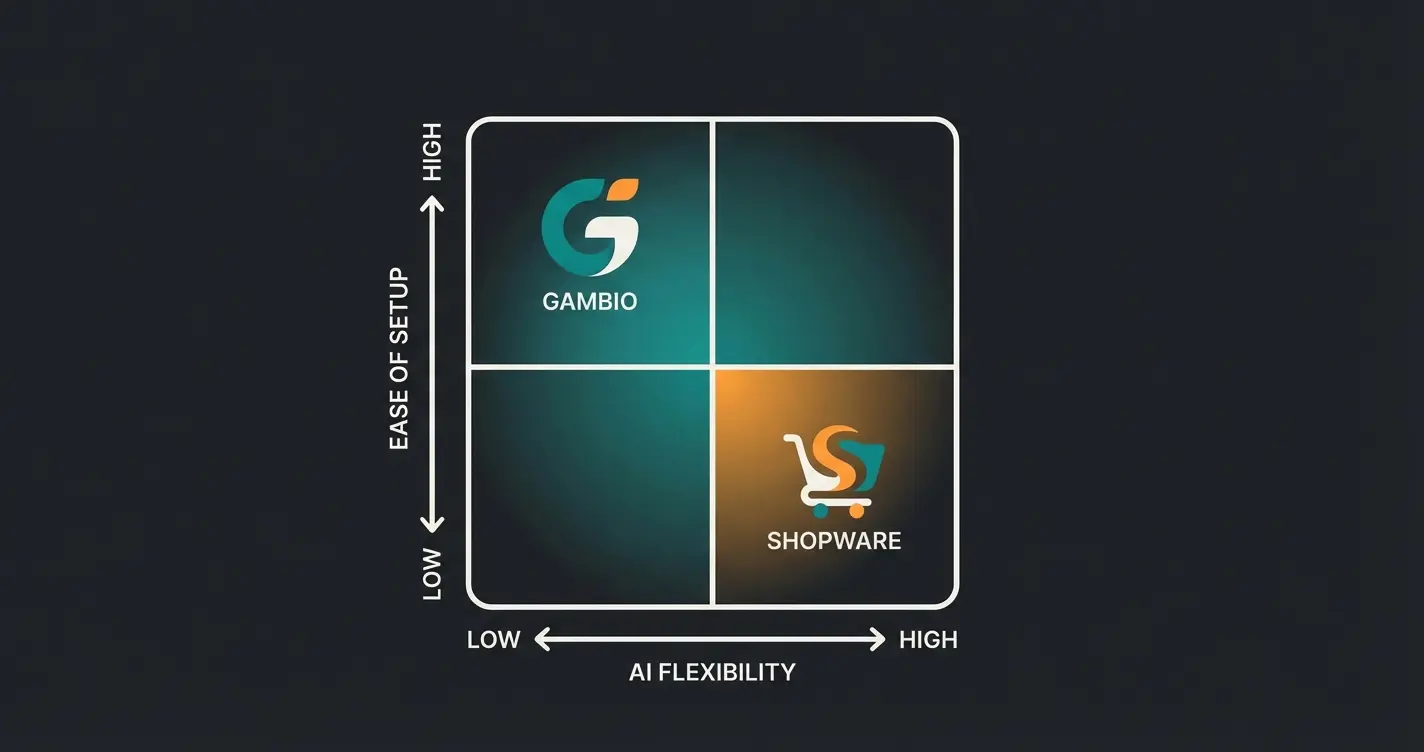
SEO and Marketing: Who Ranks Better?
Both systems offer solid SEO foundations (meta data, sitemaps, speaking URLs) according to BrandCrock SEO analysis.
Gambio: Solid home cooking. You can configure everything important (Title, Description, Alt-Tags). For deeper technical SEO measures (e.g., complex canonical logic for variants), you sometimes hit limits or need extensions.
Shopware: Offers extremely strong content marketing possibilities through Shopping Experiences. Since Google loves 'Helpful Content', the ability to seamlessly mix products and editorial content is an SEO advantage. Additionally, the technical SEO foundation (load times, code structure) in Shopware 6 is very modern according to Magecom.
Conclusion: Static vs Intelligent Commerce
The decision between Shopware and Gambio in 2025 isn't a question of 'Good or Bad', but of 'Fitting or Not Fitting' for your business model.
Choose Gambio If:
- You sell 'commodities': Your products don't need complex explanation (e.g., fashion, decor, standard food items).
- Your budget is limited: You want to start without major risk and without an agency.
- You're looking for 'all-inclusive' comfort: You don't want to worry about hosting, updates, or API interfaces.
- The German market is your focus: Gambio is perfectly tuned to German legal requirements and customs.
Choose Shopware If:
- You have consultation-intensive products: You want to use AI to actively guide customers and avoid returns.
- You want to scale (International/B2B): You need multiple currencies, languages, and complex B2B rules.
- You need automation: The 'Flow Builder' and 'AI Copilot' should take over manual work (data maintenance, emails).
- You're pursuing a 'best-of-breed' strategy: You want to connect the best CRM, the best PIM, and the best AI, requiring an open API architecture.
Frequently Asked Questions
For pure beginners with limited budgets and simple products, Gambio is typically better due to its all-inclusive approach, lower costs (€25-130/month), and easier setup without requiring technical expertise. However, if you plan to scale significantly or need advanced AI consultation capabilities, starting with Shopware Community Edition might be worth the steeper learning curve.
Yes, but with limitations. Gambio supports basic AI integrations through widgets and overlays, such as accessibility tools and text generation. However, deep AI integration that interacts with shopping carts, customer histories, and provides true conversational commerce is restricted by Gambio's monolithic architecture. For advanced AI product consultation, Shopware's API-first approach offers significantly more possibilities.
Beyond license fees, consider: agency/development costs (Shopware typically €10,000-30,000 initial setup vs. €0-2,000 for Gambio), plugin subscriptions (more expensive for Shopware), and crucially—return costs and personnel costs. Shopware's automation and AI capabilities can reduce returns and manual work, potentially offsetting higher initial costs for growing businesses.
It depends on your products and growth plans. If you sell simple commodities with low return rates and don't need complex automation, Gambio offers better value. However, if you sell consultation-intensive products, experience high return rates, or plan significant growth requiring B2B features and international expansion, Shopware's TCO can actually be lower when factoring in saved returns and automated processes.
Shopware is significantly stronger for B2B e-commerce. It offers native features like customer-specific pricing, approval workflows, quick order lists (CSV uploads), and the B2B Suite in Evolve/Beyond plans. Gambio can handle basic B2B through plugins and workarounds, but lacks the deep B2B functionality that complex business-to-business operations require.
Whether you choose Shopware or Gambio, intelligent product consultation can transform your customer experience. See how our AI solution integrates with your platform to reduce returns and increase conversions.
Get Started Today
Lasse is CEO and co-founder of Qualimero. After completing his MBA at WHU and scaling a company to seven-figure revenue, he founded Qualimero to build AI-powered digital employees for e-commerce. His focus: helping businesses measurably improve customer interaction through intelligent automation.