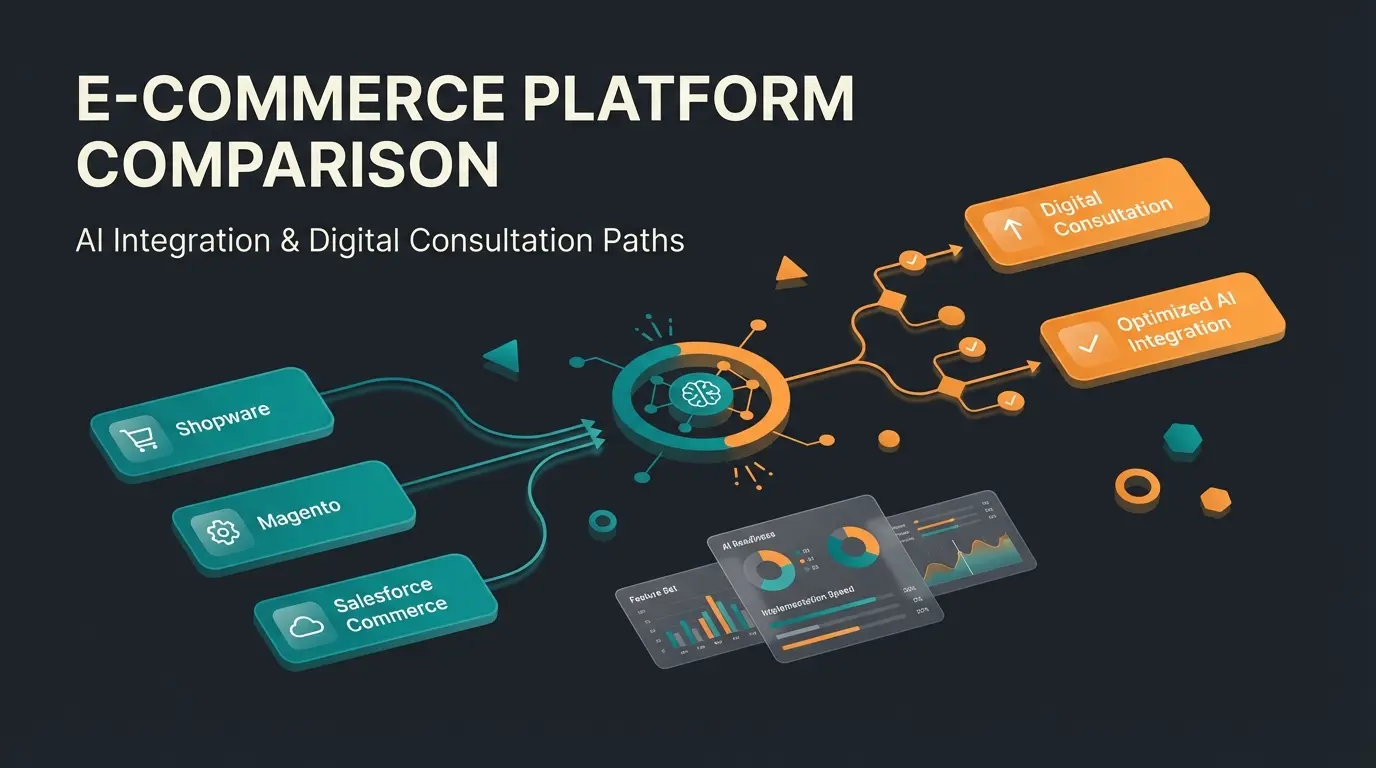
Is WooCommerce Still Relevant in 2025?
Is WooCommerce still the right choice? This question is on the minds of more and more shop owners in 2025. For years, this WordPress plugin was the undisputed standard for entering e-commerce: free, flexible, and seemingly infinitely expandable. But the reality looks quite different for many retailers today.
The "maintenance nightmare," security vulnerabilities from outdated plugins, complex adaptations for German legal requirements (GDPR, GoBD), and declining performance with growing product catalogs are driving shop owners to search for a WooCommerce alternative. According to coding9.de, the transition costs and ongoing maintenance burden make WooCommerce increasingly less attractive for serious merchants.
On top of this comes a massive technological shift: the classic online shop functioning as a "static catalog" is dying out. In 2025, customers no longer expect endless filter lists but rather interactive consultation and AI-powered shopping experiences. Understanding the different types of chatbots available today is essential for modern e-commerce success.
In this comprehensive guide, we analyze the best alternatives to WooCommerce for the German market. We examine not only prices and features but scrutinize providers regarding legal compliance, performance, and their ability to deliver conversational commerce (AI consultation). If you're also exploring options beyond other platforms, our comparison of Shopware vs WooCommerce provides additional valuable insights.
Decision Guide: What Really Matters in Germany 2025?
Before we look at the individual tools, we need to define the benchmark. Anyone switching from WooCommerce today shouldn't make the mistake of jumping "out of the frying pan into the fire." A modern WordPress WooCommerce alternative must serve three critical pillars:
1. The "German Angst": Legal Compliance (GDPR & GoBD)
A US shop system might look sleek, but when the legal warning letter arrives due to a missing "purchase button solution," incorrect tax calculation, or illegal server location, the fun is over. As noted by lass-machen.me, many international platforms require significant customization for German legal compliance.
- The Problem: Many international WooCommerce alternatives (like Squarespace or BigCommerce) are not legally compliant "out of the box" in Germany.
- The Requirement: The system must be GDPR-compliant (server location, data processing agreements), create GoBD-compliant invoices, and master specific German consumer protection guidelines (withdrawal rights, base prices).
2. Performance & Core Web Vitals
Google mercilessly penalizes slow shops. WooCommerce shops often suffer from "plugin bloat" – too many extensions make the site slow. Research from mstage.at confirms that page load speed directly impacts conversion rates.
The Requirement: A modern alternative must guarantee fast loading times (under 2.5 seconds LCP) without requiring you to pay an expensive developer for caching optimization. For shops already managing WooCommerce email templates, you know how complex even basic customizations can become.
3. From Catalog to Consultation (The AI Factor)
This is the most important trend for 2025. Customers don't want to search; they want to find. Understanding AI product consultation is becoming essential for competitive advantage.
- The Problem: Most shop systems are just digital inventory lists.
- The Opportunity: The best alternative to WooCommerce is the one that sells your products rather than just displaying them. This is where AI solutions come into play, functioning as automated sales consultants.
Shop owners spend excessive time on updates and security patches
Struggle with GDPR and GoBD requirements using international platforms
Maximum acceptable loading time for optimal Core Web Vitals score
Caused by lack of product guidance and consultation
Category A: The "Worry-Free" Solutions (Hosted SaaS)
These systems are ideal for retailers who no longer want to worry about updates, servers, and security. You rent the software (SaaS = Software as a Service). For those exploring broader options, our guide to Shopify alternatives 2025 offers additional perspectives on the hosted solution landscape.
1. Shopify: The Market Leader with Pros and Cons
Shopify is the world's most popular WooCommerce alternative. It impresses with extreme user-friendliness and a huge app ecosystem. Their approach to AI prevention strategies for returns management shows how major platforms are embracing intelligent automation.
Who it's for: Beginners through to rapidly growing brands (D2C).
Pricing 2025:
- Basic: approx. €36/month (plus transaction fees)
- Shopify: approx. €105/month
- Advanced: approx. €384/month
- Caution: If you don't use "Shopify Payments," additional fees (up to 2%) apply to all revenue.
Advantages:
- No maintenance: Shopify handles hosting, security, and updates.
- Performance: Extremely fast servers and CDNs.
- Ecosystem: Thousands of apps for marketing and sales.
2. Wix Stores: The Visual Builder
Wix has evolved from a pure website builder to a serious e-commerce solution. According to trusted.de, it's particularly popular among creative businesses and smaller shops.
Who it's for: Small shops, artists, "side hustles" with few products.
Pricing 2025:
- Core: approx. €29/month
- Business: approx. €40/month
Advantages:
- Design freedom: The drag-and-drop editor is unmatched.
- Simplicity: Everything is integrated (appointment booking, shop, blog).
Disadvantages:
- Scalability: From about 50-100 products, the backend becomes cluttered.
- AI limitation: Wix uses AI for creating the website (Wix ADI), but hardly for active sales consultation in the shop.
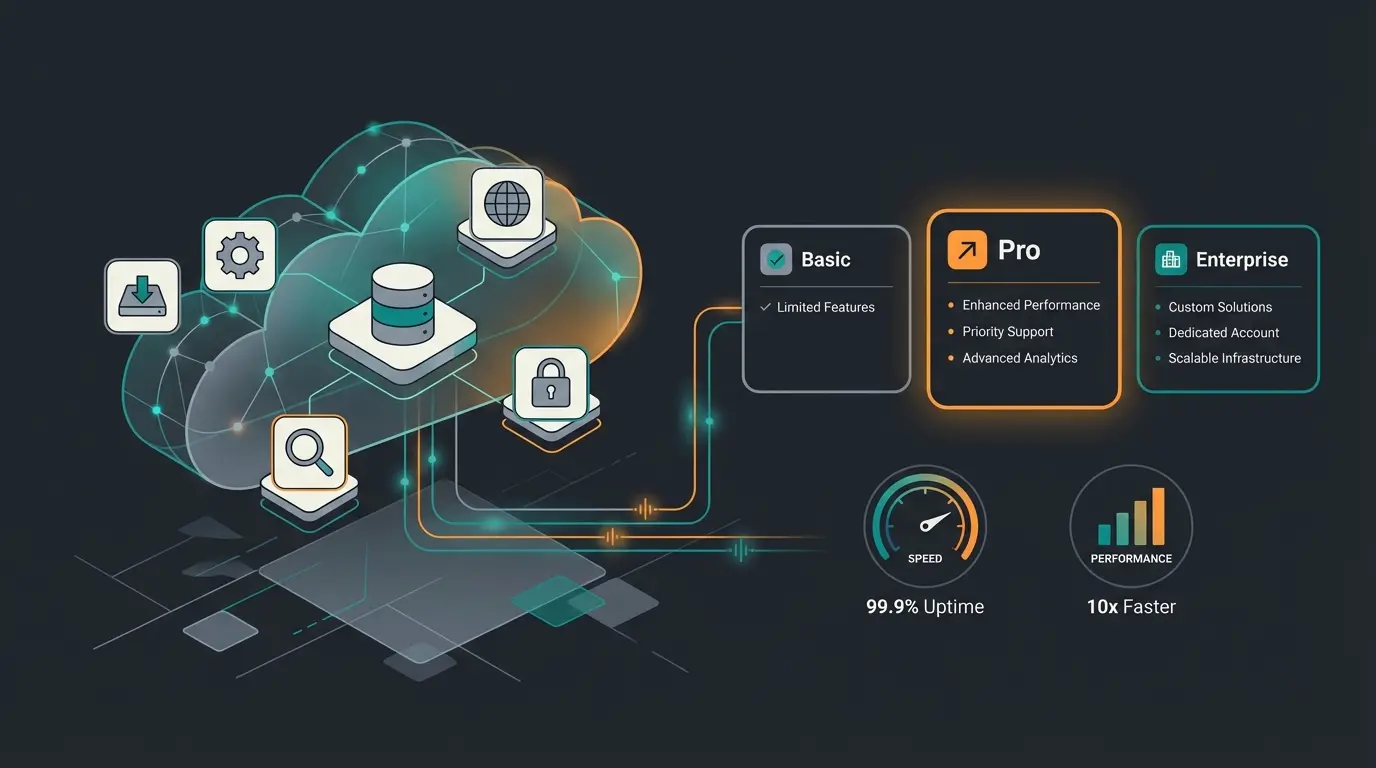
Category B: The "German Native" Solutions (Compliance Kings)
If you want to sleep peacefully at night and focus on the DACH market, you often reach for software "Made in Germany." These providers have German legal requirements in their DNA. Our comprehensive analysis of Shopware alternatives provides additional context for this category.
3. Shopware 6: The Gold Standard (With New Rules 2025)
Shopware is arguably the most powerful alternative to WooCommerce for the German mid-market. It's extremely flexible and built "API-First." According to shopware.com, the platform continues to see strong adoption in the German-speaking market.
Pricing:
- Community Edition: €0 (Self-hosted, no manufacturer support)
- Rise: from €600/month as confirmed by tikal.de
- Evolve/Beyond: On request (Enterprise level)
Advantages:
- Legal compliance: 100% designed for German law.
- B2B functions: Excellently suited for complex B2B scenarios (customer groups, price lists).
- Scalability: Grows seamlessly to corporate revenue levels.
Disadvantages:
- Complexity: Not for complete beginners. Setup often requires an agency.
- Costs: The jump from the free version to the "Rise" plan (€600/month) is steep, as noted by hexamain.de.
4. JTL-Shop: The ERP Powerhouse
JTL originally comes from inventory management (JTL-Wawi). The shop is essentially the "storefront" for the ERP system. According to uptain.de, it's particularly strong for multi-channel sellers.
Who it's for: Retailers who want to centrally manage marketplaces (Amazon, eBay) and their own shop.
Pricing 2025:
- Community Free: Free (up to 500 items)
- Standard: Often included in "JTL Editions" (e.g., Advanced from €99/month) or separately approx. €499/year (note subscription model)
Advantages:
- Process efficiency: The synchronization between warehouse, accounting, and shop is perfect.
- Value: Very fair price-performance ratio for the feature set.
Disadvantages:
- Design: The standard templates often appear somewhat "technical" and less emotional than Shopify.
- Dependency: You commit strongly to the JTL ecosystem (Wawi is mandatory).
5. Gambio: The Price-Performance Champion
Gambio is the "Volkswagen" among German shop systems: Solid, reliable, not necessarily exciting, but it runs. As detailed by omr.com, it's a reliable choice for budget-conscious German merchants.
Who it's for: Small to medium retailers looking for an affordable, legally compliant cloud solution.
Pricing 2025:
- Start-Up: approx. €25/month
- Small Business: approx. €65/month according to gambio.com
Advantages:
- Legal texts included: Interfaces to IT-Recht Kanzlei or Händlerbund are often deeply integrated.
- Cloud: Hosting in Germany included.
Disadvantages:
- Technology: Appears somewhat dated in backend and frontend compared to Shopware or Shopify.
- Flexibility: Fewer customization options for individual designs.
Shopware, Gambio, JTL - Built for German law from the ground up
Shopify - Requires apps and legal review for full GDPR/GoBD compliance
Wix - Possible but requires substantial customization and expert help
Squarespace, BigCommerce - Extremely difficult to make legally compliant in Germany
Stop losing customers to catalog confusion. Our AI solution turns passive product browsing into active sales conversations, increasing conversions while reducing returns.
Start Your Free TrialCategory C: Specialists & The AI Revolution
Here we close the gap that the big providers often leave open: specialized applications and the future of automated consultation. The rise of AI chatbots in customer service is transforming how online shops interact with customers.
6. Easy Digital Downloads (EDD)
If you only sell digital products (e-books, software, files), WooCommerce is often "overkill." EDD is a lean WordPress alternative.
- Advantage: Specialized in license keys and downloads.
- Disadvantage: Only suitable for digital goods.
7. AI-Powered Solutions: The Era of Consultation-First Commerce
The WooCommerce alternatives mentioned so far have one thing in common: they optimize the management and display of products. But they don't solve the core problem of online retail: The missing consultation.
Customers don't leave shops because they can't find the product, but because they're unsure which one is right. This is where AI sales agents are revolutionizing the shopping experience.
Why AI-Powered Solutions Are a True Alternative:
Instead of merely replacing WooCommerce with another "catalog system," AI-powered consultation tools transform your shop into an active sales floor. For businesses already using WooCommerce Lexoffice integration, adding AI consultation creates a powerful combination of backend efficiency and frontend sales power.
- The Concept: Away from static filters ("Color: Red", "Size: L"), toward dialogue ("I'm looking for an outfit for a summer wedding that won't be too warm").
- The Technology: True AI integration that doesn't just write texts (like Wix/Shopify), but acts as a Sales Agent. It analyzes customer needs in real-time and suggests perfectly matched products.
- The Added Value: Higher conversion through trust-building consultation, fewer returns because customers buy the right product, and 24/7 availability – your best salesperson is always online.
While Shopware and Shopify work on infrastructure, AI consultation solutions work on revenue. They can often even be used complementarily to systems like Shopify or Shopware, but represent the real "alternative" to passively waiting for orders. Our guide on AI product consultation for Shopify shows how these technologies integrate with existing platforms.
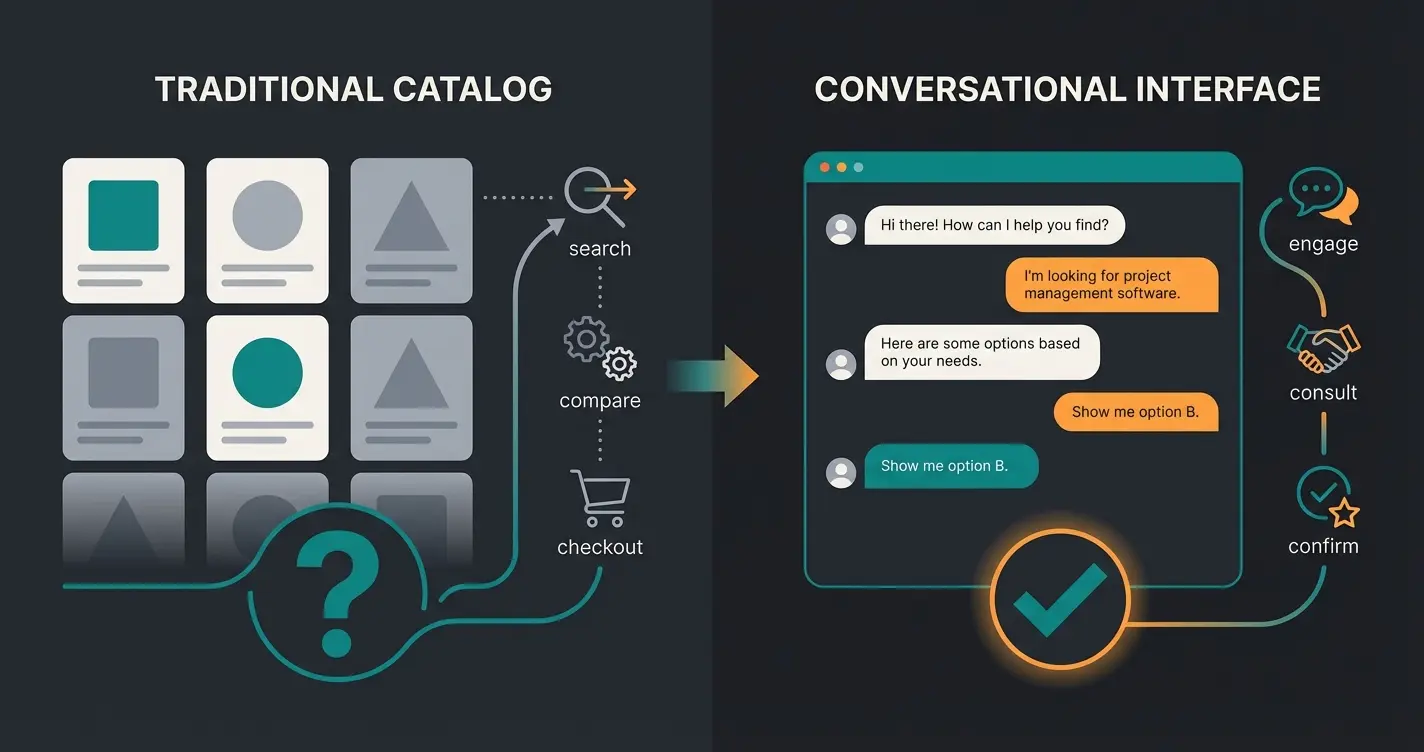
Deep Dive: Why the "Catalog Shop" Is Dying
The analysis of search results and market trends for 2025 shows clearly: the market is splitting.
- Commodity Shops: Those who sell only on price (like Amazon) need maximum efficiency (JTL, Shopware).
- Consultation Shops: Those who sell on quality, niche, and expertise lose customers with a standard WooCommerce shop.
The Problem of the "Filter Desert"
Imagine you enter a wine shop.
Scenario A (WooCommerce/Standard): Nobody speaks to you. You stand in front of a shelf with 500 bottles. Signs only say "Red Wine" or "France." You're overwhelmed and leave.
Scenario B (Consultation Commerce): An expert approaches you: "What are you cooking tonight?" – "Game." – "Then I recommend this Primitivo, it's robust enough." – Sold.
Most WooCommerce alternatives only offer Scenario A in "prettier" or "faster" versions. Only specialized AI solutions offer Scenario B. If you're switching in 2025, ask yourself: Do I just want to change software, or do I want to improve my sales model?
For print-on-demand businesses specifically, our WooCommerce print on demand guide explores how AI automation can transform product customization workflows.
Traditional filter approach overwhelms customers with too many choices
AI consultation narrows down to exactly what the customer needs
Shops with AI consultation convert significantly more visitors
Customers who receive guidance buy the right product first time
The Complete Comparison: WooCommerce Alternatives 2025
Here you can see at a glance which system meets your requirements.
| Feature | WooCommerce | Shopify | Shopware 6 | Gambio | AI Consultation |
|---|---|---|---|---|---|
| Type | Open Source (Plugin) | SaaS (Cloud) | Open Source / SaaS | SaaS (Cloud) | AI Sales Solution |
| Starting Cost | Free (but hosting/plugins expensive) | ~€36/month + fees | €0 (<€1M GMV) or €600 | ~€25/month | Varies by provider |
| Setup | Complex (technical knowledge required) | Very Easy | Medium to Complex | Easy | Very Easy |
| Legal Compliance (DE) | Only with plugins & effort | Good (with adaptations) | Excellent (Native) | Excellent (Native) | N/A (Add-on) |
| Maintenance Effort | Very High (updates, backups) | Minimal | Medium (self-hosted) | Minimal | Minimal |
| AI Consultation | No (only via plugins) | Basic (texts/magic) | Basic (AI Copilot) | No | Core Feature |
| Best For... | Tinkerers & WordPress fans | Quick starters & D2C | Mid-market & B2B | Budget-conscious DE retailers | Conversion & Consultation |
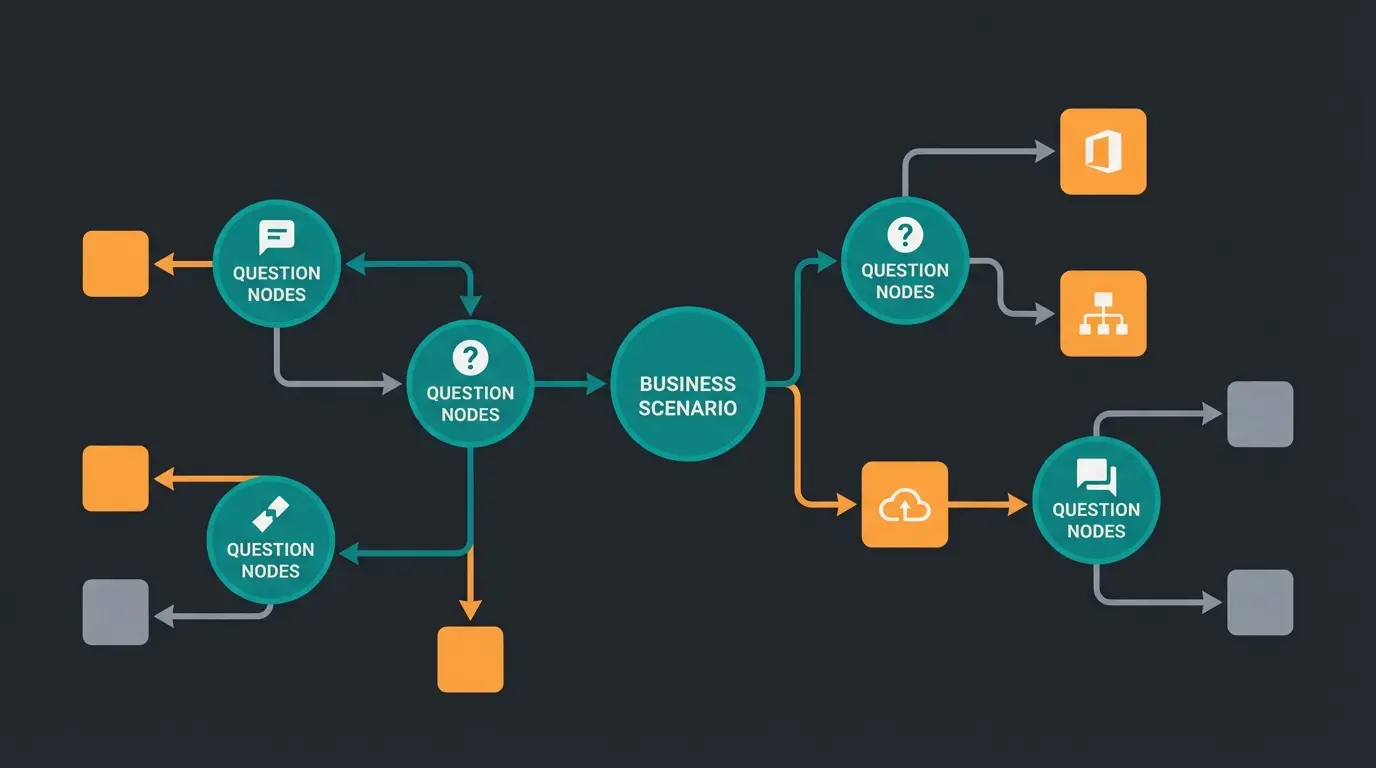
Decision Flowchart: Which Alternative Fits You?
Choosing the right WooCommerce alternative depends on your specific situation. Use this decision framework to find your ideal solution:
- Do you have more than 5,000 products? → Consider Shopware 6 or JTL-Shop for their robust catalog management
- Do you sell only digital products? → Easy Digital Downloads is your specialized solution
- Is German legal compliance your top priority? → Look at Gambio or Shopware for native DACH compliance
- Do your products require explanation or consultation? → Add an AI consultation layer to any platform
- Do you want minimal technical maintenance? → Choose hosted solutions like Shopify or Gambio
- Are you planning rapid international expansion? → Shopify offers the broadest global infrastructure
Conclusion: Which Alternative Fits Your Business?
Switching from WooCommerce is a significant step. There is no universally "best" alternative to WooCommerce – only the best one for your specific situation:
- You want peace from technology and a quick start? Go with Shopify. It's the most robust solution, even if you need to look closely at GDPR once.
- You're a German SME, B2B retailer, or planning >€1M revenue? Shopware 6 is your system. It's future-proof, modular, and "Made in Germany." But note the new license costs from 2025.
- You're looking for an affordable, legally compliant "all-inclusive" solution? Gambio is the solid partner that has your back without winning design awards.
- You want to not just manage, but *sell better*? Then switching shop systems alone might not be enough. Complement your strategy with AI consultation solutions. In a world where products are interchangeable, consultation is your only real competitive advantage.
FAQ: Common Questions About WooCommerce Alternatives
Yes, but not "just like that." You need to ensure the privacy policy fits, data processing agreements are concluded, and ideally no unnecessary data flows to US servers. Many retailers use specialized agencies or apps for this. The platform can be made compliant, but it requires conscious effort and often additional tools.
When you honestly factor in WooCommerce's hosting and maintenance costs, Gambio (from approx. €25) is often cheaper, as hosting, support, and legal texts are already included. The "free" nature of WooCommerce is deceptive once you add quality hosting, security plugins, and legal compliance tools.
Yes, all major providers (Shopify, Shopware, JTL) offer migration tools to import products, customers, and orders. This is often the easiest part of the switch. Most platforms provide step-by-step migration guides, and many agencies specialize in WooCommerce migrations.
The requirements for performance (Core Web Vitals) and security are constantly increasing. WooCommerce installations that have been "plastered" with plugins over the years are increasingly becoming security risks and performance bottlenecks. A modern SaaS approach solves these problems permanently and lets you focus on selling rather than maintaining.
Yes, modern AI consultation solutions typically work as add-ons that integrate with various platforms including Shopify, Shopware, and even existing WooCommerce installations. This means you can upgrade your sales capabilities without necessarily changing your entire shop system – though combining a modern platform with AI consultation delivers the best results.
Whether you're switching platforms or enhancing your current shop, AI-powered product consultation is the competitive advantage you need in 2025. Join forward-thinking retailers who are turning browsers into buyers.
Get Started Today
Lasse is CEO and co-founder of Qualimero. After completing his MBA at WHU and scaling a company to seven-figure revenue, he founded Qualimero to build AI-powered digital employees for e-commerce. His focus: helping businesses measurably improve customer interaction through intelligent automation.