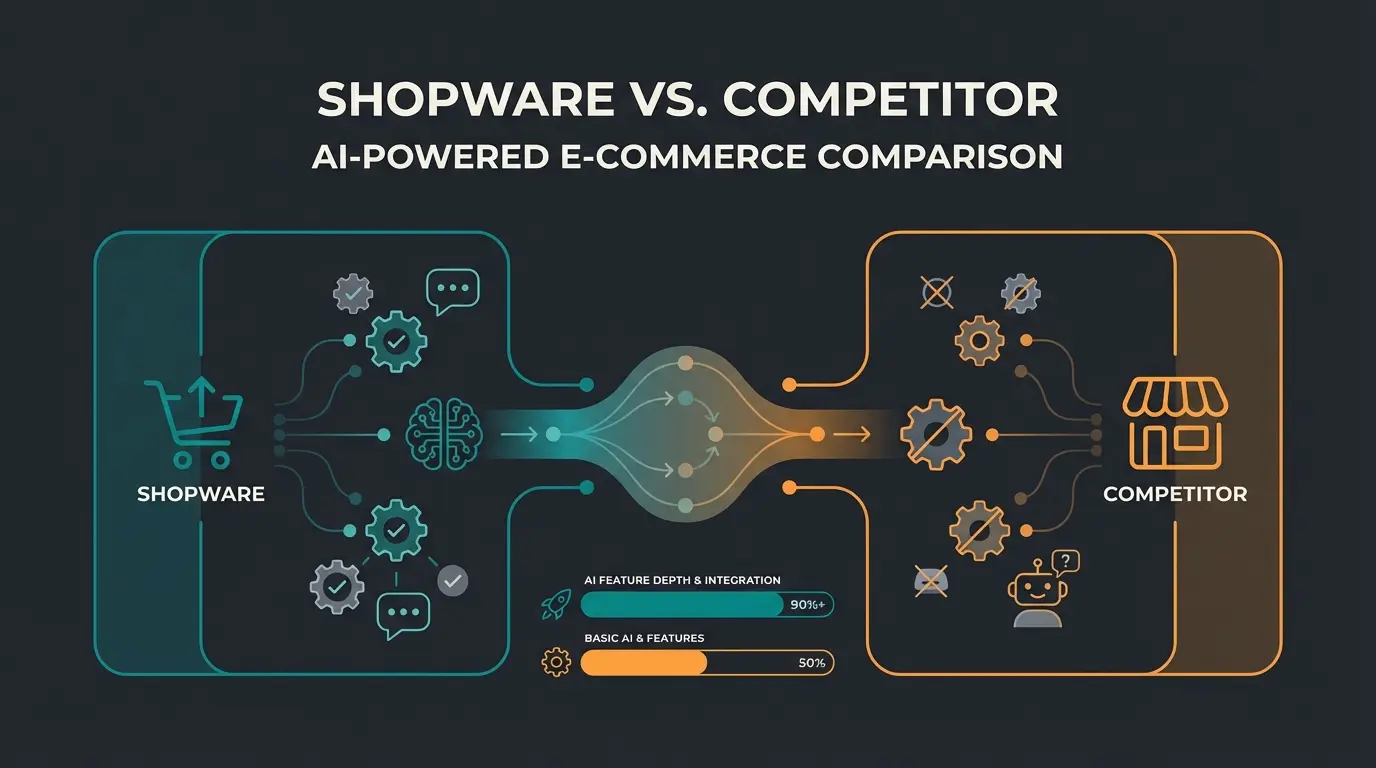
Introduction: From Vending Machine to Digital Advisor
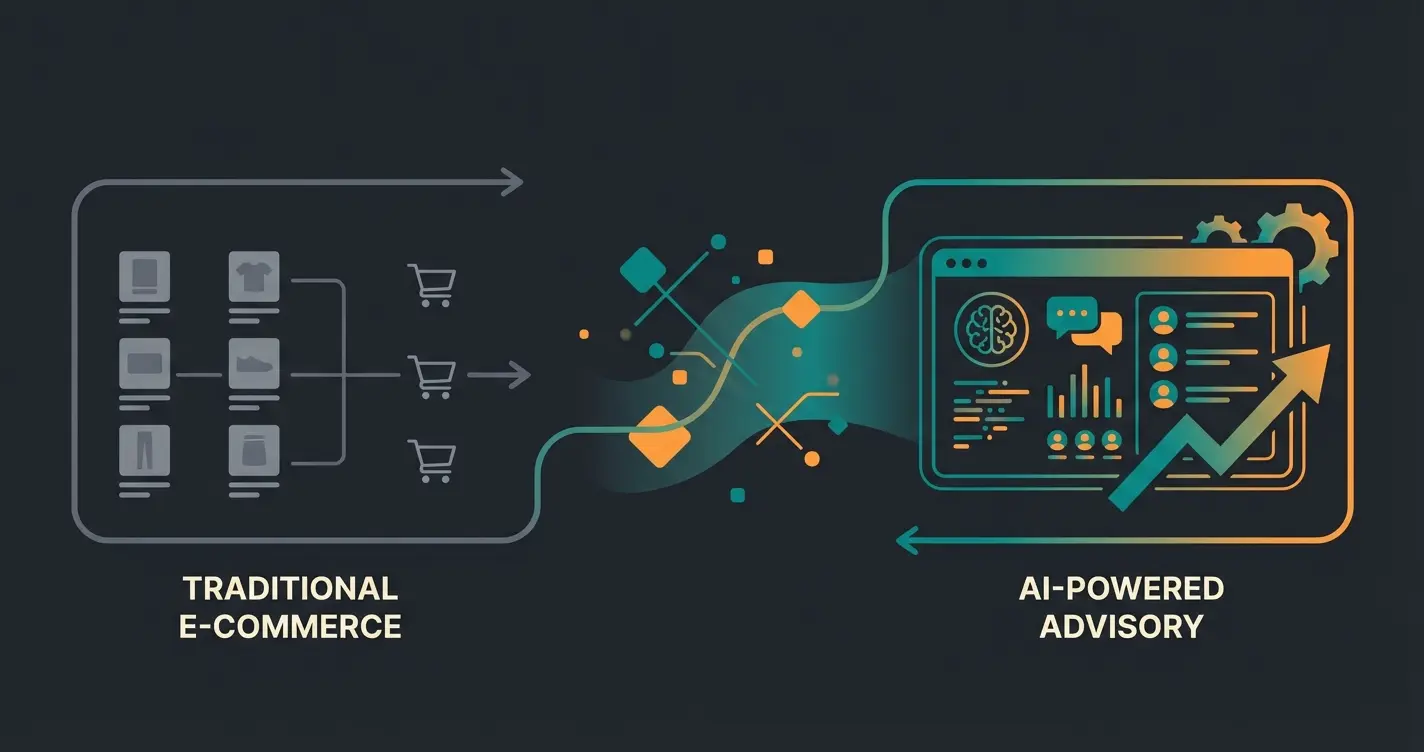
E-commerce stands at a massive turning point in 2025. For years, the mantra was: "Buy traffic, list products, optimize checkout." But the rules of the game have changed. Today's customers no longer expect just a digital inventory list—they want genuine consultation, similar to what they'd receive in a specialist brick-and-mortar store, but with the speed of the internet.
Anyone searching for a Shopware comparison today typically faces two complex questions: First, the system decision—is Shopware 6 even the right platform compared to giants like Shopify or Magento? Second, the edition choice—is the (formerly) free Community Edition sufficient, or do the new 2025 licensing models (Fair Usage Policy) force an upgrade to Rise, Evolve, or Beyond? For more details, see our Shopware 5 vs 6 comparison.
This article is not a superficial feature comparison. We analyze Shopware from the perspective of Total Cost of Ownership (TCO), data sovereignty (a critical factor for German SMEs), and—this is our unique focus—AI readiness. Because the best shop system is worthless if, in the age of artificial intelligence, it merely functions as a dumb backend instead of actively selling. For a detailed breakdown of each tier, check out our Shopware editions comparison.
Quick Decision Matrix: Shopware vs Competitors
For those in a hurry: This matrix summarizes the strategic positioning of the major e-commerce systems. Pay particular attention to the "AI Consultation Potential" column, which is often missing in standard comparisons. Understanding the full Shopware TCO in 2025 is essential for making an informed decision.
| Criterion | Shopware 6 (Self-Hosted/PaaS) | Shopify (SaaS) | Magento / Adobe Commerce |
|---|---|---|---|
| Target Group | Ambitious SMEs, B2B, D2C brands focused on individuality | Startups, D2C brands with standard products, dropshipping | Global corporations with large IT departments |
| Maintenance Effort | Medium (updates needed, but automatable via PaaS) | Low (fully-managed hosting) | Very High (complex architecture) |
| Data Protection (GDPR) | Excellent (German server location selectable, full data control) | Good (but US corporation, data transfer often debated) | Good (self-hosted), but complex to secure |
| B2B Focus | Strong (native B2B components, individual price lists) | Medium (B2B only good in "Plus", often requires apps) | Strong (but extremely expensive to implement) |
| AI Readiness (Backend) | High (AI Copilot for text/images natively integrated) | High (Shopify Magic/Sidekick) | Medium (Sensei AI available, but slow) |
| AI Consultation Potential (Frontend) | Very High (API-first allows deep integration of external sales AI) | Medium (closed ecosystem limits external data usage) | High (but API often slow/complex) |
| Cost Drivers | Initial setup & development | Transaction fees & app subscriptions (increase with revenue) | License costs & developer hourly rates |
Shopware Editions Compared: The 2025 Model
The days when you simply "bought" Shopware are over. Shopware has completely converted its model to subscriptions. Particularly significant in 2025 is the introduction of the Fair Usage Policy for the Community Edition.
The Fair Usage Policy 2025: End of Free Scaling?
For a long time, the Community Edition (CE) was the insider tip: start for free and scale without limits. That has changed. Since March 2025, a revenue threshold (GMV - Gross Merchandise Volume) applies. According to eazycode.de, shops exceeding €1 million GMV per year must switch to a paid plan (Rise, Evolve, Beyond) to maintain access to the Shopware Store (plugins) and account support.
The CE remains open source, but for professionally growing companies, it's effectively no longer a permanent solution without a commercial contract. This is confirmed by Shopware's official documentation.
Detailed Editions Comparison
Here we analyze what you get for your money and why you need it. Understanding Shopware hosting costs is crucial for accurate budgeting.
1. Shopware Rise (The B2C Standard)
Price: Starting at approximately €600/month. Target Group: Professional B2C shops that have outgrown the tinkering phase. According to Qualimero's analysis and erock-marketing.de, this tier offers the best value for growing businesses.
- Flow Builder & Rule Builder (Extended): In the CE, these tools are basic. In Rise, you can build complex automations (e.g., "If customer buys from category X AND has VIP status -> Send webhook to CRM")
- Shopware AI Copilot: Access to native AI features like text generation, image keywords, and review summaries as noted by Atwix
- Support: Direct manufacturer support (response time < 8h), which is worth its weight in gold in emergencies according to Tikal.de
2. Shopware Evolve (The B2B Gamechanger)
Price: Starting at approximately €2,400/month (revenue-dependent). Target Group: B2B companies and rapidly growing retailers. Understanding how to build a Shopware B2B customer portal is essential for maximizing this edition's value.
The killer feature here is the B2B Components. Previously, there was the "B2B Suite" (a monolithic plugin). Today, there are modular, API-first B2B Components as detailed by into-commerce.de and Shopware's official B2B documentation.
- Quick Orders: Streamlined ordering for repeat B2B customers
- Rights & Role Management: Control which customer employees can order what
- Quote Management: Professional proposal workflows as shown on YouTube tutorials
- Budget Approvals: Multi-level approval processes for purchases according to Shopware B2B features
These functions are essential for B2B companies wanting to sell digitally instead of via fax or phone.
3. Shopware Beyond (Enterprise Power)
Price: Starting at approximately €6,500/month. Target Group: Market leaders and complex corporations.
- Multi-Inventory: Management of different warehouse locations directly in the core (e.g., US warehouse vs. German warehouse)
- Digital Sales Rooms (DSR): An interactive tool for video consultation and co-browsing. A sales representative can guide customers live through the shop, as documented in Shopware's DSR overview and additional DSR documentation
- 24/7 Support: Maximum security for high-traffic events
Most popular choice for professional B2C shops
Dominant in B2B segment for modular features
Startups and sub-€1M GMV businesses
Large corporations with complex requirements
Shopware vs The Market Leaders: System Comparison
Once the edition is clarified, the question remains: Why Shopware at all, and not the international competition? For a deep dive into the most common comparison, see our Shopware vs Shopify analysis.
Shopware vs Shopify: The Battle of Philosophies
This is the most common comparison in Germany, as noted by Digitalsprung.de and eshop-guide.de.
Shopify (The "Worry-Free" Package): The advantage is extremely fast time-to-market with hosting included. The disadvantage involves transaction fees. If you don't use Shopify Payments, you pay up to 2% penalty fee on every sale according to Qualimero's Shopify analysis and tante-e.com. Additionally, data often doesn't reside exclusively in Germany, which can be problematic for strict compliance requirements (B2B/Pharma). Regarding AI, Shopify "Sidekick" is good, but you're trapped in a "walled garden." You cannot deeply integrate your own AI logic into the checkout without being a Plus customer.
Shopware (The "Freedom" Platform): The advantage is data sovereignty. You determine whether the shop runs on Hetzner, AWS Frankfurt, or Timme Hosting. No transaction fees go to Shopware (except payment provider costs). The disadvantage is higher initial effort for setup and hosting management (unless using Shopware Cloud). For any issues, understanding Shopware customer service options is valuable.
Conclusion: Choose Shopify for standard fashion/lifestyle products with quick go-live. Choose Shopware for complex products, B2B requirements, and when you want to maintain full control over your customer data.
Shopware vs Magento (Adobe Commerce)
Magento was once the dominant platform but is losing significant ground in the DACH region, as confirmed by Qualimero's market analysis and Shopware's competitive positioning.
Magento is today an "enterprise monster." Development is extremely expensive, and the system is cumbersome. It's only worthwhile for global corporations with €50M+ revenue. Shopware is considered the "modern Magento." It uses current technologies (Symfony, Vue.js), is faster to develop, and significantly cheaper to maintain (TCO).
For enterprise-grade deployments, another contender enters the picture: Spryker. Our detailed Shopware vs Spryker comparison examines where each platform excels in complex B2B and marketplace scenarios.
Shopware vs Gambio
Gambio is a German SaaS platform that positions itself as the budget-friendly entry point into e-commerce, starting at roughly EUR 19 per month. It targets small shops with fewer than 100 products, offering a solid admin interface, built-in payment integrations, and German-language support from day one. For solo entrepreneurs selling a manageable product range, Gambio delivers a functional shop without touching code.
The limitations surface quickly once a shop grows. Gambio lacks an API-first architecture, which means custom integrations require workarounds rather than clean API calls. There is no plugin marketplace comparable to Shopware's Store, and the templating system is rigid compared to Shopware's Twig-based frontend. AI readiness is essentially non-existent: no content AI, no product data enrichment, no foundation for guided selling.
For shops planning beyond EUR 500,000 in annual revenue or needing B2B features, Gambio reaches its ceiling fast. Shopware's modular architecture and active developer ecosystem provide a significantly stronger growth path. If you are evaluating the full competitive landscape beyond Gambio, our Shopware alternatives guide covers every major contender.
Discover how AI-powered product consultation can bridge the gap between basic e-commerce and consultative selling excellence.
Start Free TrialThe Game Changer: AI & Product Consultation
Here lies the greatest lever that most standard comparisons overlook. Most articles discussing "AI" only address backend efficiency (having texts written). That saves money but doesn't generate new revenue. The true competitive advantage in 2025 lies in frontend AI (Consultative Selling).
Status Quo: Shopware AI Copilot (Backend)
Shopware has done solid work with the "AI Copilot." Available from the Rise Edition, it offers content creation with product descriptions at the push of a button, image analysis with automatic keywords for SEO, export assistant with CSV exports via chat command, and property extraction that reads texts and fills filter attributes (size, color, material).
The problem: All of this helps the shop manager, but not the customer who stands helplessly before 5,000 articles. For understanding how to leverage these capabilities, explore our Shopware personalization guide.
The Gap: Missing Sales Consultation
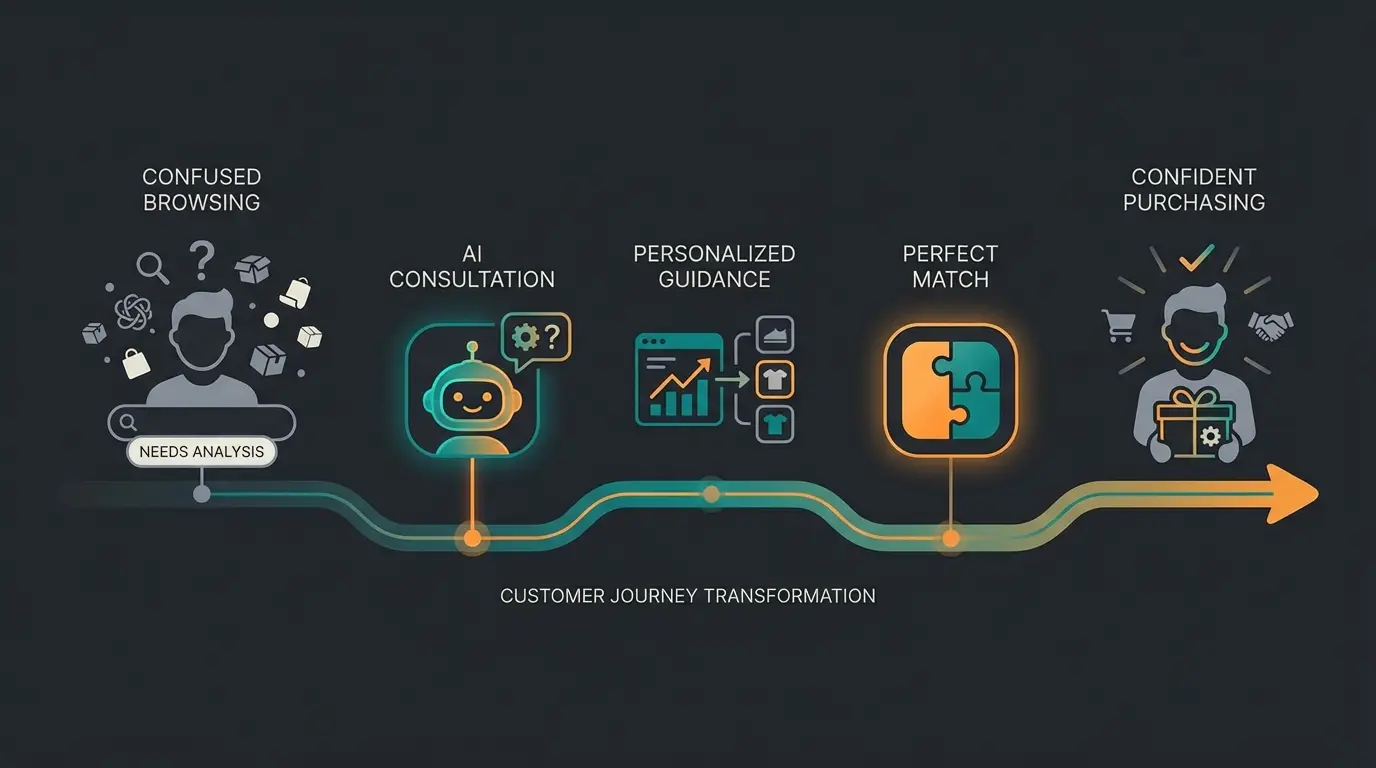
Neither Shopify nor Shopware offers an "out-of-the-box" AI salesperson who asks the customer: "What do you need the bicycle for? For commuting to work or for downhill racing?" and then recommends the appropriate product. This is where Shopware product finders and AI product consultation solutions become essential.
Why Shopware Is the Best Foundation for Consultative AI
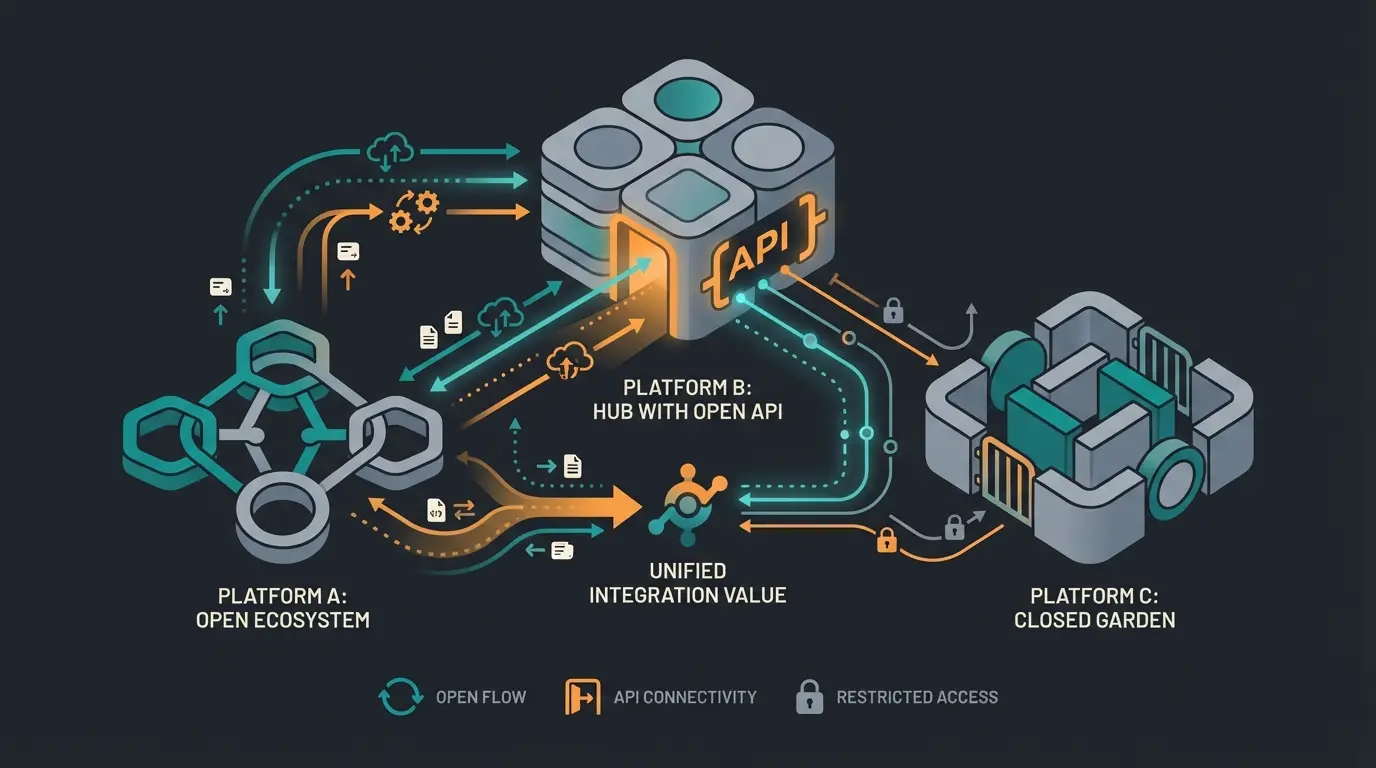
This is precisely where Shopware leverages its API-first architecture. Unlike closed SaaS systems, Shopware allows deep integration of external AI solutions. Implementing AI prevention strategies for Shopware returns becomes possible through this open architecture.
- Access to Structured Data: Shopware 6 stores product properties very cleanly. An external AI can retrieve this data via API in real-time to provide precise recommendations.
- Guided Selling: While Shopware enables human consultation with "Digital Sales Rooms" (Beyond Edition), an automated AI consultation can be connected via the API, available 24/7.
- Hybrid Scenario: You can use Shopware as a robust transaction engine (shopping cart, checkout) and layer the "consultation layer" through a specialized AI on top. This is significantly easier and more performant to implement with Shopware than with Shopify, where API limits often slow things down.
For businesses looking to expand beyond single-channel sales, understanding Shopware multi channel strategies is crucial. Implementing an AI product consultation chatbot can transform your customer experience.
Basic Shopify/CE - Focus on making products available. Functions: Search, filter, checkout. Problem: Customer must know what they want.
Shopware Rise/Evolve - Focus on automating processes. Functions: Flow Builder, backend AI (Copilot), personalized newsletters. Problem: Efficient but still "silent" toward the customer.
Shopware + External AI - Focus on consultative selling. Functions: AI-powered needs analysis, problem-solving instead of product lists. Result: Higher conversion rate, fewer returns.
Total Cost of Ownership: The True Calculation
Many retailers compare only license costs (€600 vs. €36). That's a naive calculation. Here's a realistic 3-year view for a growing retailer (€1.5 million revenue/year).
The Scenario
Revenue: €1,500,000 per year. Requirement: B2B & B2C mix, consultation needed.
| Cost Item | Shopify Advanced | Shopware Rise (Self-Hosted) |
|---|---|---|
| License / Subscription | ~€14,000 (€384/month) | ~€21,600 (€600/month) |
| Transaction Fees* | ~€27,000 (0.6% with external payment) | €0 (No platform fee) |
| Hosting | €0 (Included) | ~€5,400 (~€150/month) |
| Apps / Plugins | ~€10,000 (Many features cost extra) | ~€3,000 (Much in core/one-time purchase) |
| Setup / Agency | ~€30,000 (Faster) | ~€50,000 (More complex) |
| TOTAL (3 Years) | ~€81,000 | ~€80,000 |
Note on Shopify: Those who use Shopify Payments save the transaction fee but are bound to their conditions. Those who want to use external providers (PayPal, invoice via Ratepay) pay the penalty fee.
Charged when using external payment providers
No platform fees regardless of payment provider
Shopware's core includes more features natively
When Shopware TCO typically matches or beats Shopify
Standard vs Consultative Commerce: Feature Comparison
Understanding the difference between traditional e-commerce features and next-generation consultative capabilities is essential for choosing the right platform approach.
| Feature Category | Standard Shop Functions | Consultative Commerce Functions |
|---|---|---|
| Product Discovery | Search, Basic Filters | AI Needs Analysis, Guided Selling |
| Customer Interaction | FAQ Pages, Contact Forms | Real-time AI Dialogue, Personalized Recommendations |
| Purchase Decision Support | Product Comparison Tables | Dynamic Advisor Based on Use Case |
| Return Prevention | Standard Product Descriptions | AI-Matched Products to Actual Needs |
| Post-Purchase | Order Confirmation Emails | Proactive Usage Tips, Complementary Suggestions |
Standard Shopware excels at filters and search, but for true guided selling capabilities, external tools provide the consultative layer that converts browsers into buyers.
Conclusion: When Shopware Is the Right Choice
The Shopware comparison 2025 shows: The German system has evolved from a pure shop system to a powerful commerce platform. The new editions (Rise, Evolve, Beyond) force higher monthly expenditures than before, but offer enterprise features for the mid-market in return.
Our Recommendations
- Choose Shopware if you operate in the B2B sector or sell complex products that require more than an image and a price. Data sovereignty and customizability are unmatched here.
- Budget correctly: Don't save at the wrong end (Community Edition without support), but invest in automation (Flow Builder) and consultation.
- Close the consultation gap: Shopware delivers the perfect foundation (data, API, checkout). But to truly win in 2025, you need to take customers by the hand.
Planning a complex Shopware project or wanting to transform your existing Shopware 6 shop from an "inventory list" into a "top seller"? Don't rely solely on backend features. Use Shopware's openness to integrate genuine AI sales consultation.
FAQ: Common Shopware Comparison Questions
It remains open source and license-free. However, above €1 million revenue (GMV), you lose access to important services (Store, Account), which makes professional operation effectively impossible without switching to a paid plan.
Only if you really need to manage multiple warehouse locations (Multi-Inventory) or want to use "Digital Sales Rooms" intensively for manual sales. For most SMEs, Evolve (for B2B) or Rise (for B2C) represents the "sweet spot."
Natively, Shopware only offers intelligent search and filtering. For dialogue-based consultation (chatbot, buying advisor), you need external solutions that can be seamlessly integrated thanks to the API-first architecture.
Shopware offers superior GDPR compliance options since you can choose German server locations and maintain full data control. Shopify, as a US corporation, often faces data transfer discussions that can be problematic for strict compliance requirements.
Shopware's API-first architecture allows deep integration of external AI tools for consultative selling. Combined with clean product property storage and no API rate limits, it enables true guided selling experiences that closed SaaS platforms cannot match.
Stop being just another product catalog. Leverage Shopware's open architecture with AI-powered consultation to guide customers to the perfect purchase.
Discover AI Consultation
Lasse is CEO and co-founder of Qualimero. After completing his MBA at WHU and scaling a company to seven-figure revenue, he founded Qualimero to build AI-powered digital employees for e-commerce. His focus: helping businesses measurably improve customer interaction through intelligent automation.