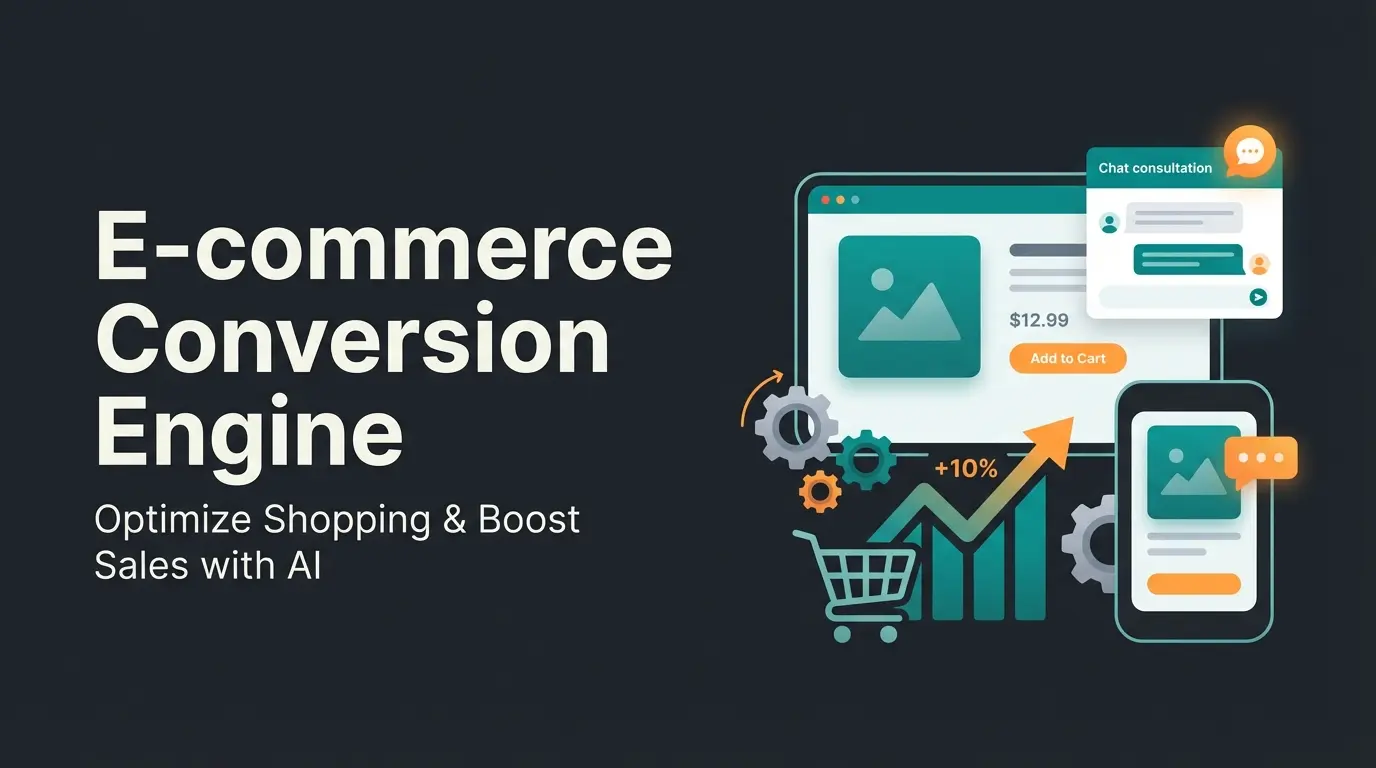
The Current State: Where Does Your Store Stand?
Before we can work on boosting your Shopify revenue, we need to understand what "good" actually means. Many merchants are completely in the dark here, unsure whether their numbers are competitive or falling behind the curve.
Current data for 2024/2025 paints a clear picture of where the industry stands. According to Red Stag Fulfillment, a typical Shopify store converts approximately 1.4% to 1.8% of its visitors into buyers. If you're above 3.2%, you're already in the top 20% of performers. The absolute elite—the top 10%—achieve values of over 4.7%, as confirmed by research from Enrich Labs.
There's also a significant gap between device types. While desktop users often convert at around 1.9%, mobile conversion rates frequently sit at just 1.2%. This disparity represents both a challenge and an opportunity for savvy merchants who understand how AI Chatbots are transforming the mobile shopping experience.
Typical Shopify store performance
High-performing stores
Top 10% of all Shopify stores
Significantly lower than desktop at 1.9%
The Problem: Most optimization guides focus on moving you from 1.4% to 1.6% by removing technical hurdles. But we want to reach the top 20%. And you won't achieve that through micro-optimizations to your layout—you need a fundamental change in your sales strategy. This is where understanding AI product consultation becomes crucial for serious e-commerce operators.
The Foundation: Hygiene Factors for Success
Before we tackle the "master class" (AI consultation), the fundamentals must be solid. If these basic elements are missing, no AI in the world will be able to optimize your Shopify conversion. Both Google and your customers expect these standards as a minimum requirement for doing business.
Trust and Legal Compliance: The Customer Anxiety Factor
E-commerce customers are security-conscious, particularly in mature markets. A missing legal notice or unclear shipping costs are immediate reasons for abandonment. Research from OMT confirms that hidden costs are among the main reasons for cart abandonment across all markets.
- Trust Badges: Use recognized seals like Trusted Shops or similar certifications. These are essential for initial trust-building in any market.
- Legal Texts: Privacy policy compliance, a proper legal notice, and clear return policies are mandatory requirements.
- Shipping Transparency: State shipping costs and delivery times before checkout. Hidden costs are one of the primary drivers of cart abandonment according to multiple studies.
Payment Mix: The Power of Habit
You can have the most beautiful store in the world—but if customers can't pay the way they want, they're gone. According to data from Händlerbund, PayPal commands approximately 28% market share as the most popular online payment method, making it absolutely essential. Buy-now-pay-later options like Klarna are extremely popular, capturing around 26% market share. Additionally, wallet solutions like Apple Pay and Google Pay are gaining importance for fast mobile checkout, as noted by Flatline Agency.
Technical Performance: Core Web Vitals
Since over 50% of traffic is mobile, your store must fly on smartphones. According to Doofinder, every second of load time costs you revenue. Use modern image formats like WebP to keep load times low without sacrificing visual quality. These technical optimizations form the baseline that allows AI-powered consultation tools to work effectively.
The Real Conversion Killer: The Paradox of Choice
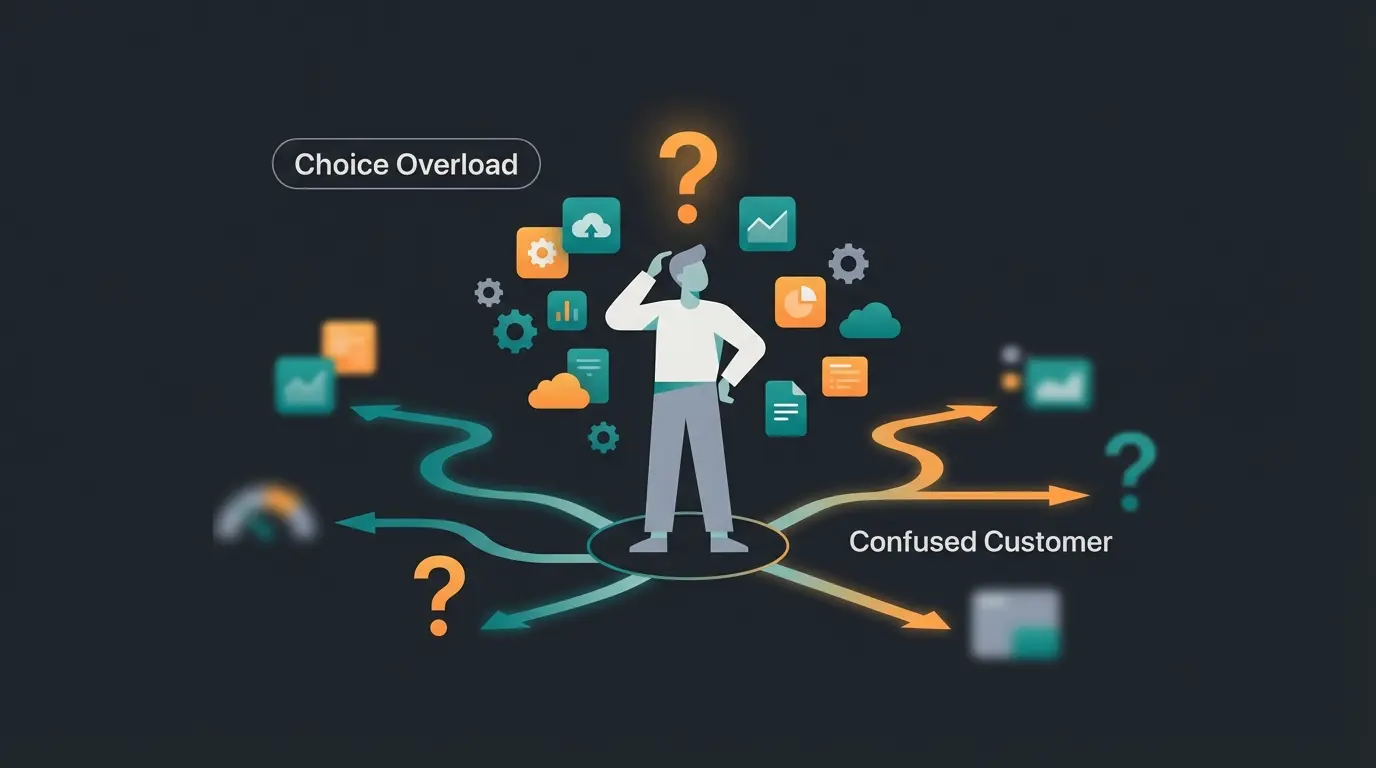
You've checked off all the hygiene factors. So why aren't people buying? This is where Shopify optimization reaches a new level. The biggest problem in modern e-commerce isn't that customers can't find the product—it's that they find too many products and don't know which one is right for them.
The Psychological Dilemma
Psychologist Barry Schwartz calls this the "Paradox of Choice." Research from ResearchGate and Help Me Choose AI shows that when people are confronted with too many options, two things happen. First, decision paralysis (Analysis Paralysis) sets in: out of fear of choosing wrong, they choose nothing at all. Second, even when they do buy, they experience buyer's remorse, constantly wondering if Option B would have been better.
This psychological phenomenon is particularly pronounced in markets with high expectations for certainty. Customers want to feel confident in their decisions, but endless product catalogs make confidence nearly impossible without expert guidance. Understanding this dynamic is essential for anyone serious about AI Guided Selling implementation.
The Reality in Your Store
Look at your category pages. A customer searches for "running shoes." They see 50 models. They use filters: "Size 10," "Red," "Under $100." They still see 12 models. The product descriptions are static: "Breathable," "Good cushioning." That's written for all 12 models.
The Result: The customer is overwhelmed. They leave the shop to "do more research"—and often never return. This is where the biggest untapped potential lies for boosting your Shopify revenue. This consultation gap represents a massive opportunity that most competitors completely ignore.
The Solution: From Searching to Finding
Your competition treats conversion optimization as a design problem. From now on, you'll treat it as a consultation problem. This mindset shift is the key differentiator between average performers and the elite stores achieving 4%+ conversion rates.
Imagine walking into a specialty running shoe store. The salesperson doesn't silently show you a shelf with 50 shoes (that's what your online store currently does). Instead, they ask targeted questions: "Do you run more on asphalt or trails?" "Do you have any knee problems?" "How often do you run per week?"
Based on your answers, they present you with one or two perfect models. This is Guided Selling. And this is exactly what you can automate today in Shopify with AI and intelligent tools. Companies like Aiden and Bluebarry AI have documented that Guided Selling can increase conversion rates by 30% to 70%. Why? Because it eliminates uncertainty.
The Shift: From Store to Consultant
You need to change your mindset. The old approach says: "Here's my catalog, pick something out." This is a passive stance that puts all the burden on the customer. The new approach says: "Tell me what you need, and I'll show you the solution." This is an active stance that guides customers to confidence.
This transformation from passive catalog to active AI consultation represents the most significant opportunity in e-commerce today. Merchants who understand this shift are the ones reaching elite conversion rates while their competitors struggle with the same tired tactics.
Customer browses catalog alone, uses filters, gets overwhelmed by options
Decision paralysis sets in—customer leaves to 'research more'
AI asks qualifying questions: What's your use case? What matters most?
Personalized recommendation builds confidence, customer converts
Support Bot vs. AI Sales Consultant: A Deep Dive
Many merchants think: "I already have a chatbot." But be careful: there's a massive difference between a classic support bot and AI sales consultation. To truly optimize Shopify conversion, you must understand that an FAQ bot doesn't generate revenue—a sales consultant does.
The distinction matters because AI Chatbots transforming customer service represent only half the equation. The other half—and the more profitable half—involves using AI to actively drive sales rather than just deflect support tickets.
| Feature | Classic Support Chatbot | AI Sales Consultant |
|---|---|---|
| Primary Goal | Reduce support tickets (save costs) | Increase revenue & boost conversion |
| Interaction Style | Reactive: Waits for questions ('Where's my package?') | Proactive: Engages the customer ('Looking for a gift?') |
| Data Basis | Static FAQs & text templates | Dynamic product data & customer behavior |
| Dialog Style | 'Here's the link to the shipping page.' | 'For mountain hiking, I recommend Model X because of the sole.' |
| Psychology | Eliminates frustration (problem-solving) | Builds trust (consultation expertise) |
Why AI Makes the Difference
Modern AI tools—which are becoming standard in 2025—understand context in ways that traditional rule-based systems never could. According to research from Landingi and Start Smart, these systems can parse nuanced customer requests that would stump traditional search and filter systems.
Consider this example: A customer asks: "I'm looking for something for dry skin, but not greasy." A filter often fails here because it can't understand the nuance of "not greasy." But an AI understands this nuance and scans your product descriptions and attributes to suggest exactly the 3 creams that fit. This is the power of AI-powered product consultation in action.
Stop losing customers to decision paralysis. Implement AI-powered product consultation and watch your conversion rates climb into the top 20%.
Start Your Free TrialThe Profit Lever: How Consultation Reduces Returns
In e-commerce, the return rate is a massive profit killer that most conversion optimization articles completely ignore. According to Bitkom, the average return rate sits around 11% across all industries. In fashion and apparel, BTE reports rates of 50% and more.
Many returns don't happen because the product is bad—they happen because it was the wrong product for that customer. Common reasons include: "The jacket wasn't warm enough after all," "I can't tolerate this cream," or "The device doesn't have the connector I need."
The 'Consultation Before Purchase' Strategy
When you optimize Shopify conversion through better consultation, something magical happens: you simultaneously optimize your profit. Through AI-powered product consultation and Guided Selling, you ensure that the customer chooses the right product before clicking "Buy."
The Formula: Better consultation = Higher confidence in purchase = Fewer "selection orders" (e.g., ordering 3 sizes) = Lower return rate. This is the lever that almost all "10 Tips for More Revenue" articles overlook. It's not just about more sales, but about better sales. This connection between conversion and profitability is what makes AI-powered product consultation so valuable.
Tactical Implementation: 3 Steps to a Consulting Store
How do you actually implement this in Shopify? Here's your roadmap for transforming from a passive catalog into an active sales consultant.
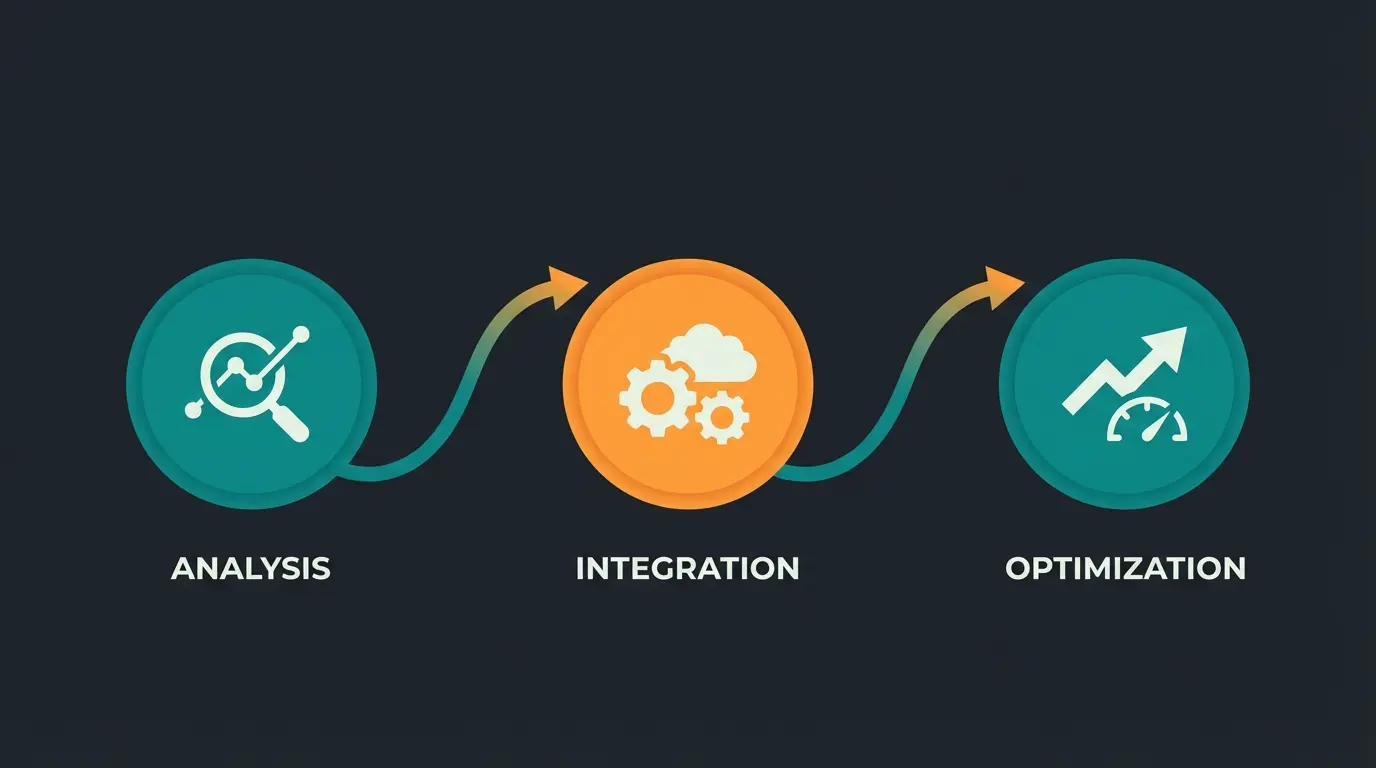
Step 1: Analyze Your Consultation Needs
Not every product needs AI consultation. Socks probably don't, but complex electronics or skincare certainly do. The key is identifying where customers are getting stuck and where better guidance would make the biggest impact.
- Analyze your return reasons. Where are customers uncertain about their choices?
- Look at products with many views but few purchases (high abandonment rate). Decision-making assistance is often missing here.
- Identify product categories where customers frequently contact support with pre-purchase questions.
- Review your most common search queries to understand what customers are looking for help with.
Step 2: Integration of Intelligent Guidance
There are different levels of implementation depending on your budget and store size. The right choice depends on your specific needs and the complexity of your product catalog.
Level 1: The Product Quiz (Quick Start) — Use apps like Octane AI or RevenueHunt. Create a quiz: "What's your skin type?" At the end, 3 products are recommended. The advantage is that it's easy to set up and collects valuable zero-party data. The disadvantage is that it's static and must be maintained manually. For many stores, this represents a good first step toward AI product consultation revolutionizing their customer experience.
Level 2: The AI Shopping Assistant (Professional Solution) — Use AI tools that index your product catalog (e.g., via Shopify Magic or specialized apps like Manifest AI or Rep). These bots sit on the product page. The customer can ask: "Does this lens fit my Canon EOS 500?" The AI answers immediately based on the technical data. This level of sophistication mirrors what Shopware 6 chatbots can achieve for merchants on that platform.
Step 3: Optimize the 'After-Click' Experience
Once the consultation is complete and the customer has the product in their cart, no more friction can occur. The path from recommendation to purchase must be seamless.
- Seamless Checkout: Offer express checkout buttons (Shop Pay, PayPal, Apple Pay) directly on the cart page.
- Reassurance: Show in the cart: "Great choice! This product perfectly matches your requirements (e.g., 'for dry skin')." This psychologically confirms the decision.
- Consistency: Ensure the same messaging and product benefits highlighted during consultation appear in the checkout flow.
Case Study: Shop A vs. Shop B Comparison
Let's illustrate the scenario with an example: A store selling ergonomic office chairs. This comparison demonstrates the stark difference between traditional e-commerce approaches and consultation-led strategies.
Scenario: Shop A (The Standard Approach)
The homepage features a large banner: "Sale: 20% off everything." Navigation includes categories like "Executive Chairs," "Stools," "Gaming." A customer with back pain is looking for help. They click through 20 products, reading technical data—"Rocker mechanism," "Synchronous mechanism"—but don't understand the difference.
The Result: The customer is unsure. They leave the shop to Google "synchronous mechanism." They land on Amazon or a blog and buy there. Conversion: 0%. The store had the traffic but lost the sale because it failed to provide guidance.
Scenario: Shop B (The 'Consultant' Approach)
The homepage features a banner: "Find the chair that ends your back pain—in 60 seconds." (Button: "Go to Chair Advisor"). An AI-powered quiz or chat window opens with targeted questions. Question 1: "How many hours do you sit daily?" Answer: "8 hours." Question 2: "Do you have current complaints?" Answer: "Yes, lower back." Question 3: "How tall are you?" Answer: "6'1"."
The Result: The AI recommends exactly one model: "Based on your height and lumbar complaints, we recommend the 'ErgoPro 500' with integrated lumbar support and extended backrest." The customer feels understood. The expert recommendation provides confidence. They buy. This is AI consulting for e-commerce in action.
Documented improvement with Guided Selling
Customers reach confidence faster
Right product = satisfied customer
Confident customers buy more
The Hierarchy of Shopify Conversion Success
Understanding where to focus your optimization efforts requires a clear framework. Most stores spend all their energy on the foundation while ignoring the factors that actually differentiate winners from losers. This pyramid structure explains why some stores achieve 4%+ conversion while others struggle at 1.4%.
The Base (Technical Foundation): Load time, mobile responsiveness, and checkout functionality solve technical blockades. These are table stakes—necessary but not sufficient for success. Every store needs these, but they won't differentiate you.
The Middle (Trust & UX): Social proof, trust badges, and usability solve trust problems. These elements build confidence but still leave customers to navigate your catalog alone. Many stores optimize heavily here and plateau.
The Top (The Winning Lever): Personal AI consultation and Guided Selling solve decision problems. This is where the market victory in 2025 will be decided. Stores that master AI-powered product consultation at this level are the ones reaching elite performance tiers.

Frequently Asked Questions
The average Shopify store converts at 1.4-1.8%. If you're above 3.2%, you're in the top 20%. Elite performers (top 10%) achieve over 4.7%. Rather than chasing arbitrary numbers, focus on the consultation gap—helping customers choose the right product is the fastest path to improvement.
Traditional chatbots are reactive support tools that answer questions like 'Where's my order?' AI sales consultants are proactive, asking questions like 'What are you looking for?' and making personalized product recommendations based on customer needs. The goal shifts from reducing support costs to increasing revenue.
Yes, significantly. Many returns happen not because products are defective, but because they were wrong for that customer. When AI consultation ensures customers choose correctly before purchasing, return rates can drop by 25-40%. In fashion, where returns often exceed 50%, this represents massive profit protection.
Start with a product quiz using apps like Octane AI or RevenueHunt. This is the quickest win—easy to set up and immediately effective. As you grow, upgrade to AI-powered shopping assistants that can have natural conversations and access your entire product catalog dynamically.
Mobile conversion typically lags desktop by 0.5-0.7 percentage points because complex filtering and browsing is harder on small screens. AI consultation actually performs better on mobile—a simple conversation interface is easier to use than filters, often boosting mobile conversion more dramatically than desktop.
Conclusion: Transform Your Shop Into an Expert
The days when e-commerce simply meant making products available online are over. To optimize Shopify conversion today, you must close the gap that the absence of in-store salespeople has created. The most successful stores in 2025 aren't just catalogs—they're consultants.
Summary of Key Principles: First, hygiene factors are mandatory—mobile speed, trust badges, and diverse payment options are your entry ticket to the game. Second, design alone isn't enough—beautiful images don't sell when customers are decision-fatigued from the Paradox of Choice. Third, consultation is the key—use AI and Guided Selling to actively guide customers to the right product. Fourth, the double win—better consultation not only increases revenue but also reduces expensive returns.
Stop viewing your store as just a digital catalog. Start transforming it into a digital consultant today. Install a product quiz or an AI sales bot and watch as uncertain visitors become confident, loyal customers. The technology exists, the implementation paths are clear, and the competitive advantage awaits those who act first.
Join the elite stores achieving 4%+ conversion rates. Implement AI-powered product consultation and transform uncertain browsers into confident buyers.
Start Free Consultation
Lasse is CEO and co-founder of Qualimero. After completing his MBA at WHU and scaling a company to seven-figure revenue, he founded Qualimero to build AI-powered digital employees for e-commerce. His focus: helping businesses measurably improve customer interaction through intelligent automation.