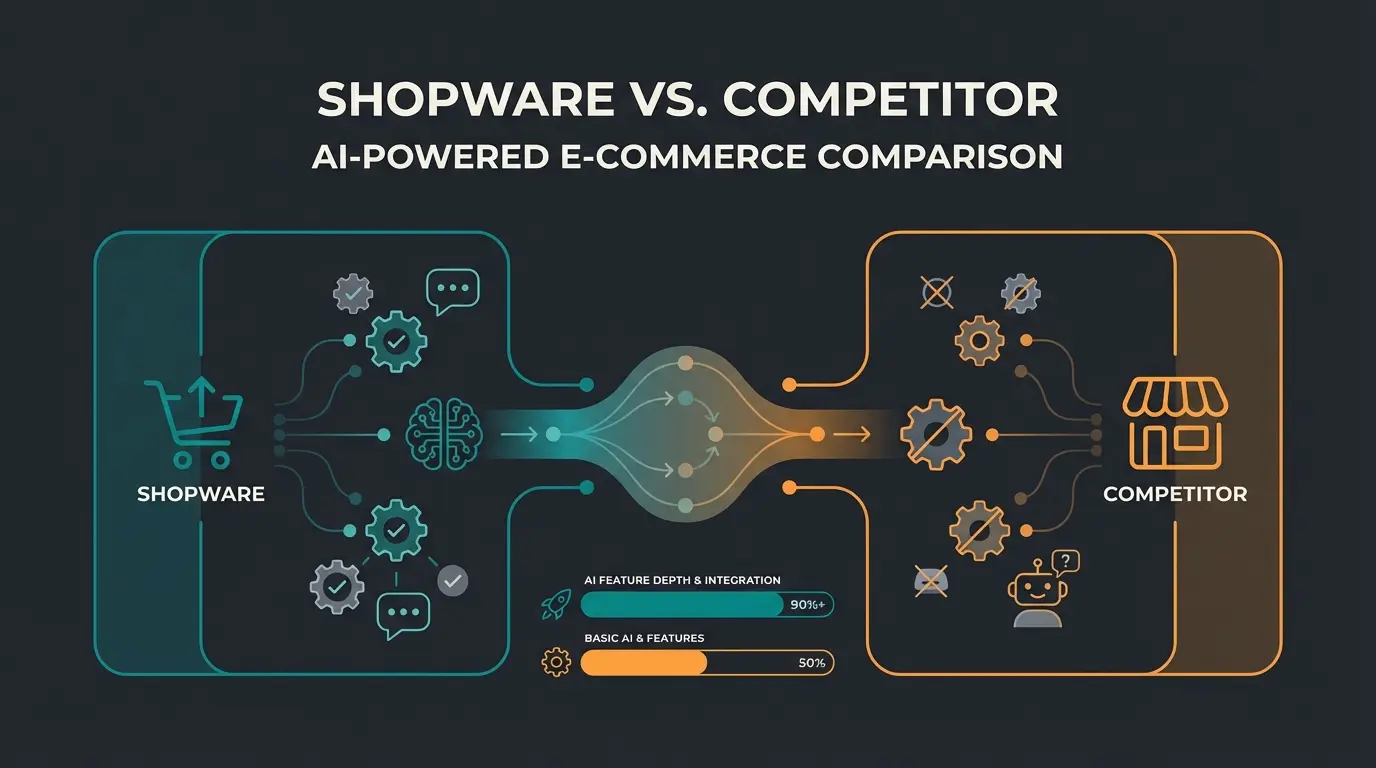
Magento and Shopware at a glance
Open the analytics dashboard of any German e-commerce agency and you will see these two names constantly: Shopware and Magento. They dominate the DACH mid-market, but they approach e-commerce from fundamentally different directions. Understanding that difference is the first step to making the right choice.
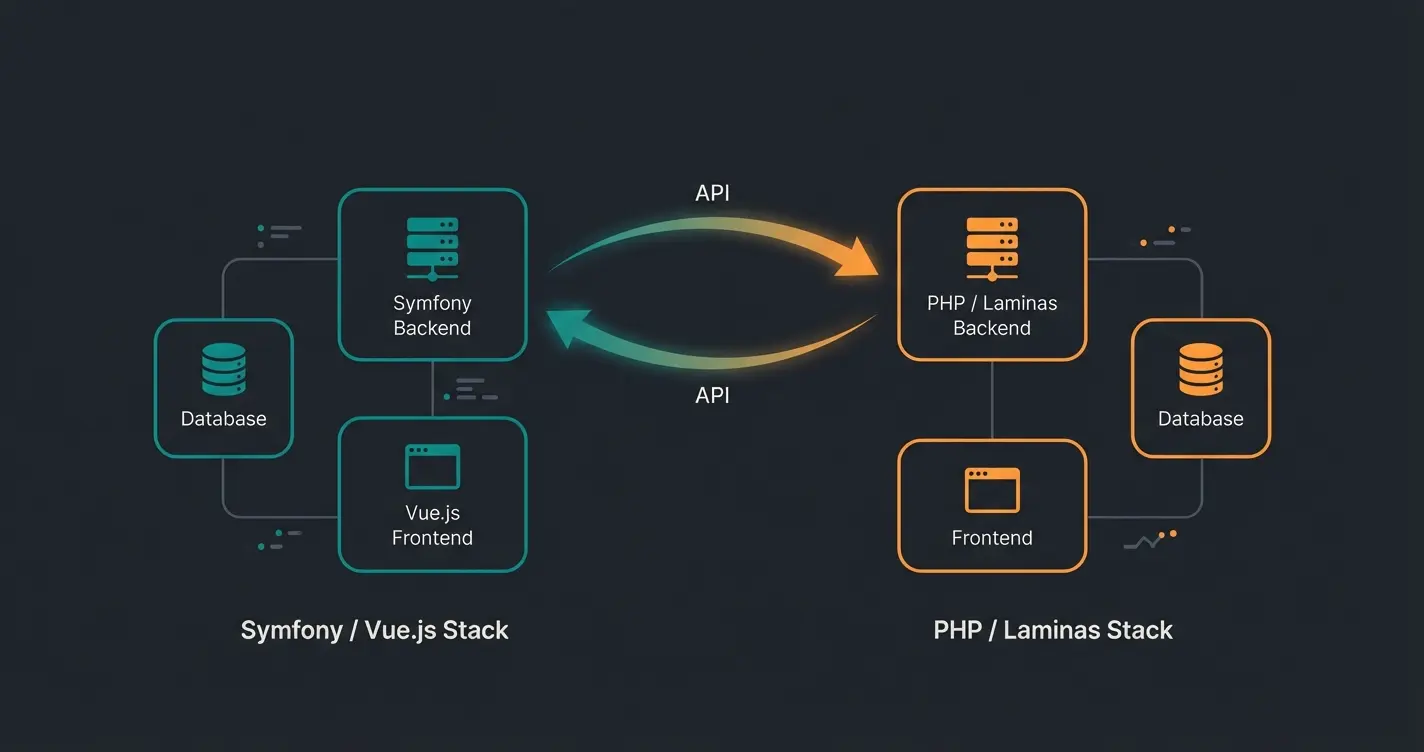
Shopware was founded in 2000 in Schoppingen, Germany. It is purpose-built for the European market, particularly DACH. The current version, Shopware 6, runs on Symfony and Vue.js with an API-first architecture. According to Statista, Shopware powers 11.5% of Germany's highest-revenue online shops, making it the market leader by revenue share.
Magento launched in 2008 and was acquired by Adobe in 2018 for $1.68 billion. It now operates as Adobe Commerce (commercial) and Magento Open Source (free). Globally, Magento holds a larger installed base, with around 19.4% of total German shop installations. Adobe Commerce 2.4.9 beta was released in March 2026. For a broader look at how Shopware compares to other platforms, see our dedicated comparison hub.
| Dimension | Shopware 6 | Magento / Adobe Commerce |
|---|---|---|
| Founded | 2000 (Schoppingen, DE) | 2008 (acquired by Adobe 2018) |
| Current version | 6.6.x (2026) | 2.4.9 beta (March 2026) |
| Architecture | Symfony + Vue.js, API-first | PHP (Laminas), API-first |
| Primary market | DACH mid-market B2C | Global enterprise B2B |
| DE market share (revenue) | 11.5% (leader) | ~8% (declining) |
| DE market share (installs) | ~9% | 19.4% (leader) |
| Open source license | MIT (Community Edition) | OSL 3.0 (Open Source) |
| Headless ready | Yes (native) | Yes (PWA Studio / Hyvä) |
The Germany-specific market context matters here. According to Statista, the German e-commerce market reached approximately USD 114 billion in 2026 and is projected to grow to USD 159 billion by 2031. In this market, Shopware has steadily gained share among revenue-leading shops while Magento's share has declined as mid-market merchants migrate to more cost-effective alternatives. The trend is clear: Magento retains its enterprise stronghold, but Shopware is winning the mid-market battle.
Usability and backend
I have watched marketing teams try to use both backends. The difference is visible within the first hour. Shopware's admin panel is built for people who run shops, not for developers who happen to also manage content. Magento's admin panel is built for people who already understand Magento.
Shopware's Shopping Experiences editor lets non-technical users build landing pages, category pages, and product storytelling with drag-and-drop. Time-to-first-product is typically under 30 minutes. Magento's Page Builder offers similar functionality but requires more configuration knowledge and is slower to render in the admin.
The practical impact: a Shopware shop-operator can independently manage 90% of daily tasks after a two-day onboarding. A Magento shop-operator typically needs ongoing developer support for tasks like custom attribute sets, catalog price rules, and multi-store configuration. That dependency costs money every month.
| Criteria | Shopware 6 | Magento |
|---|---|---|
| Learning curve | Low to moderate | Steep |
| Content editing | Drag-and-drop (Shopping Experiences) | Page Builder + manual config |
| Time-to-first-product | < 30 minutes | 1-2 hours |
| Non-technical user autonomy | High (90% of daily tasks) | Low (frequent dev dependency) |
| Admin performance | Fast (Vue.js SPA) | Slower (full page reloads common) |
One of our clients, a home and garden retailer with 3,000 products, switched from Magento to Shopware specifically because their marketing team could not independently create seasonal campaigns. On Magento, every landing page required a developer ticket. On Shopware, the same team built their spring campaign in an afternoon. That kind of operational independence is not a nice-to-have for a 15-person company. It is the difference between reacting to market trends and watching them pass.
Features and functionality
Both platforms cover the core e-commerce feature set. Products, categories, orders, customers, promotions. The differences show up in how they handle automation, content commerce, and business logic.
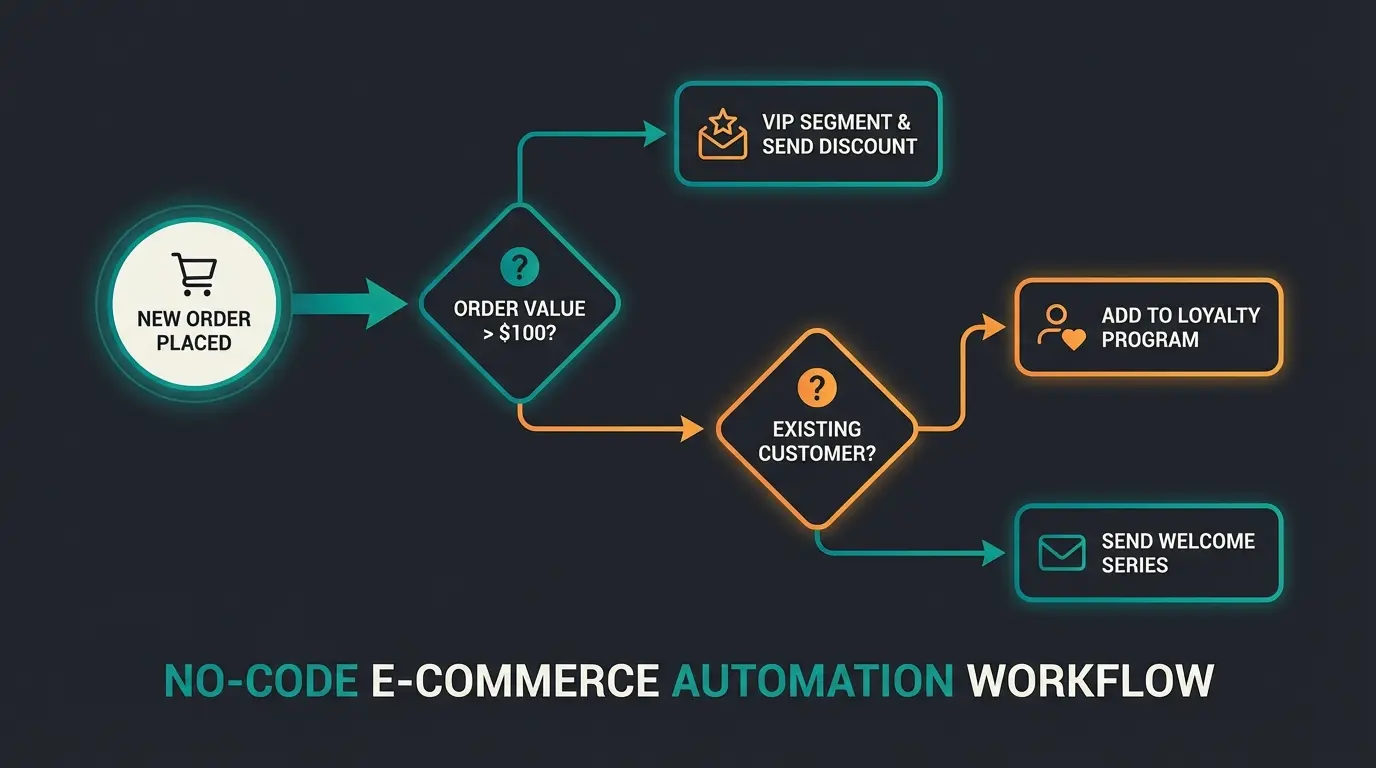
Shopware's Flow Builder and Rule Builder are the standout features. They let shop operators create complex business automations without writing code: if customer is from Switzerland and cart exceeds EUR 100, apply free shipping and send a personalized email. Magento's equivalent requires either custom development or third-party extensions for the same level of flexibility.
Magento's strength is its B2B Suite: company accounts, requisition lists, negotiable quotes, shared catalogs, and purchase approval workflows. These features are built into Adobe Commerce (not the Open Source edition). Shopware offers B2B capabilities through its B2B Components add-on, but the feature depth does not match Magento's enterprise B2B stack.
| Feature | Shopware 6 | Magento / Adobe Commerce |
|---|---|---|
| Product management | Strong (variants, properties, streams) | Strong (configurable, bundle, grouped) |
| Multi-store | Yes (Sales Channels) | Yes (native, very mature) |
| Multi-currency | Yes | Yes |
| B2B suite | Add-on (B2B Components) | Built-in (Adobe Commerce) |
| CMS / content commerce | Shopping Experiences (superior) | Page Builder |
| Business automation | Flow Builder + Rule Builder (no-code) | Limited (requires dev or extensions) |
| API-first architecture | Yes (native) | Yes (GraphQL + REST) |
| Search | Elasticsearch / OpenSearch | Elasticsearch / OpenSearch / Live Search |
| Staging / preview | Yes (from Evolve plan) | Yes (Adobe Commerce only) |
Performance and hosting
Shopware 6 runs on Symfony with a Vue.js admin and optional headless storefront. Out of the box, it is lighter and faster to deploy than Magento. A basic Shopware Cloud instance handles most mid-market workloads without custom infrastructure tuning.
Magento is resource-hungry. A production Magento instance typically requires dedicated Elasticsearch, Redis, Varnish, and at least 8 GB RAM for acceptable performance. Hosting costs for a well-performing Magento shop start at EUR 200-500 per month. Shopware self-hosted runs comfortably on EUR 50-150 per month hosting, or you use Shopware Cloud and skip infrastructure management entirely.
Time-to-launch reflects this difference. According to agency benchmarks, a typical mid-market Shopware project goes live in 3-6 months. A comparable Magento project takes 6-12 months. That is not just a timeline difference. It is a cash flow difference.
| Metric | Shopware 6 | Magento |
|---|---|---|
| Minimum hosting (production) | EUR 50-150/month | EUR 200-500/month |
| Cloud option | Shopware Cloud (managed) | Adobe Commerce Cloud ($$$) |
| Typical time-to-launch | 3-6 months | 6-12 months |
| Infrastructure complexity | Low to moderate | High |
| Caching requirements | Built-in HTTP cache | Varnish + Redis + FPC required |
Typical mid-market project timeline
Enterprise project timeline
Self-hosted production environment
Requires Varnish, Redis, Elasticsearch
Pricing and total cost of ownership
This is where most comparison articles fail. They list license prices and call it a day. The real cost of an e-commerce platform is the total cost of ownership over three to five years: licenses, hosting, development, maintenance, and the opportunity cost of slow time-to-market.
Shopware offers a free Community Edition (MIT license) for shops under EUR 1M gross merchandise volume per year. Above that, plans range from Rise (EUR 600/month) through Evolve to Beyond (custom pricing). Full details in the Shopware Editions Comparison. Shopware pricing is transparent and published.
Magento Open Source is free but requires self-hosting and self-maintenance. Adobe Commerce starts at approximately $22,000 per year for on-premise and scales to $190,000+ per year for Cloud at higher GMV tiers. Adobe Commerce pricing is not publicly listed and requires a sales conversation, which tells you something about the target customer.
| Cost component | Shopware (Rise) | Magento Open Source | Adobe Commerce |
|---|---|---|---|
| License (3 years) | EUR 21,600 | EUR 0 | EUR 66,000-150,000+ |
| Hosting (3 years) | EUR 5,400-18,000 | EUR 7,200-18,000 | Included (Cloud) or EUR 12,000+ |
| Initial development | EUR 30,000-80,000 | EUR 50,000-120,000 | EUR 80,000-200,000 |
| Annual maintenance | EUR 6,000-15,000 | EUR 12,000-30,000 | EUR 15,000-40,000 |
| 3-year total | EUR 75,000-150,000 | EUR 85,000-200,000 | EUR 200,000-500,000+ |
| Break-even vs Shopware | Baseline | +15-30% | +170-230% |
There is another cost that rarely appears in comparison articles: the cost of migration when things go wrong. We have seen multiple businesses start on Magento Open Source to save on license fees, only to spend EUR 80,000-120,000 migrating to Shopware two years later when maintenance became unsustainable. The free license is not free if it locks you into a cost structure that scales poorly for your business size.
B2B vs B2C suitability
If your business is primarily B2B with complex requirements like company accounts, approval workflows, negotiable quotes, and shared catalogs, Magento (Adobe Commerce) has the more mature feature set. These are native, battle-tested features used by thousands of B2B operations globally.
If your business is B2C or B2C-heavy with some B2B, Shopware is the stronger choice. Shopping Experiences, the Rule Builder, and the Flow Builder are designed for the kind of personalized, content-driven commerce that converts B2C shoppers. The DACH market specifically rewards this approach: brands selling home and garden, fashion, or specialty products consistently report higher engagement with Shopware's content tools.
The honest take: Shopware's B2B Components are improving rapidly, but they are not yet at parity with Adobe Commerce's B2B Suite. If B2B is your core revenue stream and you need features like requisition lists or multi-tier pricing on day one, Magento is the safer bet. For everything else, Shopware delivers more value per euro.
| Use case | Better fit | Why |
|---|---|---|
| Pure B2C (fashion, lifestyle, D2C) | Shopware | Shopping Experiences, content commerce, faster setup |
| B2C with consultation needs (home & garden, DIY) | Shopware | Rule Builder + AI employee integration |
| B2B wholesale (simple catalog) | Either | Both handle basic B2B well |
| B2B enterprise (quotes, approvals, shared catalogs) | Magento | Native B2B Suite, mature and proven |
| B2B + B2C hybrid | Depends on ratio | B2B-heavy: Magento. B2C-heavy: Shopware |
A pattern we see repeatedly: B2C brands that sell consultation-intensive products, such as plant protection, home improvement, or specialty electronics, get more value from Shopware's content commerce tools combined with an AI consultation layer than from any native B2B feature set. The products are B2C, but the buying process feels like B2B. Customers need guidance, not just a catalog. This is where the platform choice intersects with revenue: the shop that advises better sells more.
Extensions and marketplace
Magento's marketplace lists approximately 4,500 extensions. Shopware's store offers around 4,000. The numbers are close, but the ecosystems differ in important ways.
Shopware enforces quality guidelines and automated code reviews for store submissions. The result is fewer abandoned or broken plugins. Magento's marketplace has more extensions but a higher rate of compatibility issues, especially after major version updates. If you have worked with both ecosystems, you know the difference shows up during upgrades.
For payment and shipping integrations in the DACH region, Shopware has the edge. Klarna, PayPal, Mollie, DHL, and most regional providers offer first-party Shopware plugins. Magento relies more heavily on third-party integrations for DACH-specific providers. For a detailed comparison with other platforms, see our guides on Shopware vs WooCommerce, Shopware vs OXID, Shopware vs JTL, and Shopware vs Gambio.
SEO and marketing
Both platforms handle core SEO requirements: clean URL structures, canonical tags, meta fields, XML sitemaps, and structured data. Shopware generates SEO-friendly URLs automatically and offers built-in hreflang support for multi-language shops. Magento handles these well too, though some features (like advanced structured data) require extensions.
The marketing difference is in content commerce. Shopware's Shopping Experiences let marketing teams create landing pages, seasonal campaigns, and storytelling content without developer involvement. Magento's Page Builder serves a similar purpose but is less intuitive for non-technical marketers. The Rule Builder adds another layer: you can create dynamic pricing rules, personalized promotions, and segment-specific content without touching code.
For shops that rely on content-driven acquisition, organic traffic, and campaign agility, Shopware's marketing toolkit is objectively stronger out of the box.
AI and automation in e-commerce
This is the section no competitor comparison covers. And it is the one that matters most for your revenue in 2026.
Both Shopware and Magento have introduced native AI features. Shopware's AI Copilot generates product descriptions, translations, and image suggestions. Adobe Commerce integrates Adobe Sensei for product recommendations, live search, and personalization. These are useful productivity tools, but they do not solve the fundamental problem: most online shops still rely on static filters and search bars to help customers find the right product.
That is where an AI employee changes the equation. We have implemented AI employees for Shopware and Magento shops that actively advise customers in real time, answering product questions, comparing options, and guiding purchase decisions. The results are consistent across both platforms: +35% average cart value, +60% checkout rate, and 16x ROI. These are not hypothetical numbers. They come from 25+ active client implementations, including the Rasendoktor case that won the Austrian Retail Innovation Award 2025.
To put concrete numbers on this: Rasendoktor, a lawn care specialist running Shopware, deployed a Qualimero AI employee that now handles 73% of customer inquiries autonomously. Customers get real-time product recommendations based on their lawn type, garden size, and local climate. The result was a measurable increase in average order value from EUR 45 to EUR 62. The same approach works identically on Magento shops through the API integration layer.
The AI consultation approach also changes the migration calculation. Several of our clients considered switching from Magento to Shopware purely for cost reasons. After implementing an AI employee on their existing Magento shop, they saw enough revenue uplift to make the platform question secondary. The right answer is not always to migrate. Sometimes it is to make your current platform sell smarter.
More traffic alone does not increase revenue. An AI employee converts visitors into buyers, regardless of whether you run Shopware or Magento. Our clients see +35% cart value and 16x ROI.
Book a free demoMigrating from Magento to Shopware
Migration from Magento to Shopware is a real trend in the DACH market. The reasons are consistent: rising Magento maintenance costs, difficulty finding qualified Magento developers at reasonable rates, and the desire for a platform that non-technical team members can operate independently. We have guided multiple clients through this process, and the pattern is remarkably similar each time.
A typical migration follows these steps:
- Audit current Magento setup: catalog size, custom features, integrations, data volume
- Map Magento features to Shopware equivalents (most standard features map directly)
- Migrate product data, customer data, and order history using migration tools or API transfer
- Rebuild custom functionality as Shopware plugins or Flow Builder automations
- Test thoroughly in a staging environment before go-live
- Launch with a parallel run period to catch edge cases
Timeline depends on shop complexity. A straightforward catalog shop with 1,000-5,000 products typically migrates in 8-12 weeks. Complex setups with heavy customization can take 4-6 months. For a detailed migration roadmap, read our Magento to Shopware Migration Guide.
Which platform is right for you
After comparing features, costs, and real-world performance across dozens of implementations, here is the decision framework we use with our own clients.
Choose Shopware if: you operate in the DACH market, your revenue is under EUR 10M, your team includes non-technical users who need backend autonomy, you prioritize content commerce and marketing agility, and your budget for the initial build is under EUR 100K. Shopware delivers more value per euro for B2C and B2C-heavy hybrid shops.
Choose Magento (Adobe Commerce) if: you need enterprise-grade B2B features on day one, with company accounts, requisition lists, negotiable quotes, and purchase approval workflows. You operate globally across multiple storefronts with complex pricing structures and regional tax requirements. Your development team has deep Magento expertise and you can sustain EUR 100-150 per hour developer rates. Your budget supports both the license cost and the higher ongoing maintenance burden. Magento is the right choice for large-scale B2B operations where feature completeness and global scalability outweigh total cost of ownership.
| Your situation | Recommendation |
|---|---|
| DACH B2C shop, < EUR 5M revenue | Shopware (Community or Rise) |
| DACH B2C shop, EUR 5-20M revenue | Shopware (Evolve or Beyond) |
| Global B2B, complex requirements | Adobe Commerce |
| B2B + B2C hybrid, DACH focus | Shopware (with B2B Components) |
| Migrating from Magento 1 / outdated Magento 2 | Shopware (migration + lower TCO) |
| Enterprise with existing Magento team | Stay on Magento (invest in AI layer instead) |
One scenario deserves special attention: if you are currently on Magento 1 or an outdated Magento 2 installation (pre-2.4.6), migration is not optional. Magento 1 reached end-of-life in June 2020 and no longer receives security patches. Running an unpatched Magento 1 shop is a compliance liability, not just a technical risk. In this case, the question is not whether to migrate but where to migrate. For most DACH mid-market shops, Shopware offers the best combination of lower TCO, faster time-to-value, and operational independence.
For more platform comparisons, see our guides on Magento Alternatives, Magento vs Shopify, Magento vs WooCommerce, Shopware vs Shopify, Shopware vs Spryker, Shopware vs PrestaShop, and Shopware Alternatives.
Choosing the right platform is only half the equation. An AI employee works on both Shopware and Magento, turning your shop from a catalog into an active sales channel. See how it works in a live demo.
Book a demoFrequently asked questions
These are the questions we hear most often from shop operators evaluating Magento vs Shopware. The answers are based on our direct experience implementing both platforms across 25+ client projects.
Magento (Adobe Commerce) is built for global enterprise B2B with complex multi-store setups. Shopware is built for the European mid-market with a focus on usability, content commerce, and lower total cost of ownership. Both are API-first and headless-ready in 2026.
Yes, for most mid-market scenarios. Shopware's 3-year TCO for a EUR 2-5M revenue shop is typically EUR 75,000-150,000, compared to EUR 85,000-200,000 for Magento Open Source and EUR 200,000-500,000+ for Adobe Commerce. The difference comes from lower development costs and more affordable developer rates.
Yes. Migration tools and API-based data transfer make it straightforward for catalog, customer, and order data. A typical mid-size migration takes 8-12 weeks. Complex custom setups may take 4-6 months. See our Magento to Shopware Migration Guide for a detailed roadmap.
Yes, particularly for enterprise B2B. Adobe Commerce 2.4.9 (beta March 2026) continues to receive updates. However, Magento's market share in Germany is declining as mid-market shops migrate to Shopware and Shopify. For shops already on Magento with a skilled development team, staying and investing in AI consultation is often more cost-effective than migrating.
Both platforms handle core SEO well: clean URLs, canonical tags, structured data, and XML sitemaps. Shopware has a slight edge with automatic SEO URL generation and built-in hreflang support. For most shops, the SEO difference between platforms is minimal compared to the impact of content quality and site speed.
Yes. Both platforms are API-first, which means AI employees can integrate with either one. Qualimero's AI employees work on Shopware and Magento, providing real-time product consultation, customer service, and guided selling. The platform choice does not limit your AI capabilities.

Lasse is CEO and co-founder of Qualimero. After completing his MBA at WHU and scaling a company to seven-figure revenue, he founded Qualimero to build AI-powered digital employees for e-commerce. His focus: helping businesses measurably improve customer interaction through intelligent automation.